
CUPRO NICKEL 90/10, 70/30
1. Introduction to Cupro Nickel Fasteners
Cupro Nickel (Copper-Nickel) fasteners are high-performance corrosion-resistant fastening components manufactured primarily from copper-nickel alloys containing either 90% copper and 10% nickel (C70600) or 70% copper and 30% nickel (C71500), with controlled additions of iron and manganese to enhance corrosion resistance and mechanical performance. These alloys are extensively used in marine engineering, offshore structures, desalination plants, naval applications, heat exchangers, shipbuilding, LNG facilities, offshore oil platforms, petrochemical installations, and seawater handling systems where conventional stainless steels may experience localized corrosion.
Unlike carbon steel fasteners that rely on protective coatings, Cupro Nickel develops a stable, adherent oxide film that continuously protects the metal from seawater corrosion, biofouling, and erosion. This self-protecting surface significantly extends service life in aggressive chloride-rich environments.
SM Fasteners manufactures precision-engineered Cupro Nickel fasteners in compliance with international standards for EPC contractors, OEMs, offshore projects, marine infrastructure, and industrial process plants. Manufactured under an ISO 9001 quality management system and supported by MSME and UKAF certifications, these fasteners are supplied with complete material traceability, inspection records, and global export documentation.
2. Understanding Cupro Nickel Alloys
Cupro Nickel is a non-ferrous alloy family consisting primarily of copper and nickel, with carefully controlled additions of iron and manganese.
The most commonly specified engineering grades include:
| Alloy | UNS Number | Copper | Nickel | Typical Application |
|---|---|---|---|---|
| CuNi 90/10 | C70600 | Balance | 9–11% | Marine piping, seawater systems |
| CuNi 70/30 | C71500 | Balance | 29–33% | Offshore, naval, condenser systems |
Compared with stainless steels, Cupro Nickel provides:
- Outstanding seawater corrosion resistance
- High resistance to marine biofouling
- Excellent resistance to erosion corrosion
- Good thermal conductivity
- Low magnetic permeability
- Stable long-term corrosion behavior
- Excellent weldability
- Long service life in marine environments
3. Industrial Importance of Cupro Nickel Fasteners
Fasteners are often the weakest link in corrosion-resistant piping and equipment systems if an incompatible material is selected.
Cupro Nickel fasteners provide:
- Reliable structural integrity
- Long-term preload retention
- Reduced maintenance requirements
- Minimal galvanic corrosion with CuNi piping
- Excellent durability in submerged applications
These properties make them preferred fastening materials wherever seawater is continuously present.
4. Major Industries Using Cupro Nickel Fasteners
4.1 Marine Engineering
Applications include:
- Hull equipment
- Deck machinery
- Propulsion support systems
- Sea chest assemblies
- Pump installations
- Anchor equipment
4.2 Offshore Oil & Gas
Typical uses:
- Offshore platforms
- FPSO facilities
- Produced water systems
- Seawater lift pumps
- Firewater piping
- Splash zone structures
4.3 Desalination Plants
Critical applications:
- Reverse osmosis systems
- Intake piping
- Brine discharge
- Heat exchangers
- Condenser assemblies
4.4 Shipbuilding
Used for:
- Condenser systems
- Cooling water systems
- Ballast systems
- Engine room piping
- Seawater pumps
4.5 Petrochemical Industry
Suitable for:
- Chloride-containing process units
- Cooling water circuits
- Coastal chemical facilities
- Heat recovery systems
4.6 LNG Industry
Common applications include:
- Seawater cooling
- Cryogenic auxiliary equipment
- Offshore LNG terminals
- Cooling systems
4.7 Power Generation
Used in:
- Coastal thermal power plants
- Nuclear cooling circuits
- Condensers
- Heat exchangers
- Cooling towers
4.8 Naval Defense
Applications include:
- Warships
- Submarines
- Naval cooling systems
- Weapons support systems
- Deck equipment
5. Why Engineers Select Cupro Nickel Fasteners
Engineering selection is generally based on:
- Corrosion resistance
- Chloride concentration
- Service temperature
- Galvanic compatibility
- Mechanical loading
- Design life
- Maintenance interval
- Inspection accessibility
Cupro Nickel is particularly advantageous where seawater exposure is continuous and corrosion prevention is critical.
6. Functional Role of Cupro Nickel Fasteners
Fasteners perform significantly more than simple joining functions. In engineered assemblies they are responsible for maintaining structural integrity by generating and sustaining clamping force throughout the service life.
Primary functions include:
- Clamping structural members
- Maintaining gasket compression
- Transferring tensile loads
- Resisting shear forces
- Accommodating thermal expansion
- Preventing leakage
- Supporting fatigue resistance
- Ensuring equipment alignment
7. Engineering Definition of Fastener Preload
Preload is the tensile force intentionally induced in a fastener during tightening. This force compresses the joint members together, creating friction that resists separation under external loading.
Proper preload is essential because:
- It prevents joint loosening.
- It minimizes cyclic stress in the fastener.
- It improves fatigue life.
- It maintains sealing performance.
- It distributes loads evenly across the joint interface.
8. Load Mechanics of Cupro Nickel Fasteners
When a bolt is tightened, torque is converted into tensile force within the fastener. This tensile force creates a corresponding compressive force in the clamped components.
The basic relationship is:
Applied Torque → Bolt Tension → Clamp Load → Joint Integrity
This sequence ensures that operational loads are primarily absorbed by the clamped joint rather than the fastener itself.
9. Types of Loads Acting on Fasteners
9.1 Tensile Load
Acts along the longitudinal axis of the fastener.
Examples:
- Pipe flange connections
- Pressure vessel covers
- Structural supports
9.2 Shear Load
Acts perpendicular to the fastener axis.
Common in:
- Structural frames
- Marine brackets
- Equipment bases
9.3 Combined Loading
Many offshore joints experience simultaneous:
- Tension
- Shear
- Bending
- Thermal stresses
- Dynamic loading
Joint design must account for the combined effects to ensure reliability.
9.4 Dynamic Loading
Includes:
- Wave action
- Pump vibration
- Compressor vibration
- Rotating machinery
- Ship motion
- Wind loading
These cyclic loads can significantly reduce fatigue life if preload is inadequate.
10. Force Distribution in Bolted Joints
A properly designed bolted joint distributes operational forces between:
- Bolt elasticity
- Joint stiffness
- Clamped members
- Gasket compression (if applicable)
The stiffness ratio between the bolt and the joint influences how external loads are shared, affecting preload retention and fatigue performance.
11. Elastic Behavior of Fasteners
A bolt behaves like an elastic spring.
During tightening:
- Bolt elongates elastically.
- Joint members compress.
- Stored elastic energy maintains clamping force.
- External loads are absorbed while preload remains effective.
Loss of elasticity results in preload reduction and potential joint failure.
12. Friction in Bolted Assemblies
Only a small portion of tightening torque produces useful bolt tension.
Typical torque distribution:
| Torque Consumption | Approximate Percentage |
|---|---|
| Thread friction | 40–50% |
| Bearing surface friction | 35–45% |
| Useful bolt preload | 10–20% |
Therefore, lubrication, surface finish, and coating selection have a significant impact on preload accuracy.
13. Joint Design Principles
Effective bolted joint design requires consideration of:
- Fastener material compatibility
- Joint stiffness
- Bolt diameter
- Thread engagement length
- Clamp length
- Gasket characteristics
- Environmental exposure
- Service temperature
- Corrosion allowance
- Accessibility for maintenance
Proper joint design ensures sustained preload, minimizes stress concentrations, and extends service life.
14. Thread Engagement Requirements
Adequate thread engagement is necessary to prevent thread stripping and ensure full load transfer.
General engineering guidelines:
- Steel-to-steel joints: engagement approximately equal to one bolt diameter.
- Softer materials such as copper alloys or aluminum: greater engagement length may be required.
- High-vibration applications: increased engagement or locking features are recommended.
Thread engagement should be verified according to applicable design codes and material strengths.
15. Importance of Material Compatibility
Using Cupro Nickel fasteners with dissimilar materials requires evaluation of galvanic compatibility.
Preferred combinations include:
- Cupro Nickel to Cupro Nickel
- Cupro Nickel to bronze
- Cupro Nickel to copper alloys
When joining stainless steel, carbon steel, or aluminum components, insulating washers, sleeves, or protective coatings may be required to minimize galvanic corrosion, particularly in seawater service.
16. Galvanic Corrosion Considerations
In marine environments, the electrochemical potential difference between dissimilar metals can accelerate corrosion.
Engineering practices to reduce galvanic corrosion include:
- Selecting compatible materials
- Electrically isolating dissimilar metals
- Applying protective coatings where appropriate
- Avoiding unfavorable anode-to-cathode area ratios
- Ensuring proper drainage to prevent stagnant seawater accumulation
17. Temperature Performance
Cupro Nickel alloys maintain stable mechanical properties across a broad temperature range.
Typical service capabilities include:
- Excellent performance in sub-zero marine environments
- Reliable operation in hot seawater systems
- Good thermal conductivity for heat-transfer equipment
- Resistance to thermal cycling encountered in condensers and heat exchangers
18. Design Considerations for Marine Fasteners
When specifying Cupro Nickel fasteners for marine service, engineers should evaluate:
- Continuous or intermittent seawater exposure
- Chloride concentration
- Flow velocity
- Risk of erosion-corrosion
- Crevice geometry
- Oxygen availability
- Biofouling potential
- Cathodic protection systems
- Maintenance accessibility
- Expected service life
19. Advantages of Cupro Nickel Fasteners
Key engineering advantages include:
- Exceptional seawater corrosion resistance
- Excellent resistance to marine biofouling
- Superior erosion-corrosion resistance
- Good mechanical strength for marine service
- High thermal conductivity
- Low magnetic permeability
- Good weldability and fabrication characteristics
- Long operational service life
- Reduced maintenance frequency
- Excellent compatibility with Cupro Nickel piping systems
20. SM Fasteners Engineering Capability
SM Fasteners manufactures precision Cupro Nickel 90/10 (UNS C70600) and Cupro Nickel 70/30 (UNS C71500) fasteners for demanding industrial applications, including bolts, nuts, screws, washers, threaded rods, rings, custom-engineered components, and complementary PEEK fasteners for electrically insulating or non-metallic fastening requirements. Production is carried out under an ISO 9001 quality management system with MSME and UKAF certifications, emphasizing dimensional accuracy, material traceability, international standards compliance, and complete inspection documentation for EPC, offshore, marine, power generation, and global industrial projects.
21. Product Range of Cupro Nickel Fasteners
Cupro Nickel fasteners are manufactured in numerous configurations to satisfy structural, mechanical, marine, offshore, petrochemical, and heavy engineering requirements. Selection depends on joint geometry, applied loading, maintenance accessibility, corrosion environment, and international project specifications.
SM Fasteners manufactures Cupro Nickel fasteners in standard and custom dimensions suitable for EPC projects, OEM equipment, offshore platforms, naval applications, desalination plants, and process industries.
Typical product range includes:
- Hex Head Bolts
- Heavy Hex Bolts
- Hex Cap Screws
- Stud Bolts
- Fully Threaded Studs
- Threaded Rods
- Hex Nuts
- Heavy Hex Nuts
- Jam Nuts
- Lock Nuts
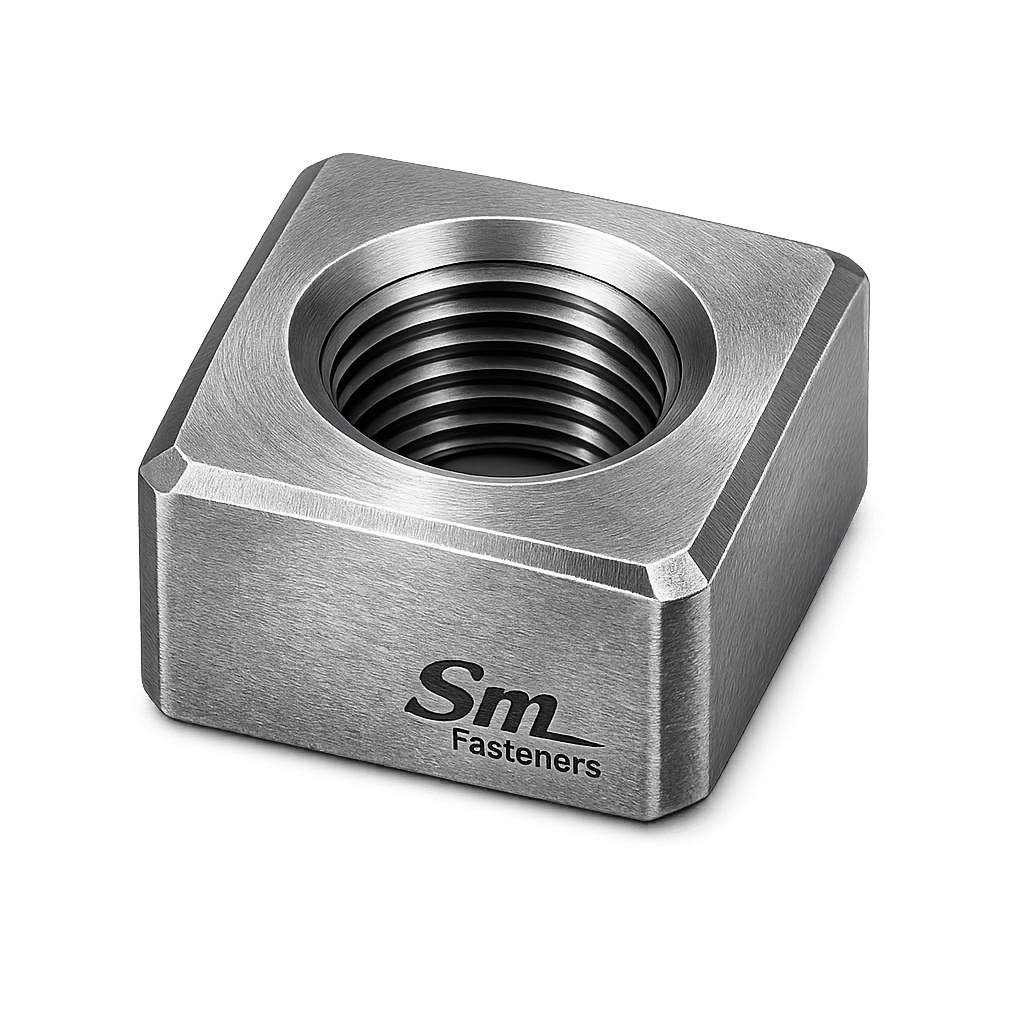
- Square nut
- Flat Washers
- Spring Washers
- Belleville Washers
- Fender Washers
- Socket Head Cap Screws
- Socket Set Screws
- Button Head Screws
- Countersunk Screws
- Eye Bolt
- Eye Nuts
- U-Bolts
- Foundation Bolts
- Anchor Bolts
- Machine Screws
- Custom Machined Fasteners
- Precision CNC Components
22. Hex Head Bolts
Hex head bolts are the most widely specified fastening components for industrial piping, steel structures, machinery, pressure equipment, and offshore facilities.
Engineering Characteristics
- Six-sided wrenching head
- High torque transmission capability
- Suitable for heavy preload
- Easy maintenance access
- Excellent for flange assemblies
Typical applications include:
- Pressure vessels
- Marine piping
- Offshore platforms
- Heat exchangers
- Pump assemblies
- Structural supports
23. Heavy Hex Bolts
Heavy hex bolts possess a larger head diameter and greater bearing surface than standard hex bolts.
Advantages include:
- Higher preload capability
- Improved load distribution
- Reduced bearing stress
- Better fatigue resistance
- Preferred for structural steel applications
Used extensively in:
- Offshore structures
- Oil & gas plants
- Petrochemical equipment
- Heavy fabrication
- Marine construction
24. Stud Bolts
Stud bolts consist of fully threaded rods used with two heavy hex nuts.
Advantages:
- Uniform load distribution
- Easy gasket replacement
- Suitable for high-temperature joints
- Preferred for pressure-containing flanges
Industries include:
- Refineries
- LNG terminals
- Offshore platforms
- Chemical plants
- Heat exchanger construction
25. Threaded Rods
Threaded rods provide continuous threading over the full length.
Applications:
- Pipe supports
- Equipment mounting
- Structural bracing
- HVAC systems
- Marine supports
Available in:
- Metric
- UNC
- UNF
- BSW
- BSF
26. Hex Nuts
Hex nuts provide mating threads for bolts and studs.
Common variants:
- Standard Hex Nut
- Heavy Hex Nut
- Thin Nut
- Jam Nut
- Slotted Nut
- Lock Nut
Engineering considerations:
- Thread accuracy
- Bearing surface finish
- Material compatibility
- Proof load
- Thread tolerance
27. Washers
Washers increase bearing area and improve load distribution.
Common types include:
Flat Washers
Functions:
- Load distribution
- Surface protection
- Improved joint stability
Spring Washers
Functions:
- Resistance to vibration
- Preload retention
- Dynamic load resistance
Belleville Washers
Suitable for:
- Thermal expansion
- Dynamic loading
- High vibration
- Offshore equipment
Fender Washers
Large outside diameter provides:
- Increased bearing area
- Thin plate reinforcement
- Soft material protection
28. Socket Head Cap Screws
These precision fasteners provide:
- High strength
- Compact installation
- Excellent alignment
- Reduced installation space
Widely used in:
- Pumps
- Compressors
- Precision machinery
- Marine equipment
29. Countersunk Screws
Used where flush mounting is required.
Applications:
- Marine panels
- Deck equipment
- Precision assemblies
- Instrumentation
Benefits:
- Smooth surface
- Reduced snagging
- Improved appearance
30. U-Bolts
Designed for pipe and tube support.
Applications:
- Marine piping
- Heat exchangers
- Structural supports
- Offshore process piping
31. Foundation Bolts
Foundation bolts secure heavy equipment to concrete foundations.
Common installations:
- Pumps
- Compressors
- Turbines
- Marine engines
- Offshore skids
32. Anchor Bolts
Anchor bolts connect structural members to foundations.
Common designs:
- L-Type
- J-Type
- Straight Anchor
- Sleeve Anchor
- Plate Anchor
33. Eye Bolts & Eye Nuts
Designed for lifting applications.
Used for:
- Heat exchangers
- Pumps
- Valves
- Marine equipment
- Heavy machinery
Design considerations:
- Working Load Limit
- Direction of loading
- Safety factor
- Thread engagement
34. Custom Engineered Fasteners
Many EPC projects require non-standard fasteners.
SM Fasteners manufactures:
- Special diameters
- Long-length studs
- Large forged bolts
- CNC-machined fasteners
- Non-standard thread forms
- Special washers
- Custom lifting hardware
- PEEK fasteners for electrical insulation and chemically aggressive environments
35. Fastener Geometry Fundamentals
Proper geometry ensures:
- Accurate preload
- Uniform stress distribution
- Reduced stress concentration
- Improved fatigue life
- Reliable installation
Important geometric parameters include:
- Nominal diameter
- Head height
- Across flats
- Across corners
- Thread length
- Grip length
- Radius
- Chamfer
- Under-head fillet
36. Dimensional Logic
Every fastener dimension directly influences joint performance.
Key dimensions include:
Nominal Diameter
Determines:
- Tensile capacity
- Shear capacity
- Torque requirement
Grip Length
Represents the total thickness of clamped materials.
Incorrect grip length may result in:
- Thread loading inside joint
- Reduced preload
- Fatigue cracking
Thread Length
Proper thread length ensures:
- Full nut engagement
- Uniform stress transfer
- Improved fatigue performance
Head Dimensions
Head diameter affects:
- Bearing stress
- Clamp force distribution
- Installation clearance
37. Standard Metric Bolt Dimensions
| Thread Size | Pitch (mm) | Head Width (mm) | Head Height (mm) |
|---|---|---|---|
| M6 | 1.0 | 10 | 4 |
| M8 | 1.25 | 13 | 5.3 |
| M10 | 1.5 | 17 | 6.4 |
| M12 | 1.75 | 19 | 7.5 |
| M16 | 2.0 | 24 | 10 |
| M20 | 2.5 | 30 | 12.5 |
| M24 | 3.0 | 36 | 15 |
| M30 | 3.5 | 46 | 18.7 |
| M36 | 4.0 | 55 | 22.5 |
(Representative dimensions based on ISO 4014/4017 standards.)
38. Standard Length Availability
Typical production lengths:
| Diameter | Available Lengths (mm) |
|---|---|
| M6 | 10–100 |
| M8 | 12–150 |
| M10 | 16–200 |
| M12 | 20–300 |
| M16 | 30–400 |
| M20 | 40–500 |
| M24 | 50–600 |
| M30 | 60–800 |
| M36 | 80–1000 |
Custom lengths are manufactured to project specifications.
39. Thread Forms
Cupro Nickel fasteners are produced in multiple thread systems.
Metric Threads
Common in:
- Europe
- Asia
- Middle East
- EPC projects
Standard:
ISO Metric Thread
UNC Threads
Preferred in:
- North America
- Offshore industry
- Oil & gas
UNF Threads
Advantages:
- Better preload
- Higher tensile area
- Improved fatigue resistance
BSW Threads
Still encountered in:
- Legacy power plants
- Marine vessels
- Railway equipment
BSF Threads
Used for:
- Maintenance
- Heritage equipment
- Existing British-standard machinery
40. Thread Standards & Tolerances
| Thread System | Standard | Typical Tolerance |
|---|---|---|
| Metric Coarse | ISO 261 / ISO 965 | 6g / 6H |
| Metric Fine | ISO 261 / ISO 965 | 6g / 6H |
| UNC | ASME B1.1 | Class 2A / 2B |
| UNF | ASME B1.1 | Class 2A / 2B |
| BSW | BS 84 | Medium Fit |
| BSF | BS 84 | Medium Fit |
41. International Manufacturing Standards
Cupro Nickel fasteners are manufactured according to globally recognized standards to ensure dimensional interchangeability, mechanical consistency, and procurement compliance.
| Standard | Scope |
|---|---|
| ISO 4014 | Hex bolts (partial thread) |
| ISO 4017 | Hex bolts (full thread) |
| ISO 4032 | Hex nuts |
| ISO 7089 | Plain washers |
| ISO 4762 | Socket head cap screws |
| ISO 10642 | Countersunk socket screws |
| ISO 3269 | Fastener acceptance inspection |
| ISO 4759 | Dimensional tolerances |
42. ASTM Standards
Relevant ASTM specifications include:
| ASTM Standard | Description |
|---|---|
| ASTM B151 | Copper-Nickel Rod, Bar & Shapes |
| ASTM B122 | Copper-Nickel Plate, Sheet & Strip |
| ASTM B466 | Seamless Copper-Nickel Pipe |
| ASTM F468 | Nonferrous Bolts & Screws |
| ASTM F467 | Nonferrous Nuts |
| ASTM B369 | Copper-Nickel Forgings |
43. DIN Standards
Frequently referenced DIN standards include:
| DIN Standard | Product |
|---|---|
| DIN 933 | Fully Threaded Hex Bolt |
| DIN 931 | Partially Threaded Hex Bolt |
| DIN 934 | Hex Nut |
| DIN 125 | Flat Washer |
| DIN 127 | Spring Washer |
| DIN 912 | Socket Head Cap Screw |
| DIN 7991 | Countersunk Socket Screw |
| DIN 975 | Threaded Rod |
44. British Standards (BS)
Common BS standards include:
| Standard | Application |
|---|---|
| BS 3692 | Metric fasteners |
| BS 4190 | ISO metric bolts & nuts |
| BS 4320 | Washers |
| BS 1768 | Hex bolts |
| BS 84 | Whitworth threads |
45. Dimensional Inspection Requirements
Each manufactured fastener undergoes dimensional verification for:
- Major diameter
- Minor diameter
- Pitch diameter
- Head dimensions
- Thread pitch
- Thread angle
- Straightness
- Overall length
- Radius
- Chamfer
- Concentricity
Inspection is performed using calibrated gauges, micrometers, vernier calipers, optical comparators, profile projectors, and thread gauges in accordance with ISO 9001 quality procedures.
46. Engineering Design Considerations
When specifying Cupro Nickel fasteners, engineers should verify:
- Applicable design code
- Operating temperature
- Pressure class
- Corrosion environment
- Thread compatibility
- Required preload
- Joint stiffness
- Inspection accessibility
- Galvanic compatibility
- Maintenance interval
These factors ensure long-term joint reliability in seawater, offshore, and process industry applications.
47. SM Fasteners Manufacturing Capability
SM Fasteners manufactures Cupro Nickel 90/10 (UNS C70600) and 70/30 (UNS C71500) fasteners in metric, UNC, UNF, BSW, and BSF thread forms, covering standard and custom dimensions for global EPC, marine, offshore, and industrial projects. Product offerings include bolts, heavy hex bolts, studs, threaded rods, nuts, washers, socket screws, anchor bolts, U-bolts, lifting hardware, and precision CNC-machined components. Production is supported by ISO 9001, MSME, and UKAF certified quality systems, ensuring dimensional accuracy, traceability, and compliance with international ISO, ASTM, DIN, and BS standards.
48. Material Engineering of Cupro Nickel Fasteners
Material selection is one of the most critical engineering decisions affecting the long-term reliability of industrial fasteners. Cupro Nickel alloys are selected where resistance to seawater corrosion, biofouling, erosion-corrosion, and chloride attack is more important than achieving the highest mechanical strength.
Unlike carbon steel and alloy steel fasteners, Cupro Nickel derives its durability from its naturally protective oxide layer rather than from external coatings. This passive film continually reforms when damaged, providing long-term protection in aggressive marine environments.
Primary engineering advantages include:
- Excellent seawater corrosion resistance
- High resistance to biofouling
- Superior erosion-corrosion resistance
- Good ductility
- Stable mechanical properties
- Excellent thermal conductivity
- Good electrical conductivity
- Low magnetic permeability
- Good weldability
- Long operational service life
49. Chemical Composition of Cupro Nickel Alloys
CuNi 90/10 – UNS C70600
| Element | Composition (%) |
|---|---|
| Copper (Cu) | Balance |
| Nickel (Ni) | 9.0–11.0 |
| Iron (Fe) | 1.0–1.8 |
| Manganese (Mn) | 0.5–1.0 |
| Zinc (Max.) | 1.0 |
| Lead (Max.) | 0.05 |
| Carbon (Max.) | 0.05 |
CuNi 70/30 – UNS C71500
| Element | Composition (%) |
|---|---|
| Copper (Cu) | Balance |
| Nickel (Ni) | 29.0–33.0 |
| Iron (Fe) | 0.4–1.0 |
| Manganese (Mn) | 0.5–1.0 |
| Zinc (Max.) | 1.0 |
| Lead (Max.) | 0.05 |
50. Comparison of Cupro Nickel Grades
| Property | C70600 (90/10) | C71500 (70/30) |
|---|---|---|
| Seawater Corrosion Resistance | Excellent | Outstanding |
| Erosion-Corrosion Resistance | Excellent | Superior |
| Mechanical Strength | Good | Higher |
| Thermal Conductivity | Higher | Moderate |
| Cost | Lower | Higher |
| Marine Biofouling Resistance | Excellent | Excellent |
| Chloride Resistance | Excellent | Outstanding |
| Typical Applications | Piping, Heat Exchangers | Offshore, Naval, Condensers |
51. Material Selection Criteria
Selection depends on several engineering parameters.
Operating Environment
Consider:
- Continuous seawater immersion
- Splash zone exposure
- Atmospheric marine conditions
- High-velocity seawater
- Brine service
- Chloride concentration
Mechanical Loading
Evaluate:
- Tensile load
- Shear load
- Cyclic loading
- Shock loading
- Fatigue loading
- Thermal expansion
Corrosion Requirements
Assessment should include:
- General corrosion
- Crevice corrosion
- Galvanic corrosion
- Erosion-corrosion
- Stress corrosion cracking
- Marine biofouling
Service Life
Engineering designs commonly target:
- 20 years
- 25 years
- 30 years
- 40 years or more in properly maintained marine systems
52. Material Comparison with Other Fastener Alloys
| Material | UTS | Corrosion Resistance | Relative Cost | Typical Applications |
|---|---|---|---|---|
| Carbon Steel | High | Poor | Low | Structural Steel |
| SS304 | Moderate | Good | Medium | General Industry |
| SS316 | Moderate | Very Good | Medium | Chemical Processing |
| Duplex S31803 | High | Excellent | High | Offshore |
| Super Duplex S32750 | Very High | Outstanding | Very High | Offshore Oil & Gas |
| CuNi 90/10 C70600 | Moderate | Excellent | High | Marine Equipment |
| CuNi 70/30 C71500 | Higher | Outstanding | Very High | Naval & Offshore |
| Monel 400 | High | Outstanding | Premium | Marine & Chemical |
| Inconel 625 | Very High | Exceptional | Premium | High Temperature |
| PEEK Fasteners | Moderate | Excellent Chemical Resistance | Premium | Electrical Insulation & Non-Metallic Assemblies |
53. Corrosion Resistance by Environment
| Environment | C70600 | C71500 |
|---|---|---|
| Seawater | Excellent | Outstanding |
| Salt Spray | Excellent | Outstanding |
| Marine Atmosphere | Excellent | Outstanding |
| Fresh Water | Excellent | Excellent |
| Brackish Water | Excellent | Outstanding |
| Chloride Solutions | Excellent | Outstanding |
| Dilute Acids | Good | Good |
| Sulfuric Acid | Limited | Limited |
| Hydrochloric Acid | Not Recommended | Not Recommended |
| Nitric Acid | Limited | Limited |
| H₂S Service | Suitable with Engineering Evaluation | |
| Offshore Splash Zone | Excellent | Outstanding |
54. Mechanical Properties
Typical room-temperature properties.
| Property | C70600 | C71500 |
|---|---|---|
| Tensile Strength | 310–380 MPa | 360–480 MPa |
| Yield Strength | 105–150 MPa | 125–180 MPa |
| Elongation | 30–40% | 30–35% |
| Hardness | 80–110 HB | 90–120 HB |
| Elastic Modulus | ~150 GPa | ~155 GPa |
| Density | 8.94 g/cm³ | 8.95 g/cm³ |
55. Temperature Capability
Cupro Nickel alloys retain stable properties over a wide operating range.
| Service Condition | Recommended |
|---|---|
| Cryogenic Service | Suitable |
| Ambient Conditions | Excellent |
| Marine Systems | Excellent |
| Heated Seawater | Excellent |
| Heat Exchangers | Excellent |
| Continuous High Temperature | Engineering Evaluation Required |
56. Heat Treatment of Cupro Nickel Fasteners
Unlike alloy steel fasteners, Cupro Nickel alloys are not strengthened through quenching and tempering. Their mechanical properties are primarily obtained through alloy composition and cold working.
Typical heat treatment objectives include:
- Stress relief
- Annealing
- Recrystallization
- Improved ductility
- Removal of residual forming stresses
57. Annealing Process
Annealing is performed after extensive cold working to restore ductility and improve machinability.
Benefits include:
- Reduced residual stresses
- Increased ductility
- Improved dimensional stability
- Better forming characteristics
- Uniform grain structure
58. Stress Relieving
Stress relieving minimizes residual stresses introduced during machining, threading, or forming.
Advantages:
- Improved dimensional stability
- Reduced distortion
- Enhanced fatigue performance
- Better service reliability
59. Cold Working
Cold working increases mechanical strength without altering alloy chemistry.
Processes include:
- Cold drawing
- Thread rolling
- Cold heading
- Cold forging
Benefits:
- Increased tensile strength
- Improved yield strength
- Better fatigue resistance
- Enhanced thread quality
60. Manufacturing Workflow
Production follows a controlled manufacturing sequence to ensure dimensional accuracy, traceability, and consistent quality.
Step 1 – Raw Material Procurement
Certified CuNi bars, rods, or forgings are sourced with complete material certification.
Verification includes:
- Heat number
- Chemical composition
- Mechanical properties
- Material Test Certificate (MTC)
Step 2 – Incoming Material Inspection
Inspection activities include:
- Visual examination
- Dimensional verification
- Positive Material Identification (PMI)
- Heat number verification
- Certification review
Step 3 – Cutting
Raw stock is cut to precise lengths using:
- Band saws
- Circular saws
- CNC cutting equipment
Step 4 – Forging
Depending on size and design:
- Hot forging
- Cold heading
- Precision forging
Forging refines grain flow and enhances mechanical integrity.
Step 5 – CNC Machining
Critical dimensions are machined using CNC equipment.
Operations include:
- Turning
- Facing
- Drilling
- Slotting
- Milling
- Chamfering
- Radius generation
Step 6 – Thread Manufacturing
Threads are produced by:
Thread Rolling
Advantages:
- Superior surface finish
- Compressive residual stresses
- Improved fatigue resistance
- Better thread accuracy
- Higher strength
Thread Cutting
Used when:
- Large diameters are involved
- Custom thread forms are required
- Low production quantities
- Repair applications
61. Thread Rolling vs Thread Cutting
| Parameter | Rolled Thread | Cut Thread |
|---|---|---|
| Fatigue Strength | Excellent | Good |
| Surface Finish | Superior | Moderate |
| Grain Flow | Continuous | Interrupted |
| Production Rate | High | Moderate |
| Tool Life | Long | Moderate |
| Strength | Higher | Lower |
Thread rolling is generally preferred for critical industrial fasteners.
62. Deburring & Cleaning
After machining:
- Burr removal
- Edge conditioning
- Surface cleaning
- Degreasing
- Drying
These operations ensure safe handling and proper coating or passivation where specified.
63. Surface Engineering
Although Cupro Nickel naturally resists corrosion, surface preparation improves cleanliness, appearance, and service performance.
Typical treatments include:
- Mechanical polishing
- Glass bead blasting
- Pickling (where appropriate)
- Degreasing
- Protective oiling for storage
64. Surface Finish Comparison
| Surface Finish | Purpose | Performance |
|---|---|---|
| As Machined | General Engineering | Good |
| Polished | Improved Cleanliness | Excellent |
| Glass Bead Blasted | Uniform Appearance | Excellent |
| Pickled | Oxide Removal | Excellent |
| Light Protective Oil | Storage Protection | Good |
| VCI Packaging Preparation | Export Protection | Excellent |
65. Protective Coatings
Cupro Nickel fasteners generally do not require sacrificial coatings such as zinc or hot-dip galvanizing because these coatings can compromise galvanic compatibility and are unnecessary for marine corrosion protection.
Where project specifications require temporary storage protection, the following may be applied:
- Water-displacing protective oils
- Dry-film rust inhibitors
- Volatile Corrosion Inhibitor (VCI) packaging
- Wax-based storage coatings
66. Failure Mechanisms
Despite their excellent corrosion resistance, improper design or installation can result in failure.
Common mechanisms include:
Fatigue Failure
Caused by:
- Cyclic loading
- Inadequate preload
- Vibration
- Stress concentrations
Shear Failure
Occurs when applied shear exceeds the fastener’s shear capacity.
Common causes:
- Undersized fasteners
- Misalignment
- Poor joint design
Thread Stripping
Results from:
- Insufficient thread engagement
- Improper tightening
- Material mismatch
- Damaged threads
Galvanic Corrosion
Occurs when Cupro Nickel is coupled with dissimilar metals in an electrolyte.
Preventive measures:
- Material compatibility
- Insulating washers
- Isolation sleeves
- Appropriate joint design
Stress Corrosion Cracking (SCC)
Cupro Nickel alloys exhibit excellent resistance to chloride-induced SCC compared with many stainless steels, making them suitable for long-term marine service.
67. NACE and Sour Service Considerations
For oil and gas applications containing hydrogen sulfide (H₂S), fastener selection should be verified against:
- NACE MR0175
- ISO 15156
Material hardness, environmental severity, and service conditions should be evaluated to ensure suitability and minimize the risk of sulfide stress cracking.
68. Traceability Throughout Manufacturing
Every production lot should maintain complete traceability from raw material to finished product, including:
- Heat number identification
- Manufacturing batch records
- Process route documentation
- Inspection records
- Dimensional reports
- Material certifications
- Final release documentation
69. Stress Corrosion Cracking (SCC)
Cupro Nickel alloys exhibit excellent resistance to chloride-induced SCC compared with many stainless steels, making them suitable for long-term marine service.
70. Marine & Shipbuilding
All incoming Cupro Nickel bars, rods, forgings, or billets should be verified before production.
Inspection activities include:
71. Incoming Material Inspection
- Material Test Certificate (MTC) review
- Heat number verification
- Chemical composition confirmation
- Surface defect inspection
- Visual inspection
- Dimensional verification
- Positive Material Identification (PMI)
- Traceability marking
72. In-Process Inspection
During manufacturing, critical characteristics are continuously monitored to prevent non-conforming products.
Typical checkpoints include:
- Forging dimensions
- CNC machining accuracy
- Thread profile
- Thread pitch
- Thread concentricity
- Head dimensions
- Under-head radius
- Chamfer quality
- Surface finish
- Burr removal
- Identification marking
73. Final Dimensional Inspection
Finished fasteners undergo dimensional verification using calibrated instruments.
Measured characteristics include:
- Major diameter
- Minor diameter
- Pitch diameter
- Thread pitch
- Overall length
- Grip length
- Across flats
- Across corners
- Head height
- Straightness
- Perpendicularity
- Concentricity
Inspection equipment commonly includes:
- Digital Vernier Calipers
- Outside Micrometers
- Thread Plug Gauges
- Thread Ring Gauges
- Height Gauges
- Coordinate Measuring Machine (CMM)
- Optical Comparator
- Profile Projector
74. Mechanical Testing
Mechanical testing confirms that the fasteners meet specified strength and ductility requirements.
Typical tests include:
- Tensile Strength Test
- Yield Strength Test
- Elongation Test
- Hardness Test
- Proof Load Test
- Bend Test (where applicable)
- Shear Strength Evaluation
75. Positive Material Identification (PMI)
PMI confirms alloy chemistry and prevents material mix-ups, particularly on critical projects.
Common PMI methods:
- X-Ray Fluorescence (XRF)
- Optical Emission Spectroscopy (OES)
PMI verifies:
- Copper content
- Nickel content
- Iron
- Manganese
- Alloy grade (C70600 or C71500)
76. Non-Destructive Testing (NDT)
Where specified by project requirements, NDT methods are applied without damaging the component.
Typical methods include:
| NDT Method | Purpose |
|---|---|
| Visual Testing (VT) | Surface defects |
| Liquid Penetrant Testing (PT) | Surface cracks |
| Ultrasonic Testing (UT)* | Internal defects (large components) |
| Eddy Current Testing (ET)* | Surface discontinuities in conductive materials |
*Applied where geometry and project specifications permit.
77. Proof Load and Tensile Strength Table
Typical Engineering Reference Values
| Thread Size | Tensile Stress Area (mm²) | Approx. Proof Load (kN)* | Approx. Ultimate Tensile Load (kN)* |
|---|---|---|---|
| M6 | 20.1 | 2.2 | 6.2 |
| M8 | 36.6 | 4.0 | 11.3 |
| M10 | 58.0 | 6.4 | 17.9 |
| M12 | 84.3 | 9.3 | 26.0 |
| M16 | 157 | 17.3 | 48.5 |
| M20 | 245 | 27.0 | 75.6 |
| M24 | 353 | 38.8 | 108.9 |
| M30 | 561 | 61.7 | 173.0 |
*Indicative values based on representative Cupro Nickel mechanical properties. Project-specific calculations should use certified material test data.
78. Tightening Torque Chart (Typical Guidance)
| Size | Dry (Nm) | Lubricated (Nm) |
|---|---|---|
| M6 | 6 | 5 |
| M8 | 15 | 12 |
| M10 | 30 | 24 |
| M12 | 52 | 42 |
| M16 | 125 | 100 |
| M20 | 245 | 195 |
| M24 | 420 | 335 |
| M30 | 840 | 670 |
Note: Actual tightening torque depends on thread condition, lubrication, nut factor (K), joint design, and desired preload. Always follow the project specification or engineering calculation.
79. Torque–Tension Relationship
The relationship between tightening torque and clamp load is commonly estimated using:
Where:
- T = Tightening Torque (N·m)
- K = Nut Factor (Coefficient of Friction)
- F = Desired Clamp Load (N)
- D = Nominal Bolt Diameter (m)
80. Preload Calculation (Worked Example)
Given:
- Bolt Size = M16
- Desired Clamp Load = 60,000 N
- Nut Factor (Lubricated) = 0.18
- Diameter = 16 mm = 0.016 m
Formula:
Calculation:
Required Tightening Torque ≈ 173 N·m
81. Recommended Thread Engagement
| Bolt Diameter | Minimum Thread Engagement |
|---|---|
| M6 | 6 mm |
| M8 | 8 mm |
| M10 | 10 mm |
| M12 | 12 mm |
| M16 | 16 mm |
| M20 | 20 mm |
| M24 | 24 mm |
For softer mating materials or highly loaded joints, greater engagement may be necessary.
82. Thread Standards & Tolerances
| Thread Type | Standard | External | Internal |
|---|---|---|---|
| Metric Coarse | ISO 261 / ISO 965 | 6g | 6H |
| Metric Fine | ISO 261 / ISO 965 | 6g | 6H |
| UNC | ASME B1.1 | 2A | 2B |
| UNF | ASME B1.1 | 2A | 2B |
| BSW | BS 84 | Medium Fit | Medium Fit |
| BSF | BS 84 | Medium Fit | Medium Fit |
83. Weight Chart (Approximate)
| Bolt Size | Approx. Weight / Piece (kg) | Approx. Weight / 100 Pieces (kg) |
|---|---|---|
| M6 × 25 | 0.010 | 1.0 |
| M8 × 30 | 0.020 | 2.0 |
| M10 × 40 | 0.039 | 3.9 |
| M12 × 50 | 0.067 | 6.7 |
| M16 × 60 | 0.158 | 15.8 |
| M20 × 70 | 0.284 | 28.4 |
| M24 × 80 | 0.490 | 49.0 |
| M30 × 100 | 0.965 | 96.5 |
*Weights are approximate and may vary with thread length, head style, and manufacturing tolerances. SM Fasteners provides project-specific weight charts upon request.
84. Common Failure Mechanisms
Proper engineering design and installation are essential to avoid premature failures.
| Failure Mode | Primary Cause | Preventive Measures |
|---|---|---|
| Fatigue | Cyclic loading, low preload | Correct preload, rolled threads |
| Shear Failure | Excessive transverse load | Correct bolt sizing and joint design |
| Thread Stripping | Inadequate engagement | Increase thread engagement length |
| Galvanic Corrosion | Dissimilar metals in electrolyte | Material compatibility or isolation |
| Crevice Corrosion | Trapped seawater | Eliminate crevices, improve drainage |
| Loosening | Vibration | Locking devices, controlled torque |
85. Industry Applications
85.1 Marine & Shipbuilding
Typical applications include:
- Seawater piping systems
- Deck equipment
- Condensers
- Cooling water systems
- Ballast systems
- Pump assemblies
- Heat exchangers
85.2 Offshore Oil & Gas
Cupro Nickel fasteners are widely used in:
- Offshore platforms
- FPSOs
- Firewater systems
- Seawater lift pumps
- Produced water treatment
- Splash zone equipment
- Offshore piping supports
85.3 Petrochemical & Chemical Processing
Applications include:
- Cooling water systems
- Heat exchangers
- Coastal process plants
- Chloride-containing service
- Chemical storage facilities
85.4 Power Generation
Common installations:
- Surface condensers
- Cooling towers
- Heat exchangers
- Seawater intake structures
- Coastal thermal power stations
85.5 LNG Industry
Typical uses:
- Seawater cooling circuits
- LNG terminals
- Offshore loading facilities
- Utility piping
- Auxiliary equipment
85.6 Construction & Infrastructure
Applications include:
- Coastal bridges
- Marine jetties
- Port facilities
- Harbour structures
- Structural steel exposed to marine environments
85.7 Railways
Cupro Nickel fasteners are used in:
- Coastal railway infrastructure
- Signalling equipment near marine environments
- Bridge components
- Electrical earthing assemblies
85.8 Automotive & Heavy Equipment
Typical applications:
- Marine vehicles
- Heavy-duty cooling systems
- Coastal equipment
- Specialized OEM assemblies
85.9 PEEK Fastener Applications
Where electrical insulation, low weight, or complete non-metallic fastening is required, PEEK fasteners complement Cupro Nickel assemblies.
Typical applications:
- Electrical insulation systems
- Instrumentation
- Chemical processing equipment
- Semiconductor manufacturing
- Lightweight assemblies
- High-purity process equipment
86. Packaging and Export Preparation
To maintain product quality during storage and international transportation, fasteners should be packaged using industrial export practices.
Typical packaging includes:
- Moisture-resistant poly bags
- Heat-sealed packaging
- VCI (Volatile Corrosion Inhibitor) protection
- Thread protectors
- Individual labeling
- Batch identification
- Heavy-duty corrugated cartons
- Wooden export crates
- ISPM-15 compliant fumigated pallets and crates
- Containerized shipment for international logistics
87. Export Documentation
International EPC and industrial projects commonly require the following documentation:
- Material Test Certificate (MTC)
- EN 10204 Type 3.1 Certificate
- EN 10204 Type 3.2 Certificate (when specified)
- Positive Material Identification (PMI) Report
- Chemical Analysis Report
- Mechanical Test Report
- Dimensional Inspection Report
- Heat Number Traceability Record
- Certificate of Conformance (CoC)
- Packing List
- Commercial Invoice
- Certificate of Origin
- Third-Party Inspection Report (TPI), where applicable
88. Quality Management and Traceability
A robust quality management system ensures that every fastener is fully traceable throughout its lifecycle.
Key quality elements include:
- Heat number traceability
- Batch identification
- Calibration of measuring instruments
- Documented inspection plans
- Manufacturing process control
- Corrective and preventive action (CAPA)
- Controlled documentation
- Final release authorization
These practices support project compliance, third-party inspections, and long-term asset integrity.
89. SM Fasteners Engineering & Manufacturing Capability
SM Fasteners manufactures precision Cupro Nickel 90/10 (UNS C70600) and Cupro Nickel 70/30 (UNS C71500) fasteners for demanding marine, offshore, petrochemical, LNG, power generation, and heavy engineering applications. The product portfolio includes bolts, heavy hex bolts, studs, threaded rods, nuts, washers, anchor bolts, U-bolts, custom CNC-machined fasteners, forged components, and complementary PEEK fasteners for specialized applications.
Operating under an ISO 9001 certified quality management system with MSME and UKAF certifications, SM Fasteners provides complete manufacturing traceability, precision machining, PMI verification, dimensional inspection, mechanical testing, and export-ready documentation. Global supply capability includes custom dimensions, international thread standards (Metric, UNC, UNF, BSW, BSF), project-specific packaging, and comprehensive certification to support EPC contractors, OEMs, shipyards, offshore platforms, power plants, and industrial infrastructure projects worldwide.
90. Engineering Summary
Cupro Nickel 90/10 (UNS C70600) and 70/30 (UNS C71500) fasteners are engineered for service in aggressive marine and chloride-rich environments where long-term corrosion resistance, erosion-corrosion performance, and reliability are critical. Their natural resistance to seawater, compatibility with copper-nickel piping systems, and stable mechanical properties make them preferred materials for offshore platforms, naval vessels, desalination plants, condensers, heat exchangers, LNG terminals, and coastal infrastructure.