
Austenitic Grades 304 316L
1. Introduction to Austenitic Stainless Steel Fasteners
Austenitic stainless steels represent the most widely specified corrosion-resistant fastener materials in global industrial engineering applications. Their unique metallurgical structure provides an optimized combination of:
- Corrosion resistance
- Toughness
- Ductility
- Cryogenic performance
- Elevated temperature stability
- Fabrication versatility
For critical bolting systems used in:
- Oil & Gas
- Petrochemical Processing
- LNG Facilities
- Offshore Structures
- Chemical Plants
- Power Generation
- Marine Installations
- Infrastructure Projects
Austenitic grades are frequently selected where carbon steel or alloy steel fasteners would be susceptible to corrosion-induced degradation.
SM Fasteners manufactures precision-engineered stainless steel fasteners in a comprehensive range of Austenitic grades including:
| Grade | UNS Number | EN Number |
|---|---|---|
| 304 | S30400 | 1.4301 |
| 316 | S31600 | 1.4401 |
| 316L | S31603 | 1.4404 |
| 317L | S31703 | 1.4438 |
| 310S | S31008 | 1.4845 |
| 321 | S32100 | 1.4541 |
These materials are supplied in accordance with international standards and quality systems maintained under ISO 9001-certified manufacturing procedures.
2. Industrial Importance of Austenitic Stainless Fasteners
Fasteners often represent less than 1% of total project value but can determine the reliability and service life of entire systems.
Failures associated with improper fastener selection commonly result from:
- Galvanic corrosion
- Pitting attack
- Crevice corrosion
- Chloride stress corrosion cracking
- Thread galling
- Fatigue fracture
- Improper preload
Because of these risks, EPC contractors and engineering organizations frequently specify Austenitic stainless fasteners for:
Corrosion Control
Protection against:
- Atmospheric exposure
- Salt-laden environments
- Chemical processing atmospheres
- Offshore splash zones
Asset Reliability
Reduced maintenance intervals and improved lifecycle cost.
Regulatory Compliance
Used where:
- NACE MR0175
- ISO 15156
- ASME
- API
- ASTM
requirements influence material selection.
3. Metallurgical Definition of Austenitic Stainless Steel
Austenitic stainless steels derive their characteristics from a face-centered cubic (FCC) crystal structure stabilized by nickel additions.
The microstructure remains predominantly austenitic at room temperature.
Typical composition ranges include:
| Element | Function |
|---|---|
| Chromium | Corrosion resistance |
| Nickel | Austenite stabilization |
| Molybdenum | Pitting resistance |
| Carbon | Strength |
| Nitrogen | Strength & corrosion resistance |
| Titanium | Carbide stabilization |
| Manganese | Deoxidation and toughness |
4. Fundamental Characteristics of Austenitic Fasteners
Non-Magnetic Behavior
Most austenitic grades are non-magnetic in annealed condition.
Advantages:
- Instrumentation systems
- Medical equipment
- Electronic assemblies
Excellent Toughness
Retains impact strength at:
- Cryogenic temperatures
- Sub-zero service conditions
Common in LNG facilities operating below −160°C.
Superior Corrosion Resistance
Passive chromium oxide film provides self-healing protection.
Corrosion resistance increases with:
- Chromium content
- Nickel content
- Molybdenum additions
High Ductility
Allows:
- Cold heading
- Thread rolling
- Deep forming
without cracking.
Elevated Temperature Capability
Certain grades such as:
- 310S
- 321
are engineered for high-temperature service.
5. Overview of Individual Austenitic Grades
Grade 304
The most widely used stainless fastener material.
Composition:
- ~18% Chromium
- ~8% Nickel
Common applications:
- Construction
- Architectural systems
- Water treatment
- Food processing
Advantages:
- Economical
- Readily available
- Excellent fabrication
Limitations:
- Moderate chloride resistance
Grade 316
Contains molybdenum.
Typical composition:
- 16–18% Chromium
- 10–14% Nickel
- 2–3% Molybdenum
Benefits:
- Improved pitting resistance
- Better seawater performance
- Enhanced chemical resistance
Applications:
- Offshore facilities
- Marine equipment
- Chemical plants
Grade 316L
Low carbon version of 316.
Carbon:
≤0.03%
Advantages:
- Reduced sensitization
- Improved weldability
- Superior resistance to intergranular corrosion
Widely specified for:
- Pressure equipment
- LNG systems
- Pharmaceutical facilities
Grade 317L
Higher molybdenum content than 316L.
Advantages:
- Improved chloride resistance
- Better crevice corrosion resistance
Applications:
- Chemical processing
- Desalination
- Pollution control systems
Grade 310S
High chromium and nickel grade.
Characteristics:
- Outstanding oxidation resistance
- Excellent heat resistance
Used in:
- Furnaces
- Heat exchangers
- Thermal processing equipment
Grade 321
Titanium stabilized stainless steel.
Benefits:
- Prevents chromium carbide precipitation
- Improved high-temperature reliability
Applications:
- Refineries
- Exhaust systems
- Thermal equipment
6. Functional Role of Fasteners in Industrial Assemblies
Fasteners do not primarily resist external load through shear.
Instead, properly engineered bolted joints function by:
Clamping Components Together
The bolt acts as a spring.
Tension generated during tightening creates:
- Preload
- Compression between joined parts
The resulting friction transfers operational loads.
Typical Fastener Functions
Structural Connections
Examples:
- Steel buildings
- Pipe racks
- Bridges
Pressure Containment
Examples:
- Flanges
- Heat exchangers
- Pressure vessels
Rotating Equipment
Examples:
- Pumps
- Compressors
- Turbines
Dynamic Systems
Examples:
- Rail equipment
- Marine machinery
- Heavy industrial equipment
7. Load Mechanics of Austenitic Fasteners
Understanding fastener mechanics is essential for safe design.
Tensile Loading
The most common loading mode.
External force acts parallel to bolt axis.
Example:
Flange bolting.
Tensile Stress Formula
Where:
- σ = tensile stress
- F = applied load
- A = stress area
Shear Loading
Force acts perpendicular to bolt axis.
Common in:
- Structural joints
- Machinery bases
Shear capacity depends upon:
- Material strength
- Bolt diameter
- Number of shear planes
Combined Loading
Many industrial joints experience:
- Tension
- Shear
- Bending
simultaneously.
Examples:
- Offshore equipment
- Crane systems
- Rotating machinery
Fatigue Loading
Critical for:
- Vibrating systems
- Pumps
- Compressors
- Engines
Repeated cyclic stress can initiate microscopic cracks.
Fatigue failures often occur below yield strength.
Thermal Loading
Thermal expansion differences create additional stresses.
Common in:
- Refineries
- Boilers
- Heat exchangers
Grades 310S and 321 are frequently selected where thermal cycling is significant.
8. Fastener Preload Fundamentals
Preload is the most important parameter in bolted joint performance.
When tightened, the bolt elongates elastically.
This elongation generates clamping force.
Simplified Preload Relationship
Where:
- Fp = preload
- k = bolt stiffness
- ΔL = elongation
Why Preload Matters
Adequate preload:
- Prevents loosening
- Prevents gasket leakage
- Improves fatigue resistance
- Reduces joint movement
Insufficient preload causes:
- Vibration loosening
- Leakage
- Fretting damage
Excessive preload causes:
- Yielding
- Thread stripping
- Bolt fracture
9. Torque-Tension Relationship
Applied torque is converted into preload.
However:
Only about 10–15% of tightening torque actually creates bolt tension.
The remainder is consumed by friction.
Approximate distribution:
| Energy Consumption | Percentage |
|---|---|
| Thread Friction | 40% |
| Bearing Friction | 45% |
| Useful Bolt Tension | 15% |
Therefore lubrication condition significantly affects preload accuracy.
Basic Torque Equation
T=KFD
Where:
- T = tightening torque
- K = nut factor
- F = preload
- D = nominal diameter
This equation forms the basis for torque chart development.
10. Joint Stiffness Principles
A bolted joint behaves as two springs:
Bolt Spring
Elastic elongation.
Joint Spring
Compression of connected materials.
Performance depends on stiffness ratio.
A stiffer joint generally:
- Maintains preload better
- Improves fatigue life
11. Thread Engagement Principles
Adequate thread engagement prevents stripping.
General engineering guidelines:
| Material | Minimum Engagement |
|---|---|
| Stainless Steel | 1.0 × Diameter |
| Aluminum | 1.5 × Diameter |
| Cast Iron | 1.5 × Diameter |
| Soft Alloys | 2.0 × Diameter |
Example:
M20 bolt:
Minimum stainless engagement ≈ 20 mm.
12. Friction Effects in Stainless Fasteners
Austenitic stainless steels exhibit higher galling tendency than carbon steels.
Galling occurs when:
- Thread surfaces weld microscopically
- Metal transfer occurs
- Seizure develops during tightening
Risk increases with:
- High tightening speed
- Dry assembly
- Fine threads
- Elevated temperature
Mitigation methods:
- Molybdenum disulfide lubricants
- PTFE coatings
- Silver plating
- Controlled installation procedures
13. Load Transfer Mechanisms
Industrial joints transfer load through:
Friction Grip
Preferred method.
Load transferred through clamping force.
Advantages:
- Reduced bolt stress
- Improved fatigue life
Bearing Type Connection
Load transferred through:
- Bolt shank
- Hole contact
More common in structural applications.
14. Failure Mechanisms in Austenitic Fasteners
Understanding failure modes is essential during material selection.
Tensile Failure
Occurs when applied load exceeds ultimate tensile strength.
Indicators:
- Necking
- Ductile fracture
Thread Stripping
Occurs when:
- Engagement insufficient
- Material too soft
Common in improperly designed tapped joints.
Fatigue Failure
Initiated by cyclic loading.
Typical crack origins:
- Thread roots
- Surface defects
- Stress concentrations
Stress Corrosion Cracking (SCC)
Austenitic stainless steels may experience SCC in:
- Chloride environments
- Elevated temperatures
Grade selection becomes critical.
Pitting Corrosion
Localized attack caused by chlorides.
Resistance ranking:
317L > 316L > 316 > 304
Crevice Corrosion
Occurs in stagnant fluid zones:
- Under washers
- Flange interfaces
- Gasket regions
Galling
Particularly important for stainless steel fasteners.
Prevention must be addressed during design and installation.
15. Joint Design Principles for EPC Projects
For critical industrial installations, bolted joints should be designed around:
Load Requirement
Determine:
- Static loads
- Dynamic loads
- Shock loads
Environmental Conditions
Evaluate:
- Chlorides
- Acids
- H₂S
- Moisture
- Temperature
Corrosion Risk
Select grade according to exposure severity.
Thermal Conditions
Consider:
- Expansion mismatch
- Thermal cycling
- Creep resistance
Inspection Accessibility
Allow:
- Torque verification
- Visual inspection
- Maintenance access
16. Engineering Selection Overview
| Requirement | Preferred Grade |
|---|---|
| General Industrial Service | 304 |
| Marine Atmosphere | 316 |
| Offshore Structures | 316L |
| Chloride Chemical Service | 317L |
| High Temperature Service | 310S |
| Thermal Cycling Equipment | 321 |
SM Fasteners Engineering Capability
SM Fasteners manufactures precision stainless steel fasteners in Austenitic grades 304, 316, 316L, 317L, 310S, and 321 for EPC, OEM, infrastructure, petrochemical, offshore, and heavy engineering applications. Production is controlled through ISO 9001-certified quality systems with complete material traceability, inspection documentation, and global project supply capability. The company also supports custom-engineered fastening solutions, advanced alloy materials, and high-performance PEEK fasteners for specialized industrial environments.
17. Product Types and Variants
Industrial fasteners manufactured from austenitic stainless steels are available in numerous configurations designed to satisfy specific load paths, installation constraints, maintenance requirements, and environmental conditions.
For EPC, petrochemical, offshore, power generation, and infrastructure projects, fastener selection extends beyond material grade and must consider:
- Joint geometry
- Load direction
- Accessibility
- Vibration conditions
- Corrosion exposure
- Assembly sequence
- Inspection requirements
SM Fasteners manufactures standard and custom-engineered fastening systems in accordance with international specifications and project-specific requirements.
18. Bolts
Bolts are externally threaded fasteners intended for use with mating nuts.
They are the most common fastening element used in:
- Structural steelwork
- Pipe supports
- Pressure equipment
- Heavy machinery
- Marine assemblies
Hex Head Bolts
Most widely specified industrial bolt configuration.
Characteristics:
- Six-sided head
- High torque transmission
- Easy field installation
- Compatible with standard tooling
Applicable Standards:
| Standard | Description |
|---|---|
| ISO 4014 | Partially threaded hex bolt |
| ISO 4017 | Fully threaded hex bolt |
| DIN 931 | Partial thread |
| DIN 933 | Full thread |
| BS EN ISO 4014 | Structural bolting |
| ASTM F593 | Stainless steel bolts |
Applications:
- Flanges
- Structural steel
- Pipe supports
- Equipment mounting
Heavy Hex Bolts
Larger bearing surface than standard hex bolts.
Advantages:
- Improved load distribution
- Better performance under high preload
- Reduced bearing stress
Standards:
| Standard | Description |
|---|---|
| ASTM A193 | High-temperature bolting |
| ASTM F593 | Stainless heavy hex |
| ASME B18.2.1 | Heavy hex dimensions |
Applications:
- Pressure vessels
- Refineries
- Heat exchangers
Flange Bolts
Incorporate integrated washer face.
Advantages:
- Larger bearing area
- Reduced assembly components
- Improved load distribution
Applications:
- Automotive systems
- Mechanical equipment
- Pumps
Socket Head Cap Screws
Internal hex drive design.
Standards:
| Standard | Description |
|---|---|
| ISO 4762 | |
| DIN 912 | |
| BS EN ISO 4762 |
Applications:
- Precision equipment
- Machinery
- OEM assemblies
Advantages:
- Compact design
- High preload capability
- Improved appearance
19. Stud Bolt
Stud bolts are threaded at both ends or continuously threaded along the entire length.
They are extensively used in pressure-retaining equipment.
Standards:
| Standard | Description |
|---|---|
| ASTM A193 | |
| ASTM A320 | |
| ASTM F593 | |
| DIN 975 | |
| DIN 976 |
Applications:
- ASME flanges
- Heat exchangers
- Pressure vessels
- Offshore equipment
Advantages:
- Uniform preload distribution
- Easier flange alignment
- Better maintenance access
Fully Threaded Studs
Used where:
- Maximum adjustability required
- Variable grip lengths occur
Double-End Studs
Typically used in:
- Equipment housings
- Pumps
- Turbines
Tap-End Studs
One end installed permanently.
Applications:
- Cast housings
- Equipment frames
20. Nuts
Nuts provide the mating internal thread for externally threaded fasteners.
Hex Nut
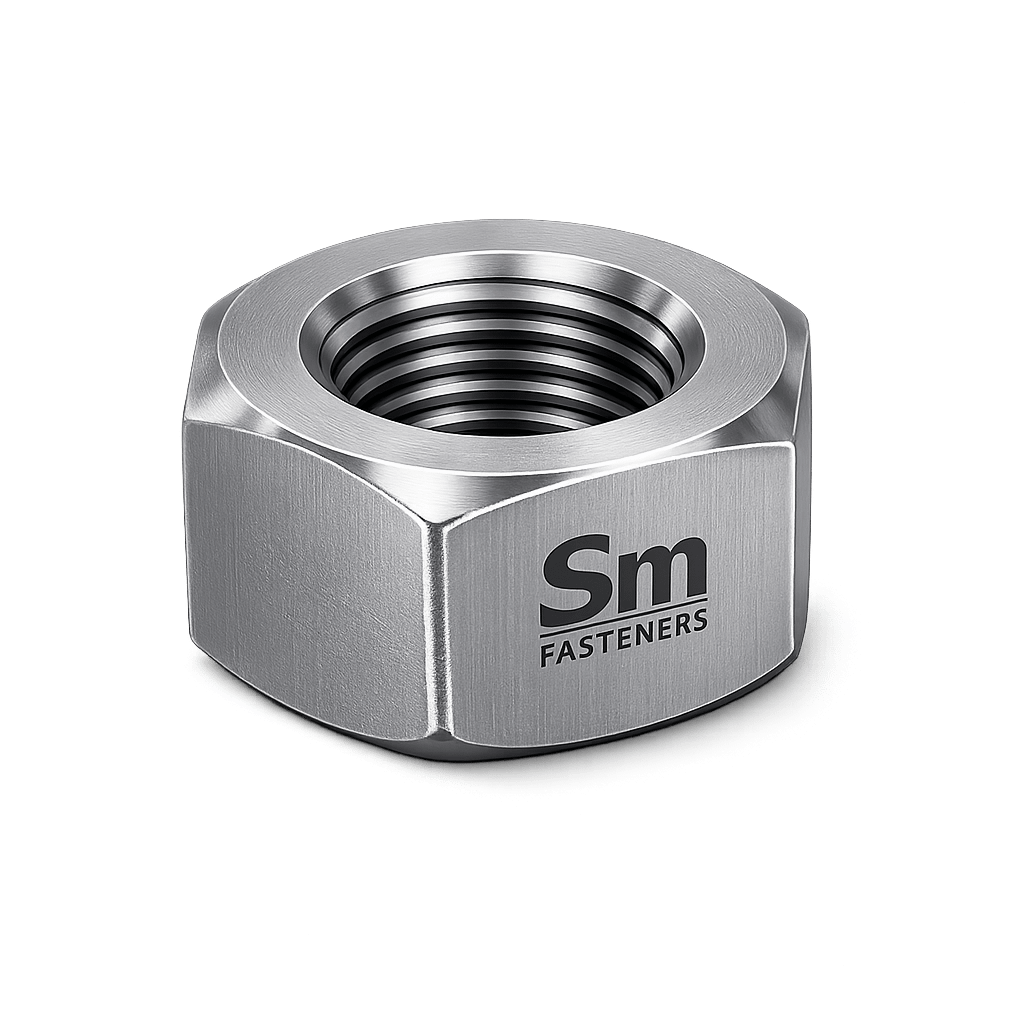
Most common fastening nut.
Standards:
| Standard | Description |
|---|---|
| ISO 4032 | |
| DIN 934 | |
| BS EN ISO 4032 |
Applications:
- General industrial assemblies
Heavy Hex Nuts
Designed for:
- Structural joints
- Pressure vessel bolting
Standards:
| Standard | Description |
|---|---|
| ASTM A194 | |
| ASTM F594 |
Lock Nuts
Designed to resist loosening under vibration.
Types:
- Nylon insert
- Prevailing torque
- All-metal lock nut
Applications:
- Railways
- Rotating equipment
- Heavy machinery
Slotted Nuts
Used with cotter pins.
Applications:
- Critical safety assemblies
21. Washers
Washers distribute preload and protect mating surfaces.
Plain Washers
Standards:
| Standard | Description |
|---|---|
| ISO 7089 | |
| DIN 125 | |
| BS 4320 |
Functions:
- Load distribution
- Surface protection
Heavy Duty Washers
Used in:
- Structural steel
- High-preload joints
Spring Washers
Designed to provide limited resistance against loosening.
Standards:
DIN 127
Belleville Washers
Disc spring design.
Applications:
- Thermal cycling
- Dynamic loading
Advantages:
- Maintains preload
22. Threaded Rods
Threaded rods provide continuous external threads.
Standards:
| Standard | Description |
|---|---|
| DIN 975 | |
| DIN 976 | |
| ASTM F593 |
Applications:
- Pipe supports
- Anchor systems
- HVAC supports
23. Screws
Unlike bolts, screws may engage directly with tapped holes.
Common variants:
- Machine screws
- Socket screws
- Set screws
- Self-tapping screws
Standards:
| Standard | Description |
|---|---|
| ISO 7045 | |
| ISO 14579 | |
| DIN 7985 | |
| DIN 963 |
24. Anchor Fasteners
Used for concrete and structural attachments.
Common configurations:
- Chemical anchors
- Expansion anchors
- Stud anchors
Applications:
- Structural supports
- Equipment foundations
25. Rings and Special Components
SM Fasteners also manufactures:
- Retaining rings
- Lock rings
- Custom-machined components
- Special aerospace configurations
- High-temperature alloy fasteners
- PEEK fastening systems
26. Dimensional Logic of Fastener Design
Fastener dimensions directly influence:
- Tensile capacity
- Shear capacity
- Fatigue life
- Assembly clearance
- Tool access
Critical dimensions include:
- Diameter
- Pitch
- Thread length
- Head size
- Bearing surface
27. Nominal Diameter
Nominal diameter represents thread major diameter.
Examples:
| Designation | Diameter |
|---|---|
| M6 | 6 mm |
| M8 | 8 mm |
| M10 | 10 mm |
| M12 | 12 mm |
| M16 | 16 mm |
| M20 | 20 mm |
| M24 | 24 mm |
| M30 | 30 mm |
Increasing diameter significantly increases tensile stress area.
28. Thread Pitch
Pitch equals distance between adjacent thread crests.
Metric designation:
M20 × 2.5
Where:
- 20 = diameter
- 2.5 = pitch
Coarse Thread Advantages
- Faster installation
- Better contamination resistance
- Improved field assembly
Fine Thread Advantages
- Higher preload precision
- Better vibration resistance
- Larger tensile stress area
29. Thread Length Logic
Thread length influences:
- Load transfer
- Nut engagement
- Fatigue performance
Excessive thread exposure can increase corrosion risk.
Insufficient engagement may result in thread stripping.
30. Head Geometry Considerations
Head dimensions affect:
- Wrench access
- Bearing stress
- Torque transfer
Heavy hex heads are preferred for:
- Pressure equipment
- Structural applications
31. Standard Metric Hex Bolt Dimensions
ISO 4014 / DIN 931
| Size | Pitch (mm) | Across Flats (mm) | Head Height (mm) |
|---|---|---|---|
| M6 | 1.0 | 10 | 4 |
| M8 | 1.25 | 13 | 5.3 |
| M10 | 1.5 | 17 | 6.4 |
| M12 | 1.75 | 19 | 7.5 |
| M16 | 2.0 | 24 | 10 |
| M20 | 2.5 | 30 | 12.5 |
| M24 | 3.0 | 36 | 15 |
| M30 | 3.5 | 46 | 18.7 |
32. Standard Length Range
Industrial production capability generally covers:
| Diameter | Standard Length Range |
|---|---|
| M6 | 10–150 mm |
| M8 | 15–200 mm |
| M10 | 20–300 mm |
| M12 | 25–400 mm |
| M16 | 30–500 mm |
| M20 | 40–600 mm |
| M24 | 50–700 mm |
| M30 | 60–1000 mm |
Custom dimensions are frequently manufactured for EPC projects.
33. Thread Standards Used Globally
Several thread systems remain active worldwide.
ISO Metric Threads
Most common internationally.
Standard:
ISO 261
Designation:
M20 × 2.5
Flank angle:
60°
Unified Threads (UNC/UNF)
Used primarily in:
- North America
- Oil & Gas equipment
Standards:
ASME B1.1
Flank angle:
60°
ननमंुBSW Threads
British Standard Whitworth.
Flank angle:
55°
BSF Threads
British Standard Fine.
Common in legacy equipment.
34. Thread Standard Comparison
| Thread Type | Angle | Region |
|---|---|---|
| Metric | 60° | Global |
| UNC | 60° | North America |
| UNF | 60° | North America |
| BSW | 55° | Legacy UK |
| BSF | 55° | Legacy UK |
35. Thread Tolerance Classes
Thread tolerances influence:
- Assembly fit
- Load distribution
- Interchangeability
Metric External Threads
Common classes:
| Class | Application |
|---|---|
| 6g | Standard |
| 4g6g | Precision |
| 8g | Loose fit |
Metric Internal Threads
| Class | Application |
|---|---|
| 6H | Standard |
| 5H | Precision |
| 7H | General industrial |
36. Thread Tolerance Table
| External | Internal | Fit Type |
|---|---|---|
| 6g | 6H | Standard |
| 4g6g | 5H | Precision |
| 8g | 7H | Loose |
37. Applicable ASTM Standards
The ASTM system dominates Oil & Gas and EPC projects.
Material Standards
| Standard | Scope |
|---|---|
| ASTM F593 | Stainless bolts |
| ASTM F594 | Stainless nuts |
| ASTM A193 | High-temperature bolting |
| ASTM A320 | Low-temperature bolting |
| ASTM A194 | Nuts for pressure service |
38. Applicable ISO Standards
| Standard | Description |
|---|---|
| ISO 3506 | Stainless fasteners |
| ISO 4014 | Hex bolts |
| ISO 4017 | Fully threaded bolts |
| ISO 4032 | Hex nuts |
| ISO 7089 | Washers |
| ISO 4762 | Socket screws |
39. Applicable DIN Standards
| Standard | Description |
|---|---|
| DIN 931 | Hex bolts partial thread |
| DIN 933 | Hex bolts full thread |
| DIN 934 | Hex nuts |
| DIN 125 | Washers |
| DIN 912 | Socket head screws |
| DIN 975 | Threaded rods |
40. Applicable British Standards
| Standard | Description |
|---|---|
| BS 3692 | Fastener dimensions |
| BS 4320 | Washers |
| BS 4190 | Hex bolts and nuts |
| BS EN ISO Series | Harmonized ISO standards |
41. ISO 3506 Stainless Fastener Property Classes
Property classes designate mechanical performance.
Common classes:
| Class | Material |
|---|---|
| A2-50 | 304 |
| A2-70 | 304 |
| A2-80 | Cold worked 304 |
| A4-70 | 316 |
| A4-80 | 316 |
Where:
- A2 = 304 family
- A4 = 316 family
42. Interchangeability Considerations
Fasteners from different standards may appear similar but possess dimensional differences.
Critical checks:
- Head dimensions
- Thread pitch
- Tolerance class
- Bearing surface
- Nut height
Improper substitution can result in:
- Reduced preload
- Fitment issues
- Inspection non-conformance
43. Engineering Selection Matrix
| Requirement | Preferred Product |
|---|---|
| Structural Steel | Hex Bolt |
| Pressure Vessel | Stud Bolt |
| Rotating Equipment | Socket Head Screw |
| Offshore Flanges | Stud Bolt + Heavy Hex Nut |
| Pipe Supports | Threaded Rod |
| Vibration Service | Lock Nut Assembly |
| Thermal Cycling | Belleville Washer System |
44. SM Fasteners Manufacturing Scope
SM Fasteners manufactures:
- Hex Bolts
- Heavy Hex Bolts
- Stud Bolts
- Hex Nuts
- Heavy Hex Nuts
- Threaded Rods
- Socket Head Cap Screws
- Washers
- Retaining Rings
- Special Fasteners
- Custom Engineered Components
- PEEK Fasteners
Production is aligned with ISO, ASTM, DIN, BS, and project-specific EPC requirements, supported by ISO 9001-certified quality systems, full traceability, and inspection-controlled manufacturing processes.
45. Materials Engineering of Austenitic Stainless Steel Fasteners
Material selection is one of the most critical decisions in bolted joint design. The chosen fastener material must withstand:
- Mechanical loading
- Environmental exposure
- Operating temperature
- Corrosion mechanisms
- Inspection requirements
- Project life-cycle expectations
For EPC, offshore, petrochemical, LNG, refinery, and power generation projects, material selection is frequently governed by:
- ASTM specifications
- ISO 3506
- ASME design codes
- NACE MR0175 / ISO 15156
- Client-approved vendor lists
- Project-specific engineering standards
SM Fasteners manufactures precision fasteners in multiple Austenitic stainless steel grades to satisfy these requirements while maintaining traceability through Mill Test Certificates (MTCs) and ISO 9001 quality systems.
46. Chemical Composition Comparison
Typical Chemical Composition (%)
| Grade | Cr | Ni | Mo | C Max | Ti | Key Characteristic |
|---|---|---|---|---|---|---|
| 304 | 18–20 | 8–10.5 | — | 0.08 | — | General corrosion resistance |
| 316 | 16–18 | 10–14 | 2–3 | 0.08 | — | Marine & chloride resistance |
| 316L | 16–18 | 10–14 | 2–3 | 0.03 | — | Welded equipment |
| 317L | 18–20 | 11–15 | 3–4 | 0.03 | — | Superior pitting resistance |
| 310S | 24–26 | 19–22 | — | 0.08 | — | High-temperature service |
| 321 | 17–19 | 9–12 | — | 0.08 | Stabilized | Thermal cycling service |
47. Mechanical Properties Comparison
Typical Mechanical Properties
| Grade | UTS (MPa) | Yield Strength (MPa) | Elongation % | Hardness HB |
|---|---|---|---|---|
| 304 | 515–620 | 205 | 40 | 201 |
| 316 | 515–620 | 205 | 40 | 217 |
| 316L | 485–620 | 170–205 | 40 | 217 |
| 317L | 515–620 | 205 | 40 | 220 |
| 310S | 520–650 | 205 | 40 | 220 |
| 321 | 515–620 | 205 | 40 | 217 |
48. ISO 3506 Property Class Comparison
Mechanical Classification
| Property Class | Minimum Tensile Strength (MPa) |
|---|---|
| A2-50 | 500 |
| A2-70 | 700 |
| A2-80 | 800 |
| A4-50 | 500 |
| A4-70 | 700 |
| A4-80 | 800 |
Where:
- A2 = 304 family
- A4 = 316 family
Most EPC specifications commonly require:
- A2-70
- A4-70
- A4-80
49. Corrosion Resistance Mechanism
Corrosion resistance is derived from a passive chromium oxide film that forms naturally on the stainless steel surface.
This passive layer:
- Self-repairs in oxygen-rich environments
- Prevents general corrosion
- Reduces oxidation
Resistance increases with:
- Chromium content
- Nickel content
- Molybdenum content
- Nitrogen content
50. Corrosion Resistance Comparison
Relative Corrosion Performance
| Environment | 304 | 316 | 316L | 317L | 310S | 321 |
|---|---|---|---|---|---|---|
| Urban Atmosphere | Excellent | Excellent | Excellent | Excellent | Excellent | Excellent |
| Industrial Atmosphere | Good | Excellent | Excellent | Excellent | Good | Good |
| Seawater Splash Zone | Fair | Good | Good | Very Good | Fair | Fair |
| Chloride Exposure | Fair | Good | Good | Excellent | Poor | Fair |
| Organic Acids | Good | Very Good | Very Good | Excellent | Good | Good |
| Sulfur Compounds | Fair | Good | Good | Good | Good | Good |
| High Temperature Oxidation | Good | Good | Good | Good | Excellent | Very Good |
51. PREN (Pitting Resistance Equivalent Number)
PREN is widely used to compare resistance to chloride-induced pitting.
Formula
Higher PREN values indicate improved chloride resistance.
Typical PREN Values
| Grade | Approximate PREN |
|---|---|
| 304 | 18–20 |
| 316 | 24–26 |
| 316L | 24–26 |
| 317L | 30–35 |
| 310S | 24 |
| 321 | 18–20 |
52. Material Selection Guide
Recommended Grade by Service Environment
| Service Environment | Recommended Grade |
|---|---|
| General Industrial | 304 |
| Food Processing | 304 / 316 |
| Water Treatment | 316 |
| Offshore Platforms | 316L |
| Marine Equipment | 316L |
| Chloride Chemical Plants | 317L |
| Refinery Heater Systems | 321 |
| Furnace Equipment | 310S |
| LNG Equipment | 316L |
| Heat Exchangers | 321 / 310S |
53. Temperature Capability
Continuous Service Temperature
| Grade | Maximum Service Temperature |
|---|---|
| 304 | 870°C |
| 316 | 870°C |
| 316L | 870°C |
| 317L | 870°C |
| 321 | 900°C |
| 310S | 1100°C |
310S is the preferred selection where oxidation resistance becomes the dominant requirement.
54. NACE MR0175 / ISO 15156 Considerations
For sour service applications involving:
- H₂S
- Chlorides
- High pressure environments
material selection must satisfy NACE requirements.
Key considerations include:
- Hardness limits
- Stress corrosion resistance
- Sulfide stress cracking resistance
Austenitic stainless steels generally perform well due to their inherent toughness and ductility, but project-specific approval remains essential.
55. Heat Treatment of Austenitic Stainless Fasteners
Unlike carbon steel fasteners, austenitic stainless steels cannot be hardened through conventional quench-and-temper methods.
Their properties arise primarily from:
- Alloy chemistry
- Cold working
- Controlled processing
56. Solution Annealing
Most important heat treatment process.
Typical Temperature Range
| Grade | Temperature |
|---|---|
| 304 | 1010–1120°C |
| 316 | 1040–1150°C |
| 316L | 1040–1150°C |
| 317L | 1040–1150°C |
| 321 | 950–1120°C |
| 310S | 1040–1150°C |
Process:
- Heat uniformly
- Dissolve carbides
- Rapid quench
Benefits:
- Restores corrosion resistance
- Improves ductility
- Removes residual stresses
57. Cold Working
Austenitic fasteners frequently obtain strength through cold deformation.
Processes include:
- Cold heading
- Thread rolling
- Cold forging
Advantages:
- Increased tensile strength
- Improved fatigue performance
- Better surface finish
58. Stress Relief
Occasionally performed for:
- Machined components
- Large custom fasteners
Purpose:
- Reduce residual stresses
- Improve dimensional stability
59. Manufacturing Workflow at SM Fasteners
Industrial fastener manufacturing requires rigorous process control to ensure compliance with international specifications.
Stage 1 – Raw Material Procurement
Approved mills supply:
- Stainless steel wire rod
- Stainless steel bar stock
Materials arrive with:
- Heat numbers
- MTC documentation
- Chemical analysis reports
Stage 2 – Incoming Inspection
Verification includes:
- Heat number confirmation
- Visual inspection
- Dimensional checks
- PMI verification (when required)
Stage 3 – Material Identification
Positive Material Identification (PMI) may be conducted using:
- XRF analyzers
- OES spectrometers
Particularly important for:
- 316 vs 316L
- 317L verification
- Mixed inventory prevention
Stage 4 – Cutting Operations
Raw stock is cut into slugs or blanks according to manufacturing drawings.
Stage 5 – Cold Heading / Hot Forging
Cold Heading
Used for:
- High-volume production
- Small to medium diameters
Advantages:
- Superior grain flow
- Better mechanical properties
- High productivity
Hot Forging
Used for:
- Large diameters
- Heavy hex bolts
- Custom geometries
Advantages:
- Reduced forming forces
- Larger size capability
60. Forging vs Machining Comparison
| Parameter | Forging | Machining |
|---|---|---|
| Grain Flow | Excellent | Interrupted |
| Strength | Higher | Lower |
| Material Utilization | Better | Less efficient |
| Cost for Volume | Lower | Higher |
| Complex Shapes | Good | Excellent |
SM Fasteners Material & Manufacturing Capability
SM Fasteners supplies precision-manufactured Austenitic stainless steel fasteners in grades 304, 316, 316L, 317L, 310S, and 321, produced under ISO 9001-certified quality systems. Manufacturing capabilities include cold heading, hot forging, thread rolling, CNC machining, passivation, specialized coating systems, custom-engineered fasteners, and advanced materials such as PEEK, Duplex, Super Duplex, Inconel, Hastelloy, Monel, Incoloy, Nickel Alloys, and SMO 254. Complete traceability is maintained from raw material receipt through final inspection and shipment documentation.