

Stud Bolt
1. Industry Context
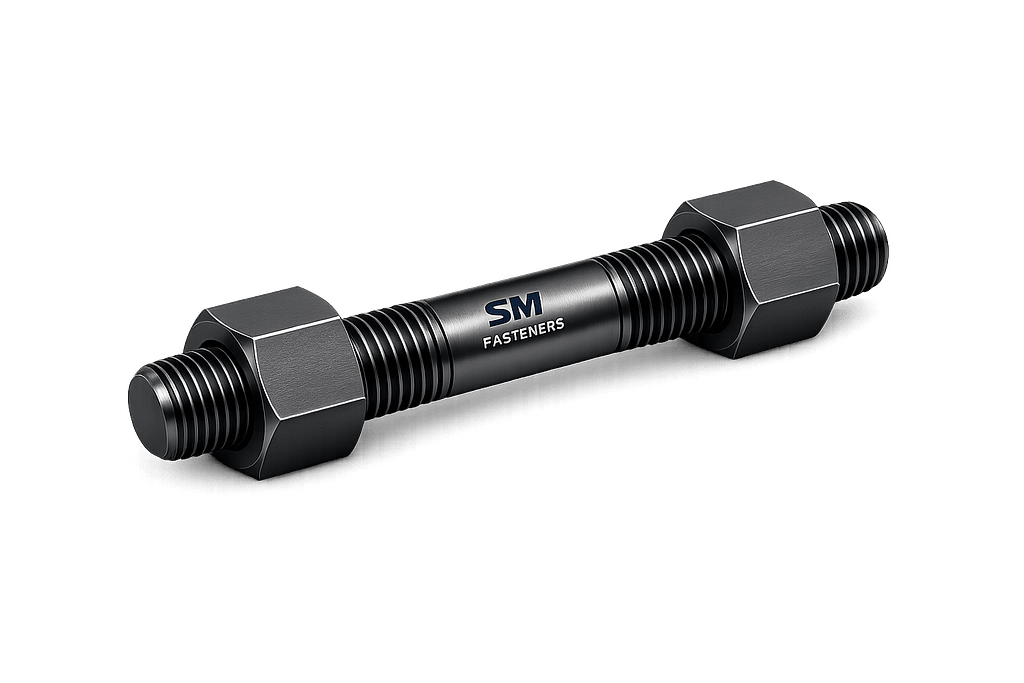
Stud bolts are among the most critical fastening elements used in pressure-containing, load-bearing, and safety-critical assemblies across global industrial sectors. Unlike conventional bolts, stud bolts are designed specifically for controlled preload generation, repeatable assembly, and high-integrity joint performance.
They are extensively specified in:
- Oil & Gas flanged piping systems
- Petrochemical reactors and pressure vessels
- Offshore subsea equipment
- Power generation turbines and boilers
- Structural steel assemblies
- Heat exchangers and compressors
- LNG terminals and cryogenic systems
Within EPC projects, stud bolts are treated as engineered components, not commodity fasteners.
Typical engineering requirements include:
- Controlled clamping force
- Resistance to cyclic loading
- High-temperature stability
- Corrosion and hydrogen resistance
- Repeatable maintenance disassembly
SM Fasteners manufactures stud bolts aligned with global project specifications, ensuring traceability, dimensional accuracy, and mechanical reliability required for international projects.
2. Technical Definition
A Stud Bolt is a fully threaded or partially threaded rod without a head, designed to be used with two nuts to create a clamping system.
Functional Definition
A stud bolt converts applied torque into axial tensile preload, generating compressive force across joint members.
Basic Configuration
 Nut — Washer — Flange — Gasket — Flange — Washer — Nut
          ← Stud Bolt →
Key Characteristics
| Parameter | Description |
|---|---|
| Head | None |
| Threads | Full length or double-end |
| Load Direction | Axial tension |
| Assembly Method | Nut tightening both ends |
| Primary Function | Controlled clamping |
3. Functional Role in Industrial Assemblies
Stud bolts enable:
- Uniform flange compression
- Accurate preload distribution
- Reduced thread wear on main equipment
- Easy disassembly during maintenance
Compared with standard bolts, stud bolts allow:
✔ Symmetrical tightening
✔ Improved gasket sealing
✔ Higher fatigue resistance
✔ Better load alignment
4. Load Mechanics & Force Behavior
4.1 Preload Concept
When tightened, a stud bolt behaves like an elastic spring.
Applied torque → Thread friction → Bolt elongation → Clamp force.
The generated preload must exceed external forces attempting to separate the joint.
4.2 Force Interaction
| Force Type | Effect |
|---|---|
| Tensile Load | Bolt elongation |
| Compressive Load | Joint compression |
| Shear Load | Friction transfer across faces |
| Thermal Expansion | Preload variation |
| Vibration | Fatigue risk |
4.3 Preload Equation
Where:
- F = Preload (N)
- T = Applied Torque (Nm)
- K = Nut factor (0.16–0.25 typical)
- D = Nominal diameter (m)
Worked Example
M24 Stud Bolt
Torque = 600 Nm
K = 0.18
D = 0.024 m
Preload ≈ 139 kN
5. Torque–Tension Relationship
Only 10–15% of applied torque generates preload.
| Energy Distribution | Percentage |
|---|---|
| Thread friction | 40% |
| Nut bearing friction | 45% |
| Useful preload | 15% |
Therefore lubrication condition critically affects joint reliability.
6. Joint Design Principles
6.1 Stud Bolt vs Bolt Selection
Stud bolts are preferred when:
- Joint is frequently dismantled
- Threaded equipment must be protected
- High preload accuracy required
- Thermal cycling expected
6.2 Thread Engagement Rule
Minimum engagement:
6.3 Grip Length & Elastic Interaction
Ideal joint design maintains:
- Long elastic bolt length
- Short clamped member deflection
This improves fatigue life.
6.4 Flange Joint Behavior
Stud bolts must:
- Maintain gasket compression
- Prevent flange rotation
- Compensate creep relaxation
Common flange standards:
- ASME B16.5
- ASME B16.47
- EN 1092
7. Failure Mechanisms
7.1 Fatigue Failure
Caused by cyclic load variation.
Prevention:
- Correct preload
- Proper material selection
- Rolled threads
7.2 Shear Failure
Occurs when friction force insufficient.
Mitigation:
- Higher preload
- Correct bolt pattern
7.3 Hydrogen Embrittlement
Risk materials:
- High-strength alloy steels (>34 HRC)
Controls:
- Baking after coating
- Controlled electroplating
7.4 Stress Corrosion Cracking
Occurs in:
- Chlorides
- H₂S environments
Solution:
- Duplex / Super Duplex
- Nickel alloys
- NACE compliant materials
8. Friction & Nut Factor
| Condition | Nut Factor (K) |
|---|---|
| Dry | 0.22–0.25 |
| Oiled | 0.18 |
| Moly Lubricant | 0.16 |
| PTFE Coated | 0.12–0.14 |
SM Fasteners supplies controlled coating systems to ensure repeatable torque values during EPC installation.
9. Stud Bolt Selection Criteria
Engineers must evaluate:
| Parameter | Consideration |
|---|---|
| Load | Static / cyclic |
| Temperature | Operating range |
| Corrosion | Chemical exposure |
| Standard | ASTM / ISO / DIN |
| Assembly Method | Torque or tensioning |
| Inspection Requirement | 3.1 / 3.2 certification |
10. Engineering Advantages of Stud Bolt Systems
- Reduced galling
- Better alignment
- Improved fatigue performance
- Accurate torque application
- Easier replacement
11. Stud Bolt Product Types & Variants
Stud bolts are engineered in multiple configurations to satisfy different mechanical loading conditions, assembly procedures, and international specifications.
Selection is governed by:
- Joint configuration
- Assembly accessibility
- Load uniformity requirements
- Maintenance frequency
- Applicable standards
11.1 Fully Threaded Stud Bolt (Continuous Thread)
Definition:
Threaded across entire length.
Primary Standard: ASTM A193 / ASME B18.31.2
Applications
- Pipe flange joints
- Pressure vessels
- Heat exchangers
- Chemical reactors
Engineering Advantages
- Maximum adjustment flexibility
- Uniform load distribution
- Simplified inventory control
11.2 Double-End Stud Bolt
Threads provided at both ends with unthreaded shank center.
Typical Standards
- DIN 938
- DIN 939
Applications
- Equipment housings
- Machinery assemblies
- Engine blocks
Engineering Benefit
- Reduced stress concentration
- Improved fatigue resistance
11.3 Tap-End Stud
One end permanently installed into tapped hole.
Applications
- Turbine casings
- Pumps
- Compressors
- High-vibration assemblies
Advantages:
- Protects equipment threads
- Enables repeated maintenance
11.4 Continuous Threaded Rod (Studding)
Long-length stud bolts supplied in bars.
Typical Length:
- 1 meter
- 2 meter
- Custom project length
Applications:
- Structural anchoring
- Cable trays
- Pipe supports
11.5 Reduced Shank Stud Bolt
Shank diameter slightly smaller than thread diameter.
Benefits:
- Increased elasticity
- Superior fatigue life
- Better preload retention
11.6 Special Engineered Variants (SM Fasteners Capability)
SM Fasteners manufactures custom configurations:
- Waisted studs
- Hollow studs
- Fine pitch high-preload studs
- High-temperature expansion compensated studs
- PEEK insulated stud systems
12. Dimensional Logic & Geometry
Stud bolt geometry directly influences:
- Stress distribution
- Assembly torque accuracy
- Fatigue performance
- Load capacity
12.1 Critical Dimensions
| Symbol | Parameter |
|---|---|
| d | Nominal diameter |
| P | Thread pitch |
| L | Overall length |
| b | Thread length |
| Le | Thread engagement |
| Aₛ | Tensile stress area |
12.2 Standard Length Determination
Stud bolt length:
Where:
- N = Nut height
- T = Total flange thickness
- G = Gasket thickness
- W = Washer allowance
12.3 Recommended Protrusion
After tightening:
- 1–3 threads visible beyond nut face.
13. Dimensional Specification Table (Metric Stud Bolts)
| Size | Pitch | Stress Area (mm²) | Nut Size (mm) | Standard Length Range (mm) |
|---|---|---|---|---|
| M12 | 1.75 | 84 | 19 | 40–200 |
| M16 | 2.0 | 157 | 24 | 50–300 |
| M20 | 2.5 | 245 | 30 | 60–400 |
| M24 | 3.0 | 353 | 36 | 70–500 |
| M27 | 3.0 | 459 | 41 | 80–600 |
| M30 | 3.5 | 561 | 46 | 90–700 |
| M36 | 4.0 | 817 | 55 | 100–900 |
| M42 | 4.5 | 1120 | 65 | 120–1000 |
| M48 | 5.0 | 1473 | 75 | 150–1200 |
All dimensions align with international engineering practice and SM Fasteners production tolerances.
14. Imperial Stud Bolt Dimensions (UNC/UNF)
| Size | Threads/Inch | Stress Area (in²) | Typical Use |
|---|---|---|---|
| 1/2″ | 13 UNC | 0.142 | Light flanges |
| 5/8″ | 11 UNC | 0.226 | General piping |
| 3/4″ | 10 UNC | 0.334 | Process equipment |
| 7/8″ | 9 UNC | 0.462 | Pressure vessels |
| 1″ | 8 UNC | 0.606 | High-load joints |
| 1-1/4″ | 7 UNC | 0.969 | Offshore flanges |
| 1-1/2″ | 6 UNC | 1.405 | Heavy equipment |
15. Thread Forms & Standards
Stud bolts must comply with globally interchangeable thread systems.
Thread Standard Comparison Table
| Standard | System | Application |
|---|---|---|
| ISO Metric | Metric | Global EPC projects |
| UNC | Unified Coarse | Oil & Gas |
| UNF | Unified Fine | High preload |
| BSW | British Standard Whitworth | Legacy equipment |
| BSF | British Fine | Maintenance replacement |
Thread Tolerances
| Thread | Tolerance Class |
|---|---|
| Metric External | 6g |
| Metric Internal | 6H |
| UNC/UNF | Class 2A / 2B |
| Precision | Class 3A |
SM Fasteners maintains calibrated threading systems to ensure interchangeability.
16. Applicable International Standards
Stud bolts are governed by both dimensional and material standards.
16.1 Dimensional Standards
| Standard | Description |
|---|---|
| ASME B18.31.2 | Continuous thread studs |
| DIN 975 | Threaded rods |
| DIN 938 | Double-end studs |
| DIN 939 | Tap-end studs |
| ISO 898 | Mechanical properties |
| BS 4882 | Metric threaded rods |
16.2 Material Standards
| Standard | Material Coverage |
|---|---|
| ASTM A193 | Alloy & stainless stud bolts |
| ASTM A320 | Low temperature service |
| ASTM A453 | High temperature |
| ASTM A307 | Carbon steel |
| ASTM A194 | Heavy hex nuts |
| ASTM F593 | Stainless studs |
16.3 Property Class System
Metric property classes:
| Property Class | Yield Strength (MPa) | Typical Use |
|---|---|---|
| 4.6 | 240 | Light duty |
| 8.8 | 640 | Structural |
| 10.9 | 900 | Heavy mechanical |
| 12.9 | 1080 | High-strength assemblies |
16.4 ASTM Grade System
| ASTM Grade | Typical Material |
|---|---|
| B7 | Alloy steel Q&T |
| B7M | Sour service |
| B16 | High temperature |
| B8 | Stainless 304 |
| B8M | Stainless 316 |
| L7 | Low temperature |
17. Interchangeability Considerations
Engineering procurement must verify:
- Thread form compatibility
- Nut grade matching
- Coating thickness allowance
- Thermal expansion behavior
Incorrect substitution leads to:
- Preload loss
- Thread galling
- Premature failure
18. Stud Bolt Geometry vs Performance
| Geometry Feature | Performance Effect |
|---|---|
| Full thread | Flexibility |
| Reduced shank | Fatigue resistance |
| Fine pitch | Higher preload |
| Rolled thread | Longer life |
| Longer grip | Better elasticity |
19. Dimensional Tolerances (Typical)
| Parameter | Tolerance |
|---|---|
| Diameter | ISO h6 |
| Length | ±1 mm (<300 mm) |
| Straightness | 0.25/300 mm |
| Thread pitch | ISO verified |
20. Engineering Design Considerations
Stud bolt sizing depends on:
- Flange pressure rating
- Gasket seating stress
- Bolt circle diameter
- Temperature expansion
- Material creep characteristics
SM Fasteners supports EPC engineering teams with:
- Custom dimensional engineering
- Drawing-based manufacturing
- Project-specific stud kits
- Global standard compliance verification
21. Material Engineering for Stud Bolts
Material selection is the most critical engineering decision influencing stud bolt performance. The selected material must simultaneously satisfy:
- Mechanical strength requirements
- Temperature resistance
- Corrosion environment compatibility
- Hydrogen embrittlement resistance
- Long-term creep stability
- Compliance with project specifications
SM Fasteners manufactures stud bolts using a full industrial material portfolio aligned with ASTM, ISO, DIN, and BS standards, supported by ISO 9001 quality management systems and full traceability.
21.1 Primary Industrial Material Categories
| Material Category | Typical Standards | Key Characteristics |
|---|---|---|
| Carbon Steel | ASTM A307 | Economical structural fastening |
| Alloy Steel | ASTM A193 B7/B16 | High strength & temperature resistance |
| Stainless Steel | ASTM A193 B8/B8M | Corrosion resistance |
| Duplex Stainless | ASTM A479 S31803 | High strength + corrosion resistance |
| Super Duplex | S32750/S32760 | Offshore & seawater service |
| Nickel Alloys | Inconel, Monel, Hastelloy | Extreme corrosion & temperature |
| SMO 254 | UNS S31254 | Chloride resistance |
| PEEK Fasteners | Engineering polymer | Electrical isolation & chemical resistance |
22. Mechanical Properties by Material Grade
Mechanical Property Table (Typical Values)
| Grade | Yield Strength MPa | UTS MPa | Hardness | Temperature Limit |
|---|---|---|---|---|
| ASTM A307 | 240 | 415 | ≤22 HRC | 300°C |
| ASTM A193 B7 | 720 | 860 | 24–35 HRC | 450°C |
| ASTM A193 B7M | 517 | 724 | ≤22 HRC | Sour service |
| ASTM A193 B16 | 760 | 965 | 28–38 HRC | 540°C |
| ASTM A193 B8 | 205 | 515 | ≤95 HRB | 400°C |
| ASTM A193 B8M | 205 | 515 | ≤95 HRB | Marine |
| Duplex S31803 | 450 | 620 | 28 HRC | 300°C |
| Super Duplex S32750 | 550 | 800 | 32 HRC | Offshore |
| Inconel 625 | 460 | 830 | — | 980°C |
| SMO 254 | 300 | 650 | — | Chloride service |
23. Material Selection Criteria
Environmental Selection Matrix
| Environment | Recommended Material |
|---|---|
| Dry Structural | Carbon Steel |
| Refinery Service | A193 B7 |
| High Temperature | B16 / Inconel |
| Seawater | Duplex / Super Duplex |
| Chloride Process | SMO 254 |
| H₂S Sour Service | B7M / NACE materials |
| Cryogenic | A320 L7 |
| Chemical Processing | Hastelloy |
| Electrical Isolation | PEEK Stud Bolts |
Corrosion Resistance vs Environment
| Material | Seawater | Acids | Chlorides | H₂S | High Temp |
|---|---|---|---|---|---|
| Carbon Steel | Poor | Poor | Poor | Limited | Good |
| B7 Alloy Steel | Fair | Fair | Moderate | Limited | Good |
| SS304 | Good | Moderate | Moderate | Poor | Good |
| SS316 | Good | Good | Good | Moderate | Good |
| Duplex | Excellent | Good | Excellent | Good | Moderate |
| Super Duplex | Outstanding | Excellent | Outstanding | Excellent | Moderate |
| Inconel | Excellent | Excellent | Excellent | Excellent | Outstanding |
| SMO 254 | Outstanding | Excellent | Outstanding | Good | Moderate |
24. NACE MR0175 / ISO 15156 Compliance
Oil & Gas sour environments require strict hardness limits.
Sour Service Requirements
| Requirement | Limit |
|---|---|
| Hardness | ≤22 HRC |
| Material | B7M / L7M / Duplex |
| Heat Treatment | Controlled Q&T |
| Documentation | Mandatory traceability |
SM Fasteners supplies NACE-compliant stud bolts with full certification packages.
25. Heat Treatment Processes
Heat treatment directly controls mechanical performance.
25.1 Quenching & Tempering (Q&T)
Used for:
- ASTM A193 B7
- B16
Process:
- Austenitizing
- Rapid quench
- Tempering
Effect:
- Increased tensile strength
- Controlled hardness
- Improved fatigue resistance
25.2 Solution Annealing
Applied to:
- Stainless steel
- Duplex alloys
Purpose:
- Restore corrosion resistance
- Remove carbide precipitation
25.3 Normalizing
Used for carbon steels to refine grain structure.
Heat Treatment Impact Table
| Process | Strength | Toughness | Corrosion Resistance |
|---|---|---|---|
| Q&T | High | Good | Moderate |
| Annealing | Moderate | Excellent | High |
| Normalizing | Medium | Good | Moderate |
26. Hardness Control (Critical Engineering Parameter)
Excess hardness increases hydrogen embrittlement risk.
| Application | Max Hardness |
|---|---|
| General B7 | 35 HRC |
| NACE Service | 22 HRC |
| Stainless Steel | 95 HRB |
| Duplex | 32 HRC |
SM Fasteners performs calibrated hardness verification per ISO inspection procedures.
27. End-to-End Manufacturing Workflow
Stud bolt manufacturing follows controlled industrial processes.
27.1 Raw Material Verification
Incoming material inspected using:
- Mill Test Certificate (MTC)
- Heat number traceability
- Chemical analysis
- PMI verification
27.2 Cutting & Preparation
- CNC sawing
- Length control
- End facing
27.3 Forging vs Machining
| Method | Advantage |
|---|---|
| Hot Forging | Grain flow strength |
| Machining | Precision customization |
SM Fasteners selects process based on grade and application.
27.4 Thread Manufacturing
Thread Rolling (Preferred)
Benefits:
- Compressive surface stresses
- Increased fatigue life
- Superior finish
Thread Cutting
Used when:
- Large diameters
- Exotic alloys
- Custom threads
27.5 Heat Treatment Stage
Performed in calibrated furnaces with:
- Temperature mapping
- Controlled cooling cycles
- Batch identification
27.6 Straightening & Stress Relief
Ensures dimensional stability.
27.7 Final Machining
Includes:
- Chamfering
- Deburring
- End finishing
27.8 Surface Preparation
Prior to coating:
- Shot blasting
- Pickling
- Degreasing
28. Surface Finishing & Coating Engineering
Coatings significantly influence:
- Corrosion life
- Torque coefficient
- Installation consistency
Surface Finish Comparison Table
| Coating | Corrosion Protection | Temperature Limit | Torque Stability | Typical Use |
|---|---|---|---|---|
| Black Oxide | Low | 300°C | Good | Indoor |
| Zinc Plated | Moderate | 120°C | Fair | Structural |
| Hot Dip Galvanized | High | 200°C | Variable | Outdoor |
| PTFE / Xylan | Excellent | 260°C | Excellent | Offshore |
| Cadmium | Excellent | 230°C | Excellent | Aerospace |
| Phosphate | Moderate | 250°C | Good | Oil & Gas |
| Dacromet | High | 300°C | Stable | Marine |
| Nickel Plating | Excellent | 400°C | Stable | Chemical |
| Passivation | Corrosion resistance | — | Excellent | Stainless |
Coating Thickness Considerations
Threads must maintain tolerance after coating.
Typical allowances:
| Coating | Thickness |
|---|---|
| Zinc | 5–12 µm |
| HDG | 50–80 µm |
| PTFE | 20–35 µm |
SM Fasteners adjusts thread class to maintain assembly compatibility.
29. Hydrogen Embrittlement Prevention
Risk factors:
- Electroplating
- High hardness steels
Preventive actions:
- Post-plating baking
- Controlled hardness
- Approved coating processes
30. PEEK Stud Bolt Engineering Applications
SM Fasteners manufactures advanced PEEK fasteners for specialized environments.
PEEK Properties
| Property | Value |
|---|---|
| Continuous Temp | 260°C |
| Chemical Resistance | Excellent |
| Electrical Insulation | Outstanding |
| Weight | Very low |
| Corrosion | Immune |
Applications:
- Semiconductor plants
- Chemical dosing systems
- Medical equipment
- Electrical isolation assemblies
31. Manufacturing Traceability System (ISO 9001)
Every stud bolt can be linked to:
- Heat number
- Raw material batch
- Heat treatment record
- Inspection report
- Final dispatch lot
This ensures compliance with global EPC project auditing requirements.
32. Inspection & Quality Control Philosophy
Stud bolts used in pressure-containing or structural applications are classified as critical safety components. Quality assurance therefore extends beyond dimensional verification into full lifecycle control.
SM Fasteners integrates inspection under an ISO 9001 certified quality management system, ensuring compliance with EPC, OEM, and third-party inspection requirements.
32.1 Quality Control Stages
| Stage | Inspection Activity |
|---|---|
| Raw Material | MTC verification, PMI |
| In-Process | Dimensional & threading checks |
| Heat Treatment | Hardness & structure validation |
| Surface Finish | Coating thickness measurement |
| Final Inspection | Mechanical testing & visual inspection |
| Dispatch | Traceability confirmation |
33. Dimensional Inspection
Performed using calibrated instruments:
- Digital micrometers
- Thread plug gauges
- Ring gauges
- Optical comparators
- Surface roughness testers
Dimensional Verification Parameters
| Parameter | Method |
|---|---|
| Diameter | Micrometer |
| Pitch | Thread gauge |
| Straightness | Dial indicator |
| Length | Digital caliper |
| Thread class | Go/No-Go gauge |
34. Mechanical Testing Requirements
Mandatory Tests
| Test | Standard |
|---|---|
| Tensile Test | ASTM E8 |
| Proof Load Test | ASTM F606 |
| Hardness Test | Rockwell / Brinell |
| Impact Test | ASTM A370 |
| Elongation | ISO 898 |
Proof Load & Tensile Strength Table
| Size | Grade B7 Proof Load (kN) | Ultimate Tensile Load (kN) |
|---|---|---|
| M12 | 60 | 84 |
| M16 | 112 | 157 |
| M20 | 175 | 245 |
| M24 | 252 | 353 |
| M27 | 328 | 459 |
| M30 | 401 | 561 |
| M36 | 584 | 817 |
| M42 | 800 | 1120 |
| M48 | 1050 | 1473 |
Values aligned with ASTM A193 mechanical expectations.
35. Non-Destructive Testing (NDT)
Applied for critical applications.
| Method | Purpose |
|---|---|
| Magnetic Particle Testing | Surface crack detection |
| Ultrasonic Testing | Internal defects |
| Dye Penetrant | Surface discontinuities |
| Radiography | Critical alloy inspection |
36. Positive Material Identification (PMI)
PMI ensures material chemistry compliance using:
- XRF analyzers
- Optical emission spectroscopy
Essential for:
- Duplex
- Nickel alloys
- Sour service studs
37. Documentation & Certification
SM Fasteners supplies complete traceability documentation.
Standard Documentation Package
| Document | Description |
|---|---|
| EN 10204 3.1 | Manufacturer test certificate |
| EN 10204 3.2 | Third-party witnessed certificate |
| MTC | Chemical & mechanical data |
| Heat Treatment Report | Furnace traceability |
| Coating Report | Thickness & process |
| Inspection Report | Dimensional verification |
| Certificate of Conformity | Compliance declaration |
38. Thread Standards & Tolerances Table
| Thread Type | Standard | Tolerance Class | Application |
|---|---|---|---|
| Metric | ISO 965 | 6g / 6H | Global EPC |
| UNC | ASME B1.1 | 2A / 2B | Oil & Gas |
| UNF | ASME B1.1 | 2A / 2B | High preload |
| BSW | BS 84 | Medium Fit | Legacy |
| BSF | BS 84 | Fine Fit | Maintenance |
39. Tightening Torque Chart
(Lubricated condition, K ≈ 0.18)
| Size | Grade B7 Torque (Nm) |
|---|---|
| M12 | 85 |
| M16 | 210 |
| M20 | 420 |
| M24 | 720 |
| M27 | 1050 |
| M30 | 1450 |
| M36 | 2500 |
| M42 | 3900 |
| M48 | 5400 |
Torque values must always be verified against project specifications.
40. Preload Calculation — Engineering Method
General Formula
Where:
- F = Clamp Force
- T = Torque
- K = Nut factor
- D = Diameter
Worked Engineering Example
Stud Bolt: M30 ASTM A193 B7
Torque Applied: 1450 Nm
Nut Factor: 0.18
Diameter: 0.03 m
Preload ≈ 268 kN
41. Mechanical Properties — Grade Comparison
| Grade | Yield MPa | UTS MPa | Hardness | Typical Industry |
|---|---|---|---|---|
| A307 | 240 | 415 | Low | Structural |
| B7 | 720 | 860 | Medium | Oil & Gas |
| B7M | 517 | 724 | Controlled | Sour Service |
| B16 | 760 | 965 | High | Power Plants |
| B8M | 205 | 515 | Low | Marine |
| Duplex | 450 | 620 | Medium | Offshore |
| Inconel | 460 | 830 | — | High Temp |
42. Weight Chart (Typical SM Fasteners Production Reference)
| Size | Weight per Piece (kg) | Weight per 100 pcs (kg) |
|---|---|---|
| M12 × 100 | 0.09 | 9 |
| M16 × 120 | 0.19 | 19 |
| M20 × 150 | 0.37 | 37 |
| M24 × 180 | 0.64 | 64 |
| M27 × 200 | 0.92 | 92 |
| M30 × 220 | 1.25 | 125 |
| M36 × 250 | 2.20 | 220 |
| M42 × 300 | 3.80 | 380 |
| M48 × 350 | 5.70 | 570 |
Weights aligned with SM Fasteners manufacturing data for logistics planning.
43. Surface Finish Performance Comparison
| Finish | Corrosion Life | Offshore Suitability | Maintenance |
|---|---|---|---|
| Black Oxide | Low | No | High |
| Zinc Plated | Moderate | Limited | Medium |
| HDG | High | Yes | Low |
| PTFE | Excellent | Excellent | Very Low |
| Dacromet | High | Yes | Low |
| Passivated Stainless | Excellent | Excellent | Minimal |
44. Industry Applications
44.1 Construction & Structural Steel
- Steel frame connections
- Base plates
- Bridge assemblies
44.2 Oil & Gas Sector
Upstream
- Wellheads
- Xmas trees
- Drilling equipment
Midstream
- Pipeline flanges
- Pump stations
Downstream
- Refineries
- Reactors
- Pressure vessels
NACE-compliant stud bolts supplied by SM Fasteners meet sour service demands.
44.3 Power Generation
- Steam turbines
- Boiler joints
- Heat recovery systems
- Nuclear auxiliary equipment
44.4 Petrochemical & Chemical Processing
- High-pressure reactors
- Acid handling systems
- Heat exchangers
44.5 LNG & Offshore
- Cryogenic piping
- Subsea assemblies
- Offshore platforms
Preferred materials:
- Duplex
- Super Duplex
- Inconel
- SMO 254
44.6 Automotive & Heavy Equipment
- Engine assemblies
- Hydraulic equipment
- Mining machinery
44.7 Railways & Infrastructure
- Structural anchoring
- Signaling systems
- Track equipment
44.8 Shipbuilding & Marine
- Propulsion systems
- Deck machinery
- Seawater systems
44.9 PEEK Stud Bolt Applications
- Semiconductor manufacturing
- Electrical insulation joints
- Chemical dosing plants
- Lightweight aerospace assemblies
45. Packaging & Export Readiness
SM Fasteners supplies stud bolts for global EPC shipments.
Industrial Packaging Methods
| Method | Purpose |
|---|---|
| VCI Packaging | Corrosion protection |
| Thread Protectors | Damage prevention |
| Oil Coating | Transit protection |
| Batch Labeling | Traceability |
Export Packaging
- ISPM-15 certified wooden crates
- Vacuum packing for offshore supply
- Palletized heavy loads
- Container optimization for bulk export
46. Global Supply Documentation
Each shipment may include:
- Packing List
- Commercial Invoice
- Certificate of Origin
- EN 10204 3.1 / 3.2 Certification
- Inspection Release Note
- Third-Party Inspection Approval
- Material Traceability Records
47. SM FASTENERS — Engineering & Manufacturing Capability
SM Fasteners operates as a precision fastener manufacturer supporting international industrial procurement requirements.
Certified Systems
- ISO 9001 Quality Management
- MSME Certified Manufacturing
- UKAF Accreditation
Core Capabilities
- Standard & custom stud bolts
- Exotic alloy manufacturing
- Project-specific machining
- Controlled heat treatment
- Advanced coating solutions
- PEEK fastener engineering
Engineering Support Provided
- Material selection guidance
- Torque & preload calculations
- Drawing-based customization
- EPC project documentation compliance
- Global logistics coordination
48. Engineering Summary
Stud bolts function as load-critical engineered components governing:
- Joint integrity
- Pressure containment
- Structural safety
- Maintenance reliability
Proper selection requires integration of:
- Mechanical design
- Material science
- Surface engineering
- Inspection control
- International standards compliance
Through certified manufacturing systems, advanced materials capability, and complete documentation readiness, SM Fasteners delivers stud bolt solutions suitable for demanding global industrial environments.