
MARTENSITIC & HIGH ALLOY GRADES
1. Industry Context
The Growing Demand for Specialized Stainless Steel Fasteners
Modern industrial facilities increasingly operate under severe mechanical and environmental conditions where conventional carbon steel fasteners are inadequate. Industries such as offshore oil & gas, LNG processing, petrochemical plants, desalination facilities, power generation stations, marine infrastructure, and heavy engineering projects require fastening systems capable of maintaining structural integrity under:
- High preload conditions
- Cyclic fatigue loading
- Chloride-rich environments
- Elevated temperatures
- Sour gas exposure
- Chemical attack
- Corrosive process media
To address these requirements, specialized stainless steel grades are utilized.
The materials covered in this guide include:
| Category | Grade |
|---|---|
| Martensitic Stainless Steel | 410 |
| Martensitic Stainless Steel | 420 |
| Ferritic Stainless Steel | 430 |
| High Alloy Austenitic Stainless Steel | 904L |
| Super Austenitic Stainless Steel | 254 SMO |
These materials occupy distinct positions in industrial fastening applications due to their unique combinations of:
- Strength
- Hardness
- Corrosion resistance
- Wear resistance
- Temperature capability
- Cost efficiency
Selection of the incorrect material can result in:
- Joint loosening
- Galvanic corrosion
- Thread seizure
- Stress corrosion cracking
- Hydrogen-assisted cracking
- Catastrophic structural failure
For EPC projects and industrial procurement programs, fastener material selection must therefore be treated as a critical engineering activity rather than a purchasing decision.
2. Technical Definition
What Are Martensitic Stainless Steel Fasteners?
Martensitic stainless steels derive their properties through heat treatment.
Grades such as:
- 410
- 420
contain sufficient carbon and chromium to allow hardening through quenching and tempering.
Characteristics:
| Property | 410 | 420 |
|---|---|---|
| Magnetic | Yes | Yes |
| Heat Treatable | Yes | Yes |
| High Hardness | Good | Excellent |
| Wear Resistance | Good | Very High |
| Corrosion Resistance | Moderate | Moderate |
| Strength | High | Very High |
Martensitic fasteners are frequently selected where:
- Mechanical strength is prioritized
- Abrasion resistance is important
- Corrosion conditions are moderate
Typical applications:
- Turbine assemblies
- Valve systems
- Pump equipment
- Mining machinery
- Mechanical drive systems
What Are Ferritic Stainless Steel Fasteners?
Grade 430 belongs to the ferritic stainless steel family.
Characteristics:
| Property | 430 |
|---|---|
| Magnetic | Yes |
| Heat Treatable | No |
| Corrosion Resistance | Moderate |
| Cost | Low |
| Thermal Expansion | Low |
| SCC Resistance | Excellent |
Ferritic stainless fasteners are commonly used in:
- Architectural applications
- HVAC systems
- Interior equipment
- Appliance manufacturing
- Moderate atmospheric environments
What Are High-Alloy Austenitic Fasteners?
904L and 254 SMO represent premium corrosion-resistant stainless steels.
Unlike martensitic grades, they are not selected for hardness but for exceptional environmental durability.
904L
Contains:
- Nickel: 23–28%
- Chromium: 19–23%
- Molybdenum: 4–5%
- Copper: 1–2%
Developed for:
- Sulfuric acid service
- Chemical processing
- Marine exposure
- Aggressive industrial environments
254 SMO
Contains:
- Chromium ≈ 20%
- Nickel ≈ 18%
- Molybdenum ≈ 6%
- Nitrogen ≈ 0.2%
Designed specifically for:
- Seawater service
- Offshore platforms
- Desalination plants
- Chloride-intensive operations
PREN (Pitting Resistance Equivalent Number) values:
| Material | PREN |
|---|---|
| 304 | ~18 |
| 316 | ~25 |
| 904L | ~35 |
| 254 SMO | >42 |
The higher the PREN value, the greater the resistance to localized corrosion.
3. Functional Role of Fasteners in Industrial Assemblies
Fasteners perform significantly more functions than simply connecting components.
A properly engineered bolted joint must:
Provide Structural Integrity
The joint must maintain load transfer between components throughout service life.
Examples:
- Pipe flange systems
- Structural steel connections
- Pressure vessel closures
- Equipment foundations
Maintain Compression
Bolts create preload.
Preload generates compression between assembled components.
The resulting clamping force prevents:
- Relative movement
- Gasket leakage
- Fatigue damage
- Vibration loosening
Enable Maintenance
Unlike welding, bolted joints permit:
- Inspection
- Component replacement
- Plant maintenance
- Shutdown activities
This is particularly important in:
- Refineries
- LNG plants
- Offshore platforms
Resist Environmental Degradation
Material selection must ensure long-term resistance against:
- Oxidation
- Chlorides
- Sulfides
- Acids
- Moisture ingress
This requirement often drives selection of 904L and 254 SMO fasteners despite higher initial cost.
4. Load Mechanics and Force Behavior
Understanding load mechanics is essential for selecting suitable fastener materials.
Tensile Loading
Tensile loads attempt to stretch the fastener along its axis.
Examples:
- Pipe flanges
- Structural joints
- Equipment mounting systems
The fastener must withstand:
σ=AF
Where:
- σ = Tensile stress
- F = Applied force
- A = Stress area
High-strength martensitic grades such as 410 and 420 are commonly selected when tensile loading dominates.
Shear Loading
Shear forces act perpendicular to the fastener axis.
Common examples:
- Structural brackets
- Machine frames
- Rail fastening systems
Fastener selection must account for:
- Single shear
- Double shear
- Combined tension and shear
Approximate shear strength:
| Material | Shear Strength |
|---|---|
| 410 | 0.6 × UTS |
| 420 | 0.6 × UTS |
| 904L | 0.58 × UTS |
| 254 SMO | 0.58 × UTS |
Bearing Loads
Bearing stresses occur between:
- Bolt shank
- Hole surface
Excessive bearing stress can cause:
- Hole elongation
- Joint distortion
- Loss of preload
Design engineers must verify:
- Edge distance
- Plate thickness
- Hole tolerances
Combined Loading
Industrial fasteners rarely experience pure loading.
Typical loading combinations include:
- Tension + shear
- Tension + bending
- Shear + vibration
- Thermal loading + tension
Examples:
| Industry | Loading Type |
|---|---|
| Offshore | Tension + fatigue |
| Petrochemical | Thermal + tensile |
| Power generation | Thermal cycling |
| Railways | Dynamic fatigue |
5. Preload Mechanics
Why Preload Matters
Approximately 90% of bolted joint failures are associated with inadequate preload.
Proper preload:
- Prevents joint separation
- Improves fatigue life
- Maintains gasket compression
- Prevents leakage
Basic Preload Relationship
Preload is generated when torque stretches the bolt elastically.
Simplified relationship:
Where:
- T = Torque
- K = Nut factor
- F = Preload
- D = Nominal diameter
Typical Nut Factors
| Condition | Nut Factor |
|---|---|
| Dry Stainless | 0.20–0.25 |
| Lubricated Stainless | 0.14–0.18 |
| PTFE Coated | 0.10–0.15 |
| Moly Lubricated | 0.08–0.12 |
This relationship significantly affects tightening accuracy.
6. Clamping Force Principles
The primary purpose of a bolt is not to resist external loads directly.
Instead, the bolt:
- Creates preload.
- Generates clamping force.
- Transfers external loads through friction.
This principle is critical in:
- Pressure vessels
- Offshore structures
- LNG piping
- Rotating machinery
Joint Compression Zone
A tightened bolt compresses material beneath:
- Bolt head
- Washer
- Nut
This compressed region forms a load cone.
Proper design requires:
- Adequate washer diameter
- Correct grip length
- Sufficient material thickness
7. Elastic Interaction Between Bolt and Joint
The fastener behaves like a spring.
The clamped components also behave like springs.
The stiffness ratio determines load distribution.
Stiff Bolt + Soft Joint
Results:
- High load transfer
- Greater fatigue risk
Flexible Bolt + Stiff Joint
Results:
- Better fatigue resistance
- Improved preload retention
This concept is widely applied in:
- Turbine bolting
- Pressure vessel closures
- Offshore flange assemblies
8. Fatigue Behavior of Stainless Fasteners
Fatigue is among the leading causes of fastener failure.
Failure may occur at loads significantly below ultimate tensile strength.
Factors affecting fatigue:
| Factor | Influence |
|---|---|
| Surface finish | High |
| Thread root geometry | High |
| Residual stress | High |
| Preload level | High |
| Corrosion exposure | High |
Fatigue Resistance by Grade
| Grade | Relative Fatigue Performance |
|---|---|
| 430 | Moderate |
| 410 | Good |
| 420 | Very Good |
| 904L | Excellent |
| 254 SMO | Excellent |
The superior corrosion resistance of 904L and 254 SMO significantly reduces corrosion-fatigue interaction.
9. Thermal Expansion Considerations
Industrial equipment often experiences temperature variation.
Different expansion rates can affect preload.
| Material | Expansion Coefficient |
|---|---|
| Carbon Steel | 12 |
| 410 | 9.9 |
| 420 | 10.3 |
| 430 | 10.4 |
| 904L | 15.8 |
| 254 SMO | 16.5 |
(µm/m°C)
Design engineers must consider thermal mismatch between:
- Bolts
- Flanges
- Pressure-retaining components
10. Joint Design Principles
Principle 1: Maintain Adequate Clamp Load
Recommended preload:
- 70–85% of proof load
Benefits:
- Improved fatigue resistance
- Better sealing
- Reduced vibration loosening
Principle 2: Ensure Sufficient Thread Engagement
Minimum thread engagement:
| Material Pairing | Engagement |
|---|---|
| Steel to Steel | 1D |
| Stainless to Stainless | 1.5D |
| Aluminum Threads | 2D |
Where D = Nominal diameter.
Principle 3: Avoid Galling
Austenitic stainless grades are susceptible to galling.
Especially:
- 904L
- 254 SMO
Mitigation:
- Lubrication
- Controlled tightening speed
- Surface coatings
- Dissimilar material pairing
Principle 4: Prevent Joint Separation
Joint separation causes:
- Loss of preload
- Fatigue failure
- Leakage
Design verification should ensure:
External load < Clamp load
throughout service life.
Principle 5: Consider Corrosion Mechanisms
Fastener material must be selected according to environment.
| Environment | Preferred Grade |
|---|---|
| Dry Indoor | 430 |
| General Industrial | 410 |
| Abrasive Service | 420 |
| Chemical Processing | 904L |
| Offshore Seawater | 254 SMO |
11. Failure Mechanisms Relevant to 410, 420, 430, 904L and 254 SMO
Fatigue Failure
Characteristics:
- Progressive crack growth
- Sudden final fracture
- Typically thread-root initiated
Most common in:
- Rotating machinery
- Structural steel
- Offshore equipment
Shear Failure
Occurs when transverse loads exceed capacity.
Common causes:
- Undersized bolts
- Improper joint design
- Dynamic loading
Stress Corrosion Cracking (SCC)
Most severe in chloride environments.
Resistance ranking:
| Grade | SCC Resistance |
|---|---|
| 410 | Moderate |
| 420 | Moderate |
| 430 | Good |
| 904L | Excellent |
| 254 SMO | Outstanding |
Hydrogen Embrittlement
Particularly relevant for:
- High hardness martensitic fasteners
- Improper electroplating operations
Risk increases when hardness exceeds:
≈ 34 HRC
Proper heat treatment control is therefore essential.
Crevice Corrosion
Occurs in:
- Flange interfaces
- Washer interfaces
- Thread roots
254 SMO offers the highest resistance among the grades discussed.
Engineering Summary
The selection of 410, 420, 430, 904L, and 254 SMO fasteners requires balancing mechanical performance, preload behavior, fatigue resistance, environmental exposure, and lifecycle reliability. Martensitic grades (410 and 420) provide high strength and wear resistance through heat treatment, while 430 offers economical corrosion resistance for moderate environments. High-alloy grades 904L and 254 SMO deliver exceptional protection against chlorides, acids, and aggressive process media, making them critical materials for offshore, petrochemical, LNG, desalination, and chemical processing projects.
12. Product Types and Variants
Industrial fasteners manufactured in martensitic and high-alloy stainless steels are available in numerous configurations designed to satisfy specific loading conditions, assembly constraints, maintenance requirements, and environmental exposures.
Hex Head Bolts
Hex head bolts remain the most widely used industrial fastener type.
Characteristics
- External wrenching
- High torque capability
- Suitable for structural joints
- Easy field installation
- Compatible with hydraulic tensioning
Typical Applications
- Steel structures
- Pipe supports
- Pressure vessels
- Offshore platforms
- Heat exchangers
Common Standards
| Standard | Description |
|---|---|
| ISO 4014 | Hex Bolt Partial Thread |
| ISO 4017 | Hex Bolt Full Thread |
| DIN 931 | Partial Thread |
| DIN 933 | Full Thread |
| ASTM A193 | Pressure Service Bolting |
Heavy Hex Bolt
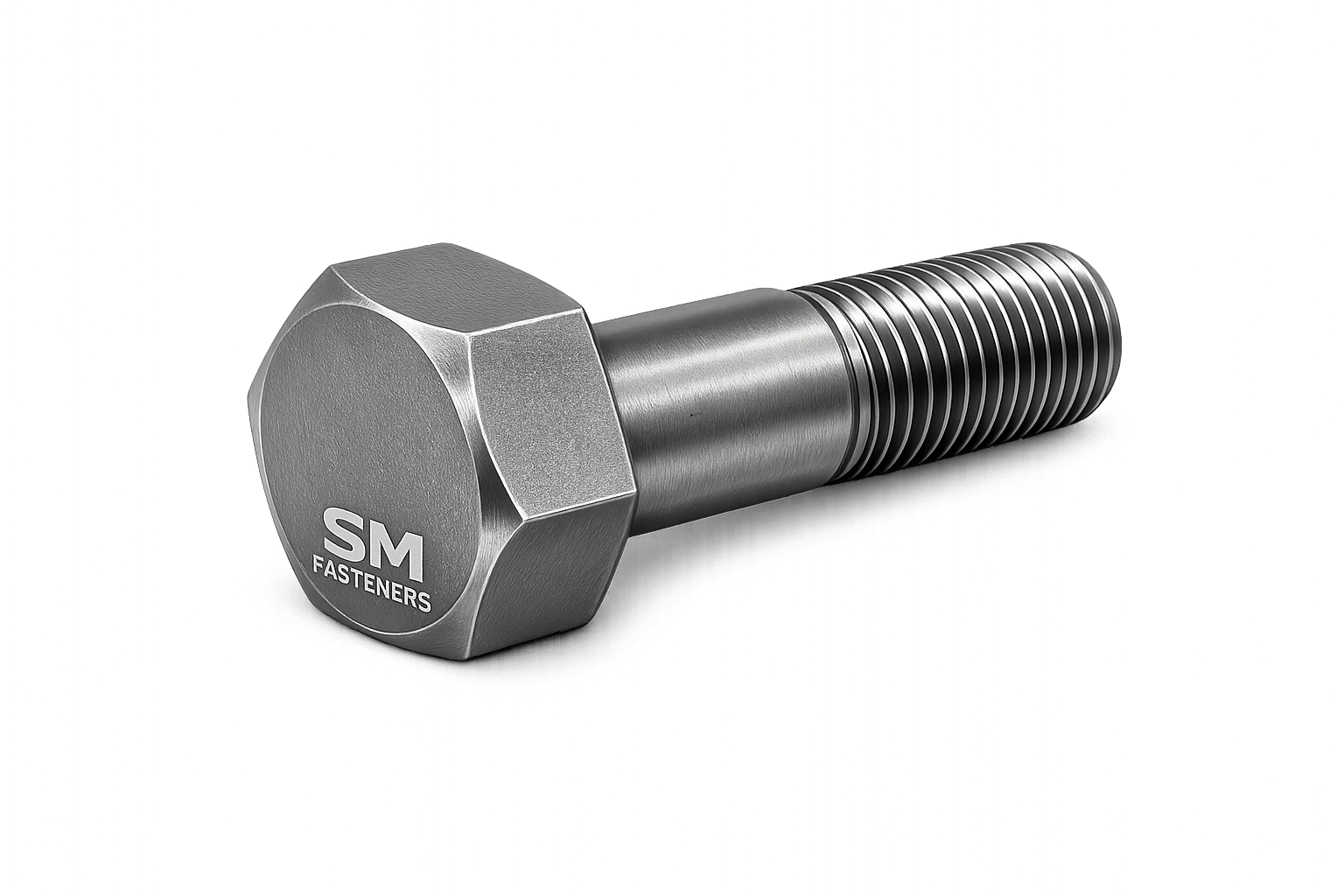
Heavy hex bolts feature larger head dimensions than standard hex bolts.
Advantages
- Larger bearing surface
- Improved wrench engagement
- Higher preload capability
Applications
- ASME flanges
- Pressure vessels
- Refinery piping
- LNG facilities
Typical material selections:
- 410
- 420
- 904L
- 254 SMO
Hex Cap Screws
Cap screws are fully threaded fasteners designed for tapped-hole assemblies.
Features
- Precision tolerance
- High clamping force
- Suitable for machinery
Applications include:
- Pumps
- Compressors
- Turbines
- Rotating equipment
Socket Head Cap Screws
Manufactured according to:
- ISO 4762
- DIN 912
Advantages
- High strength
- Compact head design
- Suitable for restricted spaces
Frequently used in:
- OEM equipment
- Tooling systems
- Valve assemblies
- Instrumentation
420 stainless steel is commonly selected where wear resistance is required.
Stud Bolt
Stud bolts are extensively used in flange connections.
Construction
Threads on both ends.
Used with:
- Two nuts
- Hardened washers
Applications:
- Petrochemical plants
- Offshore facilities
- LNG terminals
- Power stations
Common standards:
| Standard | Description |
|---|---|
| ASTM A193 | Stud Bolts |
| ASTM A320 | Low Temperature Studs |
| ASME B16.5 | Flange Systems |
Threaded Rods
Threaded rods provide continuous thread engagement along their entire length.
Advantages
- Adjustable installation
- Long grip lengths
- Structural anchoring
Applications:
- Pipe supports
- HVAC systems
- Structural assemblies
- Anchor systems
Materials:
- 410
- 430
- 904L
- 254 SMO
Nuts
Nut selection must match:
- Fastener material
- Mechanical strength
- Corrosion resistance
Common types:
Hex Nuts
Standards:
- ISO 4032
- DIN 934
Heavy Hex Nuts
Standards:
- ASTM A194
- ASME B18.2.2
Lock Nuts
Used where vibration resistance is required.
Jam Nuts
Used for preload locking.
Washers
Washers distribute load and protect mating surfaces.
Types include:
Flat Washers
Standards:
- ISO 7089
- DIN 125
Heavy Duty Washers
Standards:
- ASTM F436
Spring Washers
Standards:
- DIN 127
Belleville Washers
Used for:
- Thermal cycling
- Vibration resistance
- Preload retention
Screws
Industrial screws include:
- Machine screws
- Self-tapping screws
- Set screws
- Countersunk screws
Applications:
- Instrumentation
- Control panels
- Electrical enclosures
- HVAC equipment
Rings and Specialty Fasteners
SM Fasteners manufactures engineered fastening components including:
- Retaining rings
- Locking rings
- Custom retaining solutions
Applications:
- Rotating equipment
- Aerospace support systems
- Heavy machinery
PEEK Fasteners
For environments where metal fasteners are unsuitable.
Characteristics
- Non-conductive
- Lightweight
- Chemical resistant
- Corrosion free
Applications:
- Semiconductor plants
- Chemical processing
- Electronics manufacturing
- Medical equipment
Custom Engineered Fasteners
Many EPC projects require non-standard configurations.
Examples:
- Long-length stud bolts
- Reduced shank bolts
- Special head geometries
- Custom thread forms
- Large-diameter bolting
SM Fasteners supports engineered-to-drawing manufacturing for project-specific requirements.
13. Dimensional Logic and Fastener Geometry
Fastener performance depends heavily on geometry.
Incorrect dimensions may result in:
- Insufficient preload
- Fatigue failures
- Thread stripping
- Joint separation
Basic Fastener Dimensions
A bolt is defined by:
| Parameter | Symbol |
|---|---|
| Nominal Diameter | d |
| Pitch | P |
| Thread Length | b |
| Grip Length | g |
| Head Height | k |
| Across Flats | s |
| Across Corners | e |
| Overall Length | L |
Metric Fastener Designation
Example:
M20 × 2.5 × 100
Meaning:
| Element | Value |
|---|---|
| Diameter | 20 mm |
| Pitch | 2.5 mm |
| Length | 100 mm |
Thread Geometry
Thread geometry influences:
- Load carrying capacity
- Fatigue resistance
- Assembly behavior
Key parameters:
Major Diameter
Largest thread diameter.
Minor Diameter
Smallest thread diameter.
Pitch Diameter
Effective load transfer diameter.
Flank Angle
Metric threads:
60°
Unified threads:
60°
Whitworth threads:
55°
Thread Engagement Requirements
Thread engagement must prevent stripping.
Recommended minimum engagement:
| Material Combination | Engagement Length |
|---|---|
| Steel to Steel | 1D |
| Stainless to Stainless | 1.5D |
| Aluminum | 2D |
| Cast Iron | 1.5D |
Where D = Nominal Diameter.
Grip Length
Grip length refers to:
Total thickness of clamped materials.
Design objective:
Threads should not be located in the primary shear plane whenever possible.
Benefits:
- Increased fatigue life
- Improved shear capacity
Head Geometry Considerations
Head shape affects:
- Bearing pressure
- Torque transmission
- Installation access
Common head types:
| Head Type | Application |
|---|---|
| Hex | General Industrial |
| Heavy Hex | Flanges |
| Socket Head | Compact Assemblies |
| Countersunk | Flush Surface |
| Button Head | Low Profile |
Hole Tolerances
Bolt-hole clearance affects assembly behavior.
Typical clearance:
| Bolt Size | Hole Diameter |
|---|---|
| M12 | 13 mm |
| M16 | 18 mm |
| M20 | 22 mm |
| M24 | 26 mm |
| M30 | 33 mm |
14. Dimensional Specifications Table
Standard Metric Hex Bolt Dimensions
| Size | Pitch (Coarse) | Head AF (mm) | Head Height (mm) | Standard Length Range |
|---|---|---|---|---|
| M6 | 1.0 | 10 | 4 | 10–100 mm |
| M8 | 1.25 | 13 | 5.3 | 12–120 mm |
| M10 | 1.5 | 17 | 6.4 | 16–150 mm |
| M12 | 1.75 | 19 | 7.5 | 20–200 mm |
| M16 | 2.0 | 24 | 10 | 25–300 mm |
| M20 | 2.5 | 30 | 12.5 | 30–400 mm |
| M24 | 3.0 | 36 | 15 | 40–500 mm |
| M30 | 3.5 | 46 | 18.7 | 50–600 mm |
| M36 | 4.0 | 55 | 22.5 | 60–800 mm |
15. Thread Standards and Tolerances
Industrial projects often involve multiple thread systems.
Interchangeability must be carefully verified.
Metric Threads
Applicable Standards:
- ISO 68
- ISO 261
- ISO 724
- ISO 965
Designation:
M20 × 2.5
Tolerance Classes:
| External | Internal |
|---|---|
| 6g | 6H |
| 4g6g | 6H |
| 8g | 7H |
Most industrial fasteners:
6g / 6H
Unified Threads (UNC/UNF)
Applicable Standards:
- ASME B1.1
Examples:
| Thread | TPI |
|---|---|
| 1/2″-13 UNC | 13 |
| 1/2″-20 UNF | 20 |
| 3/4″-10 UNC | 10 |
| 3/4″-16 UNF | 16 |
British Standard Threads
BSW
British Standard Whitworth
55° profile.
BSF
British Standard Fine
Higher thread density.
Used in:
- Legacy equipment
- Railway infrastructure
- Heritage installations
Thread Standards & Tolerance Table
| System | Angle | Standard |
|---|---|---|
| Metric | 60° | ISO 68 |
| UNC | 60° | ASME B1.1 |
| UNF | 60° | ASME B1.1 |
| BSW | 55° | BS 84 |
| BSF | 55° | BS 84 |
16. Applicable International Standards
ISO Standards
| Standard | Description |
|---|---|
| ISO 4014 | Hex Bolts Partial Thread |
| ISO 4017 | Hex Bolts Full Thread |
| ISO 4032 | Hex Nuts |
| ISO 4762 | Socket Head Cap Screws |
| ISO 7089 | Flat Washers |
| ISO 898 | Mechanical Properties |
| ISO 3506 | Stainless Fasteners |
ASTM Standards
Pressure Service Fasteners
| Standard | Application |
|---|---|
| ASTM A193 | High Temperature Bolting |
| ASTM A320 | Low Temperature Bolting |
| ASTM A194 | Nuts |
| ASTM F436 | Washers |
DIN Standards
| Standard | Description |
|---|---|
| DIN 931 | Hex Bolt Partial Thread |
| DIN 933 | Hex Bolt Full Thread |
| DIN 934 | Hex Nuts |
| DIN 125 | Washers |
| DIN 912 | Socket Head Screws |
British Standards
| Standard | Description |
|---|---|
| BS 3692 | Metric Fasteners |
| BS 4190 | ISO Metric Hex Bolts |
| BS 4320 | Washers |
| BS 1768 | Nuts |
17. Interchangeability Considerations
Interchangeability is critical during maintenance and project procurement.
Engineers must verify:
Thread Compatibility
Metric and UNC threads are not interchangeable.
Material Compatibility
Avoid galvanic mismatch.
Examples:
- 254 SMO + carbon steel may require isolation.
- 904L + aluminum may require isolation washers.
Mechanical Compatibility
Fasteners must meet:
- Proof load requirements
- Torque requirements
- Fatigue requirements
Dimensional Compatibility
Verify:
- Head dimensions
- Washer dimensions
- Nut height
- Thread engagement
18. Engineering Selection Matrix by Product Type
| Product Type | Preferred Grades |
|---|---|
| Structural Bolts | 410, 420 |
| Heavy Hex Bolts | 410, 904L, 254 SMO |
| Flange Stud Bolts | 904L, 254 SMO |
| Threaded Rods | 410, 430, 904L |
| Machinery Screws | 420 |
| Chemical Plant Fasteners | 904L |
| Offshore Fasteners | 254 SMO |
| Desalination Equipment | 254 SMO |
| Architectural Fasteners | 430 |
| PEEK Fasteners | Non-metallic applications |
The geometry, dimensions, and thread configuration of stainless steel fasteners directly influence preload generation, fatigue life, installation reliability, and long-term service performance. Grades 410, 420, 430, 904L, and 254 SMO are manufactured into a complete range of industrial fastening products including bolts, nuts, screws, washers, stud bolts, threaded rods, rings, and engineered custom components. Compliance with ISO, ASTM, DIN, and BS standards ensures dimensional interchangeability and procurement consistency across global EPC and industrial projects.
For critical applications such as offshore structures, pressure vessels, petrochemical plants, power stations, and LNG facilities, fastener selection must consider both material performance and geometric design to achieve the required structural integrity and lifecycle reliability.
19. Material Selection Philosophy
Material selection must be based on the interaction of:
- Mechanical loading
- Corrosion exposure
- Temperature conditions
- Service life requirements
- Inspection accessibility
- Regulatory compliance
- Life-cycle cost
Fastener failure is often attributable to incorrect material selection rather than manufacturing defects.
Engineering evaluation should consider:
Mechanical Requirements
- Tensile strength
- Yield strength
- Fatigue resistance
- Impact toughness
- Hardness
Environmental Requirements
- Atmospheric corrosion
- Chloride exposure
- Acid exposure
- Sour gas environments
- Marine immersion
Operational Requirements
- Installation method
- Torque requirements
- Maintenance intervals
- Replacement accessibility
20. Overview of Stainless Steel Families
| Grade | Family |
|---|---|
| 410 | Martensitic |
| 420 | Martensitic |
| 430 | Ferritic |
| 904L | High-Alloy Austenitic |
| 254 SMO | Super Austenitic |
Each family offers distinct advantages.
21. Grade 410 Stainless Steel
Technical Characteristics
410 stainless steel contains approximately:
| Element | Typical Content |
|---|---|
| Chromium | 11.5–13.5% |
| Carbon | 0.08–0.15% |
| Nickel | Low |
| Molybdenum | None |
410 is the most commonly used martensitic stainless steel for industrial fasteners.
Advantages
- Heat treatable
- Good strength
- Moderate corrosion resistance
- Economical
- Good wear resistance
Limitations
- Lower chloride resistance
- Limited acid resistance
- Moderate SCC resistance
Typical Applications
- Valve assemblies
- Turbines
- Pump systems
- Structural equipment
- General industrial machinery
22. Grade 420 Stainless Steel
420 stainless steel contains higher carbon than 410.
Key Characteristics
| Property | Relative Rating |
|---|---|
| Hardness | Excellent |
| Wear Resistance | Excellent |
| Corrosion Resistance | Moderate |
| Strength | Very High |
Applications
- Mechanical equipment
- Mining systems
- Wear-prone assemblies
- High-strength screws
- Precision components
Advantages
- Exceptional hardness after heat treatment
- Excellent abrasion resistance
Limitations
- Reduced ductility
- Reduced weldability
- Moderate corrosion resistance
23. Grade 430 Stainless Steel
430 is a ferritic stainless steel.
Characteristics
| Property | Rating |
|---|---|
| Corrosion Resistance | Moderate |
| Strength | Moderate |
| SCC Resistance | Good |
| Cost | Low |
Applications
- Architectural systems
- HVAC equipment
- Appliance manufacturing
- Interior industrial installations
Advantages
- Cost effective
- Magnetic
- Good atmospheric resistance
Limitations
- Non-hardenable
- Lower strength than martensitic grades
24. Grade 904L Stainless Steel
904L is a highly alloyed austenitic stainless steel.
Typical Chemistry
| Element | Content |
|---|---|
| Chromium | 19–23% |
| Nickel | 23–28% |
| Molybdenum | 4–5% |
| Copper | 1–2% |
Benefits
- Excellent acid resistance
- Superior pitting resistance
- Excellent crevice corrosion resistance
- Good weldability
Applications
- Sulfuric acid plants
- Chemical processing
- Fertilizer plants
- Offshore equipment
25. Grade 254 SMO
254 SMO is a premium super-austenitic stainless steel.
Typical Composition
| Element | Content |
|---|---|
| Chromium | ~20% |
| Nickel | ~18% |
| Molybdenum | ~6% |
| Nitrogen | ~0.2% |
Benefits
- Outstanding chloride resistance
- Exceptional pitting resistance
- Excellent seawater performance
- High strength
Applications
- Offshore platforms
- Desalination systems
- LNG facilities
- Marine structures
26. Material Comparison Table
Mechanical & Corrosion Performance Comparison
| Property | 410 | 420 | 430 | 904L | 254 SMO |
|---|---|---|---|---|---|
| UTS (MPa) | 650–950 | 750–1200 | 450–600 | 490–710 | 650–850 |
| Yield Strength (MPa) | 450–700 | 500–900 | 205–350 | 220–450 | 300–600 |
| Hardness (HB) | 180–320 | 220–450 | 140–200 | 150–220 | 180–260 |
| Chloride Resistance | Moderate | Moderate | Moderate | Excellent | Outstanding |
| Acid Resistance | Moderate | Moderate | Moderate | Excellent | Excellent |
| Wear Resistance | Good | Excellent | Moderate | Moderate | Moderate |
| Cost Index | 1.0 | 1.2 | 0.9 | 3.5 | 5.0 |
27. Mechanical Properties Table
Typical Mechanical Properties
| Grade | Tensile Strength (MPa) | Yield Strength (MPa) | Elongation (%) |
|---|---|---|---|
| 410 | 650–950 | 450–700 | 15–20 |
| 420 | 750–1200 | 500–900 | 10–18 |
| 430 | 450–600 | 205–350 | 20–25 |
| 904L | 490–710 | 220–450 | 35–40 |
| 254 SMO | 650–850 | 300–600 | 30–40 |
28. Corrosion Resistance versus Environment
| Environment | 410 | 420 | 430 | 904L | 254 SMO |
|---|---|---|---|---|---|
| Indoor Industrial | Good | Good | Good | Excellent | Excellent |
| Urban Atmosphere | Good | Good | Good | Excellent | Excellent |
| Marine Atmosphere | Fair | Fair | Fair | Excellent | Outstanding |
| Seawater Splash Zone | Poor | Poor | Poor | Very Good | Outstanding |
| Full Seawater Immersion | Poor | Poor | Poor | Good | Excellent |
| Sulfuric Acid | Poor | Poor | Poor | Excellent | Excellent |
| Chloride Process Water | Fair | Fair | Fair | Excellent | Outstanding |
| LNG Facilities | Good | Good | Fair | Excellent | Excellent |
| Offshore Platforms | Fair | Fair | Fair | Excellent | Outstanding |
| Desalination Plants | Poor | Poor | Poor | Very Good | Outstanding |
29. NACE MR0175 / ISO 15156 Considerations
Oil and gas facilities handling sour service environments require compliance with:
- NACE MR0175
- ISO 15156
Critical concerns:
- Sulfide stress cracking
- Hydrogen-assisted cracking
- Hardness control
Martensitic Grades
410 and 420 require careful hardness control.
Excessive hardness increases SSC susceptibility.
Austenitic Grades
904L and 254 SMO generally exhibit superior resistance in properly engineered applications.
Material qualification must always be project-specific.
30. Temperature Capability
| Grade | Continuous Service Temperature |
|---|---|
| 410 | Up to 650°C |
| 420 | Up to 650°C |
| 430 | Up to 815°C |
| 904L | Up to 400°C |
| 254 SMO | Up to 550°C |
Actual service limits depend upon:
- Load level
- Corrosion conditions
- Design code requirements
31. Heat Treatment Processes
Heat treatment significantly affects martensitic stainless steel fasteners.
Heat Treatment of 410
Step 1 — Austenitizing
Typical temperature:
950–1050°C
Step 2 — Quenching
Methods:
- Oil quench
- Air quench
Step 3 — Tempering
Typical range:
200–700°C
Results:
- Increased toughness
- Reduced brittleness
- Controlled hardness
Heat Treatment of 420
420 follows a similar process.
Typical Sequence
- Austenitize
- Quench
- Temper
Result:
- Maximum hardness
- High wear resistance
- Increased tensile strength
Heat Treatment of 430
430 is ferritic.
Heat Treatment Capability
Not hardenable by quenching.
Heat treatment primarily used for:
- Stress relief
- Annealing
Heat Treatment of 904L
904L is supplied in solution-annealed condition.
Process
Heating:
≈1050–1150°C
Rapid cooling follows.
Benefits:
- Maximum corrosion resistance
- Homogeneous microstructure
Heat Treatment of 254 SMO
254 SMO also utilizes solution annealing.
Benefits include:
- Restored corrosion resistance
- Improved toughness
- Controlled microstructure
32. Heat Treatment Effects on Mechanical Properties
| Process | Impact |
|---|---|
| Quenching | Increased hardness |
| Tempering | Improved toughness |
| Annealing | Reduced stress |
| Solution Annealing | Corrosion optimization |
| Stress Relieving | Reduced residual stress |
33. Manufacturing Workflow
SM Fasteners follows a controlled manufacturing workflow supporting traceability and quality assurance.
Step 1 — Raw Material Verification
Incoming material inspection includes:
- Mill Test Certificates (MTC)
- Chemical verification
- Heat number traceability
- Dimensional verification
Applicable standards:
- EN 10204
- ASTM
- ISO
Step 2 — Positive Material Identification (PMI)
PMI verifies alloy composition.
Methods:
- XRF
- OES
Particularly important for:
- 904L
- 254 SMO
Step 3 — Cutting Operations
Raw materials processed as:
- Bars
- Wire rods
- Forging stock
Cut to required blank size.
Step 4 — Hot Forging
Used for:
- Large bolts
- Heavy hex fasteners
- Stud blanks
Benefits:
- Grain flow improvement
- Enhanced mechanical properties
Step 5 — Cold Forging
Used for:
- High-volume fasteners
- Precision bolts
- Screws
Benefits:
- Excellent dimensional consistency
- Improved surface finish
- Increased production efficiency
Step 6 — Machining Operations
Required for:
- Special geometries
- Custom fasteners
- Precision threads
Processes include:
- CNC turning
- Milling
- Drilling
- Slotting
Step 7 — Thread Manufacturing
Thread Rolling
Preferred method.
Benefits:
- Improved fatigue resistance
- Better surface finish
- Work hardening effect
Thread Cutting
Used where:
- Large diameters exist
- Special thread forms are required
Thread Rolling versus Thread Cutting
| Property | Rolled Thread | Cut Thread |
|---|---|---|
| Fatigue Resistance | Excellent | Good |
| Surface Finish | Excellent | Moderate |
| Strength | Higher | Lower |
| Production Speed | Faster | Slower |
Step 8 — Heat Treatment
Performed where required.
Particularly for:
- 410
- 420
Step 9 — Surface Finishing
Processes applied according to project specifications.
34. Surface Finishes
Mill Finish
Standard finish from manufacturing process.
Applications:
- General industrial service
Bright Finish
Provides:
- Improved appearance
- Reduced contamination risk
Used in:
- Food processing
- Pharmaceutical equipment
Passivation
Removes free iron contamination.
Benefits:
- Improved corrosion resistance
- Enhanced oxide layer formation
Applicable standards:
- ASTM A967
- ASTM A380
Electropolishing
Produces:
- Smooth surface
- Improved cleanliness
- Enhanced corrosion resistance
Applications:
- Semiconductor
- Pharmaceutical
- Ultra-clean systems
35. Coating Technologies
Although stainless steels rely primarily on inherent corrosion resistance, coatings may provide additional benefits.
PTFE Coating
Advantages:
- Reduced galling
- Reduced friction
- Improved assembly
Applications:
- Offshore bolting
- Chemical plants
Xylan Coating
Provides:
- Low friction
- Improved corrosion performance
- Consistent torque values
Molybdenum-Based Lubricant Coatings
Used for:
- High preload applications
- Controlled torque tightening
Surface Finish Comparison Table
| Surface Finish | Corrosion Performance | Galling Resistance | Appearance |
|---|---|---|---|
| Mill Finish | Good | Moderate | Industrial |
| Passivated | Very Good | Moderate | Clean |
| Electropolished | Excellent | Moderate | Bright |
| PTFE Coated | Excellent | Excellent | Coated |
| Xylan Coated | Excellent | Excellent | Coated |
36. Galling Prevention for 904L and 254 SMO
Austenitic stainless fasteners are susceptible to galling.
Recommended controls:
- Controlled tightening speed
- Lubrication
- PTFE coating
- Moly-based lubricants
- Proper thread tolerances
These controls are particularly important for:
- Large-diameter flange bolting
- Offshore equipment
- Pressure-retaining joints
37. Inspection and Quality Control Framework
Industrial fasteners used in critical applications must be manufactured under controlled quality systems to ensure:
- Mechanical integrity
- Material conformity
- Dimensional accuracy
- Full traceability
- Regulatory compliance
SM Fasteners integrates quality controls aligned with:
- ISO 9001 Quality Management Systems
- ASTM Standards
- ISO Standards
- DIN Standards
- BS Standards
- EN 10204 Documentation Requirements
38. Incoming Material Inspection
Material Verification Requirements
Every production batch should be verified against:
Mill Test Certificate (MTC)
Verification includes:
| Parameter | Verification |
|---|---|
| Heat Number | Mandatory |
| Chemical Composition | Mandatory |
| Mechanical Properties | Mandatory |
| Manufacturing Route | Required |
| Material Grade | Required |
Raw Material Dimensional Inspection
Inspection points:
- Diameter
- Straightness
- Surface defects
- Decarburization
- Material identification
39. Positive Material Identification (PMI)
PMI is essential for premium alloys such as:
- 904L
- 254 SMO
Methods include:
XRF Testing
Verifies:
- Chromium
- Nickel
- Molybdenum
- Copper
Optical Emission Spectroscopy (OES)
Provides higher accuracy and carbon analysis.
Applications:
- Offshore projects
- Petrochemical plants
- LNG facilities
- Third-party inspections
40. In-Process Quality Control
Forging Inspection
Verification of:
- Head formation
- Flash removal
- Surface cracking
- Grain flow integrity
Machining Inspection
Checks include:
- Concentricity
- Head dimensions
- Under-head radius
- Surface finish
Thread Inspection
Inspection tools:
- GO Gauges
- NO-GO Gauges
- Thread Micrometers
Applicable Standards:
- ISO 965
- ASME B1.1
41. Final Inspection Requirements
Dimensional Verification
Typical measurements:
| Characteristic | Inspection Method |
|---|---|
| Diameter | Vernier / Micrometer |
| Length | Calibrated Scale |
| Pitch | Thread Gauge |
| Head Height | Micrometer |
| Across Flats | Vernier Caliper |
Visual Inspection
Verification of:
- Surface defects
- Burrs
- Cracks
- Corrosion
- Coating integrity
42. Mechanical Testing
Tensile Testing
Applicable Standards:
- ASTM F606
- ISO 898
- ISO 3506
Measured properties:
- Ultimate tensile strength
- Yield strength
- Elongation
- Reduction of area
Hardness Testing
Methods:
| Method | Application |
|---|---|
| Rockwell C | Martensitic Grades |
| Brinell | General Evaluation |
| Vickers | Precision Analysis |
Proof Load Testing
Proof load verifies elastic load-carrying capability without permanent deformation.
43. Proof Load and Tensile Strength Table
Typical Engineering Values
| Grade | Tensile Strength (MPa) | Yield Strength (MPa) | Approx. Proof Stress (MPa) |
|---|---|---|---|
| 410 HT | 750–950 | 450–700 | 500–650 |
| 420 HT | 850–1200 | 500–900 | 600–800 |
| 430 | 450–600 | 205–350 | 220–300 |
| 904L | 490–710 | 220–450 | 240–400 |
| 254 SMO | 650–850 | 300–600 | 350–550 |
HT = Heat Treated
44. Approximate Proof Load Table by Size
Example Values for Engineering Reference
| Size | Stress Area (mm²) | Proof Load @ 500 MPa (kN) |
|---|---|---|
| M10 | 58 | 29 |
| M12 | 84 | 42 |
| M16 | 157 | 79 |
| M20 | 245 | 122 |
| M24 | 353 | 176 |
| M30 | 561 | 281 |
Actual values depend upon grade, standard, and heat treatment condition.
45. Non-Destructive Testing (NDT)
Critical fasteners may require NDT.
Magnetic Particle Inspection (MPI)
Suitable for:
- 410
- 420
Detects:
- Surface cracks
- Near-surface defects
Dye Penetrant Testing (PT)
Suitable for:
- 430
- 904L
- 254 SMO
Detects:
- Surface discontinuities
- Forging defects
Ultrasonic Testing (UT)
Used for:
- Large diameter studs
- Heavy-section fasteners
46. Corrosion Testing
Tests may include:
Salt Spray Testing
Applicable Standard:
- ASTM B117
Pitting Resistance Evaluation
Applicable for:
- 904L
- 254 SMO
Ferrite Testing
Where project specifications require microstructural verification.
47. Tightening Torque Engineering
Importance of Torque Control
Proper torque generates preload.
Incorrect torque can result in:
- Leakage
- Fatigue failure
- Thread stripping
- Bolt yielding
Torque–Tension Relationship
Engineering relationship:
Where:
- T = Torque
- K = Nut factor
- F = Preload
- D = Nominal diameter
48. Tightening Torque Chart
Lubricated Stainless Fasteners (Approximate)
| Size | Preload (kN) | Torque (Nm) |
|---|---|---|
| M8 | 12 | 18 |
| M10 | 20 | 35 |
| M12 | 30 | 60 |
| M16 | 60 | 145 |
| M20 | 95 | 290 |
| M24 | 135 | 500 |
| M30 | 220 | 1000 |
Engineering values only. Project-specific verification is required.
49. Torque Comparison by Lubrication Condition
| Condition | Relative Torque |
|---|---|
| Dry | 100% |
| Oiled | 85–90% |
| PTFE Coated | 70–80% |
| Moly Lubricated | 65–75% |
50. Preload Engineering
Why Preload Matters
The majority of bolted joint failures are related to insufficient preload.
Recommended preload:
70–85% of proof load.
Benefits:
- Improved fatigue life
- Leak prevention
- Vibration resistance
- Joint integrity
51. Preload Calculation Formula
Basic Relationship
Where:
- F = Preload
- Sp = Proof stress
- As = Tensile stress area
Worked Example
M20 Fastener
Assumptions:
| Parameter | Value |
|---|---|
| Proof Stress | 500 MPa |
| Stress Area | 245 mm² |
| Preload Factor | 75% |
Calculation:
F = 0.75 × 500 × 245
F = 91,875 N
F ≈ 92 kN
Recommended assembly preload:
Approximately 92 kN
52. Thread Standards and Tolerance Reference Table
| Thread Type | Angle | Standard |
|---|---|---|
| Metric Coarse | 60° | ISO 68 |
| Metric Fine | 60° | ISO 68 |
| UNC | 60° | ASME B1.1 |
| UNF | 60° | ASME B1.1 |
| BSW | 55° | BS 84 |
| BSF | 55° | BS 84 |
Common Tolerance Classes
| External Thread | Internal Thread |
|---|---|
| 6g | 6H |
| 4g6g | 6H |
| 8g | 7H |
53. Weight Chart
Approximate Hex Bolt Weights
| Size | Weight/Piece (kg) | Weight/100 pcs (kg) |
|---|---|---|
| M10 × 50 | 0.038 | 3.8 |
| M12 × 60 | 0.067 | 6.7 |
| M16 × 80 | 0.158 | 15.8 |
| M20 × 100 | 0.312 | 31.2 |
| M24 × 120 | 0.565 | 56.5 |
| M30 × 150 | 1.120 | 112 |
Actual production weights vary according to:
- Material grade
- Thread length
- Head style
- Applicable standard
SM Fasteners can provide project-specific weight schedules aligned with manufacturing drawings and procurement documentation.
54. Industry Applications
Construction and Structural Steel
Applications:
- Steel framing
- Bridges
- Industrial buildings
- Heavy structural connections
Preferred grades:
- 410
- 420
Oil & Gas
Upstream
Applications:
- Wellhead equipment
- Drilling systems
- Offshore structures
Preferred grades:
- 904L
- 254 SMO
Midstream
Applications:
- Pipelines
- Compressor stations
- LNG transfer systems
Preferred grades:
- 904L
- 254 SMO
Downstream
Applications:
- Refineries
- Petrochemical plants
- Process equipment
Preferred grades:
- 904L
- 254 SMO
Power Generation
Applications:
- Turbines
- Boiler systems
- Structural supports
- Cooling systems
Preferred grades:
- 410
- 420
- 904L
Petrochemical Processing
Applications:
- Reactor systems
- Heat exchangers
- Pressure vessels
Preferred grades:
- 904L
- 254 SMO
LNG and Offshore Facilities
Requirements:
- Chloride resistance
- Long service life
- Corrosion resistance
Preferred grade:
- 254 SMO
Marine and Shipbuilding
Applications:
- Deck equipment
- Structural assemblies
- Mooring systems
Preferred grades:
- 904L
- 254 SMO
Railways and Infrastructure
Applications:
- Track systems
- Signaling equipment
- Structural hardware
Preferred grades:
- 410
- 420
- 430
Heavy Equipment and OEM Manufacturing
Applications:
- Mining equipment
- Earthmoving machinery
- Industrial machinery
Preferred grades:
- 410
- 420
PEEK Fastener Applications
Where metallic fasteners are unsuitable.
Applications:
- Semiconductor facilities
- Chemical processing
- Electrical insulation systems
- High-purity process equipment
Advantages:
- Non-conductive
- Lightweight
- Corrosion-free
- Chemically resistant
55. Packaging Requirements
Industrial fasteners require packaging that protects:
- Threads
- Surface finish
- Traceability
Standard Packaging
- Cartons
- Wooden boxes
- Pallets
Corrosion Protection
Methods include:
- VCI packaging
- Moisture barrier wrapping
- Desiccant systems
Thread Protection
Protection methods:
- Plastic thread caps
- Protective sleeves
- Custom separators
56. Export Packaging
For international projects:
ISPM-15 Compliance
Required for:
- Export wooden packaging
Export Crating
Provides:
- Mechanical protection
- Moisture resistance
- Handling safety
Container Loading Controls
Verification of:
- Weight distribution
- Marking
- Packing list accuracy
57. Project Documentation Package
Industrial projects typically require comprehensive documentation.
Material Test Certificate (MTC)
Includes:
- Heat number
- Chemical composition
- Mechanical properties
Heat Treatment Report
Required for:
- 410
- 420
Includes:
- Furnace records
- Temperatures
- Holding times
Inspection Report
Includes:
- Dimensional verification
- Thread inspection
- Visual inspection
PMI Report
Particularly important for:
- 904L
- 254 SMO
Coating Report
Where applicable.
Includes:
- Coating type
- Thickness
- Compliance
Certificate of Conformity (CoC)
Confirms compliance with:
- Purchase order
- Applicable standards
- Inspection requirements
58. EN 10204 Certification
Common documentation levels:
| Type | Description |
|---|---|
| 2.1 | Declaration of Compliance |
| 2.2 | Test Report |
| 3.1 | Independent Inspection Documentation |
| 3.2 | Third-Party Witnessed Certification |
For EPC and offshore projects:
- EN 10204 3.1
- EN 10204 3.2
are frequently specified.
59. Global Supply Readiness
For international EPC and industrial projects, supply capability extends beyond manufacturing.
Key requirements include:
- Material traceability
- Standards compliance
- Inspection readiness
- Export packaging
- Documentation control
- Third-party inspection support
SM Fasteners supports project requirements through:
- ISO 9001-certified quality systems
- MSME registration
- UKAF-aligned certification framework
- Manufacturing of bolts, nuts, screws, washers, threaded rods, rings, coated fasteners, and custom-engineered components
- Capability in advanced materials including 410, 420, 430, 904L, 254 SMO, Duplex, Super Duplex, Hastelloy, Inconel, Incoloy, Monel, Nickel Alloys, and PEEK
- Support for EN 10204 documentation and project traceability requirements
Final Engineering Conclusion
410, 420, 430, 904L, and 254 SMO stainless steel fasteners occupy critical positions within modern industrial fastening systems. Selection should be based on a systematic assessment of mechanical loading, corrosion exposure, temperature conditions, inspection requirements, and lifecycle cost. Martensitic grades 410 and 420 provide high strength and wear resistance through controlled heat treatment, while 430 offers economical corrosion resistance for atmospheric service. High-alloy grades 904L and 254 SMO deliver exceptional performance in aggressive chemical, offshore, marine, LNG, and desalination environments where chloride-induced corrosion resistance is essential.
Through controlled material verification, PMI testing, forging, machining, thread rolling, heat treatment, passivation, inspection, and documentation processes, SM Fasteners is positioned to support technically demanding EPC, power, petrochemical, offshore, infrastructure, and OEM projects requiring precision-engineered fastening solutions, international standards compliance, traceability, and global supply readiness.