
Hastelloy Grades C-276 / C-22 / B-2
1. Introduction to Hastelloy Fasteners
Hastelloy is a family of high-performance nickel-molybdenum and nickel-chromium-molybdenum alloys developed for severe corrosion environments where conventional stainless steels, duplex grades, and many nickel alloys experience rapid degradation.
For critical bolted joints operating in:
- Sulfuric acid systems
- Hydrochloric acid processing
- Chlorine handling plants
- Offshore platforms
- Sour gas facilities
- Petrochemical reactors
- Flue gas desulfurization units
- Pharmaceutical processing equipment
- LNG terminals
Hastelloy fasteners provide superior corrosion resistance, metallurgical stability, and mechanical reliability.
SM Fasteners manufactures precision-engineered Hastelloy fasteners under ISO 9001 quality systems, supported by MSME and UKAF-certified processes, supplying EPC contractors, OEMs, and industrial maintenance projects worldwide.
2. Major Hastelloy Grades Used for Fasteners
| Grade | UNS Number | Principal Alloy System | Primary Strength |
|---|---|---|---|
| Hastelloy C-276 | N10276 | Ni-Cr-Mo-W | Universal corrosion resistance |
| Hastelloy C-22 | N06022 | Ni-Cr-Mo-W | Superior oxidizing resistance |
| Hastelloy B-2 | N10665 | Ni-Mo | Hydrochloric acid resistance |
| Hastelloy B-3 | N10675 | Ni-Mo | Improved thermal stability |
These alloys are selected primarily based on corrosion performance rather than strength alone.
3. Industrial Importance of Hastelloy Fasteners
Fasteners often become the weakest component in highly corrosive assemblies.
Failure modes include:
- Thread pitting
- Crevice corrosion
- Chloride attack
- Stress corrosion cracking
- Galvanic corrosion
- Acid-induced metal loss
Hastelloy fasteners eliminate these risks in applications where equipment life can exceed 20–30 years.
Typical industries include:
| Industry | Requirement |
|---|---|
| Offshore Oil & Gas | Chloride resistance |
| Chemical Processing | Acid resistance |
| LNG | Cryogenic reliability |
| Power Generation | Corrosion protection |
| Pharmaceutical | Contamination resistance |
| Marine | Saltwater durability |
| Desalination | Chloride attack prevention |
| Fertilizer Plants | Acid service capability |
4. Technical Definition of Hastelloy Fasteners
A Hastelloy fastener is a threaded mechanical component manufactured from nickel-based corrosion-resistant alloys and used to create detachable mechanical joints while maintaining structural integrity under:
- High loads
- Elevated temperatures
- Corrosive chemicals
- Seawater exposure
- Sour gas environments
Products include:
- Hex bolts
- Heavy hex bolts
- Socket screws
- Stud bolts
- Threaded rods
- Hex nuts
- Heavy hex nuts
- Lock nuts
- Flat washers
- Spring washers
- Structural fasteners
- Custom-machined fasteners
5. Functional Role in Mechanical Assemblies
A bolted joint converts tightening torque into clamping force.
The fastener functions as a tension member.
The joint members function as compressed elements.
When preload exceeds service loads:
- Joint separation is prevented
- Leakage is minimized
- Vibration loosening is reduced
- Fatigue life increases
6. Load Mechanics of Hastelloy Fasteners
Tensile Loading
Occurs when forces attempt to pull the joint apart.
Examples:
- Pressure vessel flanges
- Heat exchangers
- Reactor closures
Formula:
Where:
| Symbol | Definition |
|---|---|
| σ | Tensile stress |
| F | Applied load |
| A | Tensile stress area |
Shear Loading
Occurs when forces act perpendicular to bolt axis.
Examples:
- Structural supports
- Pipe clamps
- Equipment frames
Formula:
Where:
τ = Shear stress
Combined Loading
Industrial joints commonly experience:
- Tensile load
- Shear load
- Thermal load
- Vibration load
Design must account for simultaneous stress conditions.
7. Clamping Force Principles
The most important function of a fastener is preload generation.
Relationship:
Where:
| Parameter | Meaning |
|---|---|
| Fclamp | Clamping force |
| T | Tightening torque |
| K | Nut factor |
| D | Nominal diameter |
Typical Nut Factor Values
| Condition | K Value |
|---|---|
| Dry Threads | 0.20–0.25 |
| Lubricated Threads | 0.15–0.18 |
| PTFE Coated | 0.10–0.14 |
| Moly Lubricated | 0.08–0.12 |
Because Hastelloy is prone to galling, lubrication is strongly recommended.
8. Torque-Tension Relationship
Only a small percentage of tightening torque becomes useful preload.
| Torque Consumption | Percentage |
|---|---|
| Under-head friction | 50% |
| Thread friction | 40% |
| Useful preload | 10% |
This is why controlled lubrication is essential.
9. Thread Engagement Principles
Minimum thread engagement depends upon:
- Material strength
- Load direction
- Corrosion allowance
General recommendation:
| Material Combination | Engagement |
|---|---|
| Same Alloy | 1 × Diameter |
| Dissimilar Metals | 1.25 × Diameter |
| Soft Materials | 1.5 × Diameter |
10. Joint Stiffness Considerations
Joint performance depends on:
Bolt Stiffness
Joint Stiffness
Where:
- A = Area
- E = Modulus
- L = Length
A properly designed joint transfers external load through elastic deformation.
11. Load Distribution Along Threads
Thread loading is not uniform.
Approximate distribution:
| Thread | Load Share |
|---|---|
| 1st Thread | 34% |
| 2nd Thread | 23% |
| 3rd Thread | 16% |
| 4th Thread | 11% |
| Remaining Threads | 16% |
Therefore thread quality and tolerances are critical.
12. Fatigue Behavior of Hastelloy Fasteners
Fatigue occurs under cyclic loading.
Common sources:
- Rotating equipment
- Pumps
- Compressors
- Offshore structures
- Wind loading
Factors improving fatigue life:
- High preload
- Rolled threads
- Smooth surface finish
- Proper alignment
- Corrosion protection
13. Failure Mechanisms
Fatigue Failure
Characteristics:
- Progressive crack growth
- Sudden fracture
Causes:
- Under-tightening
- Vibration
- Stress concentration
Thread Stripping
Caused by:
- Insufficient engagement
- Excess torque
- Material mismatch
Galling
Especially important for nickel alloys.
Occurs due to:
- Metal transfer
- Adhesive wear
- High friction
Mitigation:
- Silver plating
- PTFE coating
- Moly lubricant
- Controlled installation speed
Stress Corrosion Cracking
A significant concern for stainless steels.
Hastelloy C-276 and C-22 exhibit exceptional SCC resistance.
Pitting Corrosion
Localized attack causing deep penetration.
Excellent resistance:
- C-22
- C-276
Moderate resistance:
- B-2
- B-3
Crevice Corrosion
Develops beneath:
- Washers
- Gaskets
- Deposits
C-22 offers industry-leading resistance.
14. Thermal Expansion Considerations
Nickel alloys expand more than carbon steel.
Approximate coefficient:
| Material | µm/m°C |
|---|---|
| Carbon Steel | 12 |
| Stainless Steel | 17 |
| Hastelloy C-276 | 12.4 |
| Hastelloy C-22 | 13.1 |
Designers must account for differential expansion.
15. High-Temperature Performance
| Grade | Maximum Continuous Service |
|---|---|
| C-276 | 1040°C |
| C-22 | 1250°C |
| B-2 | 900°C |
| B-3 | 925°C |
Actual fastener design temperature depends upon stress level and environment.
16. Cryogenic Performance
Hastelloy alloys maintain toughness at:
- LNG temperatures
- Liquid nitrogen temperatures
- Cryogenic process systems
No ductile-to-brittle transition occurs as in carbon steel.
17. Joint Design Principles for EPC Projects
Engineers should evaluate:
Mechanical Requirements
- Tensile load
- Shear load
- Fatigue load
Environmental Requirements
- Acid exposure
- Chlorides
- Sour gas
- Elevated temperature
Inspection Requirements
- PMI verification
- NDT acceptance
- Traceability
Lifecycle Cost
Although Hastelloy has a higher acquisition cost, lifecycle cost is often lower due to:
- Reduced maintenance
- Longer service life
- Fewer shutdowns
18. Fastener Selection Methodology
Step-by-step approach:
| Step | Evaluation Criteria |
|---|---|
| 1 | Service environment |
| 2 | Corrosion mechanism |
| 3 | Design load |
| 4 | Temperature |
| 5 | Applicable code |
| 6 | Inspection requirements |
| 7 | Certification requirements |
| 8 | Traceability requirements |
19. Typical EPC Procurement Requirements
Procurement specifications commonly require:
- ASTM-compliant materials
- EN 10204 3.1 certification
- Heat number traceability
- PMI testing
- Mechanical test reports
- Dimensional inspection reports
SM Fasteners manufactures Hastelloy fasteners with full material traceability and inspection documentation suitable for global EPC and industrial projects.
20. Engineering Summary
Hastelloy C-276, C-22, B-2, and B-3 fasteners are critical components for severe corrosion service where stainless steel, duplex, and conventional alloys cannot provide adequate reliability.
Their engineering value derives from:
- Exceptional corrosion resistance
- Strong preload retention
- Excellent fatigue performance
- Resistance to stress corrosion cracking
- High-temperature capability
- Long-term lifecycle reliability
In complex industrial assemblies, proper preload management, thread engagement, material compatibility, and corrosion-resistant design principles are essential for achieving safe, leak-free, and maintenance-efficient bolted joints.
21. Product Types and Variants of Hastelloy Fasteners
Hastelloy fasteners are manufactured in a wide range of configurations to satisfy structural, pressure-containing, corrosive-process, offshore, power generation, and heavy engineering applications.
Selection depends upon:
- Applied load direction
- Joint accessibility
- Assembly method
- Corrosion environment
- Inspection requirements
- Maintenance frequency
- Applicable design code
SM Fasteners manufactures standard and custom Hastelloy fasteners in accordance with international standards and project-specific EPC requirements.
22. Hex Head Bolts
Hex head bolts are the most widely used Hastelloy fasteners.
Characteristics
- Six-sided external drive
- Full-thread or partial-thread construction
- Suitable for high preload applications
- Easy field installation
Typical Applications
- Pressure vessels
- Heat exchangers
- Offshore skids
- Chemical reactors
- Structural supports
Standard References
| Standard | Description |
|---|---|
| ISO 4014 | Hex bolts partially threaded |
| ISO 4017 | Hex bolts fully threaded |
| DIN 931 | Partially threaded hex bolts |
| DIN 933 | Fully threaded hex bolts |
| ASTM F468 | Non-ferrous bolts |
| ASME B18.2.1 | Inch series hex bolts |
23. Heavy Hex Bolt
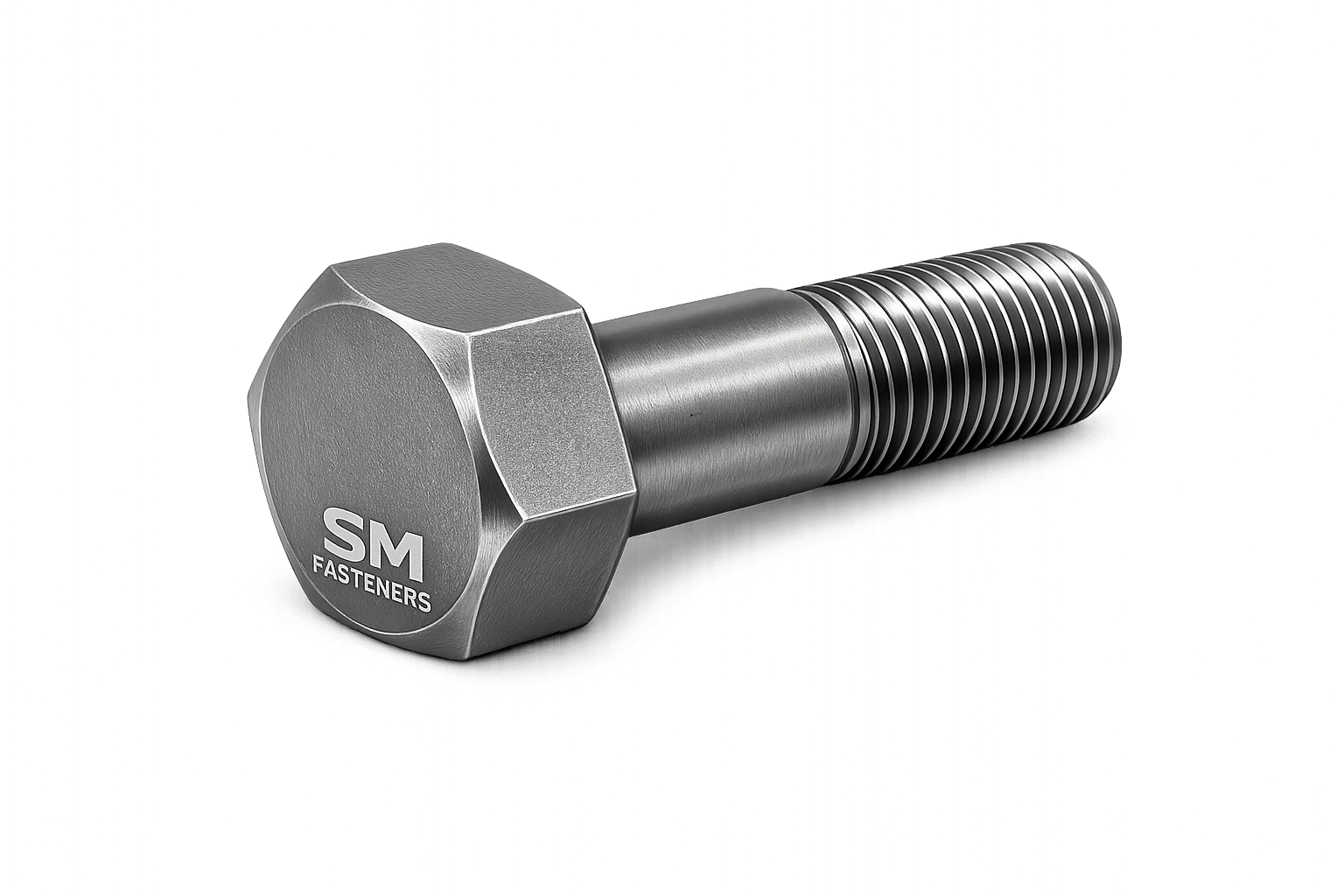
Heavy hex bolts possess larger head dimensions than standard hex bolts.
Advantages
- Higher wrenching strength
- Improved load distribution
- Better gasket compression
- Preferred for pressure-containing joints
Typical Industries
- Oil & Gas
- LNG
- Refineries
- Petrochemical plants
Governing Standards
| Standard | Description |
|---|---|
| ASME B18.2.1 | Heavy hex bolts |
| ASTM A193 | High-performance stud and bolt materials |
| ASTM F468 | Nickel alloy bolts |
24. Stud Bolt
Stud bolts are threaded on both ends or fully threaded throughout.
Benefits
- Uniform preload distribution
- Easier maintenance
- Reduced flange damage
- Preferred for critical pressure joints
Applications
- ASME B16.5 flanges
- B16.47 flanges
- Heat exchangers
- Pressure vessels
Applicable Standards
| Standard | Description |
|---|---|
| ASTM A193 | Alloy stud bolts |
| ASME B16.5 | Flanged joints |
| ASME PCC-1 | Bolted flange assembly |
25. Threaded Rods
Threaded rods provide continuous threading along the entire length.
Typical Uses
- Pipe supports
- Structural anchoring
- Hangers
- Equipment mounting
Available Thread Forms
- Metric Coarse
- Metric Fine
- UNC
- UNF
- BSW
- BSF
26. Socket Head Cap Screws
Used where space limitations prevent hex head installation.
Characteristics
- Cylindrical head
- Internal hex drive
- High preload capability
- Precision assembly applications
Standards
| Standard | Description |
|---|---|
| ISO 4762 | Metric socket screws |
| DIN 912 | Socket head cap screws |
| ASME B18.3 | Inch socket screws |
27. Set Screws
Used primarily for positioning and locking functions.
Common Drive Types
- Hex socket
- Slotted
- Torx
Point Styles
- Cone point
- Flat point
- Dog point
- Cup point
28. Hex Nuts
Hex nuts provide mating threads for bolt assemblies.
Types
- Standard Hex Nut
- Heavy Hex Nut
- Jam Nut
- Lock Nut
Standards
| Standard | Description |
|---|---|
| ISO 4032 | Standard hex nuts |
| DIN 934 | Hex nuts |
| ASTM F467 | Non-ferrous nuts |
| ASME B18.2.2 | Inch series nuts |
29. Heavy Hex Nuts
Heavy hex nuts are preferred in:
- Pressure vessels
- Flanges
- Structural joints
- High-load assemblies
Advantages include:
- Greater bearing area
- Improved thread engagement
- Higher preload capability
30. Lock Nuts
Designed to resist vibration-induced loosening.
Types
| Type | Function |
|---|---|
| Prevailing Torque | Friction locking |
| Nylon Insert | Mechanical retention |
| All-Metal Lock Nut | High temperature locking |
| Serrated Flange Nut | Surface grip |
For severe temperatures, all-metal lock nuts are preferred.
31. Flat Washers
Flat washers distribute compressive loads.
Functions
- Prevent surface damage
- Reduce embedment
- Improve preload consistency
Standards
| Standard | Description |
|---|---|
| ISO 7089 | Plain washers |
| DIN 125 | Flat washers |
| ASTM F436 | Hardened washers |
32. Spring Lock Washers
Provide resistance against loosening caused by vibration.
Common Types
- Helical spring washer
- Split lock washer
Used where dynamic loads are present.
33. Belleville Washers
Disc spring washers capable of generating high spring force.
Applications include:
- Thermal expansion compensation
- Vibration resistance
- High-temperature equipment
34. Structural Fasteners
Designed for structural steel connections.
Requirements
- Controlled preload
- Dimensional accuracy
- Traceability
Industries:
- Bridges
- Industrial structures
- Offshore platforms
35. Custom Machined Hastelloy Fasteners
SM Fasteners manufactures engineered specials including:
- Collar bolts
- Shoulder bolts
- Special studs
- Flange bolts
- Eye bolts
- Foundation bolts
- Anchor bolts
- Reactor fasteners
Custom designs are produced from approved engineering drawings and project specifications.
36. Dimensional Logic of Fasteners
Fastener geometry directly affects:
- Load capacity
- Fatigue resistance
- Joint reliability
- Installation torque
Key dimensions include:
| Parameter | Symbol |
|---|---|
| Diameter | d |
| Pitch | P |
| Head Width | s |
| Head Height | k |
| Thread Length | b |
| Overall Length | L |
37. Metric Thread Geometry
Metric threads follow ISO profile standards.
Thread Angle
Designation Example
M20 × 2.5 × 100
Where:
| Parameter | Meaning |
|---|---|
| M | Metric thread |
| 20 | Nominal diameter |
| 2.5 | Pitch |
| 100 | Length |
38. Unified Thread Geometry
Used extensively in North America.
UNC
Unified National Coarse
UNF
Unified National Fine
Thread angle:
39. Whitworth Thread Geometry
Widely encountered in legacy British installations.
Thread Angle
Standards:
- BSW
- BSF
40. Standard Metric Hex Bolt Dimensions
ISO 4014 / ISO 4017
| Size | Pitch (mm) | Head Width (mm) | Head Height (mm) |
|---|---|---|---|
| M6 | 1.0 | 10 | 4 |
| M8 | 1.25 | 13 | 5.3 |
| M10 | 1.5 | 16 | 6.4 |
| M12 | 1.75 | 18 | 7.5 |
| M16 | 2.0 | 24 | 10 |
| M20 | 2.5 | 30 | 12.5 |
| M24 | 3.0 | 36 | 15 |
| M30 | 3.5 | 46 | 18.7 |
| M36 | 4.0 | 55 | 22.5 |
41. Standard Length Ranges
| Diameter | Typical Length Range |
|---|---|
| M6 | 10–150 mm |
| M8 | 12–200 mm |
| M10 | 16–300 mm |
| M12 | 20–400 mm |
| M16 | 25–500 mm |
| M20 | 30–600 mm |
| M24 | 40–800 mm |
| M30 | 50–1000 mm |
| M36 | 60–1200 mm |
42. Thread Standards and Tolerances
Metric Threads
| Standard | Tolerance Class |
|---|---|
| ISO 965 | 6g / 6H |
| ISO 261 | Metric series |
| ISO 262 | Preferred pitches |
Unified Threads
| Standard | Tolerance |
|---|---|
| ASME B1.1 | 2A / 2B |
| ASME B1.1 | 3A / 3B |
British Threads
| Standard | Thread Type |
|---|---|
| BS 84 | BSW |
| BS 84 | BSF |
43. Thread Standards Comparison Table
| Standard | Thread Angle | Application |
|---|---|---|
| Metric ISO | 60° | Global industrial use |
| UNC | 60° | North America |
| UNF | 60° | High preload joints |
| BSW | 55° | Legacy equipment |
| BSF | 55° | Fine thread systems |
44. Coarse vs Fine Thread Selection
| Feature | Coarse Thread | Fine Thread |
|---|---|---|
| Assembly Speed | Faster | Slower |
| Damage Resistance | Better | Moderate |
| Tensile Stress Area | Lower | Higher |
| Vibration Resistance | Moderate | Better |
| Adjustment Accuracy | Lower | Higher |
Fine threads are commonly selected for:
- Pressure-containing equipment
- High vibration systems
- Precision assemblies
45. Thread Engagement Chart
| Diameter | Recommended Minimum Engagement |
|---|---|
| M6 | 6 mm |
| M8 | 8 mm |
| M10 | 10 mm |
| M12 | 12 mm |
| M16 | 16 mm |
| M20 | 20 mm |
| M24 | 24 mm |
| M30 | 30 mm |
46. International Standards Governing Hastelloy Fasteners
Material Standards
| Standard | Scope |
|---|---|
| ASTM B574 | Hastelloy fasteners |
| ASTM B335 | Hastelloy bars |
| ASTM B574 UNS N10276 | C-276 fasteners |
| ASTM B574 UNS N06022 | C-22 fasteners |
| ASTM B574 UNS N10665 | B-2 fasteners |
| ASTM B574 UNS N10675 | B-3 fasteners |
47. Fastener Manufacturing Standards
| Standard | Scope |
|---|---|
| ASTM F468 | Non-ferrous bolts |
| ASTM F467 | Non-ferrous nuts |
| ISO 898 (Reference) | Mechanical property framework |
| ASME B18 Series | Dimensional requirements |
48. Pressure Equipment Standards
| Standard | Application |
|---|---|
| ASME BPVC Section VIII | Pressure vessels |
| ASME PCC-1 | Flange assembly |
| API 6A | Wellhead equipment |
| API 17D | Offshore systems |
| API 20E | Alloy bolting |
| API 20F | Nickel alloy bolting |
49. NACE Compliance Considerations
For sour service:
Applicable standards:
- NACE MR0175
- ISO 15156
Evaluation includes:
- Hardness control
- Environmental compatibility
- Sulfide stress cracking resistance
Material acceptance depends on project requirements.
50. Dimensional and Standards Summary
Proper fastener selection requires evaluation of:
- Diameter
- Thread form
- Pitch
- Length
- Head geometry
- Applicable ASTM standards
- ISO dimensional requirements
- API compliance requirements
- NACE requirements
- Installation accessibility
For EPC, offshore, LNG, petrochemical, and process-industry projects, dimensional compliance and standards conformance are equally important as corrosion resistance.
SM Fasteners manufactures Hastelloy C-276, C-22, B-2, and B-3 fasteners in metric and imperial dimensions, including custom-engineered configurations, with full traceability and inspection documentation aligned with international project specifications.
51. Materials Engineering of Hastelloy Fasteners
Hastelloy alloys belong to the family of nickel-based corrosion-resistant alloys (CRAs) specifically engineered for aggressive chemical environments where stainless steel, duplex stainless steel, and many conventional nickel alloys experience rapid deterioration.
The selection of Hastelloy fasteners should be based on:
- Corrosion mechanism
- Process chemistry
- Operating temperature
- Pressure conditions
- Mechanical load requirements
- Maintenance intervals
- Regulatory compliance requirements
For critical EPC projects, material selection must consider total lifecycle performance rather than initial acquisition cost.
52. Chemical Composition of Hastelloy Grades
Hastelloy C-276 (UNS N10276)
| Element | Typical % |
|---|---|
| Nickel | Balance |
| Chromium | 14.5–16.5 |
| Molybdenum | 15.0–17.0 |
| Iron | 4.0–7.0 |
| Tungsten | 3.0–4.5 |
| Cobalt | ≤2.5 |
| Carbon | ≤0.01 |
Key Characteristics
- Excellent overall corrosion resistance
- Outstanding pitting resistance
- Superior crevice corrosion resistance
- Excellent chloride resistance
- Broadest industrial applicability
Hastelloy C-22 (UNS N06022)
| Element | Typical % |
|---|---|
| Nickel | Balance |
| Chromium | 20–22.5 |
| Molybdenum | 12.5–14.5 |
| Iron | 2–6 |
| Tungsten | 2.5–3.5 |
| Carbon | ≤0.015 |
Key Characteristics
- Highest resistance to oxidizing environments
- Superior wet chlorine resistance
- Excellent mixed acid resistance
- Exceptional crevice corrosion resistance
Hastelloy B-2 (UNS N10665)
| Element | Typical % |
|---|---|
| Nickel | Balance |
| Molybdenum | 26–30 |
| Iron | ≤2 |
| Chromium | ≤1 |
| Carbon | ≤0.02 |
Key Characteristics
- Outstanding hydrochloric acid resistance
- Excellent reducing acid performance
- Poor oxidizing acid resistance
Hastelloy B-3 (UNS N10675)
| Element | Typical % |
|---|---|
| Nickel | Balance |
| Molybdenum | 27–32 |
| Iron | 1–3 |
| Chromium | 1–3 |
| Carbon | ≤0.01 |
Key Characteristics
- Improved thermal stability
- Better fabrication characteristics
- Improved resistance to stress corrosion cracking
- Enhanced weld heat affected zone stability
53. Material Selection Criteria
Selection should be based on service environment.
Decision Matrix
| Environment | Recommended Grade |
|---|---|
| Hydrochloric Acid | B-2, B-3 |
| Sulfuric Acid | C-276 |
| Nitric Acid | C-22 |
| Chlorine Gas | C-22 |
| Seawater | C-276 |
| Sour Gas Service | C-276 |
| Flue Gas Desulfurization | C-276 |
| Mixed Acid Processing | C-22 |
| Pharmaceutical Processing | C-22 |
| Offshore Equipment | C-276 |
54. Material Comparison Table
Hastelloy Grade Comparison
| Property | C-276 | C-22 | B-2 | B-3 |
|---|---|---|---|---|
| UTS (MPa) | 690 | 690 | 760 | 760 |
| Yield Strength (MPa) | 283 | 310 | 350 | 350 |
| Elongation (%) | 40 | 45 | 40 | 45 |
| Pitting Resistance | Excellent | Excellent+ | Moderate | Moderate |
| Chloride Resistance | Excellent | Excellent | Good | Good |
| Hydrochloric Acid Resistance | Very Good | Good | Excellent | Excellent |
| Oxidizing Acids | Excellent | Outstanding | Poor | Poor |
| Fabrication Ease | Good | Good | Moderate | Better |
| Relative Cost | High | High | High | High |
55. Corrosion Resistance Comparison
Corrosion Resistance vs Environment
| Environment | C-276 | C-22 | B-2 | B-3 |
|---|---|---|---|---|
| Seawater | Excellent | Excellent | Good | Good |
| Chlorides | Excellent | Excellent | Moderate | Moderate |
| Hydrochloric Acid | Very Good | Good | Excellent | Excellent |
| Sulfuric Acid | Excellent | Excellent | Good | Good |
| Nitric Acid | Good | Excellent | Poor | Poor |
| Wet Chlorine | Excellent | Outstanding | Poor | Poor |
| H₂S | Excellent | Excellent | Good | Good |
| Acetic Acid | Excellent | Excellent | Very Good | Very Good |
| Phosphoric Acid | Excellent | Excellent | Good | Good |
56. Mechanical Properties Table
Room Temperature Mechanical Properties
| Grade | Tensile Strength MPa | Yield Strength MPa | Hardness HRB |
|---|---|---|---|
| C-276 | 690 | 283 | 100 Max |
| C-22 | 690 | 310 | 100 Max |
| B-2 | 760 | 350 | 100 Max |
| B-3 | 760 | 350 | 100 Max |
57. Temperature Capability Table
| Grade | Continuous Service Temperature |
|---|---|
| C-276 | 1040°C |
| C-22 | 1250°C |
| B-2 | 900°C |
| B-3 | 925°C |
Actual fastener design limits must consider creep, stress relaxation, and joint preload retention.
58. NACE MR0175 / ISO 15156 Considerations
For sour service applications:
Engineers must evaluate:
- Sulfide stress cracking resistance
- Hardness limits
- Process chemistry
- Partial pressure of H₂S
Typical requirements include:
- Controlled hardness
- Material traceability
- Chemical verification
- Mechanical testing
SM Fasteners can provide material traceability documentation supporting project-specific NACE requirements.
59. Heat Treatment Objectives
Heat treatment is performed to:
- Restore corrosion resistance
- Remove residual stresses
- Dissolve harmful precipitates
- Improve metallurgical uniformity
Unlike carbon steel fasteners, Hastelloy grades are not strengthened primarily through quench and temper processes.
Strength is mainly derived from alloy chemistry and controlled processing.
60. Solution Annealing Process
The most important heat treatment for Hastelloy alloys.
Objectives
- Dissolve secondary phases
- Restore corrosion resistance
- Improve ductility
- Improve microstructural uniformity
Typical Process
| Grade | Temperature Range |
|---|---|
| C-276 | 1120–1175°C |
| C-22 | 1120–1175°C |
| B-2 | 1065–1095°C |
| B-3 | 1065–1100°C |
Followed by:
- Rapid water quenching
- Accelerated cooling
61. Stress Relief Treatment
Applied when required after machining or fabrication.
Purpose
- Reduce residual stresses
- Improve dimensional stability
Improper stress relief may reduce corrosion resistance and should only be performed under controlled procedures.
62. Metallurgical Risks During Heat Treatment
Improper thermal exposure may result in:
Sigma Phase Formation
Effects:
- Reduced ductility
- Reduced corrosion resistance
Carbide Precipitation
Effects:
- Localized corrosion susceptibility
- Intergranular attack
Grain Growth
Effects:
- Reduced mechanical properties
Proper furnace control is essential.
63. Raw Material Verification
Manufacturing begins with certified raw material.
Verification includes:
- Heat number confirmation
- Chemical analysis
- Material grade validation
- Dimensional inspection
Required documentation:
- Mill Test Certificate (MTC)
- EN 10204 3.1 certification
64. End-to-End Manufacturing Workflow
Manufacturing Flow
Raw Material Receipt
↓
Material Verification
↓
Cutting
↓
Hot Forging / Machining
↓
Heat Treatment
↓
Descaling
↓
Thread Manufacturing
↓
Dimensional Inspection
↓
PMI Verification
↓
Mechanical Testing
↓
Surface Finishing
↓
Final Inspection
↓
Packaging
↓
Dispatch
65. Hot Forging Process
Hot forging is preferred for larger fasteners.
Advantages
- Refined grain structure
- Improved fatigue performance
- Higher mechanical integrity
- Reduced internal discontinuities
Typical products:
- Hex bolts
- Heavy hex bolts
- Stud bolts
- Nuts
66. Precision Machining Operations
CNC machining is utilized for:
- Custom fasteners
- Special geometry components
- Tight tolerance products
Operations include:
- Turning
- Milling
- Drilling
- Boring
- Slotting
- Thread generation
67. Thread Rolling vs Thread Cutting
Thread Rolling
Advantages:
- Improved fatigue strength
- Compressive surface stresses
- Superior surface finish
Recommended for standard production.
Thread Cutting
Advantages:
- Suitable for large diameters
- Suitable for special threads
- Useful for low production quantities
Comparison Table
| Feature | Rolled Threads | Cut Threads |
|---|---|---|
| Fatigue Resistance | Higher | Lower |
| Surface Finish | Better | Moderate |
| Production Speed | Faster | Slower |
| Tooling Cost | Higher | Lower |
| Thread Strength | Higher | Lower |
68. Manufacturing Traceability
Each batch should maintain traceability through:
- Heat numbers
- Production lot numbers
- Inspection records
- Material certificates
Traceability is essential for:
- Oil & Gas projects
- LNG facilities
- Offshore platforms
- Nuclear-adjacent applications
69. Surface Finishing Requirements
Nickel alloys typically do not require protective coatings for corrosion resistance.
However surface finishing improves:
- Appearance
- Cleanliness
- Installation performance
- Galling resistance
70. Common Surface Finishes
| Finish Type | Purpose |
|---|---|
| As Manufactured | Standard industrial use |
| Pickled | Oxide removal |
| Passivated | Surface cleaning |
| Electropolished | Reduced contamination |
| Mechanical Polished | Improved appearance |
71. Pickling Process
Purpose:
- Oxide removal
- Heat tint removal
- Surface cleaning
Benefits:
- Improved corrosion resistance
- Better inspection visibility
72. Electropolishing
Used in:
- Pharmaceutical plants
- Food processing
- Semiconductor facilities
Advantages:
- Smooth surface finish
- Reduced bacterial retention
- Enhanced cleanability
73. Anti-Galling Coatings
Nickel alloys are susceptible to galling during assembly.
Recommended solutions include:
PTFE Coating
Advantages:
- Lower friction
- Improved installation
Silver Plating
Advantages:
- Excellent anti-seize properties
- High-temperature capability
Molybdenum Disulfide
Advantages:
- Reduced friction coefficient
- Improved preload consistency
74. Surface Finish Comparison Table
| Surface Finish | Corrosion Resistance | Galling Resistance | Cost |
|---|---|---|---|
| As Manufactured | Good | Moderate | Low |
| Pickled | Better | Moderate | Low |
| Passivated | Better | Moderate | Low |
| Electropolished | Excellent | Good | High |
| PTFE Coated | Excellent | Excellent | Medium |
| Silver Plated | Excellent | Outstanding | High |
75. Coating Performance Comparison
| Coating | Friction Reduction | Temperature Capability | Typical Application |
|---|---|---|---|
| PTFE | Excellent | Moderate | Chemical plants |
| Silver Plating | Excellent | High | High-temperature bolting |
| MoS₂ | Excellent | High | Pressure vessels |
| Dry Film Lubricant | Good | Moderate | Offshore systems |
76. Galvanic Compatibility Considerations
When Hastelloy fasteners are installed with:
- Carbon steel
- Stainless steel
- Aluminum
- Copper alloys
Engineers must evaluate galvanic potential.
Mitigation methods:
- Isolation washers
- Non-metallic sleeves
- PEEK washers
- Insulating bushings
77. PEEK Fasteners and Isolation Components
SM Fasteners also manufactures PEEK fasteners and engineered polymer isolation components.
Applications include:
- Electrical isolation
- Galvanic corrosion prevention
- Semiconductor systems
- Chemical processing equipment
PEEK components are often combined with Hastelloy assemblies to improve long-term reliability.
78. Manufacturing and Material Selection Summary
The performance of Hastelloy C-276, C-22, B-2, and B-3 fasteners depends on:
- Correct alloy selection
- Controlled heat treatment
- Certified raw material sourcing
- Precision manufacturing
- Proper thread generation
- Traceable quality systems
- Appropriate surface finish selection
Through ISO 9001-certified manufacturing processes, material traceability controls, precision forging, machining, inspection, and custom engineering capabilities, SM Fasteners supports EPC contractors, OEMs, offshore operators, petrochemical facilities, and industrial maintenance organizations requiring high-performance Hastelloy fastening solutions for severe service environments.