

SMO 254
1 . Industry Context
Overview of SMO 254 Fasteners
SMO 254 (UNS S31254 / W.Nr. 1.4547) is a high-alloy austenitic stainless steel specifically developed for severe chloride-bearing and highly corrosive industrial environments where conventional stainless steels such as 304, 316, and even many duplex grades may not provide sufficient corrosion resistance.
The alloy was originally engineered for seawater handling systems and has since become a preferred material for:
- Offshore platforms
- Desalination plants
- Marine engineering systems
- Chemical processing facilities
- Flue gas desulfurization systems
- Pulp and paper bleaching plants
- Petrochemical installations
- LNG terminals
- Power generation facilities
In bolting applications, SMO 254 fasteners are selected when:
- Chloride concentration exceeds acceptable limits for 316L
- Pitting corrosion is a primary concern
- Crevice corrosion risk exists
- Long service life is required
- Maintenance shutdown costs are significant
- Corrosion-induced joint failures cannot be tolerated
For critical EPC projects, SMO 254 fasteners provide a balance between corrosion performance and mechanical reliability while avoiding the substantially higher cost associated with nickel-based alloys such as Hastelloy C276 or Inconel 625.
Position of SMO 254 Among Corrosion Resistant Alloys
Material Hierarchy
| Material Grade | UNS Number | Corrosion Resistance | Relative Cost | Typical Use |
|---|---|---|---|---|
| SS304 | S30400 | Moderate | Low | General industrial |
| SS316L | S31603 | Good | Low-Medium | Chemical & marine |
| Duplex 2205 | S32205 | Very Good | Medium | Offshore |
| Super Duplex 2507 | S32750 | Excellent | High | Seawater systems |
| SMO 254 | S31254 | Excellent | High | Chloride-rich environments |
| Alloy 625 | N06625 | Outstanding | Very High | Extreme service |
| Hastelloy C276 | N10276 | Outstanding | Very High | Aggressive chemical media |
SMO 254 occupies a strategic position between Super Duplex and Nickel Alloys, offering exceptional chloride resistance while maintaining austenitic toughness and fabrication characteristics.
2. Technical Definition
What is SMO 254?
SMO 254 is a high-molybdenum, high-nitrogen austenitic stainless steel standardized as:
| Designation System | Grade |
|---|---|
| UNS | S31254 |
| EN | 1.4547 |
| ASTM | A182 F44 |
| ASTM Bolting | A193 B8M Class 2 (special chemistry) |
| Common Trade Name | SMO 254 |
The alloy chemistry is optimized to maximize resistance to:
- Pitting corrosion
- Crevice corrosion
- Chloride stress corrosion cracking
- Seawater attack
- Acidic process streams
Chemical Composition
SMO 254 Typical Composition
| Element | Content (%) |
|---|---|
| Chromium (Cr) | 19.5 – 20.5 |
| Nickel (Ni) | 17.5 – 18.5 |
| Molybdenum (Mo) | 6.0 – 6.5 |
| Nitrogen (N) | 0.18 – 0.22 |
| Copper (Cu) | 0.5 – 1.0 |
| Carbon (C) | Max 0.02 |
| Manganese (Mn) | Max 1.0 |
| Silicon (Si) | Max 0.8 |
| Iron (Fe) | Balance |
The combination of:
- High Molybdenum
- Elevated Nickel
- Controlled Nitrogen
produces superior corrosion resistance compared with conventional stainless steels.
3. Functional Role of Fasteners in Industrial Assemblies
Why Fasteners Matter
A bolted joint is fundamentally a force transmission system.
The fastener’s primary purpose is not simply holding components together but creating sufficient preload to:
- Maintain gasket compression
- Resist external loads
- Prevent separation
- Minimize vibration loosening
- Ensure structural integrity
In severe environments, corrosion-resistant fasteners become as important as the equipment materials themselves.
A corrosion-resistant pipe flange can fail prematurely if lower-grade fasteners experience:
- Crevice attack
- SCC cracking
- Thread degradation
- Galvanic corrosion
Typical SMO 254 Fastener Products
SM Fasteners manufactures and supplies:
Bolts
- Hex Head Bolts
- Heavy Hex Bolts
- Structural Bolts
- Flange Bolts
- Stud Bolts
- Anchor Bolts
Nuts
- Hex Nuts
- Heavy Hex Nuts
- Jam Nuts
- Lock Nuts
- Slotted Nuts
Washers
- Plain Washers
- Heavy Duty Washers
- Structural Washers
- Spring Washers
Threaded Components
- Fully Threaded Rods
- Double-End Studs
- Tap-End Studs
- Special Machined Fasteners
Custom Engineered Components
- Offshore bolting systems
- High-temperature assemblies
- Pressure vessel fasteners
- Corrosion-critical custom hardware
4. Load Mechanics of SMO 254 Fasteners
Fundamental Load Types
Industrial fasteners are subjected to:
Tensile Load
Force acts parallel to bolt axis.
Examples:
- Pipe flanges
- Pressure vessels
- Structural joints
Formula:
Where:
- σ = Stress (MPa)
- F = Applied Force (N)
- A = Stress Area (mm²)
Shear Load
Force acts perpendicular to bolt axis.
Formula:
Applications:
- Structural steel connections
- Machinery mounting
- Offshore support systems
Combined Loading
Real-world joints often experience:
- Tension
- Shear
- Bending
- Dynamic fatigue
simultaneously.
SMO 254 fasteners maintain integrity because of:
- High toughness
- Austenitic ductility
- Excellent crack resistance
5. Preload Principles
What is Preload?
Preload is the tensile force intentionally induced during tightening.
The clamping force generated by preload keeps joint members compressed.
Relationship
A correctly preloaded fastener:
- Prevents joint separation
- Increases fatigue resistance
- Improves sealing
- Minimizes vibration loosening
Why Preload Matters
A bolt carrying external load without sufficient preload experiences:
- Cyclic stress
- Fatigue cracking
- Thread loosening
- Leakage
Proper preload shifts most external loading into the joint members rather than the fastener itself.
6. Torque–Tension Relationship
Fundamental Equation
Where:
| Variable | Meaning |
|---|---|
| T | Torque (N·m) |
| K | Nut Factor |
| F | Desired Preload (N) |
| D | Nominal Diameter (m) |
Nut Factor Values
| Condition | K Factor |
|---|---|
| Dry | 0.20–0.25 |
| Zinc Coated | 0.18–0.22 |
| PTFE Coated | 0.10–0.15 |
| Moly Lubricated | 0.12–0.18 |
Because friction consumes 85–90% of tightening torque, lubrication has a major influence on achieved preload.
7. Clamping Force and Joint Integrity
Friction-Based Load Transfer
The joint relies on friction generated between mating surfaces.
Where:
- μ = Coefficient of friction
- Fclamp = Clamping force
Increasing preload increases frictional resistance.
Joint Separation Prevention
For a joint to remain closed:
When external force exceeds preload:
- Gasket unloading occurs
- Joint separation begins
- Leakage becomes possible
This is particularly critical in:
- Offshore flanges
- LNG piping
- Chemical reactors
- Pressure vessels
8. Thread Engagement Principles
Importance of Thread Engagement
Insufficient thread engagement causes:
- Thread stripping
- Reduced tensile capacity
- Uneven stress distribution
Recommended minimum engagement:
| Material Combination | Engagement |
|---|---|
| Steel-to-Steel | 1 × Diameter |
| Stainless-to-Stainless | 1.25 × Diameter |
| Soft Materials | 1.5–2 × Diameter |
Load Distribution Across Threads
Thread loading is not uniform.
Approximate load distribution:
| Thread Position | Load Share |
|---|---|
| First Thread | 34% |
| Second Thread | 23% |
| Third Thread | 16% |
| Fourth Thread | 11% |
| Remaining Threads | 16% |
This explains why thread quality is critical for high-integrity bolting systems.
9. Joint Design Principles
Key Engineering Objectives
A bolted joint must:
Provide Sufficient Clamp Force
To resist:
- Separation
- Leakage
- Slip
Maintain Load Under Service Conditions
Including:
- Temperature cycling
- Vibration
- Pressure fluctuations
Prevent Fastener Failure
By controlling:
- Stress concentration
- Fatigue loading
- Corrosion attack
Joint Stiffness Concept
The external load shared by a fastener depends on:
- Bolt stiffness
- Joint stiffness
A stiffer joint transfers less load to the fastener.
This improves fatigue performance significantly.
10. Failure Mechanisms in SMO 254 Fasteners
Although highly corrosion resistant, improper design can still result in failure.
Fatigue Failure
Caused by:
- Cyclic loading
- Inadequate preload
- Stress concentration
Indicators:
- Beach marks
- Crack propagation zones
Mitigation:
- Correct preload
- Rolled threads
- Proper washer selection
Thread Stripping
Causes:
- Insufficient engagement
- Over-tightening
- Material mismatch
Mitigation:
- Correct nut height
- Controlled torque
- Thread inspection
Galling
Austenitic stainless steels are susceptible to galling.
Causes:
- High friction
- Lack of lubrication
- Rapid tightening
Prevention:
- Moly lubricant
- PTFE coating
- Controlled installation speed
Crevice Corrosion
Occurs in:
- Thread roots
- Washer interfaces
- Gasket contact regions
SMO 254 offers exceptional resistance but proper joint design remains necessary.
Stress Corrosion Cracking (SCC)
SMO 254 significantly outperforms 304 and 316 in chloride SCC environments.
Common SCC sources:
- Hot chloride solutions
- Residual stresses
- Tensile loading
Applications include:
- Desalination plants
- Offshore topsides
- Seawater cooling systems
11. Corrosion Resistance Performance
PREN Value Comparison
Pitting Resistance Equivalent Number:
Typical PREN
| Material | PREN |
|---|---|
| 304 | 18 |
| 316L | 25 |
| Duplex 2205 | 35 |
| Super Duplex 2507 | 42–45 |
| SMO 254 | 43–45 |
This places SMO 254 among the highest-performing stainless steel fastener materials for chloride resistance.
12. Corrosion Resistance vs Environment
| Environment | 316L | Duplex 2205 | SMO 254 |
|---|---|---|---|
| Fresh Water | Excellent | Excellent | Excellent |
| Seawater Splash Zone | Moderate | Very Good | Excellent |
| Full Seawater Immersion | Poor | Good | Excellent |
| Chloride Process Streams | Moderate | Very Good | Excellent |
| Sulfuric Acid Dilute | Good | Good | Excellent |
| Phosphoric Acid | Moderate | Good | Excellent |
| Caustic Solutions | Good | Good | Excellent |
| Offshore Atmosphere | Good | Very Good | Excellent |
| Desalination Systems | Moderate | Good | Excellent |
13. Product Types and Variants
SMO 254 fasteners are produced in a wide range of configurations to meet the requirements of pressure-retaining equipment, offshore structures, rotating machinery, marine systems, and corrosion-critical process plants.
Selection of fastener geometry directly influences:
- Load distribution
- Joint stiffness
- Fatigue performance
- Assembly accessibility
- Maintenance requirements
- Corrosion resistance
- Inspection capability
SM Fasteners manufactures standard and custom-engineered SMO 254 fastening systems according to international specifications and project requirements.
14. SMO 254 Bolt Types
Hex Head Bolts
The most widely used industrial fastening system.
Features
- External wrench drive
- High load carrying capability
- Easy field installation
- Suitable for structural and pressure applications
Applications
- Steel structures
- Process equipment
- Pipe supports
- Offshore modules
Standards
| Standard | Description |
|---|---|
| ISO 4014 | Partially threaded hex bolt |
| ISO 4017 | Fully threaded hex bolt |
| DIN 931 | Partially threaded |
| DIN 933 | Fully threaded |
| ASTM A193 | Pressure service bolting |
Heavy Hex Bolt
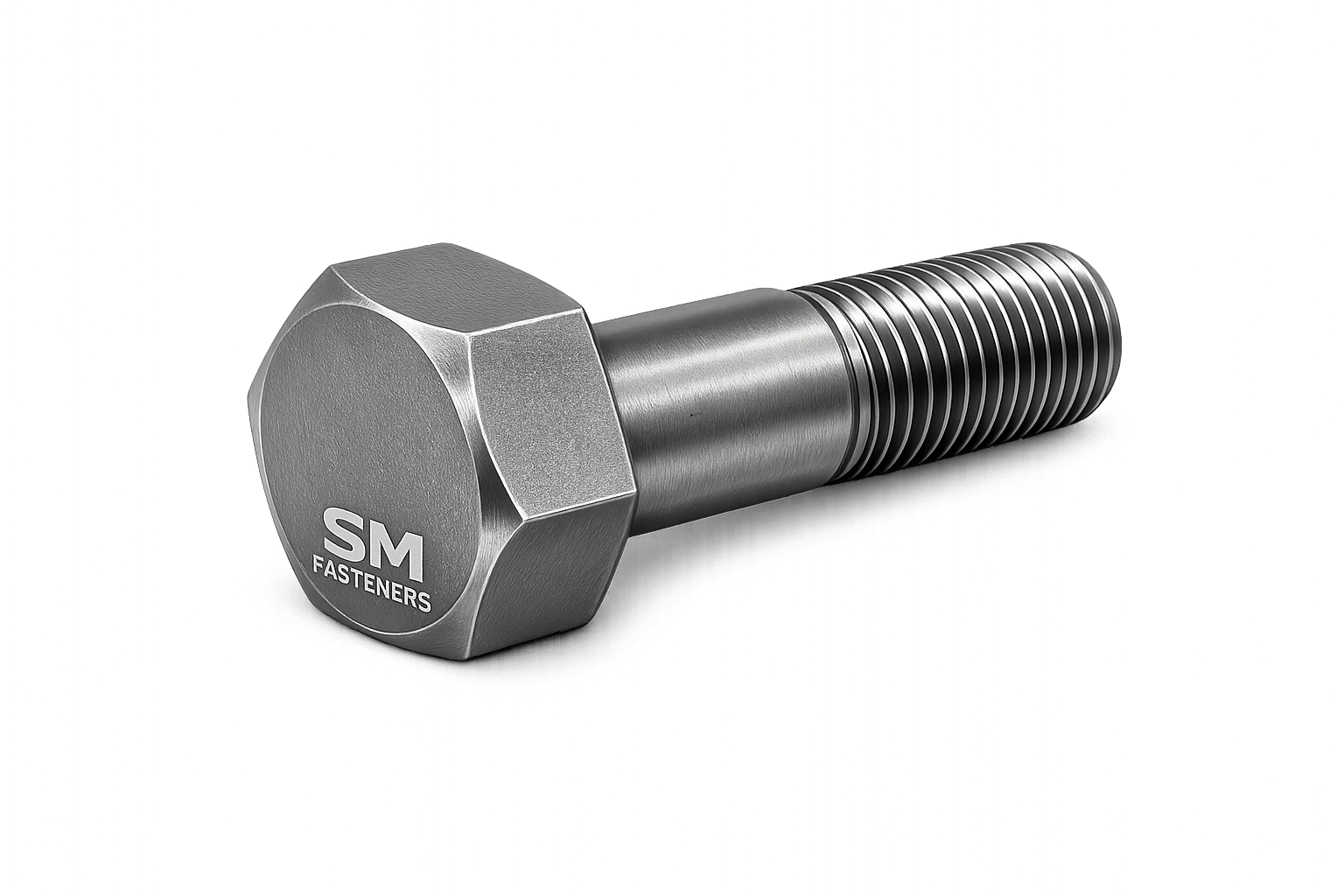
Heavy hex bolts feature larger bearing surfaces and increased wrenching dimensions.
Advantages
- Improved load distribution
- Enhanced fatigue resistance
- Better suitability for critical joints
Typical Uses
- Pressure vessels
- Heat exchangers
- Structural steel
- Flange assemblies
Flange Bolts
Feature an integrated washer face.
Benefits
- Larger bearing area
- Reduced loosening risk
- Improved vibration resistance
Used extensively in:
- Pumps
- Compressors
- Mechanical equipment
Structural Bolts
Designed specifically for steel construction.
Characteristics include:
- High tensile strength
- Controlled mechanical properties
- Reliable preload performance
Applications:
- Bridges
- Buildings
- Transmission towers
- Offshore structures
Eye Bolts
Used for:
- Lifting
- Rigging
- Equipment handling
Important design considerations:
- Load angle
- Thread engagement
- Safety factor
Anchor Bolts
Installed into concrete foundations.
Types include:
- L-Type
- J-Type
- Straight Anchor
- Sleeve Anchor
- Chemical Anchor Assemblies
Applications:
- Equipment foundations
- Pipe racks
- Structural supports
15. Stud Bolt Variants
Stud bolts are the preferred fastening system for flange joints in process industries.
Fully Threaded Stud Bolts
Threaded along entire length.
Advantages:
- Maximum adjustment flexibility
- Suitable for heavy hex nuts
Standards:
- ASTM A193
- DIN 975
- DIN 976
Applications:
- Pipe flanges
- Valves
- Heat exchangers
Tap-End Studs
Threaded on both ends.
One end screws directly into equipment.
Applications:
- Pumps
- Turbines
- Compressors
Double-End Studs
Used where repeated assembly and disassembly occur.
Benefits:
- Reduced thread wear
- Improved maintenance access
16. Nut Types
Nut selection must always correspond with:
- Bolt strength
- Thread class
- Corrosion resistance
- Operating temperature
Hex Nuts
Most common fastening nut.
Standards:
| Standard | Description |
|---|---|
| ISO 4032 | Standard hex nut |
| DIN 934 | Hex nut |
| ASTM A194 | Pressure service nut |
Heavy Hex Nuts
Feature:
- Increased thickness
- Greater bearing surface
- Enhanced stripping resistance
Used in:
- Pressure vessels
- Offshore systems
- Structural assemblies
Jam Nuts
Reduced thickness.
Used for:
- Locking
- Positioning
- Secondary retention
Lock Nuts
Designed to resist loosening from vibration.
Variants:
- Nylon insert
- All-metal lock
- Prevailing torque
Slotted Nuts
Used with cotter pins.
Applications:
- Rotating assemblies
- Safety-critical equipment
17. Washer Types
Washers play a significant role in load distribution and joint reliability.
Plain Washers
Functions:
- Increase bearing area
- Reduce surface damage
- Improve preload distribution
Standards:
- ISO 7089
- DIN 125
Heavy Duty Washers
Used with:
- Structural bolts
- High preload joints
Benefits:
- Reduced bearing stress
- Improved fatigue performance
Spring Washers
Provide limited anti-loosening functionality.
Standards:
- DIN 127
Belleville Washers
Disc spring geometry provides:
- Load compensation
- Thermal expansion control
Applications:
- High-temperature systems
- Dynamic assemblies
18. Threaded Rods
Threaded rods are commonly used in:
- Pipe supports
- Structural bracing
- Equipment anchoring
Standards:
| Standard | Description |
|---|---|
| DIN 975 | Continuous thread rod |
| DIN 976 | Stud bolt rod |
| ASTM A193 | Pressure service rod |
19. Dimensional Logic of Fasteners
Fastener dimensions are engineered to ensure:
- Adequate strength
- Assembly compatibility
- Tool accessibility
- Standard interchangeability
Critical dimensions include:
- Diameter
- Pitch
- Head size
- Head height
- Thread length
- Overall length
20. Metric Thread System
The ISO Metric thread is the most common thread form globally.
Designation:
Example:
Where:
- 20 mm = nominal diameter
- 2.5 mm = thread pitch
21. Metric Thread Dimensions
Standard Coarse Pitch Series
| Thread Size | Pitch (mm) |
|---|---|
| M6 | 1.0 |
| M8 | 1.25 |
| M10 | 1.5 |
| M12 | 1.75 |
| M16 | 2.0 |
| M20 | 2.5 |
| M24 | 3.0 |
| M30 | 3.5 |
| M36 | 4.0 |
| M42 | 4.5 |
| M48 | 5.0 |
| M56 | 5.5 |
| M64 | 6.0 |
22. Standard Hex Bolt Dimensions
ISO 4014 / DIN 931 Reference Dimensions
| Size | Across Flats (mm) | Head Height (mm) |
|---|---|---|
| M6 | 10 | 4 |
| M8 | 13 | 5.3 |
| M10 | 17 | 6.4 |
| M12 | 19 | 7.5 |
| M16 | 24 | 10 |
| M20 | 30 | 12.5 |
| M24 | 36 | 15 |
| M30 | 46 | 18.7 |
| M36 | 55 | 22.5 |
| M42 | 65 | 26 |
| M48 | 75 | 30 |
23. Standard Length Availability
SMO 254 fasteners are commonly supplied in:
| Diameter | Standard Length Range |
|---|---|
| M6 | 10–100 mm |
| M8 | 12–150 mm |
| M10 | 16–200 mm |
| M12 | 20–300 mm |
| M16 | 25–400 mm |
| M20 | 30–500 mm |
| M24 | 40–600 mm |
| M30 | 50–800 mm |
| M36 | 60–1000 mm |
Custom lengths can be manufactured according to EPC specifications.
24. Thread Standards and Tolerances
Fastener interchangeability depends on thread standard compliance.
Metric Threads
| Standard | Description |
|---|---|
| ISO 68 | Basic profile |
| ISO 261 | Preferred diameters |
| ISO 262 | Metric combinations |
| ISO 965 | Tolerance system |
Tolerance Class:
| Component | Class |
|---|---|
| External Thread | 6g |
| Internal Thread | 6H |
Unified Threads (UNC / UNF)
Widely used in:
- North America
- Offshore projects
- Oil & gas facilities
Standards:
| Standard | Description |
|---|---|
| ASME B1.1 | Unified Threads |
| ASTM Standards | Bolting Applications |
UNC Series
| Size | TPI |
|---|---|
| 1/4″ | 20 |
| 5/16″ | 18 |
| 3/8″ | 16 |
| 1/2″ | 13 |
| 5/8″ | 11 |
| 3/4″ | 10 |
| 1″ | 8 |
UNF Series
| Size | TPI |
|---|---|
| 1/4″ | 28 |
| 5/16″ | 24 |
| 3/8″ | 24 |
| 1/2″ | 20 |
| 5/8″ | 18 |
| 3/4″ | 16 |
| 1″ | 12 |
25. British Thread Standards
Many legacy installations still utilize British thread forms.
BSW
British Standard Whitworth
Thread angle:
Applications:
- Railways
- Heritage equipment
- Legacy infrastructure
BSF
British Standard Fine
Provides:
- Improved vibration resistance
- Higher tensile stress area
Thread Standards Comparison Table
| Thread System | Angle | Typical Application |
|---|---|---|
| Metric ISO | 60° | Global industrial |
| UNC | 60° | Heavy engineering |
| UNF | 60° | High strength joints |
| BSW | 55° | Legacy systems |
| BSF | 55° | Precision assemblies |
26. Applicable International Standards
SMO 254 fasteners may be supplied according to numerous international specifications.
ISO Standards
| Standard | Scope |
|---|---|
| ISO 4014 | Hex bolts |
| ISO 4017 | Hex bolts fully threaded |
| ISO 4032 | Hex nuts |
| ISO 7089 | Plain washers |
| ISO 898 | Mechanical properties |
| ISO 965 | Thread tolerances |
| ISO 3506 | Stainless fasteners |
ASTM Standards
| Standard | Scope |
|---|---|
| ASTM A193 | Alloy bolting materials |
| ASTM A194 | Nuts |
| ASTM F593 | Stainless bolts |
| ASTM F594 | Stainless nuts |
| ASTM A276 | Stainless bar stock |
| ASTM A479 | Pressure service bar |
DIN Standards
| Standard | Description |
|---|---|
| DIN 931 | Hex bolts |
| DIN 933 | Hex bolts |
| DIN 934 | Hex nuts |
| DIN 125 | Plain washers |
| DIN 127 | Spring washers |
| DIN 975 | Threaded rod |
| DIN 976 | Stud bolts |
British Standards
| Standard | Description |
|---|---|
| BS 3692 | Metric fasteners |
| BS 4190 | Hex bolts and nuts |
| BS 4320 | Washers |
| BSW | Whitworth threads |
| BSF | Fine threads |
27. Dimensional Specification Table
Standard Metric Bolt Dimensions
| Size | Pitch | Head AF | Head Height | Tensile Stress Area (mm²) |
|---|---|---|---|---|
| M6 | 1.0 | 10 | 4.0 | 20.1 |
| M8 | 1.25 | 13 | 5.3 | 36.6 |
| M10 | 1.5 | 17 | 6.4 | 58 |
| M12 | 1.75 | 19 | 7.5 | 84.3 |
| M16 | 2.0 | 24 | 10 | 157 |
| M20 | 2.5 | 30 | 12.5 | 245 |
| M24 | 3.0 | 36 | 15 | 353 |
| M30 | 3.5 | 46 | 18.7 | 561 |
| M36 | 4.0 | 55 | 22.5 | 817 |
28. Fastener Selection Criteria
SMO 254 should be selected when one or more of the following conditions exist:
Corrosion Drivers
- High chloride exposure
- Seawater service
- Crevice corrosion risk
- Acid contamination
Mechanical Drivers
- High preload requirements
- Dynamic loading
- Long-term reliability demands
Operational Drivers
- Difficult maintenance access
- Long design life requirements
- Offshore exposure
- Critical safety systems
Regulatory Drivers
- Owner specifications
- EPC standards
- Corrosion management programs
- Asset integrity requirements
29. Interchangeability Considerations
Before replacing fasteners, engineers must verify:
- Diameter
- Pitch
- Length
- Head geometry
- Material grade
- Corrosion resistance
- Strength level
- Applicable project specification
Substituting standard stainless fasteners for SMO 254 can significantly reduce service life in aggressive chloride environments.
30. SM Fasteners Manufacturing Capability
SM Fasteners supplies SMO 254 fasteners in metric, UNC, UNF, BSW, and BSF thread forms, including standard and custom-engineered dimensions for EPC, offshore, petrochemical, desalination, LNG, power generation, and marine applications. Manufacturing is supported by ISO 9001 quality management systems, MSME registration, UKAF-certified quality processes, material traceability, and project-specific inspection requirements.
31. Material Grades and Selection Criteria
Understanding SMO 254 as a Fastener Material
SMO 254 (UNS S31254 / EN 1.4547) belongs to the family of high-alloy austenitic stainless steels specifically engineered for aggressive chloride-bearing environments.
The alloy combines:
- High Chromium content
- High Nickel content
- High Molybdenum content
- Nitrogen strengthening
to achieve exceptional resistance to:
- Pitting corrosion
- Crevice corrosion
- Chloride stress corrosion cracking
- Seawater attack
- Acidic process media
Unlike duplex and super duplex alloys, SMO 254 maintains a fully austenitic microstructure, providing:
- Excellent toughness
- High ductility
- Superior fabrication characteristics
- Excellent low-temperature performance
32. Material Selection Methodology
Material selection should never be based solely on mechanical strength.
Industrial fastener selection requires evaluation of:
Environmental Factors
- Chloride concentration
- Moisture exposure
- Immersion conditions
- Acid contamination
- H₂S exposure
- Process temperature
Mechanical Factors
- Static load
- Dynamic load
- Fatigue loading
- Impact loading
- Thermal expansion effects
Operational Factors
- Maintenance accessibility
- Inspection frequency
- Service life expectations
- Asset criticality
Selection Decision Matrix
| Service Condition | Recommended Material |
|---|---|
| Fresh Water | SS316L |
| Marine Atmosphere | Duplex 2205 |
| Seawater Immersion | SMO 254 |
| Desalination Plants | SMO 254 |
| Offshore Splash Zone | SMO 254 |
| Chloride Process Streams | SMO 254 |
| Sour Gas Service | Super Duplex / SMO 254 (Project Specific) |
| Aggressive Acid Service | Hastelloy C276 |
| High Temperature Corrosion | Inconel 625 |
33. Mechanical Properties of SMO 254
Mechanical properties are governed by:
- Chemical composition
- Solution annealing
- Cold working
- Manufacturing process
Typical Mechanical Properties
| Property | Typical Value |
|---|---|
| Tensile Strength (UTS) | ≥ 650 MPa |
| Yield Strength (0.2%) | ≥ 300 MPa |
| Elongation | ≥ 35% |
| Reduction of Area | ≥ 50% |
| Hardness | ≤ 220 HB |
| Elastic Modulus | 195 GPa |
| Density | 8.0 g/cm³ |
Mechanical Property Comparison
| Material | Yield (MPa) | UTS (MPa) | Elongation (%) |
|---|---|---|---|
| SS304 | 215 | 515 | 40 |
| SS316L | 220 | 515 | 40 |
| Duplex 2205 | 450 | 620 | 25 |
| Super Duplex 2507 | 550 | 800 | 20 |
| SMO 254 | 300 | 650 | 35 |
| Inconel 625 | 460 | 830 | 30 |
34. Mechanical Behavior Under Service Loads
Elastic Behavior
Below yield strength:
Where:
- σ = Stress
- E = Modulus of Elasticity
- ε = Strain
SMO 254 exhibits predictable elastic behavior suitable for critical bolted joints.
Plastic Deformation
When yield strength is exceeded:
- Permanent deformation occurs
- Clamp force decreases
- Joint reliability deteriorates
Proper design ensures service stresses remain below allowable limits.
35. Proof Load Fundamentals
Proof load represents the maximum load a fastener can sustain without permanent deformation.
Approximate Proof Loads for SMO 254 Fasteners
| Size | Stress Area (mm²) | Proof Load (kN) |
|---|---|---|
| M8 | 36.6 | 9.5 |
| M10 | 58 | 15 |
| M12 | 84.3 | 22 |
| M16 | 157 | 41 |
| M20 | 245 | 64 |
| M24 | 353 | 92 |
| M30 | 561 | 146 |
| M36 | 817 | 212 |
Actual values depend on manufacturing specification and project requirements.
36. Tensile Strength Table
Estimated Tensile Capacity
| Size | Stress Area (mm²) | Ultimate Tensile Load (kN) |
|---|---|---|
| M8 | 36.6 | 23.8 |
| M10 | 58 | 37.7 |
| M12 | 84.3 | 54.8 |
| M16 | 157 | 102 |
| M20 | 245 | 159 |
| M24 | 353 | 229 |
| M30 | 561 | 365 |
| M36 | 817 | 531 |
Based on minimum UTS of approximately 650 MPa.
37. Temperature Performance
Recommended Service Temperature Range
| Condition | Temperature |
|---|---|
| Cryogenic Service | Down to -196°C |
| General Service | Ambient |
| Elevated Service | Up to 550°C |
| Intermittent Service | Up to 600°C |
Thermal Expansion
SMO 254 exhibits thermal expansion similar to other austenitic stainless steels.
| Property | Value |
|---|---|
| Coefficient of Thermal Expansion | 16 × 10⁻⁶ /°C |
This must be considered in:
- Flange design
- Heat exchangers
- Offshore piping systems
38. NACE and Sour Service Considerations
For oil and gas applications:
- NACE MR0175
- ISO 15156
requirements may apply.
Evaluation typically includes:
- Hardness limits
- Sulfide stress cracking resistance
- Process chemistry
Project specifications should always govern final acceptance.
39. Heat Treatment of SMO 254
Unlike carbon steel fasteners, SMO 254 derives corrosion resistance from its chemistry rather than quench-and-temper processing.
Solution Annealing
Primary heat treatment process.
Typical Temperature
Followed by:
- Rapid water quenching
- Controlled cooling
Purpose of Solution Annealing
Removes:
- Harmful precipitates
- Sigma phase
- Intermetallic compounds
Restores:
- Corrosion resistance
- Ductility
- Toughness
40. Effects of Improper Heat Treatment
Improper thermal processing may cause:
Sigma Phase Formation
Results in:
- Reduced toughness
- Reduced corrosion resistance
Chromium Depletion
Leads to:
- Intergranular attack
- Premature corrosion
Reduced Mechanical Reliability
Potential consequences:
- Cracking
- Loss of ductility
- Reduced fatigue performance
41. Manufacturing Workflow
SM Fasteners follows a controlled manufacturing process to ensure compliance with customer and project specifications.
42. Raw Material Procurement
Manufacturing begins with certified raw material.
Typical forms include:
- Round bars
- Forging stock
- Wire rods
Material verification includes:
- Heat number confirmation
- Chemical composition review
- Mill Test Certificate verification
Material Documentation
Typical standards:
- ASTM A276
- ASTM A479
- EN 10088
Material is linked to heat numbers for complete traceability.
43. Incoming Material Inspection
Verification includes:
Chemical Analysis
Methods:
- Optical Emission Spectroscopy
- PMI Testing
Dimensional Verification
Checks:
- Diameter
- Straightness
- Surface condition
Documentation Review
Validation of:
- MTC
- Heat number
- Specification compliance
44. Forging Process
Hot Forging
Used for:
- Hex bolts
- Heavy hex bolts
- Special fasteners
Advantages:
- Improved grain flow
- Better fatigue resistance
- Enhanced mechanical integrity
Forging Sequence
- Raw material cutting
- Heating
- Forging
- Trimming
- Cooling
- Inspection
45. Machining Operations
Machining is used for:
- Custom fasteners
- Precision studs
- Special geometries
Processes include:
- CNC turning
- Milling
- Drilling
- Slotting
46. Thread Manufacturing
Thread quality directly influences fastener performance.
Thread Rolling
Preferred process.
Benefits:
- Compressive residual stresses
- Improved fatigue life
- Superior surface finish
Thread Cutting
Used when:
- Large diameters exist
- Custom thread forms are required
- Small production runs are involved
Comparison
| Characteristic | Rolled Thread | Cut Thread |
|---|---|---|
| Fatigue Strength | Excellent | Good |
| Surface Finish | Superior | Moderate |
| Production Rate | High | Medium |
| Material Waste | Low | Higher |
| Cost Efficiency | Better | Lower |
47. Surface Preparation
Before finishing:
- Deburring
- Cleaning
- Degreasing
- Inspection
are performed.
48. Passivation Process
Passivation is strongly recommended for stainless fasteners.
Purpose
Removes:
- Free iron contamination
- Surface impurities
Promotes:
- Stable chromium oxide layer
- Enhanced corrosion resistance
Standards
| Standard | Description |
|---|---|
| ASTM A967 | Passivation |
| ASTM A380 | Cleaning & Passivation |
49. Electropolishing
Advanced finishing option.
Benefits include:
- Reduced surface roughness
- Enhanced cleanliness
- Improved corrosion resistance
- Lower bacterial adhesion
Common applications:
- Pharmaceutical
- Food processing
- Semiconductor industries
50. Surface Finish Comparison
| Finish Type | Corrosion Resistance | Surface Smoothness | Appearance |
|---|---|---|---|
| As Machined | Moderate | Moderate | Industrial |
| Pickled | Good | Moderate | Matte |
| Passivated | Excellent | Good | Clean Metallic |
| Electropolished | Outstanding | Excellent | Bright Metallic |
51. Coating Considerations for SMO 254
Because SMO 254 already possesses exceptional corrosion resistance, coatings are generally not required for corrosion protection.
Optional Functional Coatings
PTFE (Xylan)
Provides:
- Reduced friction
- Galling resistance
- Easier assembly
Molybdenum Disulfide
Provides:
- Lower nut factor
- Consistent preload
Typical Coating Selection
| Coating | Main Purpose |
|---|---|
| None | Maximum alloy exposure |
| Passivation | Corrosion enhancement |
| PTFE | Anti-galling |
| Xylan | Low friction |
| MoS₂ | Torque control |
52. Corrosion Resistance Comparison
Chloride Environment Performance
| Material | Pitting Resistance | Crevice Resistance |
|---|---|---|
| SS304 | Fair | Poor |
| SS316L | Good | Moderate |
| Duplex 2205 | Very Good | Good |
| Super Duplex 2507 | Excellent | Excellent |
| SMO 254 | Excellent | Excellent |
| Hastelloy C276 | Outstanding | Outstanding |
53. Corrosion Resistance vs Industrial Environment
| Environment | SMO 254 Performance |
|---|---|
| Marine Atmosphere | Excellent |
| Offshore Splash Zone | Excellent |
| Seawater Immersion | Excellent |
| Desalination Plants | Excellent |
| Brine Systems | Excellent |
| Chlorinated Water | Excellent |
| Phosphoric Acid | Very Good |
| Sulfuric Acid (Dilute) | Very Good |
| Caustic Service | Excellent |
| LNG Facilities | Excellent |
54. Galvanic Corrosion Considerations
When joining dissimilar metals:
Potential concerns include:
- Accelerated attack
- Localized corrosion
- Reduced service life
Recommended pairing materials:
- SMO 254
- Duplex 2205
- Super Duplex 2507
- High-alloy stainless steels
Insulating washers may be required where dissimilar metals cannot be avoided.
55. PEEK Fasteners and Hybrid Assemblies
SM Fasteners also manufactures advanced PEEK fastening solutions for specialized applications.
PEEK fasteners may be used where:
- Electrical insulation is required
- Weight reduction is critical
- Chemical resistance is required
- Metal-free assemblies are necessary
Hybrid systems may combine:
- SMO 254 structural fasteners
- PEEK insulating components
for highly specialized engineering applications.
56. Material Comparison Table
| Material | UTS (MPa) | Yield (MPa) | Corrosion Resistance | Relative Cost | Typical Application |
|---|---|---|---|---|---|
| SS304 | 515 | 215 | Moderate | Low | General Industry |
| SS316L | 515 | 220 | Good | Low-Medium | Marine & Chemical |
| Duplex 2205 | 620 | 450 | Very Good | Medium | Offshore |
| Super Duplex 2507 | 800 | 550 | Excellent | High | Seawater Systems |
| SMO 254 | 650 | 300 | Excellent | High | Desalination & Offshore |
| Inconel 625 | 830 | 460 | Outstanding | Very High | High Temperature |
| Hastelloy C276 | 690 | 280 | Outstanding | Very High | Aggressive Chemicals |
SM Fasteners Manufacturing Capability
SM Fasteners manufactures SMO 254 fasteners from fully traceable raw materials under ISO 9001 quality systems with controlled forging, machining, thread rolling, passivation, inspection, and documentation processes. Production capabilities include bolts, nuts, washers, threaded rods, custom-engineered fastening systems, and corrosion-resistant assemblies for EPC, offshore, marine, petrochemical, desalination, LNG, and power generation projects requiring high-performance stainless steel fastening solutions
57. Inspection and Quality Control Philosophy
For critical fastening systems used in offshore, petrochemical, LNG, power generation, and structural applications, quality assurance extends far beyond dimensional compliance.
The objective of quality control is to ensure that every fastener satisfies:
- Material specification requirements
- Mechanical property requirements
- Dimensional tolerances
- Traceability requirements
- Corrosion resistance expectations
- Customer and EPC specifications
SM Fasteners integrates inspection controls throughout the manufacturing cycle under ISO 9001 quality management systems, ensuring consistent compliance with project specifications and international standards.
58. Quality Control Stages
Stage 1 – Raw Material Verification
Verification includes:
Material Test Certificate Review
Checks include:
- Heat number
- Chemical composition
- Mechanical properties
- Applicable standards
Positive Material Identification (PMI)
Verification of alloy chemistry before manufacturing.
Typical PMI methods:
- XRF Analysis
- Optical Emission Spectroscopy (OES)
Stage 2 – In-Process Inspection
Performed during:
- Cutting
- Forging
- Machining
- Thread rolling
- Heat treatment
- Surface finishing
Controls include:
- Dimensional verification
- Thread inspection
- Surface quality assessment
Stage 3 – Final Inspection
Verification before shipment:
- Dimensions
- Thread accuracy
- Mechanical properties
- Surface condition
- Marking compliance
- Documentation review
59. Dimensional Inspection Requirements
Critical Dimensions
Inspection typically includes:
| Feature | Inspection Requirement |
|---|---|
| Diameter | Calibrated measurement |
| Length | Vernier / Digital measurement |
| Head Dimensions | GO/NO-GO verification |
| Thread Pitch | Thread gauge verification |
| Across Flats | Dimensional check |
| Concentricity | Project-specific requirement |
| Straightness | Visual and dimensional |
Thread Inspection
Thread integrity directly affects joint reliability.
Inspection methods:
- Thread ring gauges
- Plug gauges
- Optical profile measurement
- Coordinate Measuring Machines (CMM)
60. Mechanical Testing
Mechanical testing validates performance under load.
Tensile Testing
Conducted according to:
- ASTM standards
- ISO standards
- Customer specifications
Determines:
- Yield strength
- Ultimate tensile strength
- Elongation
Hardness Testing
Methods include:
| Method | Standard |
|---|---|
| Brinell (HB) | ASTM E10 |
| Rockwell (HRB/HRC) | ASTM E18 |
| Vickers (HV) | ASTM E92 |
Proof Load Testing
Used to verify:
- Elastic behavior
- Permanent deformation resistance
- Compliance with specification
61. Positive Material Identification (PMI)
PMI is frequently mandatory in:
- Oil & Gas
- Offshore
- LNG
- Refinery projects
Purpose
Ensures:
- Correct alloy supplied
- Material substitution prevention
- Full traceability
Typical Elements Verified
| Element | Importance |
|---|---|
| Cr | Corrosion resistance |
| Ni | Austenitic structure |
| Mo | Pitting resistance |
| N | Strength and PREN |
| Cu | Acid resistance |
62. Non-Destructive Testing (NDT)
NDT verifies integrity without damaging the fastener.
Liquid Penetrant Testing (PT)
Used to detect:
- Surface cracks
- Forging defects
- Machining defects
Applicable Standards:
- ASTM E165
- ASME Section V
Magnetic Particle Inspection (MPI)
Generally not applicable to fully austenitic SMO 254 due to non-magnetic structure.
Ultrasonic Testing (UT)
Used for:
- Large diameter studs
- Critical bolting
- Custom forged components
Detects:
- Internal discontinuities
- Voids
- Inclusions
63. Corrosion Testing
Project specifications may require:
ASTM G48 Testing
Evaluates:
- Pitting resistance
- Crevice corrosion resistance
Salt Spray Testing
Used for coated components where specified.
64. Traceability System
Traceability is critical for EPC projects.
Typical traceability includes:
- Heat number
- Manufacturing batch
- Inspection lot
- Production records
Each batch can be linked back to:
- Raw material source
- Manufacturing records
- Inspection reports
65. Fastener Marking Requirements
Marking typically includes:
- Manufacturer identification
- Material grade
- Heat number (where required)
- Project identification (special orders)
Marking must remain legible throughout service life.
66. Mechanical Properties Table
SMO 254 Fasteners
| Property | Typical Value |
|---|---|
| Yield Strength | ≥ 300 MPa |
| Tensile Strength | ≥ 650 MPa |
| Elongation | ≥ 35% |
| Hardness | ≤ 220 HB |
| Density | 8.0 g/cm³ |
| Elastic Modulus | 195 GPa |
67. Proof Load and Tensile Strength Table
| Size | Stress Area (mm²) | Proof Load (kN) | Ultimate Load (kN) |
|---|---|---|---|
| M8 | 36.6 | 9.5 | 23.8 |
| M10 | 58 | 15 | 37.7 |
| M12 | 84.3 | 22 | 54.8 |
| M16 | 157 | 41 | 102 |
| M20 | 245 | 64 | 159 |
| M24 | 353 | 92 | 229 |
| M30 | 561 | 146 | 365 |
| M36 | 817 | 212 | 531 |
68. Tightening Torque Fundamentals
Torque is applied to create preload.
Relationship:
Where:
| Symbol | Meaning |
|---|---|
| T | Torque |
| K | Nut Factor |
| F | Preload |
| D | Diameter |
69. Recommended Tightening Torque Chart
Lubricated SMO 254 Fasteners
| Size | Preload (kN) | Torque (N·m) |
|---|---|---|
| M8 | 14 | 22 |
| M10 | 22 | 44 |
| M12 | 32 | 77 |
| M16 | 60 | 190 |
| M20 | 95 | 380 |
| M24 | 137 | 660 |
| M30 | 218 | 1370 |
| M36 | 318 | 2290 |
Actual tightening values should always be verified against project specifications, lubrication condition, and gasket requirements.
70. Torque Comparison by Lubrication Condition
| Condition | Nut Factor |
|---|---|
| Dry | 0.22–0.25 |
| Light Oil | 0.18–0.22 |
| Moly Lubricant | 0.12–0.18 |
| PTFE Coated | 0.10–0.15 |
| Xylan Coated | 0.10–0.15 |
71. Preload Calculation Example
Formula
Example
M20 SMO 254 Bolt
Given:
- Torque = 380 N·m
- K = 0.20
- Diameter = 0.020 m
Calculation:
Result:
Preload generated ≈ 95 kN
72. Joint Design Example
Flange Connection
Given:
- Internal pressure = 20 bar
- Gasket seating force = 400 kN
- Number of bolts = 8
Required preload per bolt:
Applying design factor:
Recommended preload per bolt:
This methodology is commonly used for flange joint calculations.
73. Weight Chart for SMO 254 Hex Bolts
Approximate Unit Weight
| Size × 100 mm | Weight/Piece (kg) | Weight/100 pcs (kg) |
|---|---|---|
| M8 | 0.04 | 4 |
| M10 | 0.07 | 7 |
| M12 | 0.11 | 11 |
| M16 | 0.22 | 22 |
| M20 | 0.39 | 39 |
| M24 | 0.62 | 62 |
| M30 | 1.10 | 110 |
| M36 | 1.82 | 182 |
Actual values vary based on thread length, head style, and customer drawings.
SM Fasteners can provide project-specific weight charts aligned with manufacturing dimensions and procurement schedules.
74. Surface Finish Performance Comparison
| Finish | Corrosion Resistance | Galling Resistance | Appearance |
|---|---|---|---|
| As Machined | Moderate | Moderate | Industrial |
| Pickled | Good | Moderate | Matte |
| Passivated | Excellent | Good | Clean Metallic |
| Electropolished | Outstanding | Good | Bright |
| PTFE Coated | Excellent | Excellent | Colored Finish |
| Xylan Coated | Excellent | Excellent | Colored Finish |
75. Industry Applications
Construction & Structural Steel
Applications include:
- Coastal structures
- Marine bridges
- Corrosion-resistant steelwork
- Infrastructure exposed to salt environments
Benefits:
- Long service life
- Reduced maintenance
- Improved reliability
Oil & Gas Industry
Upstream
Used in:
- Offshore platforms
- Wellhead equipment
- Seawater injection systems
Midstream
Applications:
- Pipeline systems
- Pump stations
- Compressor facilities
Downstream
Applications:
- Refineries
- Chemical plants
- Process piping
Petrochemical Industry
Common equipment:
- Reactors
- Heat exchangers
- Pressure vessels
- Flanged piping
SMO 254 provides excellent resistance to chloride contamination commonly encountered in process plants.
LNG Facilities
Used in:
- Cryogenic systems
- Storage terminals
- Regasification plants
Advantages:
- Excellent toughness
- Corrosion resistance
- Long-term reliability
Power Generation
Applications include:
- Cooling water systems
- Desalination units
- Emission control systems
- Coastal power plants
Marine and Shipbuilding
Applications:
- Deck equipment
- Seawater systems
- Hull structures
- Offshore vessels
Railways and Infrastructure
Used in:
- Coastal railway systems
- Bridges
- Corrosion-sensitive structures
Desalination Plants
One of the most important application sectors.
SMO 254 fasteners are widely used in:
- Reverse osmosis systems
- Brine handling systems
- Seawater intake facilities
76. PEEK Fastener Applications
SM Fasteners manufactures advanced PEEK fastening solutions for specialized industries.
PEEK fasteners are selected where:
- Electrical insulation is required
- Metal contamination must be avoided
- Weight reduction is important
- Chemical resistance is critical
Applications include:
- Semiconductor manufacturing
- Medical equipment
- Electronics
- Chemical processing systems
Hybrid assemblies often combine:
- SMO 254 structural fasteners
- PEEK insulating components
to achieve both mechanical strength and electrical isolation.
77. Packaging and Preservation
Proper packaging prevents:
- Corrosion
- Mechanical damage
- Thread damage
- Contamination
Standard Packaging
Includes:
- Polybag packing
- Box packing
- Carton packaging
- Palletized shipments
VCI Protection
VCI (Volatile Corrosion Inhibitor) packaging provides:
- Corrosion prevention
- Moisture protection
- Long transit durability
Thread Protection
Methods include:
- Plastic caps
- Thread sleeves
- Protective separators
Especially important for:
- Stud bolts
- Threaded rods
- Precision machined fasteners
78. Export Crating
For international shipments:
ISPM-15 Compliant Wooden Crates
Features:
- Fumigated timber
- Export markings
- Heavy-duty construction
Suitable for:
- Offshore projects
- EPC shipments
- Long-distance transportation
79. Export Documentation
SM Fasteners supports project documentation requirements for global industrial procurement.
Material Test Certificate (MTC)
Contains:
- Heat number
- Chemical composition
- Mechanical properties
EN 10204 3.1 Certification
Includes:
- Manufacturer verification
- Material traceability
- Test results
EN 10204 3.2 Certification
May include:
- Third-party witness inspection
- Independent verification
Inspection Reports
Can include:
- Dimensional reports
- PMI reports
- Mechanical test reports
- NDT reports
Heat Treatment Reports
Where applicable:
- Furnace records
- Temperature records
- Batch traceability
Certificate of Conformity (CoC)
Confirms:
- Compliance with purchase order
- Applicable specifications
- Inspection completion
80. Global Supply Capability
SM Fasteners supports industrial projects requiring precision-manufactured SMO 254 fasteners for critical service environments.
Manufacturing capabilities include:
- Hex bolts
- Heavy hex bolts
- Stud bolts
- Threaded rods
- Hex nuts
- Heavy hex nuts
- Washers
- Custom-engineered fasteners
Supported thread standards:
- Metric ISO
- UNC
- UNF
- BSW
- BSF
Available documentation:
- MTC
- EN 10204 3.1
- EN 10204 3.2
- PMI Reports
- Mechanical Test Reports
- Dimensional Reports
- CoC
Quality systems are supported by:
- ISO 9001 Certification
- MSME Registration
- UKAF-Certified Quality Frameworks
The combination of advanced material expertise, controlled manufacturing processes, inspection traceability, corrosion-resistant alloy capability, and custom engineering support enables SM Fasteners to supply SMO 254 fastening solutions suitable for offshore, desalination, petrochemical, LNG, marine, power generation, infrastructure, and EPC projects worldwide.
Engineering Summary
SMO 254 (UNS S31254 / EN 1.4547) fasteners represent one of the highest-performing stainless steel fastening solutions available for chloride-rich and seawater environments. The alloy’s high chromium, nickel, molybdenum, and nitrogen content delivers exceptional resistance to pitting, crevice corrosion, and chloride stress corrosion cracking while maintaining excellent toughness and fabrication characteristics. When manufactured under controlled ISO 9001 quality systems with full traceability, PMI verification, dimensional inspection, and project-specific documentation, SMO 254 fasteners provide a reliable solution for critical bolted joints in offshore, marine, desalination, petrochemical, LNG, power generation, and infrastructure applications where long-term corrosion resistance and asset integrity are essential.