

Spring Nut
1. Industry Context
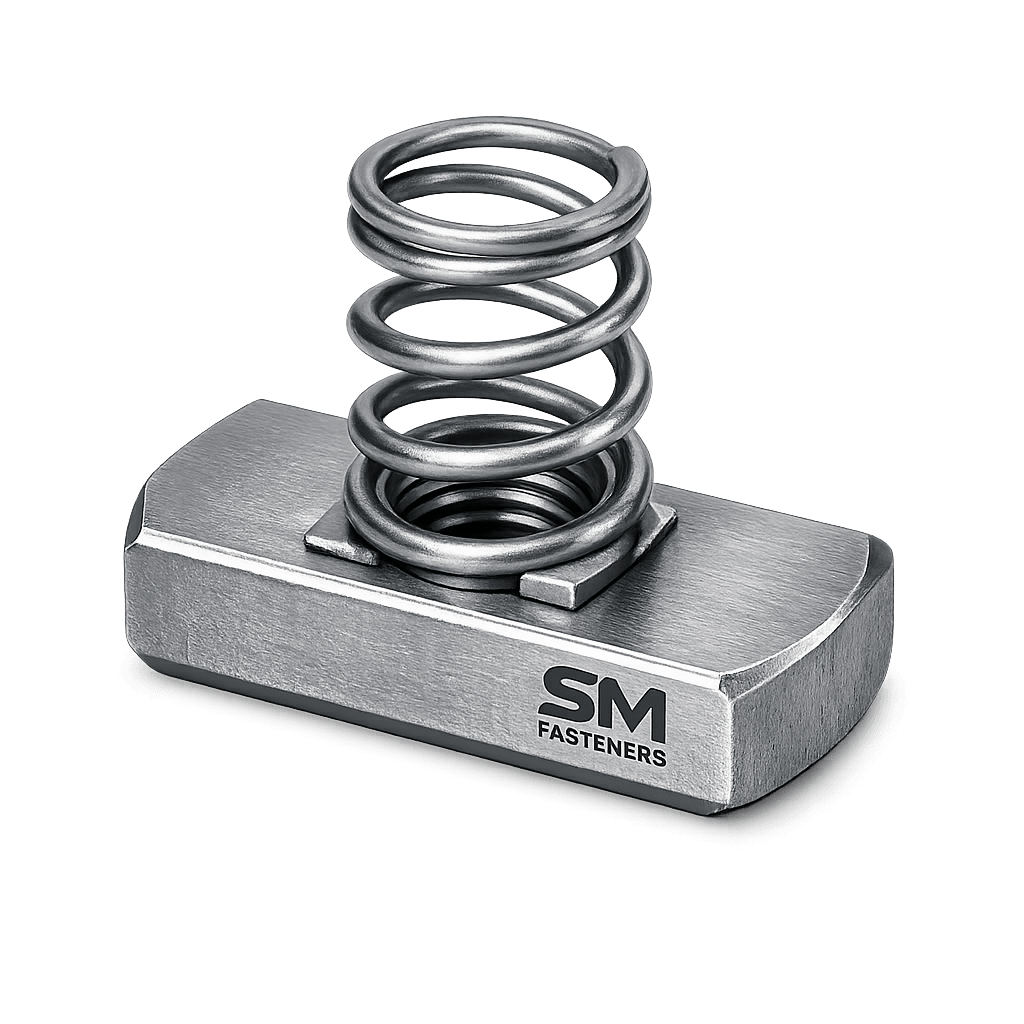
Spring Nuts are specialized fastening elements developed to enable rapid, adjustable, vibration-resistant connections in structural framing systems without welding or drilling operations. Their adoption has expanded significantly across:
- Modular construction systems
- Industrial pipe support assemblies
- Electrical and HVAC support infrastructure
- Oil & Gas cable tray installations
- Equipment mounting frames
- Solar mounting structures
- Offshore module fabrication
Modern EPC projects prioritize:
- Reduced installation time
- Adjustable positioning capability
- Repeatable torque performance
- Non-destructive assembly methods
Spring nuts directly support these requirements by allowing tool-controlled fastening inside slotted channels or strut systems.
Within engineered support systems, they function as a captured nut element that provides controlled preload while maintaining position through an integrated spring mechanism.
2. Technical Definition
A Spring Nut is defined as:
A threaded fastening component incorporating an integrated spring retainer designed to engage structural channels or strut systems, enabling positional retention prior to bolt installation while ensuring reliable load transfer after tightening.
Fundamental Components
- Threaded Nut Body
- Typically square or rectangular geometry
- Designed to fit inside strut channel lips
- Spring Element
- Stainless or spring steel clip
- Provides temporary retention force
- Bearing Surface
- Transfers clamp load into channel walls
- Thread System
- Metric or Unified thread forms
Functional Role
Spring nuts perform three simultaneous engineering functions:
| Function | Description |
|---|---|
| Positioning | Holds nut inside channel before tightening |
| Alignment | Maintains perpendicular thread engagement |
| Load Transfer | Converts bolt torque into clamping force |
3. Typical Assembly Configuration
Standard installation sequence:
- Insert spring nut into strut channel.
- Rotate 90° to lock against channel lips.
- Spring holds position.
- Bolt engagement generates preload.
- Channel lips transmit reaction forces.
No secondary wrench access is required.
4. Load Mechanics & Force Behavior
Spring nuts operate within bolted joint mechanics, not as structural springs.
The spring component does NOT carry operational load after tightening.
4.1 Force Path
4.2 Preload Generation
The governing relationship:
Where:
- Fp = preload force (N)
- T = tightening torque (Nm)
- K = nut factor (0.18–0.25 typical)
- D = nominal diameter (m)
Preload must exceed service loads to prevent joint slip.
4.3 Load Types Acting on Spring Nut Assemblies
| Load Type | Effect |
|---|---|
| Tensile Load | Direct bolt loading |
| Shear Load | Channel slip resistance |
| Dynamic Load | Vibration exposure |
| Thermal Expansion | Relaxation risk |
| Impact Load | Momentary overload |
4.4 Frictional Behavior
Three friction zones influence torque:
- Thread flank friction (~40%)
- Under-head friction (~50%)
- Elastic deformation (~10%)
Proper lubrication dramatically affects preload accuracy.
5. Joint Design Principles
Spring nuts are used primarily in adjustable structural support joints rather than permanent welded structures.
Key Design Requirements
✔ Adequate thread engagement
✔ Channel compatibility
✔ Correct preload
✔ Controlled torque application
✔ Corrosion resistance selection
5.1 Thread Engagement Rule
Minimum engagement:
| Bolt Diameter | Minimum Engagement |
|---|---|
| ≤ M8 | 1 × Diameter |
| M10–M16 | 1–1.5 × Diameter |
| ≥ M20 | 1.5 × Diameter |
5.2 Channel Load Interaction
Load capacity depends on:
- Channel thickness
- Lip geometry
- Material strength
- Nut bearing area
Failure usually occurs in the channel, not the nut.
5.3 Anti-Rotation Mechanism
Spring nut geometry creates:
- Mechanical locking against channel lips
- Increased frictional resistance
- Improved vibration resistance
6. Torque–Tension Relationship
Engineering tightening must account for friction variability.
Typical preload utilization:
| Application | Target Preload |
|---|---|
| Static supports | 60–70% proof load |
| Vibrating systems | 70–80% proof load |
| Dynamic machinery | 75–85% proof load |
7. Failure Mechanisms
7.1 Thread Stripping
Occurs when:
- Channel thickness insufficient
- Incorrect grade combination
7.2 Fatigue Failure
Caused by:
- Insufficient preload
- Cyclic vibration
7.3 Slip Failure
Common in poorly torqued assemblies.
7.4 Hydrogen Embrittlement
Risk exists for:
- Electroplated high-strength carbon steels (>1000 MPa)
Mitigation:
- Controlled baking process.
7.5 Stress Corrosion Cracking
Critical environments:
- Chlorides
- H₂S service
- Offshore installations
Material selection becomes decisive.
8. Engineering Selection Criteria
| Parameter | Consideration |
|---|---|
| Load | Static / Dynamic |
| Environment | Indoor / Offshore |
| Material | Strength vs corrosion |
| Installation | Accessibility |
| Standards Compliance | Project specification |
9. Application Relevance in Modern Engineering
Spring nuts enable:
- No-weld installation philosophy
- Faster EPC execution
- Reconfigurable infrastructure
- Reduced hot-work permits (Oil & Gas)
They are therefore heavily specified in:
- Refineries
- LNG terminals
- Metro rail systems
- Data centers
- Power plants
10. SM Fasteners Engineering Positioning
SM Fasteners manufactures Spring Nuts under:
- ISO 9001 Quality Management System
- UKAF certified processes
- MSME registered industrial manufacturing
Capabilities include:
- Standardized production
- Custom geometry engineering
- Exotic alloy manufacturing
- PEEK fastener integration
- Global EPC project supply
All designs align with internationally accepted bolted joint engineering practices.
11. Product Types and Engineering Variants
Spring Nuts are engineered to accommodate different channel systems, load requirements, and installation environments. Selection is driven by compatibility with structural framing standards and mechanical performance expectations.
11.1 Standard Spring Nut (Long Spring Type)
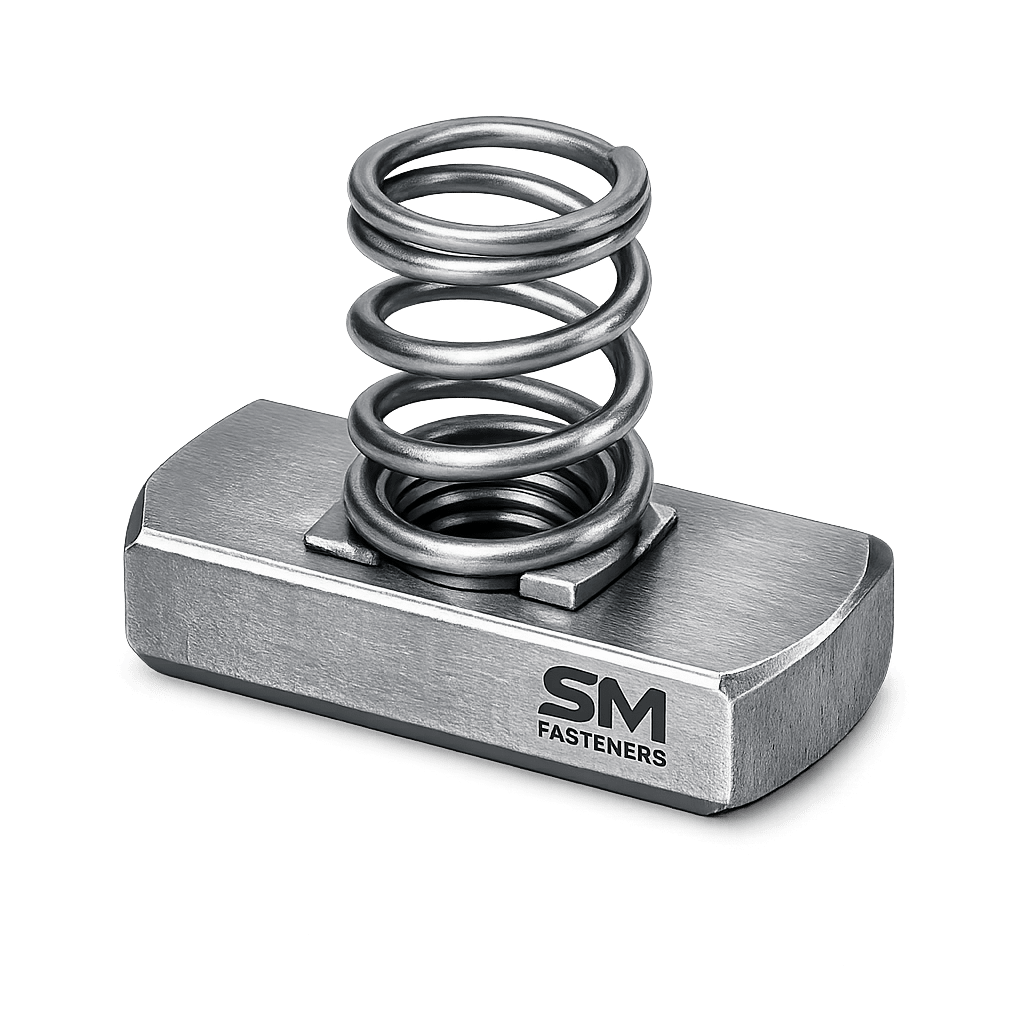
Description
- Rectangular nut body
- Extended spring clip
- Maximum retention during installation
Engineering Characteristics
- Strong pre-installation holding force
- Ideal for overhead installations
- High positional stability
Typical Applications
- HVAC suspension systems
- Cable trays
- Pipe supports
- Industrial ceilings
11.2 Short Spring Nut
Description
- Compact spring element
- Reduced insertion resistance
Engineering Advantages
- Faster installation
- Suitable for shallow channels
- Lower insertion torque
Used when rapid assembly outweighs retention strength.
11.3 No-Spring Channel Nut (Channel Nut Only)
Although not technically a spring nut, this variant is commonly interchangeable.
- No spring retainer
- Requires manual positioning
Used where access is available from both sides.
11.4 Serrated Spring Nut
Includes engineered teeth or serrations on the bearing surface.
Function
- Penetrates coating layers
- Improves slip resistance
- Enhances vibration resistance
Common in railway and heavy equipment installations.
11.5 Heavy-Duty Spring Nut
Designed for structural loading conditions.
Features:
- Increased body thickness
- Larger bearing surface
- Higher proof load capacity
Typical industries:
- Oil & Gas pipe racks
- Offshore modules
- Power plant structures
11.6 Stainless Steel Spring Nut
Used in corrosive environments:
- Offshore platforms
- Food processing
- Chemical plants
- Pharmaceutical facilities
Materials:
- A2-70
- A4-80
- Duplex stainless steels
11.7 PEEK Spring Nut (Specialized Engineering Variant)
SM Fasteners provides high-performance polymer spring nuts manufactured from PEEK for specialized environments.
Advantages
- Electrically non-conductive
- Lightweight
- Chemical resistant
- Non-magnetic
- Radiation resistant
Applications include:
- Semiconductor manufacturing
- Medical equipment
- Electrical insulation assemblies
- LNG instrumentation supports
12. Dimensional Logic and Geometry
Spring nut geometry is dictated by channel profile interaction rather than external wrench size.
12.1 Fundamental Dimensional Parameters
| Symbol | Description |
|---|---|
| D | Thread Diameter |
| P | Thread Pitch |
| W | Nut Width |
| L | Nut Length |
| H | Nut Thickness |
| S | Spring Height |
| B | Bearing Area |
| C | Channel Compatibility Width |
12.2 Channel Compatibility Concept
Spring nuts are designed to engage:
- 41 × 41 mm strut channels
- 41 × 21 mm half channels
- 52 mm heavy structural channels
Load capacity depends heavily on channel lip geometry.
12.3 Typical Dimensional Specification Table
(SM Fasteners Standard Manufacturing Range)
| Thread Size | Pitch (mm) | Nut Width W (mm) | Length L (mm) | Thickness H (mm) | Spring Height (mm) | Approx Weight (g/pc) |
|---|---|---|---|---|---|---|
| M6 | 1.0 | 12 | 20 | 5 | 10 | 9 |
| M8 | 1.25 | 13 | 22 | 6 | 11 | 14 |
| M10 | 1.5 | 15 | 25 | 8 | 13 | 25 |
| M12 | 1.75 | 18 | 30 | 10 | 14 | 40 |
| M16 | 2.0 | 22 | 35 | 12 | 16 | 70 |
Dimensions may be customized according to EPC project specifications.
13. Geometry Engineering Considerations
13.1 Bearing Surface Design
Engineering objective:
- Maximize load distribution
- Prevent channel deformation
- Reduce localized stress concentration
13.2 Spring Design Mechanics
Spring element provides:
- Temporary retention force only
- Controlled insertion resistance
- Assembly alignment
Typical spring material hardness:
- 38–45 HRC
13.3 Thread Geometry
Threads are manufactured using:
- Cold rolled threads (preferred)
- Precision tapped threads (special alloys)
Benefits of rolled threads:
- Improved fatigue strength
- Grain flow continuity
- Higher surface hardness
14. Thread Forms and International Compatibility
Spring nuts supplied by SM Fasteners support global project requirements.
14.1 Metric Thread System
Applicable Standards:
- ISO 261 — Metric thread series
- ISO 724 — Basic dimensions
- ISO 965 — Tolerances
- ISO 898-2 — Mechanical properties
Common tolerances:
- Internal thread class: 6H
14.2 Unified Thread System (UNC / UNF)
Used in:
- American OEM equipment
- Offshore modules
- LNG export plants
Standards:
- ASME B1.1
- ASTM A563 compatibility
14.3 British Thread Forms
Still specified in legacy infrastructure.
- BSW — British Standard Whitworth
- BSF — British Standard Fine
15. Thread Standards & Tolerance Table
| Thread System | Standard | Flank Angle | Typical Fit |
|---|---|---|---|
| Metric | ISO 261 | 60° | 6H / 6g |
| UNC | ASME B1.1 | 60° | 2B / 2A |
| UNF | ASME B1.1 | 60° | 2B / 2A |
| BSW | BS 84 | 55° | Medium |
| BSF | BS 84 | 55° | Fine |
16. Property Class Compatibility
Spring nuts must match bolt mechanical strength.
| Nut Property Class | Compatible Bolt Class |
|---|---|
| Class 6 | ≤ 5.8 bolts |
| Class 8 | 8.8 bolts |
| Class 10 | 10.9 bolts |
| Class 12 | 12.9 bolts |
Mismatch may cause thread stripping.
17. Applicable International Standards
Spring nuts are function-based components; therefore compliance involves multiple standard systems.
Dimensional & Mechanical Standards
- ISO 898-2 — Nut mechanical properties
- DIN 928 / DIN 929 (reference geometries)
- ASTM A563 — Carbon steel nuts
- ASTM F594 — Stainless steel nuts
- DIN EN 1090 — Structural assemblies
- ISO 4759 — Fastener tolerances
- BS 4190 — Metric fasteners
Material Standards
- ASTM A193 / A194
- ASTM A320 (low temperature)
- ASTM F593 stainless steels
- NACE MR0175 / ISO 15156 (sour service)
18. Interchangeability Considerations
EPC projects require interchangeability between global suppliers.
Critical checks include:
- Channel size compatibility
- Thread tolerance matching
- Property class verification
- Coating thickness allowance
- Torque calibration adjustments
SM Fasteners maintains dimensional conformity enabling replacement within international modular systems.
19. Dimensional Tolerance Philosophy
Engineering tolerances ensure:
- Proper channel rotation
- Controlled clearance
- No thread misalignment
Typical tolerances:
| Parameter | Tolerance |
|---|---|
| Width | ±0.20 mm |
| Length | ±0.30 mm |
| Thread pitch | ISO tolerance |
| Parallelism | ≤0.1 mm |
20. Weight Chart (SM Fasteners Reference Data)
| Size | Weight / Piece (g) | Weight / 100 pcs (kg) |
|---|---|---|
| M6 | 9 | 0.90 |
| M8 | 14 | 1.40 |
| M10 | 25 | 2.50 |
| M12 | 40 | 4.00 |
| M16 | 70 | 7.00 |
Weight data supports:
- Structural load estimation
- Logistics planning
- Export documentation
- EPC material take-off calculations
21. Engineering Selection Flow (Design Logic)
Step 1: Identify channel system
Step 2: Define load requirement
Step 3: Select bolt grade
Step 4: Match nut property class
Step 5: Select material for environment
Step 6: Confirm coating specification
Step 7: Verify torque requirement
22. SM Fasteners Manufacturing Scope
SM Fasteners provides:
- Standard spring nut production
- Heavy-duty engineered variants
- Custom channel compatibility
- High-alloy & exotic material capability
- PEEK engineered fasteners
- Global dimensional compliance
All production follows ISO 9001 documented process control ensuring dimensional repeatability and audit-ready traceability
23. Material Engineering Philosophy
Material selection for Spring Nuts is a critical engineering decision because performance depends on the interaction of:
- Mechanical strength
- Corrosion resistance
- Temperature stability
- Galling resistance
- Environmental compatibility
- Long-term preload retention
Unlike conventional nuts, spring nuts operate inside channels where inspection access is limited, requiring materials capable of long service life without maintenance.
SM Fasteners manufactures Spring Nuts across a full industrial material spectrum to meet global EPC specifications.
24. Industrial Material Grades
24.1 Carbon Steel Spring Nuts
Primary choice for structural applications.
Typical Grades
- ASTM A563 Grade A
- ASTM A563 Grade DH
- ISO Property Class 8 / 10
- EN 1.0038 / C1018 / C1022
Characteristics
- High strength-to-cost ratio
- Suitable for indoor and coated outdoor service
- Excellent machinability and forming behavior
Applications:
- Construction framing
- HVAC systems
- Cable tray supports
- Equipment mounting
24.2 Alloy Steel Spring Nuts
Used where higher mechanical loads exist.
Common grades:
- ASTM A194 Grade 2H
- 4140 / 42CrMo4
- ISO Property Class 10 / 12
Advantages:
- Higher proof load capacity
- Better fatigue resistance
- Improved elevated temperature strength
Industries:
- Power generation
- Heavy equipment
- Oil & Gas structural modules
24.3 Stainless Steel Spring Nuts
Essential in corrosive environments.
| Grade | Equivalent | Typical Use |
|---|---|---|
| A2-70 | 304 SS | General corrosion resistance |
| A4-80 | 316 SS | Marine & chemical exposure |
| 316L | Low carbon | Weld zones & chloride resistance |
| 321 | Stabilized | High temperature |
| 904L | High alloy | Acid service |
Benefits:
- Excellent corrosion resistance
- Non-rusting assemblies
- Reduced maintenance lifecycle cost
24.4 Duplex & Super Duplex Stainless Steel
High-performance option for offshore projects.
Grades supplied by SM Fasteners:
- UNS S31803 (Duplex 2205)
- UNS S32750 (Super Duplex)
- UNS S32760
Advantages:
- Double yield strength vs 316
- Exceptional pitting resistance
- Chloride SCC resistance
Typical use:
- Offshore pipe racks
- LNG facilities
- Desalination plants
24.5 Nickel Alloy Spring Nuts
For extreme environments.
Materials include:
- Hastelloy C276
- Inconel 625 / 718
- Incoloy 825
- Monel 400
- SMO 254
Performance characteristics:
- Acid resistance
- High temperature stability
- Oxidation resistance
- Sour gas compatibility
Used in:
- Petrochemical reactors
- Refineries
- Hydrogen service
- Offshore processing units
24.6 PEEK Spring Nuts — Advanced Polymer Engineering
SM Fasteners manufactures PEEK (Polyether Ether Ketone) spring nuts for specialized engineering environments.
Properties:
- Continuous temperature: 250°C
- Electrically insulating
- Chemical inertness
- Non-sparking
- Lightweight
Applications:
- Semiconductor equipment
- Electrical isolation systems
- LNG instrumentation
- Aerospace interiors
25. Material Comparison Table
| Material | UTS (MPa) | Yield (MPa) | Corrosion Resistance | Temp Limit | Relative Cost | Typical Industry |
|---|---|---|---|---|---|---|
| Carbon Steel | 400–800 | 240–640 | Low | 300°C | Low | Construction |
| Alloy Steel | 900–1200 | 700–1000 | Medium | 450°C | Medium | Power |
| SS 304 | 700 | 450 | Good | 870°C | Medium | Industrial |
| SS 316 | 800 | 600 | Very Good | 870°C | Medium-High | Marine |
| Duplex 2205 | 950 | 650 | Excellent | 300°C | High | Offshore |
| Super Duplex | 1000+ | 750 | Outstanding | 300°C | Very High | LNG |
| Inconel 625 | 1030 | 760 | Exceptional | 980°C | Premium | Petrochemical |
| PEEK | 95 | 90 | Chemical Resistant | 250°C | High | Electronics |
26. Material Selection Criteria
Engineering selection must evaluate:
Mechanical Requirements
- Proof load compatibility
- Dynamic loading conditions
- Fatigue resistance
Environmental Conditions
- Chloride exposure
- H₂S presence
- Chemical attack
- Temperature cycling
Standards Compliance
- NACE MR0175 / ISO 15156
- Project specifications
- Client-approved materials list
27. Heat Treatment Processes
Heat treatment controls final mechanical properties and dimensional stability.
27.1 Carbon Steel Heat Treatment
Process sequence:
- Austenitizing
- Quenching
- Tempering
Purpose:
- Increase hardness
- Improve tensile strength
- Enhance fatigue resistance
Typical hardness range:
- 22–34 HRC (Class 8)
- 32–39 HRC (Class 10)
27.2 Alloy Steel Heat Treatment
Advanced controlled cycles used:
- Oil quenching
- Double tempering
- Stress relief
Benefits:
- Improved toughness
- Reduced brittleness
- Stable preload retention
27.3 Stainless Steel Treatment
Usually supplied:
- Solution annealed
- Passivated
Avoids carbide precipitation and maintains corrosion resistance.
27.4 Spring Clip Heat Treatment
Spring element undergoes:
- Hardening
- Tempering
Typical hardness:
38–45 HRC
Ensures elastic retention without permanent deformation.
27.5 Hydrogen Embrittlement Prevention
Critical for electroplated high-strength fasteners.
SM Fasteners applies:
- Post-plating baking
- Controlled electroplating parameters
- Hardness monitoring
28. End-to-End Manufacturing Workflow
SM Fasteners follows a fully controlled ISO 9001 manufacturing chain.
28.1 Raw Material Verification
Incoming inspection includes:
- Mill Test Certificate verification
- Chemical composition analysis
- PMI testing (when required)
- Heat number traceability
28.2 Material Preparation
- Bar or coil cutting
- Surface cleaning
- Pre-forming inspection
28.3 Cold Forging / Precision Forming
Preferred method due to:
- Grain flow continuity
- Increased strength
- Reduced material waste
Heavy-duty or exotic materials may be CNC machined.
28.4 Thread Manufacturing
Two processes:
Thread Rolling (Preferred)
- Improved fatigue life
- Work-hardened surface
- Superior thread strength
Thread Tapping
Used for:
- Stainless steels
- Nickel alloys
- PEEK components
28.5 Spring Manufacturing
Spring clip production:
- Precision stamping
- Controlled forming
- Heat treatment
- Elasticity testing
28.6 Assembly Integration
- Nut and spring assembled
- Retention force verified
- Rotation test performed
28.7 Heat Treatment & Stress Relief
Applied according to material grade.
Process monitored with:
- Furnace calibration
- Temperature recording
- Batch traceability
28.8 Surface Preparation
Prior to coating:
- Shot blasting
- Degreasing
- Pickling
- Cleaning
28.9 Final Inspection
Performed before finishing:
- Dimensional verification
- Thread gauge testing
- Visual inspection
29. Surface Finishing & Protective Coatings
Surface engineering is essential to prevent corrosion and maintain torque consistency.
29.1 Common Coating Types
| Coating | Thickness | Corrosion Resistance | Typical Use |
|---|---|---|---|
| Zinc Plated | 5–12 µm | Indoor | Construction |
| HDG | 50–80 µm | Outdoor | Infrastructure |
| Mechanical Galvanized | 40 µm | Structural | Steel framing |
| Zinc Flake | 8–15 µm | High | Automotive |
| Phosphate | Thin | Assembly aid | Machinery |
| PTFE | Variable | Chemical | Process plants |
| Passivation | — | Stainless protection | Marine |
| Black Oxide | Minimal | Low | Indoor |
29.2 Surface Finish Performance Comparison
| Finish | Salt Spray Resistance | Torque Stability | Hydrogen Risk |
|---|---|---|---|
| Zinc | Medium | Good | Medium |
| HDG | Very High | Variable | Low |
| Zinc Flake | Excellent | Excellent | Very Low |
| PTFE | Excellent | Outstanding | None |
| Passivated SS | Excellent | Stable | None |
29.3 Coating Selection vs Environment
| Environment | Recommended Finish |
|---|---|
| Indoor dry | Zinc plated |
| Outdoor urban | HDG |
| Marine | SS 316 / Duplex |
| Chemical plant | PTFE / Nickel alloy |
| H₂S service | NACE compliant materials |
| Electrical insulation | PEEK |
30. Manufacturing Traceability at SM Fasteners
Every Spring Nut supplied includes:
- Heat number traceability
- Batch manufacturing records
- Process inspection logs
- Coating certification
- Mechanical testing data
Integrated within ISO 9001 documentation systems audited under UKAF accreditation.
31. Engineering Reliability Assurance
SM Fasteners ensures:
- Material authenticity
- Controlled mechanical properties
- Consistent preload performance
- Long-term corrosion resistance
- Global project conformity
Custom engineering solutions are provided for:
- Special channel profiles
- High-load assemblies
- Extreme temperature service
- PEEK and exotic alloy applications
32. Inspection & Quality Control Philosophy
Spring Nuts are frequently installed inside structural channels where post-installation inspection access is restricted. Therefore, reliability must be ensured before shipment, not after installation.
SM Fasteners integrates inspection into every manufacturing stage under:
- ISO 9001 Certified Quality Management System
- UKAF Accredited Processes
- MSME Registered Manufacturing Operations
Quality assurance focuses on:
- Mechanical integrity
- Dimensional conformity
- Thread accuracy
- Surface performance
- Traceability
33. Incoming Material Inspection
All raw materials undergo verification prior to production.
Inspection Activities
| Inspection | Method | Purpose |
|---|---|---|
| MTC Verification | EN 10204 3.1 | Chemical compliance |
| PMI Testing | XRF Analyzer | Alloy confirmation |
| Visual Inspection | Surface check | Defect removal |
| Hardness Check | Portable tester | Heat condition validation |
| Heat Number Recording | ERP traceability | Full traceability |
34. In-Process Quality Control
Critical manufacturing checkpoints:
34.1 Dimensional Inspection
- Vernier and digital gauges
- Optical measurement systems
- Go/No-Go thread gauges
34.2 Thread Inspection
Standards followed:
- ISO 1502
- ASME B1.2
Checks:
- Pitch diameter
- Major/minor diameter
- Lead accuracy
34.3 Spring Retention Verification
Spring force is tested to ensure:
- Adequate channel holding force
- Correct rotational engagement
- No plastic deformation
34.4 Heat Treatment Validation
- Furnace calibration reports
- Temperature cycle monitoring
- Hardness verification
35. Final Inspection & Testing
Before dispatch, SM Fasteners performs comprehensive verification.
| Test | Standard | Objective |
|---|---|---|
| Proof Load Test | ISO 898-2 | Load capacity |
| Tensile Verification | ASTM F606 | Strength validation |
| Hardness Test | ISO 6508 | Mechanical integrity |
| Coating Thickness | ISO 2178 | Corrosion protection |
| Salt Spray Test | ASTM B117 | Corrosion resistance |
| Visual Examination | ISO 3269 | Surface acceptance |
35.1 Non-Destructive Testing (When Required)
- Magnetic Particle Inspection (MPI)
- Dye Penetrant Testing (DPT)
- Ultrasonic inspection for special alloys
36. Mechanical Properties Table (Grade-wise)
| Property Class | Proof Load (MPa) | Min Tensile Strength (MPa) | Hardness Range |
|---|---|---|---|
| Class 6 | 600 | 600 | 150–220 HV |
| Class 8 | 800 | 800 | 22–30 HRC |
| Class 10 | 1000 | 1040 | 30–39 HRC |
| Class 12 | 1200 | 1220 | 39–44 HRC |
| A2-70 | 450 | 700 | ≤223 HB |
| A4-80 | 600 | 800 | ≤250 HB |
37. Proof Load & Tensile Capacity (Typical Values)
| Size | Proof Load Class 8 (kN) | Proof Load Class 10 (kN) |
|---|---|---|
| M6 | 8 | 10 |
| M8 | 14 | 18 |
| M10 | 23 | 30 |
| M12 | 33 | 45 |
| M16 | 60 | 85 |
Values assume proper thread engagement and compatible bolt grades.
38. Tightening Torque Chart
(Typical Engineering Reference — Zinc Plated Condition)
| Size | Grade 8 (Nm) | Grade 10 (Nm) | Lubricated (Nm) |
|---|---|---|---|
| M6 | 10 | 14 | 8 |
| M8 | 25 | 35 | 20 |
| M10 | 49 | 70 | 40 |
| M12 | 85 | 120 | 70 |
| M16 | 210 | 300 | 170 |
Torque must be project validated.
39. Preload Calculation — Engineering Example
Formula:
Where:
- Torque (T) = 70 Nm
- Nut Factor (K) = 0.20
- Bolt Diameter (D) = 0.01 m (M10)
Result:
Approximate clamping force = 35 kN
This preload ensures joint stability against vibration and slip.
40. Failure Mode Engineering Analysis
| Failure Mode | Cause | Prevention |
|---|---|---|
| Thread Stripping | Under-grade nut | Correct property class |
| Channel Collapse | Thin strut | Load verification |
| Fatigue Failure | Low preload | Correct torque |
| Galling | Stainless threads | Lubrication |
| Hydrogen Embrittlement | Improper plating | Controlled baking |
| SCC | Chloride exposure | Duplex/Nickel alloys |
41. Corrosion Resistance vs Environment
| Environment | Carbon Steel | SS304 | SS316 | Duplex | Nickel Alloy | PEEK |
|---|---|---|---|---|---|---|
| Indoor | Good | Excellent | Excellent | Excellent | Excellent | Excellent |
| Outdoor | Fair | Good | Excellent | Excellent | Excellent | Excellent |
| Marine | Poor | Moderate | Excellent | Outstanding | Outstanding | Excellent |
| Acidic | Poor | Fair | Good | Excellent | Outstanding | Excellent |
| H₂S | Limited | Limited | Moderate | Excellent | Excellent | Excellent |
| Chemical Plants | Poor | Good | Excellent | Excellent | Outstanding | Excellent |
42. Surface Finish Performance Table
| Finish | Corrosion Life | Friction Stability | Maintenance Need |
|---|---|---|---|
| Zinc Plated | Medium | Stable | Medium |
| HDG | High | Variable | Low |
| Zinc Flake | Very High | Excellent | Very Low |
| PTFE | Exceptional | Excellent | Minimal |
| Passivated Stainless | Exceptional | Stable | Minimal |
43. Thread Standards & Tolerances Table
| System | Standard | Internal Tolerance |
|---|---|---|
| Metric | ISO 965 | 6H |
| UNC | ASME B1.1 | 2B |
| UNF | ASME B1.1 | 2B |
| BSW | BS 84 | Medium |
| BSF | BS 84 | Fine |
44. Weight Reference Chart (SM Fasteners Data)
| Size | Weight / Piece | Weight / 100 pcs |
|---|---|---|
| M6 | 9 g | 0.90 kg |
| M8 | 14 g | 1.40 kg |
| M10 | 25 g | 2.50 kg |
| M12 | 40 g | 4.00 kg |
| M16 | 70 g | 7.00 kg |
Used for:
- EPC material take-off
- Shipping calculations
- Structural load estimation
45. Industrial Applications
45.1 Construction & Structural Steel
- Modular framing systems
- Seismic bracing supports
- Ceiling suspension assemblies
45.2 Oil & Gas Industry
Upstream
- Instrumentation supports
- Skid equipment mounting
Midstream
- Pipeline auxiliary supports
- Cable management
Downstream
- Refinery pipe racks
- Maintenance platforms
NACE MR0175 compliant materials available.
45.3 Power Generation
- Boiler piping supports
- Cable trays
- Turbine auxiliary systems
45.4 Petrochemical & Chemical Processing
- Corrosion-resistant mounting
- PTFE and nickel alloy variants
45.5 LNG & Offshore Structures
- Marine-grade stainless systems
- Duplex structural assemblies
- Vibration-resistant mounting
45.6 Automotive & Heavy Equipment
- Assembly fixtures
- Conveyor systems
- Manufacturing automation frames
45.7 Railways & Infrastructure
- Signaling equipment supports
- Station mechanical installations
45.8 Shipbuilding
- Electrical tray mounting
- Accommodation modules
45.9 PEEK Fastener Applications
SM Fasteners PEEK spring nuts are used where metal fasteners are unsuitable:
- Electrical insulation systems
- MRI environments
- Semiconductor cleanrooms
- Cryogenic instrumentation supports
46. Export Capability & Global Supply
SM Fasteners supports EPC and OEM procurement worldwide.
Global Supply Strengths
- ISO 9001 documented manufacturing
- UKAF certified quality systems
- Batch traceability
- Multi-material manufacturing capability
- Custom engineering production
47. Industrial Packaging Standards
Standard Packing
- VCI corrosion protection
- Thread protection
- Moisture barrier packaging
- Heat number labeling
Export Packing
- ISPM-15 fumigated wooden crates
- Palletized cargo
- Shock-resistant packaging
- Container optimization
48. Documentation Package
Each shipment may include:
| Document | Purpose |
|---|---|
| EN 10204 3.1 MTC | Material verification |
| Heat Treatment Report | Mechanical validation |
| Inspection Report | Dimensional confirmation |
| Coating Certificate | Surface compliance |
| PMI Report | Alloy confirmation |
| Certificate of Conformity | Project approval |
| Packing List | Logistics control |
3.2 certification available via third-party inspection.
49. Traceability System
Every Spring Nut supplied by SM Fasteners is traceable through:
- Heat number stamping
- Batch control
- Manufacturing lot records
- Inspection archive retention
Supports audits by:
- EPC clients
- Third-party inspectors
- Oil & Gas operators
50. Engineering Integration — SM FASTENERS
SM Fasteners demonstrates full industrial readiness through:
✔ Precision manufacturing capability
✔ Advanced alloy expertise
✔ PEEK engineering solutions
✔ ISO 9001 controlled production
✔ UKAF accredited systems
✔ MSME recognized manufacturing base
✔ Global export compliance
Spring Nuts supplied are engineered not merely as components but as load-critical fastening solutions supporting modern industrial infrastructure.