

Set screws
1. Industry Context
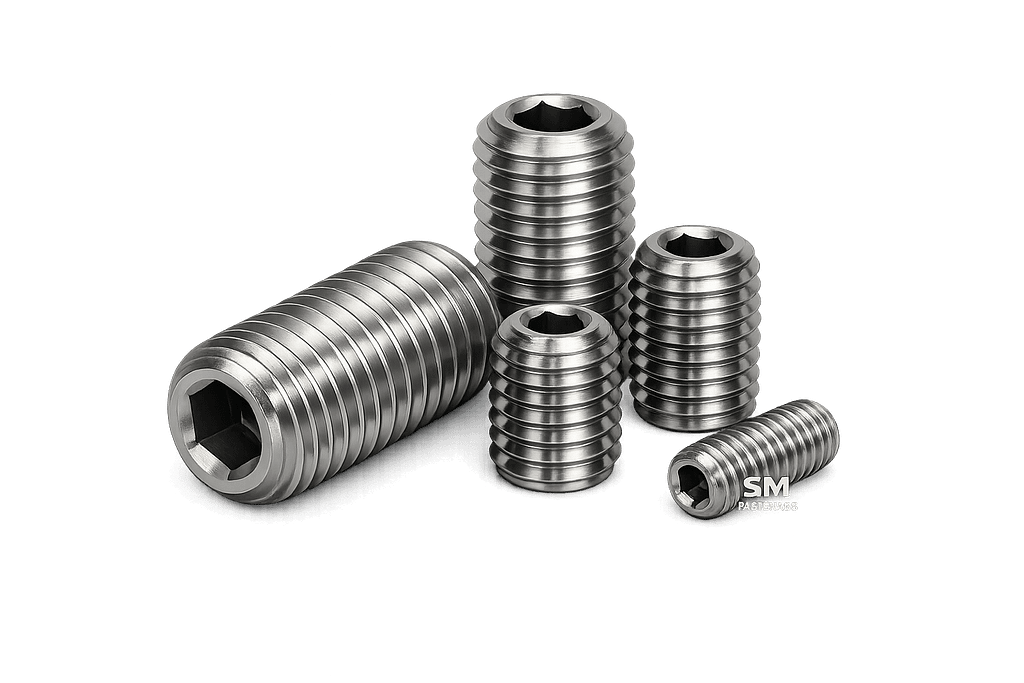
Set screws are torque-transmitting and positional locking fasteners used where:
- Components must be secured without protruding heads
- Radial locking or axial positioning is required
- Space constraints prohibit conventional bolt-nut assemblies
- Repeatable precision alignment is critical
Unlike conventional screws designed to create clamping force between members, set screws function primarily as locking elements.
Primary Industrial Usage
| Industry | Functional Role |
|---|---|
| Construction Equipment | Shaft locking, couplings |
| Oil & Gas | Valve stems, instrumentation retention |
| Power Generation | Turbine accessories |
| Petrochemical | Actuator positioning |
| Rail & Infrastructure | Gearbox assemblies |
| Heavy Machinery | Pulley & hub retention |
| Shipbuilding | Marine equipment alignment |
| Automotive OEM | Transmission components |
SM Fasteners supplies set screws globally for OEM assemblies, EPC projects, and MRO environments requiring dimensional repeatability and certified material traceability.
2. Technical Definition
A Set Screw is defined as:
A headless threaded fastener designed to secure an object within or against another object, typically by applying compressive force via a tip configuration.
Key Characteristics:
- Fully threaded body
- No projecting head
- Driven internally (hex socket, slotted, Torx)
- Applies localized compressive force
3. Functional Role in Mechanical Assemblies
Set screws are primarily used to:
- Prevent relative motion
- Transmit torque
- Maintain axial positioning
- Eliminate backlash
- Lock rotating elements
Typical Assembly Example:
- Shaft + Hub + Set Screw
→ Screw tip presses against shaft → frictional locking created.
4. Load Mechanics & Force Behavior
4.1 Force Transmission Model
Set screw performance depends on:
- Contact Force
- Friction Coefficient
- Material Hardness Interaction
- Thread Engagement Length
Unlike bolts:
- Minimal tensile loading
- Dominant compressive + shear resistance
Contact Force Equation
Where:
- F = Preload force
- T = Applied torque
- K = Nut factor (0.18–0.25)
- d = Nominal diameter
4.2 Torque–Tension Relationship
Only 10–15% of applied torque creates useful locking force.
Remaining torque losses:
| Energy Loss | Approx % |
|---|---|
| Thread friction | 40% |
| Tip friction | 45% |
| Useful preload | 15% |
Engineering implication:
👉 Surface finish and lubrication dramatically affect locking reliability.
5. Joint Design Principles
5.1 Correct Design Approach
Engineers must consider:
- Shaft hardness vs screw hardness
- Contact geometry
- Dynamic loading
- Vibration exposure
- Thermal expansion
Recommended Shaft Hardness Matching
| Screw Grade | Recommended Shaft Hardness |
|---|---|
| 45H Steel | ≤ 30 HRC |
| 12.9 Alloy Steel | ≤ 40 HRC |
| Stainless A4-80 | ≤ 28 HRC |
5.2 Thread Engagement Rule
Minimum engagement length:
Where D = nominal diameter
5.3 Point Contact Mechanics
Set screw tip type defines performance:
| Tip Type | Behavior |
|---|---|
| Cup Point | General purpose |
| Cone Point | Permanent locking |
| Flat Point | Surface protection |
| Dog Point | Accurate positioning |
| Knurled Cup | Vibration resistance |
6. Preload Calculation — Worked Example
Given:
- M8 set screw
- Torque = 18 Nm
- Nut factor K = 0.20
- Diameter = 8 mm
Result: Approx. 11.2 kN locking force
7. Friction & Locking Efficiency
Critical parameters:
- Surface roughness Ra
- Coating friction coefficient
- Lubrication state
- Tip deformation behavior
Friction Coefficient Comparison
| Condition | Coefficient |
|---|---|
| Dry Steel | 0.20–0.25 |
| Zinc Plated | 0.16–0.20 |
| MoS₂ Coated | 0.08–0.12 |
| PTFE Coated | 0.05–0.10 |
8. Failure Mechanisms
8.1 Fatigue Failure
Occurs due to cyclic micro-movement.
Mitigation:
- Knurled cup points
- Proper torque control
8.2 Shear Failure
Common in torque-transmitting applications.
Where A = shear area.
8.3 Thread Stripping
Causes:
- Insufficient engagement
- Soft mating material
- Over-torque
8.4 Hydrogen Embrittlement
High-strength grades (>1000 MPa) vulnerable after electroplating.
SM Fasteners controls risk through:
- Post-bake procedures
- Process validation
- Hardness monitoring
8.5 Stress Corrosion Cracking
Typical environments:
- Chlorides
- H₂S
- Offshore marine service
Materials such as Duplex, Super Duplex, Inconel, SMO 254 supplied where required.
9. Engineering Selection Criteria
| Parameter | Design Consideration |
|---|---|
| Load Type | Static / Dynamic |
| Environment | Corrosive / Offshore |
| Temperature | Cryogenic → High temp |
| Access | Internal drive requirement |
| Maintenance | Reusable vs permanent |
| Certification | NACE / EN / ASTM |
10. Functional Advantages of Set Screws
- Flush mounting
- High positional accuracy
- Low mass
- Compact assemblies
- Simplified automation assembly
11. Product Types and Variants
Set screws are engineered in multiple configurations to satisfy mechanical retention, positioning accuracy, vibration resistance, and surface protection requirements across industrial assemblies.
SM Fasteners manufactures set screws across metric and imperial systems, including customized geometries for OEM and EPC project specifications.
11.1 Point Style Classification
| Point Type | Mechanical Function | Typical Application | Locking Strength |
|---|---|---|---|
| Cup Point | Creates indentation for friction lock | General machinery | High |
| Cone Point | Penetrates shaft surface | Permanent positioning | Very High |
| Flat Point | Non-marring contact | Soft shafts | Medium |
| Dog Point | Positive location into hole | Indexing assemblies | High |
| Knurled Cup | Increased vibration resistance | Dynamic equipment | Very High |
| Oval Point | Reduced surface damage | Precision assemblies | Medium |
Engineering Note:
Cup point set screws represent approximately 70–80% of industrial usage due to balanced locking performance and reusability.
11.2 Drive Types (Internal Engagement)


| Drive Type | Torque Capacity | Industrial Preference |
|---|---|---|
| Hex Socket (Allen) | Excellent | Global standard |
| Torx / Star Drive | Very High | High-torque automation |
| Slotted | Low | Legacy equipment |
| Square Socket | Medium | Specialty applications |
| Hexalobular Security | Controlled | Restricted access assemblies |
SM Fasteners primarily supplies hex socket drive set screws compliant with ISO and DIN standards for global interchangeability.
11.3 Functional Variant Classification
| Variant | Description |
|---|---|
| Half Dog Point | Partial engagement for repeat positioning |
| Long Dog Point | Accurate alignment systems |
| Nylon Tip | Non-damage locking |
| Brass Tip | Electrical insulation |
| PEEK Tip | Chemical & cryogenic environments |
| Patch-locking | Pre-applied locking element |
PEEK tipped set screws supplied by SM Fasteners are widely used in:
- Semiconductor equipment
- Chemical reactors
- High-purity systems
- LNG instrumentation
12. Dimensional Logic & Geometry
Set screw performance depends strongly on geometric relationships between:
- Diameter
- Thread pitch
- Length
- Drive depth
- Tip geometry
12.1 Standard Dimensional Parameters
| Symbol | Parameter |
|---|---|
| d | Nominal Diameter |
| P | Thread Pitch |
| L | Length |
| s | Hex Socket Size |
| t | Socket Depth |
| dp | Point Length |
12.2 Metric Set Screw Dimensions (ISO/DIN)
| Size | Pitch (mm) | Socket Size (mm) | Typical Length Range (mm) |
|---|---|---|---|
| M3 | 0.5 | 1.5 | 3–20 |
| M4 | 0.7 | 2 | 4–30 |
| M5 | 0.8 | 2.5 | 5–40 |
| M6 | 1.0 | 3 | 6–50 |
| M8 | 1.25 | 4 | 8–60 |
| M10 | 1.5 | 5 | 10–80 |
| M12 | 1.75 | 6 | 12–100 |
| M16 | 2.0 | 8 | 16–120 |
| M20 | 2.5 | 10 | 20–150 |
All dimensional tolerances supplied by SM Fasteners conform to ISO tolerance classes 6g / 6H unless otherwise specified.
12.3 Imperial Thread Sizes
| Size | UNC Pitch | UNF Pitch |
|---|---|---|
| #10 | 24 | 32 |
| 1/4″ | 20 | 28 |
| 5/16″ | 18 | 24 |
| 3/8″ | 16 | 24 |
| 1/2″ | 13 | 20 |
| 5/8″ | 11 | 18 |
13. Applicable International Standards
Set screws must comply with globally interchangeable standards to ensure EPC compatibility.
13.1 ISO Standards
| Standard | Description |
|---|---|
| ISO 4026 | Hex socket set screw — flat point |
| ISO 4027 | Hex socket set screw — cone point |
| ISO 4028 | Hex socket set screw — dog point |
| ISO 4029 | Hex socket set screw — cup point |
| ISO 898-1 | Mechanical properties carbon/alloy steel |
| ISO 3506 | Stainless steel fasteners |
13.2 DIN Standards
| DIN Standard | Type |
|---|---|
| DIN 913 | Flat point |
| DIN 914 | Cone point |
| DIN 915 | Dog point |
| DIN 916 | Cup point |
DIN and ISO versions are dimensionally interchangeable for international projects.
13.3 ASTM Standards
| ASTM | Scope |
|---|---|
| ASTM F912/F912M | Alloy steel socket set screws |
| ASTM A193 | High-temperature service alloys |
| ASTM A320 | Low-temperature applications |
| ASTM F593 | Stainless steel fasteners |
13.4 British Standards (BS)
| BS Standard | Description |
|---|---|
| BS 4168 | Metric set screws |
| BS 2470 | Imperial threaded fasteners |
14. Property Class System (Metric)
Mechanical performance of set screws is governed by property class.
| Property Class | Min Tensile Strength (MPa) | Typical Use |
|---|---|---|
| 8.8 | 800 | General machinery |
| 10.9 | 1000 | Heavy equipment |
| 12.9 | 1200 | High torque locking |
SM Fasteners supplies certified property classes with hardness verification per ISO 898-1.
15. Thread Standards & Tolerances
Thread System Comparison
| Thread Type | Standard | Application |
|---|---|---|
| Metric | ISO 261/965 | Global industrial |
| UNC | ASME B1.1 | North America |
| UNF | ASME B1.1 | Precision assemblies |
| BSW | BS 84 | Legacy equipment |
| BSF | BS 84 | Fine thread British systems |
Tolerance Classes
| Class | Fit Description |
|---|---|
| 6g | External thread standard |
| 6H | Internal thread standard |
| 4g6g | Precision assemblies |
| 2A/2B | Unified threads |
SM Fasteners ensures compatibility for multinational EPC installations.
16. Dimensional Tolerance Control
Critical inspection parameters:
- Major diameter
- Pitch diameter
- Minor diameter
- Socket depth
- Point concentricity
Tolerance verification performed through:
- Optical profile measurement
- GO/NO-GO gauges
- Coordinate measurement systems
17. Geometry Influence on Performance
Thread Pitch Influence
| Pitch Type | Performance Effect |
|---|---|
| Coarse | Higher stripping resistance |
| Fine | Better vibration resistance |
| Extra Fine | Precision positioning |
Length Selection Rule
Recommended:
Ensures sufficient contact force without thread failure.
18. Interchangeability Considerations
Global projects require interchangeability between:
- ISO ↔ DIN
- ASTM ↔ Unified threads
- Metric ↔ Imperial equipment
SM Fasteners maintains:
- Dual-standard tooling
- Cross-standard verification
- Export-ready dimensional validation
19. Engineering Selection Matrix — Type vs Application
| Application | Recommended Type |
|---|---|
| Shaft locking | Cup point |
| Permanent locking | Cone point |
| Precision alignment | Dog point |
| Soft material | Flat point |
| High vibration | Knurled cup |
| Chemical plants | Stainless / PEEK tip |
20. Procurement Engineering Considerations
EPC buyers typically specify:
- Standard compliance
- Material grade
- Surface finish
- Heat treatment condition
- Traceability requirements
SM Fasteners supports project-specific customization, including:
- Non-standard lengths
- Special alloys
- Coating specification compliance
- Batch traceability aligned with ISO 9001 systems
21. Material Grades and Selection Criteria
Set screw performance is fundamentally governed by material metallurgy, influencing:
- Load capacity
- Wear resistance
- Corrosion behavior
- Temperature capability
- Galling resistance
- Service life reliability
SM Fasteners manufactures set screws across a full industrial metallurgy spectrum to support EPC, OEM, offshore, chemical, and power sector requirements.
21.1 Industrial Material Categories
| Material Group | Typical Standards | Key Characteristics |
|---|---|---|
| Carbon Steel | ISO 898-1 | High strength, economical |
| Alloy Steel | ASTM F912 | Very high hardness capability |
| Stainless Steel | ISO 3506 | Corrosion resistance |
| Duplex Stainless | ASTM A182 F51 | Chloride resistance |
| Super Duplex | ASTM A182 F53/F55 | Offshore service |
| Nickel Alloys | Inconel, Monel | Extreme environments |
| SMO 254 | UNS S31254 | Seawater resistance |
| PEEK Fasteners | ASTM D6262 | Chemical & electrical insulation |
22. Material Comparison Table
| Material | UTS (MPa) | Yield (MPa) | Temp Limit | Corrosion Resistance | Relative Cost | Typical Applications |
|---|---|---|---|---|---|---|
| Carbon Steel 8.8 | 800 | 640 | 300°C | Low | Low | General machinery |
| Alloy Steel 12.9 | 1220 | 1100 | 400°C | Low | Medium | Heavy equipment |
| SS 304 (A2-70) | 700 | 450 | 425°C | Good | Medium | Industrial assemblies |
| SS 316 (A4-80) | 800 | 600 | 450°C | Excellent | Medium-High | Marine & chemical |
| Duplex F51 | 750 | 550 | 300°C | Very High | High | Offshore |
| Super Duplex F55 | 895 | 650 | 300°C | Extreme | Very High | Subsea systems |
| Inconel 625 | 827 | 414 | 980°C | Extreme | Premium | LNG & turbines |
| Monel 400 | 550 | 240 | 480°C | Seawater resistant | High | Marine |
| SMO 254 | 680 | 300 | 400°C | Superior chloride | Premium | Desalination |
| PEEK | — | — | 260°C | Chemical inert | High | Electronics/chemical |
23. Material Selection Criteria
Engineering selection must consider:
Mechanical Requirements
- Required preload force
- Contact deformation
- Wear resistance at contact tip
Environmental Exposure
- Chlorides
- H₂S sour service
- Acids or solvents
- Marine atmosphere
Temperature Range
| Service Condition | Recommended Material |
|---|---|
| Indoor machinery | Carbon steel |
| Marine | SS316 / Duplex |
| Offshore | Super Duplex |
| Cryogenic | Austenitic stainless |
| High temperature | Inconel/Incoloy |
| Chemical plants | SMO 254 / PEEK |
SM Fasteners supports material selection review during EPC procurement stages.
24. NACE MR0175 / ISO 15156 Compliance
For sour service environments:
Key controls include:
- Hardness limitation (< 22 HRC typical)
- Controlled heat treatment
- PMI verification
- Material traceability
Applicable materials supplied:
- Duplex Stainless Steel
- Nickel Alloys
- Special stainless grades
25. Mechanical Properties — Grade Wise
| Property Class | Tensile Strength (MPa) | Yield Strength (MPa) | Hardness Range |
|---|---|---|---|
| 8.8 | 800 | 640 | 22–32 HRC |
| 10.9 | 1040 | 940 | 32–39 HRC |
| 12.9 | 1220 | 1100 | 39–44 HRC |
| A2-70 | 700 | 450 | ≤ 25 HRC |
| A4-80 | 800 | 600 | ≤ 30 HRC |
26. Heat Treatment Processes
Heat treatment determines strength, toughness, and fatigue resistance.
26.1 Heat Treatment Flow
- Austenitizing
- Quenching
- Tempering
- Stress Relieving
- Hardness Verification
26.2 Process Impact
| Process | Effect |
|---|---|
| Quenching | Strength increase |
| Tempering | Toughness restoration |
| Case hardening | Surface wear resistance |
| Solution annealing | Corrosion resistance restoration |
SM Fasteners controls furnace parameters through calibrated systems under ISO 9001 procedures.
Hardness Control (Critical)
| Application | Max Hardness |
|---|---|
| Standard service | 44 HRC |
| Sour service | ≤22 HRC |
| Stainless fasteners | Controlled cold work |
27. End-to-End Manufacturing Workflow


SM Fasteners follows a fully traceable manufacturing sequence.
27.1 Raw Material Verification
- Mill Test Certificate verification
- Chemical composition testing
- Ultrasonic inspection (when required)
- Heat number assignment
27.2 Forming Process
Cold Heading (Preferred)
- Grain flow continuity
- High fatigue strength
- Material efficiency
CNC Machining
Used for:
- Exotic alloys
- Custom geometries
- Low-volume EPC orders
27.3 Thread Manufacturing
| Method | Advantage |
|---|---|
| Thread Rolling | Increased strength, better fatigue |
| Thread Cutting | Suitable for hard alloys |
SM Fasteners prioritizes rolled threads wherever metallurgy permits.
27.4 Tip Formation
- Precision grinding
- Automated forming dies
- Point concentricity inspection
27.5 Heat Treatment
Performed in:
- Controlled atmosphere furnaces
- Batch traceability maintained
- Temperature uniformity surveys conducted
27.6 Final Cleaning
- Ultrasonic cleaning
- Degreasing
- Surface preparation before coating
28. Surface Finishing & Coating Technologies
Surface engineering directly impacts:
- Corrosion resistance
- Torque coefficient
- Galling resistance
- Service life
Surface Finish Comparison Table
| Coating | Corrosion Protection | Friction | Temperature Limit | Typical Use |
|---|---|---|---|---|
| Black Oxide | Low | Medium | 300°C | Machinery |
| Zinc Plated | Moderate | Medium | 120°C | General industry |
| Hot Dip Galvanized | High | High | 200°C | Structural |
| Mechanical Galvanized | Medium | Medium | 150°C | Infrastructure |
| Phosphate | Low | Low friction | 250°C | Automotive |
| PTFE/Xylan | Excellent | Very Low | 260°C | Offshore |
| Dacromet/Geomet | High | Controlled | 300°C | EPC projects |
| Nickel Plating | Moderate | Smooth | 400°C | Wear resistance |
| Passivation (SS) | Excellent | Stable | 450°C | Chemical plants |
29. Corrosion Resistance vs Environment
| Environment | Recommended Material/Finish |
|---|---|
| Indoor dry | Black oxide |
| Outdoor industrial | Zinc plated |
| Marine atmosphere | SS316 / Duplex |
| Offshore splash zone | Super Duplex + PTFE |
| Acidic chemical | Nickel alloy |
| H₂S sour service | NACE compliant alloy |
| High humidity | Passivated stainless |
| Food/pharma | Electropolished stainless |
30. Galling Prevention Strategy
Particularly important for stainless steel set screws.
Mitigation methods:
- MoS₂ lubrication
- Silver coating
- PTFE coating
- Controlled torque application
- Material pairing strategy
31. Hydrogen Embrittlement Control
SM Fasteners implements:
- Baking after electroplating
- Process timing control
- Hardness monitoring
- Coating process qualification
Critical for property class 10.9 and 12.9 fasteners.
32. Advanced Materials Capability — SM Fasteners
Available specialty fasteners:
- Duplex & Super Duplex
- Inconel 625 / 718
- Monel 400
- Hastelloy grades
- SMO 254
- Titanium (project-specific)
- PEEK engineered fasteners
PEEK Set Screw Applications
| Industry | Benefit |
|---|---|
| Semiconductor | Non-metallic contamination control |
| Chemical processing | Acid resistance |
| Electrical equipment | Insulation |
| Cryogenic LNG | Thermal stability |
| Medical equipment | Non-magnetic |
33. Manufacturing Traceability System
Each production lot includes:
- Heat number marking
- Batch identification
- Process history tracking
- Inspection linkage
Integrated within SM Fasteners’ ISO 9001 quality framework.
34. Engineering Value Delivered by SM Fasteners
- Certified metallurgy control
- Advanced heat treatment validation
- Precision geometry consistency
- Coating performance optimization
- Export-grade manufacturing readiness
35. Inspection & Quality Control Philosophy
Set screws used in EPC, oil & gas, power, and heavy engineering applications must satisfy traceable mechanical integrity requirements, not merely dimensional acceptance.
SM Fasteners integrates inspection activities into an ISO 9001 certified manufacturing workflow, ensuring verification from raw material to final dispatch.
35.1 Quality Assurance Structure
Inspection is divided into:
| Stage | Inspection Activity |
|---|---|
| Incoming Material | Chemical & dimensional verification |
| In-Process | Thread & geometry monitoring |
| Heat Treatment | Hardness and structure validation |
| Surface Finish | Coating thickness testing |
| Final Inspection | Mechanical & dimensional audit |
| Pre-Dispatch | Documentation verification |
36. Dimensional Inspection
Critical parameters verified:
- Major diameter
- Pitch diameter
- Minor diameter
- Thread pitch accuracy
- Socket depth & hex size
- Point concentricity
- Length tolerance
Inspection tools used:
- GO / NO-GO gauges
- Optical comparators
- Digital profile measurement
- Coordinate Measuring Machines (CMM)
37. Mechanical Testing
| Test | Standard | Purpose |
|---|---|---|
| Tensile Testing | ISO 898-1 | Strength validation |
| Proof Load Test | ASTM F912 | Functional capacity |
| Hardness Test | ISO 6508 | Heat treatment verification |
| Torque Test | Internal spec | Drive integrity |
| Wedge Load Test | ISO method | Thread performance |
| Fatigue Testing | Project specific | Dynamic reliability |
38. Non-Destructive Testing (NDT)
Applied when required by EPC or third-party inspection agencies.
| Method | Application |
|---|---|
| MPI | Surface crack detection |
| DPI | Stainless & alloy fasteners |
| Ultrasonic Testing | Large diameter screws |
| Eddy Current | Surface integrity |
| PMI Testing | Alloy verification |
39. Positive Material Identification (PMI)
Mandatory for:
- Duplex
- Super Duplex
- Nickel Alloys
- SMO 254
- Critical refinery projects
PMI ensures chemical composition compliance with purchase specifications.
40. Certification & Documentation
SM Fasteners supplies complete documentation packages aligned with global procurement standards.
Standard Documentation
- Mill Test Certificate (MTC)
- Heat Treatment Reports
- Hardness Reports
- Dimensional Inspection Reports
- Coating Compliance Reports
- Certificate of Conformity (CoC)
Certification Formats
| Standard | Description |
|---|---|
| EN 10204 2.1 | Declaration of compliance |
| EN 10204 3.1 | Manufacturer verified certification |
| EN 10204 3.2 | Third-party witnessed certification |
41. Industry Applications Mapping


| Industry | Application Function |
|---|---|
| Construction | Structural equipment positioning |
| Oil & Gas Upstream | Valve stems & instrumentation |
| Midstream | Pump & compressor couplings |
| Downstream Refining | Actuator assemblies |
| Power Generation | Turbine auxiliary locking |
| Petrochemical | Mixer & agitator shafts |
| LNG | Cryogenic instrumentation |
| Automotive | Gear & pulley retention |
| Railways | Drive systems |
| Shipbuilding | Marine propulsion equipment |
PEEK Fastener Application Integration
| Sector | Benefit |
|---|---|
| Electronics | Electrical insulation |
| Chemical Plants | Corrosion immunity |
| Semiconductor | Cleanroom compatibility |
| LNG Systems | Thermal stability |
42. Failure Prevention Engineering
Common field failures and mitigation:
| Failure Mode | Root Cause | Prevention |
|---|---|---|
| Loosening | Vibration | Knurled cup point |
| Galling | Stainless friction | PTFE/MoS₂ coating |
| Thread stripping | Low engagement | ≥1D engagement |
| Tip deformation | Material mismatch | Correct hardness pairing |
| Corrosion seizure | Marine exposure | Duplex/Super Duplex |
| Hydrogen embrittlement | Improper plating | Controlled baking |
43. Tightening Torque Chart
(Reference values — dry condition)
| Size | Grade 8.8 (Nm) | Grade 10.9 (Nm) | Grade 12.9 (Nm) |
|---|---|---|---|
| M4 | 2.8 | 4 | 5 |
| M5 | 5.5 | 8 | 10 |
| M6 | 9 | 13 | 16 |
| M8 | 22 | 32 | 40 |
| M10 | 44 | 63 | 80 |
| M12 | 76 | 108 | 135 |
| M16 | 185 | 260 | 325 |
| M20 | 360 | 510 | 640 |
Lubricated torque ≈ 70–80% of dry torque.
44. Proof Load & Tensile Strength Table
| Size | Proof Load 8.8 (kN) | Proof Load 10.9 (kN) | Proof Load 12.9 (kN) |
|---|---|---|---|
| M6 | 8 | 10 | 12 |
| M8 | 15 | 19 | 23 |
| M10 | 24 | 30 | 36 |
| M12 | 35 | 44 | 52 |
| M16 | 68 | 85 | 102 |
| M20 | 106 | 133 | 160 |
45. Thread Standards & Tolerances Table
| Thread System | Standard | Tolerance |
|---|---|---|
| Metric | ISO 261 | 6g |
| Unified UNC | ASME B1.1 | 2A |
| Unified UNF | ASME B1.1 | 2A |
| BSW | BS 84 | Medium |
| BSF | BS 84 | Fine |
46. Surface Finish Performance Comparison
| Finish | Salt Spray Resistance | Friction Stability | Maintenance Requirement |
|---|---|---|---|
| Black Oxide | 24 hrs | Stable | Indoor |
| Zinc Plated | 72–120 hrs | Moderate | Medium |
| HDG | 500+ hrs | High friction | Outdoor |
| Dacromet | 1000+ hrs | Controlled | EPC |
| PTFE | Excellent | Low | Offshore |
| Passivated SS | Excellent | Stable | Chemical |
47. Corrosion Resistance vs Environment Table
| Environment | Recommended Solution |
|---|---|
| Urban | Zinc plated |
| Industrial | Phosphate coated |
| Marine | SS316 / Duplex |
| Offshore Splash | Super Duplex |
| Acidic | Hastelloy/Inconel |
| H₂S | NACE compliant |
| Cryogenic LNG | Austenitic SS / PEEK |
48. Weight Chart — SM Fasteners Reference
(Approximate theoretical values)
| Size | Weight/Piece (kg) | Weight/100 pcs (kg) |
|---|---|---|
| M4×10 | 0.002 | 0.20 |
| M5×12 | 0.004 | 0.40 |
| M6×16 | 0.007 | 0.70 |
| M8×20 | 0.015 | 1.50 |
| M10×25 | 0.028 | 2.80 |
| M12×30 | 0.050 | 5.00 |
| M16×40 | 0.110 | 11.0 |
| M20×50 | 0.220 | 22.0 |
Weight charts align with SM Fasteners logistics and export packing calculations.
49. Preload Calculation Reference
Formula
Where:
- F = Preload (N)
- T = Torque (Nm)
- K = Nut factor
- d = Nominal diameter (m)
Worked Example
M10 Grade 10.9
Torque = 63 Nm
K = 0.20
d = 0.010 m
Preload ≈ 31.5 kN
50. Industrial Packaging & Export Readiness
SM Fasteners supplies global shipments compliant with EPC logistics practices.
Packaging Methods
- VCI corrosion protection bags
- Thread protection caps
- Oil or dry preservation options
- Batch traceability labels
- Barcoded identification
Export Packaging
- ISPM-15 certified wooden crates
- Moisture barrier wrapping
- Vacuum packing (project specific)
- Palletized container loading
51. Global Supply & Project Execution Capability
SM Fasteners supports:
- EPC bulk supply programs
- OEM annual contracts
- Shutdown & turnaround requirements
- Custom engineered fasteners
- Multi-material project packages
Supported Industries
- Oil & Gas
- LNG Projects
- Power Plants
- Refineries
- Offshore Platforms
- Infrastructure & Rail
- Heavy Machinery OEMs
- Shipbuilding
52. Integration with ISO 9001 Quality System
SM Fasteners quality framework ensures:
- Controlled procedures
- Risk-based thinking
- Continuous improvement
- Calibration management
- Supplier qualification
- Document traceability
Certified under:
- ISO 9001
- MSME Registration
- UKAF Accreditation
53. Engineering Summary — Set Screws
Set screws remain critical precision components enabling:
- Accurate mechanical positioning
- Reliable torque transmission
- Compact assembly design
- High vibration resistance
- Repeatable maintenance operations
Through controlled metallurgy, precision manufacturing, certified inspection systems, and export-ready logistics, SM Fasteners delivers set screws suitable for global EPC and industrial environments.
Set screws are headless threaded fasteners designed to secure components such as gears, pulleys, hubs, collars, and couplings onto shafts by applying localized compressive force. Unlike conventional screws, they function through mechanical locking and positioning rather than clamping two separate parts.
From an engineering perspective, set screws operate by generating controlled preload and frictional resistance, preventing rotational or axial movement under static or dynamic loads. Performance depends on correct selection of:
- Point style (cup, cone, flat, dog)
- Material grade and hardness
- Thread engagement length
- Torque application and preload control
- Environmental compatibility
SM Fasteners manufactures set screws compliant with ISO, DIN, ASTM, and BS standards, available in:
- Carbon steel and alloy steel (Grades 8.8, 10.9, 12.9)
- Stainless steels (A2, A4)
- Duplex & Super Duplex alloys
- Nickel alloys (Inconel, Monel, Hastelloy)
- SMO 254 and advanced PEEK engineered fasteners
Manufacturing includes cold forming or precision machining, thread rolling, controlled heat treatment, surface coating, and full inspection traceability under ISO 9001 quality systems.
Typical applications span:
- Oil & Gas equipment
- Power generation systems
- Petrochemical plants
- Heavy machinery & OEM assemblies
- Offshore and marine installations
- Rail, infrastructure, and LNG projects
Each supply batch can include MTC, inspection reports, hardness verification, PMI testing, and EN 10204 certification, ensuring global EPC procurement readiness.
In essence:
Set screws from SM Fasteners provide precision positioning, vibration-resistant locking, and reliable performance across critical industrial assemblies requiring certified quality and international standards compliance.