
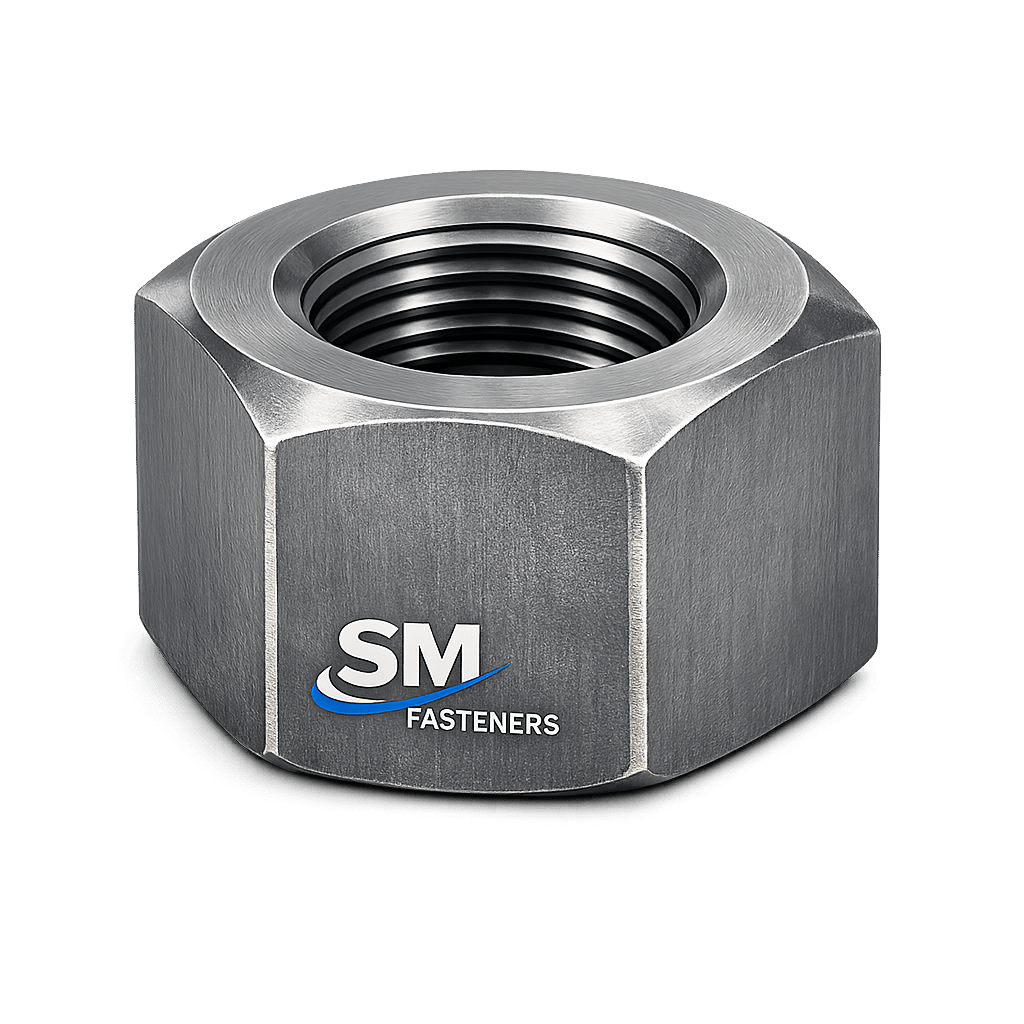
Heavy Hex Nut
1 .INDUSTRY CONTEXT, FUNCTIONAL MECHANICS & JOINT DESIGN PRINCIPLES
1.1 Industry Context
Heavy Hex Nuts represent one of the most critical fastening components used in high-load structural and pressure-retaining assemblies. Unlike standard hex nuts, heavy hex nuts incorporate increased width across flats and greater bearing surface area, enabling improved load distribution and resistance to deformation under high preload conditions.
These nuts are extensively specified across:
- Structural steel fabrication
- Oil & Gas pipeline flanges
- Pressure vessels
- Offshore platforms
- Power generation equipment
- LNG cryogenic systems
- Petrochemical processing units
- Heavy machinery assemblies
Engineering specifications frequently mandate heavy hex geometry for applications involving:
- High tensile bolts
- Elevated temperature service
- Cyclic loading environments
- Corrosive exposure
- Safety-critical joints
Global EPC procurement specifications commonly reference:
- ASTM A194
- ASTM A563
- ISO 4033
- DIN 6915
- BS EN standards
SM Fasteners manufactures heavy hex nuts aligned with international interchangeability requirements, ensuring compatibility across global supply chains.
1.2 Technical Definition
A Heavy Hex Nut is defined as:
A six-sided internally threaded fastener with increased width across flats and thickness compared to standard hex nuts, designed to provide higher proof load capacity, improved wrenching strength, and enhanced bearing stress distribution.
Key Geometric Characteristics
| Feature | Engineering Function |
|---|---|
| Larger Width Across Flats | Higher torque transmission |
| Increased Thickness | Greater thread engagement |
| Wider Bearing Surface | Reduced compressive stress |
| Higher Mass | Improved preload stability |
| Deep Thread Engagement | Enhanced fatigue resistance |
Heavy hex nuts are normally paired with:
- Heavy hex bolts
- stud bolt
- Anchor rods
- Flange bolting systems
1.3 Functional Role in Bolted Assemblies
Heavy hex nuts serve three primary mechanical roles:
1. Clamping Force Generation
The nut converts applied torque into axial preload.
2. Load Retention
Maintains compression between joint members.
3. Structural Load Transfer
Ensures safe distribution of tensile and shear forces.
The effectiveness of a bolted joint depends more on preload than on bolt shear strength.
1.4 Load Mechanics & Force Behavior
1.4.1 Bolt–Nut Interaction
When tightened:
- Torque applied → nut rotation.
- Threads generate axial movement.
- Bolt elongates elastically.
- Joint members compress.
- Clamping force develops.
This preload produces friction between joint surfaces preventing separation.
1.4.2 Force Components in Heavy Hex Nut Assemblies
| Force Type | Description | Engineering Effect |
|---|---|---|
| Tensile Load | Axial bolt loading | Primary design condition |
| Shear Load | Lateral forces | Resisted via friction |
| Bearing Stress | Contact pressure | Controlled by nut face area |
| Bending Stress | Misalignment effects | Reduced by heavy hex geometry |
| Dynamic Load | Cyclic vibration | Requires higher preload stability |
1.5 Preload Fundamentals
Preload Equation
F=K×DT
Where:
- F = Preload force (N)
- T = Applied torque (Nm)
- K = Nut factor (friction coefficient)
- D = Nominal diameter (m)
Typical Nut Factor Values:
| Condition | K Value |
|---|---|
| Dry threads | 0.20 |
| Light oil | 0.17 |
| Moly lubrication | 0.12 |
| PTFE coating | 0.10 |
Worked Example
Bolt: M24
Torque: 850 Nm
Lubricated condition: K = 0.17F=0.17×0.024850 F=208,333N
Preload ≈ 208 kN
This preload ensures joint integrity under dynamic loads.
1.6 Joint Design Principles
1.6.1 Proper Thread Engagement
Recommended engagement:Le≥1.0×D
Where:
- Le = thread engagement length
- D = bolt diameter
Heavy hex nuts naturally achieve this requirement due to increased thickness.
1.6.2 Bearing Stress Control
Bearing stress:σb=AbF
Where:
- Ab = nut bearing area
Heavy hex nuts reduce localized yielding in softer flange materials.
1.6.3 Elastic Interaction
An optimized joint behaves like:
- Bolt → spring in tension
- Joint → spring in compression
Design goal:
Maximize bolt elasticity relative to joint stiffness
Heavy hex nuts assist by enabling higher controlled preload without face crushing.
1.7 Torque–Tension Relationship
Only 10–15% of tightening torque generates preload.
Energy distribution:
| Loss Mechanism | Percentage |
|---|---|
| Thread friction | 40–50% |
| Bearing friction | 35–45% |
| Useful preload | 10–15% |
Thus surface finish and lubrication strongly influence performance.
1.8 Failure Mechanisms in Nut Assemblies
1. Fatigue Failure
Occurs under fluctuating loads.
Mitigation:
- Proper preload
- Rolled threads
- High-strength grades
2. Thread Stripping
Caused by insufficient engagement or low material hardness.
Heavy hex geometry increases stripping resistance.
3. Hydrogen Embrittlement
Risk for high-strength carbon/alloy steels.
Control measures:
- Baking after plating
- Controlled electroplating
4. Stress Corrosion Cracking (SCC)
Common in:
- Chloride environments
- Sour gas service
Material selection becomes critical.
5. Galling (Stainless Steel)
Adhesive wear between mating threads.
Solutions:
- Surface coating
- Controlled hardness differential
- Lubrication
1.9 Functional Selection Criteria
Engineers select heavy hex nuts based on:
| Parameter | Engineering Consideration |
|---|---|
| Load magnitude | Proof load requirement |
| Temperature | Material stability |
| Environment | Corrosion resistance |
| Standards compliance | EPC specification |
| Maintenance access | Torque method |
| Reusability | Material hardness |
1.10 Heavy Hex Nuts in Critical Industries
Oil & Gas
- Flanged joints
- Pressure vessels
- Wellhead equipment
- NACE-compliant assemblies
Power Generation
- Turbine casings
- Boiler connections
- Structural anchoring
Structural Steel
- High-strength friction grip joints
- Bridge construction
LNG & Cryogenic
- Austenitic stainless & nickel alloys
Chemical Processing
- Acid-resistant materials
Infrastructure & Rail
- High vibration joints
1.11 Engineering Advantages of Heavy Hex Geometry
| Feature | Benefit |
|---|---|
| Larger wrench size | Reduced rounding |
| Greater thickness | Higher stripping strength |
| Increased bearing face | Lower stress concentration |
| Higher mass | Better preload retention |
| Superior rigidity | Improved fatigue resistance |
1.12 SM Fasteners Engineering Position
SM Fasteners manufactures heavy hex nuts under controlled ISO 9001 quality systems with:
- Full material traceability
- Certified mechanical performance
- Precision thread manufacturing
- Compatibility with global EPC standards
- Capability in exotic alloys and PEEK engineered fasteners
Production aligns with requirements for:
Long-term industrial service reliability
Third-party inspection
International project procurement
2. PRODUCT TYPES, DIMENSIONAL GEOMETRY & INTERNATIONAL STANDARDS
2.1 Product Classification of Heavy Hex Nuts
Heavy hex nuts are engineered for high-load bolting systems where standard hex nuts cannot provide sufficient bearing area, torque capacity, or thread engagement.
Within global procurement specifications, heavy hex nuts are categorized by:
- Geometry configuration
- Thread system
- Mechanical property class
- Application environment
- Standard compliance
SM Fasteners manufactures heavy hex nuts across all industrial classifications to ensure interchangeability within EPC, OEM, and infrastructure projects.
2.1.1 Primary Heavy Hex Nut Types
| Type | Description | Typical Application |
|---|---|---|
| Heavy Hex Finished Nut | Precision machined faces and threads | Structural & industrial assemblies |
| Heavy Hex Structural Nut | Designed for structural bolting systems | Bridges, towers, steel frames |
| Heavy Hex High-Strength Nut | Heat-treated for high proof load | Oil & Gas flanges |
| Heavy Hex Stud Nut | Used with stud bolts | Pressure vessels |
| Double Chamfer Heavy Nut | Improved assembly alignment | Automated installation |
| Washer Face Heavy Nut | Integrated bearing surface | Structural steel joints |
| Locking Heavy Hex Nut | Prevailing torque feature | Vibration environments |
| PEEK Heavy Hex Nut | Polymer high-performance variant | Chemical & electrical isolation |
2.2 Geometry and Dimensional Logic
Heavy hex nuts differ fundamentally from standard hex nuts through increased:
- Width Across Flats (WAF)
- Nut Thickness
- Bearing Surface Area
- Thread Engagement Depth
These dimensional increases directly improve:
- Torque transmission capability
- Resistance to deformation
- Load distribution efficiency
2.2.1 Key Dimensional Parameters
| Symbol | Parameter | Engineering Purpose |
|---|---|---|
| D | Nominal Diameter | Bolt compatibility |
| P | Thread Pitch | Load transfer accuracy |
| S | Width Across Flats | Wrench strength |
| M | Nut Thickness | Thread engagement |
| e | Corner Distance | Tool clearance |
| dw | Bearing Diameter | Stress distribution |
2.3 Metric Heavy Hex Nut Dimensional Specifications
(ISO/DIN Reference Geometry — Typical Engineering Values)
| Size | Pitch (mm) | Width Across Flats S (mm) | Thickness M (mm) | Corner Distance e (mm) |
|---|---|---|---|---|
| M12 | 1.75 | 22 | 12 | 24.7 |
| M16 | 2.0 | 27 | 16 | 30.0 |
| M20 | 2.5 | 34 | 20 | 37.3 |
| M24 | 3.0 | 41 | 24 | 45.2 |
| M30 | 3.5 | 50 | 30 | 55.4 |
| M36 | 4.0 | 60 | 36 | 66.4 |
| M42 | 4.5 | 70 | 42 | 77.5 |
| M48 | 5.0 | 75 | 48 | 83.1 |
| M56 | 5.5 | 85 | 56 | 94.5 |
| M64 | 6.0 | 95 | 64 | 105.7 |
Dimensions may vary slightly depending on ISO, DIN, ASTM, or project specifications.
2.4 Imperial Heavy Hex Nut Dimensions (ASTM Practice)
| Size (inch) | Threads per Inch | Width Across Flats (in) | Thickness (in) |
|---|---|---|---|
| 1/2″ | 13 UNC | 7/8 | 1/2 |
| 5/8″ | 11 UNC | 1-1/16 | 5/8 |
| 3/4″ | 10 UNC | 1-1/4 | 3/4 |
| 7/8″ | 9 UNC | 1-7/16 | 7/8 |
| 1″ | 8 UNC | 1-5/8 | 1 |
| 1-1/8″ | 7 UNC | 1-13/16 | 1-1/8 |
| 1-1/4″ | 7 UNC | 2 | 1-1/4 |
| 1-1/2″ | 6 UNC | 2-3/8 | 1-1/2 |
| 2″ | 4.5 UNC | 3 | 2 |
2.5 Dimensional Engineering Logic
Increased Width Across Flats
Benefits:
- Higher wrench torque capacity
- Reduced rounding risk
- Better load transfer
Increased Nut Thickness
Provides:
- Full tensile strength utilization
- Higher stripping resistance
- Improved fatigue life
2.6 Thread Standards & Tolerances
Heavy hex nuts must maintain compatibility across international bolt systems.
Thread Standard Comparison
| System | Standard | Typical Use |
|---|---|---|
| Metric Coarse | ISO 261 / ISO 965 | Global industrial |
| Metric Fine | ISO 261 | High vibration |
| UNC | ASME B1.1 | Oil & Gas USA |
| UNF | ASME B1.1 | Aerospace / fatigue |
| BSW | BS 84 | Legacy UK equipment |
| BSF | BS 84 | Precision assemblies |
Thread Tolerance Classes
| Thread Type | Nut Class | Fit Description |
|---|---|---|
| Metric | 6H | Standard industrial fit |
| Metric Precision | 5H | Close tolerance |
| UNC/UNF | 2B | Standard fit |
| UNC/UNF | 3B | High precision |
| Structural | Oversize tolerance | Coated bolts |
SM Fasteners maintains thread inspection using calibrated GO/NO-GO gauges in accordance with ISO 1502.
2.7 Applicable International Standards
Heavy hex nuts are governed by multiple global standards depending on service requirements.
ISO Standards
| Standard | Scope |
|---|---|
| ISO 4033 | Hex nuts style 2 |
| ISO 898-2 | Mechanical properties |
| ISO 965 | Thread tolerances |
| ISO 4759 | Dimensional tolerances |
| ISO 3506 | Stainless fasteners |
ASTM Standards
| Standard | Application |
|---|---|
| ASTM A194 | High-pressure service nuts |
| ASTM A563 | Structural heavy hex nuts |
| ASTM F594 | Stainless steel nuts |
| ASTM A453 | High-temperature alloys |
| ASTM B637 | Nickel alloy fasteners |
DIN Standards
| Standard | Application |
|---|---|
| DIN 6915 | Structural heavy hex nuts |
| DIN 934 (reference) | Hex nuts |
| DIN EN 14399 | Preloaded structural assemblies |
British Standards
| Standard | Application |
|---|---|
| BS EN ISO 4033 | Metric heavy hex nuts |
| BS 3692 | General purpose metric |
| BS 4190 | Imperial fasteners |
2.8 Property Class Systems
Mechanical performance classification ensures interchangeability.
Metric Property Classes
| Property Class | Minimum Proof Stress (MPa) | Typical Use |
|---|---|---|
| 8 | 800 | Structural |
| 10 | 1000 | High strength joints |
| 12 | 1200 | Heavy machinery |
| A2-70 | Stainless | Corrosion resistance |
| A4-80 | Marine/chemical | Chloride exposure |
ASTM Strength Grades
| Grade | Associated Bolt | Service |
|---|---|---|
| A563 DH | A325 bolts | Structural steel |
| A194 2H | B7 studs | Oil & Gas |
| A194 7 | High temperature | Refinery |
| A194 8M | Stainless | Corrosive service |
2.9 Interchangeability Considerations
Engineering procurement frequently involves mixed global sourcing.
Critical checks:
- Thread compatibility
- Proof load equivalence
- Coating thickness allowance
- Wrench size compatibility
- Hardness matching
SM Fasteners designs heavy hex nuts ensuring compatibility between:
- ISO ↔ ASTM
- DIN ↔ BS
- Metric ↔ Imperial project systems
2.10 Structural Bolting Assemblies
Heavy hex nuts are essential components of:
- HSFG (High Strength Friction Grip) systems
- Preloaded structural joints
- Slip-critical connections
Design standards include:
- EN 14399
- ASTM F3125
- AISC Structural Specifications
2.11 Geometry Influence on Mechanical Performance
| Geometry Parameter | Mechanical Effect |
|---|---|
| Larger bearing face | Lower flange stress |
| Increased thickness | Higher stripping strength |
| Larger WAF | Improved torque transfer |
| Chamfer angle | Easier installation |
| Thread depth | Increased fatigue life |
2.12 Engineering Considerations for Coated Fasteners
Coatings influence dimensional requirements.
Allowance must be made for:
- Zinc plating buildup
- Hot-dip galvanizing thickness
- PTFE coating tolerance
- Xylan fluoropolymer layers
Typical oversize thread requirement for HDG:
- Nut tapped oversize after galvanizing.
2.13 PEEK Heavy Hex Nuts — Special Variant
SM Fasteners supplies PEEK heavy hex nuts for specialized environments.
Engineering Characteristics
| Property | Performance |
|---|---|
| Continuous temperature | Up to 260°C |
| Chemical resistance | Excellent |
| Electrical insulation | High |
| Weight reduction | ~70% lighter than steel |
| Non-magnetic | Yes |
Typical applications:
- Semiconductor equipment
- Chemical processing
- Medical systems
- Offshore electronics
- Electrical isolation assemblies
2.14 Dimensional Verification & Inspection
Dimensional inspection includes:
- Width across flats measurement
- Thickness verification
- Thread pitch check
- Concentricity inspection
- Bearing face flatness
Inspection tools:
- Digital micrometers
- Optical comparators
- Thread gauges
- Coordinate measuring machines (CMM)
All inspection processes integrate into SM Fasteners’ ISO 9001 quality system.
3 . MATERIAL ENGINEERING, HEAT TREATMENT, MANUFACTURING WORKFLOW & SURFACE ENGINEERING
3.1 Materials Engineering Philosophy for Heavy Hex Nuts
Material selection is the primary determinant of mechanical performance, corrosion resistance, temperature capability, and service life of heavy hex nuts.
Unlike standard fastening applications, heavy hex nuts frequently operate in:
- High preload assemblies
- Pressure-containing systems
- Elevated temperature environments
- Sour gas service
- Marine exposure
- Cryogenic LNG installations
Therefore, SM Fasteners applies a load–environment–life cycle engineering approach when selecting materials.
Fundamental Selection Variables
| Parameter | Engineering Requirement |
|---|---|
| Proof Load Capacity | Must exceed bolt strength |
| Operating Temperature | Retain mechanical properties |
| Corrosion Resistance | Prevent SCC & pitting |
| Hardness Compatibility | Avoid galling/embrittlement |
| Standards Compliance | ASTM / ISO / NACE |
| Inspection Traceability | MTC verification |
3.2 Industrial Material Range — SM Fasteners Capability
SM Fasteners manufactures heavy hex nuts across a full spectrum of engineered materials.
3.2.1 Carbon Steel Grades
Used where strength and cost efficiency are primary requirements.
| Grade | Standard | Typical Use |
|---|---|---|
| ASTM A563 Gr A | Structural | General construction |
| ASTM A563 DH | High strength | Structural bolting |
| ASTM A194 2H | Pressure service | Oil & Gas |
| C45 / EN8 | Medium carbon | Machinery |
Characteristics
- High load capacity
- Economical
- Requires corrosion protection
3.2.2 Alloy Steel Grades
Designed for elevated temperature and pressure service.
| Material | Standard | Application |
|---|---|---|
| ASTM A194 2H | Oil & Gas studs | Refinery flanges |
| ASTM A194 7 | High temperature | Boilers |
| ASTM A194 7M | Sour service | H₂S environments |
| 4140 / 4142 | Alloy steel | Heavy equipment |
3.2.3 Stainless Steel Grades
Provide corrosion resistance with moderate-to-high strength.
| Grade | Standard | Environment |
|---|---|---|
| A2-70 (304) | ISO 3506 | General corrosion |
| A4-80 (316) | ISO 3506 | Marine/chemical |
| 316L | Low carbon | Welded assemblies |
| 321 | Stabilized | High temperature |
| 904L | High alloy | Acid exposure |
3.2.4 Duplex & Super Duplex Stainless Steel
Used in aggressive offshore environments.
| Grade | Key Property |
|---|---|
| Duplex 2205 | High strength + corrosion resistance |
| Super Duplex 2507 | Extreme chloride resistance |
Benefits:
- Twice strength of austenitic stainless
- Excellent SCC resistance
- Reduced weight requirement
3.2.5 Nickel & High-Performance Alloys
For extreme temperature and chemical exposure.
| Alloy | Typical Application |
|---|---|
| Inconel 625 | Offshore & subsea |
| Inconel 718 | High temperature turbines |
| Hastelloy C276 | Acid processing |
| Monel 400 | Seawater service |
| Incoloy 825 | Chemical plants |
| SMO 254 | Chloride environments |
| Nickel 200 | Alkali processing |
3.2.6 Engineering Polymer — PEEK Heavy Hex Nuts
SM Fasteners supplies precision-machined PEEK heavy hex nuts for specialized applications.
| Property | Value |
|---|---|
| Continuous temperature | 260°C |
| Chemical resistance | Excellent |
| Dielectric strength | High |
| Weight reduction | Significant |
| Magnetic signature | None |
Applications:
- Semiconductor manufacturing
- Electrical isolation assemblies
- Medical equipment
- Chemical dosing systems
3.3 Material Comparison Table
| Material | UTS (MPa) | Yield (MPa) | Corrosion Resistance | Temp Limit | Relative Cost | Typical Industry |
|---|---|---|---|---|---|---|
| Carbon Steel | 800–1000 | 640 | Low | 300°C | Low | Construction |
| Alloy Steel | 1000–1200 | 850 | Moderate | 500°C | Medium | Oil & Gas |
| SS 304 | 700 | 450 | Good | 425°C | Medium | General industry |
| SS 316 | 800 | 600 | Very Good | 500°C | Medium | Marine |
| Duplex 2205 | 900 | 650 | Excellent | 300°C | High | Offshore |
| Super Duplex | 1000 | 750 | Exceptional | 300°C | High | Subsea |
| Inconel 625 | 930 | 600 | Outstanding | 1000°C | Very High | LNG |
| Hastelloy C276 | 790 | 355 | Acid resistant | 1000°C | Very High | Chemical |
| PEEK | — | — | Excellent | 260°C | High | Electronics |
3.4 Corrosion Resistance vs Environment
| Environment | Carbon Steel | SS304 | SS316 | Duplex | Inconel | PEEK |
|---|---|---|---|---|---|---|
| Atmospheric | Fair | Good | Excellent | Excellent | Excellent | Excellent |
| Seawater | Poor | Moderate | Good | Excellent | Excellent | Excellent |
| Chlorides | Poor | Moderate | Good | Excellent | Excellent | Excellent |
| H₂S Sour Service | Limited | Good | Good | Excellent | Excellent | Excellent |
| Acids | Poor | Moderate | Good | Very Good | Outstanding | Outstanding |
| Cryogenic | Fair | Good | Excellent | Excellent | Excellent | Excellent |
3.5 Heat Treatment Processes
Heat treatment determines final mechanical properties.
3.5.1 Quenching & Tempering
Used for alloy and carbon steel heavy hex nuts.
Process:
- Austenitizing
- Rapid quenching
- Tempering
Results:
- High tensile strength
- Improved toughness
- Controlled hardness
Typical hardness:
- A194 2H: 24–35 HRC
3.5.2 Normalizing
Refines grain structure for structural nuts.
Benefits:
- Improved machinability
- Uniform mechanical properties
3.5.3 Solution Annealing (Stainless Steel)
Required for corrosion resistance restoration.
Process:
- Heating to ~1050°C
- Rapid cooling
Prevents:
- Carbide precipitation
- Intergranular corrosion
3.5.4 Age Hardening (Nickel Alloys)
Applied to precipitation-hardened materials like Inconel 718.
Provides:
- Extreme strength retention at temperature.
3.5.5 Sour Service Hardness Control
For NACE MR0175 / ISO 15156 compliance:
| Material | Maximum Hardness |
|---|---|
| Carbon/Alloy Steel | 22 HRC |
| 7M Grade | Controlled hardness |
| Duplex Stainless | Controlled ferrite balance |
3.6 End-to-End Manufacturing Workflow
(SM Fasteners Controlled Process)
3.6.1 Raw Material Verification
Incoming inspection includes:
- Mill Test Certificate verification
- Heat number traceability
- Chemical composition confirmation
- Positive Material Identification (PMI)
3.6.2 Forging Operations
Preferred manufacturing route for heavy hex nuts.
Hot Forging Advantages
- Grain flow alignment
- Higher fatigue resistance
- Reduced internal defects
Steps:
- Billet cutting
- Induction heating
- Closed-die forging
- Trimming
3.6.3 CNC Machining
Used for:
- Large diameters
- Exotic alloys
- PEEK fasteners
- Custom dimensions
3.6.4 Thread Manufacturing
Thread Tapping
Standard process for nuts.
Benefits:
- Accurate pitch control
- Smooth engagement
Rolled vs Cut Threads (Bolt Compatibility)
Rolled threads preferred on mating bolts for fatigue performance.
3.6.5 Heat Treatment Execution
Controlled furnaces ensure:
- Uniform hardness
- Minimal distortion
- Repeatable mechanical performance
All cycles recorded for traceability.
3.6.6 Deburring & Surface Preparation
Processes include:
- Shot blasting
- Vibratory finishing
- Edge chamfering
Ensures accurate torque behavior.
3.7 Surface Finishing & Coatings
Surface engineering directly influences:
- Friction coefficient
- Corrosion resistance
- Torque accuracy
- Service life
3.7.1 Coating Types Supported by SM Fasteners
| Coating | Thickness | Corrosion Protection | Typical Use |
|---|---|---|---|
| Black Oxide | Minimal | Low | Indoor machinery |
| Zinc Electroplated | 5–12 µm | Moderate | Construction |
| Hot Dip Galvanized | 40–80 µm | High | Structural steel |
| Mechanical Galvanized | Uniform | High | HSFG bolts |
| Phosphate & Oil | Low | Assembly lubrication | Automotive |
| PTFE / Xylan | Low friction | Excellent | Offshore |
| Dacromet / Geomet | Flake coating | Very High | Automotive/Oil |
| Nickel Plating | Decorative + corrosion | Medium | Chemical |
| Passivation (SS) | Chemical protection | High | Stainless systems |
3.8 Surface Finish Performance Comparison
| Coating | Friction Stability | Corrosion Life | Galling Resistance | Temperature Limit |
|---|---|---|---|---|
| Zinc Plated | Moderate | Medium | Moderate | 120°C |
| HDG | Variable | High | Good | 200°C |
| PTFE | Excellent | Very High | Excellent | 260°C |
| Xylan | Excellent | Very High | Excellent | 300°C |
| Passivation | Stable | High | Moderate | 400°C |
3.9 Hydrogen Embrittlement Control
Critical for high-strength heavy hex nuts.
Preventive measures:
- Controlled electroplating
- Post-plate baking
- Hardness limitations
- Alternative coatings selection
3.10 Manufacturing Traceability
Each production batch at SM Fasteners includes:
- Heat number marking
- Batch traceability
- Process documentation
- Inspection linkage
Ensures compliance with global EPC auditing practices.
3.11 Engineering Summary
Heavy hex nut performance is governed by integrated control of:
- Material metallurgy
- Heat treatment precision
- Manufacturing integrity
- Surface engineering optimization
Through ISO 9001 controlled manufacturing, SM Fasteners delivers heavy hex nuts capable of operating across:
4. INSPECTION, QUALITY CONTROL, APPLICATION ENGINEERING, EXPORT READINESS & COMPLETE ENGINEERING TABLES
4.1 Inspection & Quality Assurance Philosophy
Heavy hex nuts are frequently used in safety-critical assemblies where failure can result in:
- Pressure loss
- Structural collapse
- Environmental release
- Equipment shutdown
Therefore, SM Fasteners applies a multi-stage inspection regime fully integrated within its ISO 9001 certified quality management system, supported by MSME registration and UKAF accreditation.
Quality assurance is built around:
- Prevention
- Verification
- Traceability
- Documentation compliance
4.2 Incoming Material Inspection
Every production lot begins with controlled verification.
Incoming Inspection Activities
| Inspection Item | Method | Objective |
|---|---|---|
| Mill Test Certificate (MTC) | Document review | Chemical compliance |
| Heat Number Traceability | Identification | Full material tracking |
| Chemical Composition | PMI / Spectrometer | Alloy confirmation |
| Surface Condition | Visual inspection | Defect detection |
| Raw Bar Dimensions | Measurement | Forging suitability |
PMI testing is mandatory for stainless, duplex, and nickel alloy heavy hex nuts.
4.3 In-Process Quality Control
During manufacturing, inspection checkpoints ensure dimensional and metallurgical stability.
| Stage | Inspection |
|---|---|
| Forging | Grain flow & defects |
| Machining | Dimensional tolerance |
| Thread tapping | Gauge verification |
| Heat treatment | Hardness testing |
| Surface coating | Thickness measurement |
4.4 Final Inspection & Mechanical Testing
Mandatory Final Checks
| Test | Standard | Purpose |
|---|---|---|
| Visual Inspection | ISO 3269 | Surface defects |
| Dimensional Inspection | ISO 4759 | Geometry compliance |
| Thread Gauge Test | ISO 1502 | Thread fit |
| Hardness Test | ASTM E18 | Heat treatment validation |
| Proof Load Test | ISO 898-2 | Load capacity verification |
| Tensile Test | ASTM F606 | Mechanical strength |
| Coating Thickness | ASTM B499 | Corrosion protection |
4.5 Non-Destructive Testing (NDT)
Applied for critical EPC projects.
| Method | Application |
|---|---|
| Magnetic Particle Testing | Surface crack detection |
| Dye Penetrant Inspection | Stainless alloys |
| Ultrasonic Testing | Internal discontinuities |
| Eddy Current Testing | Surface integrity |
| Radiography (if required) | Special projects |
4.6 Certification & Documentation
SM Fasteners supplies full project documentation packages.
Standard Documentation
| Document | Description |
|---|---|
| EN 10204 3.1 MTC | Material certification |
| EN 10204 3.2 | Third-party witnessed certification |
| Heat Treatment Report | Furnace traceability |
| Dimensional Inspection Report | QA compliance |
| Coating Certificate | Surface treatment validation |
| Certificate of Conformity (CoC) | Order compliance |
| Packing List | Export control |
4.7 Mechanical Properties Table — Property Class Comparison
| Property Class | Proof Stress (MPa) | Hardness Range | Typical Standard |
|---|---|---|---|
| Class 8 | 800 | 22–32 HRC | ISO 898-2 |
| Class 10 | 1000 | 26–36 HRC | ISO 898-2 |
| Class 12 | 1200 | 32–39 HRC | ISO 898-2 |
| A2-70 | 450 | ≤223 HB | ISO 3506 |
| A4-80 | 600 | ≤290 HB | ISO 3506 |
| ASTM A194 2H | 850 | 24–35 HRC | ASTM A194 |
| ASTM A563 DH | 830 | 24–38 HRC | ASTM A563 |
4.8 Proof Load & Tensile Strength Table (Metric Heavy Hex Nuts)
| Size | Stress Area (mm²) | Proof Load Class 8 (kN) | Proof Load Class 10 (kN) | Proof Load Class 12 (kN) |
|---|---|---|---|---|
| M12 | 84 | 67 | 84 | 101 |
| M16 | 157 | 126 | 157 | 188 |
| M20 | 245 | 196 | 245 | 294 |
| M24 | 353 | 282 | 353 | 424 |
| M30 | 561 | 449 | 561 | 673 |
| M36 | 817 | 653 | 817 | 980 |
| M42 | 1120 | 896 | 1120 | 1344 |
| M48 | 1473 | 1178 | 1473 | 1768 |
4.9 Tightening Torque Chart
(Typical Engineering Values — Lubricated Condition)
| Size | Class 8 Torque (Nm) | Class 10 Torque (Nm) | Class 12 Torque (Nm) |
|---|---|---|---|
| M12 | 85 | 120 | 145 |
| M16 | 210 | 300 | 360 |
| M20 | 410 | 580 | 700 |
| M24 | 710 | 1000 | 1200 |
| M30 | 1400 | 2000 | 2400 |
| M36 | 2450 | 3500 | 4200 |
| M42 | 3900 | 5600 | 6700 |
| M48 | 6000 | 8500 | 10200 |
Actual torque must be validated based on lubrication and coating.
4.10 Preload Calculation Reference
Engineering Formula
F=K×DT
Where:
- F = preload force (N)
- T = torque (Nm)
- K = nut factor
- D = nominal diameter (m)
Example Calculation
Heavy Hex Nut — M30
Torque = 2000 Nm
Lubricated condition K = 0.17F=0.17×0.032000 F≈392,000N
Preload ≈ 392 kN
4.11 Thread Standards & Tolerances Table
| Thread System | Pitch Type | Nut Class | Standard |
|---|---|---|---|
| Metric Coarse | Standard | 6H | ISO 965 |
| Metric Fine | Fine | 6H | ISO 965 |
| UNC | Coarse | 2B | ASME B1.1 |
| UNF | Fine | 2B | ASME B1.1 |
| BSW | Coarse | Medium fit | BS 84 |
| BSF | Fine | Medium fit | BS 84 |
4.12 Surface Finish Performance Comparison
| Finish | Corrosion Resistance | Friction Control | Typical Industry |
|---|---|---|---|
| Black Oxide | Low | Stable | Machinery |
| Zinc Plated | Medium | Good | Construction |
| Hot Dip Galvanized | High | Variable | Structural steel |
| PTFE / Xylan | Very High | Excellent | Offshore |
| Dacromet | Very High | Excellent | Automotive |
| Passivated SS | High | Stable | Chemical plants |
4.13 Heavy Hex Nut Weight Chart
(Approximate Values — SM Fasteners Reference Data)
| Size | Weight per Piece (kg) | Weight per 100 pcs (kg) |
|---|---|---|
| M12 | 0.03 | 3 |
| M16 | 0.07 | 7 |
| M20 | 0.14 | 14 |
| M24 | 0.25 | 25 |
| M30 | 0.50 | 50 |
| M36 | 0.90 | 90 |
| M42 | 1.40 | 140 |
| M48 | 2.20 | 220 |
| M56 | 3.50 | 350 |
| M64 | 5.20 | 520 |
Weights align with SM Fasteners manufacturing data used for logistics planning and export packing.
4.14 Failure Prevention Engineering
Fatigue Control
- Maintain ≥70% proof preload
- Use hardened washers
- Avoid joint separation
Galling Prevention
- Lubrication
- Surface coatings
- Hardness differential
Hydrogen Embrittlement Prevention
- Controlled plating
- Baking treatment
- Hardness limitations
Stress Corrosion Prevention
- Correct alloy selection
- NACE MR0175 compliance
4.15 Industry Application Mapping
Construction & Structural Steel
- High Strength Friction Grip connections
- Bridges
- Industrial buildings
- Transmission towers
Oil & Gas (Upstream, Midstream, Downstream)
- Pipeline flanges
- Pressure vessels
- Wellhead equipment
- Compressor skids
Typical materials:
A194 2H, 7M, Duplex, Inconel.
Power Generation
- Turbine casings
- Boiler assemblies
- Nuclear auxiliary systems
Petrochemical & Chemical Processing
- Reactor flanges
- Heat exchangers
- Acid handling systems
LNG & Offshore
- Cryogenic bolting
- Subsea connectors
- FPSO structures
Automotive & Heavy Equipment
- Mining machinery
- Earthmovers
- High vibration joints
Railways & Infrastructure
- Track systems
- Structural anchoring
- Bridge components
Shipbuilding & Marine
- Propulsion equipment
- Deck structures
- Seawater piping systems
PEEK Heavy Hex Nut Applications
- Electrical isolation joints
- Semiconductor tooling
- Chemical dosing equipment
- Lightweight assemblies
4.16 Industrial Packaging & Export Readiness
SM Fasteners supports global EPC supply logistics.
Packaging Methods
| Method | Purpose |
|---|---|
| VCI Packaging | Corrosion prevention |
| Thread Protectors | Damage prevention |
| Heat-sealed bags | Moisture control |
| Batch labeling | Traceability |
Export Packing
- ISPM-15 compliant wooden crates
- Palletized shipment
- Container optimization
- Barcode & heat number marking
4.17 Global Supply Documentation Package
Each export shipment may include:
- EN 10204 3.1 / 3.2 Certification
- Material Test Certificates
- Inspection Reports
- Heat Treatment Charts
- Coating Certification
- Packing List
- Certificate of Origin
- Compliance Declaration
Designed to satisfy EPC, OEM, and third-party inspector requirements.
4.18 SM Fasteners — Engineering & Manufacturing Capability
SM Fasteners integrates:
- ISO 9001 certified manufacturing controls
- MSME registered industrial production
- UKAF accredited quality systems
- Precision forging and machining
- Custom fastener engineering capability
- Advanced materials including Duplex, Nickel Alloys, and PEEK
Manufacturing supports:
- Project-specific specifications
- Non-standard dimensions
- Special coatings
- High-performance alloy requirements
- Global export logistics
4.19 Engineering Conclusion
Heavy Hex Nuts are critical structural elements enabling reliable preload generation in demanding industrial environments.
Performance depends on controlled integration of:
- Correct geometry
- Verified materials
- Precision heat treatment
- Engineered surface finishes
- Rigorous inspection
- Certified documentation
Through certified quality systems, advanced metallurgy capability, and full lifecycle manufacturing control, SM Fasteners delivers heavy hex nuts aligned with international engineering standards and global EPC procurement expectations.