

Shoulder bolt
1. Industry Context
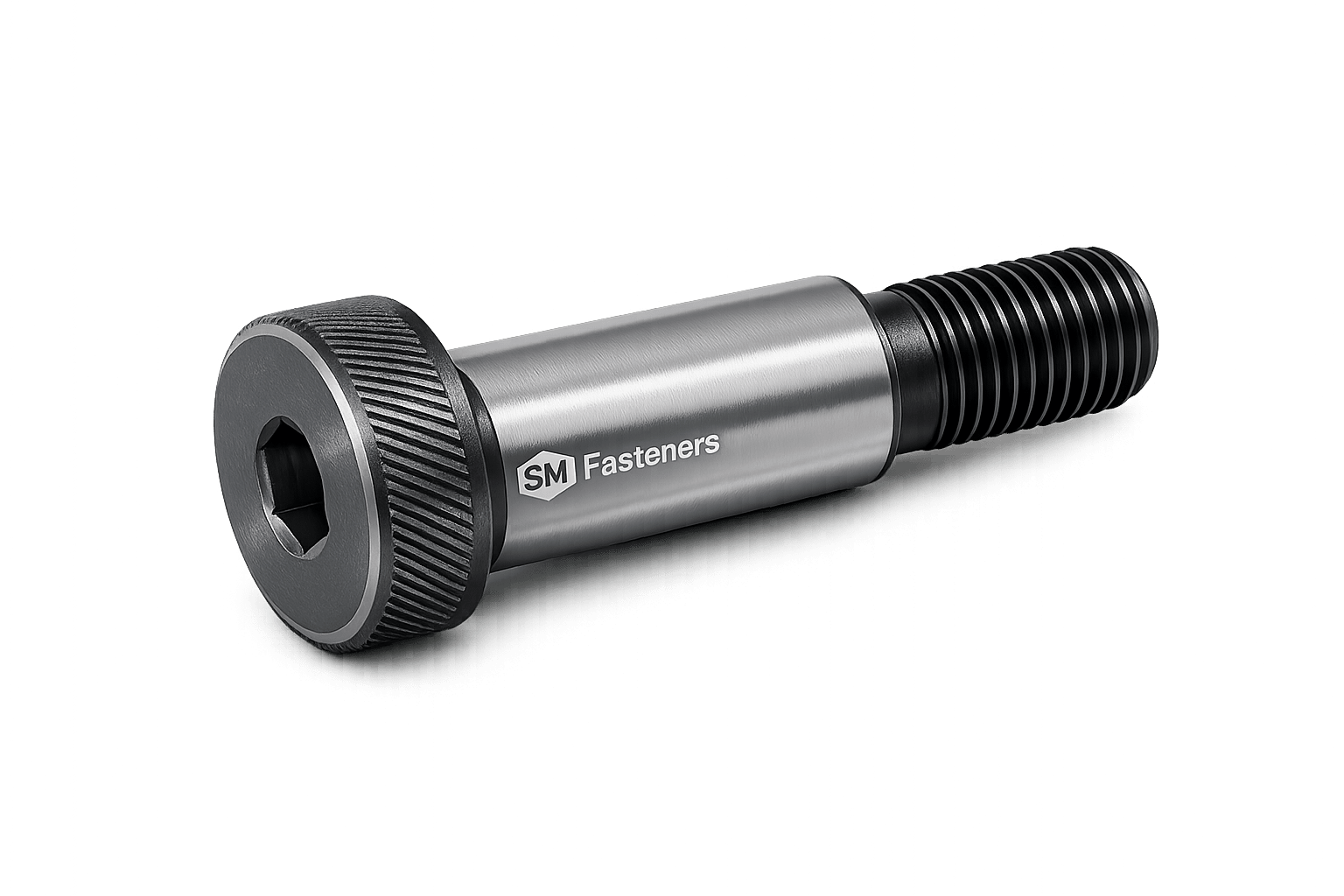
Shoulder bolts (also known as shoulder screws, stripper bolts, precision shoulder fasteners) are specialized engineered fasteners designed to serve both fastening and precision motion functions within mechanical assemblies.
Unlike conventional bolts that primarily provide clamping force, shoulder bolts introduce a precision ground cylindrical shoulder between the head and threaded portion, enabling:
- Controlled rotational movement
- Accurate alignment
- Load bearing through a smooth shank
- Wear-resistant pivot interfaces
They are widely specified in high-precision industrial sectors:
| Industry Sector | Functional Role |
|---|---|
| OEM Machinery | Pivot joints, linkages |
| Oil & Gas Equipment | Actuator mechanisms |
| Power Generation | Turbine auxiliary systems |
| Automation & Robotics | Linear and rotary motion |
| Tooling & Dies | Stripper plates |
| Automotive | Suspension & hinge mechanisms |
| Aerospace Support Equipment | Alignment fixtures |
| Petrochemical Plants | Valve and damper assemblies |
Within EPC and heavy engineering projects, shoulder bolts are treated as functional machine components, not general-purpose fasteners.
SM Fasteners manufactures shoulder bolts compliant with global specifications and supports custom engineering designs aligned with project-specific mechanical requirements.
2. Technical Definition
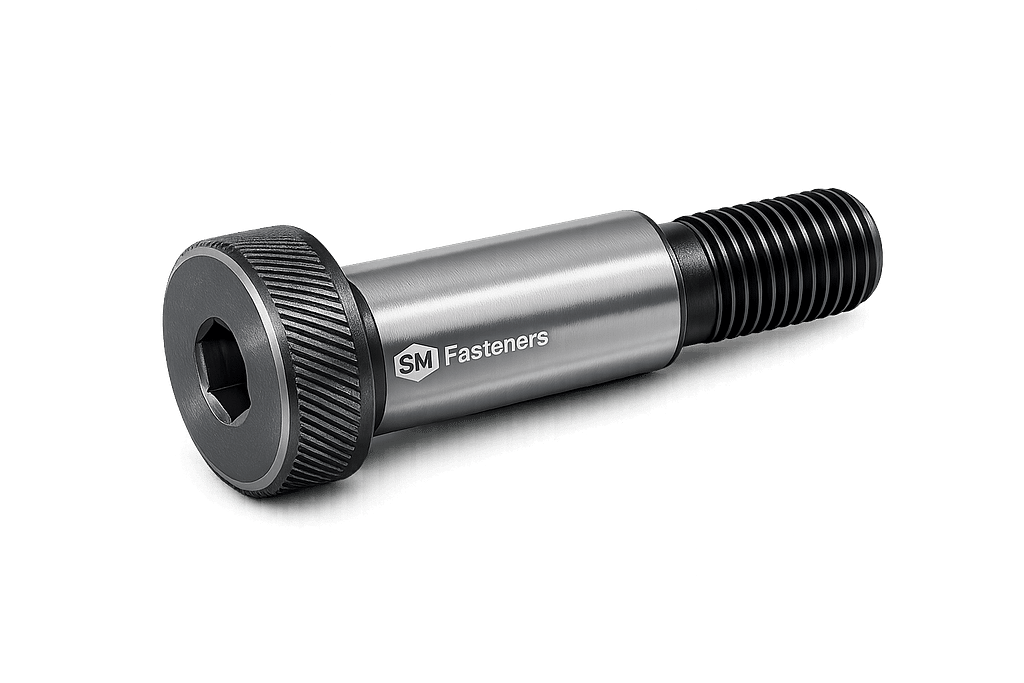
A Shoulder Bolt consists of three engineered zones:
2.1 Structural Elements
| Component | Function |
|---|---|
| Head | Torque transmission |
| Shoulder (Precision Shank) | Load bearing & alignment |
| Threaded Portion | Retention and preload |
The shoulder diameter is intentionally larger than the thread diameter.
Key Engineering Characteristic:
Load transfer occurs primarily through the shoulder, not the threads.
2.2 Fundamental Geometry
 Head → Shoulder → Thread
┌───┐ ███████ ///////- Shoulder = precision ground tolerance
- Thread = anchoring element only
- Head = drive interface
3. Functional Role in Assemblies
Shoulder bolts are selected where standard bolts would fail due to:
- Bearing wear
- Misalignment
- Fatigue cracking
- Thread shear
Typical engineering functions:
✔ Pivot axis
✔ Guide shaft
✔ Bearing journal
✔ Locator pin replacement
✔ Sliding interface
4. Load Mechanics & Force Behavior
Understanding load paths is essential for correct selection.
4.1 Load Distribution
Standard bolts experience:
- Tensile loading
- Thread shear
- Clamping stress
Shoulder bolts redistribute forces:
| Load Type | Load Path |
|---|---|
| Radial load | Shoulder surface |
| Shear load | Shoulder body |
| Axial tension | Threaded section |
| Bending moment | Shoulder transition |
This separation significantly improves fatigue performance.
4.2 Shear Load Mechanics
Shear capacity depends on:
Where:
- = shear force
- = allowable shear stress
- = shoulder cross-section area
Shoulder diameter selection is therefore critical.
4.3 Bearing Stress
Bearing stress between mating component and shoulder:
Where:
- = shoulder diameter
- = engagement length
Design objective:
- Prevent galling
- Minimize wear
- Maintain alignment
4.4 Torque–Tension Relationship
Shoulder bolts generally are not tightened for structural preload, but controlled tightening is still required.
General relationship:
Where:
- T = torque
- K = nut factor (0.15–0.22)
- F = preload
- D = nominal thread diameter
Excess torque may distort motion interfaces.
5. Joint Design Principles
5.1 Proper Shoulder Engagement
Engineering rule:
Shoulder length ≥ moving part thickness
Threads must never lie within the shear plane.
5.2 Clearance Design
Recommended fit classes:
| Fit Type | Application |
|---|---|
| Close sliding fit | Precision automation |
| Running fit | Machinery pivots |
| Loose fit | Maintenance assemblies |
Typical clearance:
- +0.01 to +0.03 mm for precision assemblies.
5.3 Thread Engagement Requirement
Minimum engagement:
| Material | Engagement |
|---|---|
| Steel | 1× diameter |
| Aluminum | 1.5× diameter |
| Cast iron | 1.25× diameter |
5.4 Alignment & Fatigue Prevention
Incorrect design causes:
- Shoulder bending
- Micro-movement
- Fretting fatigue
Engineering solutions:
- Use hardened washers
- Maintain coaxial alignment
- Avoid cantilever loading
6. Preload Calculation — Worked Example
Example:
M10 Shoulder Bolt — Class 12.9
Target preload:
Proof load (M10-12.9) ≈ 830 MPa.
Stress area:
Torque:
7. Failure Mechanisms
7.1 Fatigue Failure
Occurs when:
- Shoulder unsupported
- Cyclic shear loading exists
Mitigation:
- Fillet radius optimization
- Surface hardening
7.2 Shear Failure
Caused by:
- Undersized shoulder diameter
- Shock loading
7.3 Hydrogen Embrittlement
Risk in high-strength alloy steels (>1000 MPa).
SM Fasteners applies:
- Controlled plating processes
- Post-bake de-embrittlement procedures.
7.4 Stress Corrosion Cracking
Common environments:
- Chlorides
- Sour gas (H₂S)
- Marine exposure
Material selection becomes critical (covered Part 3).
7.5 Wear & Galling
Especially in stainless steel motion joints.
Engineering solutions:
- Dry film lubricants
- PEEK bushings
- Surface coating selection
8. Functional Selection Criteria
Engineers select shoulder bolts based on:
| Parameter | Consideration |
|---|---|
| Load Type | Shear / pivot / sliding |
| Motion Frequency | Static or dynamic |
| Environment | Corrosion / temperature |
| Precision Requirement | Tolerance class |
| Maintenance Interval | Replaceability |
| Compliance | ISO / ASTM standards |
9. Advantages Over Conventional Bolts
| Feature | Standard Bolt | Shoulder Bolt |
|---|---|---|
| Alignment | Poor | Excellent |
| Wear Resistance | Low | High |
| Motion Capability | Limited | Designed for motion |
| Fatigue Life | Moderate | High |
| Precision | Low | Engineered |
10. SM Fasteners Engineering Position
SM Fasteners manufactures shoulder bolts under an ISO 9001 certified quality system, supporting:
- Custom shoulder tolerances
- Special alloys
- PEEK-compatible assemblies
- EPC project traceability
- Global export supply
11. Shoulder Bolt Product Types & Variants
Shoulder bolts are engineered for specific mechanical functions rather than simple fastening. Variants differ primarily by head configuration, shoulder geometry, thread form, and tolerance control.
SM Fasteners supplies both standardized and fully custom-engineered shoulder bolts to meet OEM, EPC, and industrial machinery requirements.
11.1 Standard Shoulder Bolt (Socket Head Type)
Most widely used configuration
Characteristics:
- Cylindrical precision ground shoulder
- Internal hex drive
- High-strength alloy steel construction
- Close tolerance shoulder diameter
Typical applications:
- Machine pivots
- Robotics
- Fixtures
- Die sets
- Automation equipment
11.2 Hex Head Shoulder Bolt
Used where:
- Higher tightening torque required
- Field maintenance tools preferred
- Heavy industrial environments exist
Applications:
- Heavy equipment
- Structural mechanisms
- Mining equipment
11.3 Low Head Shoulder Bolt
Design objective:
- Reduced head height
- Clearance-restricted assemblies
Common in:
- Aerospace ground equipment
- Compact mechanical modules
- Electronics tooling
11.4 Precision Shoulder Screw (Stripper Bolt)
Manufactured with:
- Ultra-precision shoulder tolerance
- Polished bearing surface
- Controlled concentricity
Primary usage:
- Injection mould tooling
- Punch press dies
- Stripper plate assemblies
11.5 Shoulder Bolt with Extended Thread
Used when:
- Thick mounting plates exist
- Adjustable spacing required
- Spacer function integrated
11.6 Shoulder Bolt with Internal Lubrication Grooves
Specialized configuration:
- Oil retention grooves
- Reduced friction coefficient
- Increased wear life
Used in:
- Continuous motion systems
- Conveyor equipment
- Actuator linkages
11.7 Custom Engineered Shoulder Bolts (SM Fasteners Capability)
SM Fasteners provides engineered variants including:
- Stepped shoulders
- Double-diameter shoulders
- Hollow shoulder bolts
- Non-standard head designs
- Special drive systems
- Metric + Imperial hybrid configurations
- PEEK-compatible low-friction assemblies
12. Dimensional Logic & Geometry Principles
Shoulder bolt dimensions are governed by functional geometry, not only nominal thread size.
12.1 Critical Dimensions
| Parameter | Symbol | Engineering Function |
|---|---|---|
| Shoulder Diameter | Ds | Load bearing & alignment |
| Shoulder Length | Ls | Engagement depth |
| Thread Diameter | Dt | Retention |
| Thread Length | Lt | Clamp capability |
| Head Diameter | Dh | Torque transfer |
| Head Height | H | Tool engagement |
| Fillet Radius | r | Fatigue resistance |
12.2 Engineering Design Rule
The shoulder must always carry the shear load.
12.3 Shoulder Length Selection
Recommended:
| Assembly Condition | Shoulder Length |
|---|---|
| Sliding joint | Equal to moving thickness |
| Pivot joint | Slightly longer (+0.1 mm clearance) |
| Bearing interface | Full engagement length |
| Spacer application | Defined stack height |
12.4 Clearance Fit Recommendations
| Fit Class | Clearance |
|---|---|
| Precision fit | 0.005–0.015 mm |
| Sliding fit | 0.015–0.035 mm |
| Free rotation | 0.04–0.08 mm |
13. Dimensional Specification Table (Metric Series)
Typical ISO/DIN Shoulder Bolt Dimensions
| Thread Size | Shoulder Dia (mm) | Shoulder Length Range (mm) | Thread Pitch | Head Dia (mm) | Head Height (mm) |
|---|---|---|---|---|---|
| M5 | 6 | 6–25 | 0.8 | 8.5 | 5 |
| M6 | 8 | 8–40 | 1.0 | 10 | 6 |
| M8 | 10 | 10–60 | 1.25 | 13 | 8 |
| M10 | 12 | 12–80 | 1.5 | 16 | 10 |
| M12 | 16 | 16–100 | 1.75 | 18 | 12 |
| M16 | 20 | 20–150 | 2.0 | 24 | 16 |
| M20 | 25 | 25–200 | 2.5 | 30 | 20 |
(Custom dimensions manufactured by SM Fasteners per project drawing.)
14. Dimensional Specification Table (Imperial Series)
| Size | Shoulder Dia (in) | Shoulder Length | Thread Type | Head Dia |
|---|---|---|---|---|
| 1/4″ | 5/16 | 1/4–2″ | UNC/UNF | 3/8 |
| 5/16″ | 3/8 | 3/8–3″ | UNC/UNF | 1/2 |
| 3/8″ | 1/2 | 1/2–4″ | UNC/UNF | 9/16 |
| 1/2″ | 5/8 | 1–6″ | UNC/UNF | 3/4 |
| 5/8″ | 3/4 | 1–8″ | UNC/UNF | 15/16 |
15. International Standards & Compliance
Shoulder bolts operate across global projects requiring interchangeability.
15.1 ISO Standards
| Standard | Description |
|---|---|
| ISO 7379 | Hexagon socket head shoulder screws |
| ISO 4762 | Socket head cap screws reference |
| ISO 898-1 | Mechanical properties of fasteners |
| ISO 965 | Thread tolerances |
| ISO 3506 | Stainless steel fasteners |
15.2 DIN Standards
| DIN Standard | Application |
|---|---|
| DIN 7379 | Shoulder screws |
| DIN 912 | Socket head reference geometry |
| DIN 13 | Metric thread system |
15.3 ASTM Standards
| ASTM Standard | Application |
|---|---|
| ASTM A574 | Alloy steel socket screws |
| ASTM A193 | High temperature service |
| ASTM F593 | Stainless steel bolts |
| ASTM B637 | Nickel alloy fasteners |
15.4 British Standards (BS)
| Standard | Description |
|---|---|
| BS 2470 | Shoulder screws |
| BS 3643 | Thread forms |
| BS EN ISO equivalents | Harmonized EU adoption |
16. Thread Standards & Tolerances
Shoulder bolts may use multiple thread systems depending on equipment origin.
Thread Standards Comparison Table
| Thread System | Standard | Angle | Typical Tolerance |
|---|---|---|---|
| Metric | ISO 68 | 60° | 6g / 6H |
| UNC | ASME B1.1 | 60° | 2A/2B |
| UNF | ASME B1.1 | 60° | 2A/2B |
| BSW | BS 84 | 55° | Medium |
| BSF | BS 84 | 55° | Fine |
SM Fasteners supports metric–imperial interchangeability for multinational EPC projects.
17. Property Class & Mechanical Grade Systems
Shoulder bolts typically use high-strength grades.
Mechanical Property Classes
| Property Class | Yield Strength (MPa) | UTS (MPa) | Typical Use |
|---|---|---|---|
| 8.8 | 640 | 800 | General machinery |
| 10.9 | 940 | 1040 | Dynamic loading |
| 12.9 | 1100 | 1220 | Precision motion |
| A2-70 | 450 | 700 | Corrosion resistance |
| A4-80 | 600 | 800 | Marine service |
18. Proof Load & Tensile Strength Table
| Size | Grade 8.8 Proof Load (kN) | Grade 10.9 (kN) | Grade 12.9 (kN) |
|---|---|---|---|
| M6 | 8.1 | 11.9 | 14.2 |
| M8 | 14.5 | 21.2 | 25.4 |
| M10 | 23.2 | 33.9 | 40.7 |
| M12 | 33.8 | 49.3 | 59.1 |
| M16 | 67.5 | 98.6 | 118.2 |
| M20 | 105 | 153 | 183 |
19. Joint Interchangeability Considerations
Global equipment integration requires:
- Equivalent head geometry
- Thread compatibility
- Shoulder tolerance equivalence
- Load rating verification
Engineering checks performed by SM Fasteners include:
✔ Cross-standard dimensional verification
✔ Thread compatibility confirmation
✔ Mechanical property equivalence review
20. Engineering Tolerance Control
Critical tolerances:
| Feature | Typical Tolerance |
|---|---|
| Shoulder diameter | h6 |
| Shoulder concentricity | ≤0.02 mm |
| Runout | ≤0.03 mm |
| Thread tolerance | 6g |
| Surface finish | Ra ≤ 0.8 µm |
Precision grinding ensures motion performance.
21. Design Integration with Bearings & Bushings
Shoulder bolts frequently interface with:
- Bronze bushings
- PTFE liners
- Polymer bearings
- PEEK bush systems supplied for chemical environments
PEEK-compatible designs offer:
- Electrical insulation
- Chemical resistance
- Low friction operation
- High temperature capability
22. Dimensional Weight Chart
(Aligned with SM Fasteners Manufacturing Data)
| Size | Approx Weight (kg/pc) | Weight per 100 pcs (kg) |
|---|---|---|
| M6×20 | 0.008 | 0.8 |
| M8×30 | 0.018 | 1.8 |
| M10×40 | 0.035 | 3.5 |
| M12×50 | 0.065 | 6.5 |
| M16×60 | 0.145 | 14.5 |
| M20×80 | 0.310 | 31 |
Used for EPC logistics and export packing calculations.
23. Engineering Selection Checklist
Before specifying shoulder bolts:
- Verify shear load capacity
- Confirm shoulder length vs stack thickness
- Select material based on environment
- Confirm hardness compatibility
- Review coating compatibility
- Validate applicable standards
24. SM Fasteners Engineering Capability
Through ISO 9001 certified processes, SM Fasteners supports:
- Precision shoulder grinding
- Tight tolerance machining
- Multi-standard production
- Special alloy manufacturing
- Project-specific dimensional engineering
25. Material Engineering Philosophy for Shoulder Bolts
Shoulder bolts function simultaneously as:
- Structural fasteners
- Precision shafts
- Wear surfaces
- Load-bearing pins
Therefore, material selection must satisfy four engineering criteria simultaneously:
- Mechanical strength
- Surface wear resistance
- Dimensional stability
- Environmental corrosion resistance
SM Fasteners manufactures shoulder bolts using certified raw materials verified under ISO 9001 quality management systems, ensuring traceability from mill source to final shipment.
26. Industrial Material Grades Used for Shoulder Bolts
26.1 Carbon Steel Grades
| Material | Standard | UTS (MPa) | Yield (MPa) | Temperature Limit | Typical Application |
|---|---|---|---|---|---|
| C35 / EN8 | EN 10083 | 600–700 | 350 | 300°C | General machinery |
| C45 | EN 10083 | 700–800 | 420 | 350°C | Moderate load pivots |
| ASTM A108 | ASTM | 650–750 | 400 | 300°C | OEM equipment |
Advantages:
- Cost-effective
- Good machinability
- Suitable for coated applications
Limitations:
- Requires corrosion protection.
26.2 Alloy Steel Grades (High Strength)
Primary materials for precision shoulder bolts.
| Material | Standard | UTS | Hardness Range | Application |
|---|---|---|---|---|
| 42CrMo4 | EN 10083 | 1000–1200 MPa | 28–38 HRC | Heavy machinery |
| ASTM A574 | ASTM | ≥1220 MPa | 32–39 HRC | High precision |
| SCM435 | JIS | 1100 MPa | 30–36 HRC | Automation systems |
| 4140 / 4142 | ASTM | 1000–1300 MPa | 28–40 HRC | Dynamic loading |
Engineering benefit:
- High fatigue resistance
- Excellent wear properties
- Stable shoulder geometry
26.3 Stainless Steel Grades
Used where corrosion resistance is primary.
| Grade | Standard | UTS | Corrosion Resistance | Industry |
|---|---|---|---|---|
| A2-70 (304) | ISO 3506 | 700 MPa | Good | Food & equipment |
| A4-80 (316) | ISO 3506 | 800 MPa | Marine | Offshore |
| 316L | ASTM A193 | 620 MPa | Chloride resistant | Chemical plants |
| 17-4 PH | ASTM A564 | 1100 MPa | High | Aerospace tooling |
26.4 Duplex & Super Duplex Stainless Steel
| Grade | Standard | Advantage |
|---|---|---|
| Duplex 2205 | ASTM A182 | High strength + corrosion |
| Super Duplex 2507 | ASTM A479 | Seawater resistance |
| Zeron 100 | NORSOK | Offshore critical service |
Used in:
- Offshore platforms
- Subsea equipment
- Desalination plants
26.5 Nickel Alloys & High Performance Materials
SM Fasteners supports advanced alloys for severe environments.
| Material | Key Property | Service Condition |
|---|---|---|
| Inconel 625 | Oxidation resistant | High temperature |
| Inconel 718 | High creep strength | Turbines |
| Hastelloy C276 | Acid resistance | Chemical reactors |
| Monel 400 | Seawater resistance | Marine systems |
| SMO 254 | Chloride resistance | Desalination |
| Incoloy 825 | Sour gas resistant | Oil & Gas |
26.6 PEEK Shoulder Bolt Applications
PEEK (Polyether Ether Ketone) fasteners supplied by SM Fasteners are used where metals are unsuitable.
Properties:
- Operating temperature up to 260°C
- Electrical insulation
- Chemical inertness
- Non-magnetic
- Low friction
Applications:
- Semiconductor equipment
- LNG instrumentation
- Chemical dosing systems
- Electrical assemblies
27. Material Comparison Table
| Material | Strength | Corrosion Resistance | Cost Index | Temperature Capability | Typical Industry |
|---|---|---|---|---|---|
| Carbon Steel | Medium | Low | 1 | Medium | Machinery |
| Alloy Steel | Very High | Low | 1.5 | Medium | Heavy Equipment |
| SS 304 | Medium | Good | 2 | Medium | Process plants |
| SS 316 | Medium | Very Good | 2.5 | Medium | Marine |
| Duplex 2205 | High | Excellent | 4 | High | Offshore |
| Inconel | Very High | Exceptional | 8 | Extreme | Power/LNG |
| PEEK | Moderate | Chemical-proof | 6 | High | Electronics |
28. Corrosion Resistance vs Environment
| Environment | Recommended Material |
|---|---|
| Indoor machinery | Carbon steel coated |
| Marine atmosphere | SS316 / Duplex |
| Seawater immersion | Super Duplex / Monel |
| Acidic chemical plant | Hastelloy |
| Sour gas (H₂S) | NACE compliant alloys |
| High temperature (>500°C) | Inconel |
| Electrical insulation | PEEK |
SM Fasteners provides material compliance aligned with NACE MR0175 / ISO 15156 for sour service applications.
29. Heat Treatment Processes
Heat treatment defines shoulder bolt performance.
29.1 Quenching & Tempering
Process:
- Austenitizing
- Oil quenching
- Controlled tempering
Result:
- High tensile strength
- Toughness improvement
- Fatigue resistance
Typical hardness:
28–36 HRC.
29.2 Induction Hardening (Shoulder Surface)
Applied specifically to shoulder area.
Benefits:
- Wear-resistant surface
- Tough core retained
- Increased service life
29.3 Case Hardening / Carburizing
Used when:
- Sliding motion dominates
- Wear resistance critical
Surface hardness:
55–62 HRC.
29.4 Precipitation Hardening (PH Stainless)
Used for:
- 17-4PH stainless shoulder bolts.
Advantages:
- High strength + corrosion resistance.
29.5 Hydrogen Embrittlement Control
For high-strength bolts:
SM Fasteners applies:
- Controlled electroplating chemistry
- Baking at 190–230°C
- Process validation per ISO standards.
30. Mechanical Properties (Grade-Wise)
| Grade | Hardness | Yield Strength | UTS | Typical Use |
|---|---|---|---|---|
| 8.8 | 22–30 HRC | 640 MPa | 800 MPa | General machinery |
| 10.9 | 32–36 HRC | 940 MPa | 1040 MPa | Dynamic loading |
| 12.9 | 36–39 HRC | 1100 MPa | 1220 MPa | Precision pivots |
| A2-70 | HRB 95 | 450 MPa | 700 MPa | Corrosive areas |
| A4-80 | HRB 100 | 600 MPa | 800 MPa | Offshore |
31. End-to-End Manufacturing Workflow
(SM Fasteners Production System)
31.1 Raw Material Verification
Incoming material inspected for:
- Mill Test Certificate (MTC)
- Heat number traceability
- Chemical composition
- PMI verification (for alloys)
31.2 Forging vs Machining
| Process | Use Case |
|---|---|
| Cold forging | High volume standard sizes |
| Hot forging | Large diameter bolts |
| CNC machining | Precision shoulder bolts |
| Grinding | Tight tolerance shoulder finishing |
Shoulder bolts generally require precision CNC machining + grinding.
31.3 Shoulder Precision Grinding
Critical manufacturing step.
Achieves:
- h6 tolerance
- Low surface roughness
- Perfect concentricity
31.4 Thread Manufacturing
Thread Rolling (Preferred)
Advantages:
- Improved fatigue strength
- Compressive grain flow
- Superior thread surface
Thread Cutting
Used for:
- Exotic alloys
- Large diameters
- Custom geometries
31.5 Heat Treatment & Hardness Control
Performed in calibrated furnaces:
- Controlled atmosphere
- Batch traceability
- Hardness verification
31.6 Surface Preparation
Processes include:
- Shot blasting
- Deburring
- Ultrasonic cleaning
- Passivation (stainless grades)
32. Surface Engineering & Coatings
Surface finish dramatically affects performance and corrosion resistance.
Surface Finish Comparison Table
| Coating | Corrosion Protection | Friction | Temperature Limit | Application |
|---|---|---|---|---|
| Black Oxide | Low | Low | 300°C | Machinery |
| Zinc Plating | Medium | Moderate | 120°C | Indoor use |
| HDG | High | High | 450°C | Structural |
| Geomet | Very High | Stable | 300°C | Automotive |
| Dacromet | Very High | Low | 300°C | Offshore |
| PTFE | Excellent | Very Low | 260°C | Chemical |
| Nickel Plating | Good | Low | 600°C | Precision motion |
| Passivation | Stainless protection | Low | High | Process plants |
32.1 Coating Selection Considerations
Engineers evaluate:
- Operating temperature
- Torque coefficient
- Corrosion class
- Hydrogen embrittlement risk
- Maintenance interval
32.2 Friction & Nut Factor Influence
Typical nut factors:
| Condition | Nut Factor (K) |
|---|---|
| Dry | 0.20–0.22 |
| Oiled | 0.16–0.18 |
| PTFE coated | 0.10–0.14 |
Torque must be adjusted accordingly.
32.3 Galvanic Compatibility
Avoid dissimilar metal combinations:
Example:
- Stainless bolt + aluminum housing → galvanic corrosion.
Recommended:
- Isolation washer
- PEEK bushing
- Matching alloy selection
33. Manufacturing Traceability at SM Fasteners
Each shoulder bolt batch maintains:
- Heat number marking
- Process routing sheet
- Inspection history
- Operator traceability
- Final QC approval
Aligned with:
- ISO 9001 quality systems
- UKAF accredited procedures
- EPC procurement requirements
34. Engineering Value Delivered by SM Fasteners
SM Fasteners integrates:
✔ Advanced alloy capability
✔ Precision machining & grinding
✔ Controlled heat treatment
✔ Surface engineering expertise
✔ NACE-compliant manufacturing
✔ Custom fastener engineering
Supporting global industrial and EPC projects requiring high-reliability precision fasteners.
35. Inspection & Quality Control Philosophy
Shoulder bolts are classified as functional precision components, not standard hardware. Their performance depends heavily on dimensional accuracy, metallurgical integrity, and surface condition.
SM Fasteners operates under an ISO 9001 certified quality management system, supported by MSME registration and UKAF-accredited processes, ensuring repeatable manufacturing control suitable for EPC, OEM, and regulated industrial projects.
Quality assurance objectives:
- Ensure dimensional conformity
- Verify mechanical performance
- Maintain material traceability
- Prevent premature failure in service
- Achieve international procurement acceptance
36. Incoming Material Inspection
Before production, all raw material undergoes verification:
36.1 Documentation Verification
- Mill Test Certificate (EN 10204 3.1)
- Heat number confirmation
- Chemical composition review
- Supplier qualification validation
36.2 Positive Material Identification (PMI)
Applied for:
- Duplex stainless steels
- Nickel alloys
- Sour service materials
- High-value EPC orders
Methods:
- XRF analysis
- Optical emission spectroscopy
37. Dimensional Inspection Procedures
Shoulder bolts require stricter inspection compared to standard bolts.
| Inspection Parameter | Method | Typical Control |
|---|---|---|
| Shoulder diameter | Micrometer | h6 tolerance |
| Shoulder length | Vernier/CMM | ±0.02 mm |
| Concentricity | Dial indicator | ≤0.02 mm |
| Thread pitch | Thread gauge | GO/NO-GO |
| Head dimensions | Profile measurement | ISO/DIN compliance |
| Surface roughness | Profilometer | Ra ≤0.8 µm |
CMM inspection is applied for critical assemblies.
38. Mechanical Testing
Performed per ISO 898-1, ASTM, and DIN requirements.
Testing Methods
- Tensile testing
- Proof load testing
- Hardness testing (Rockwell/Vickers)
- Impact testing (where specified)
- Shear testing (application specific)
Mechanical Properties Verification Table
| Grade | Hardness Test | Acceptance Range |
|---|---|---|
| 8.8 | HRC | 22–30 |
| 10.9 | HRC | 32–36 |
| 12.9 | HRC | 36–39 |
| A2-70 | HRB | ≤95 |
| A4-80 | HRB | ≤100 |
39. Non-Destructive Testing (NDT)
Applied for critical service shoulder bolts.
| NDT Method | Purpose |
|---|---|
| Magnetic Particle Testing (MPI) | Surface crack detection |
| Dye Penetrant Testing (DPT) | Non-magnetic alloys |
| Ultrasonic Testing | Internal defects |
| Eddy Current Testing | Surface integrity |
40. Surface Coating Inspection
Verification includes:
- Coating thickness measurement
- Adhesion testing
- Salt spray testing
- Hydrogen embrittlement control validation
Typical requirements:
| Coating | Thickness |
|---|---|
| Zinc plating | 8–12 µm |
| HDG | 45–85 µm |
| Dacromet/Geomet | 8–15 µm |
| PTFE | Project specific |
41. Documentation & Certification
SM Fasteners supplies full project documentation:
Standard Documentation Package
- EN 10204 3.1 Material Test Certificate
- Heat treatment reports
- Dimensional inspection report
- Coating certificate
- Mechanical test reports
- Certificate of Conformity (CoC)
Optional EPC Documentation
- EN 10204 3.2 third-party certification
- NACE compliance declaration
- PMI reports
- ITP compliance records
- Traceability matrix
42. Industry Applications
42.1 Construction & Structural Steel
Applications:
- Expansion mechanisms
- Sliding structural connections
- Bridge hinge systems
- Heavy facade assemblies
Engineering Requirement:
- High shear capacity
- Corrosion protection
42.2 Oil & Gas (Upstream / Midstream / Downstream)
Used in:
- Valve actuators
- Pipeline equipment
- Drilling machinery
- Compressor linkages
Material Requirements:
- NACE MR0175 compliance
- Sour service resistance
- High fatigue reliability
42.3 Power Generation
Applications:
- Turbine auxiliary linkages
- Damper mechanisms
- Generator assemblies
- Boiler equipment
Materials:
- Alloy steel
- Inconel
- Heat-resistant stainless grades
42.4 Petrochemical & Chemical Processing
Critical needs:
- Chemical resistance
- Precision motion
- Non-galling performance
Typical materials:
- SS316L
- Hastelloy
- SMO 254
- PEEK fasteners
42.5 LNG & Offshore Systems
Requirements:
- Seawater corrosion resistance
- High vibration tolerance
- Long service intervals
Preferred materials:
- Duplex / Super Duplex
- Monel
- Inconel alloys
42.6 Automotive & Heavy Equipment
Applications:
- Suspension pivots
- Hydraulic linkages
- Robot arms
- Assembly tooling
Key property:
- High wear resistance.
42.7 Railways & Infrastructure
Used in:
- Bogie mechanisms
- Track maintenance equipment
- Signalling assemblies
Requirement:
- High fatigue life.
42.8 Shipbuilding & Marine Engineering
Applications:
- Hatch mechanisms
- Steering linkages
- Deck equipment
Material preference:
- A4-80 stainless
- Duplex stainless steel.
43. Export Capability & Global Supply Readiness
SM Fasteners supports international procurement programs through structured export processes.
43.1 Industrial Packaging
- VCI corrosion protection
- Thread protectors
- Oil-wrapped components
- Vacuum sealed packaging
- Batch labeling & barcoding
43.2 Export Crating
- ISPM-15 compliant wooden crates
- Moisture barrier protection
- Shock-resistant packing
- Container optimization for weight distribution
43.3 Logistics Documentation
Provided with shipment:
- Commercial invoice
- Packing list
- Certificate of Origin
- Inspection release note
- Material traceability documents
- HS code classification
44. Tightening Torque Chart
(Reference values — lubricated condition)
| Size | Grade 8.8 (Nm) | Grade 10.9 (Nm) | Grade 12.9 (Nm) |
|---|---|---|---|
| M6 | 10 | 14 | 17 |
| M8 | 24 | 35 | 42 |
| M10 | 49 | 72 | 86 |
| M12 | 85 | 125 | 150 |
| M16 | 210 | 310 | 370 |
| M20 | 410 | 600 | 720 |
Torque values must consider coating friction coefficient.
45. Preload Calculation Formula
Where:
- F = Preload (N)
- T = Applied Torque (Nm)
- K = Nut Factor
- D = Nominal Diameter (m)
Worked Example
M12 Shoulder Bolt
Torque = 125 Nm
K = 0.18
46. Failure Mechanism Prevention Matrix
| Failure Mode | Cause | Engineering Prevention |
|---|---|---|
| Fatigue cracking | Misalignment | Correct shoulder fit |
| Galling | Stainless contact | PTFE coating |
| Hydrogen embrittlement | Improper plating | Bake treatment |
| Thread stripping | Insufficient engagement | Proper thread length |
| Wear | Soft shoulder | Induction hardening |
47. Surface Finish Performance Comparison
| Finish | Corrosion Resistance | Wear Resistance | Friction | Maintenance Interval |
|---|---|---|---|---|
| Black Oxide | Low | Medium | Low | Short |
| Zinc | Medium | Medium | Medium | Moderate |
| HDG | High | Medium | High | Long |
| Dacromet | Very High | High | Low | Long |
| PTFE | Excellent | High | Very Low | Extended |
| Passivated SS | Excellent | Medium | Low | Extended |
48. Thread Standards & Tolerances Table
| Standard | Fit Class | Typical Use |
|---|---|---|
| ISO Metric | 6g/6H | Global machinery |
| UNC | 2A/2B | North America |
| UNF | 2A/2B | Precision assemblies |
| BSW | Medium | Legacy systems |
| BSF | Fine | High precision |
49. Corrosion Resistance vs Environment Table
| Environment | Recommended Material |
|---|---|
| Indoor dry | Carbon steel coated |
| Humid industrial | SS304 |
| Marine | SS316 / Duplex |
| Seawater immersion | Super Duplex |
| Acidic | Hastelloy |
| Sour gas | NACE compliant alloys |
| Chemical exposure | PEEK |
50. Weight Reference Chart (SM Fasteners Standard Data)
| Size | Weight per Piece (kg) | Weight per 100 pcs (kg) |
|---|---|---|
| M6×20 | 0.008 | 0.8 |
| M8×30 | 0.018 | 1.8 |
| M10×40 | 0.035 | 3.5 |
| M12×50 | 0.065 | 6.5 |
| M16×60 | 0.145 | 14.5 |
| M20×80 | 0.310 | 31 |
Used for EPC logistics planning and freight optimization.
51. SM Fasteners — Engineering & Manufacturing Capability
SM Fasteners demonstrates complete industrial readiness through:
Engineering Strength
- Precision shoulder geometry control
- Multi-standard manufacturing (ISO / ASTM / DIN / BS)
- Advanced alloy expertise
- PEEK fastener engineering
Manufacturing Capability
- CNC machining & grinding
- Controlled heat treatment
- Certified coating systems
- Custom fastener development
Quality Assurance
- ISO 9001 certified systems
- UKAF aligned procedures
- Full traceability
- EPC documentation compliance
Global Supply Readiness
- Export packaging systems
- Third-party inspection support
- Project-based manufacturing
- Reliable international logistics
CONCLUSION
Shoulder bolts are critical engineered components combining fastening strength with precision mechanical functionality. Proper material selection, geometry control, heat treatment, surface engineering, and inspection are essential to ensure reliability in demanding industrial environments.
Through certified quality systems, advanced materials capability, and engineering-driven manufacturing processes, SM Fasteners delivers shoulder bolts suitable for:
- High-precision machinery
- Offshore and energy infrastructure
- Chemical and petrochemical plants
- Heavy equipment and automation systems
- Global EPC and OEM projects