

U-Nut
1. Industry Context
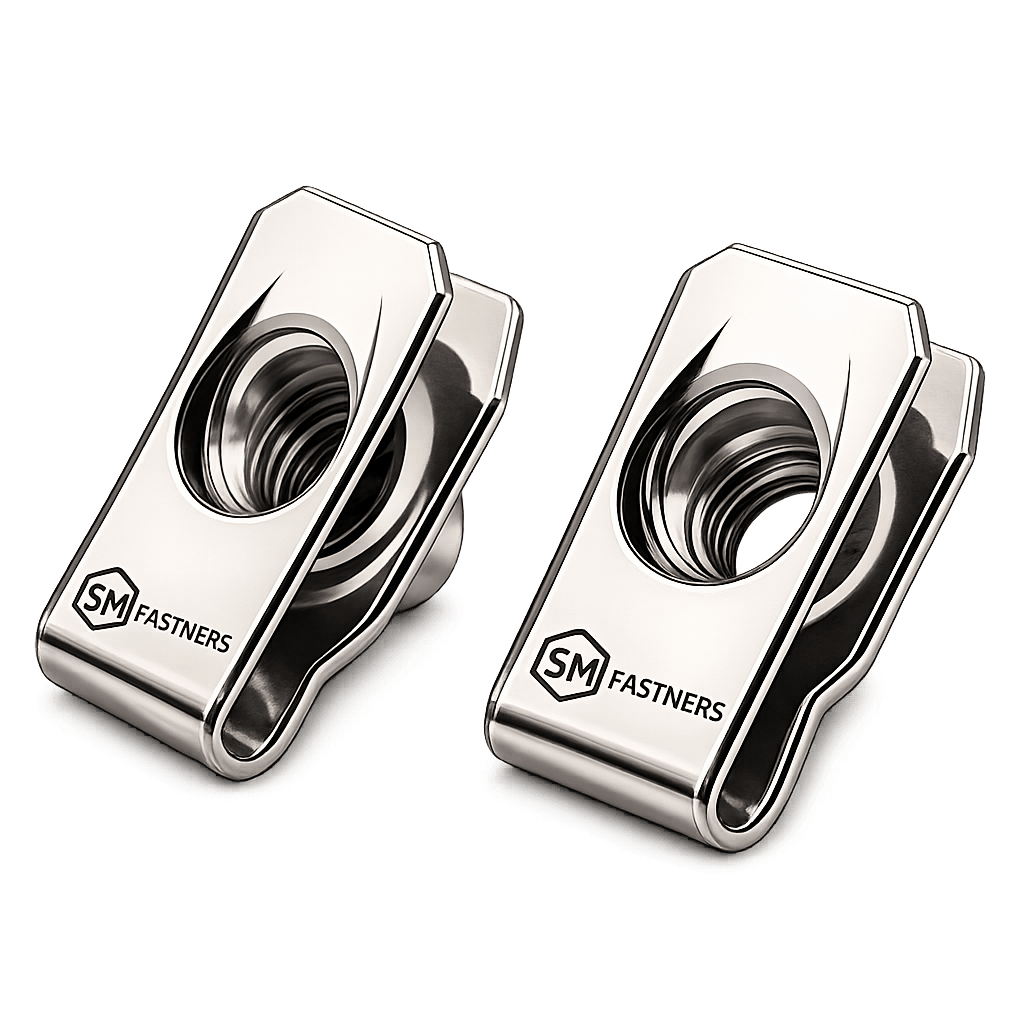
U-Nuts are specialized self-retaining sheet metal fastening elements extensively used in modern industrial assemblies where:
- Access to the backside of a joint is restricted
- Welding or tapping operations must be avoided
- Assembly speed and serviceability are critical
- Lightweight structures require distributed clamping points
Across global industries, U-Nuts enable repeatable threaded engagement without permanent modification of structural components.
Key Industrial Drivers
| Industry Requirement | Engineering Need | Role of U-Nut |
|---|---|---|
| High assembly speed | Tool-less positioning | Clip-on installation |
| Thin sheet structures | No tapping capability | Provides reusable thread |
| Maintenance access | Replaceable fastening | Non-destructive fixing |
| Corrosion environments | Protected joints | Coated or stainless materials |
| Cost optimization | Reduced fabrication | Eliminates welding |
Primary Industrial Users
- Automotive OEM manufacturing
- Electrical enclosures & switchgear
- HVAC and ducting systems
- Railway coach manufacturing
- Infrastructure panels & guard systems
- Oil & gas equipment housings
- Marine sheet structures
- Heavy equipment cabins
SM Fasteners supplies U-Nuts designed for OEM production lines, EPC procurement packages, and export assemblies compliant with international standards.
2. Technical Definition
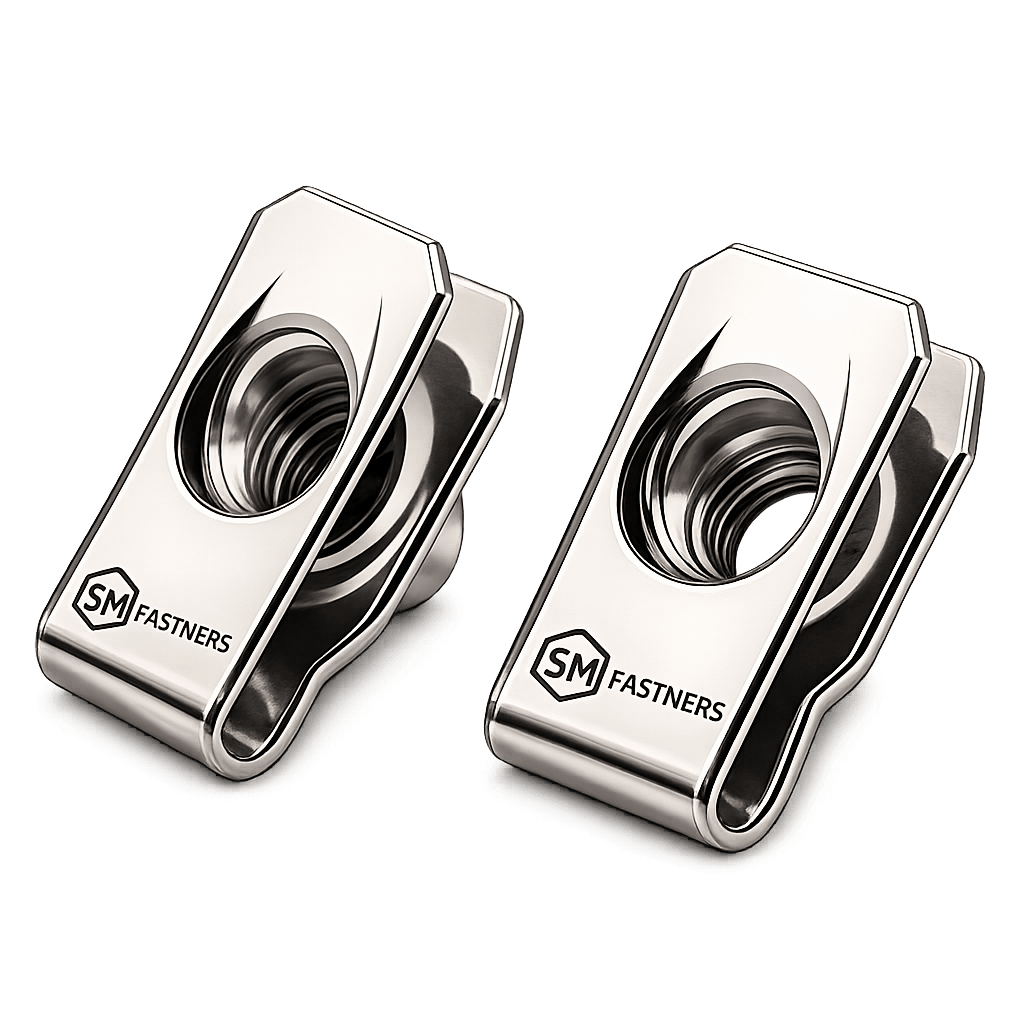
A U-Nut (also called Speed Nut, Clip Nut, or Spring Nut) is a self-retaining, spring-steel fastener shaped like a “U” profile that clips over sheet material, providing an internally threaded or extruded thread feature.
Functional Characteristics
- Dual-leg spring configuration
- Self-locking friction retention
- Floating or fixed thread alignment
- Compatible with machine screws or bolts
- Eliminates loose nut handling
Mechanical Concept
The U-Nut operates through elastic deformation:
- Legs flex during installation.
- Spring force grips panel edges.
- Threaded section aligns with screw.
- Clamp load develops during tightening.
Unlike conventional nuts, U-Nuts combine:
- Retention
- Thread formation
- Anti-vibration behavior
into a single engineered component.
3. Functional Role in Mechanical Assemblies
U-Nuts primarily function as:
3.1 Captive Thread Providers
Allow threaded fastening where:
- Sheet thickness < thread engagement requirement
- Rear-side access unavailable
- Weld distortion unacceptable
3.2 Assembly Alignment Devices
Floating variants compensate for:
- Hole tolerance variation
- Panel misalignment
- Thermal expansion
3.3 Anti-Loosening Components
Spring preload generates continuous friction.
4. Load Mechanics & Force Behavior
U-Nut performance depends on three interacting forces:
4.1 Installation Retention Force
Spring legs create normal force:
Where:
- = spring stiffness
- = elastic deflection
This prevents displacement prior to tightening.
4.2 Clamp Load Development
Bolt tightening generates preload:
Where:
| Symbol | Meaning |
|---|---|
| T | Applied torque |
| K | Nut factor |
| D | Nominal diameter |
Typical Nut Factor:
| Condition | K Value |
|---|---|
| Dry steel | 0.20–0.25 |
| Zinc plated | 0.18 |
| Lubricated | 0.14–0.16 |
4.3 Load Transfer Mechanism
Unlike hex nuts:
- Load is partially transferred to sheet edges.
- Local bearing stresses govern performance.
Primary stresses:
- Thread shear
- Sheet bearing
- Spring fatigue
5. Joint Design Principles
Correct engineering selection is critical.
5.1 Thread Engagement Requirement
Minimum engagement:
For softer materials:
5.2 Panel Thickness Compatibility
| Panel Thickness | Recommended U-Nut Type |
|---|---|
| 0.5–1.0 mm | Spring steel extruded |
| 1–3 mm | Standard threaded |
| >3 mm | Floating cage type |
5.3 Hole Alignment Tolerance
Floating U-Nuts allow:
±1.0–1.5 mm positional compensation.
5.4 Torque Limitation
U-Nuts are not designed for structural preload comparable to heavy hex nuts.
Engineering limitation:
- Intended for light to medium clamping loads
- Ideal for panels, guards, housings, covers
6. Mechanical Behavior Under Service Loads
Tensile Loading
Screw carries tensile load; U-Nut provides thread support.
Shear Loading
Transferred through:
- Panel interface
- Screw shank
Vibration Response
Spring pressure maintains frictional resistance.
7. Torque–Tension Relationship
Approximate tightening behavior:
| Torque Increase | Result |
|---|---|
| Low torque | Seating & alignment |
| Medium torque | Elastic clamp load |
| Excess torque | Thread stripping risk |
8. Failure Mechanisms
Engineering risk evaluation is mandatory.
8.1 Thread Stripping
Occurs when:
- Panel too thin
- Over-torquing
- Low hardness material
8.2 Spring Fatigue
Repeated removal causes loss of retention force.
8.3 Bearing Failure
Localized crushing of sheet material.
8.4 Hydrogen Embrittlement
Risk for high-strength coated spring steel.
SM Fasteners controls coating processes per ISO plating standards to mitigate risk.
8.5 Stress Corrosion Cracking
Relevant in:
- Marine atmosphere
- Chloride exposure
- Sour gas environments
Material upgrade recommended:
- Stainless steel
- Duplex
- PEEK fasteners
9. Functional Selection Criteria
Engineers must evaluate:
| Parameter | Selection Basis |
|---|---|
| Load level | Screw size |
| Panel thickness | Leg geometry |
| Environment | Material/coating |
| Assembly speed | Clip retention force |
| Serviceability | Floating vs fixed |
10. Engineering Advantages of U-Nuts
- Eliminates weld nuts
- Reduces machining cost
- Enables blind assembly
- Improves production efficiency
- Reduces inventory complexity
11. Role Within SM Fasteners Portfolio
U-Nuts complement SM Fasteners’ precision range:
- Nuts
- Bolts
- Washers
- Rings
- Threaded rods
- Custom engineered fasteners
- High-performance PEEK fastening systems
Manufactured under:
- ISO 9001 Quality System
- UKAF Certified Processes
- MSME Manufacturing Framework
12. Product Types and Engineering Variants
U-Nuts are engineered in multiple configurations to accommodate different assembly constraints, loading conditions, and manufacturing tolerances. Selection must be based on functional performance, not visual similarity.
12.1 Standard U-Nut (Fixed Thread Type)
Description
- Traditional U-shaped spring clip
- Threaded portion formed or tapped
- Fixed thread alignment
Engineering Characteristics
- Fast installation
- High positional stability
- Suitable for repetitive production assembly
Typical Applications
- Automotive body panels
- Electrical cabinets
- HVAC covers
- Machine guards
12.2 Floating U-Nut
Description
Threaded element allowed controlled lateral movement.
Engineering Advantage
Compensates for:
- Hole misalignment
- Panel tolerance stack-up
- Thermal expansion variation
| Parameter | Typical Value |
|---|---|
| Float Range | ±1.0–1.5 mm |
| Assembly Efficiency | High |
| Misalignment Capability | Excellent |
Industrial Use
- Rail coach assemblies
- Aerospace interiors
- Switchgear panels
- OEM equipment housing
12.3 Extruded Thread U-Nut
Threads formed by material extrusion rather than tapping.
Benefits
- Increased thread engagement
- Higher stripping resistance
- Reduced manufacturing cost
Best suited for thin sheets.
12.4 Self-Locking U-Nut
Includes intentional thread interference.
Locking mechanisms:
- Spring tension locking
- Offset thread design
- Prevailing torque concept
Used where vibration resistance is required.
12.5 Double U-Nut / Heavy Retention Clip
Features:
- Extended spring legs
- Higher grip force
- Improved retention before tightening
Used in heavy equipment panels.
12.6 Edge Clip U-Nut
Designed specifically for panel edges.
Applications:
- Vehicle trims
- Cable trays
- Sheet metal enclosures
12.7 Plastic / PEEK U-Nut
SM Fasteners manufactures engineered polymer variants including PEEK U-Nuts.
Advantages:
- Electrically non-conductive
- Lightweight
- Corrosion immune
- Chemical resistant
- Non-magnetic
Typical sectors:
- Semiconductor manufacturing
- Offshore electronics
- Chemical processing
- LNG instrumentation panels
13. Dimensional Logic and Geometry
U-Nut geometry directly affects mechanical performance.
13.1 Primary Geometric Elements
| Parameter | Symbol | Function |
|---|---|---|
| Thread diameter | D | Load capacity |
| Pitch | P | Engagement strength |
| Clip height | H | Panel compatibility |
| Leg gap | G | Retention force |
| Material thickness | T | Spring stiffness |
| Thread offset | O | Alignment tolerance |
13.2 Engineering Design Philosophy
Unlike hex nuts, U-Nut strength depends on:
- Spring elasticity
- Thread depth
- Panel bearing area
- Material hardness
13.3 Typical Dimensional Specification Table
(Representative engineering data aligned with SM Fasteners manufacturing capability)
| Thread Size | Pitch (mm) | Clip Height H (mm) | Panel Range (mm) | Material Thickness (mm) | Recommended Screw |
|---|---|---|---|---|---|
| M3 | 0.5 | 6.0 | 0.5–1.2 | 0.5 | Machine screw |
| M4 | 0.7 | 7.0 | 0.6–1.6 | 0.6 | Machine screw |
| M5 | 0.8 | 8.5 | 0.8–2.0 | 0.7 | Bolt/screw |
| M6 | 1.0 | 10.0 | 1.0–2.5 | 0.8 | Bolt |
| M8 | 1.25 | 12.0 | 1.2–3.0 | 1.0 | Bolt |
| M10 | 1.5 | 14.0 | 1.5–3.5 | 1.2 | Bolt |
13.4 Thread Engagement Logic
Effective thread engagement:
Where:
- = shear area
- = thread diameter
- = engagement length
13.5 Panel Edge Clearance Requirement
Minimum recommended clearance:
Ensures elastic deformation without plastic damage.
14. Thread Forms & Tolerances
U-Nuts supplied by SM Fasteners are compatible with major global thread systems.
Thread Standards & Tolerances Table
| Thread System | Standard | Typical Fit | Application |
|---|---|---|---|
| Metric Coarse | ISO 261 / ISO 965 | 6H | Global industrial |
| Metric Fine | ISO 261 | 6H | Precision assemblies |
| UNC | ASME B1.1 | Class 2B | North America |
| UNF | ASME B1.1 | Class 2B | High vibration |
| BSW | BS 84 | Medium fit | Legacy UK equipment |
| BSF | BS 84 | Fine fit | Restoration/rail |
| Custom | Project spec | Controlled | EPC supply |
Interchangeability Considerations
Engineers must verify:
- Pitch compatibility
- Screw coating thickness
- Tolerance stacking
- Class of fit
15. Applicable International Standards
Although U-Nuts are often application-specific, manufacturing and testing align with global fastener standards.
Dimensional & General Standards
| Standard | Description |
|---|---|
| DIN 7965 | Speed nuts / sheet metal nuts |
| DIN 7976 | Spring steel nuts |
| ISO 7089 | Washer interface reference |
| ISO 4759 | Fastener tolerances |
| ISO 3269 | Acceptance inspection |
Mechanical Property References
| Standard | Scope |
|---|---|
| ISO 898-1 | Mechanical properties of bolts |
| ISO 898-2 | Nut property classes |
| ASTM F568M | Metric fasteners |
| ASTM A684 | Spring steel material |
Coating & Surface Standards
| Standard | Application |
|---|---|
| ISO 4042 | Electroplating |
| ISO 10683 | Zinc flake coatings |
| ASTM B633 | Zinc plating |
| ASTM B117 | Salt spray testing |
Quality & Manufacturing Standards
SM Fasteners operates under:
- ISO 9001 Certified Quality Management
- UKAF Accredited System
- MSME Manufacturing Compliance
16. Property Class & Strength Logic
Unlike conventional nuts, U-Nuts typically do not carry ISO nut property classes (8, 10, 12).
Instead, strength derives from:
- Spring steel hardness
- Thread formation quality
- Material yield strength
Typical hardness range:
| Material | Hardness |
|---|---|
| Spring Steel | 38–48 HRC |
| Stainless Steel | 20–30 HRC |
| PEEK | Non-metallic |
17. Engineering Selection Matrix
| Requirement | Recommended Variant |
|---|---|
| Fast assembly | Standard U-Nut |
| Hole misalignment | Floating U-Nut |
| High vibration | Self-locking |
| Corrosive environment | Stainless / Duplex |
| Electrical insulation | PEEK |
| Lightweight system | Extruded type |
18. Geometry Influence on Mechanical Performance
| Geometry Change | Result |
|---|---|
| Increased thickness | Higher preload capability |
| Larger leg gap | Lower retention |
| Longer legs | Improved stability |
| Floating cage | Alignment flexibility |
19. Design Integration with Fastener Systems
U-Nuts function as part of complete joint systems supplied by SM Fasteners:
- Screws
- Bolts
- Washers
- Threaded rods
- Custom engineered assemblies
This ensures:
- Thread compatibility
- Torque reliability
- Global interchangeability
20. Material Grades and Selection Criteria
Material selection is the most critical engineering decision influencing U-Nut performance. Unlike conventional nuts, U-Nuts must satisfy dual mechanical requirements:
- Provide reliable threaded engagement
- Maintain spring elasticity throughout service life
Therefore, materials must balance:
- Strength
- Elastic recovery
- Fatigue resistance
- Corrosion performance
- Formability during stamping
SM Fasteners manufactures U-Nuts across a wide industrial material spectrum aligned with EPC and OEM specifications.
20.1 Carbon Steel Spring Materials
Most commonly used for industrial U-Nuts.
| Material | Standard | Key Properties | Typical Use |
|---|---|---|---|
| C67 / C75 | EN 10132 | High elasticity | Automotive |
| SAE 1074 / 1075 | ASTM | Excellent spring behavior | Panels & enclosures |
| ASTM A684 | Spring steel strip | High fatigue strength | OEM production |
Advantages
- High retention force
- Economical
- Excellent formability
- Consistent preload
Limitations
- Requires protective coating
- Not ideal for aggressive corrosion environments
20.2 Stainless Steel Grades
Used where corrosion resistance dominates over cost.
| Grade | Standard | Characteristics | Applications |
|---|---|---|---|
| SS 304 | ASTM A240 | General corrosion resistance | Indoor equipment |
| SS 316 | ASTM A240 | Chloride resistance | Marine & offshore |
| SS 316L | Low carbon | Weld zone stability | Chemical plants |
| SS 410 | Martensitic | Higher strength | Structural clips |
Benefits:
- No coating required
- Reduced maintenance
- Long service life
20.3 Alloy Steel Materials
Applied where increased strength or elevated temperature capability is needed.
| Grade | Standard | Feature |
|---|---|---|
| 4140 | ASTM A29 | High fatigue strength |
| 6150 | Spring alloy steel | Superior resilience |
20.4 Duplex & Super Duplex Stainless Steel
SM Fasteners supplies advanced materials for severe industrial environments.
| Material | Corrosion Resistance | Typical Sector |
|---|---|---|
| Duplex 2205 | Excellent | Offshore structures |
| Super Duplex 2507 | Extreme | Seawater systems |
| SMO 254 | Chloride resistant | Chemical processing |
Advantages:
- High yield strength
- Stress corrosion resistance
- Long offshore service life
20.5 Nickel Alloy Materials
For critical EPC and petrochemical applications.
| Alloy | Environment |
|---|---|
| Inconel 625 | High temperature & oxidation |
| Incoloy 825 | Acidic service |
| Hastelloy C276 | Severe chemical exposure |
| Monel 400 | Marine & alkali resistance |
20.6 PEEK U-Nuts (Engineering Polymer Option)
SM Fasteners manufactures PEEK U-Nuts for specialized applications.
Properties
- Continuous service temperature: ~260°C
- Non-corrosive
- Electrically insulating
- Non-magnetic
- Lightweight
Applications:
- LNG instrumentation panels
- Semiconductor equipment
- Medical systems
- Aerospace electronics
21. Material Selection Matrix
Material Comparison Table
| Material | UTS (MPa) | Yield (MPa) | Corrosion Resistance | Temp Limit | Relative Cost | Typical Use |
|---|---|---|---|---|---|---|
| Carbon Spring Steel | 900–1200 | 700 | Low | 150°C | Low | Automotive |
| SS304 | 515 | 205 | Good | 400°C | Medium | Industrial panels |
| SS316 | 515 | 205 | Very Good | 450°C | Medium-High | Marine |
| Duplex 2205 | 800 | 550 | Excellent | 300°C | High | Offshore |
| Super Duplex | 900 | 650 | Extreme | 300°C | Very High | Seawater |
| Inconel 625 | 1000+ | 450 | Extreme | 700°C | Premium | Oil & Gas |
| PEEK | — | — | Immune | 260°C | High | Electronics |
22. Corrosion Resistance vs Environment
| Environment | Recommended Material |
|---|---|
| Indoor industrial | Zinc plated carbon steel |
| Outdoor atmosphere | Zn-Ni coated steel |
| Marine splash zone | SS316 / Duplex |
| Seawater immersion | Super Duplex / Monel |
| Acidic chemical plant | Hastelloy |
| Sour gas (H₂S) | NACE compliant alloys |
| Electrical isolation | PEEK |
SM Fasteners supports NACE MR0175 / ISO 15156 compliance for sour service projects upon request.
23. Heat Treatment Processes
Heat treatment controls both strength and spring functionality.
23.1 Process Sequence
- Stamping / forming
- Austenitizing
- Quenching
- Tempering
- Stress relieving
23.2 Mechanical Impact of Heat Treatment
| Process | Engineering Effect |
|---|---|
| Hardening | Improves strength |
| Tempering | Restores ductility |
| Stress relief | Prevents cracking |
| Controlled cooling | Maintains elasticity |
23.3 Typical Hardness Range
| Material | Hardness (HRC) |
|---|---|
| Spring Steel U-Nut | 38–48 |
| Alloy Spring Steel | 42–50 |
| Stainless Steel | 20–30 |
| Duplex | 28–36 |
23.4 Sour Service Hardness Limits
Per NACE MR0175:
Maximum hardness typically:
≤ 22 HRC for susceptible materials.
SM Fasteners performs hardness validation during batch inspection.
24. End-to-End Manufacturing Workflow
SM Fasteners follows a controlled manufacturing system compliant with ISO 9001 quality procedures.
24.1 Raw Material Verification
Incoming materials verified through:
- Mill Test Certificates (EN 10204 3.1)
- Heat number traceability
- Chemical composition validation
- Mechanical property verification
24.2 Coil Preparation
Spring steel supplied as precision strip coils:
- Thickness tolerance control
- Surface cleanliness inspection
- Edge condition verification
24.3 Progressive Stamping & Forming
High-precision tooling produces:
- U profile geometry
- Thread extrusion features
- Leg spring configuration
Engineering considerations:
- Grain flow direction
- Bend radius control
- Springback compensation
24.4 Thread Formation Methods
| Method | Advantage |
|---|---|
| Extruded thread | Higher strength |
| Tapped thread | Precision fit |
| Rolled thread | Improved fatigue life |
Thread rolling preferred due to:
- Compressive grain structure
- Reduced crack initiation
24.5 Heat Treatment Line
Controlled furnaces ensure:
- Uniform hardness
- Distortion control
- Repeatable spring characteristics
Batch traceability maintained throughout.
24.6 Deburring & Surface Preparation
Processes include:
- Vibratory finishing
- Shot blasting
- Edge conditioning
Ensures coating adhesion and safe handling.
25. Surface Finishing & Protective Coatings
Surface engineering directly determines service life.
25.1 Surface Finish Comparison Table
| Coating | Standard | Corrosion Resistance | Temp Limit | Typical Use |
|---|---|---|---|---|
| Zinc Plating | ISO 4042 | 96–240 hrs | 120°C | Indoor |
| Zinc Nickel | ASTM B841 | 720+ hrs | 180°C | Automotive |
| Mechanical Galvanizing | ASTM B695 | High | 200°C | Structural |
| Zinc Flake | ISO 10683 | 1000+ hrs | 240°C | Offshore |
| Phosphate + Oil | — | Moderate | 150°C | Assembly |
| Passivated SS | ASTM A967 | Excellent | High | Marine |
| PTFE Coating | — | Chemical resistant | 260°C | Chemical plants |
25.2 Hydrogen Embrittlement Control
SM Fasteners applies:
- Controlled electroplating parameters
- Post-plate baking
- Process validation testing
Critical for hardened spring steel parts.
25.3 Friction Management
Coatings influence torque coefficient (K).
| Surface Condition | Typical K Value |
|---|---|
| Dry steel | 0.22 |
| Zinc plated | 0.18 |
| Lubricated coating | 0.14 |
| PTFE coated | 0.10–0.12 |
25.4 Surface Engineering Selection Logic
| Requirement | Recommended Finish |
|---|---|
| Indoor equipment | Zinc plated |
| Automotive vibration | Zn-Ni |
| Offshore EPC | Zinc flake |
| Chemical exposure | PTFE |
| Cleanroom electronics | Passivated SS |
| Electrical insulation | PEEK material |
26. Manufacturing Traceability
Each SM Fasteners production batch maintains:
- Heat number tracking
- Process routing records
- Operator accountability
- Inspection linkage
- Export documentation alignment
This ensures suitability for:
- EPC vendor qualification
- Third-party inspection
- Global project audits
27. Inspection & Quality Control Framework
U-Nuts used in industrial assemblies must demonstrate consistent mechanical behavior, dimensional accuracy, coating integrity, and traceability. Because U-Nuts combine spring mechanics with threaded fastening, inspection extends beyond conventional nut verification.
SM Fasteners operates an ISO 9001 certified quality management system, audited under UKAF accreditation, ensuring repeatable manufacturing and inspection control.
27.1 Incoming Material Inspection
Every production batch begins with controlled verification.
Verification Activities
- Mill Test Certificate (EN 10204 3.1) review
- Chemical composition validation
- Coil thickness inspection
- Surface condition assessment
- Hardness sampling
| Inspection Item | Method | Standard |
|---|---|---|
| Chemical composition | Spectrometer | ASTM E415 |
| Material thickness | Digital gauge | ISO 286 |
| Coil flatness | Visual & gauge | Internal SOP |
| Hardness | Rockwell test | ASTM E18 |
27.2 In-Process Manufacturing Inspection
Critical checkpoints during forming ensure spring performance consistency.
Monitored Parameters
- Bend angle tolerance
- Leg spacing
- Thread concentricity
- Burr height
- Spring recovery force
Automated gauging prevents dimensional drift during mass production.
27.3 Final Dimensional Inspection
| Parameter | Inspection Tool |
|---|---|
| Thread pitch | Thread gauge |
| Major diameter | Micrometer |
| Clip height | Height gauge |
| Panel grip range | GO/NO-GO fixture |
| Thread alignment | Optical comparator |
Sampling follows ISO 3269 acceptance inspection.
27.4 Mechanical Testing
Although U-Nuts are non-structural nuts, mechanical validation confirms performance reliability.
Mechanical Properties Table (Typical)
| Material | Hardness | Spring Recovery | Fatigue Resistance |
|---|---|---|---|
| Spring Steel | 38–48 HRC | Excellent | High |
| Stainless Steel | 20–30 HRC | Good | Medium |
| Duplex | 28–36 HRC | Excellent | High |
| PEEK | N/A | Elastic | Excellent |
27.5 Coating & Corrosion Testing
| Test | Standard | Purpose |
|---|---|---|
| Salt spray | ASTM B117 | Corrosion resistance |
| Coating thickness | ISO 2178 | Plating verification |
| Adhesion test | ISO 2819 | Coating durability |
| Hydrogen embrittlement | ASTM F519 | Safety validation |
27.6 Non-Destructive Testing (When Required)
- Visual inspection
- Magnetic particle inspection
- Dye penetrant testing
- PMI (Positive Material Identification)
Required particularly for:
- Duplex alloys
- Nickel alloys
- Oil & Gas projects
27.7 Certification & Documentation
SM Fasteners supplies complete traceable documentation:
- EN 10204 3.1 Material Test Certificate
- Heat treatment reports
- Coating compliance reports
- Dimensional inspection reports
- Certificate of Conformity (CoC)
- Third-party inspection (TPI) support
28. Failure Prevention & Reliability Engineering
Common Failure Modes
| Failure | Cause | Engineering Prevention |
|---|---|---|
| Thread stripping | Over torque | Torque control |
| Spring fatigue | Repeated removal | Material upgrade |
| Corrosion seizure | Poor coating | Stainless or Zn-flake |
| Hydrogen embrittlement | Improper plating | Controlled baking |
| Panel deformation | Thin substrate | Washer integration |
29. Industrial Applications
U-Nuts are widely used where blind fastening, quick assembly, and maintenance accessibility are required.
29.1 Construction & Structural Steel
- Façade panels
- Ceiling grids
- Access covers
- Cable tray installations
29.2 Oil & Gas Industry
Upstream
- Control panel housings
- Instrument mounting plates
Midstream
- Compressor enclosure panels
- Cable management systems
Downstream
- Refinery equipment guards
- Analyzer cabinets
Materials supplied with NACE compliance where required.
29.3 Power Generation
- Turbine enclosure panels
- Electrical switchgear
- Generator covers
- Solar mounting electronics
29.4 Petrochemical & Chemical Processing
Use of:
- SS316
- SMO 254
- Hastelloy
- PTFE-coated U-Nuts
to resist aggressive chemical exposure.
29.5 LNG & Offshore Installations
Requirements include:
- Chloride resistance
- Anti-vibration security
- Long maintenance intervals
Recommended materials:
- Duplex stainless steel
- Super duplex
- Zinc flake coated spring steel
29.6 Automotive & Heavy Equipment
High-volume applications:
- Interior trim panels
- HVAC brackets
- Engine compartment covers
- Truck body panels
29.7 Railways & Infrastructure
- Coach interiors
- Signaling cabinets
- Station equipment panels
- Safety barriers
29.8 Shipbuilding & Marine
- Navigation housings
- Deck panels
- Electrical enclosures
Preferred materials:
SS316 / Monel / Duplex.
29.9 PEEK Fastener Applications
SM Fasteners supplies PEEK U-Nuts for:
- Semiconductor fabs
- MRI environments
- Electronics cooling systems
- Chemical dosing equipment
30. Export Capability & Global Supply Readiness
SM Fasteners supports EPC contractors, OEMs, and global buyers through structured export systems.
30.1 Industrial Packaging
| Packaging Type | Purpose |
|---|---|
| VCI bags | Corrosion protection |
| Oil wrapping | Moisture resistance |
| Thread protectors | Damage prevention |
| Barcode labeling | Traceability |
| Batch tagging | Inspection linkage |
30.2 Export Crating
- ISPM-15 compliant wooden crates
- Vacuum packaging available
- Sea freight corrosion protection
- Shock-resistant packing
30.3 Documentation Package
Each shipment may include:
- Commercial invoice
- Packing list
- Certificate of Origin
- MTC EN 10204 3.1 / 3.2
- Inspection reports
- Coating certificates
- Heat treatment records
- Compliance declarations
31. Engineering Tables (Comprehensive Reference)
31.1 Dimensional Specification Table
| Size | Pitch | Clip Height (mm) | Panel Range (mm) | Recommended Torque (Nm) |
|---|---|---|---|---|
| M3 | 0.5 | 6 | 0.5–1.2 | 0.8–1.2 |
| M4 | 0.7 | 7 | 0.6–1.6 | 2–3 |
| M5 | 0.8 | 8.5 | 0.8–2.0 | 4–6 |
| M6 | 1.0 | 10 | 1.0–2.5 | 8–10 |
| M8 | 1.25 | 12 | 1.2–3.0 | 18–22 |
| M10 | 1.5 | 14 | 1.5–3.5 | 35–40 |
31.2 Proof Load & Tensile Strength (Reference)
| Screw Size | Proof Load (kN) | Typical Clamp Load |
|---|---|---|
| M3 | 2.5 | Light duty |
| M4 | 4.0 | Medium duty |
| M5 | 6.5 | Panel fastening |
| M6 | 9.0 | Equipment covers |
| M8 | 16 | Heavy panel |
| M10 | 25 | Structural enclosure |
31.3 Mechanical Properties by Grade
| Material | Yield Strength | Elasticity | Fatigue Life |
|---|---|---|---|
| Spring Steel | High | Excellent | High |
| SS304 | Medium | Good | Medium |
| Duplex | High | Excellent | High |
| Nickel Alloy | Very High | Excellent | Extreme |
| PEEK | Moderate | Elastic | Very High |
31.4 Corrosion Resistance vs Environment
| Environment | Performance |
|---|---|
| Industrial atmosphere | Zinc plated adequate |
| Marine | SS316 preferred |
| Offshore splash | Duplex |
| Acid exposure | Hastelloy |
| H₂S service | NACE compliant alloys |
| Electronics | PEEK ideal |
31.5 Tightening Torque Chart
| Size | Dry (Nm) | Lubricated (Nm) | Zn Flake (Nm) |
|---|---|---|---|
| M3 | 1.0 | 0.8 | 0.7 |
| M4 | 3.0 | 2.4 | 2.2 |
| M5 | 6.0 | 5.0 | 4.5 |
| M6 | 10 | 8 | 7 |
| M8 | 22 | 18 | 16 |
| M10 | 40 | 32 | 30 |
31.6 Preload Calculation Example
Formula:
Example — M6 U-Nut Assembly
- Torque T = 10 Nm
- Nut factor K = 0.18
- Diameter D = 0.006 m
Result: Approximate clamp preload = 9.2 kN
31.7 Thread Standards & Tolerances
| Thread | Standard | Tolerance |
|---|---|---|
| Metric | ISO 965 | 6H |
| UNC | ASME B1.1 | 2B |
| UNF | ASME B1.1 | 2B |
| BSW | BS 84 | Medium |
| BSF | BS 84 | Fine |
31.8 Surface Finish Performance Comparison
| Coating | Salt Spray Life | Friction | Best Use |
|---|---|---|---|
| Zinc | 120 hrs | Medium | Indoor |
| Zn-Ni | 720 hrs | Stable | Automotive |
| Zinc Flake | 1000+ hrs | Controlled | Offshore |
| PTFE | Chemical resistant | Low | Process plants |
| Passivated SS | Excellent | Stable | Marine |
31.9 Weight Chart (Typical — SM Fasteners Reference)
| Size | Weight / Piece (g) | Weight / 100 pcs (kg) |
|---|---|---|
| M3 | 0.6 | 0.06 |
| M4 | 1.1 | 0.11 |
| M5 | 1.8 | 0.18 |
| M6 | 2.8 | 0.28 |
| M8 | 5.0 | 0.50 |
| M10 | 8.5 | 0.85 |
(Exact weights available per SM Fasteners production drawing.)
32. SM Fasteners — Engineering Capability Summary
SM Fasteners integrates:
- Certified ISO 9001 Quality Management
- UKAF accredited systems
- MSME recognized manufacturing
- Advanced alloy material capability
- Custom fastener engineering
- Global export logistics readiness
Capabilities include:
- Standard and custom U-Nuts
- High-performance alloy manufacturing
- PEEK engineered fastening solutions
- EPC project documentation support
- Batch traceability and inspection compliance
Engineering Conclusion
U-Nuts represent a highly efficient fastening solution combining spring mechanics, threaded functionality, and installation efficiency. Proper engineering selection considering:
- Load behavior
- Environmental exposure
- Material science
- Coating technology
- Inspection rigor
ensures long-term joint reliability.
Through certified manufacturing systems, advanced material capability, and complete inspection traceability, SM Fasteners delivers U-Nut solutions aligned with global industrial procurement standards and demanding engineering environments.