

Fully threaded stud
1. Industry Context
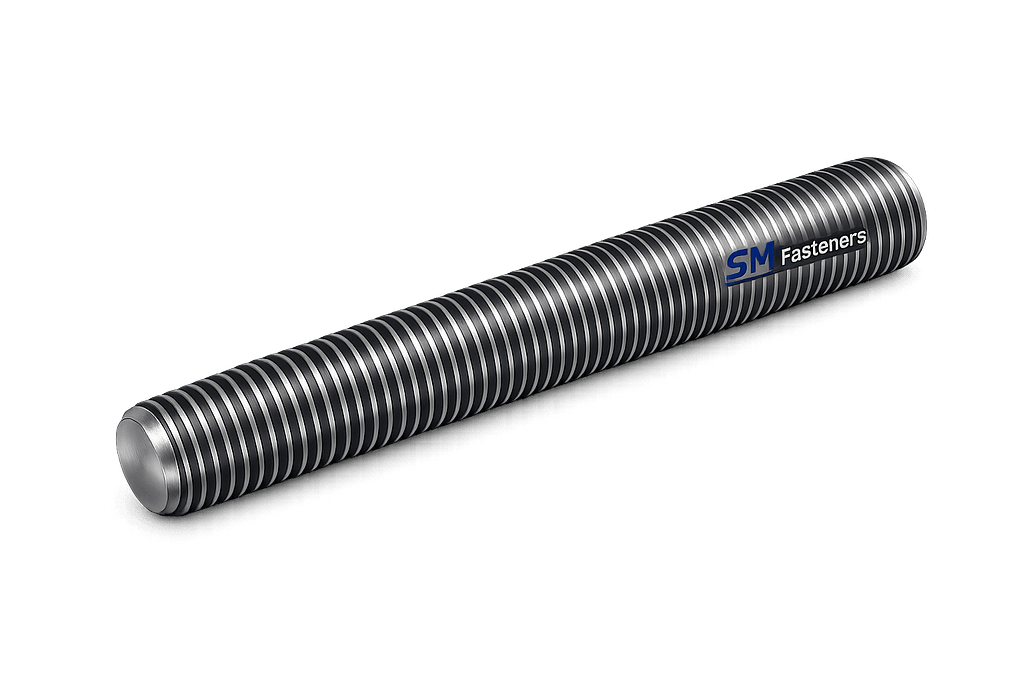
Fully threaded studs represent one of the most widely specified fastening elements in high-integrity industrial assemblies where uniform load distribution, adjustability, and repeatable clamping performance are critical.
Unlike headed bolts, fully threaded studs provide:
- Continuous thread engagement
- Symmetrical load transfer
- Superior preload control
- Improved fatigue resistance in cyclic loading environments
They are extensively used across global industries governed by international engineering codes and procurement standards.
1.1 Role in Modern Industrial Engineering
Fully threaded studs are essential where assemblies require:
| Requirement | Engineering Need | Stud Advantage |
|---|---|---|
| Frequent disassembly | Maintenance access | Replaceable nut system |
| High temperature service | Thermal expansion accommodation | Elastic load distribution |
| Long grip lengths | Structural flexibility | Continuous threading |
| Heavy vibration | Preload stability | Balanced force transmission |
| Corrosive environments | Material flexibility | Wide alloy availability |
1.2 Global Industry Dependence
Primary Sectors Using Fully Threaded Studs
- Structural Steel Fabrication
- Oil & Gas Production Facilities
- Refineries & Petrochemical Plants
- LNG Terminals & Offshore Platforms
- Power Generation (Thermal, Nuclear, Renewable)
- Heavy Machinery & OEM Manufacturing
- Railway Infrastructure
- Shipbuilding & Marine Engineering
Engineering specifications commonly reference:
- ASTM
- ISO
- DIN
- BS
- ASME
- NACE MR0175 / ISO 15156
SM Fasteners manufactures fully threaded studs compliant with these global frameworks, ensuring procurement readiness for EPC and international projects.
2. Technical Definition
2.1 What is a Fully Threaded Stud?
A Fully Threaded Stud is:
A cylindrical fastener having continuous external threading across the entire length, intended for use with nuts or tapped holes to generate axial clamping force.
Unlike double-end studs or stud bolts:
- No unthreaded shank exists.
- Thread engagement can occur anywhere along the length.
- Load transfer occurs entirely through thread interfaces.
2.2 Basic Geometry
|<----------- FULL THREAD LENGTH ----------->|

=============================================
|||||||||||||||||||||||||||||||||||||||||||||
=============================================

Major Diameter (d)
Pitch (P)
Thread Angle
Length (L)
Key Geometric Parameters
| Parameter | Symbol | Function |
|---|---|---|
| Nominal Diameter | d | Load capacity |
| Pitch | P | Adjustment resolution |
| Length | L | Joint span |
| Minor Diameter | d3 | Shear resistance |
| Thread Angle | α | Load transfer behavior |
2.3 Functional Role in Assemblies
Fully threaded studs primarily act as:
- Clamping Elements
- Alignment Members
- Load Transfer Components
- Replaceable Wear Interfaces
Common assembly configuration:
Nut — Washer — Component — Component — Washer — NutAdvantages:
- Equal tensile loading from both ends
- Reduced galling in base material
- Improved serviceability
3. Load Mechanics & Force Behavior
Understanding force mechanics is fundamental to proper stud selection.
3.1 Preload Concept
The primary function of a fully threaded stud is not to carry service load directly, but to:
Generate clamping force sufficient to prevent joint separation.
Preload Relationship
Where:
- = Preload force
- = Applied torque
- = Nut factor (friction coefficient)
- = Nominal diameter
Engineering Principle
External loads must never exceed preload force.
If separation occurs:
- fatigue failure initiates,
- vibration loosening begins,
- joint integrity collapses.
3.2 Force Distribution in Fully Threaded Studs
Compared with partially threaded bolts:
| Characteristic | Fully Threaded Stud | Bolt |
|---|---|---|
| Load Distribution | Uniform | Concentrated near shank |
| Adjustability | Excellent | Limited |
| Elastic Stretch | Higher | Lower |
| Fatigue Resistance | Improved in long joints | Moderate |
3.3 Tensile Loading
Primary load mode:
Where:
- = Stress
- = Applied axial force
- = Tensile stress area
Continuous threading slightly reduces stress area but increases flexibility, improving dynamic load performance.
3.4 Shear Behavior
Studs may experience shear under:
- flange misalignment
- thermal displacement
- structural vibration
Design recommendation:
Studs should not be primary shear elements.
Shear should be absorbed by:
- dowels
- fitted bolts
- joint friction
3.5 Elastic Interaction Between Joint and Stud
A bolted joint behaves as two springs:
- Stud = tensile spring
- Clamped parts = compressive spring
External Load →
[ Joint Compression ] + [ Stud Tension ]
Joint reliability depends on stiffness ratio:
Where:
- = stud stiffness
- = joint stiffness
Fully threaded studs provide greater elastic compliance — beneficial for:
- pressure vessels
- high-temperature equipment
- rotating machinery
4. Torque–Tension Relationship
4.1 Friction Influence
Approximately:
- 90% of applied torque is lost to friction
- Only 10% produces preload
Friction sources:
- Thread friction
- Bearing surface friction
- Surface roughness
- Coating condition
Typical Nut Factors
| Condition | Nut Factor (K) |
|---|---|
| Dry steel | 0.20–0.25 |
| Zinc plated | 0.18 |
| Lubricated | 0.15 |
| PTFE coated | 0.10–0.13 |
4.2 Importance for EPC Procurement
Incorrect torque assumptions cause:
- Under-tightening → leakage/fatigue
- Over-tightening → yielding or fracture
SM Fasteners provides torque guidance aligned with ISO and ASTM fastening practices to ensure repeatable installation performance.
5. Joint Design Principles
5.1 Thread Engagement Requirements
Minimum engagement length:
| Material | Engagement Length |
|---|---|
| Steel into Steel | 1 × Diameter |
| Steel into Aluminum | 1.5 × Diameter |
| Cast Iron | 1.5–2 × Diameter |
| Plastic / PEEK | 2–2.5 × Diameter |
5.2 Grip Length Consideration
Ideal condition:
Benefits:
- Increased elasticity
- Reduced fatigue stress
- Stable preload retention
Fully threaded studs are ideal for long grip assemblies.
5.3 Use with Dual Nut Systems
Common configurations:
- Standard nut + LOCK NUT
- Hydraulic tensioning
- flange nut systems
- Heavy hex nut assemblies
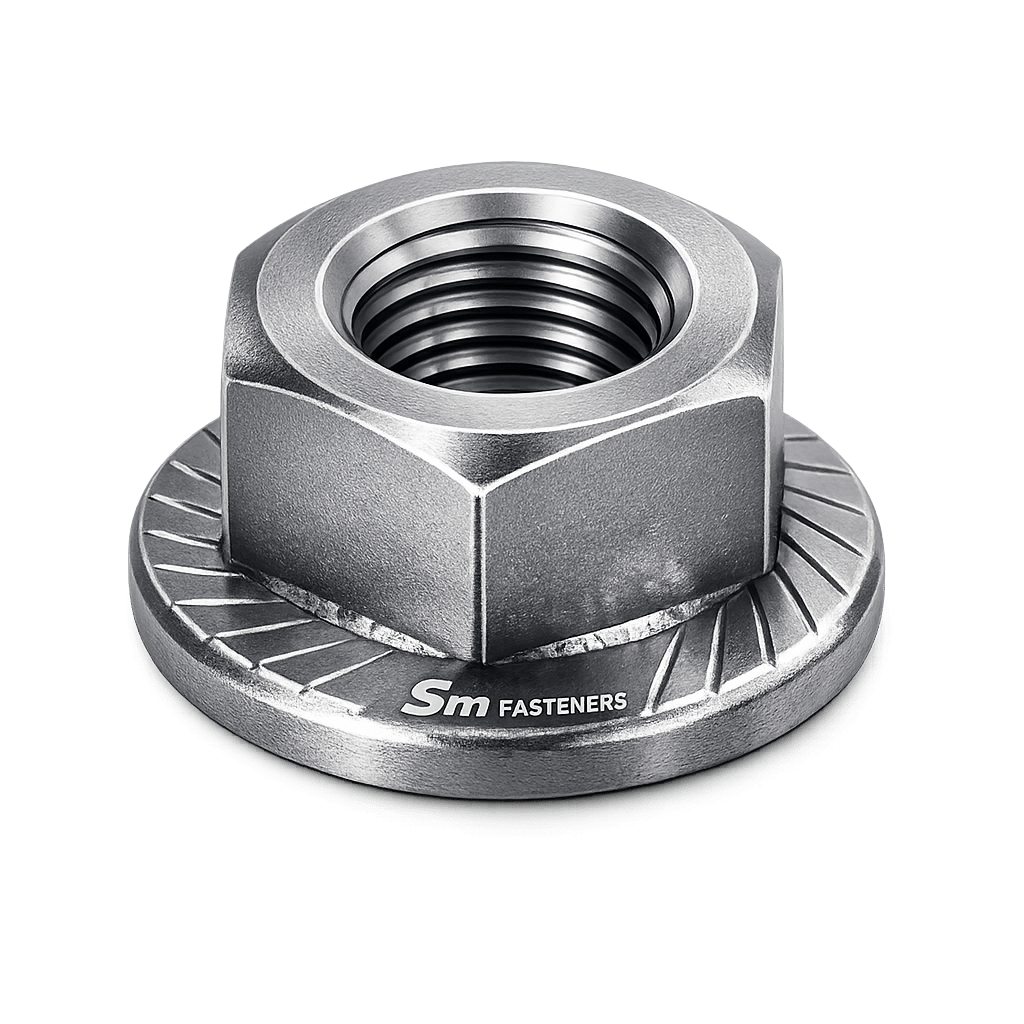
Used extensively in:
- pressure vessels
- turbines
- compressors
- heat exchangers
5.4 Preload Loss Mechanisms
| Mechanism | Engineering Cause |
|---|---|
| Embedment relaxation | Surface roughness collapse |
| Thermal expansion | Differential material growth |
| Gasket creep | Soft sealing materials |
| Vibration | Microscopic slip |
| Corrosion | Section loss |
5.5 Design Against Fatigue Failure
Critical engineering practices:
- Maintain preload ≥ 70% proof load
- Avoid bending loads
- Use hardened washers
- Ensure perpendicular seating
- Use rolled threads for fatigue applications
SM Fasteners employs precision thread manufacturing and certified material control to maintain fatigue reliability demanded by EPC projects.
6. Failure Mechanisms
6.1 Fatigue Failure
Most common failure mode.
Initiated by:
- fluctuating stress
- preload loss
- misalignment
Mitigation:
- Proper torque control
- Correct material grade
- Surface finish optimization
6.2 Shear Failure
Occurs when studs substitute for locating pins.
Engineering rule:
Studs clamp — they do not locate.
6.3 Hydrogen Embrittlement
Risk materials:
- High-strength carbon/alloy steels (>1000 MPa)
Sources:
- electroplating
- acid cleaning
- corrosion reactions
Controls:
- baking after plating
- controlled coating selection
- hardness limitation
6.4 Stress Corrosion Cracking (SCC)
Occurs in:
- chloride environments
- H₂S service
- elevated temperature conditions
Mitigated using:
- Duplex stainless steels
- Nickel alloys
- NACE-compliant materials
SM Fasteners supports sour-service applications compliant with NACE MR0175 / ISO 15156.
6.5 Galling & Seizure
Common in stainless steel studs.
Prevention:
- anti-seize lubricants
- dissimilar material pairing
- coated threads
7. Functional Selection Overview
Engineering selection must consider:
| Parameter | Design Impact |
|---|---|
| Load type | Tensile / cyclic |
| Temperature | Material stability |
| Corrosion | Alloy/coating choice |
| Installation method | Torque vs tensioning |
| Inspection requirements | Traceability level |
| Maintenance frequency | Stud vs bolt choice |
Fully threaded studs remain the preferred fastening solution where repeatable preload, flexibility, and long-term serviceability are required.
SM Fasteners integrates certified quality systems (ISO 9001, MSME, UKAF) with precision manufacturing practices to support critical infrastructure and global EPC supply chains.
8. Product Types and Variants
Fully threaded studs are manufactured in multiple configurations to satisfy structural, pressure-retaining, and precision mechanical assemblies. Selection depends on load condition, accessibility, installation method, and applicable international standard.
8.1 Standard Fully Threaded Stud (Continuous Thread Rod)
Definition:
A stud threaded over its complete length without unthreaded shank or formed head.
Functional Characteristics
- Uniform tensile load transfer
- Infinite nut positioning flexibility
- Suitable for variable grip thickness
- Simplified field adjustment
Typical Uses
- Structural connections
- Pipe supports
- Equipment mounting
- Cable tray systems
- Machinery assemblies
8.2 Cut-to-Length Fully Threaded Stud
Manufactured as long threaded bars and cut per project requirement.
Advantages:
- Reduced inventory complexity
- Custom project lengths
- EPC site flexibility
SM Fasteners supplies project-specific lengths aligned with construction drawings and isometric documentation.
8.3 Precision Machined Fully Threaded Stud
Used in critical applications requiring:
- tight tolerances
- precision fit
- uniform preload
Applications:
- Turbine casings
- Compressor housings
- Rotating equipment
- Aerospace-grade assemblies
8.4 High-Strength Fully Threaded Stud
Manufactured from quenched & tempered alloy steels.
Typical grades:
- ASTM A193 B7
- ASTM A320 L7
- Property Class 10.9
- Property Class 12.9
Designed for:
- high pressure flanges
- offshore structures
- power plant equipment
8.5 Corrosion-Resistant Alloy Studs
Manufactured using advanced alloys available within SM Fasteners material capability:
- Stainless Steel (304, 316, 321)
- Duplex & Super Duplex
- Inconel
- Incoloy
- Hastelloy
- Monel
- Nickel Alloys
- SMO 254
Used where corrosion resistance governs design life.
8.6 PEEK Fully Threaded Studs
SM Fasteners also manufactures PEEK (Polyether Ether Ketone) fasteners for specialized engineering environments.
Characteristics
| Property | Engineering Benefit |
|---|---|
| Non-metallic | No galvanic corrosion |
| Chemical resistance | Acid/alkali compatibility |
| Lightweight | Reduced system mass |
| Electrical insulation | Electronic assemblies |
| Temperature resistance | Up to ~260°C |
Applications:
- Semiconductor equipment
- Chemical processing
- Medical systems
- Offshore instrumentation
9. Dimensional Logic and Geometry
Dimensional selection directly influences:
- preload capability
- fatigue performance
- installation reliability
- joint stiffness
9.1 Primary Dimensional Parameters
| Parameter | Symbol | Engineering Influence |
|---|---|---|
| Nominal Diameter | d | Strength capacity |
| Thread Pitch | P | Adjustment precision |
| Length | L | Joint span |
| Stress Area | As | Tensile performance |
| Thread Engagement | Le | Load transfer |
| Pitch Diameter | d2 | Fit accuracy |
9.2 Standard Diameter Range
SM Fasteners manufacturing capability:
| Metric Size | Typical Use |
|---|---|
| M6 – M12 | Equipment assemblies |
| M16 – M24 | Structural & machinery |
| M27 – M48 | Heavy engineering |
| M52 – M100 | Offshore & power plants |
Imperial equivalents available for global projects.
10. Dimensional Specification Table (Metric Series)
(Engineering reference — ISO/DIN compliant)
| Size | Pitch (mm) | Stress Area As (mm²) | Across Flats Nut (mm) | Typical Length Range (mm) |
|---|---|---|---|---|
| M8 | 1.25 | 36.6 | 13 | 20–2000 |
| M10 | 1.5 | 58 | 17 | 25–3000 |
| M12 | 1.75 | 84.3 | 19 | 30–3000 |
| M16 | 2.0 | 157 | 24 | 40–4000 |
| M20 | 2.5 | 245 | 30 | 50–4000 |
| M24 | 3.0 | 353 | 36 | 60–5000 |
| M30 | 3.5 | 561 | 46 | 80–6000 |
| M36 | 4.0 | 817 | 55 | 100–6000 |
11. Thread Forms and Geometry Logic
Thread geometry determines load efficiency and interchangeability.
11.1 Metric Threads (ISO)
Standard:
- ISO 68
- ISO 261
- ISO 965
Characteristics:
- 60° thread angle
- Global EPC preference
- Balanced strength and manufacturability
11.2 Unified Thread Series (UNC / UNF)
Used primarily in:
- US oil & gas projects
- ASME pressure equipment
| Type | Application |
|---|---|
| UNC | General engineering |
| UNF | High vibration |
| 8UN | Pressure vessel flanges |
11.3 British Thread Systems
| Standard | Application |
|---|---|
| BSW | Legacy structures |
| BSF | Automotive & machinery |
| BSP | Pressure piping interfaces |
12. Thread Standards & Tolerances Table
| System | Standard | Typical Tolerance Class |
|---|---|---|
| Metric | ISO 965 | 6g / 6H |
| UNC | ASME B1.1 | 2A / 2B |
| UNF | ASME B1.1 | 2A / 2B |
| BSW | BS 84 | Medium fit |
| BSF | BS 84 | Close fit |
SM Fasteners manufactures threads meeting controlled tolerance verification under ISO 9001 inspection procedures.
13. Applicable International Standards
Fully threaded studs must comply with mechanical, dimensional, and material standards simultaneously.
13.1 ISO Standards
| Standard | Scope |
|---|---|
| ISO 898-1 | Mechanical properties carbon steel |
| ISO 3506 | Stainless steel fasteners |
| ISO 965 | Thread tolerance |
| ISO 3269 | Acceptance inspection |
| ISO 6157 | Surface discontinuities |
13.2 ASTM Standards
| Standard | Application |
|---|---|
| ASTM A193 | High temperature studs |
| ASTM A320 | Low temperature service |
| ASTM A307 | General purpose |
| ASTM F593 | Stainless steel studs |
| ASTM A453 | High-temperature alloy studs |
13.3 DIN Standards
| DIN Standard | Description |
|---|---|
| DIN 976 | Threaded rods |
| DIN 975 | Fully threaded bars |
| DIN 267 | Mechanical properties |
13.4 British Standards
| BS Standard | Application |
|---|---|
| BS 4190 | ISO metric bolts/studs |
| BS EN ISO 4014 | Metric fasteners |
| BS 3643 | Metric threads |
14. Property Class System (Mechanical Grading)
14.1 Metric Property Classes
| Class | Yield Strength (MPa) | UTS (MPa) | Typical Application |
|---|---|---|---|
| 4.6 | 240 | 400 | Light duty |
| 8.8 | 640 | 800 | Structural |
| 10.9 | 900 | 1040 | Heavy machinery |
| 12.9 | 1080 | 1220 | High-stress assemblies |
14.2 ASTM Mechanical Grades
| Grade | Material | Application |
|---|---|---|
| B7 | Alloy steel | Pressure vessels |
| B8 | SS 304 | Corrosion resistance |
| B8M | SS 316 | Marine service |
| B16 | High temp alloy | Turbines |
| L7 | Low temperature | Cryogenic |
15. Interchangeability Considerations
Global EPC projects frequently involve mixed standards.
Critical checks:
- Pitch compatibility
- Tolerance class
- Mechanical property equivalence
- Heat treatment condition
- Coating thickness allowance
Example:
| Equivalent Grades |
|---|
| ISO 10.9 ≈ ASTM A193 B7 |
| ISO A4-80 ≈ ASTM B8M Class 2 |
SM Fasteners supports cross-standard engineering review to ensure safe substitution during procurement.
16. Dimensional Engineering Considerations
16.1 Length Measurement Rules
Fully threaded stud length measured:
End → End (overall length)No head reference exists.
16.2 Thread Runout & Chamfer
Standard requirements:
- 30° chamfer
- Deburred ends
- Full nut engagement
Purpose:
- Prevent thread damage
- Enable automatic assembly
- Reduce galling risk
16.3 Straightness Requirements
Typical tolerance:
Critical for:
- flange alignment
- automated tightening
- hydraulic tensioning systems
17. Weight Chart — Fully Threaded Studs
(Aligned with SM Fasteners manufacturing reference data)
Approximate Carbon Steel Weights
| Size | Weight / Piece (kg/m) | Weight / 100 pcs (1m length) |
|---|---|---|
| M8 | 0.395 | 39.5 kg |
| M10 | 0.617 | 61.7 kg |
| M12 | 0.888 | 88.8 kg |
| M16 | 1.58 | 158 kg |
| M20 | 2.47 | 247 kg |
| M24 | 3.55 | 355 kg |
| M30 | 5.55 | 555 kg |
| M36 | 7.99 | 799 kg |
Actual supplied weights vary by material density (Duplex, Nickel alloy, PEEK).
18. Engineering Selection Summary
| Engineering Condition | Recommended Stud Feature |
|---|---|
| High preload | Fine thread |
| Corrosive environment | Duplex / Nickel alloy |
| High temperature | ASTM A193 B16 |
| Frequent maintenance | Fully threaded configuration |
| Chemical exposure | PEEK fasteners |
| Offshore | Super Duplex / coated alloy |
SM Fasteners manufactures fully threaded studs in strict alignment with international dimensional standards, controlled tolerances, and globally accepted property class systems, enabling seamless integration into EPC, OEM, and infrastructure projects worldwide.
19. Material Grades and Engineering Selection Criteria
Material selection is the primary engineering decision governing the performance, safety, and service life of fully threaded studs.
The selected material must simultaneously satisfy:
- Mechanical strength requirements
- Environmental resistance
- Temperature capability
- Regulatory compliance
- Fabrication compatibility
- Lifecycle cost targets
SM Fasteners manufactures fully threaded studs across a broad industrial material spectrum, supporting EPC procurement specifications and international engineering codes.
19.1 Material Classification Overview
| Material Category | Typical Standards | Primary Advantage |
|---|---|---|
| Carbon Steel | ASTM A307, ISO 898 | Cost efficiency |
| Alloy Steel | ASTM A193 B7/B16 | High strength |
| Stainless Steel | ASTM F593 / ISO 3506 | Corrosion resistance |
| Duplex Stainless | ASTM A479 | Strength + corrosion |
| Super Duplex | UNS S32750/S32760 | Offshore performance |
| Nickel Alloys | Inconel, Monel | Extreme environments |
| High-Performance Polymer | PEEK | Chemical/electrical isolation |
19.2 Carbon Steel Studs
Characteristics
- Economical
- High machinability
- Suitable for structural applications
Typical Grades
- ASTM A307
- ISO Property Class 4.6 / 5.8
Applications
- Construction structures
- Equipment mounting
- Infrastructure assemblies
Limitations:
- Requires protective coatings for corrosion environments.
19.3 Alloy Steel Studs
Designed for high mechanical loading and elevated temperature service.
Common Grades
| Grade | Specification | Application |
|---|---|---|
| ASTM A193 B7 | Cr-Mo Alloy Steel | Pressure vessels |
| ASTM A193 B16 | High temp alloy | Turbines |
| ISO 10.9 | Heat-treated alloy | Heavy machinery |
| ISO 12.9 | Ultra-high strength | Dynamic equipment |
Engineering Benefits
- High tensile capacity
- Excellent fatigue resistance
- Stable preload retention
19.4 Stainless Steel Studs
Austenitic Grades
| Grade | Equivalent | Features |
|---|---|---|
| 304 | A2-70 | General corrosion resistance |
| 316 | A4-70 | Marine & chemical resistance |
| 321 | Stabilized SS | High temperature |
Advantages:
- Corrosion resistance
- Non-magnetic behavior
- Good cryogenic toughness
Risk:
- Galling during installation (requires lubrication).
19.5 Duplex & Super Duplex Stainless Steel
Engineered for aggressive offshore and chloride environments.
| Grade | Yield Strength | Key Advantage |
|---|---|---|
| Duplex 2205 | ~450 MPa | Strength + corrosion |
| Super Duplex 2507 | ~550 MPa | Seawater resistance |
Applications:
- Offshore platforms
- Desalination plants
- Subsea equipment
- LNG facilities
19.6 Nickel-Based Alloys
Used where conventional steels fail.
| Alloy | Environment |
|---|---|
| Inconel 625 | High temperature oxidation |
| Inconel 718 | Aerospace/high stress |
| Hastelloy C276 | Strong acids |
| Monel 400 | Marine exposure |
| Incoloy 825 | Chemical processing |
| SMO 254 | Chloride attack resistance |
19.7 PEEK Fully Threaded Studs
SM Fasteners manufactures precision PEEK studs for non-metallic fastening solutions.
Engineering Properties
| Property | Value |
|---|---|
| Continuous Temperature | ~260°C |
| Density | ~1.3 g/cm³ |
| Electrical Conductivity | Insulating |
| Chemical Resistance | Excellent |
Applications:
- Semiconductor processing
- Electronics manufacturing
- Chemical dosing systems
- MRI & medical equipment
20. Material Comparison Table
| Material | UTS (MPa) | Yield (MPa) | Corrosion Resistance | Cost Level | Typical Industry |
|---|---|---|---|---|---|
| Carbon Steel | 400–600 | 240–350 | Low | Low | Construction |
| Alloy Steel B7 | 860 | 720 | Moderate | Medium | Oil & Gas |
| SS 304 | 700 | 450 | Good | Medium | Process plants |
| SS 316 | 700 | 450 | Very Good | Medium | Marine |
| Duplex 2205 | 800 | 450 | Excellent | High | Offshore |
| Super Duplex | 900 | 550 | Extreme | High | Subsea |
| Inconel 625 | 1000+ | 600 | Exceptional | Very High | Aerospace/LNG |
| PEEK | 100 | 90 | Chemical resistant | High | Electronics |
21. Corrosion Resistance vs Environment
| Environment | Recommended Material |
|---|---|
| Indoor dry | Carbon steel |
| Outdoor atmosphere | Galvanized steel |
| Marine | SS316 / Duplex |
| Seawater immersion | Super Duplex |
| Sour service (H₂S) | NACE-compliant alloys |
| Acid processing | Hastelloy |
| High temperature oxidation | Inconel |
| Chemical reactors | PEEK |
SM Fasteners supports material compliance aligned with NACE MR0175 / ISO 15156 for sour-service oil & gas installations.
22. Mechanical Properties Table (Grade Wise)
| Grade | Proof Load (MPa) | Yield (MPa) | Tensile (MPa) | Hardness Limit |
|---|---|---|---|---|
| 4.6 | 225 | 240 | 400 | 120–220 HB |
| 8.8 | 580 | 640 | 800 | 22–32 HRC |
| 10.9 | 830 | 900 | 1040 | 32–39 HRC |
| 12.9 | 970 | 1080 | 1220 | 39–44 HRC |
| B7 | 720 | 720 | 860 | ≤35 HRC |
| B16 | 860 | 760 | 1030 | Controlled |
23. Heat Treatment Processes
Heat treatment defines final mechanical behavior.
23.1 Quenching and Tempering
Applied to alloy steel studs.
Process:
- Austenitizing
- Rapid quench
- Controlled tempering
Results:
- High strength
- Improved toughness
- Controlled hardness
23.2 Solution Annealing (Stainless Steel)
Purpose:
- Restore corrosion resistance
- Remove carbide precipitation
Typical temperature:
1040–1100°C
23.3 Stress Relieving
Used after machining or thread rolling.
Benefits:
- Reduced residual stress
- Improved fatigue life
- Dimensional stability
23.4 Hydrogen Embrittlement Control
Critical for high-strength studs.
Preventive controls:
- Post-plating baking
- Controlled electroplating chemistry
- Hardness limitation (<35 HRC for sour service)
24. End-to-End Manufacturing Workflow
SM Fasteners integrates ISO 9001 quality systems throughout manufacturing.
24.1 Raw Material Verification
Incoming inspection includes:
- Mill Test Certificate (MTC)
- Heat number traceability
- Chemical composition verification
- Ultrasonic testing (when required)
Standards:
EN 10204 Type 3.1 / 3.2.
24.2 Bar Preparation
Operations:
- Straightening
- Saw cutting
- End chamfering
- Surface cleaning
24.3 Forming Method: Forging vs Machining
| Method | Advantage | Application |
|---|---|---|
| Cold forming | Grain flow strength | Standard studs |
| Hot forging | Large diameter | Heavy engineering |
| CNC machining | Precision tolerance | Critical equipment |
24.4 Thread Manufacturing
Thread Rolling (Preferred)
Benefits:
- Compressive surface stresses
- Improved fatigue resistance
- Superior surface finish
Thread Cutting
Used for:
- Large diameters
- Exotic alloys
- Low production volumes
24.5 Heat Treatment Stage
Controlled furnaces ensure:
- Uniform hardness
- Metallurgical consistency
- Batch traceability
24.6 Straightness & Dimensional Control
Checked using:
- V-block inspection
- Laser straightness verification
- Thread gauges (GO/NO-GO)
24.7 Identification & Traceability
Each production batch maintains:
- Heat number
- Lot number
- Material grade
- Inspection reference
SM Fasteners maintains full traceability from raw material to shipment.
25. Surface Finishing and Protective Coatings
Surface engineering directly influences corrosion resistance, friction behavior, and service life.
25.1 Coating Objectives
- Corrosion protection
- Controlled friction coefficient
- Galling prevention
- Improved installation reliability
25.2 Surface Finish Comparison Table
| Coating | Corrosion Protection | Temperature Limit | Friction Control | Typical Use |
|---|---|---|---|---|
| Black Oxide | Low | 150°C | Good | Indoor machinery |
| Zinc Plating | Moderate | 120°C | Good | General construction |
| Hot Dip Galvanized | High | 200°C | Moderate | Outdoor structures |
| PTFE / Xylan | Excellent | 260°C | Excellent | Offshore flanges |
| Cadmium | High | Aerospace | Excellent | Aviation |
| Phosphate | Low | 200°C | Good | Pre-lubricated |
| Nickel Plating | Moderate | 400°C | Good | Chemical equipment |
| Dacromet/Geomet | Very High | 300°C | Controlled | Automotive |
25.3 Coating Thickness Engineering Considerations
Important for thread fit:
Oversized threads may be required for:
- Hot-dip galvanizing
- Heavy fluoropolymer coatings
25.4 Lubrication Systems
Used to control torque–tension relationship:
- Molybdenum disulfide
- PTFE dry film
- Graphite lubricant
- Anti-seize compounds
25.5 Surface Engineering for Sour Service
Requirements include:
- Hardness limits
- Controlled plating processes
- Hydrogen embrittlement prevention
- NACE compliance verification
26. Engineering Performance Integration
Material + Heat Treatment + Surface Finish determine:
- preload reliability
- fatigue resistance
- corrosion life
- installation repeatability
SM Fasteners integrates advanced metallurgy, controlled manufacturing, and certified quality management systems (ISO 9001, MSME, UKAF) to deliver fully threaded studs engineered for global industrial service conditions.
27. Inspection & Quality Control Systems
Fully threaded studs used in EPC, oil & gas, power generation, and infrastructure projects must pass rigorous inspection regimes to ensure structural reliability and regulatory compliance.
SM Fasteners integrates inspection controls within an ISO 9001 certified quality management system, ensuring complete traceability from raw material to final dispatch.
27.1 Quality Assurance Philosophy
Quality assurance objectives:
- Dimensional conformity
- Mechanical integrity
- Metallurgical compliance
- Surface condition verification
- Documentation traceability
Quality control is executed at three stages:
- Incoming material inspection
- In-process manufacturing inspection
- Final inspection & certification
27.2 Incoming Material Inspection
All raw materials undergo verification before production release.
Verification Parameters
| Inspection | Method |
|---|---|
| Chemical composition | Spectrometer analysis |
| Mill Test Certificate | EN 10204 3.1 / 3.2 |
| Heat number traceability | Batch control |
| Surface condition | Visual examination |
| Ultrasonic testing | Optional for critical grades |
Materials remain traceable throughout manufacturing.
27.3 Dimensional Inspection
Conducted using calibrated instruments.
Key Measurements
- Major diameter
- Pitch diameter
- Thread pitch
- Length tolerance
- Straightness
- Chamfer geometry
Inspection Tools
- Vernier & micrometer
- Optical comparator
- Thread ring gauges
- GO / NO-GO gauges
- Digital height gauges
27.4 Mechanical Testing
Mechanical properties verified according to ISO and ASTM requirements.
| Test | Purpose |
|---|---|
| Tensile testing | Verify UTS & Yield |
| Proof load test | Preload capability |
| Hardness test | Heat treatment confirmation |
| Impact testing | Low temperature service |
| Bend testing | Ductility verification |
27.5 Non-Destructive Testing (NDT)
Applied for safety-critical projects.
| Method | Detects |
|---|---|
| Magnetic Particle (MPI) | Surface cracks |
| Dye Penetrant (DPI) | Micro discontinuities |
| Ultrasonic Testing | Internal defects |
| Eddy Current | Surface anomalies |
27.6 PMI — Positive Material Identification
Mandatory for alloy and nickel materials.
Performed using:
- XRF Analyzer
- Optical emission spectrometry
Ensures correct alloy supply for petrochemical and offshore projects.
27.7 Surface & Coating Inspection
Verification includes:
- Coating thickness measurement
- Adhesion testing
- Salt spray testing (ASTM B117)
- Visual uniformity inspection
27.8 Documentation & Certification
SM Fasteners supplies full project documentation:
- Material Test Certificates (MTC)
- Heat treatment reports
- Dimensional inspection reports
- NDT reports
- Coating certificates
- Certificate of Conformity (CoC)
- Packing list & traceability sheet
28. Functional Industry Applications
Fully threaded studs are universal fastening solutions for heavy engineering assemblies.
28.1 Construction & Structural Steel
Applications:
- Steel frames
- Bridge structures
- Column base assemblies
- Pipe racks
- Infrastructure supports
Preferred Grades:
Property Class 8.8 / 10.9, HDG coated.
28.2 Oil & Gas Industry
Upstream
- Wellhead equipment
- Drilling rigs
- Offshore topsides
Midstream
- Pipeline supports
- Compressor stations
Downstream
- Refinery reactors
- Pressure vessels
- Heat exchangers
Typical Standards:
ASTM A193 B7, B16, B8M, Duplex, Super Duplex.
NACE MR0175 compliance available.
28.3 Power Generation
Used in:
- Turbines
- Boilers
- Generators
- Nuclear balance-of-plant equipment
Materials:
B16, Alloy steel, Inconel.
28.4 Petrochemical & Chemical Processing
Requirements:
- Chemical resistance
- Thermal stability
- High reliability
Common materials:
Hastelloy, Incoloy, SMO 254, SS316.
28.5 LNG & Offshore Facilities
Operating conditions:
- Cryogenic temperatures
- Chloride exposure
- Cyclic loading
Preferred materials:
Super Duplex, Nickel alloys.
28.6 Automotive & Heavy Equipment
Applications:
- Engine assemblies
- Hydraulic systems
- Mining equipment
- Construction machinery
28.7 Railways & Infrastructure
Used for:
- Track assemblies
- Structural mounting
- Signaling equipment
28.8 Shipbuilding & Marine Engineering
Key requirements:
- Saltwater resistance
- Fatigue strength
- Long service life
Materials:
SS316, Duplex, Monel.
28.9 PEEK Fastener Applications
SM Fasteners provides engineered PEEK fully threaded studs for:
- Semiconductor manufacturing
- Electrical insulation assemblies
- Medical equipment
- Chemical dosing skids
- EMI-sensitive systems
29. Export Capability & Global Supply Readiness
SM Fasteners operates as a project-oriented precision manufacturer supporting international procurement programs.
29.1 Industrial Packaging Standards
Packaging designed to prevent damage and corrosion.
| Protection Method | Purpose |
|---|---|
| VCI packing | Corrosion prevention |
| Thread protectors | Prevent mechanical damage |
| Oil coating | Temporary protection |
| Heat sealed bags | Moisture control |
29.2 Export Crating
- ISPM-15 compliant wooden crates
- Palletized bulk packing
- Container optimization
- Project tagging & barcoding
29.3 Logistics Integration
Supported shipment modes:
- Air freight
- Sea freight
- Break bulk cargo
- Project cargo consolidation
29.4 Traceability for EPC Projects
Each shipment includes:
- Heat number mapping
- Batch traceability
- Inspection linkage
- Drawing reference marking
30. Engineering Reference Tables
30.1 Proof Load & Tensile Strength Table
| Size | Stress Area (mm²) | Proof Load Class 8.8 (kN) | Tensile Capacity (kN) |
|---|---|---|---|
| M10 | 58 | 33 | 46 |
| M12 | 84 | 49 | 67 |
| M16 | 157 | 91 | 125 |
| M20 | 245 | 142 | 196 |
| M24 | 353 | 205 | 282 |
| M30 | 561 | 325 | 449 |
| M36 | 817 | 474 | 653 |
30.2 Tightening Torque Chart
(Lubricated condition, approximate values)
| Size | Class 8.8 (Nm) | Class 10.9 (Nm) | Class 12.9 (Nm) |
|---|---|---|---|
| M10 | 49 | 69 | 81 |
| M12 | 86 | 121 | 142 |
| M16 | 210 | 295 | 346 |
| M20 | 410 | 575 | 675 |
| M24 | 710 | 1000 | 1175 |
| M30 | 1420 | 2000 | 2350 |
Actual torque values depend on friction coefficient and coating condition.
30.3 Preload Calculation — Worked Example
Formula
Where:
- Torque
- Nut factor
- Diameter
Preload ≈ 137 kN
This preload prevents joint separation under service loads below this value.
30.4 Thread Standards Comparison
| Thread Type | Angle | Standard | Application |
|---|---|---|---|
| Metric | 60° | ISO 261 | Global EPC |
| UNC | 60° | ASME B1.1 | US industry |
| UNF | 60° | ASME B1.1 | Vibration service |
| BSW | 55° | BS 84 | Legacy equipment |
| BSF | 55° | BS 84 | Machinery |
30.5 Surface Finish Performance Comparison
| Finish | Corrosion Resistance | Friction Stability | Offshore Suitability |
|---|---|---|---|
| Black Oxide | Low | Good | No |
| Zinc | Moderate | Good | Limited |
| HDG | High | Moderate | Yes |
| PTFE/Xylan | Excellent | Excellent | Excellent |
| Dacromet | Very High | Stable | Yes |
| Nickel | Moderate | Stable | Chemical plants |
30.6 Weight Reference Table
(SM Fasteners Production Alignment)
| Size | Weight / Piece (1m) | Weight / 100 pcs |
|---|---|---|
| M8 | 0.395 kg | 39.5 kg |
| M10 | 0.617 kg | 61.7 kg |
| M12 | 0.888 kg | 88.8 kg |
| M16 | 1.58 kg | 158 kg |
| M20 | 2.47 kg | 247 kg |
| M24 | 3.55 kg | 355 kg |
| M30 | 5.55 kg | 555 kg |
| M36 | 7.99 kg | 799 kg |
31. Failure Prevention Engineering Summary
| Failure Mode | Prevention Method |
|---|---|
| Fatigue | Maintain preload ≥70% proof load |
| Hydrogen embrittlement | Controlled plating + baking |
| Galling | Lubricated installation |
| Stress corrosion cracking | Correct alloy selection |
| Thread stripping | Proper engagement length |
32. SM FASTENERS — Engineering Capability Positioning
SM Fasteners operates as a precision fastener manufacturer delivering fully threaded studs engineered for global industrial deployment.
Integrated strengths include:
- ISO 9001 certified quality management
- MSME & UKAF recognized manufacturing systems
- Advanced metallurgy capability
- Full international standards compliance
- Custom engineering & project manufacturing
- Supply of metallic and PEEK fastening solutions
- Complete inspection traceability
- EPC project documentation readiness
- Export-grade packaging and logistics
Fully threaded studs manufactured by SM Fasteners are engineered to meet the performance expectations of structural engineers, EPC procurement teams, inspectors, and global industrial buyers requiring verified reliability, repeatable quality, and international compliance.