

LOCK NUT
1. Industry Context
Lock nuts are critical mechanical locking elements used in safety-critical bolted assemblies where vibration, dynamic loading, thermal cycling, or rotational forces may cause conventional threaded joints to loosen.
Across modern industrial infrastructure, loss of preload remains one of the most common causes of joint failure. Studies within heavy engineering sectors show that self-loosening under transverse vibration accounts for a significant percentage of mechanical failures in rotating machinery, structural assemblies, pressure equipment, and transport systems.
Therefore, lock nuts are not simply fastening accessories — they are engineered reliability components designed to maintain clamping force throughout the service life of an assembly.
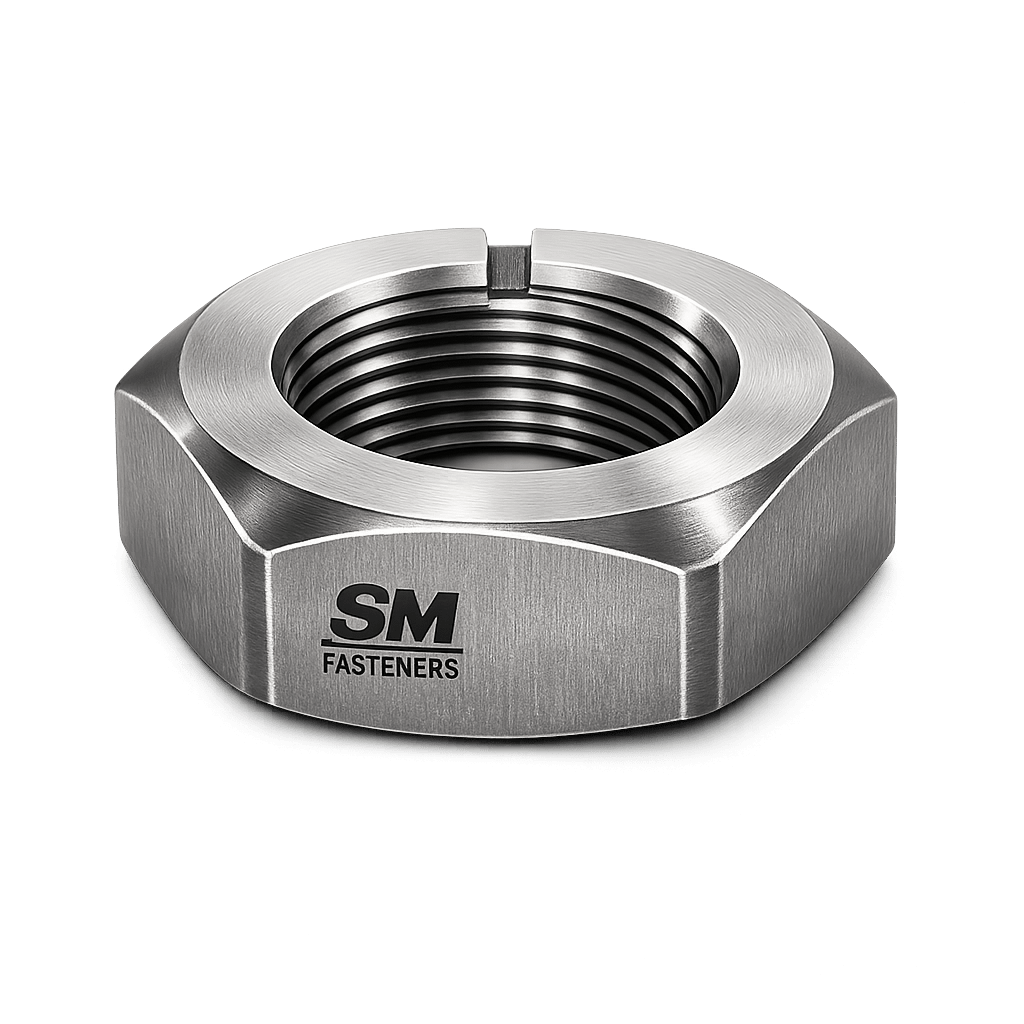
1.1 Global Industrial Dependence
Lock nuts are standard requirements across EPC specifications and OEM equipment designs in:
- Structural steel connections
- Rotating machinery
- Pipeline systems
- Offshore platforms
- Heavy transport equipment
- High-temperature process plants
- Railway and infrastructure assemblies
- Power generation turbines
Engineering procurement specifications frequently mandate locking systems complying with:
- ISO fastening systems
- ASTM material standards
- DIN mechanical locking designs
- BS structural applications
SM Fasteners manufactures lock nuts within an ISO 9001 certified quality management system, supporting global supply chains requiring full traceability and inspection compliance.
1.2 Why Conventional Nuts Fail
A standard nut relies purely on friction generated by preload.
Under operational conditions:
- Vibration reduces friction
- Thermal expansion alters preload
- Cyclic loads induce micro-movement
- Joint embedment reduces clamp force
- Surface relaxation occurs
This leads to self-loosening, described by the Junker vibration mechanism.
Lock nuts introduce secondary locking mechanisms that resist rotation independent of friction alone.
1.3 Role of Lock Nuts in Modern Engineering Design
Lock nuts provide:
✔ Preload retention
✔ Vibration resistance
✔ Rotational locking
✔ Enhanced fatigue resistance
✔ Safety redundancy
They are essential where joint failure could result in:
- Equipment shutdown
- Structural instability
- Leakage of hazardous media
- Personnel safety risk
2. Technical Definition
A Lock Nut is a threaded fastener incorporating a mechanical, prevailing torque, deformation, or auxiliary locking feature designed to prevent loosening after tightening.
Unlike standard hex nuts, lock nuts maintain resistance against rotation even when preload decreases.
2.1 Functional Definition
Engineering Definition
A lock nut is a threaded fastening device that maintains clamp load and resists rotation through controlled interference, elastic deformation, or integrated locking mechanisms.
2.2 Fundamental Locking Methods
Lock nuts operate using one or more of the following principles:
1. Prevailing Torque Locking
Resistance created by thread interference.
Examples:
- Nylon insert lock nut
- All-metal distorted thread nut
2. Mechanical Locking
Physical restraint prevents rotation.
Examples:
- Castellated nut with cotter pin
- Tab locking systems
3. Friction Enhancement
Increased frictional resistance.
Examples:
- Serrated flange lock nut
4. Chemical Locking (System Level)
Used with thread lockers rather than internal nut design.
2.3 Distinction from Standard Nuts
| Feature | Standard Nut | Lock Nut |
|---|---|---|
| Rotation resistance | Friction only | Mechanical + friction |
| Vibration performance | Moderate | High |
| Reusability | High | Type dependent |
| Safety critical use | Limited | Preferred |
| Preload retention | Variable | Controlled |
3. Load Mechanics & Force Behavior
Understanding lock nut performance requires analysis of bolted joint mechanics.
3.1 The Bolted Joint System
A bolted joint consists of:
- Nut (lock nut)
- Clamped members
- Washer/interface surfaces
The nut converts applied torque into:
- Bolt tension
- Joint compression
- Frictional resistance
3.2 Preload Generation
When tightening torque is applied:T=K×F×D
Where:
- T = Applied torque
- K = Nut factor (friction coefficient)
- F = Preload force
- D = Nominal diameter
Typical nut factor values:
| Condition | Nut Factor (K) |
|---|---|
| Dry | 0.20–0.25 |
| Zinc plated | 0.18 |
| Lubricated | 0.12–0.15 |
| PTFE coated | 0.10–0.13 |
Lock nuts must maintain this preload despite external disturbances.
3.3 Clamp Force Mechanics
The bolt behaves like a spring.
- Bolt elongates elastically.
- Joint compresses.
- Stored elastic energy maintains clamping force.
Loss of preload occurs when:
- External load exceeds joint stiffness
- Surfaces embed
- Thermal expansion mismatch occurs
Lock nuts reduce loosening even after partial preload loss.
3.4 Self-Loosening Under Vibration
Transverse vibration causes microscopic sliding between joint faces.
Sequence:
- Shear displacement occurs.
- Friction moment drops.
- Nut rotation begins.
- Preload collapses rapidly.
Lock nuts introduce prevailing torque or positive locking to stop rotation during this stage.
3.5 Load Types Acting on Lock Nuts
Static Tensile Loads
Structural steel assemblies.
Dynamic Cyclic Loads
Rotating machinery, engines, rail systems.
Shear Loads
Flange joints and frame connections.
Impact Loads
Mining and heavy equipment.
Thermal Loads
Power plants and petrochemical reactors.
Lock nut selection must consider the dominant load regime.
4. Joint Design Principles
Proper lock nut performance depends more on joint design than on fastener strength alone.
4.1 Fundamental Design Rule
A lock nut prevents loosening — it does NOT compensate for poor joint design.
4.2 Bolt Stretch vs Joint Stiffness
Optimal joints satisfy:
Design implications:
- Use longer grip lengths when possible
- Avoid excessive joint rigidity
- Maintain sufficient bolt elongation
4.3 Required Thread Engagement
Recommended minimum engagement:
| Material Combination | Engagement Length |
|---|---|
| Steel–Steel | 1 × diameter |
| Steel–Aluminum | 1.5 × diameter |
| Stainless–Stainless | 1.25 × diameter |
| High temperature alloys | ≥1.5 × diameter |
Insufficient engagement causes:
- Thread stripping
- Load concentration
- Fatigue initiation
4.4 Preload Target
Engineering best practice:
Benefits:
- Maximized fatigue life
- Minimal joint separation
- Improved vibration resistance
4.5 Lock Nut Selection Criteria
Engineers evaluate:
Mechanical Requirements
- Required preload
- Dynamic loading
- Fatigue resistance
Environmental Conditions
- Corrosion exposure
- Temperature range
- Chemical compatibility
- Sour service (H₂S)
Maintenance Strategy
- Reusable vs single use
- Inspection accessibility
Regulatory Compliance
- ISO / ASTM / DIN / BS standards
- NACE MR0175 / ISO 15156 where applicable
SM Fasteners supports engineering-driven selection through material traceability, certified production, and customized locking configurations.
4.6 Interaction with Washers
Lock nuts may be paired with:
- Hardened washers
- Belleville washers
- Insulating washers
- PEEK washers for electrical isolation
Proper washer selection prevents embedding losses and maintains preload stability.
4.7 Failure Mechanisms Prevented by Lock Nuts
| Failure Mode | Cause | Lock Nut Contribution |
|---|---|---|
| Self-loosening | Vibration | Rotation resistance |
| Fatigue failure | Preload loss | Clamp force retention |
| Fretting | Micro movement | Surface stabilization |
| Leakage | Joint separation | Compression retention |
| Structural instability | Dynamic loads | Mechanical locking |
4.8 Engineering Responsibility
Correct specification must define:
- Nut type
- Material grade
- Property class
- Surface finish
- Inspection level
- Certification requirements
SM Fasteners integrates these parameters within ISO 9001-controlled manufacturing and documentation systems aligned with global EPC procurement expectations.
5. Product Types and Variants
Lock nuts exist in multiple engineered configurations, each designed to resist loosening through a specific mechanical principle. Correct selection depends on vibration severity, load type, operating temperature, maintenance philosophy, and regulatory standards.
SM Fasteners manufactures lock nuts across international dimensional systems and advanced material grades, enabling compatibility with global EPC and OEM specifications.
5.1 Classification by Locking Mechanism
| Locking Principle | Lock Nut Type | Primary Function | Reusability |
|---|---|---|---|
| Prevailing Torque | Nylon Insert Lock Nut | Elastic interference | Limited |
| Prevailing Torque | All-Metal Lock Nut | Thread distortion | High |
| Mechanical Lock | Castellated Nut | Pin locking | Reusable |
| Mechanical Lock | Slotted Nut | Positive restraint | Reusable |
| Friction Lock | Serrated Flange Nut | Surface bite | Moderate |
| Jam Locking | Thin Jam Nut | Secondary locking | High |
| Chemical Assisted | Standard + Threadlocker | Adhesive retention | Limited |
| Polymer Lock | PEEK Insert Lock Nut | High temperature insulation | High |
5.2 Major Industrial Lock Nut Types
5.2.1 Nylon Insert Lock Nut (Nyloc Type)
Design Concept
A nylon collar positioned at the top of the nut produces radial pressure on threads.
Engineering Characteristics
- Controlled prevailing torque
- Excellent vibration resistance
- Low installation torque variation
- Reduced galling for stainless assemblies
Limitations
- Temperature limited (~120°C typical)
- Not suitable for hydrocarbon fire zones
- Limited reuse cycles
Typical Standards:
- DIN 985
- ISO 10511
- ASTM F594/F594M
5.2.2 All-Metal Prevailing Torque Lock Nut
Locking achieved via:
- Elliptical deformation
- Top thread crimping
- Slotted crown deformation
Advantages
✔ High temperature capability
✔ Chemical resistance
✔ Aerospace and oil & gas suitability
✔ No polymer degradation risk
Common Standards:
- DIN 980V
- ISO 7042
- ASTM A194 Grade 2H (modified)
5.2.3 Castellated Lock Nut
Designed for positive mechanical locking using cotter pins.
Applications:
- Rotating shafts
- Axle assemblies
- Structural pivot joints
Standards:
- DIN 935
- ISO 7035
- BS 1768
5.2.4 Slotted Lock Nut
Similar to castellated designs but with deeper slots for load-bearing shafts.
Used where:
- Absolute rotational security required
- Safety certification mandates visible locking
5.2.5 Serrated Flange Lock Nut
Integrated washer face with serrations.
Function:
- Increased friction coefficient
- Load distribution
- Reduced washer requirement
Limitations:
- Not recommended for hardened surfaces
- May damage coating layers
Standards:
- DIN 6923 (locking variants)
5.2.6 jam lock nut (Thin Pattern)
Used in double-nut locking systems.
Procedure:
- Main nut tightened to preload.
- Jam nut tightened against main nut.
- Thread compression prevents rotation.
Typical in:
- Pipe supports
- Machinery adjustment assemblies
- Precision alignment systems
5.2.7 High-Temperature & Polymer Lock Nuts (PEEK Insert)
SM Fasteners provides PEEK-based locking systems for extreme environments.
Advantages:
- Continuous service temperature up to ~250°C
- Electrical insulation
- Chemical resistance
- Non-magnetic properties
Applications:
- LNG instrumentation
- Offshore electronics
- Semiconductor equipment
- Chemical reactors
6. Dimensional Logic and Geometry
Lock nut geometry directly influences:
- Load distribution
- Prevailing torque
- Thread engagement
- Stress concentration
- Installation accessibility
6.1 Standard Geometry Elements
| Parameter | Symbol | Function |
|---|---|---|
| Nominal Diameter | d | Thread size |
| Pitch | P | Load transfer efficiency |
| Width Across Flats | s | Tool engagement |
| Nut Height | m | Thread engagement |
| Bearing Face Diameter | dw | Load distribution |
| Locking Zone | — | Prevailing torque region |
6.2 Height Variants
| Type | Height Ratio | Application |
|---|---|---|
| Standard | 0.8d | General use |
| High | 1.0d | High strength joints |
| Thin (Jam) | 0.5d | Locking secondary nut |
| Heavy Pattern | 1.2d | Structural steel |
Higher nut height increases:
- Thread shear area
- Fatigue resistance
- Load distribution
6.3 Thread Geometry Considerations
Engineering performance depends on:
Thread Form
- Metric ISO
- Unified (UNC/UNF)
- Whitworth (BSW/BSF)
Pitch Selection
| Pitch Type | Behavior |
|---|---|
| Coarse | Faster installation, dirt tolerant |
| Fine | Higher preload accuracy |
| Extra Fine | Vibration resistance |
Fine threads improve resistance to loosening due to smaller helix angle.
6.4 Dimensional Specification Table
(Metric ISO Lock Nuts — Reference Data)
| Size | Pitch (mm) | Width Across Flats (mm) | Height (mm) | Approx Weight (kg/100 pcs)* |
|---|---|---|---|---|
| M6 | 1.0 | 10 | 6 | 0.9 |
| M8 | 1.25 | 13 | 8 | 1.8 |
| M10 | 1.5 | 17 | 10 | 3.6 |
| M12 | 1.75 | 19 | 12 | 6.0 |
| M16 | 2.0 | 24 | 16 | 13.5 |
| M20 | 2.5 | 30 | 20 | 26 |
| M24 | 3.0 | 36 | 24 | 46 |
| M30 | 3.5 | 46 | 30 | 95 |
| M36 | 4.0 | 55 | 36 | 170 |
*Weights aligned with SM Fasteners production references.
6.5 Thread Engagement Mechanics
Minimum threads engaged:
Where:
- = engagement length
- = pitch
Recommended engagement:
6–10 full threads for structural joints.
7. International Standards & Compliance
Lock nuts must comply with global interchangeability requirements.
SM Fasteners manufactures according to ISO, ASTM, DIN, and BS systems to ensure worldwide compatibility.
7.1 ISO Standards
| Standard | Scope |
|---|---|
| ISO 7040 | Prevailing torque hex nuts |
| ISO 7042 | All-metal lock nuts |
| ISO 10511 | Thin nylon insert nuts |
| ISO 2320 | Prevailing torque testing |
| ISO 898-2 | Mechanical properties of nuts |
| ISO 4032 | Hex nut dimensions |
7.2 DIN Standards
| DIN Standard | Description |
|---|---|
| DIN 985 | Nylon insert lock nuts |
| DIN 980 | All-metal lock nuts |
| DIN 6923 | Flange lock nuts |
| DIN 935 | Castellated nuts |
7.3 ASTM Standards
| ASTM Standard | Application |
|---|---|
| ASTM A194 | High-pressure nuts |
| ASTM A563 | Structural nuts |
| ASTM F594 | Stainless steel nuts |
| ASTM F836 | Washer compatibility |
| ASTM B633 | Zinc coating |
7.4 British Standards (BS)
| BS Standard | Application |
|---|---|
| BS 3692 | ISO metric fasteners |
| BS 1768 | Castellated nuts |
| BS 1083 | Structural assemblies |
7.5 Property Class System (ISO)
Mechanical strength of nuts corresponds to bolt property class.
| Nut Property Class | Compatible Bolt Class |
|---|---|
| 5 | 5.6 |
| 8 | 8.8 |
| 10 | 10.9 |
| 12 | 12.9 |
Rule:
Nut proof load must exceed bolt tensile capacity.
8. Thread Standards & Tolerances Table
| Thread System | Standard | Angle | Typical Tolerance |
|---|---|---|---|
| Metric ISO | ISO 965 | 60° | 6H |
| UNC | ASME B1.1 | 60° | 2B |
| UNF | ASME B1.1 | 60° | 2B |
| BSW | BS 84 | 55° | Medium |
| BSF | BS 84 | 55° | Medium |
SM Fasteners supports mixed-system projects requiring interchangeability across global supply chains.
9. Interchangeability & Engineering Compatibility
Critical procurement considerations:
- Thread form compatibility
- Property class matching
- Coating thickness tolerance
- Temperature rating
- Galvanic compatibility
Incorrect substitution may cause:
- Thread stripping
- Reduced preload
- Hydrogen embrittlement risk
- Premature joint failure
9.1 EPC Procurement Verification Checklist
✔ Standard reference defined
✔ Property class specified
✔ Material grade confirmed
✔ Coating requirement identified
✔ Certification level required (EN 10204 3.1 / 3.2)
✔ Inspection testing defined
SM Fasteners integrates these parameters into manufacturing documentation packages aligned with international EPC workflows.
9.2 Dimensional Control Philosophy at SM Fasteners
Production control includes:
- CNC gauging
- Go/No-Go thread inspection
- Optical profile measurement
- Statistical process control (SPC)
- ISO 9001 documented calibration systems
Ensuring dimensional interchangeability across multinational projects.
10. Material Grades and Selection Criteria
Material selection for lock nuts is one of the most critical engineering decisions affecting:
- Mechanical strength
- Preload retention
- Corrosion resistance
- Temperature capability
- Galling behavior
- Compliance with industry regulations
Unlike standard fastening applications, lock nuts frequently operate in dynamic and aggressive environments, making metallurgy a primary reliability factor.
SM Fasteners manufactures lock nuts using a full industrial alloy portfolio supported by ISO 9001 certified manufacturing, controlled raw material traceability, and certified inspection systems.
10.1 Industrial Material Categories
| Material Group | Typical Grades | Key Characteristics |
|---|---|---|
| Carbon Steel | C35, C45 | Structural applications |
| Alloy Steel | 4140, 4340, B7 | High strength & fatigue resistance |
| Stainless Steel | A2-70, A4-80 | Corrosion resistance |
| Duplex Stainless | UNS S31803 | Strength + corrosion resistance |
| Super Duplex | UNS S32750 | Offshore & chloride environments |
| Nickel Alloys | Inconel, Monel | Extreme temperature |
| SMO 254 | 6Mo Stainless | Seawater resistance |
| Hastelloy | C276 | Chemical processing |
| PEEK Polymer | Engineering thermoplastic | Electrical isolation |
10.2 Mechanical Property Classes (ISO 898-2)
Lock nut strength must always equal or exceed bolt strength.
| Property Class | Proof Load (MPa) | Typical Application |
|---|---|---|
| 5 | 500 | Light structures |
| 8 | 800 | Structural steel |
| 10 | 1000 | Heavy machinery |
| 12 | 1200 | Critical dynamic joints |
10.3 ASTM Material Grades
| ASTM Grade | Material | Industry Use |
|---|---|---|
| ASTM A563 DH | Carbon Steel | Structural |
| ASTM A194 2H | Alloy Steel | Pressure vessels |
| ASTM A194 7 | High temperature | Power plants |
| ASTM F594 | Stainless Steel | Marine & chemical |
| ASTM A453 Gr 660 | High-temp alloy | Turbine systems |
10.4 Material Selection Matrix
| Environment | Recommended Material |
|---|---|
| Indoor structural | Carbon steel |
| Outdoor construction | Zinc-coated alloy steel |
| Marine atmosphere | A4 / Duplex |
| Offshore splash zone | Super Duplex |
| Sour service (H₂S) | NACE compliant alloys |
| Chemical plants | Hastelloy / SMO 254 |
| Cryogenic LNG | Austenitic stainless |
| Electrical isolation | PEEK lock nut |
SM Fasteners provides engineering support for material selection aligned with EPC project specifications.
11. Mechanical Properties Comparison Table
| Material | UTS (MPa) | Yield (MPa) | Temp Limit °C | Corrosion Resistance | Relative Cost | Typical Industry |
|---|---|---|---|---|---|---|
| Carbon Steel | 600 | 360 | 300 | Low | Low | Construction |
| Alloy Steel | 1000+ | 850 | 450 | Moderate | Medium | Oil & Gas |
| SS 304 | 700 | 450 | 400 | Good | Medium | Food/Process |
| SS 316 | 800 | 500 | 450 | Excellent | Medium | Marine |
| Duplex | 900 | 650 | 300 | Very High | High | Offshore |
| Super Duplex | 1000 | 750 | 300 | Extreme | High | Subsea |
| Inconel 625 | 1030 | 700 | 980 | Exceptional | Very High | Aerospace |
| Hastelloy C276 | 790 | 355 | 1000 | Acid Resistant | Very High | Chemical |
| SMO 254 | 650 | 300 | 400 | Seawater | High | Desalination |
| PEEK | — | — | 250 | Chemical inert | High | Electronics |
12. Corrosion Resistance vs Environment
| Environment | Carbon Steel | SS316 | Duplex | Super Duplex | Nickel Alloy | PEEK |
|---|---|---|---|---|---|---|
| Atmosphere | Fair | Excellent | Excellent | Excellent | Excellent | Excellent |
| Seawater | Poor | Good | Excellent | Outstanding | Outstanding | Excellent |
| Chlorides | Poor | Good | Excellent | Outstanding | Outstanding | Excellent |
| Acidic Media | Poor | Moderate | Good | Very Good | Excellent | Excellent |
| H₂S Sour Service | Limited | Controlled | Suitable | Excellent | Excellent | Excellent |
| High Humidity | Moderate | Excellent | Excellent | Excellent | Excellent | Excellent |
Materials selected by SM Fasteners follow corrosion mapping based on project exposure conditions.
13. Heat Treatment Processes
Heat treatment directly controls strength, toughness, and fatigue performance.
13.1 Typical Heat Treatment Routes
Quenching & Tempering
Used for:
- Alloy steel lock nuts
- ASTM A194 Grade 2H
Process:
- Austenitizing
- Rapid quenching
- Tempering
Benefits:
- High proof load
- Improved toughness
- Fatigue resistance
Solution Annealing
Applied to stainless steels.
13.2 Hardness Limits (Typical)
| Material | Hardness Range |
|---|---|
| Class 8 | 22–30 HRC |
| Class 10 | 32–39 HRC |
| Class 12 | 39–44 HRC |
| NACE Sour Service | ≤22 HRC |
Compliance with NACE MR0175 / ISO 15156 is mandatory for H₂S environments to prevent sulfide stress cracking.
14. End-to-End Manufacturing Workflow
SM Fasteners follows a controlled manufacturing process integrating metallurgical verification, precision forming, and inspection traceability.
14.1 Raw Material Verification
Incoming material inspection includes:
- Mill Test Certificate verification
- Heat number traceability
- Chemical composition validation
- Positive Material Identification (PMI)
14.2 Manufacturing Process Flow
Step 1 — Raw Material Preparation
- Certified bars or wire rod
- Ultrasonic inspection where required
Step 2 — Cold Forging / Hot Forging
Cold forging advantages:
- Grain flow alignment
- Higher fatigue strength
- Minimal material waste
Hot forging used for:
- Large diameter lock nuts
- High alloy materials
Step 3 — Machining Operations
- Facing
- Chamfering
- Slotting (castellated types)
- Flange forming
CNC machining ensures dimensional accuracy aligned with ISO tolerance classes.
Step 4 — Thread Formation
Thread Rolling (Preferred)
- Improves fatigue resistance
- Work hardening increases strength
- Superior surface finish
Thread Cutting
Used for:
- Large diameters
- Exotic alloys
Step 5 — Locking Feature Creation
Depending on type:
- Nylon insert installation
- Elliptical deformation
- Crown slot machining
- Serration forming
- PEEK insert integration
Step 6 — Heat Treatment
Performed under controlled furnaces with calibrated temperature systems.
Step 7 — Surface Preparation
Cleaning, shot blasting, or pickling prior to coating.
Step 8 — Coating / Surface Engineering
(covered below)
Step 9 — Inspection & Traceability Marking
- Batch coding
- Property class marking
- Manufacturer identification
15. Surface Finishing and Coatings
Surface engineering protects lock nuts against corrosion, friction variation, and galling.
SM Fasteners offers coating systems compatible with global project specifications.
15.1 Surface Finish Comparison Table
| Finish | Corrosion Protection | Temp Limit | Friction Control | Typical Use |
|---|---|---|---|---|
| Black Oxide | Low | 300°C | Stable | Indoor machinery |
| Zinc Plating | Moderate | 120°C | Good | Construction |
| Hot Dip Galvanized | High | 200°C | Variable | Structural steel |
| Mechanical Galvanized | High | 150°C | Controlled | Bridges |
| Zinc Nickel | Very High | 300°C | Stable | Automotive |
| PTFE Coated | Excellent | 260°C | Low friction | Offshore |
| Dacromet/Geomet | High | 300°C | Excellent | Wind turbines |
| Passivated Stainless | Excellent | 400°C | Stable | Chemical plants |
| Nickel Plating | High | 600°C | Moderate | Power plants |
15.2 Coating Selection Considerations
Engineers must evaluate:
- Hydrogen embrittlement risk
- Coating thickness tolerance
- Thread fit after coating
- Temperature exposure
- Chemical compatibility
SM Fasteners performs baking procedures post electroplating where required to reduce hydrogen embrittlement risk.
15.3 Galvanic Compatibility
When dissimilar metals contact:
- Electrochemical corrosion may occur.
- Insulating washers or PEEK lock nuts are recommended.
15.4 Friction Control & Torque Stability
Coatings influence the nut factor (K).
Typical values:
| Surface Condition | Nut Factor |
|---|---|
| Dry Steel | 0.22 |
| Zinc Plated | 0.18 |
| Lubricated | 0.14 |
| PTFE | 0.11 |
Correct torque calculation must reflect coating condition.
15.5 Surface Engineering Philosophy at SM Fasteners
- Controlled coating thickness
- Salt spray performance validation
- Batch traceability
- ISO 9001 controlled subcontract processing
- Compatibility with offshore and petrochemical standards
16. Inspection & Quality Control
Lock nuts used in industrial environments must comply with strict inspection protocols to ensure mechanical reliability, interchangeability, and traceability throughout project life cycles.
SM Fasteners integrates inspection systems within an ISO 9001 certified quality management framework, supported by calibrated instruments, documented procedures, and full material traceability.
16.1 Incoming Material Inspection
Verification conducted before production:
- Mill Test Certificate (MTC) validation
- Heat number verification
- Chemical composition confirmation
- PMI (Positive Material Identification)
- Visual surface inspection
- Ultrasonic testing (when required)
16.2 In-Process Inspection
During manufacturing:
- Forging dimensional verification
- Thread profile inspection
- Prevailing torque measurement
- Heat treatment temperature monitoring
- Coating thickness measurement
- Statistical Process Control (SPC)
16.3 Final Inspection Requirements
| Inspection Type | Method | Purpose |
|---|---|---|
| Dimensional Inspection | Vernier / CMM | Geometry conformity |
| Thread Check | GO/NO-GO Gauges | Tolerance compliance |
| Hardness Testing | Rockwell / Vickers | Mechanical verification |
| Proof Load Test | ISO 898-2 | Load capability |
| Prevailing Torque Test | ISO 2320 | Locking performance |
| Coating Thickness | XRF / Magnetic | Corrosion protection |
| Visual Inspection | ISO 3269 | Surface defects |
16.4 Non-Destructive Testing (NDT)
Applied where project specifications require:
- Magnetic Particle Testing (MT)
- Dye Penetrant Testing (PT)
- Ultrasonic Testing (UT)
- Eddy Current inspection
16.5 Certification & Documentation
SM Fasteners supplies:
- EN 10204 3.1 Material Test Certificates
- 3.2 certification (third-party witness when required)
- Heat treatment reports
- Mechanical test reports
- Coating compliance certificates
- Certificate of Conformity (CoC)
17. Mechanical Properties Table (Grade-Wise)
| Nut Property Class | Proof Stress (MPa) | Compatible Bolt | Typical Use |
|---|---|---|---|
| Class 5 | 500 | 5.6 | Light equipment |
| Class 8 | 800 | 8.8 | Structural |
| Class 10 | 1000 | 10.9 | Heavy machinery |
| Class 12 | 1200 | 12.9 | Critical assemblies |
18. Proof Load & Tensile Capacity Table
(Metric Lock Nuts)
| Size | Stress Area (mm²) | Proof Load Class 8 (kN) | Proof Load Class 10 (kN) |
|---|---|---|---|
| M6 | 20.1 | 16 | 20 |
| M8 | 36.6 | 29 | 36 |
| M10 | 58 | 46 | 58 |
| M12 | 84.3 | 67 | 84 |
| M16 | 157 | 126 | 157 |
| M20 | 245 | 196 | 245 |
| M24 | 353 | 282 | 353 |
| M30 | 561 | 449 | 561 |
19. Tightening Torque Chart
(Typical values — lubricated condition)
| Size | Grade 8 Torque (Nm) | Grade 10 Torque (Nm) |
|---|---|---|
| M6 | 10 | 13 |
| M8 | 25 | 32 |
| M10 | 50 | 65 |
| M12 | 85 | 110 |
| M16 | 210 | 270 |
| M20 | 410 | 520 |
| M24 | 710 | 900 |
| M30 | 1420 | 1800 |
Torque must always consider coating friction factor and lubrication condition.
20. Preload Calculation
Lock nut effectiveness depends on achieving correct preload.
20.1 Engineering Formula
Where:
- F = Preload Force (N)
- T = Torque (Nm)
- K = Nut Factor
- D = Nominal Diameter (m)
20.2 Worked Example
M16 Lock Nut — Grade 8
Given:
- Torque = 210 Nm
- Nut Factor = 0.14 (lubricated)
- Diameter = 0.016 m
Result:
Preload ≈ 94 kN
Recommended target:
70–80% of proof load.
21. Weight Chart — SM Fasteners Reference
| Size | Weight / Piece (kg) | Weight / 100 pcs (kg) |
|---|---|---|
| M6 | 0.009 | 0.9 |
| M8 | 0.018 | 1.8 |
| M10 | 0.036 | 3.6 |
| M12 | 0.060 | 6.0 |
| M16 | 0.135 | 13.5 |
| M20 | 0.260 | 26 |
| M24 | 0.460 | 46 |
| M30 | 0.950 | 95 |
| M36 | 1.70 | 170 |
Aligned with SM Fasteners manufacturing data for logistics and project estimation.
22. Surface Finish Performance Comparison
| Coating | Salt Spray Resistance | Hydrogen Risk | Offshore Suitability |
|---|---|---|---|
| Black Oxide | Low | None | No |
| Zinc Plated | Medium | Moderate | Limited |
| Hot Dip Galvanized | High | Low | Yes |
| Zinc Nickel | Very High | Controlled | Excellent |
| PTFE | Excellent | None | Outstanding |
| Dacromet/Geomet | Very High | None | Excellent |
| Passivated Stainless | Excellent | None | Chemical plants |
23. Industry Applications
23.1 Construction & Structural Steel
- Steel frame connections
- Bridge assemblies
- Wind towers
- Seismic joints
Lock nuts prevent preload loss caused by structural vibration and environmental exposure.
23.2 Oil & Gas Sector
Upstream
- Drilling rigs
- Wellhead equipment
- Subsea systems
Midstream
- Pipeline supports
- Compressor stations
Downstream
- Refineries
- Process vessels
- Flange systems
NACE compliant materials supplied where sour service exists.
23.3 Power Generation
- Steam turbines
- Boiler structures
- Nuclear auxiliary systems
- Renewable energy installations
High-temperature all-metal lock nuts preferred.
23.4 Petrochemical & Chemical Processing
- Reactors
- Heat exchangers
- Pump systems
- Corrosive chemical handling
SM Fasteners supplies nickel alloys and SMO 254 lock nuts for aggressive environments.
23.5 LNG & Offshore
- Cryogenic piping
- Offshore platforms
- FPSO modules
- Desalination plants
Super Duplex and PTFE coated lock nuts widely applied.
23.6 Automotive & Heavy Equipment
- Suspension assemblies
- Powertrain systems
- Mining equipment
- Earthmoving machinery
Prevailing torque lock nuts resist dynamic vibration.
23.7 Railways & Infrastructure
- Track fastening systems
- Signal equipment
- Bridge expansion joints
Positive locking designs ensure operational safety.
23.8 Shipbuilding & Marine
- Deck equipment
- Propulsion assemblies
- Corrosion-prone structures
Duplex and stainless solutions recommended.
23.9 PEEK Lock Nut Applications
SM Fasteners’ advanced polymer fasteners enable:
- Electrical isolation systems
- Semiconductor manufacturing
- Medical equipment
- Hydrogen energy systems
- High-frequency instrumentation
Benefits:
- Non-conductive
- Non-magnetic
- Chemical inertness
- Lightweight performance
24. Failure Mechanisms & Prevention
| Failure Mode | Cause | Prevention Using Lock Nuts |
|---|---|---|
| Fatigue cracking | Preload loss | Prevailing torque |
| Shear failure | Joint slip | Maintained clamp force |
| Hydrogen embrittlement | Electroplating | Controlled baking |
| Stress corrosion cracking | Material mismatch | Proper alloy selection |
| Galling | Stainless friction | Lubrication/coatings |
25. Export Capability & Global Supply
SM Fasteners supports international EPC procurement through structured export processes.
25.1 Industrial Packaging
- VCI corrosion protection
- Oil wrapping
- Thread protectors
- Batch identification labels
- Moisture barrier packaging
25.2 Export Crating
- ISPM-15 compliant wooden crates
- Heavy-duty palletization
- Container load optimization
- Shock protection for machined parts
25.3 Documentation Package
Typical export dossier includes:
- EN 10204 3.1 / 3.2 MTC
- Inspection reports
- Dimensional reports
- Heat treatment certificates
- Coating compliance certificates
- Certificate of Conformity
- Packing list & traceability data
26. Engineering Selection Guide
| Condition | Recommended Lock Nut |
|---|---|
| High vibration | All-metal prevailing torque |
| Structural steel | HDG lock nut |
| Offshore | Duplex / PTFE coated |
| High temperature | All-metal lock nut |
| Chemical exposure | Hastelloy / SMO 254 |
| Electrical isolation | PEEK lock nut |
| Adjustable assemblies | Jam nut system |
27. SM FASTENERS — Engineering & Manufacturing Capability
SM Fasteners integrates:
✔ ISO 9001 certified quality systems
✔ MSME registered manufacturing facility
✔ UKAF certification framework
✔ Precision cold forging & CNC machining
✔ Advanced alloy manufacturing capability
✔ Custom fastener engineering
✔ Global EPC project supply readiness
Material capability includes:
- Stainless Steel
- Carbon & Alloy Steel
- Duplex & Super Duplex
- Hastelloy
- Inconel / Incoloy
- Monel
- Nickel Alloys
- SMO 254
- High-performance PEEK fasteners
28. Procurement Readiness Summary
SM Fasteners lock nuts deliver:
- International standards compliance
- Full mechanical traceability
- Engineered locking performance
- Corrosion-resistant material solutions
- Certified inspection and testing
- Export-ready documentation
- Custom manufacturing flexibility