

1. Industrial Context of Allen CSK Screws
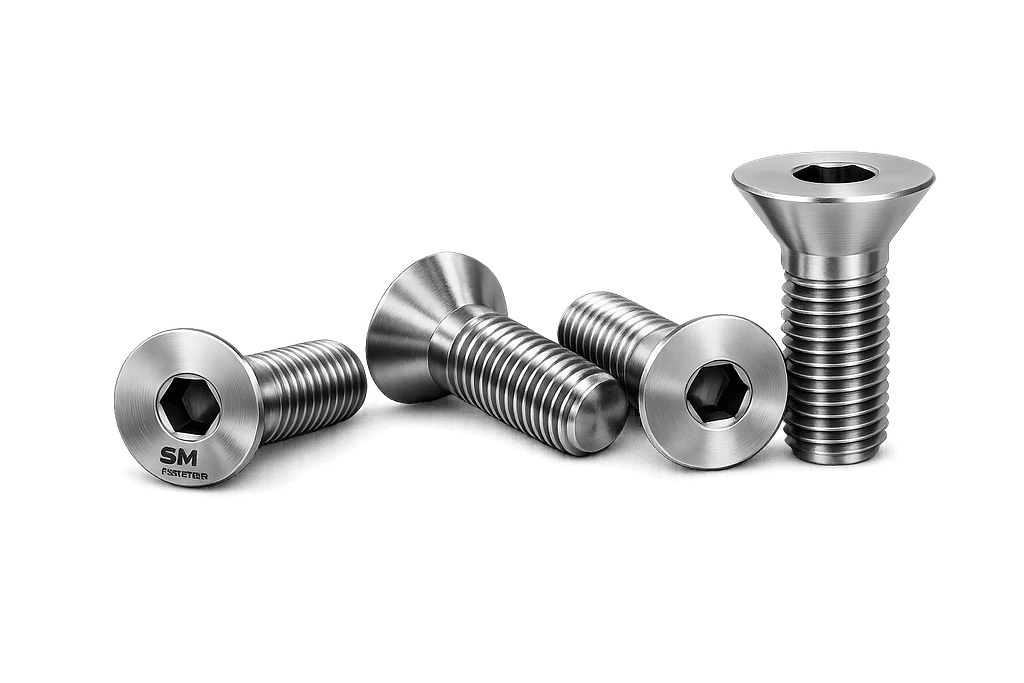


Allen CSK Screws (Allen Countersunk Socket Head Screws) are precision-engineered recessed-head threaded fasteners designed to provide:
- Flush surface integration
- Controlled clamping force
- High-strength mechanical retention
- Reduced aerodynamic and interference profiles
These fasteners are extensively deployed in load-bearing assemblies where surface protrusion is unacceptable or where mechanical clearance and stress distribution are critical.
Industrial Demand Drivers
Allen CSK screws are widely specified across:
| Industry | Functional Requirement |
|---|---|
| Structural Steel Fabrication | Flush finishing & fatigue resistance |
| Oil & Gas Equipment | Compact bolting envelopes |
| Power Generation | Vibration-resistant assemblies |
| Petrochemical Plants | Corrosion-controlled fastening |
| Offshore Platforms | Weight and clearance optimization |
| Automotive & Rail | Surface alignment & safety |
| Heavy Machinery | Precision load transfer |
| Electronics & Instrumentation | Space-constrained fastening |
Within EPC procurement environments, Allen CSK screws are selected when joint integrity must coexist with dimensional precision.
SM Fasteners manufactures Allen CSK screws under ISO 9001 quality systems, ensuring traceability from raw material to dispatch.
2. Technical Definition
Engineering Definition
An Allen CSK Screw is:
A fully threaded or partially threaded screw incorporating a countersunk conical head with an internal hexagonal (Allen) drive, designed to sit flush within a countersunk hole while transmitting axial clamp force.
Fundamental Geometry
Key elements:
- Conical Head: Typically 90° or 82° included angle
- Internal Hex Drive: Enables high torque transmission
- Precision Thread Form
- Flush Seating Surface
Key Functional Characteristics
| Parameter | Engineering Purpose |
|---|---|
| Countersunk Head | Eliminates surface projection |
| Internal Hex Drive | Higher torque capacity vs slot/Phillips |
| Axial Preload | Joint compression |
| Friction Locking | Resistance to loosening |
| Full Seating | Even stress distribution |
3. Functional Role in Mechanical Assemblies
Allen CSK screws serve three primary engineering roles:
3.1 Structural Clamping
Creates compressive preload between joint members.
3.2 Alignment Control
Countersink geometry automatically centers the fastener.
3.3 Surface Continuity
Allows moving components or sealing surfaces to remain unobstructed.
Typical assemblies include:
- Machine tool beds
- Bearing housings
- Structural brackets
- Pump casings
- Aerospace panels
- Railway coach interiors
4. Load Mechanics & Force Behavior
4.1 Force Distribution
Unlike hex head bolts, Allen CSK screws introduce combined loading modes:
- Axial tension
- Radial compressive reaction
- Interface shear resistance
The countersunk head transforms tightening torque into:
Where:
- Fp = Preload force
- T = Applied torque
- K = Nut factor
- d = Nominal diameter
4.2 Countersunk Load Transfer
Because of the conical seat:
- Load spreads along head cone
- Localized stress occurs at seating interface
- Material hardness compatibility becomes critical
Improper countersink angles cause:
- Head fracture
- Embedding failure
- Loss of preload
4.3 Preload Principle
Allen CSK screws operate primarily as elastic tension members.
Proper tightening produces:
- Elastic bolt elongation
- Joint compression
- Frictional resistance to external loads
Engineering Rule:
External service load must never exceed preload force.
4.4 Torque–Tension Relationship
Approximate torque distribution:
| Torque Component | Percentage |
|---|---|
| Thread friction | 40–50% |
| Head friction | 35–45% |
| Useful preload | 10–15% |
This explains why lubrication and coating selection are critical procurement parameters.
5. Joint Design Principles
5.1 Countersink Geometry Requirement
Standard included angles:
| Standard | Countersink Angle |
|---|---|
| ISO Metric | 90° |
| Unified (UNC/UNF) | 82° |
| Aerospace | 100° |
Mismatch leads to catastrophic seating stress.
5.2 Minimum Thread Engagement
Recommended engagement:
| Material | Engagement Length |
|---|---|
| Steel | 1 × diameter |
| Aluminum | 1.5 × diameter |
| Cast Iron | 1.25 × diameter |
| Polymer/PEEK | 2 × diameter |
5.3 Joint Stiffness Concept
Joint stiffness ratio determines load sharing:
Where:
- Kb = Bolt stiffness
- Kj = Joint stiffness
Higher joint stiffness improves fatigue resistance.
5.4 Failure Modes in Allen CSK Screws
Fatigue Failure
Occurs under cyclic loading if preload insufficient.
Head Shear or Cone Fracture
Caused by:
- Over-tightening
- Incorrect countersink angle
Hydrogen Embrittlement
Risk for high-strength alloy steel grades.
Stress Corrosion Cracking
Common in chloride or H₂S environments.
Thread Stripping
Occurs in softer mating materials.
SM Fasteners controls these risks through:
- Controlled heat treatment
- Hardness verification
- Material traceability
- ISO 9001 inspection systems
5.5 Design Recommendations
Engineering best practices:
- Maintain ≥70% proof load preload
- Use lubricated tightening for repeatability
- Match head angle with countersink
- Avoid countersunk screws in primary shear joints unless supported
- Specify coating compatible with torque values
6. Functional Selection Criteria
| Design Factor | Engineering Consideration |
|---|---|
| Load Type | Static / Dynamic / Impact |
| Environment | Corrosion, temperature, chemicals |
| Clearance | Flush requirement |
| Material Compatibility | Avoid galvanic corrosion |
| Maintenance Access | Allen drive accessibility |
| Assembly Method | Manual or controlled torque |
Role in Precision Manufacturing
Allen CSK screws are frequently selected where:
- Surface finishing quality matters
- Aerodynamic flow required
- Sliding or rotating components exist
- Cleanroom equipment demands flush surfaces
SM Fasteners supports custom countersink geometry, specialized alloys, and advanced materials including PEEK fasteners for electrically isolated or high-temperature assemblies.
7. Product Types & Engineering Variants of Allen CSK Screws


Allen CSK screws are not a single universal configuration. Industrial applications require controlled variations in head geometry, thread configuration, drive depth, material strength class, and tolerance class.
SM Fasteners manufactures variants aligned with global interchangeability requirements, enabling EPC buyers to substitute across ISO, DIN, ASTM, and BS systems without functional deviation.
7.1 Standard Allen CSK Screw (Full Thread)
Primary Industrial Configuration
Characteristics
- Fully threaded shank
- 90° countersunk head
- Internal hex drive
- Flush surface seating
Applications
- Machine assemblies
- Structural covers
- Equipment housings
- Precision fixtures
Advantages
- Maximum thread engagement
- High clamping efficiency
- Easy replacement compatibility
7.2 Partially Threaded Allen CSK Screw
Used when shear strength and alignment control are required.
Engineering Benefit
- Unthreaded grip length improves joint alignment.
- Reduces shear loading on threads.
Common in:
- Structural steel connections
- Heavy equipment brackets
- Rotating assemblies
7.3 Reduced Head Height Variant
Designed for space-constrained assemblies.
| Feature | Engineering Value |
|---|---|
| Reduced cone height | Clearance optimization |
| Lower torque capacity | Controlled tightening required |
| Compact assemblies | Electronics & aerospace |
7.4 High-Strength Alloy Steel CSK Screws
Property Classes:
- 8.8
- 10.9
- 12.9
Used where:
- High preload required
- Dynamic loading exists
- Fatigue resistance critical
7.5 Stainless Steel Allen CSK Screws
Typical Grades:
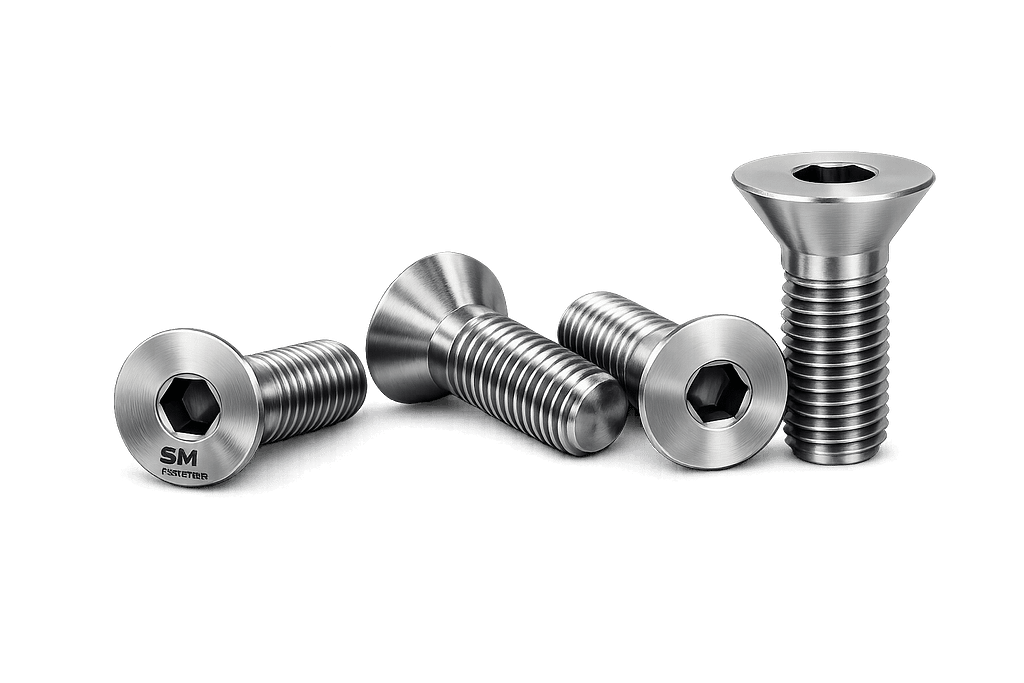
- A2-70
- A4-70
- A4-80
- Duplex
- Super Duplex
Primary advantage:
- Corrosion resistance
- Chemical compatibility
- Offshore durability
7.6 Non-Metallic & Advanced Polymer (PEEK) CSK Screws
SM Fasteners manufactures PEEK countersunk screws for specialized industries.
Applications include:
- Semiconductor equipment
- Electrical insulation assemblies
- MRI equipment
- Chemical processing systems
Advantages:
| Property | Benefit |
|---|---|
| Electrical insulation | No galvanic reaction |
| Lightweight | Weight reduction |
| Chemical resistance | Acid environments |
| Temperature stability | Up to ~250°C |
8. Geometry Logic of Allen CSK Screws
Countersunk fasteners rely heavily on geometry precision.
8.1 Head Cone Angle
| System | Included Angle |
|---|---|
| ISO Metric | 90° |
| Unified (UNC/UNF) | 82° |
| Aerospace | 100° |
Critical Rule:
Head angle must match countersink angle exactly.
8.2 Internal Hex Drive Design
Allen drive dimensions influence:
- Torque transmission
- Tool engagement
- Cam-out resistance
Deeper hex sockets allow:
- Higher tightening torque
- Reduced rounding risk
8.3 Head Diameter vs Load Distribution
Larger head diameter:
- Increases bearing surface
- Reduces surface stress
- Improves fatigue life
8.4 Thread Geometry
Metric threads dominate global EPC procurement.
Important parameters:
- Pitch
- Flank angle (60°)
- Major diameter
- Minor diameter
- Pitch diameter tolerance
Thread rolling (preferred at SM Fasteners) improves:
- Grain flow
- Fatigue resistance
- Surface hardness
9. Applicable International Standards
Allen CSK screws must comply with globally recognized standards for interchangeability and inspection acceptance.
9.1 ISO Standards
| Standard | Description |
|---|---|
| ISO 10642 | Hexagon socket countersunk head screws |
| ISO 898-1 | Mechanical properties of carbon/alloy steel |
| ISO 3506 | Stainless steel fasteners |
| ISO 965 | Thread tolerances |
| ISO 3269 | Acceptance inspection |
9.2 DIN Standards
| DIN Standard | Scope |
|---|---|
| DIN 7991 | Hex socket countersunk screws |
| DIN EN ISO 10642 | Harmonized European equivalent |
9.3 ASTM Standards (Material Focus)
| ASTM Standard | Application |
|---|---|
| ASTM A574 | Alloy steel socket screws |
| ASTM F837 | Stainless steel socket screws |
| ASTM A193 | High temperature bolting |
| ASTM A453 | High temperature strength grades |
9.4 British Standards (BS)
| BS Standard | Description |
|---|---|
| BS 4168 | Metric precision fasteners |
| BS EN ISO 10642 | UK adoption of ISO |
9.5 Property Class System
| Property Class | Yield Strength (MPa) | Typical Use |
|---|---|---|
| 8.8 | 640 | General engineering |
| 10.9 | 900 | Structural machinery |
| 12.9 | 1080 | High load assemblies |
10. Dimensional Specification Table (Metric Series)
(Representative ISO 10642 / DIN 7991 Dimensions)
| Size | Pitch (mm) | Head Dia (dk) mm | Head Height (k) mm | Hex Socket (s) mm | Standard Length Range (mm) |
|---|---|---|---|---|---|
| M3 | 0.5 | 6.0 | 1.7 | 2.0 | 6–30 |
| M4 | 0.7 | 8.0 | 2.3 | 2.5 | 6–40 |
| M5 | 0.8 | 10.0 | 2.8 | 3.0 | 8–50 |
| M6 | 1.0 | 12.0 | 3.3 | 4.0 | 10–80 |
| M8 | 1.25 | 16.0 | 4.4 | 5.0 | 12–100 |
| M10 | 1.5 | 20.0 | 5.5 | 6.0 | 16–120 |
| M12 | 1.75 | 24.0 | 6.5 | 8.0 | 20–150 |
| M16 | 2.0 | 30.0 | 8.0 | 10.0 | 25–200 |
Custom dimensions available through SM Fasteners engineered production.
11. Thread Standards & Tolerance Classes
| Thread System | Standard | Tolerance Class |
|---|---|---|
| Metric Coarse | ISO 261 | 6g |
| Metric Fine | ISO 262 | 6g |
| UNC | ASME B1.1 | 2A |
| UNF | ASME B1.1 | 2A |
| BSW | BS 84 | Medium Fit |
| BSF | BS 84 | Close Fit |
SM Fasteners maintains calibrated thread gauges traceable to international metrology standards.
12. Dimensional Logic — Engineering Selection
Flush Seating Depth
Countersink depth:
Where θ = countersink angle.
Improper depth causes:
- head protrusion
- seating stress
- reduced fatigue life
Grip Length Selection
Recommended rule:
13. Interchangeability Considerations
Procurement teams must verify:
| Parameter | Risk if Incorrect |
|---|---|
| Head angle | Joint failure |
| Thread pitch | Assembly rejection |
| Property class | Strength deficiency |
| Coating thickness | Torque deviation |
| Drive size | Tool incompatibility |
SM Fasteners provides drawing verification and cross-standard equivalency validation before production release.
14. Material Grades & Engineering Selection Criteria


Material selection is the primary determinant of performance, reliability, and lifecycle cost for Allen CSK screws.
Engineering selection must consider:
- Mechanical strength
- Corrosion resistance
- Temperature exposure
- Chemical compatibility
- Hydrogen embrittlement risk
- Regulatory compliance (NACE / ISO / EPC specifications)
SM Fasteners manufactures Allen CSK screws using certified raw materials supported by Mill Test Certificates (MTC) and full traceability under ISO 9001 quality systems.
14.1 Carbon Steel Grades
Used where high strength and cost efficiency are required.
| Grade | Standard | Typical Property Class | Application |
|---|---|---|---|
| C1022 | ISO 898 | 4.8–5.8 | Light mechanical use |
| Medium Carbon Steel | ISO 898 | 8.8 | Structural assemblies |
| Boron Steel | ISO 898 | 10.9 | Heavy equipment |
| Alloy Carbon Steel | ASTM A574 | 12.9 | High load machinery |
Advantages
- High tensile strength
- Economical
- Good fatigue performance after heat treatment
Limitations
- Requires corrosion protection.
14.2 Alloy Steel Fasteners
Alloy steels contain chromium, molybdenum, nickel, or vanadium.
Typical grades:
- 4140
- 4340
- SCM435
- EN19
Used in:
- Power plants
- Oil & gas rotating equipment
- Structural load joints
Benefits:
- Superior fatigue strength
- Improved hardenability
- Higher temperature capability
14.3 Stainless Steel Grades
| Grade | Standard | Characteristics | Environment |
|---|---|---|---|
| A2-70 | ISO 3506 | General corrosion resistance | Industrial |
| A4-70 | ISO 3506 | Mo added | Marine |
| A4-80 | ISO 3506 | Higher strength | Offshore |
| 316L | ASTM F837 | Low carbon | Chemical |
| 904L | ASTM | Acid resistant | Process plants |
14.4 Duplex & Super Duplex Stainless Steel
Designed for aggressive chloride environments.
| Grade | PREN Value | Typical Use |
|---|---|---|
| Duplex 2205 | ~35 | Offshore structures |
| Super Duplex 2507 | >40 | Subsea systems |
| SMO 254 | ~43 | Seawater handling |
Advantages:
- High strength + corrosion resistance
- Excellent SCC resistance
- Reduced maintenance cost
14.5 Nickel & High-Performance Alloys
SM Fasteners supplies advanced materials for extreme service:
| Alloy | Service Capability |
|---|---|
| Inconel 625 | High temperature oxidation |
| Inconel 718 | Aerospace strength |
| Hastelloy C276 | Acid resistance |
| Monel 400 | Seawater resistance |
| Incoloy 825 | Chemical processing |
Typical industries:
- LNG terminals
- Refineries
- Nuclear power
- Offshore platforms
14.6 Engineering Polymer — PEEK Allen CSK Screws
PEEK fasteners represent a specialized segment supported by SM Fasteners.
| Property | Value |
|---|---|
| Continuous Temp | ~250°C |
| Chemical Resistance | Excellent |
| Electrical Insulation | Complete |
| Density | ~1.3 g/cm³ |
Applications:
- Semiconductor manufacturing
- Medical imaging equipment
- Chemical dosing systems
- Electrical isolation assemblies
15. Material Comparison Table
| Material | UTS (MPa) | Yield (MPa) | Corrosion Resistance | Temperature Limit | Relative Cost | Typical Application |
|---|---|---|---|---|---|---|
| Carbon Steel 8.8 | 800 | 640 | Low | 300°C | Low | Structural |
| Alloy Steel 12.9 | 1200 | 1080 | Low | 400°C | Medium | Machinery |
| SS A2-70 | 700 | 450 | Good | 400°C | Medium | Industrial |
| SS A4-80 | 800 | 600 | Excellent | 450°C | High | Marine |
| Duplex 2205 | 850 | 620 | Excellent | 300°C | High | Offshore |
| Inconel 625 | 900 | 450 | Outstanding | 1000°C | Very High | LNG |
| PEEK | 100 | — | Chemical resistant | 250°C | High | Electrical |
16. Heat Treatment Processes
Heat treatment transforms mechanical properties by controlling microstructure.
16.1 Heat Treatment Objectives
- Increase tensile strength
- Improve fatigue resistance
- Control hardness
- Enhance wear resistance
- Maintain ductility
16.2 Standard Heat Treatment Cycle
- Austenitizing
- Quenching
- Tempering
- Stress relieving
16.3 Property Class Heat Treatment
| Property Class | Treatment |
|---|---|
| 8.8 | Quenched & tempered |
| 10.9 | Controlled quench + temper |
| 12.9 | Precision hardening |
Hardness limits must comply with ISO 898-1.
16.4 Hydrogen Embrittlement Control
Critical for high-strength CSK screws.
Preventive methods:
- Controlled electroplating
- Post-plate baking (200°C)
- Mechanical coating alternatives
- Hardness limitation (<39 HRC for sour service)
16.5 NACE MR0175 / ISO 15156 Compliance
Required in H₂S environments.
Controls include:
- Hardness restriction
- Material chemistry control
- Verified heat treatment records
SM Fasteners provides compliant manufacturing for oil & gas sour service applications.
17. End-to-End Manufacturing Workflow
Allen CSK screws require precision manufacturing to maintain geometric accuracy and mechanical integrity.
17.1 Raw Material Verification
Incoming inspection includes:
- Chemical analysis verification
- Heat number traceability
- PMI (Positive Material Identification)
- MTC verification
17.2 Cold Forging / Hot Forging
Cold Forging (Preferred)
- Improves grain flow
- Enhances fatigue strength
- Reduces machining waste
Hot Forging
Used for larger diameters or exotic alloys.
17.3 Head Formation
Multi-station heading machines produce:
- Accurate cone angles
- Controlled head height
- Concentric geometry
17.4 Thread Formation
Thread Rolling (Preferred Method)
Advantages:
- Work hardening
- Improved fatigue resistance
- Smooth surface finish
Thread Cutting
Used only for:
- Large diameters
- Special alloys
17.5 Heat Treatment Integration
Performed under calibrated furnace control:
- Temperature uniformity surveys
- Batch traceability
- Hardness verification
17.6 Surface Preparation
Processes include:
- Shot blasting
- Pickling
- Passivation
- Cleaning
18. Surface Finishing & Coating Technologies
Surface engineering strongly influences torque values and corrosion performance.
18.1 Common Coating Types
| Coating | Thickness | Corrosion Resistance | Notes |
|---|---|---|---|
| Black Oxide | Minimal | Low | Indoor machinery |
| Zinc Plating | 5–12 µm | Moderate | General industrial |
| HDG | 40–80 µm | High | Structural outdoor |
| Zinc Flake | 8–15 µm | Very High | Automotive |
| Phosphate | Thin | Assembly lubrication | Pre-coat |
| PTFE/Xylan | Variable | Chemical resistant | Low friction |
| Passivation | — | Stainless protection | No thickness |
18.2 Surface Finish vs Performance Table
| Finish | Friction Coefficient | Corrosion Resistance | Torque Consistency |
|---|---|---|---|
| Plain | 0.20 | Low | Variable |
| Zinc Plated | 0.18 | Medium | Good |
| Zinc Flake | 0.12 | High | Excellent |
| PTFE | 0.10 | Very High | Outstanding |
| Passivated SS | 0.15 | Excellent | Stable |
18.3 Galvanic Compatibility
Material pairing must avoid electrochemical corrosion.
Example:
- Stainless screw + aluminum → insulation washer recommended
- Carbon steel + stainless → coating isolation required
18.4 Coating Selection Criteria
| Environment | Recommended Finish |
|---|---|
| Indoor machinery | Black oxide |
| Outdoor structural | HDG |
| Marine offshore | A4 stainless / Duplex |
| Chemical plant | PTFE coated |
| Automotive | Zinc flake |
| Electronics | PEEK |
18.5 SM Fasteners Surface Engineering Capability
- Controlled coating thickness verification
- Salt spray testing
- Adhesion testing
- Friction coefficient control
- Batch traceability
All coatings validated under ISO 9001 documented procedures.
19. Inspection & Quality Control Framework
Allen CSK screws used in EPC, offshore, infrastructure, and heavy engineering projects must undergo controlled inspection regimes to ensure compliance with international standards.
At SM Fasteners, inspection activities operate within an ISO 9001 certified quality management system, ensuring full lifecycle traceability.
19.1 Incoming Raw Material Inspection
Verification includes:
- Mill Test Certificate (EN 10204 3.1)
- Heat number traceability
- Chemical composition verification
- Positive Material Identification (PMI)
- Visual & dimensional checks
19.2 In-Process Inspection
| Stage | Inspection Activity |
|---|---|
| Wire/Bar Incoming | Chemical verification |
| Heading | Head geometry check |
| Thread Rolling | Pitch & flank verification |
| Heat Treatment | Hardness & microstructure |
| Coating | Thickness measurement |
19.3 Final Inspection
Performed before shipment release.
Dimensional Checks
- Head diameter
- Countersink angle
- Socket depth
- Thread tolerances
Mechanical Testing
- Proof load test
- Tensile strength test
- Hardness testing
- Torque testing
19.4 Non-Destructive Testing (NDT)
Applicable for critical applications:
- Magnetic Particle Inspection (MPI)
- Dye Penetrant Testing (DPT)
- Ultrasonic inspection (large sizes)
19.5 Certification & Documentation
Supplied documentation may include:
- EN 10204 3.1 / 3.2 certification
- Heat treatment reports
- Coating compliance report
- Inspection Test Plan (ITP)
- Certificate of Conformity (CoC)
20. Mechanical Properties Table (Grade Wise)
| Property Class | Tensile Strength (MPa) | Yield Strength (MPa) | Hardness (HRC) | Typical Use |
|---|---|---|---|---|
| 8.8 | 800 | 640 | 22–32 | General machinery |
| 10.9 | 1040 | 900 | 32–39 | Structural equipment |
| 12.9 | 1220 | 1080 | 39–44 | High-load assemblies |
| A2-70 | 700 | 450 | ≤25 | Corrosion environments |
| A4-80 | 800 | 600 | ≤30 | Offshore & marine |
21. Proof Load & Tensile Capacity Table
| Size | Stress Area (mm²) | Proof Load 8.8 (kN) | Proof Load 10.9 (kN) | Proof Load 12.9 (kN) |
|---|---|---|---|---|
| M4 | 8.8 | 5.6 | 7.9 | 9.5 |
| M5 | 14.2 | 9.1 | 12.8 | 15.4 |
| M6 | 20.1 | 12.9 | 18.3 | 22.0 |
| M8 | 36.6 | 23.4 | 33.3 | 39.9 |
| M10 | 58 | 37.1 | 52.8 | 63.4 |
| M12 | 84.3 | 53.9 | 76.7 | 92.0 |
| M16 | 157 | 100.5 | 143.0 | 171.6 |
22. Tightening Torque Chart
(Dry vs Lubricated Condition)
| Size | Torque 8.8 Dry (Nm) | Torque 8.8 Lubricated | Torque 12.9 Dry | Torque 12.9 Lubricated |
|---|---|---|---|---|
| M4 | 3 | 2.2 | 5 | 3.5 |
| M5 | 6 | 4.5 | 9 | 6.5 |
| M6 | 10 | 7 | 17 | 12 |
| M8 | 25 | 18 | 41 | 30 |
| M10 | 49 | 35 | 83 | 60 |
| M12 | 86 | 62 | 145 | 105 |
| M16 | 210 | 150 | 355 | 255 |
Note: Actual torque depends on coating friction coefficient.
23. Preload Calculation — Engineering Method
Formula
Where:
- F = Preload force (N)
- T = Applied torque (Nm)
- K = Nut factor (≈0.18 lubricated steel)
- d = Nominal diameter (m)
Worked Example
M10 Property Class 10.9
Given:
- Torque = 50 Nm
- Nut factor = 0.18
- Diameter = 0.01 m
Result: ≈ 27.8 kN clamp force
24. Corrosion Resistance vs Environment
| Environment | Carbon Steel | SS A2 | SS A4 | Duplex | Nickel Alloys | PEEK |
|---|---|---|---|---|---|---|
| Indoor Dry | Good | Excellent | Excellent | Excellent | Excellent | Excellent |
| Outdoor Atmosphere | Moderate | Good | Excellent | Excellent | Excellent | Excellent |
| Marine Seawater | Poor | Moderate | Excellent | Outstanding | Outstanding | Excellent |
| Acid Processing | Poor | Moderate | Good | Excellent | Outstanding | Outstanding |
| H₂S Service | Limited | Moderate | Good | Excellent | Outstanding | Excellent |
| High Temperature | Moderate | Good | Good | Good | Excellent | Moderate |
25. Surface Finish Performance Comparison
| Surface Finish | Salt Spray Resistance | Friction Stability | Maintenance Need |
|---|---|---|---|
| Black Oxide | Low | Medium | High |
| Zinc Plated | Medium | Good | Medium |
| HDG | High | Variable | Low |
| Zinc Flake | Very High | Excellent | Low |
| PTFE | Excellent | Outstanding | Minimal |
| Passivated Stainless | Excellent | Stable | Minimal |
26. Weight Chart — Allen CSK Screws
(Aligned with SM Fasteners Production Data)
| Size | Length (mm) | Weight / Piece (g) | Weight / 100 pcs (kg) |
|---|---|---|---|
| M4 | 12 | 1.2 | 0.12 |
| M5 | 16 | 2.3 | 0.23 |
| M6 | 20 | 4.5 | 0.45 |
| M8 | 25 | 9.8 | 0.98 |
| M10 | 30 | 18.5 | 1.85 |
| M12 | 40 | 36 | 3.60 |
| M16 | 50 | 85 | 8.50 |
Custom weight calculations available for project BOQ planning.
27. Failure Mechanisms & Engineering Prevention
Fatigue Failure
Mitigation:
- Correct preload
- Rolled threads
- Proper lubrication
Head Cone Cracking
Avoid:
- Incorrect countersink angle
- Excess torque
Hydrogen Embrittlement
Control:
- Post-plating bake
- Hardness limitation
Stress Corrosion Cracking
Material upgrade:
- A4 / Duplex / Nickel alloys
28. Industry Applications


Allen CSK screws are deployed across high-reliability industries:
Construction & Structural Steel
- Architectural steel
- Access platforms
- Façade systems
Oil & Gas (Upstream / Midstream / Downstream)
- Valve assemblies
- Instrument panels
- Pump skids
- Offshore modules
NACE-compliant materials supplied when required.
Power Generation
- Turbine enclosures
- Generator housings
- Control panels
Petrochemical & Chemical Processing
- Reactor equipment
- Corrosion-resistant assemblies
LNG & Offshore
- Seawater systems
- Subsea equipment
- Marine structural interfaces
Automotive & Heavy Equipment
- Transmission housings
- Robotics systems
- Precision mechanical assemblies
Railways & Infrastructure
- Coach interiors
- Signaling systems
- Mechanical brackets
Shipbuilding
- Deck equipment
- Interior fittings
- Control instrumentation
PEEK Fastener Applications
- Electrical isolation systems
- Cleanroom assemblies
- Semiconductor tooling
29. Export Capability & Global Supply Readiness
SM Fasteners supports international EPC procurement through controlled export logistics.
Industrial Packaging
- VCI corrosion protection
- Thread protection caps
- Batch identification labels
- Moisture barrier packing
Export Crating
- ISPM-15 compliant wooden crates
- Vacuum packing (on request)
- Container optimization for bulk orders
Documentation Package
Typical export dossier includes:
- Mill Test Certificates (MTC)
- EN 10204 3.1 / 3.2 certification
- Heat treatment records
- Coating certificates
- Inspection reports
- Dimensional reports
- Certificate of Conformity (CoC)
- Packing List & Traceability Records
30. ISO 9001 Quality System Integration
Quality assurance at SM Fasteners integrates:
- Controlled manufacturing procedures
- Calibrated inspection instruments
- Batch traceability
- Continuous improvement auditing
- UKAF-accredited certification framework
31. Engineering Procurement Advantages — SM Fasteners
SM Fasteners demonstrates procurement readiness through:
- Multi-material manufacturing capability
- Custom fastener engineering
- Advanced alloys & PEEK solutions
- Global standards compliance
- Project documentation support
- Weight-controlled supply planning
- EPC project traceability
ENGINEERING CONCLUSION
Allen CSK screws represent precision clamping components where geometry, material metallurgy, surface engineering, and preload control directly determine assembly reliability.
Through ISO-certified manufacturing, advanced material capability, rigorous inspection, and export-grade documentation, SM Fasteners provides Allen CSK screws engineered for demanding global industrial environments.