

Plain Washers
1. Industrial Context of Plain Washers


Plain washers are critical load-distribution elements within bolted assemblies. While geometrically simple, they perform essential mechanical functions influencing:
- Structural joint reliability
- Bolt preload retention
- Surface protection
- Fatigue life of assemblies
- Compliance with international structural standards
Across EPC projects, washers are mandatory engineered components, not accessories.
Industries relying heavily on precision washers include:
| Industry | Functional Importance |
|---|---|
| Structural Steel Construction | Prevent embedment & plate deformation |
| Oil & Gas | Load control in flange joints |
| Power Plants | Vibration stability |
| Petrochemical Plants | Corrosion isolation |
| LNG & Offshore | Galling prevention |
| Heavy Equipment | Surface protection |
| Railways | Dynamic load resistance |
| Shipbuilding | Corrosion + vibration reliability |
SM Fasteners manufactures washers aligned with global industrial procurement specifications, ensuring interchangeability with ISO, ASTM, DIN, and BS systems.
2. Technical Definition
A Plain Washer is a flat annular mechanical component placed between a fastener head/nut and the bearing surface to:
- Distribute compressive load
- Increase bearing area
- Prevent surface damage
- Reduce friction variation
- Improve preload consistency
Fundamental Geometry
- Outside Diameter (OD)
- Inside Diameter (ID)
- Thickness (t)
- Bearing Surface Area
Engineering definition:
This directly influences stress distribution under preload.
3. Functional Role in Bolted Assemblies
Plain washers serve four primary engineering functions:
3.1 Load Distribution
Without a washer:
- High compressive stress develops beneath bolt head.
- Local yielding or indentation occurs.
With washer:
- Stress spreads uniformly across contact surface.
- Structural integrity preserved.
3.2 Preload Stabilization
Bolt preload depends strongly on friction conditions.
Washer provides:
- Consistent friction interface
- Reduced torque scatter
- Predictable clamp load
3.3 Surface Protection
Essential when assembling:
- Painted structures
- Coated steels
- Soft materials
- Composite plates
- Stainless steel joints
3.4 Alignment Compensation
Washers compensate for:
- Minor hole misalignment
- Surface irregularities
- Installation tolerances
4. Load Mechanics & Force Behaviour


4.1 Preload Concept
Bolt tightening creates tensile force:
Where:
- = preload force
- = applied torque
- = nut factor
- = nominal diameter
Plain washers directly influence K-factor stability.
4.2 Compression Cone Theory
Load spreads through joint members forming a compression cone.
Washers:
- Expand cone base
- Reduce localized crushing
- Improve fatigue resistance
4.3 Friction Distribution
Typical torque breakdown:
| Component | Torque Share |
|---|---|
| Thread friction | 40% |
| Under-head friction | 50% |
| Actual preload | 10% |
Washers control the largest torque variable — under-head friction.
4.4 Contact Stress Reduction
Contact pressure:
Increasing washer area reduces surface stress significantly.
5. Joint Design Principles
5.1 Washer Selection Philosophy
Engineers must evaluate:
- Bolt diameter
- Joint material hardness
- Coating system
- Temperature
- Corrosion exposure
- Dynamic loading
5.2 Hardness Compatibility Rule
General engineering rule:
Prevents embedding loss.
5.3 Structural Steel Requirements
Standards often mandate washers:
- EN 14399
- AISC Steel Construction
- Eurocode 3
Used with:
- High-strength friction grip bolts
- Structural connections
- Slip-critical joints
5.4 Preload Retention & Relaxation
Washer improves resistance against:
- Embedment relaxation
- Thermal expansion cycles
- Creep deformation
- Vibration loosening
5.5 Failure Prevention Role
Plain washers mitigate:
| Failure Mode | Washer Contribution |
|---|---|
| Fatigue cracking | Load distribution |
| Joint relaxation | Surface stabilization |
| Galling | Reduced friction |
| Surface indentation | Bearing enlargement |
| Coating damage | Protective interface |
5.6 Washer Use in Critical Services
Mandatory in:
- Pressure vessel bolting
- Offshore flanges
- LNG cryogenic systems
- NACE MR0175 sour service
- High vibration machinery
6. Functional Behavior in Different Load Conditions
| Load Type | Washer Role |
|---|---|
| Static Load | Bearing stabilization |
| Cyclic Load | Fatigue reduction |
| Impact Load | Stress dispersion |
| Thermal Cycling | Preload retention |
| Corrosive Exposure | Barrier protection |
6.7 Washer Interaction with Fastener Systems
Compatible with:
- Bolts
- Screws
- Stud bolts
- Threaded rods
- PEEK fasteners (electrical isolation systems)
SM Fasteners provides washer solutions engineered alongside full fastener assemblies to ensure system-level reliability, not component-only supply.
7. Product Types & Engineering Variants of Plain Washers
Plain washers are manufactured in multiple engineered configurations designed to meet specific load distribution, tolerance control, and structural performance requirements.
SM Fasteners produces washers conforming to international dimensional systems ensuring interchangeability across global EPC projects.
7.1 Standard Plain Washers (Normal Series)
Typical Standards
- DIN 125
- ISO 7089
- ISO 7090
- BS 4320 Form A
Characteristics
- Standard OD-to-ID ratio
- General industrial usage
- Controlled bearing surface
Applications
- Machinery assembly
- Automotive components
- Equipment frames
- General bolting systems
7.2 Large OD Washers (Fender / Repair Series)
Standards
- DIN 9021
- ISO 7093
- BS 4320 Form G
Engineering Purpose
- Increased bearing area
- Suitable for soft materials
Applications
- Sheet metal structures
- Composite panels
- Insulation mounting
- Fabricated assemblies
7.3 Structural Washers (Heavy Duty)
Standards
- DIN 6916
- EN 14399-6
- ASTM F436
Design Features
- Increased thickness
- High hardness
- Structural bolt compatibility
Used in:
- Steel bridges
- High-strength friction grip joints
- Heavy infrastructure
7.4 Precision Ground Washers
Manufactured with tight flatness tolerances.
Used where:
- Alignment accuracy required
- Rotating machinery assemblies
- Bearing seating
- Aerospace equipment
7.5 Square & Plate Washers
Common in civil engineering:
- Timber structures
- Foundation anchoring
- Rail infrastructure
Provide large bearing surfaces for non-metal substrates.
7.6 PEEK Plain Washers (Advanced Polymer)
SM Fasteners supplies PEEK washers for specialized applications.
Properties:
- Electrical insulation
- Chemical resistance
- Non-magnetic
- Lightweight
- Temperature resistance up to ~260°C
Applications:
- Semiconductor plants
- Medical equipment
- Offshore instrumentation
- Hydrogen systems
8. Dimensional Logic & Geometry
Washer geometry directly controls contact stress distribution.
8.1 Fundamental Dimensional Parameters
| Parameter | Symbol | Function |
|---|---|---|
| Nominal Bolt Size | d | Fit control |
| Inside Diameter | ID | Clearance |
| Outside Diameter | OD | Load distribution |
| Thickness | t | Bearing strength |
| Flatness | — | Preload stability |
8.2 Clearance Design
Standard clearance:ID=Bolt Diameter+Clearance
Typical clearance:
0.2–1.0 mm depending on standard.
8.3 OD Selection Principle
Engineering guideline:
| Joint Type | Recommended OD |
|---|---|
| Hard steel plates | Standard OD |
| Soft metals | Large OD |
| Composite materials | Extra large OD |
| Structural bolting | Heavy series |
9. Dimensional Specification Table (Metric Series)
Standard Plain Washer Dimensions (ISO 7089 / DIN 125)
| Bolt Size | ID (mm) | OD (mm) | Thickness (mm) |
|---|---|---|---|
| M3 | 3.2 | 7 | 0.5 |
| M4 | 4.3 | 9 | 0.8 |
| M5 | 5.3 | 10 | 1.0 |
| M6 | 6.4 | 12 | 1.6 |
| M8 | 8.4 | 16 | 1.6 |
| M10 | 10.5 | 20 | 2.0 |
| M12 | 13 | 24 | 2.5 |
| M16 | 17 | 30 | 3.0 |
| M20 | 21 | 37 | 3.0 |
| M24 | 25 | 44 | 4.0 |
| M30 | 31 | 56 | 4.0 |
| M36 | 37 | 66 | 5.0 |
Manufactured under calibrated tooling systems within ISO dimensional tolerances.
10. Heavy Series Washer Dimensions (DIN 6916 / ASTM F436 Equivalent)
| Bolt Size | ID | OD | Thickness |
|---|---|---|---|
| M12 | 13 | 24 | 4 |
| M16 | 17 | 30 | 6 |
| M20 | 21 | 37 | 6 |
| M24 | 25 | 44 | 8 |
| M27 | 28 | 50 | 8 |
| M30 | 31 | 56 | 10 |
| M36 | 37 | 66 | 12 |
Designed for high preload structural bolts class 8.8 / 10.9.
11. Dimensional Logic for Structural Engineering
Washer thickness must resist:
Ensures washer does not plastically deform under preload.
12. International Standards & Compliance
SM Fasteners manufactures washers fully compliant with globally accepted standards.
12.1 ISO Standards
| Standard | Description |
|---|---|
| ISO 7089 | Normal series washers |
| ISO 7090 | Chamfered washers |
| ISO 7091 | Product grade C |
| ISO 7093 | Large OD washers |
| ISO 7094 | Structural washers |
12.2 DIN Standards
| Standard | Application |
|---|---|
| DIN 125 | Standard washer |
| DIN 126 | Heavy washers |
| DIN 9021 | Large OD washer |
| DIN 6916 | Structural steel washer |
12.3 ASTM Standards
| Standard | Description |
|---|---|
| ASTM F844 | General purpose washers |
| ASTM F436 | Structural washers |
| ASTM A240 | Stainless steel plate material |
| ASTM A193/A320 | Stud bolt assemblies compatibility |
12.4 British Standards (BS)
| Standard | Description |
|---|---|
| BS 4320 | Metric washer series |
| BS 3410 | Structural assemblies |
| BS EN 14399 | Preloaded structural bolting |
13. Thread Standards & Tolerance Compatibility
Although washers are non-threaded, they must match bolt systems.
Thread Compatibility Table
| System | Standard |
|---|---|
| Metric Coarse | ISO 261 |
| Metric Fine | ISO 965 |
| UNC | ASME B1.1 |
| UNF | ASME B1.1 |
| BSW | BS 84 |
| BSF | BS 84 |
Washer clearance dimensions ensure compatibility across these systems.
14. Interchangeability Considerations
Global EPC procurement requires:
- Metric ↔ Imperial compatibility
- Standard OD equivalence
- Structural bolt system alignment
- Inspection acceptance by third-party auditors
SM Fasteners maintains dimensional equivalency allowing seamless replacement in international projects.
15. Geometry Influence on Performance
| Geometry Parameter | Performance Effect |
|---|---|
| Larger OD | Lower contact stress |
| Greater thickness | Higher preload capacity |
| Flatness accuracy | Torque repeatability |
| Chamfered edge | Seating accuracy |
16. Dimensional Inspection Parameters
Critical inspection characteristics:
- OD tolerance
- ID tolerance
- Parallelism
- Flatness
- Burr-free edges
- Surface finish Ra value
Inspection executed under ISO 9001 controlled systems.
Engineering Summary — Part 2
Plain washers must be selected not by availability but by:
- Load class
- Joint material
- Applicable international standard
- Preload level
- Environmental exposure
Correct dimensional selection directly governs joint reliability and lifecycle performance.
17. Materials Engineering for Plain Washers


Material selection is the primary determinant of washer performance, directly influencing:
- Load-bearing capacity
- Hardness compatibility
- Corrosion resistance
- Temperature tolerance
- Service life reliability
SM Fasteners manufactures washers across full industrial metallurgy ranges, supporting EPC, offshore, petrochemical, and high-performance engineering sectors.
17.1 Industrial Material Categories
| Material Family | Typical Grades | Primary Use |
|---|---|---|
| Carbon Steel | IS 2062, ASTM A36 | General engineering |
| Alloy Steel | EN 24, 4140, 4340 | High strength joints |
| Stainless Steel | 304, 316, 316L | Corrosion resistance |
| Duplex Stainless | 2205 | Offshore & chemical |
| Super Duplex | 2507 | Seawater service |
| Nickel Alloys | Inconel, Monel | High temperature |
| High Alloy | SMO 254 | Chloride resistance |
| Exotic Alloys | Hastelloy C276 | Acid environments |
| Engineering Polymer | PEEK | Electrical isolation |
18. Mechanical Property Comparison Table
| Material | Yield Strength (MPa) | UTS (MPa) | Temp Limit °C | Corrosion Resistance | Typical Application |
|---|---|---|---|---|---|
| Carbon Steel | 250 | 400–550 | 300 | Low | Structural steel |
| Alloy Steel QT | 850 | 1000+ | 450 | Moderate | Heavy machinery |
| SS 304 | 215 | 505 | 870 | Good | Process plants |
| SS 316 | 205 | 515 | 870 | Excellent | Marine |
| Duplex 2205 | 450 | 620 | 300 | Very High | Offshore |
| Super Duplex 2507 | 550 | 800 | 300 | Extreme | Seawater |
| Inconel 625 | 460 | 827 | 980 | Exceptional | LNG & turbines |
| Hastelloy C276 | 355 | 790 | 1000 | Acid resistant | Chemical plants |
| SMO 254 | 300 | 650 | 400 | Chloride resistant | Desalination |
| PEEK | — | — | 260 | Chemical inert | Electrical isolation |
19. Material Selection Criteria
Engineering selection must consider:
Mechanical Factors
- Bolt property class
- Preload magnitude
- Contact pressure
- Hardness compatibility
Environmental Factors
- Chloride exposure
- H₂S presence
- Acidic chemicals
- Temperature cycling
Regulatory Compliance
- NACE MR0175 / ISO 15156
- Pressure vessel codes
- Offshore standards
20. Corrosion Resistance vs Environment
| Environment | Recommended Materials |
|---|---|
| Atmospheric | Carbon Steel + Zinc |
| Industrial Pollution | SS304 |
| Marine | SS316 / Duplex |
| Seawater Immersion | Super Duplex |
| Chloride Chemical | SMO 254 |
| Sour Gas (H₂S) | Duplex / Nickel Alloy |
| Strong Acids | Hastelloy |
| Cryogenic LNG | Inconel |
| Electrical Isolation | PEEK |
SM Fasteners supports material traceability through EN 10204 certification.
21. Mechanical Property Classes (Steel Washers)
Washer hardness must support bolt preload without yielding.
| Washer Class | Typical Hardness | Compatible Bolt Class |
|---|---|---|
| 140 HV | Soft joints | ≤ 5.8 |
| 200 HV | General engineering | 8.8 |
| 300 HV | Structural | 10.9 |
| 380 HV | Heavy duty | 12.9 |
Structural washers (ASTM F436) typically ≥ 38 HRC equivalent.
22. Heat Treatment Processes
Heat treatment ensures washers achieve required hardness and mechanical stability.
22.1 Annealing
Purpose:
- Stress relief
- Improved machinability
Applied to:
- Stainless steels
- Nickel alloys
22.2 Quenching & Tempering (Q&T)
Process:
- Austenitizing
- Rapid quenching
- Controlled tempering
Benefits:
- High strength
- Toughness balance
- Structural washer performance
22.3 Solution Annealing
Used for:
- Duplex
- Super Duplex
- Nickel alloys
Restores corrosion resistance.
22.4 Hardness Limits (Sour Service)
For NACE compliance:
- Maximum hardness typically ≤ 22 HRC
- Prevents sulphide stress cracking
23. End-to-End Manufacturing Workflow


SM Fasteners follows an ISO 9001 controlled production workflow.
23.1 Raw Material Verification
- Approved mills only
- Heat number traceability
- MTC verification
- PMI testing for alloy confirmation
23.2 Blanking / Forging
Stamping / Punching
- High production efficiency
- Tight dimensional control
Forged Washers
- Structural applications
- Improved grain flow
23.3 Machining (Precision Washers)
CNC turning used when:
- Tight tolerances required
- Exotic alloys used
- Custom geometries specified
23.4 Deburring & Edge Conditioning
Prevents:
- Coating damage
- Assembly scoring
- Stress concentration
23.5 Heat Treatment
Controlled atmosphere furnaces ensure:
- Uniform hardness
- Oxidation control
- Metallurgical consistency
23.6 Surface Preparation
Includes:
- Shot blasting
- Pickling
- Passivation
- Cleaning
24. Surface Finishing & Coatings
Surface engineering protects washers against corrosion and controls friction characteristics.
24.1 Surface Finish Comparison Table
| Finish | Corrosion Resistance | Friction Control | Temperature Limit | Typical Use |
|---|---|---|---|---|
| Plain Oil | Low | Stable | 120°C | Indoor machinery |
| Zinc Plated | Moderate | Good | 200°C | Construction |
| Hot Dip Galvanized | High | Variable | 450°C | Structural steel |
| Mechanical Galvanized | High | Uniform | 300°C | Infrastructure |
| Black Oxide | Low | Excellent | 400°C | Precision machinery |
| Phosphate | Moderate | Lubricity | 300°C | Automotive |
| PTFE / Xylan | Very High | Excellent | 260°C | Offshore |
| Passivated SS | Excellent | Stable | 870°C | Chemical plants |
24.2 Coating Selection Logic
| Requirement | Recommended Finish |
|---|---|
| Low cost indoor | Zinc plated |
| Outdoor structural | HDG |
| Marine exposure | SS Passivated |
| Offshore oil & gas | PTFE |
| High temperature | Black oxide |
| Chemical plants | Nickel alloy base |
25. Hydrogen Embrittlement Control
Critical for high-strength steel washers.
SM Fasteners applies:
- Controlled plating processes
- Post-bake de-embrittlement
- ASTM B850 compliance practices
26. Surface Engineering for Preload Accuracy
Coatings influence nut factor (K):
| Surface Condition | Nut Factor |
|---|---|
| Dry steel | 0.20–0.25 |
| Zinc plated | 0.18 |
| Lubricated | 0.12–0.16 |
| PTFE coated | 0.10 |
Stable friction improves torque reliability.
27. Manufacturing Traceability & Control
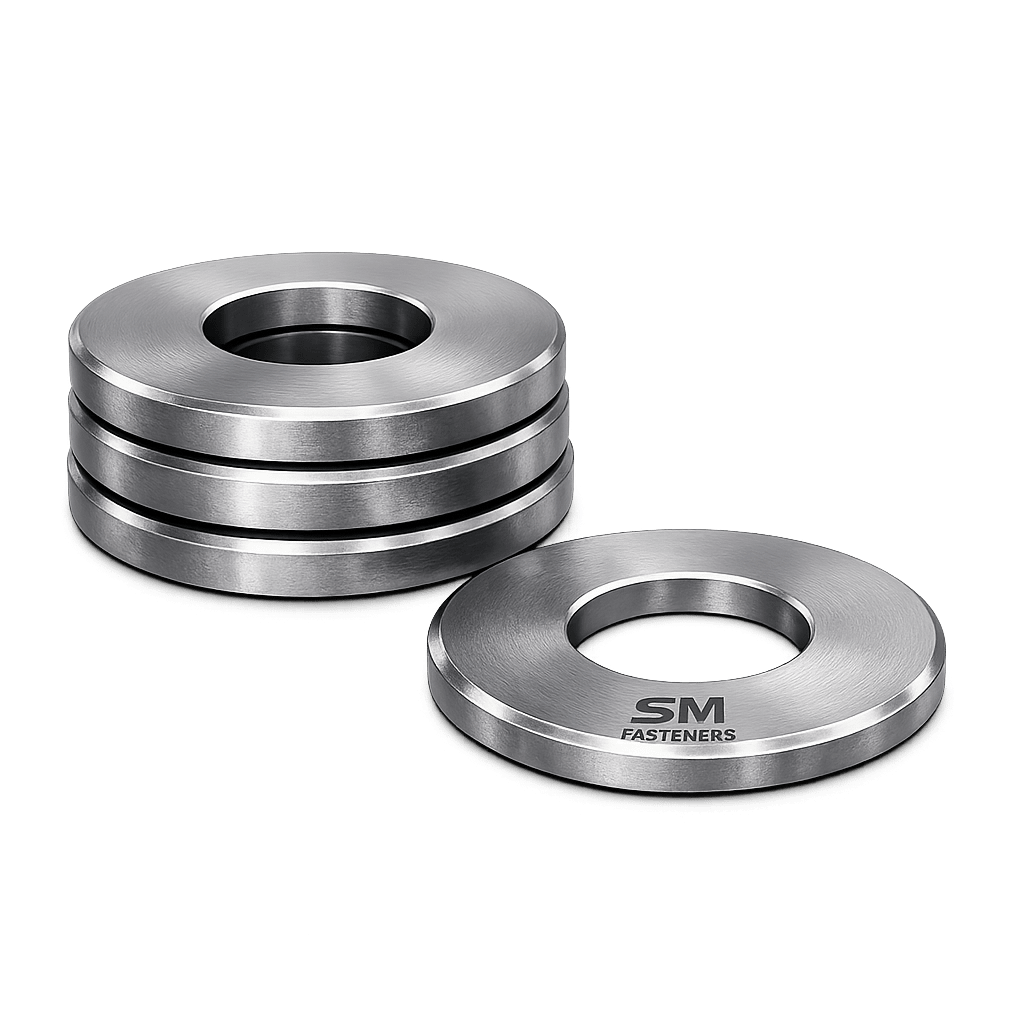
Each production batch includes:
- Heat number marking
- Batch identification
- Process documentation
- Inspection history
- Traceable packaging
Integrated within SM Fasteners ISO 9001 quality management system.
Engineering Summary — Part 3
Plain washer performance depends on correct integration of metallurgy, heat treatment, and surface engineering.
Failure to match washer material with bolt grade, environment, or coating system can result in:
- Embedment loss
- Corrosion failure
- Stress corrosion cracking
- Preload relaxation
SM Fasteners delivers washers engineered as load-bearing mechanical components, not commodity hardware.
28. Inspection & Quality Control Framework


Plain washers used in industrial assemblies are load-bearing engineered components requiring validated inspection under controlled quality systems.
SM Fasteners operates an ISO 9001 certified quality management system, integrating manufacturing, inspection, and documentation traceability aligned with EPC and global project procurement standards.
28.1 Incoming Raw Material Inspection
Verification performed prior to production:
- Mill Test Certificate (MTC) validation
- Chemical composition verification
- Heat number traceability
- Surface defect inspection
- Positive Material Identification (PMI) for alloy grades
Standards referenced:
- ASTM A751
- ISO 4042
- EN 10204
28.2 In-Process Dimensional Inspection
Critical dimensional checks:
| Parameter | Inspection Method |
|---|---|
| Inside Diameter (ID) | Go/No-Go gauges |
| Outside Diameter (OD) | Digital calipers |
| Thickness | Micrometer |
| Flatness | Surface plate measurement |
| Parallelism | Comparator inspection |
| Burr condition | Visual & tactile inspection |
Statistical Process Control (SPC) applied for batch stability.
28.3 Mechanical Testing
| Test | Standard | Purpose |
|---|---|---|
| Hardness Test | ISO 6508 | Verify property class |
| Compression Test | ASTM F606 | Load capability |
| Microstructure Exam | ASTM E3 | Heat treatment verification |
| Coating Thickness | ISO 1461 / ASTM B633 | Corrosion protection |
| Salt Spray Test | ASTM B117 | Coating performance |
28.4 Non-Destructive Testing (NDT)
Applied for critical applications:
- Magnetic Particle Inspection (MPI)
- Dye Penetrant Testing (PT)
- Ultrasonic Examination (UT)
- Eddy Current Testing
28.5 Certification & Documentation
SM Fasteners provides:
- EN 10204 3.1 Material Certificates
- EN 10204 3.2 Third-Party Certification (when required)
- Heat Treatment Reports
- Dimensional Inspection Reports
- Coating Certificates
- Certificate of Conformity (CoC)
Suitable for international audit environments.
29. Failure Mechanisms & Engineering Prevention
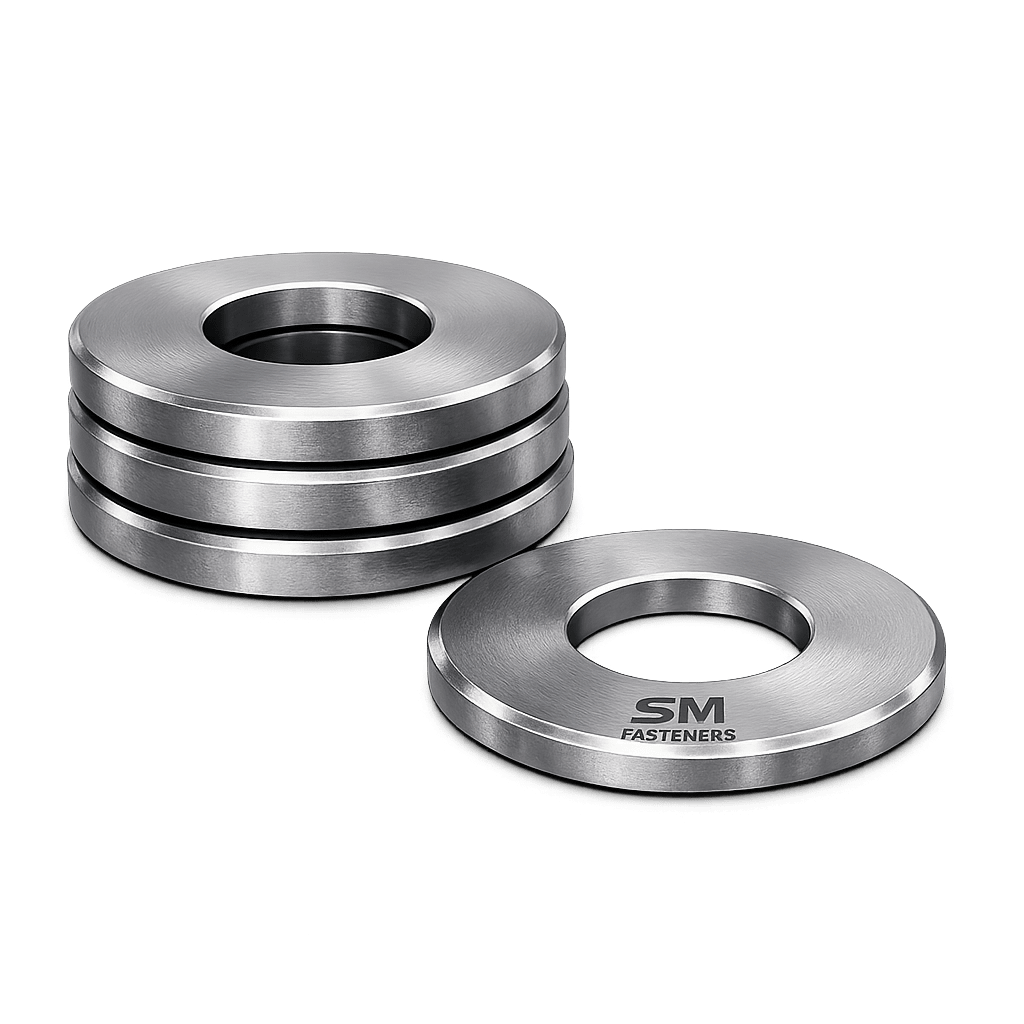
29.1 Embedment Relaxation
Cause:
- Washer hardness too low
Solution:
- Structural grade washers
29.2 Fatigue Failure
Cause:
- Uneven load distribution
Mitigation:
- Proper washer OD selection
29.3 Hydrogen Embrittlement
Risk in plated high-strength steel.
Control:
- Post-bake treatment
- Controlled electroplating
29.4 Stress Corrosion Cracking
Occurs in:
- Chloride environments
- Sour gas service
Solution:
- Duplex / Nickel alloys
- NACE compliant hardness
30. Industrial Applications Mapping
30.1 Construction & Structural Steel
- Structural bolting assemblies
- Bridges & transmission towers
- Slip-critical joints
Standards: EN 14399 / ASTM F436.
30.2 Oil & Gas Industry
Upstream
- Wellhead equipment
- Pipeline supports
Midstream
- Pump stations
- Compressor skids
Downstream
- Refinery piping systems
- Pressure vessels
Materials:
Duplex, Super Duplex, Inconel.
30.3 Power Generation
- Steam turbine assemblies
- Boiler structures
- Nuclear auxiliary systems
Requirements:
- Preload stability
- High temperature resistance
30.4 Petrochemical & Chemical Processing
- Acid handling systems
- Reactors
- Heat exchangers
Materials:
Hastelloy, SMO 254, SS316L.
30.5 LNG & Offshore
Critical considerations:
- Cryogenic temperatures
- Saltwater exposure
- Dynamic vibration
Preferred materials:
Super Duplex / Nickel alloys.
30.6 Automotive & Heavy Equipment
- Chassis connections
- Suspension systems
- Engine assemblies
Washers prevent coating damage and embedment loss.
30.7 Railways & Infrastructure
- Track fastening systems
- Bridge anchor bolts
- Signaling equipment
Heavy structural washers widely used.
30.8 Shipbuilding
- Deck equipment mounting
- Marine propulsion systems
- Corrosion resistant assemblies
30.9 PEEK Washer Applications
- Electrical insulation
- Semiconductor processing
- Medical equipment
- Hydrogen energy systems
Advantages:
- Non-conductive
- Lightweight
- Chemical resistance
31. Export Capability & Global Supply Readiness


SM Fasteners supports international EPC procurement with controlled export logistics.
31.1 Industrial Packaging
Options include:
- VCI corrosion protection packaging
- Oil-coated packaging
- Heat-sealed poly bags
- Palletized bulk packing
- Barcode traceability labels
31.2 Export Crating
- ISPM-15 compliant fumigated wooden crates
- Shock-resistant packaging
- Moisture barrier systems
- Containerized shipment readiness
31.3 Documentation Package
Provided with shipments:
| Document | Purpose |
|---|---|
| MTC (EN 10204 3.1/3.2) | Material traceability |
| Inspection Reports | QA validation |
| Heat Treatment Records | Mechanical verification |
| Coating Certificate | Surface compliance |
| Certificate of Conformity | Project approval |
| Packing List | Logistics tracking |
| Commercial Invoice | Export clearance |
32. Engineering Tables — Complete Reference Section
32.1 Proof Load & Tensile Strength Compatibility
(Washer hardness must exceed joint bearing requirements)
| Bolt Grade | Proof Strength MPa | Recommended Washer Hardness |
|---|---|---|
| 4.6 | 240 | 140 HV |
| 5.8 | 380 | 160 HV |
| 8.8 | 640 | 200 HV |
| 10.9 | 830 | 300 HV |
| 12.9 | 970 | ≥380 HV |
32.2 Tightening Torque Chart (Typical Steel Bolts)
| Size | Grade 8.8 Dry (Nm) | Lubricated (Nm) |
|---|---|---|
| M6 | 10 | 7 |
| M8 | 25 | 18 |
| M10 | 49 | 35 |
| M12 | 85 | 60 |
| M16 | 210 | 150 |
| M20 | 410 | 290 |
| M24 | 710 | 500 |
| M30 | 1400 | 1000 |
Washer surface finish directly influences torque repeatability.
32.3 Preload Calculation — Worked Example
Given:
- Bolt: M16 Grade 8.8
- Torque = 210 Nm
- Nut factor K = 0.20
- Diameter = 16 mm
Washer must withstand this compressive load without yielding.
32.4 Material Comparison Table
| Material | Relative Cost | Strength | Corrosion Resistance | Typical Sector |
|---|---|---|---|---|
| Carbon Steel | Low | Medium | Low | Construction |
| Alloy Steel | Medium | High | Medium | Machinery |
| SS304 | Medium | Medium | Good | Industrial |
| SS316 | Higher | Medium | Excellent | Marine |
| Duplex | High | High | Very High | Offshore |
| Super Duplex | Very High | Very High | Extreme | LNG |
| Nickel Alloy | Premium | High | Exceptional | Chemical |
| PEEK | Premium | Moderate | Chemical inert | Electronics |
32.5 Corrosion Resistance vs Environment
| Environment | Carbon | SS304 | SS316 | Duplex | Nickel Alloy |
|---|---|---|---|---|---|
| Indoor | ✓ | ✓ | ✓ | ✓ | ✓ |
| Outdoor | △ | ✓ | ✓ | ✓ | ✓ |
| Marine | ✗ | △ | ✓ | ✓✓ | ✓✓ |
| Seawater | ✗ | ✗ | △ | ✓✓ | ✓✓ |
| Acidic | ✗ | △ | ✓ | ✓ | ✓✓ |
| H₂S Sour | ✗ | △ | ✓ | ✓✓ | ✓✓ |
✓✓ = Preferred
32.6 Surface Finish Performance Comparison
| Coating | Corrosion Life | Friction Stability | Maintenance Need |
|---|---|---|---|
| Zinc Plated | Medium | Good | Medium |
| HDG | High | Variable | Low |
| Black Oxide | Low | Excellent | High |
| PTFE | Very High | Excellent | Very Low |
| Passivated SS | Excellent | Stable | Minimal |
32.7 Thread Standards & Tolerance Compatibility
| System | Standard | Usage Region |
|---|---|---|
| Metric | ISO 261 / ISO 965 | Global |
| UNC | ASME B1.1 | USA |
| UNF | ASME B1.1 | Aerospace |
| BSW | BS 84 | UK legacy |
| BSF | BS 84 | Industrial legacy |
32.8 Washer Weight Chart (Reference — SM Fasteners Manufacturing Data)
| Size | Weight / Piece (kg) | Weight / 100 pcs (kg) |
|---|---|---|
| M6 | 0.002 | 0.20 |
| M8 | 0.004 | 0.40 |
| M10 | 0.007 | 0.70 |
| M12 | 0.011 | 1.10 |
| M16 | 0.020 | 2.00 |
| M20 | 0.035 | 3.50 |
| M24 | 0.060 | 6.00 |
| M30 | 0.110 | 11.0 |
| M36 | 0.180 | 18.0 |
Aligned with SM Fasteners production capability and export packing calculations.
33. Integrated Quality & Manufacturing Capability — SM FASTENERS
SM Fasteners demonstrates:
- ISO 9001 certified production systems
- MSME recognized manufacturing infrastructure
- UKAF accredited quality management
- Full traceability manufacturing
- Advanced alloy & PEEK fastener capability
- Custom washer engineering for EPC projects
Manufacturing philosophy:
Washers engineered as structural load components — not commodity items.
Engineering Summary — Plain Washers
Plain washers perform essential mechanical roles in bolted joint integrity:
- Control load distribution
- Stabilize preload
- Protect surfaces
- Improve fatigue life
- Ensure compliance with international standards
Correct washer selection integrates:
- Geometry
- Material metallurgy
- Heat treatment
- Surface engineering
- Inspection validation
Through certified quality systems, advanced materials capability, and export-ready documentation, SM Fasteners provides globally compliant plain washer solutions suitable for critical industrial, offshore, infrastructure, and energy sector applications.