

Spring Washers
1. Industry Context
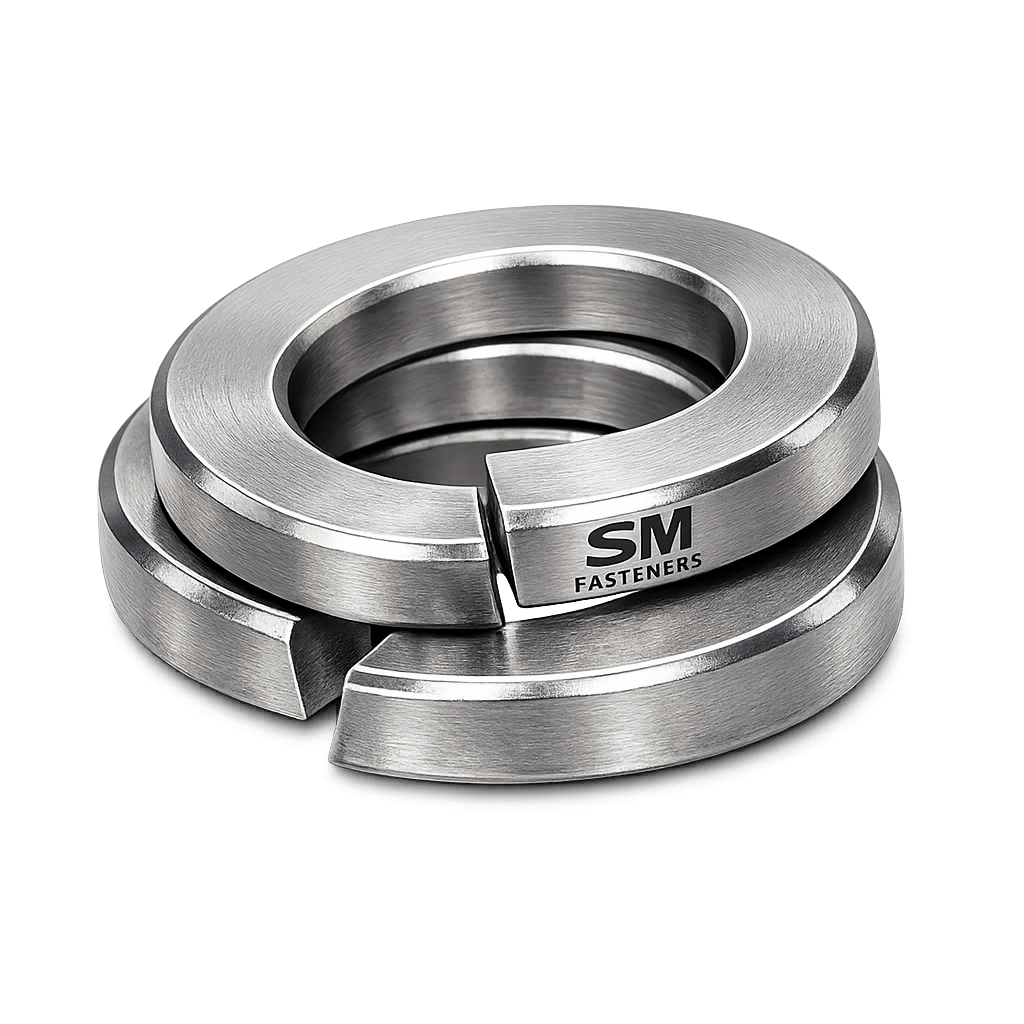
Spring washers are critical mechanical locking and load-retention elements used in bolted assemblies subjected to vibration, thermal cycling, and dynamic loading conditions.
In modern engineered systems, bolted joints are expected to:
- Maintain consistent preload
- Resist self-loosening
- Compensate for elastic deformation
- Preserve joint integrity over service life
Across sectors such as oil & gas, power generation, petrochemical processing, offshore structures, heavy equipment, rail infrastructure, and structural steel, spring washers remain a standardized secondary locking method aligned with international fastening practices.
Within EPC procurement environments, spring washers are specified to:
- DIN / ISO mechanical standards
- Project-specific technical datasheets
- Inspection Test Plans (ITP)
- Reliability-centered maintenance programs
SM Fasteners, operating under ISO 9001 quality management, MSME registration, and UKAF certification frameworks, manufactures precision spring washers engineered for globally compliant assemblies requiring predictable mechanical behavior and traceable metallurgy.
2. Technical Definition
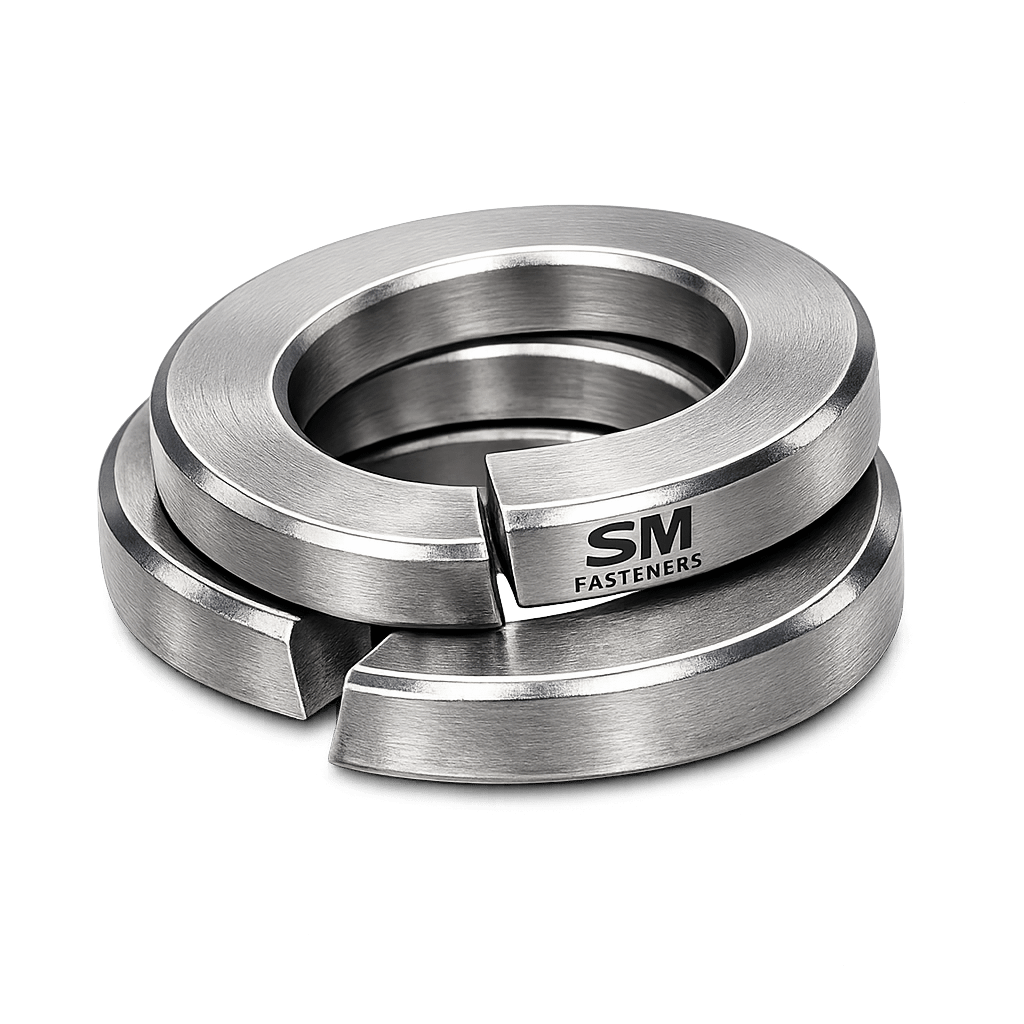
A spring washer is an axially elastic washer designed to introduce controlled spring force into a bolted joint.
Core Functional Characteristics
| Parameter | Engineering Description |
|---|---|
| Geometry | Helical or curved washer profile |
| Function | Maintains preload through elastic deflection |
| Action | Generates reaction force opposing loosening |
| Load Type | Axial compression with torsional resistance |
| Installation | Under nut or bolt head |
| Mechanism | Stored elastic strain energy |
Spring washers are commonly referred to as:
- Split lock washers
- Helical spring washers
- Lock washers (engineering classification)
3. Functional Role in Bolted Assemblies
A properly designed bolted joint behaves like a preloaded spring system.
Components Acting as Springs
| Component | Elastic Behavior |
|---|---|
| Bolt | Tensile spring |
| Clamped Parts | Compression spring |
| Spring Washer | Auxiliary elastic element |
The spring washer increases total system elasticity, improving resistance against:
- Vibrational loosening
- Embedment relaxation
- Thermal expansion mismatch
- Shock loading
4. Load Mechanics & Force Behavior
4.1 Elastic Deflection Principle
When tightened:
- Washer compresses elastically.
- Stored energy generates restoring force.
- Force maintains contact pressure between mating threads.
Hooke’s Law Relationship
Where:
- F = Spring force
- k = Washer stiffness
- δ = Deflection
4.2 Torque → Tension → Preload Conversion
Only 10–15% of applied torque creates useful preload.
Remaining torque losses:
| Loss Mechanism | Typical % |
|---|---|
| Thread friction | 40–50% |
| Bearing surface friction | 35–45% |
| Useful preload | 10–15% |
Spring washers compensate for preload loss caused by:
- Micro-settlement
- Surface embedding
- Material creep
4.3 Joint Stiffness Interaction
Total Joint Stiffness:
Adding a spring washer increases compliance and improves fatigue resistance.
5. Anti-Loosening Mechanism
Spring washers resist loosening through combined effects:
Mechanical Actions
- Radial locking pressure
- Increased friction coefficient
- Edge biting action
- Elastic preload retention
Resistance Against
| Condition | Washer Contribution |
|---|---|
| Vibration | Maintains contact pressure |
| Impact loads | Absorbs transient energy |
| Thermal cycling | Compensates expansion |
| Rotational slip | Friction enhancement |
6. Joint Design Principles
6.1 When Spring Washers Should Be Used
Recommended applications:
- Rotating machinery
- Pumps & compressors
- Structural connections with vibration
- Rail assemblies
- Electrical equipment
- Automotive assemblies
6.2 When Not Recommended
Engineering standards discourage use in:
- Direct tension critical structural joints
- High preload flange connections (ASME PCC-1)
- Extremely hardened mating surfaces
- Torque-critical calibrated joints
6.3 Bolt Preload Concept
Preload must exceed external service load:
Spring washer assists in maintaining this condition throughout service life.
7. Failure Mechanisms in Spring Washer Applications
7.1 Fatigue Failure
Occurs due to cyclic deflection exceeding elastic limit.
Prevention:
- Correct hardness
- Proper material selection
- Avoid over-compression
7.2 Plastic Flattening
Over-tightening causes loss of spring effect.
Engineering Control:
- Torque monitoring
- Hardened washer selection
7.3 Hydrogen Embrittlement
Critical for high-strength carbon steel washers.
Risk environments:
- Electroplating processes
- Offshore service
- Sour gas systems
SM Fasteners applies controlled plating processes aligned with ISO 4042 requirements.
7.4 Stress Corrosion Cracking (SCC)
High risk in:
- Chloride environments
- Offshore platforms
- Chemical plants
Material upgrade recommended:
- Duplex stainless steel
- Nickel alloys
- SMO 254
| Industry | Function of Spring Washer |
|---|---|
| Construction | Prevent bolt loosening |
| Oil & Gas | Maintain flange integrity |
| Power Plants | Resist thermal cycling |
| LNG | Cryogenic stability |
| Petrochemical | Corrosion resistant locking |
| Railways | Vibration resistance |
| Shipbuilding | Dynamic load retention |
| Heavy Equipment | Shock absorption |
9. Engineering Selection Criteria
Key Design Inputs
| Factor | Selection Requirement |
|---|---|
| Bolt Grade | Washer hardness compatibility |
| Load Type | Static / Dynamic |
| Temperature | Material stability |
| Corrosion | Alloy selection |
| Vibration Level | Spring stiffness |
| Surface Hardness | Avoid embedding |
10. Preload Calculation — Worked Example
Given:
- Bolt: M16 Class 8.8
- Target preload = 70% proof load
Proof Load (8.8 bolt) ≈ 580 MPa
Stress Area (M16) = 157 mm²
Required tightening torque:
Assume:
- Nut factor K = 0.20
- Diameter d = 16 mm
Spring washer ensures preload retention after relaxation.
11. Engineering Advantages Provided by SM Fasteners Spring Washers
Compatibility with high-performance alloys and PEEK fastener systems
Precision-controlled spring geometry
Uniform hardness distribution
Certified raw material traceability
Global standards compliance


Spring washers are manufactured in multiple geometrical configurations, each developed to deliver a specific mechanical response within bolted joints.
Selection must consider:
- Joint stiffness
- Load spectrum
- Surface hardness
- Environmental exposure
- Required locking reliability
12.Product Types & Engineering Variants
12.1 Split (Helical) Spring Washers — DIN 127 / DIN 7980
Most widely used industrial spring washer design.
Mechanical Characteristics
| Feature | Engineering Function |
|---|---|
| Split helix geometry | Generates axial spring force |
| Sharp ends | Increase frictional resistance |
| Elastic compression | Maintains preload |
| Radial expansion | Improves locking action |
Variants
| Type | Description | Application |
|---|---|---|
| DIN 127 Type A | Square edge | General engineering |
| DIN 127 Type B | Chamfered edge | Improved seating |
| DIN 7980 | Heavy duty | High-strength bolts |
Typical industries:
- Structural steel
- Machinery manufacturing
- Power equipment
- EPC construction assemblies
12.2 Curved Spring Washers — DIN 137
Designed for controlled low-load elastic compensation.
| Parameter | Function |
|---|---|
| Single curvature | Provides flexible deflection |
| Low spring rate | Suitable for thin materials |
| Large elastic range | Prevents joint relaxation |
Applications:
- Electrical panels
- Aluminum assemblies
- Sheet metal fastening
- Precision equipment
12.3 Wave Spring Washers — DIN 137B / Wave Type
Wave-shaped geometry increases deflection capability with reduced space requirement.
Advantages:
- High deflection-to-thickness ratio
- Even load distribution
- Reduced installation height
Used in:
- Automotive components
- Bearings
- Electronic housings
- Rotating equipment
12.4 Toothed / Serrated Spring Washers — DIN 6797
Provide locking through surface penetration.
| Type | Description |
|---|---|
| External tooth | Maximum locking torque |
| Internal tooth | Aesthetic finish protection |
| Combination tooth | High vibration resistance |
Common in:
- Electrical grounding
- Control panels
- Lightweight assemblies
12.5 Heavy Duty Spring Washers
Engineered for:
- High-strength bolts (10.9 / 12.9)
- Structural applications
- Offshore equipment
- Heavy machinery
Manufactured with increased thickness and higher hardness limits.
12.6 Special Engineered Variants — SM Fasteners Capability
SM Fasteners manufactures custom spring washers including:
- Duplex & Super Duplex spring washers
- Nickel alloy high-temperature washers
- Cryogenic LNG service washers
- PEEK spring washers for electrically insulated assemblies
- Custom spring rates based on project load calculations
13. Dimensional Logic & Geometry Engineering
Spring washer performance depends primarily on geometry.
Critical Dimensional Parameters
| Parameter | Symbol | Engineering Importance |
|---|---|---|
| Nominal size | d | Bolt compatibility |
| Inner diameter | d₁ | Clearance fit |
| Outer diameter | d₂ | Load distribution |
| Thickness | s | Spring stiffness |
| Free height | h₀ | Available deflection |
| Gap width | g | Locking effectiveness |
13.1 Geometry Influence on Spring Behavior
| Geometry Change | Mechanical Effect |
|---|---|
| Increased thickness | Higher stiffness |
| Larger OD | Improved load distribution |
| Larger gap | Increased flexibility |
| Higher free height | Greater energy storage |
14. Dimensional Specification Table
(Aligned with DIN 127 Type B — Typical Industrial Sizes)
| Nominal Size | ID d₁ (mm) | OD d₂ (mm) | Thickness s (mm) | Free Height h₀ (mm) | Approx Weight /100 pcs (kg) |
|---|---|---|---|---|---|
| M3 | 3.2 | 6.2 | 0.5 | 1.1 | 0.03 |
| M4 | 4.1 | 7.6 | 0.7 | 1.5 | 0.05 |
| M5 | 5.1 | 9.2 | 1.0 | 2.0 | 0.08 |
| M6 | 6.1 | 11.8 | 1.6 | 2.6 | 0.15 |
| M8 | 8.2 | 14.8 | 2.0 | 3.2 | 0.28 |
| M10 | 10.2 | 18.1 | 2.5 | 4.0 | 0.45 |
| M12 | 12.2 | 21.1 | 3.0 | 4.8 | 0.70 |
| M16 | 16.2 | 27.4 | 4.0 | 6.5 | 1.60 |
| M20 | 20.2 | 33.6 | 5.0 | 8.0 | 2.70 |
| M24 | 24.5 | 39.6 | 6.0 | 9.5 | 4.40 |
(SM Fasteners weight data maintained for procurement estimation and logistics planning.)
15. International Standards & Compliance
Spring washers are governed by globally recognized dimensional and performance standards.
15.1 ISO Standards
| Standard | Scope |
|---|---|
| ISO 7089 | Plain washers reference |
| ISO 7090 | Chamfered washers |
| ISO 10683 | Coating performance |
| ISO 4042 | Electroplating requirements |
| ISO 4759 | Fastener tolerances |
15.2 DIN Standards
| DIN Standard | Description |
|---|---|
| DIN 127 | Split spring washers |
| DIN 7980 | Heavy duty spring washers |
| DIN 137 | Curved & wave washers |
| DIN 6797 | Toothed lock washers |
DIN standards remain dominant in EPC procurement documentation.
15.3 ASTM Standards
| ASTM Standard | Application |
|---|---|
| ASTM F436 | Hardened washers reference |
| ASTM A684 | High carbon steel |
| ASTM A313 | Stainless spring wire |
| ASTM B633 | Zinc coating |
15.4 British Standards (BS)
| BS Standard | Description |
|---|---|
| BS 4464 | Spring washer dimensions |
| BS 4320 | Metric washers |
| BS EN ISO adoption | Harmonized European system |
16. Thread Compatibility & Tolerance Table
Spring washers must align with bolt thread systems used in global projects.
| Thread System | Standard | Typical Tolerance |
|---|---|---|
| Metric Coarse | ISO 261 | 6g / 6H |
| Metric Fine | ISO 965 | 6g |
| UNC | ASME B1.1 | 2A / 2B |
| UNF | ASME B1.1 | 2A / 2B |
| BSW | BS 84 | Medium fit |
| BSF | BS 84 | Fine fit |
Spring washer ID tolerances ensure free rotation without interference.
17. Mechanical Property Classification Compatibility
Spring washer hardness must exceed mating surface hardness.
| Bolt Property Class | Washer Hardness Requirement |
|---|---|
| 4.6 | ≥ 200 HV |
| 8.8 | 300–420 HV |
| 10.9 | 420–520 HV |
| 12.9 | Special hardened washer required |
Improper hardness pairing leads to:
- Embedment loss
- Preload relaxation
- Joint failure
18. Interchangeability Considerations
EPC and global OEM projects frequently require interchangeability between standards.
Engineering considerations:
- DIN ↔ ISO dimensional equivalence
- Metric ↔ UNC conversion
- Washer OD seating compatibility
- Load distribution equivalence
SM Fasteners maintains dimensional traceability ensuring compatibility across multinational project specifications.
19. Engineering Selection Matrix
| Application Condition | Recommended Spring Washer |
|---|---|
| General machinery | DIN 127 |
| High strength bolts | DIN 7980 |
| Light assemblies | DIN 137 curved |
| Space limitation | Wave washer |
| Electrical bonding | Toothed washer |
| Offshore corrosion | Duplex / SMO 254 |
| Chemical plants | Nickel alloys |
| Electrical insulation | PEEK washers |
20. Functional Summary — Geometry vs Performance
| Washer Type | Spring Effect | Locking Strength | Deflection | Typical Industry |
|---|---|---|---|---|
| Split | Medium | Medium | Medium | Structural |
| Curved | Low | Low | High | Electrical |
| Wave | Medium | Medium | Very High | Automotive |
| Toothed | Low | Very High | Low | Electrical |
| Heavy Duty | High | High | Medium | Oil & Gas |
21. Material Engineering & Metallurgical Selection
Material selection governs the mechanical reliability, corrosion resistance, temperature capability, and service life of spring washers.
Spring washers function as elastic components; therefore, materials must possess:
- High yield strength
- Controlled hardness
- Elastic recovery capability
- Fatigue resistance
- Environmental compatibility
SM Fasteners manufactures spring washers using globally approved industrial alloys, fully traceable through EN 10204 certification systems under ISO 9001 quality control.
22. Industrial Material Grades Used for Spring Washers
22.1 Carbon Steel Spring Washers
Most common engineering solution for general industrial applications.
Typical Grades:
- C60 / C67 spring steel
- EN 10132 spring steel
- ASTM A684
- SAE 1070 / 1095
Characteristics:
- High elastic modulus
- Excellent spring memory
- Economical large-scale production
Applications:
- Structural assemblies
- Heavy equipment
- Machinery foundations
22.2 Alloy Steel Spring Washers
Used where higher strength or fatigue resistance is required.
Common Materials:
- 51CrV4
- 6150 alloy steel
- EN 10089 spring steels
Advantages:
- Superior fatigue resistance
- Higher allowable stress
- Improved shock load tolerance
Typical Use:
- Mining equipment
- Power turbines
- Railway systems
22.3 Stainless Steel Spring Washers
Used in corrosive environments and hygienic applications.
| Grade | Standard | Characteristics |
|---|---|---|
| SS 304 | ASTM A240 | General corrosion resistance |
| SS 316 | ASTM A240 | Chloride resistance |
| SS 316L | Low carbon | Weld compatibility |
| SS 321 | Stabilized | High temperature service |
| SS 410 | Martensitic | High hardness capability |
Industries:
- Petrochemical plants
- Offshore structures
- Food processing
- Marine installations
22.4 Duplex & Super Duplex Stainless Steel
Advanced materials supplied by SM Fasteners for aggressive environments.
| Material | Key Advantage |
|---|---|
| Duplex 2205 | High strength + corrosion resistance |
| Super Duplex 2507 | Extreme seawater resistance |
| UNS S32760 | Offshore compliance |
Suitable for:
- Subsea equipment
- Desalination plants
- Offshore platforms
- LNG terminals
22.5 Nickel & High-Performance Alloys
Designed for severe operating environments.
| Alloy | Service Capability |
|---|---|
| Inconel 625 | High temperature + corrosion |
| Inconel 718 | High fatigue strength |
| Monel 400 | Seawater resistance |
| Hastelloy C276 | Acid environments |
| Incoloy 825 | Chemical processing |
| SMO 254 | Chloride & pitting resistance |
22.6 PEEK Spring Washers (High-Performance Polymer)
SM Fasteners supplies PEEK spring washers where metal washers are unsuitable.
Advantages:
- Electrical insulation
- Lightweight assemblies
- Non-magnetic properties
- Chemical resistance
- Cryogenic stability
- Temperature range: −196°C to +260°C
Applications:
- Semiconductor equipment
- Aerospace electronics
- Medical devices
- LNG instrumentation
23. Material Comparison Table
| Material | UTS (MPa) | Yield (MPa) | Corrosion Resistance | Temp Limit | Relative Cost | Typical Industry |
|---|---|---|---|---|---|---|
| Carbon Steel | 800–1000 | 600 | Low | 250°C | Low | Construction |
| Alloy Steel | 1000–1400 | 900 | Medium | 350°C | Medium | Heavy equipment |
| SS 304 | 520–750 | 210 | Good | 400°C | Medium | General industry |
| SS 316 | 520–750 | 220 | Very Good | 450°C | Medium | Marine |
| Duplex 2205 | 800 | 550 | Excellent | 300°C | High | Offshore |
| Super Duplex | 950 | 650 | Outstanding | 300°C | Very High | Subsea |
| Inconel 718 | 1200 | 1000 | Exceptional | 700°C | Premium | Aerospace |
| SMO 254 | 650 | 300 | Extreme | 400°C | Premium | Chemical |
| PEEK | — | — | Excellent | 260°C | High | Electronics |
24. Corrosion Resistance vs Service Environment
| Environment | Carbon Steel | SS304 | SS316 | Duplex | Nickel Alloy | PEEK |
|---|---|---|---|---|---|---|
| Atmospheric | ✓ | ✓ | ✓ | ✓ | ✓ | ✓ |
| Marine Seawater | ✗ | △ | ✓ | ✓✓ | ✓✓ | ✓ |
| Acidic Media | ✗ | △ | ✓ | ✓ | ✓✓ | ✓✓ |
| H₂S Sour Service | ✗ | △ | ✓ | ✓✓ | ✓✓ | ✓ |
| Chlorides | ✗ | △ | ✓ | ✓✓ | ✓✓ | ✓ |
| Cryogenic LNG | △ | ✓ | ✓ | ✓ | ✓ | ✓✓ |
✓✓ = Recommended
△ = Limited use
25. Heat Treatment Processes
Heat treatment is critical because spring washers rely on elastic recovery.
SM Fasteners performs controlled heat treatment aligned with ISO 898 and metallurgical process validation.
25.1 Austenitizing
Steel heated to 800–900°C.
Purpose:
- Dissolve carbides
- Prepare structure for hardening
25.2 Quenching
Rapid cooling using:
- Oil
- Polymer
- Controlled atmosphere
Result:
- High hardness martensitic structure
25.3 Tempering
Reheating at 350–500°C.
Benefits:
- Removes brittleness
- Improves toughness
- Stabilizes spring properties
25.4 Solution Annealing (Stainless Steels)
Applied to austenitic and duplex grades.
Purpose:
- Restore corrosion resistance
- Remove internal stresses
25.5 Hardness Control Requirements
| Washer Type | Hardness Range |
|---|---|
| Standard spring washer | 42–52 HRC |
| Heavy duty washer | 45–55 HRC |
| Stainless washer | 30–45 HRC |
| NACE sour service | Controlled ≤ 34 HRC |
Compliance maintained with NACE MR0175 / ISO 15156 for oil & gas service.
26. End-to-End Manufacturing Workflow — SM Fasteners
Step 1 — Raw Material Verification
- Approved mills only
- Mill Test Certificate (MTC)
- Chemical analysis verification
- Positive Material Identification (PMI)
Step 2 — Wire / Strip Preparation
- Precision slit strip
- Surface cleaning
- Thickness verification
Step 3 — Cold Forming / Stamping
Process:
- High-speed stamping
- Controlled geometry forming
- Gap shaping
Advantages:
- Grain flow continuity
- Improved fatigue strength
Step 4 — Heat Treatment
- Continuous furnace systems
- Atmosphere control
- Hardness validation
Step 5 — Shot Blasting / Surface Conditioning
Removes scale and improves coating adhesion.
Step 6 — Surface Coating
Applied per customer specification.
Step 7 — Final Inspection & Traceability
- Batch marking
- Dimensional audit
- Mechanical validation
- Lot traceability maintained
27. Thread Rolling vs Machining (Related Fastener Compatibility)
Although washers are not threaded, compatibility with rolled threads is essential.
| Parameter | Thread Rolled Fasteners | Cut Threads |
|---|---|---|
| Surface finish | Superior | Moderate |
| Fatigue strength | Higher | Lower |
| Washer seating | Stable | Variable |
SM Fasteners recommends pairing spring washers with rolled-thread fasteners for maximum joint reliability.
28. Surface Engineering & Coatings
Surface treatments protect washers from corrosion while maintaining friction characteristics.
28.1 Zinc Plating (Electroplated)
- Economical
- Indoor applications
- Thickness: 5–12 µm
Risk:
- Hydrogen embrittlement (controlled baking required)
28.2 Hot Dip Galvanizing (HDG)
- Thick zinc layer (45–85 µm)
- Structural steel projects
- Outdoor exposure
28.3 Mechanical Galvanizing
- No hydrogen embrittlement risk
- Uniform coating
28.4 Phosphate Coating
- Improves lubrication
- Used with oil coating
28.5 Dacromet / Geomet Coatings
- Non-electrolytic
- Excellent corrosion resistance
- Offshore and automotive use
28.6 Stainless Passivation
Removes free iron contamination.
Standards:
- ASTM A967
- ASTM A380
28.7 PTFE / Xylan Coatings
Provide:
- Low friction coefficient
- Chemical resistance
- Anti-galling performance
29. Surface Finish Performance Comparison
30. Manufacturing Quality Advantages — SM Fasteners
- ISO 9001 controlled production
- UKAF-certified systems
- MSME manufacturing infrastructure
- Automated forming lines
- Advanced alloy capability
- Custom spring-rate engineering
- Full traceability from raw material to shipment
SM FASTENERS — Precision Fasteners Engineered for Strength & Reliability


31. Inspection & Quality Control Philosophy
Spring washers are classified as functional elastic components, not merely spacing elements.
Therefore, inspection must validate:
- Geometry accuracy
- Mechanical performance
- Metallurgical integrity
- Surface condition
- Traceability
SM Fasteners integrates inspection within an ISO 9001 certified quality management system, supported by UKAF accreditation requirements and MSME manufacturing compliance.
32. Incoming Raw Material Inspection
Verification Controls
| Inspection Stage | Method | Objective |
|---|---|---|
| Mill Certificate Review | EN 10204 3.1 | Chemical compliance |
| Spectrometer Analysis | PMI | Alloy confirmation |
| Wire Diameter Check | Micrometer | Forming accuracy |
| Surface Examination | Visual | Crack prevention |
| Hardness Baseline | HV test | Process control |
Raw materials remain batch-linked throughout manufacturing for full traceability.
33. In-Process Manufacturing Inspection
| Process | Inspection Activity |
|---|---|
| Stamping/Forming | OD, ID, thickness control |
| Heat Treatment | Furnace chart validation |
| Hardening | Rockwell hardness testing |
| Gap Geometry | Optical measurement |
| Surface Prep | Scale removal inspection |
Statistical Process Control (SPC) ensures dimensional consistency across production lots.
34. Final Inspection & Testing
34.1 Dimensional Inspection
Measured parameters:
- Inner diameter
- Outer diameter
- Thickness
- Free height
- Split gap angle
Standards:
- DIN 127
- DIN 7980
- ISO tolerance systems
34.2 Mechanical Testing
| Test | Standard | Purpose |
|---|---|---|
| Hardness Test | ISO 6508 | Elastic capability |
| Compression Test | Internal spec | Spring performance |
| Load Deflection Test | Engineering validation | Preload retention |
| Metallography | ASTM E3 | Grain structure |
34.3 Non-Destructive Testing (NDT)
Applied when required by EPC or oil & gas projects.
| Method | Application |
|---|---|
| Magnetic Particle (MPI) | Surface cracks |
| Dye Penetrant (DPT) | Stainless alloys |
| Ultrasonic | Critical batches |
| PMI | Alloy verification |
34.4 Certification & Documentation
SM Fasteners supplies:
- EN 10204 3.1 / 3.2 Material Test Certificate
- Heat Treatment Records
- Coating Thickness Report
- Dimensional Inspection Report
- Hardness Report
- Certificate of Conformity (CoC)
All documents aligned with international EPC procurement requirements.
35. Mechanical Properties — Grade Wise Table
| Material | Hardness (HRC) | Yield Strength (MPa) | Elastic Recovery | Fatigue Resistance |
|---|---|---|---|---|
| Carbon Spring Steel | 42–52 | 600–900 | High | High |
| Alloy Steel | 45–55 | 900–1100 | Very High | Excellent |
| SS304 | 30–40 | 210 | Medium | Good |
| SS316 | 30–42 | 220 | Medium | Very Good |
| Duplex 2205 | 28–36 | 550 | High | Excellent |
| Inconel 718 | 35–45 | 1000 | Exceptional | Outstanding |
| PEEK | — | — | Controlled | High (non-metallic) |
36. Proof Load & Strength Compatibility Table
Spring washer hardness must exceed bolt bearing hardness.
| Bolt Grade | Proof Load (MPa) | Recommended Washer Type |
|---|---|---|
| 4.6 | 225 | Standard spring washer |
| 8.8 | 580 | Hardened washer |
| 10.9 | 830 | Heavy duty washer |
| 12.9 | 970 | Special alloy washer |
37. Tightening Torque Chart
(Typical Engineering Reference Values)
| Bolt Size | Grade 8.8 Dry (Nm) | Grade 8.8 Lubricated (Nm) | Grade 10.9 Dry (Nm) |
|---|---|---|---|
| M6 | 10 | 7 | 14 |
| M8 | 25 | 18 | 36 |
| M10 | 49 | 35 | 70 |
| M12 | 85 | 60 | 120 |
| M16 | 210 | 150 | 295 |
| M20 | 410 | 290 | 580 |
| M24 | 710 | 500 | 1000 |
(Values represent engineering guidelines; project specifications prevail.)
38. Torque–Tension Relationship
Where:
- T = Torque
- K = Nut factor (0.18–0.25)
- F = Desired preload
- D = Nominal diameter
Spring washers stabilize preload after torque application.
39. Preload Calculation — Engineering Example
Assembly: M12 Bolt Class 8.8
Stress Area = 84.3 mm²
Proof Strength = 580 MPa
Target Preload = 70%
Torque (K = 0.20):
Spring washer compensates relaxation caused by:
- Surface embedment
- Thermal cycling
- Vibrational energy
40. Thread Standards & Compatibility Table
| Thread Type | Standard | Typical Usage |
|---|---|---|
| Metric Coarse | ISO 261 | Global EPC |
| Metric Fine | ISO 965 | Automotive |
| UNC | ASME B1.1 | North America |
| UNF | ASME B1.1 | High strength joints |
| BSW | BS 84 | Legacy equipment |
| BSF | BS 84 | Fine pitch systems |
Spring washers manufactured by SM Fasteners maintain compatibility across all systems.
41. Weight Chart — Spring Washers
(Aligned with SM Fasteners Logistics Data)
| Size | Weight / Piece (kg) | Weight /100 pcs (kg) |
|---|---|---|
| M4 | 0.0005 | 0.05 |
| M5 | 0.0008 | 0.08 |
| M6 | 0.0015 | 0.15 |
| M8 | 0.0028 | 0.28 |
| M10 | 0.0045 | 0.45 |
| M12 | 0.0070 | 0.70 |
| M16 | 0.016 | 1.60 |
| M20 | 0.027 | 2.70 |
| M24 | 0.044 | 4.40 |
Used for:
- Project quantity estimation
- Freight planning
- EPC bid costing
42. Failure Modes & Engineering Prevention
| Failure Mode | Cause | Engineering Prevention |
|---|---|---|
| Flattening | Over-torque | Torque control |
| Fatigue cracking | Cyclic loading | Alloy selection |
| Hydrogen embrittlement | Electroplating | Baking treatment |
| Stress corrosion | Chlorides | Duplex/Nickel alloys |
| Embedment loss | Soft surfaces | Hardened washer |
43. Industry Applications Mapping
Construction & Structural Steel
- Steel frames
- Towers
- Bridges
- Pre-engineered buildings
Oil & Gas (Upstream / Midstream / Downstream)
- Pumps
- Valves
- Compressors
- Pipe supports
- Skid packages
NACE-compliant materials available.
Power Generation
- Turbines
- Boilers
- Switchyards
- Renewable energy systems
Petrochemical & Chemical Processing
- Reactor systems
- Heat exchangers
- Corrosive service assemblies
LNG & Offshore Platforms
- Cryogenic equipment
- Marine structures
- Subsea systems
Automotive & Heavy Equipment
- Engines
- Suspension assemblies
- Earthmoving machinery
Railways & Infrastructure
- Track systems
- Signaling equipment
- Structural fastening
Shipbuilding & Marine Engineering
- Deck machinery
- Propulsion systems
- Corrosion-resistant assemblies
PEEK Fastener Applications
Used where metallic locking is unsuitable:
- Electrical insulation assemblies
- Medical equipment
- Aerospace electronics
- Semiconductor manufacturing
44. Export Capability & Global Supply Readiness
SM Fasteners supports international EPC projects through structured export systems.
Industrial Packaging
- VCI anti-corrosion packing
- Batch identification labeling
- Thread protection systems
- Moisture-controlled packaging
Export Crating
- ISPM-15 certified wooden crates
- Palletized shipment
- Container load optimization
- Long-distance marine protection
Documentation Package
Supplied with every export shipment:
- Material Test Certificate (EN 10204 3.1 / 3.2)
- Heat Treatment Records
- Inspection Reports
- Dimensional Reports
- Coating Certification
- Packing List
- Certificate of Conformity
45. Quality System Integration — SM Fasteners
Manufacturing operates under:
- ISO 9001 Quality Management
- UKAF certified systems
- MSME registered manufacturing
- Full traceability
- Inspection-controlled production
- Custom engineering capability
Capabilities include:
- Special alloy spring washers
- Custom spring-rate design
- Project-specific standards compliance
- Prototype to bulk EPC supply
46. Engineering Selection Workflow (Procurement Guide)
- Define bolt size & grade
- Determine service environment
- Evaluate vibration severity
- Select washer geometry
- Choose material grade
- Verify hardness compatibility
- Confirm coating requirement
- Review inspection documentation
- Validate logistics weight data
- Issue purchase specification
47. Final Engineering Summary
Spring washers remain essential elastic locking elements in engineered bolted joints when properly selected and installed.
Correct performance depends on:
- Geometry precision
- Material metallurgy
- Controlled heat treatment
- Surface engineering
- Verified inspection practices
- Standards compliance
Through integrated manufacturing, advanced materials capability—including stainless, duplex, nickel alloys, and PEEK—and ISO 9001 controlled processes, SM Fasteners delivers spring washers engineered for global industrial reliability and EPC procurement readiness.