

Cap Nut Protective
1. Industry Context
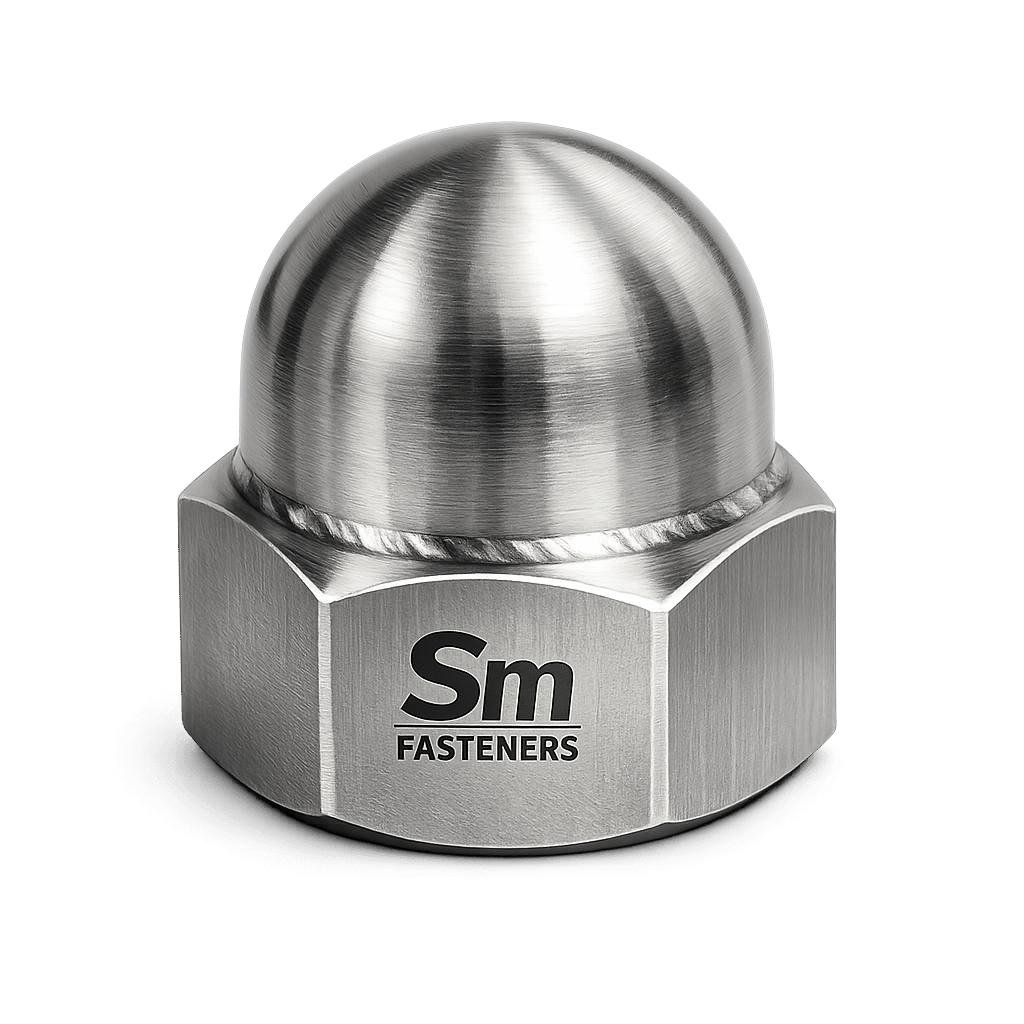
Cap Nuts — commonly known as Protective Cap Nuts, Dome Nuts, Acorn Nuts, or Closed-End Nuts — represent a specialized fastening solution designed to combine mechanical retention with thread protection, sealing enhancement, and personnel safety.
Within industrial assemblies supplied to:
- Oil & Gas EPC Projects
- Structural Steel Fabrication
- Power Generation Systems
- Petrochemical Equipment
- Offshore & Marine Installations
- Heavy Machinery Manufacturing
cap nuts are not decorative components; they function as protective mechanical elements that enhance durability and lifecycle reliability.
Unlike standard hex nuts, a cap nut incorporates a fully enclosed dome which prevents exposure of threaded bolt ends to:
- Atmospheric corrosion
- Mechanical damage
- Contaminant ingress
- Human contact hazards
In high-reliability engineering environments, exposed threads frequently become failure initiation points. Protective cap nuts mitigate these risks.
SM Fasteners manufactures cap nuts under controlled ISO 9001 quality systems with material traceability suitable for global EPC procurement.
2. Technical Definition
A Cap Nut (Protective) is defined as:
A threaded fastening element with a closed or domed end designed to completely cover the protruding male thread while providing standard nut clamping functionality.
Core Functional Characteristics
| Function | Engineering Purpose |
|---|---|
| Thread Protection | Prevents corrosion and galling |
| Safety | Eliminates exposed sharp threads |
| Environmental Shielding | Reduces moisture/chemical ingress |
| Aesthetic Finish | Required in visible assemblies |
| Assembly Reliability | Maintains thread integrity during service |
Geometry Overview
Key geometric features:
- Hexagonal driving face
- Internal threaded bore
- Closed dome cavity
- Bearing face
- Optional sealing interface
Two main dome styles:
- Low Crown Cap Nut
- High Dome Cap Nut
The dome height determines allowable bolt projection.
3. Functional Role in Mechanical Assemblies
Cap nuts perform dual engineering roles:
3.1 Primary Function — Load Bearing Fastener
The nut creates clamping force identical to a standard hex nut.
Load transfer occurs through:
- Thread flank contact
- Bearing face compression
- Bolt tension generation
3.2 Secondary Function — Protective Barrier
The enclosed cavity:
- Prevents electrolyte formation
- Avoids thread oxidation
- Reduces hydrogen ingress risk
- Protects coatings on bolt threads
This is critical in:
- Offshore platforms
- Chemical plants
- Food processing equipment
- Public infrastructure assemblies
4. Load Mechanics & Force Behavior
4.1 Preload Generation
When torque is applied:
Where:
- = Bolt preload force (N)
- = Applied torque (Nm)
- = Nut factor (friction coefficient)
- = Nominal diameter (m)
Approximately 85–90% of torque is consumed overcoming friction.
Only 10–15% produces useful preload.
4.2 Force Distribution in Cap Nuts
Compared with open nuts:
| Parameter | Standard Hex Nut | Cap Nut |
|---|---|---|
| Load Path | Open | Closed dome constraint |
| Bolt Projection | Allowed | Limited |
| Thread Exposure | Yes | None |
| Corrosion Initiation | Higher | Reduced |
The dome does not carry structural load — it functions purely as protection.
4.3 Stress Behavior
Major stresses include:
- Axial tensile stress
- Thread shear stress
- Bearing compression stress
- Residual stress from tightening
Failure occurs if bolt projection contacts dome top prematurely.
Engineering Rule:
Bolt engagement depth must be less than dome internal height.
5. Joint Design Principles
5.1 Thread Engagement Requirement
Minimum engagement:
For softer materials:
5.2 Dome Clearance Requirement
Required internal clearance:
| Bolt Size | Minimum Clearance |
|---|---|
| M6–M10 | 1.5–2 mm |
| M12–M20 | 2–4 mm |
| M24+ | 4–6 mm |
Incorrect clearance leads to:
- False torque readings
- Under-preloaded joints
- Fatigue loosening
5.3 Torque–Tension Relationship
Critical variables:
- Surface coating
- Lubrication
- Thread tolerance
- Material hardness pairing
Cap nuts often exhibit slightly higher friction factors due to enclosed air compression and increased thread contact area.
6. Clamping Force Mechanics
Typical preload distribution:
| Torque Energy Use | Percentage |
|---|---|
| Thread friction | 40–50% |
| Bearing friction | 35–45% |
| Useful preload | 10–15% |
Proper lubrication dramatically improves preload accuracy.
7. Failure Mechanisms
7.1 Fatigue Failure
Caused by insufficient preload.
Common in
7.2 Thread Stripping
Occurs when:
Typically seen in low-strength stainless assemblies.
7.3 Hydrogen Embrittlement
Risk conditions:
- High strength carbon/alloy steels
- Electroplated coatings
- Offshore hydrogen exposure
SM Fasteners controls hardness limits to prevent embrittlement.
7.4 Stress Corrosion Cracking (SCC)
Observed in:
- Chloride environments
- High temperature chemical plants
Materials like Duplex SS and SMO 254 are selected accordingly.
8. Engineering Selection Criteria
Cap nut selection depends on:
| Parameter | Consideration |
|---|---|
| Mechanical load | Property class requirement |
| Environment | Corrosion resistance |
| Bolt projection | Dome depth |
| Inspection requirement | Closed-end suitability |
| Temperature | Material stability |
9. Application Relevance in Assemblies
Cap nuts are preferred where:
- Personnel safety regulations exist
- Hygienic surfaces required
- Visual inspection important
- Thread contamination unacceptable
Typical assemblies:
- Handrails
- Rotating equipment guards
- Valve stems
- Food processing conveyors
- Marine deck fittings
10. SM FASTENERS Engineering Positioning
Under ISO 9001 and UKAF accreditation, SM Fasteners integrates:
- Controlled forging processes
- Advanced alloy material capability
- Custom dome depth engineering
- Precision thread manufacturing
- Export-grade inspection traceability
Manufacturing scope includes:
- Stainless steels
- Duplex & Super Duplex
- Nickel alloys
- PEEK protective cap nuts for non-metallic assemblies
11. Product Types and Variants of Cap Nuts (Protective)
Cap nuts are engineered in multiple configurations to satisfy mechanical loading conditions, environmental exposure requirements, and assembly constraints encountered in EPC and OEM applications.
SM Fasteners manufactures cap nuts according to international dimensional systems while supporting custom engineered variants.
11.1 Standard Dome (Acorn) Cap Nut
Description:
Fully closed hemispherical dome covering the entire bolt projection.
Engineering Characteristics
- Standard hex driving face
- Full thread engagement
- Maximum corrosion protection
- Improved personnel safety
Typical Applications
- Structural handrails
- Machinery guards
- Architectural steel
- Public infrastructure
11.2 High Crown Cap Nut
Designed with increased internal cavity depth.
Advantages
- Accommodates longer bolt projection
- Enables tolerance compensation
- Suitable for heavy structural assemblies
Used In
- Heavy equipment frames
- Power plant structures
- Offshore installations
11.3 Low Crown Cap Nut
Reduced dome height.
Engineering Purpose
- Compact installations
- Limited clearance zones
- Weight-sensitive assemblies
Common in automotive and equipment enclosures.
11.4 Stainless Hygienic Cap Nut
Special surface profile minimizing contamination retention.
Typical sectors:
- Food processing
- Pharmaceutical plants
- Cleanroom equipment
Often supplied in A2 / A4 stainless steel with polished finish.
11.5 Sealing Cap Nut (Protective Variant)
Incorporates:
- Nylon insert
- O-ring seal
- PTFE sealing washer
Provides:
- Splash protection
- Moisture ingress resistance
- Vibration resistance
Used in marine and outdoor electrical assemblies.
11.6 heavy hex nut /Cap Nut
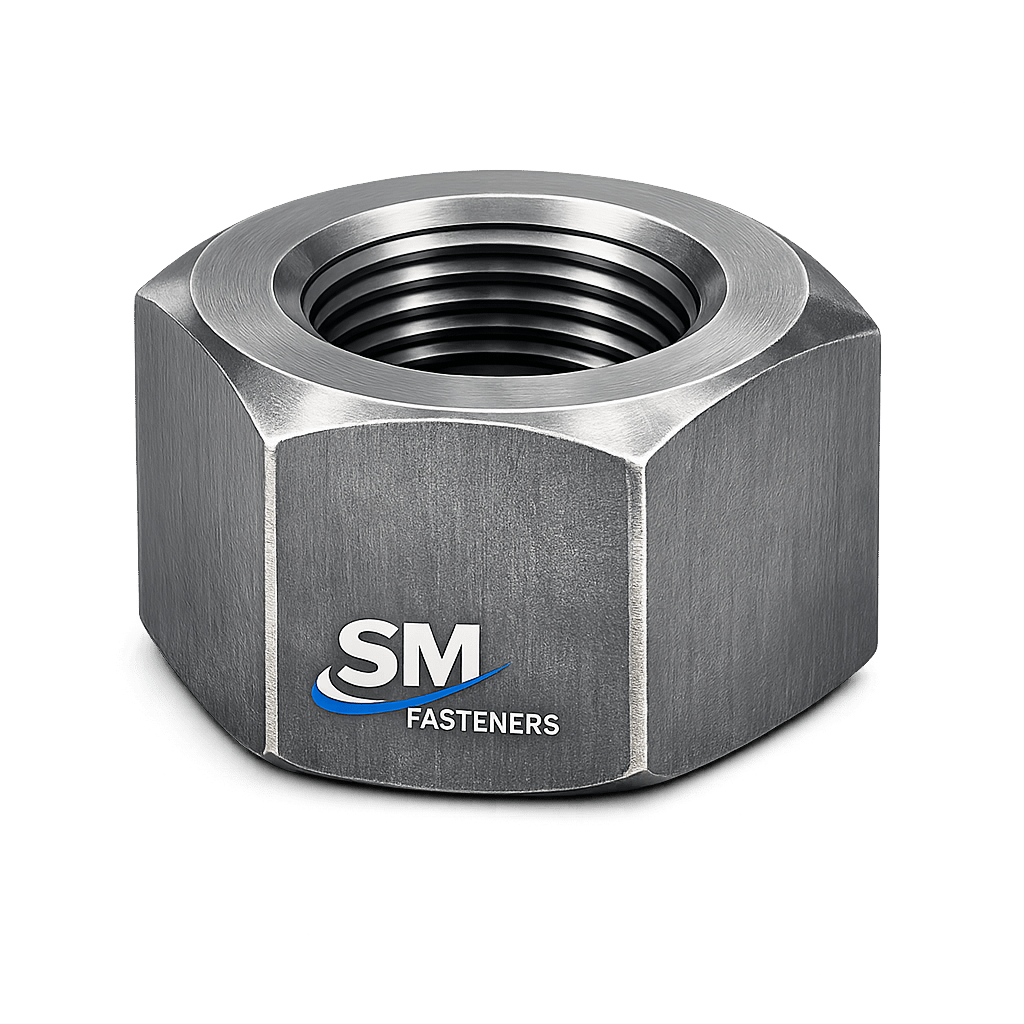
Oversized hex profile for high preload applications.
Benefits:
- Larger bearing surface
- Improved load distribution
- Higher torque capacity
Used in:
- Petrochemical flanges
- Pressure equipment
- Structural bolting systems
11.7 PEEK Cap Nut (Non-Metallic Protective Fastener)
Manufactured using high-performance polymer:
PEEK (Polyether Ether Ketone)
Key engineering benefits:
- Electrically insulating
- Non-magnetic
- Chemical resistant
- Lightweight
- Radiation resistant
Applications:
- Semiconductor equipment
- Chemical processing units
- Medical assemblies
- Electrical insulation zones
SM Fasteners supports precision machining of PEEK cap nuts for specialized OEM programs.
12. Dimensional Logic and Geometry
Cap nut design is governed by geometric relationships ensuring proper load transfer while maintaining dome clearance.
12.1 Critical Dimensions
| Symbol | Parameter | Engineering Function |
|---|---|---|
| d | Thread diameter | Load capacity |
| P | Thread pitch | Engagement strength |
| m | Nut height | Thread engagement |
| s | Width across flats | Torque transmission |
| e | Width across corners | Tool clearance |
| h | Dome height | Thread protection |
| dc | Bearing diameter | Load distribution |
12.2 Standard Metric Dimensional Table (DIN 1587 / ISO Equivalent)
| Size | Pitch (mm) | Width Across Flats (mm) | Nut Height m (mm) | Dome Height h (mm) | Bearing Dia (mm) |
|---|---|---|---|---|---|
| M6 | 1.0 | 10 | 6 | 10 | 11.8 |
| M8 | 1.25 | 13 | 8 | 13 | 15.8 |
| M10 | 1.5 | 17 | 10 | 16 | 19.6 |
| M12 | 1.75 | 19 | 12 | 18 | 21.9 |
| M16 | 2.0 | 24 | 16 | 24 | 27.7 |
| M20 | 2.5 | 30 | 20 | 30 | 34.6 |
| M24 | 3.0 | 36 | 24 | 36 | 41.6 |
(Dimensions aligned with global procurement tolerances and SM Fasteners production capability.)
12.3 Thread Engagement vs Dome Depth Logic
Engineering requirement:
If violated:
- False torque readings occur
- Preload reduces drastically
- Joint loosening risk increases
Recommended safety margin:
13. Thread Systems and Global Compatibility
Cap nuts must interface with global bolt standards used across EPC supply chains.
13.1 Supported Thread Forms
| Thread System | Standard | Region |
|---|---|---|
| Metric Coarse | ISO 261 / ISO 965 | Global |
| Metric Fine | ISO 261 | Precision assemblies |
| UNC | ASME B1.1 | USA |
| UNF | ASME B1.1 | Aerospace / machinery |
| BSW | BS 84 | Legacy UK systems |
| BSF | BS 84 | Fine British threads |
13.2 Thread Tolerance Classes
| System | External | Internal |
|---|---|---|
| Metric | 6g | 6H |
| UNC/UNF | 2A | 2B |
| Precision Fit | 4H | 4g |
SM Fasteners maintains calibrated thread gauges traceable to ISO standards.
14. Applicable International Standards
Cap nuts are governed by dimensional and mechanical standards depending on region and application.
14.1 Primary Dimensional Standards
| Standard | Description |
|---|---|
| DIN 1587 | Hexagon dome cap nuts |
| ISO 1587 | International equivalent |
| BS 3692 | British metric fasteners |
| ASME B18.2.2 | Inch hex nuts (reference compatibility) |
14.2 Mechanical Property Standards
| Standard | Scope |
|---|---|
| ISO 898-2 | Carbon steel nut mechanical properties |
| ASTM A563 | Carbon steel structural nuts |
| ASTM A194 | Alloy & stainless steel pressure service |
| ASTM F594 | Stainless steel nuts |
| ASTM F836 | Washer interface compatibility |
14.3 Property Classes (ISO System)
| Property Class | Proof Load (MPa) | Typical Application |
|---|---|---|
| 5 | Medium duty | |
| 8 | Structural | |
| 10 | High strength | |
| 12 | Heavy engineering |
15. Proof Load & Tensile Strength Table
| Size | Property Class | Proof Load (kN) | Min Tensile Strength (MPa) |
|---|---|---|---|
| M8 | Class 8 | 18 | 800 |
| M10 | Class 8 | 29 | 800 |
| M12 | Class 10 | 46 | 1000 |
| M16 | Class 10 | 93 | 1000 |
| M20 | Class 10 | 145 | 1000 |
| M24 | Class 10 | 210 | 1000 |
Values aligned with ISO 898-2 calculations.
16. Dimensional Tolerances
Manufacturing tolerances ensure interchangeability across global suppliers.
| Feature | Typical Tolerance |
|---|---|
| Width across flats | ISO 4759 |
| Height | ±0.3 mm |
| Thread pitch | ISO 965 |
| Concentricity | ≤0.1 mm |
17. Geometry Influence on Mechanical Performance
Bearing Face Diameter
Controls:
- Surface pressure
- Joint relaxation
- Embedment loss
Dome Thickness
Controls:
- Impact resistance
- Environmental durability
Thread Length
Controls:
- Load distribution
- Fatigue life
18. Interchangeability Considerations for EPC Procurement
EPC buyers require global compatibility.
SM Fasteners designs cap nuts to ensure:
- ISO ↔ DIN interchangeability
- ASTM bolt compatibility
- Cross-regional thread acceptance
- Documentation alignment with project specifications
19. Engineering Selection Guide (Geometry Based)
| Condition | Recommended Type |
|---|---|
| Outdoor corrosion exposure | High crown stainless cap nut |
| Heavy preload | Heavy hex cap nut |
| Hygiene requirement | Polished SS cap nut |
| Electrical insulation | PEEK cap nut |
| Limited space | Low crown cap nut |
20. SM FASTENERS Manufacturing Integration
Under ISO 9001 quality management:
- CNC controlled dome forming
- Forged grain flow optimization
- Precision thread rolling
- Gauge-controlled dimensional inspection
- Custom dome depth manufacturing
Capabilities include:
- Standard production
- EPC custom drawings
- Non-standard thread forms
- Advanced alloy supply
21. Material Engineering for Protective Cap Nuts
Material selection is the most critical engineering decision affecting:
- Mechanical performance
- Corrosion resistance
- Temperature capability
- Fatigue life
- Compliance with project specifications
Protective cap nuts operate in environments ranging from indoor machinery to offshore sour service conditions. The closed dome geometry makes material integrity even more important because trapped moisture or chemicals may accelerate localized corrosion if incorrect materials are selected.
SM Fasteners manufactures cap nuts using certified raw materials with Mill Test Certificates (MTC) traceable to international standards.
21.1 Industrial Material Categories
| Material Family | Standards | Typical Grades |
|---|---|---|
| Carbon Steel | ISO 898-2 / ASTM A563 | Class 5, 8, 10 |
| Alloy Steel | ASTM A194 | 2H, 7, L7 |
| Stainless Steel | ASTM F594 | A2-70, A4-80 |
| Duplex Stainless | ASTM A479 | UNS S31803 |
| Super Duplex | ASTM A182 | UNS S32750 |
| Nickel Alloys | ASTM B564 | Inconel, Monel |
| High Corrosion Alloy | ASTM B462 | Hastelloy |
| Super Austenitic | ASTM A182 | SMO 254 |
| Engineering Polymer | ASTM D6262 | PEEK |
22. Mechanical Properties — Grade Wise
| Material / Grade | Yield Strength (MPa) | UTS (MPa) | Hardness | Temp Limit °C |
|---|---|---|---|---|
| CS Class 8 | 640 | 800 | 22–32 HRC | 300 |
| CS Class 10 | 900 | 1000 | 32–36 HRC | 350 |
| Alloy Steel 2H | 850 | 1040 | 24–35 HRC | 425 |
| SS A2-70 | 450 | 700 | HRB 95 | 425 |
| SS A4-80 | 600 | 800 | HRB 100 | 450 |
| Duplex S31803 | 550 | 800 | 28 HRC max | 300 |
| Super Duplex S32750 | 650 | 950 | 32 HRC max | 300 |
| Inconel 625 | 460 | 830 | 220 HB | 980 |
| Monel 400 | 240 | 550 | 150 HB | 480 |
| SMO 254 | 300 | 650 | 96 HRB | 400 |
| PEEK | — | — | — | 260 |
23. Material Selection Criteria
Load-Based Selection
| Load Condition | Recommended Material |
|---|---|
| General structural | Carbon steel Class 8 |
| High preload | Alloy steel Class 10 |
| Corrosion exposure | Stainless A4 |
| Offshore seawater | Duplex / Super Duplex |
| Chemical plant | Hastelloy / SMO 254 |
| High temperature | Inconel |
| Electrical isolation | PEEK |
Environmental Selection Matrix
| Environment | Recommended Material |
|---|---|
| Atmospheric exposure | Zinc plated carbon steel |
| Marine | A4 Stainless / Duplex |
| H₂S Sour Service | Duplex (NACE compliant) |
| Chloride chemical plant | SMO 254 |
| Acid service | Hastelloy |
| Cryogenic LNG | Austenitic stainless |
| Electrical equipment | PEEK cap nuts |
SM Fasteners supports NACE MR0175 / ISO 15156 compliant material supply.
24. Corrosion Resistance vs Environment
| Environment | Carbon Steel | SS 304 | SS 316 | Duplex | SMO 254 | Nickel Alloy |
|---|---|---|---|---|---|---|
| Outdoor humidity | Medium | Good | Excellent | Excellent | Excellent | Excellent |
| Seawater | Poor | Moderate | Good | Excellent | Superior | Superior |
| Chlorides | Poor | Moderate | Good | Excellent | Superior | Excellent |
| Acids | Poor | Moderate | Good | Very Good | Excellent | Outstanding |
| H₂S | Poor | Moderate | Good | Excellent | Excellent | Excellent |
| High temperature | Moderate | Good | Good | Good | Good | Outstanding |
25. Heat Treatment Processes
Heat treatment ensures mechanical reliability and compliance with ISO property classes.
25.1 Carbon & Alloy Steel Cap Nuts
Process Flow
- Austenitizing
- Quenching (oil/polymer)
- Tempering
- Stress relief
Engineering Effects
- Increased tensile strength
- Improved fatigue resistance
- Controlled hardness
25.2 Hardness Control (Critical for Cap Nuts)
Because cap nuts are closed-end components:
Excess hardness → crack risk at dome apex.
| Service Condition | Maximum Hardness |
|---|---|
| Standard service | 36 HRC |
| Galvanized fasteners | 34 HRC |
| Sour service | 22 HRC max |
25.3 Stainless Steel Heat Treatment
- Solution annealing
- Rapid cooling
- Carbide dissolution
- Corrosion resistance restoration
25.4 Duplex & Super Duplex Treatment
Controlled thermal cycle maintains:
- 50/50 ferrite–austenite structure
- Pitting resistance
- SCC resistance
25.5 Nickel Alloy Processing
Nickel alloys are supplied:
- Solution annealed
- Age hardened (where applicable)
Used for extreme temperature and aggressive chemical environments.
26. End-to-End Manufacturing Workflow
SM Fasteners operates integrated manufacturing aligned with ISO 9001 quality management systems.
26.1 Raw Material Verification
Incoming inspection includes:
- Heat number traceability
- Chemical composition verification
- Mechanical certification review
- PMI testing (when required)
Documentation: EN 10204 3.1 MTC
26.2 Forging Process
Preferred manufacturing method.
Advantages:
- Continuous grain flow
- Higher fatigue strength
- Improved dome impact resistance
Process:
- Bar cutting
- Cold/Hot forging
- Dome forming
- Flash trimming
26.3 Machining Operations
Used for:
- Nickel alloys
- Low volume custom orders
- PEEK fasteners
Includes CNC turning and precision boring.
26.4 Thread Manufacturing
Thread Rolling (Preferred)
Benefits:
- Work hardening
- Improved fatigue resistance
- Smooth surface finish
Thread Cutting
Used for:
- Large diameters
- Exotic alloys
- Custom threads
26.5 Dome Integrity Control
Critical inspection checks:
- Dome thickness uniformity
- Internal cavity depth
- Concentricity with thread axis
Prevents dome cracking under torque.
26.6 Cleaning & Preparation
Processes include:
- Degreasing
- Shot blasting
- Ultrasonic cleaning
- Passivation (stainless)
27. Surface Finishing & Coating Engineering
Surface engineering determines corrosion performance and friction behavior.
27.3 Lubrication & Nut Factor Influence
Typical nut factors:
| Condition | Nut Factor (K) |
|---|---|
| Dry | 0.20–0.25 |
| Zinc plated | 0.18 |
| Lubricated | 0.15 |
| PTFE coated | 0.10–0.13 |
Directly impacts preload accuracy.
28. Hydrogen Embrittlement Control
Preventive measures used by SM Fasteners:
- Controlled plating processes
- Post-bake de-embrittlement
- Hardness monitoring
- Coating selection engineering
Critical for property class ≥10 components.
29. Failure Prevention Through Material Engineering
| Failure Mode | Prevention Method |
|---|---|
| Fatigue | Forged grain flow |
| SCC | Duplex/Nickel alloys |
| Galling | Surface coatings |
| Corrosion | Material upgrade |
| Embrittlement | Hardness control |
30. SM FASTENERS MATERIAL CAPABILITY POSITIONING
SM Fasteners supports global procurement requirements through:
- Certified ISO 9001 manufacturing system
- UKAF accredited quality framework
- MSME registered industrial manufacturing
- Advanced alloy machining capability
- PEEK engineering fastener production
- Full traceability from raw material to dispatch
Custom solutions include:
- Extended dome depth
- Special thread tolerances
- EPC drawing compliance
- High-performance coatings
31. Inspection & Quality Control Philosophy
Protective cap nuts used in EPC, oil & gas, infrastructure, and heavy engineering projects are classified as safety-relevant fastening components.
Because the dome conceals thread ends, inspection control becomes more critical than standard hex nuts.
SM Fasteners integrates inspection through an ISO 9001 certified Quality Management System audited under UKAF accreditation, ensuring manufacturing traceability and compliance verification suitable for global project audits.
31.1 Inspection Stages
| Stage | Inspection Activity |
|---|---|
| Incoming | Raw material verification |
| In-Process | Forging & dimensional checks |
| Threading | Gauge validation |
| Heat Treatment | Hardness & structure verification |
| Surface Finish | Coating thickness testing |
| Final Inspection | Mechanical & visual inspection |
| Dispatch | Documentation verification |
32. Dimensional Inspection Requirements
Critical measurements for cap nuts:
- Thread pitch accuracy
- Dome internal clearance
- Concentricity
- Bearing face flatness
- Across-flats dimension
Gauging Tools Used
- GO / NO-GO thread gauges
- Digital height gauges
- Optical comparators
- Coordinate Measuring Machines (CMM)
- Profile projectors
33. Mechanical Testing
Performed in accordance with ISO and ASTM requirements.
| Test | Standard | Purpose |
|---|---|---|
| Proof Load Test | ISO 898-2 | Load capacity validation |
| Hardness Test | ISO 6508 | Heat treatment verification |
| Tensile Test | ASTM F606 | Strength confirmation |
| Wedge Load Test | ASTM F606 | Thread integrity |
| Torque Test | Internal procedure | Preload validation |
34. Non-Destructive Testing (NDT)
Used particularly for alloy steel and critical applications.
| Method | Application |
|---|---|
| Magnetic Particle (MPI) | Crack detection |
| Dye Penetrant (DPT) | Surface flaws |
| Ultrasonic Testing | Internal defects |
| PMI (Positive Material Identification) | Alloy verification |
35. Chemical & Metallurgical Verification
SM Fasteners performs:
- Spectrometer chemical analysis
- Grain flow verification (forged nuts)
- Microstructure analysis
- Ferrite testing for duplex steels
36. Certification & Documentation
Global EPC supply requires comprehensive documentation packages.
Standard Documentation
| Document | Description |
|---|---|
| EN 10204 3.1 MTC | Material certification |
| Heat Treatment Report | Mechanical compliance |
| Dimensional Inspection Report | Geometry verification |
| Coating Certificate | Surface treatment validation |
| Certificate of Conformance | Order compliance |
| Packing List | Traceability control |
Optional:
- EN 10204 3.2 certification
- Third-party inspection (TPI)
- Client witness inspection
37. Traceability System
Each SM Fasteners batch includes:
- Heat number marking
- Production lot identification
- Inspection record linkage
- Packing traceability
Ensures full lifecycle accountability.
38. Industrial Applications of Protective Cap Nuts
38.1 Construction & Structural Steel
Functions:
- Protection of exposed anchor bolts
- Personnel safety at walkways
- Corrosion prevention
Used in:
- Bridges
- Stadiums
- Industrial buildings
- Handrail assemblies
38.2 Oil & Gas Industry
Upstream
- Wellhead equipment
- Drilling structures
- Access platforms
Midstream
- Pipeline supports
- Valve assemblies
Downstream
- Refinery equipment
- Process structures
Duplex, Super Duplex, and Nickel Alloy cap nuts commonly specified.
38.3 Power Generation
Applications include:
- Turbine enclosures
- Generator frames
- Switchyard equipment
- Solar mounting systems
38.4 Petrochemical & Chemical Processing
Closed dome prevents chemical deposition on threads.
Typical environments:
- Acid vapors
- Chloride exposure
- Chemical washdown areas
Materials: SMO 254, Hastelloy, A4 Stainless.
38.5 LNG & Offshore Platforms
Critical advantages:
- Salt spray protection
- Reduced maintenance cycles
- Improved inspection reliability
Coatings commonly used:
- PTFE
- Xylan
- Hot dip galvanizing
38.6 Automotive & Heavy Equipment
Used where safety and aesthetics combine:
- Wheel covers
- Exterior assemblies
- Machinery guards
38.7 Railways & Infrastructure
Applications:
- Passenger safety zones
- Platform railings
- Signal structures
38.8 Shipbuilding & Marine Engineering
Cap nuts prevent marine corrosion initiation at exposed threads.
Materials:
- A4 Stainless
- Duplex
- Nickel alloys
38.9 PEEK Cap Nut Applications
SM Fasteners supplies PEEK protective cap nuts for:
- Electrical insulation
- Semiconductor tooling
- MRI equipment
- Chemical reactors
- Lightweight aerospace assemblies
39. Engineering Tables
39.1 Thread Standards & Tolerances
| Thread Type | Standard | Tolerance |
|---|---|---|
| Metric | ISO 261 / 965 | 6H |
| UNC | ASME B1.1 | 2B |
| UNF | ASME B1.1 | 2B |
| BSW | BS 84 | Medium |
| BSF | BS 84 | Fine |
39.2 Tightening Torque Chart (Typical Values)
(Lubricated condition, Property Class 8)
| Size | Torque (Nm) | Approx Preload (kN) |
|---|---|---|
| M6 | 10 | 5 |
| M8 | 25 | 12 |
| M10 | 49 | 19 |
| M12 | 85 | 28 |
| M16 | 210 | 55 |
| M20 | 410 | 85 |
| M24 | 710 | 120 |
39.3 Preload Calculation — Worked Example
Given
- Bolt: M12
- Torque: 85 Nm
- Nut factor K=0.18
- Diameter D=0.012m
Result:
Approximate preload = 39 kN
39.4 Dimensional Specification Reference
| Size | Pitch | Across Flats | Height | Dome Height |
|---|---|---|---|---|
| M6 | 1.0 | 10 | 6 | 10 |
| M8 | 1.25 | 13 | 8 | 13 |
| M10 | 1.5 | 17 | 10 | 16 |
| M12 | 1.75 | 19 | 12 | 18 |
| M16 | 2.0 | 24 | 16 | 24 |
| M20 | 2.5 | 30 | 20 | 30 |
| M24 | 3.0 | 36 | 24 | 36 |
39.5 Weight Chart (Approximate — SM Fasteners Alignment)
| Size | Weight / Piece (kg) | Weight / 100 pcs (kg) |
|---|---|---|
| M6 | 0.004 | 0.4 |
| M8 | 0.009 | 0.9 |
| M10 | 0.017 | 1.7 |
| M12 | 0.030 | 3.0 |
| M16 | 0.070 | 7.0 |
| M20 | 0.140 | 14.0 |
| M24 | 0.250 | 25.0 |
39.6 Surface Finish Performance Comparison
| Finish | Corrosion Resistance | Friction Stability | Typical Industry |
|---|---|---|---|
| Zinc Plated | Medium | Good | General construction |
| HDG | High | Moderate | Structural steel |
| PTFE | Very High | Excellent | Offshore |
| Dacromet | High | Excellent | Automotive |
| Passivated SS | Excellent | Good | Chemical |
| Electropolished | Maximum | Excellent | Hygienic systems |
39.7 Material Comparison Table
| Material | UTS | Corrosion Resistance | Relative Cost | Typical Use |
|---|---|---|---|---|
| Carbon Steel | High | Low | Low | Structural |
| SS 304 | Medium | Good | Medium | General industry |
| SS 316 | Medium | Excellent | Medium-High | Marine |
| Duplex | High | Excellent | High | Offshore |
| SMO 254 | High | Superior | Very High | Chemical plants |
| Inconel | High | Extreme | Premium | High temperature |
| PEEK | Moderate | Chemical proof | Premium | Electrical |
40. Industrial Packaging & Export Readiness
SM Fasteners supplies export-ready fastening systems.
40.1 Packaging Standards
- VCI anti-corrosion packing
- Thread protection caps
- Heat number labeling
- Moisture barrier bags
40.2 Export Crating
- ISPM-15 compliant wooden crates
- Palletized shipment
- Container optimization
- Shock protection
40.3 Global Supply Documentation
Provided with shipments:
- MTC (EN 10204 3.1 / 3.2)
- Inspection reports
- Heat treatment records
- Coating certificates
- Certificate of Conformance
- Packing & traceability list
41. SM FASTENERS — ENGINEERING & GLOBAL SUPPLY POSITION
Through integrated manufacturing capability, SM Fasteners delivers:
- ISO 9001 certified production
- UKAF accredited quality systems
- MSME registered industrial manufacturing
- Advanced alloy fastener capability
- PEEK engineering solutions
- Custom fastener engineering
- EPC project documentation readiness
Cap Nuts (Protective) manufactured by SM Fasteners are engineered not merely as fastening accessories but as critical reliability components supporting long-life industrial assemblies worldwide.