

Castle Nut
1. Industry Context
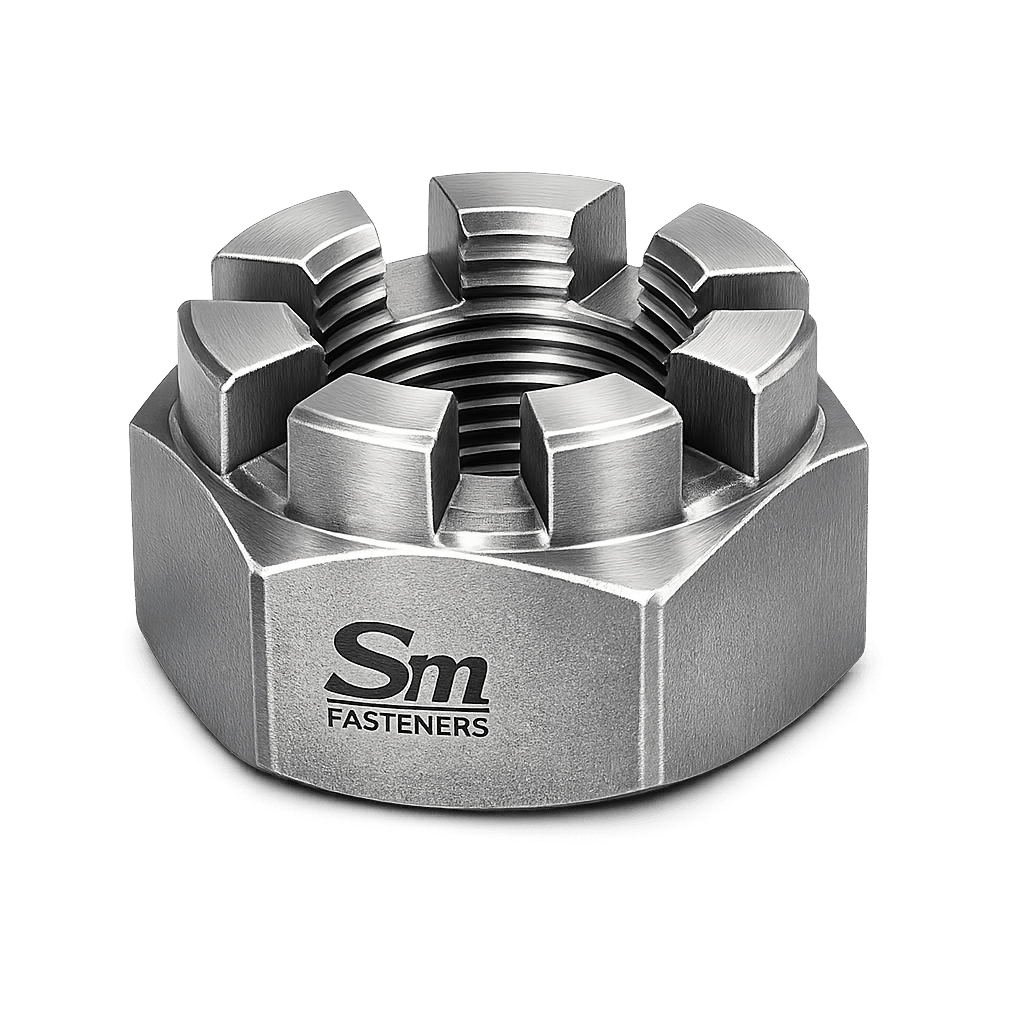
Castle Nuts are critical mechanical locking fasteners used in assemblies where joint integrity under vibration, cyclic loading, and dynamic movement is mandatory. Unlike standard hex nuts that rely solely on preload friction, castle nuts incorporate positive mechanical locking using a cotter pin or split pin.
They are widely specified in:
- Rotating mechanical assemblies
- Safety-critical joints
- Structural hinge mechanisms
- Axle and bearing retention systems
- Offshore and transportation equipment
Industries specifying castle nuts include:
| Industry | Functional Requirement |
|---|---|
| Oil & Gas | Anti-rotation locking under vibration |
| Power Generation | Shaft and coupling retention |
| Automotive & Heavy Equipment | Wheel hubs, steering linkages |
| Railways | Safety-critical articulation joints |
| Shipbuilding | Rudder and propulsion assemblies |
| Construction Equipment | Pivot and suspension joints |
| Aerospace Ground Equipment | High reliability mechanical retention |
Castle nuts remain preferred where:
- Thread-locking adhesives are unsuitable
- High temperatures degrade polymer locking elements
- Maintenance visibility is required
- Disassembly inspection cycles are frequent
SM Fasteners manufactures castle nuts aligned with global EPC project specifications, supporting both standard and engineered custom designs.
2. Technical Definition
A Castle Nut (also called Castellated Nut) is:
A hexagonal nut incorporating equally spaced slots on the top face, allowing insertion of a cotter pin through a drilled bolt or shaft to prevent rotation.
Fundamental Characteristics
- Hex body for torque transmission
- Slotted cylindrical extension
- Mechanical locking via cotter pin
- Reusable locking mechanism
- Suitable for dynamic load applications
Basic Geometry Elements
| Feature | Function |
|---|---|
| Hex Flats | Torque application |
| Castellations | Locking interface |
| Slot Width | Cotter pin clearance |
| Slot Depth | Engagement reliability |
| Bearing Face | Load transfer surface |
3. Functional Role in Mechanical Assemblies
Castle nuts operate under a dual retention philosophy:
- Preload Clamping Force
- Positive Mechanical Lock
Unlike prevailing torque nuts:
- Locking does not depend on friction
- Vibration cannot cause rotation once pinned
- Preload loss does not immediately cause disengagement
This makes them essential in fail-safe engineering systems.
4. Load Mechanics & Force Behavior
4.1 Load Transmission
The primary load path:
Castle nuts behave mechanically as standard nuts until locking is applied.
4.2 Preload Generation
Preload results from tightening torque applied to the nut.
Where:
| Symbol | Meaning |
|---|---|
| Fp | Preload Force |
| T | Applied Torque |
| K | Nut Factor |
| D | Nominal Diameter |
Typical Nut Factor:
| Condition | K Value |
|---|---|
| Dry | 0.20–0.25 |
| Light Oil | 0.16–0.18 |
| MoS₂ Lubricated | 0.12–0.15 |
4.3 Worked Example — Preload
Bolt Size: M20
Torque: 420 Nm
Lubricated K: 0.16
This preload produces required clamping prior to cotter pin locking.
4.4 Force Behavior Under Service
Castle nut joints experience:
| Load Type | Behavior |
|---|---|
| Static Tension | Carried by bolt preload |
| Shear | Shared by bolt shank & joint friction |
| Vibration | Prevented from rotation by cotter pin |
| Impact | Energy absorbed through preload elasticity |
5. Joint Design Principles
5.1 Alignment Requirement
Castle nuts require:
- Bolt with cross-drilled hole
- Alignment of slot with hole after tightening
- Controlled torque + angular positioning
Engineers must avoid:
❌ Backing off nut to align slot
✔ Continue tightening to next slot position
5.2 Slot Indexing Design
Typical indexing increment:
Design tolerance allows minor torque variation.
5.3 Thread Engagement Requirement
Minimum engagement:
Preferred in dynamic applications:
5.4 Preload vs Locking Concept
Important engineering clarification:
Cotter pin does NOT carry load.
It only prevents rotation.
Load remains borne by:
- Bolt tensile stress
- Nut bearing surface
5.5 Friction & Torque–Tension Relationship
Torque distribution:
| Component | % Torque Consumed |
|---|---|
| Thread Friction | 40–50% |
| Bearing Friction | 40–50% |
| Useful Preload | 10–15% |
Therefore:
Surface finish and lubrication strongly influence preload accuracy.
6. Failure Mechanisms in Castle Nut Assemblies
6.1 Fatigue Failure
Occurs due to:
- Insufficient preload
- Micro-movement
- Cyclic stress reversal
Mitigation:
- Correct torque
- High property class bolts
- Controlled lubrication
6.2 Shear Failure
Possible when:
- Joint slips
- Bolt carries transverse load
Design Solution:
- Use fitted bolts
- Increase clamp force
6.3 Hydrogen Embrittlement
Risk zones:
- Electroplated high-strength steel (>1000 MPa)
Controls at SM Fasteners:
- Baking procedures
- Controlled plating chemistry
- ISO-compliant processing
6.4 Stress Corrosion Cracking (SCC)
Common in:
- Chloride environments
- Sour service (H₂S)
Recommended materials:
- Duplex Stainless Steel
- SMO 254
- Nickel alloys
6.5 Cotter Pin Failure
Not structural but operational:
- Incorrect pin size
- Reused pins
- Improper bending
Engineering rule:
Cotter pins must always be replaced during maintenance.
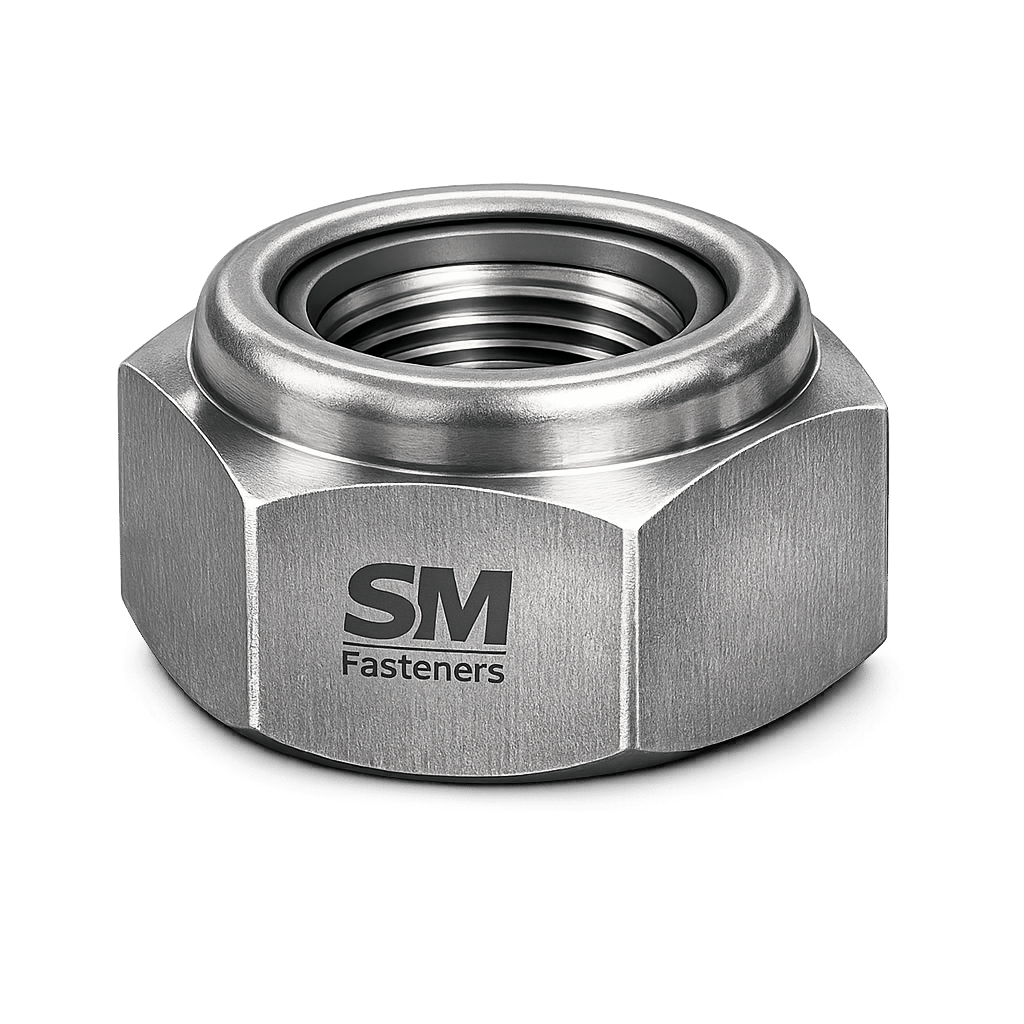
7. Mechanical Advantages Over Other Locking Nuts
| Nut Type | Locking Principle | Reusable | High Temp | Inspection Friendly |
|---|---|---|---|---|
| Nylon Insert | Polymer friction | Limited | No | Medium |
| All metal lock nut | Prevailing torque | Yes | Yes | Low |
| Double Nut | Friction | Yes | Yes | Low |
| castle nut | Positive lock | Yes | Yes | Excellent |
8. Design Integration in Critical Assemblies
Castle nuts are favored when:
- Human safety depends on retention
- Visual inspection is required
- Scheduled maintenance is practiced
- Regulatory standards demand mechanical locking
Common engineered assemblies:
- Wheel hubs
- Valve actuators
- Crane pivots
- Turbine linkages
- Marine steering systems
9. Engineering Selection Criteria
| Parameter | Consideration |
|---|---|
| Load | Static vs dynamic |
| Environment | Corrosive / offshore |
| Temperature | Polymer lock unsuitable |
| Maintenance | Periodic inspection required |
| Safety Class | Fail-safe required |
10. SM Fasteners Engineering Capability
SM Fasteners integrates castle nut production within an ISO 9001 certified manufacturing system, ensuring:
- Traceable raw material procurement
- Precision forging and machining
- Controlled slot geometry
- International standards compliance
- Custom engineering support
Material capability includes:
- Carbon & Alloy Steel
- Stainless Steel
- Duplex & Super Duplex
- Nickel Alloys
- PEEK high-performance polymer fasteners
Supporting global EPC procurement requirements.
11. Product Types and Variants of Castle Nuts
Castle nuts are engineered in multiple configurations to satisfy varying load capacities, thread systems, environmental exposure conditions, and assembly constraints.
While the locking concept remains constant, geometry variations directly influence:
- Load distribution
- Torque capacity
- Thread compatibility
- Assembly accessibility
- Inspection reliability
11.1 Standard Castle Nut (Hex Castellated Nut)
The most widely specified configuration.
Characteristics
- Hexagonal body
- Six castellations
- Flat bearing surface
- Designed for cotter pin locking
Applications
- Wheel hubs
- Steering assemblies
- Mechanical pivots
- General industrial retention
Typical standards:
- DIN 935
- ISO 7035
- BS 1768
- ANSI/ASME B18.2.2 (Castellated)
11.2 Slotted Nut (Low Pattern)
Often confused with castle nuts but geometrically distinct.
| Feature | Castle Nut | Slotted Nut |
|---|---|---|
| Top Extension | Raised | Minimal |
| Slot Depth | Deep | Shallow |
| Torque Capacity | Higher | Moderate |
| Standard | DIN 935 | DIN 937 |
Used where height restrictions exist.
11.3 High-Type Castle Nut
Designed for higher thread engagement and load-bearing.
Advantages:
- Increased stripping resistance
- Improved fatigue resistance
- Better load alignment
Common in:
- Heavy machinery
- Offshore equipment
- Crane assemblies
11.4 Fine Thread Castle Nuts
Used where:
- Precise preload control is required
- Vibration resistance must be enhanced
- Limited adjustment movement is desired
Typical systems:
- UNF
- BSF
- Metric Fine Pitch
11.5 Heavy Hex Castle Nuts
Feature:
- Larger across-flat dimension
- Increased bearing area
- Higher torque capacity
Specified in:
- Oil & Gas flanges
- Structural EPC assemblies
- Pressure equipment supports
11.6 Metric vs Imperial Castle Nuts
Metric Series
- ISO Metric Thread
- Preferred in Europe, Asia, Middle East EPC projects
Example:
- M12 × 1.75
- M24 × 3.0
Imperial Series
Used extensively in:
- Oil & Gas legacy systems
- Power plants
- North American equipment
Thread systems:
- UNC
- UNF
- BSW
- BSF
SM Fasteners supplies both systems ensuring global interchangeability.
12. Dimensional Logic & Geometry Engineering
Castle nut geometry is governed by:
- Load transmission
- Tool engagement
- Locking reliability
- Manufacturing tolerance control
12.1 Key Dimensional Parameters
| Symbol | Description |
|---|---|
| m | Nut Height |
| s | Width Across Flats |
| e | Width Across Corners |
| h₁ | Castellated Height |
| w | Slot Width |
| t | Slot Depth |
| P | Thread Pitch |
Functional Design Principles
1. Slot Alignment
- Must intersect bolt hole centerline.
2. Minimum Wall Thickness
- Prevent slot-induced cracking.
3. Bearing Surface Flatness
- Ensures uniform preload distribution.
12.2 Standard Dimensional Specification Table (Metric)
| Size | Pitch (mm) | Width Across Flats (mm) | Nut Height (mm) | Slot Width (mm) | Approx Weight (kg/100 pcs) |
|—|—|—|—|—|
| M6 | 1.0 | 10 | 7 | 2 | 0.8 |
| M8 | 1.25 | 13 | 9 | 2.5 | 1.5 |
| M10 | 1.5 | 17 | 11 | 3 | 2.8 |
| M12 | 1.75 | 19 | 14 | 3.5 | 4.6 |
| M16 | 2.0 | 24 | 18 | 4 | 9.5 |
| M20 | 2.5 | 30 | 22 | 5 | 17 |
| M24 | 3.0 | 36 | 26 | 6 | 29 |
| M30 | 3.5 | 46 | 32 | 7 | 56 |
| M36 | 4.0 | 55 | 38 | 8 | 95 |
(Weight values aligned with SM Fasteners production references.)
12.3 Imperial Castle Nut Dimensions (Typical)
| Size | Thread | Across Flats (in) | Height (in) | Slot Width (in) |
|---|---|---|---|---|
| 1/4″ | UNC | 7/16 | 5/16 | 0.06 |
| 3/8″ | UNC | 9/16 | 7/16 | 0.08 |
| 1/2″ | UNC | 3/4 | 9/16 | 0.10 |
| 3/4″ | UNC | 1-1/8 | 13/16 | 0.13 |
| 1″ | UNC | 1-1/2 | 1 | 0.16 |
12.4 Dimensional Tolerance Philosophy
Castle nuts follow tolerance classes ensuring:
- Proper wrench fit
- Thread compatibility
- Reliable locking alignment
Typical tolerance systems:
| Parameter | Standard |
|---|---|
| Thread | ISO 965 |
| Hex Flats | ISO 4759 |
| Nut Height | Product Grade A/B |
| Slot Location | Functional tolerance |
13. Applicable International Standards
Castle nuts are governed by multiple global standards to ensure interchangeability across industries and continents.
13.1 ISO Standards
| Standard | Description |
|---|---|
| ISO 7035 | Castellated nuts, style 1 |
| ISO 7036 | Castellated nuts, style 2 |
| ISO 4032 | Hex nut reference geometry |
| ISO 898-2 | Mechanical properties of nuts |
| ISO 965 | Thread tolerances |
| ISO 4759 | Fastener tolerances |
13.2 DIN Standards
| DIN Standard | Description |
|---|---|
| DIN 935 | Castle nuts |
| DIN 937 | Slotted nuts |
| DIN 267 | Technical delivery conditions |
| DIN 13 | Metric threads |
DIN 935 remains one of the most widely referenced standards globally.
13.3 ASTM / ASME Standards
| Standard | Application |
|---|---|
| ASTM A563 | Carbon steel nuts |
| ASTM A194 | Alloy & stainless nuts |
| ASTM F594 | Stainless steel nuts |
| ASME B18.2.2 | Square & hex nuts |
| ASME B1.1 | Unified threads |
13.4 British Standards (BS)
| Standard | Description |
|---|---|
| BS 1768 | Castle nuts |
| BS 3692 | ISO metric fasteners |
| BS 1083 | High-strength applications |
13.5 Property Class Systems
Mechanical performance classification:
Metric Property Classes
| Class | Typical Use |
|---|---|
| 5 | Light mechanical |
| 8 | Structural |
| 10 | Heavy equipment |
| 12 | Critical dynamic loading |
Imperial Grades
| Grade | Equivalent |
|---|---|
| ASTM A563 Grade A | Class 5 |
| ASTM A563 DH | Class 10 |
| ASTM A194 2H | High strength |
| ASTM F594 | Stainless |
13.6 Interchangeability Considerations
Engineering caution:
- ISO and DIN usually interchangeable.
- Imperial threads not interchangeable with metric.
- Fine vs coarse pitch affects preload accuracy.
SM Fasteners supports multi-standard supply for EPC projects requiring mixed legacy systems.
14. Thread Standards & Tolerances Table
| Thread System | Standard | Pitch Type | Tolerance Class |
|---|---|---|---|
| Metric | ISO 68/261 | Coarse/Fine | 6H |
| UNC | ASME B1.1 | Coarse | 2B |
| UNF | ASME B1.1 | Fine | 2B |
| BSW | BS 84 | Coarse | Medium |
| BSF | BS 84 | Fine | Medium |
15. Engineering Geometry Considerations for Designers
15.1 Slot Count Optimization
Typical design:
- 6 slots
- 60° indexing
Benefits:
- Acceptable torque tolerance
- Easy alignment
- Balanced stress distribution
15.2 Slot Depth vs Strength Trade-Off
Increasing slot depth:
✔ Improves locking visibility
❌ Reduces torsional strength
Design balance is essential — SM Fasteners maintains controlled slot geometry to preserve mechanical integrity.
15.3 Bearing Stress Control
Bearing stress:
Where:
- F = preload
- A = bearing area
Heavy hex designs reduce bearing stress in soft materials.
15.4 Thread Engagement & Stripping Resistance
Nut stripping strength depends on:
- Material hardness ratio
- Engagement length
- Thread form accuracy
Recommended rule:
Nut strength ≥ Bolt strength.
16. Weight Reference Chart (SM Fasteners Production Alignment)
| Size | Weight per Piece (kg) | Weight per 100 pcs (kg) |
|---|---|---|
| M8 | 0.015 | 1.5 |
| M10 | 0.028 | 2.8 |
| M12 | 0.046 | 4.6 |
| M16 | 0.095 | 9.5 |
| M20 | 0.170 | 17 |
| M24 | 0.290 | 29 |
| M30 | 0.560 | 56 |
| M36 | 0.950 | 95 |
Supports accurate project logistics and freight estimation.
17. SM Fasteners Design & Custom Engineering Capability
SM Fasteners supports:
- Custom castellated heights
- Special slot indexing
- Non-standard pitches
- Heavy hex EPC designs
- High-temperature alloy execution
- PEEK castellated nuts for electrically isolated assemblies
Manufacturing controlled under:
- ISO 9001 Quality Management
- UKAF certification
- MSME registered industrial production.
18. Material Grades and Engineering Selection Criteria
Material selection for castle nuts directly determines:
- Mechanical strength
- Fatigue life
- Corrosion resistance
- Temperature capability
- Compatibility with mating bolts
- Compliance with international project specifications
Castle nuts frequently operate in dynamic and safety-critical environments, therefore improper material pairing may cause:
- Thread galling
- Stress corrosion cracking
- Hydrogen embrittlement
- Loss of preload
SM Fasteners manufactures castle nuts across the full industrial material spectrum to support EPC, offshore, petrochemical, and infrastructure projects worldwide.
18.1 Major Industrial Material Families
Carbon Steel Castle Nuts
Primary choice for structural and mechanical applications.
Typical Standards:
- ASTM A563
- ISO 898-2
- DIN 267
Common Grades:
- Class 5
- Class 8
- ASTM A563 Grade A
- ASTM A563 DH
Advantages
- High strength-to-cost ratio
- Excellent machinability
- Suitable for zinc or hot-dip galvanizing
Limitations
- Requires corrosion protection.
Alloy Steel Castle Nuts
Used for heavy load and fatigue-critical assemblies.
Typical Grades:
- ASTM A194 2H
- ASTM A563 DH
- Property Class 10 / 12
Applications:
- Pressure equipment
- Heavy rotating machinery
- Power generation shafts
Benefits:
- Higher proof load
- Improved fatigue strength
- Superior creep resistance
Stainless Steel Castle Nuts
Used where corrosion resistance dominates over strength.
Standards:
- ASTM F594
- ASTM A194 Grade 8
- ISO 3506
Grades:
- A2-70 (304)
- A4-80 (316)
- 316L
Advantages:
- Atmospheric corrosion resistance
- Marine suitability
- No coating required
Consideration:
- Lower yield strength compared to alloy steel.
Duplex & Super Duplex Stainless Steel
Required for aggressive chloride environments.
Typical Materials:
- Duplex 2205
- Super Duplex 2507
Benefits:
- High strength + corrosion resistance
- Excellent resistance to pitting and SCC
- Offshore compliant
Nickel Alloy Castle Nuts
For extreme temperature and chemical exposure.
Available at SM Fasteners:
| Alloy | Application |
|---|---|
| Inconel 625 | Offshore, LNG |
| Inconel 718 | High temperature load |
| Monel 400 | Marine exposure |
| Hastelloy C276 | Acid processing |
| Incoloy 825 | Chemical plants |
| SMO 254 | Seawater service |
PEEK Castle Nuts (Advanced Polymer Fasteners)
SM Fasteners also engineers PEEK castellated nuts for specialized applications.
Characteristics:
- Non-metallic
- Electrically insulating
- Lightweight
- Corrosion immune
- Chemical resistant
Applications:
- Semiconductor equipment
- Electrical isolation assemblies
- MRI & medical equipment
- Chemical dosing systems
18.2 Material Comparison Table
| Material | UTS (MPa) | Yield (MPa) | Corrosion Resistance | Temp Limit | Relative Cost | Typical Industry |
|---|---|---|---|---|---|---|
| Carbon Steel | 400–800 | 240–640 | Low | 300°C | Low | Construction |
| Alloy Steel | 800–1200 | 640–1000 | Moderate | 450°C | Medium | Power |
| SS 304 | 700 | 450 | Good | 425°C | Medium | General industrial |
| SS 316 | 800 | 600 | Very Good | 500°C | Medium-High | Marine |
| Duplex 2205 | 850 | 550 | Excellent | 300°C | High | Offshore |
| Super Duplex | 950 | 650 | Exceptional | 300°C | Very High | Oil & Gas |
| Inconel 718 | 1200+ | 1000 | Exceptional | 700°C | Premium | Aerospace/LNG |
| PEEK | 100 | 90 | Immune | 260°C | Premium | Electronics |
18.3 Material Selection Criteria
Engineers evaluate:
| Parameter | Selection Impact |
|---|---|
| Load | Determines strength class |
| Environment | Drives alloy choice |
| Temperature | Limits coating/polymer use |
| Inspection interval | Influences corrosion margin |
| NACE compliance | Material hardness limits |
NACE MR0175 / ISO 15156 Considerations
For sour service (H₂S):
- Controlled hardness required
- Sulfide stress cracking prevention
- Restricted heat treatment windows
SM Fasteners supports NACE-compliant material sourcing and processing.
19. Mechanical Properties — Grade Wise
| Property Class | Proof Load (MPa) | Hardness (HV) | Typical Bolt Match |
|---|---|---|---|
| Class 5 | 500 | 120–200 | 5.8 |
| Class 8 | 800 | 200–300 | 8.8 |
| Class 10 | 1000 | 272–353 | 10.9 |
| Class 12 | 1200 | 353–390 | 12.9 |
Proof Load & Tensile Capacity Table (Metric Example)
| Size | Class 8 Proof Load (kN) | Class 10 Proof Load (kN) | Class 12 Proof Load (kN) |
|---|---|---|---|
| M10 | 34 | 42 | 50 |
| M12 | 49 | 61 | 73 |
| M16 | 91 | 114 | 136 |
| M20 | 142 | 177 | 212 |
| M24 | 204 | 255 | 306 |
| M30 | 355 | 444 | 533 |
20. Heat Treatment Processes
Heat treatment defines the final mechanical performance of castle nuts.
20.1 Heat Treatment Objectives
- Achieve required property class
- Improve fatigue strength
- Control hardness
- Reduce residual stresses
20.2 Typical Heat Treatment Cycle
Carbon & Alloy Steel
- Forging
- Normalizing
- Austenitizing
- Quenching
- Tempering
- Stress relieving
Mechanical Impact
| Process | Effect |
|---|---|
| Quenching | Strength increase |
| Tempering | Toughness restoration |
| Stress Relief | Dimensional stability |
Hardness Control (Critical)
Excess hardness may cause:
- Hydrogen embrittlement
- Crack initiation
SM Fasteners maintains hardness verification aligned with:
- ISO 898-2
- ASTM A563
- NACE MR0175
20.3 Stainless Steel Processing
- Solution annealing
- Rapid quenching
- Passivation
Prevents carbide precipitation and intergranular corrosion.
20.4 Nickel Alloy Processing
- Vacuum heat treatment
- Controlled precipitation hardening
- High temperature stabilization
Required for LNG and petrochemical applications.
21. End-to-End Manufacturing Workflow
SM Fasteners follows an ISO 9001 certified manufacturing flow ensuring traceability and repeatability.
21.1 Raw Material Verification
Incoming inspection includes:
- Mill Test Certificate (EN 10204 3.1)
- Heat number verification
- PMI testing
- Chemical composition analysis
21.2 Forging vs Machining
Hot Forging (Primary Method)
Advantages:
- Grain flow alignment
- Improved fatigue resistance
- Reduced material waste
Used for:
CNC Machining
Used when:
- Exotic alloys
- Low quantity production
- Custom geometry required
21.3 Slot Formation (Castellation Creation)
Performed by:
- Precision milling
- Broaching
- CNC slotting
Critical controls:
- Slot symmetry
- Burr removal
- Stress concentration minimization
21.4 Thread Manufacturing
Thread Rolling (Preferred)
Benefits:
- Work hardening
- Higher fatigue life
- Improved surface finish
Thread Cutting
Used for:
- Hard alloys
- Large diameters
- Special threads
21.5 Process Flow Diagram
22. Surface Finishing & Coating Engineering
Surface engineering directly affects:
- Corrosion resistance
- Torque coefficient
- Service life
22.1 Common Surface Finishes
| Finish | Thickness | Corrosion Resistance | Application |
|---|---|---|---|
| Plain/Oiled | — | Low | Indoor |
| Zinc Plating | 5–12 µm | Moderate | Construction |
| Hot Dip Galvanized | 50–80 µm | High | Structural steel |
| Mechanical Galvanized | 40 µm | High | Large assemblies |
| Black Oxide | 1 µm | Low | Machinery |
| Phosphate | — | Anti-galling | Automotive |
| Dacromet/Geomet | 8–12 µm | Very High | Offshore |
| PTFE/Xylan | Variable | Chemical resistant | Petrochemical |
| Passivation | — | Stainless protection | Marine |
| Electropolishing | — | Enhanced corrosion | Pharma |
22.2 Surface Finish Performance Comparison
| Coating | Corrosion Life | Friction Stability | Hydrogen Risk | Temperature Capability |
|---|---|---|---|---|
| Zinc | Medium | Moderate | Medium | 120°C |
| HDG | High | Variable | Low | 200°C |
| Dacromet | Very High | Stable | Low | 300°C |
| PTFE | Excellent | Excellent | None | 260°C |
| Passivation | Excellent | Stable | None | 500°C |
22.3 Hydrogen Embrittlement Control
Critical for high-strength castle nuts.
SM Fasteners applies:
- Controlled acid pickling
- Baking within 4 hours of plating
- Hardness monitoring
- Process validation under ISO 9001 system
22.4 Surface Preparation Prior to Coating
Steps include:
- Degreasing
- Shot blasting
- Pickling
- Rinsing
- Activation
Ensures coating adhesion and durability.
22.5 Lubrication & Torque Stability
Lubrication directly impacts preload.
Common systems:
- Wax coating
- MoS₂ lubrication
- PTFE dry film
Used for EPC torque-critical applications.
23. Traceability & Marking
Each SM Fasteners castle nut may include:
- Manufacturer identification
- Property class marking
- Heat number traceability
- Standard reference
Ensures audit compliance and lifecycle traceability.
24. Inspection & Quality Control Philosophy
Castle nuts are frequently deployed in safety-critical assemblies where loss of locking integrity may lead to catastrophic mechanical failure. Therefore, inspection extends beyond dimensional conformity to include:
- Mechanical reliability
- Material traceability
- Process validation
- Regulatory compliance
SM Fasteners manufactures castle nuts under an ISO 9001 certified Quality Management System, integrating inspection from raw material procurement through final dispatch.
24.1 Inspection Stages
| Stage | Inspection Activity |
|---|---|
| Incoming | Raw material verification |
| In-Process | Forging & threading inspection |
| Post Heat Treatment | Hardness & structure validation |
| Final Inspection | Dimensional + mechanical |
| Pre-Dispatch | Documentation & packaging audit |
24.2 Dimensional Inspection
Critical parameters verified:
- Width across flats
- Nut height
- Slot depth & spacing
- Thread pitch diameter
- Perpendicularity
- Bearing surface flatness
Inspection tools used:
- Digital vernier & micrometer
- Thread plug gauges (Go/No-Go)
- Optical comparator
- Profile projector
- CMM inspection for custom EPC orders
24.3 Mechanical Testing
Castle nuts must withstand proof loads without thread stripping.
Mandatory Tests
| Test | Standard | Purpose |
|---|---|---|
| Proof Load Test | ISO 898-2 | Load capability |
| Hardness Test | ASTM E18 | Heat treatment validation |
| Tensile Verification | ASTM F606 | Strength confirmation |
| Wedge Load Test | ISO standard | Thread performance |
| Torque Testing | Internal | Preload consistency |
24.4 Non-Destructive Testing (NDT)
Applied particularly to alloy steel and critical service fasteners.
| Method | Application |
|---|---|
| Magnetic Particle Testing (MPI) | Surface crack detection |
| Ultrasonic Testing (UT) | Internal flaws |
| Dye Penetrant (DPT) | Stainless & nickel alloys |
| Eddy Current | Surface discontinuities |
24.5 Positive Material Identification (PMI)
Essential for:
- Duplex stainless steel
- Nickel alloys
- Sour service applications
Verification via handheld spectrometers ensures supplied material matches project specifications.
24.6 Certification & Documentation
SM Fasteners supplies complete inspection documentation:
- EN 10204 3.1 Material Test Certificate
- Optional 3.2 Third-Party Certification
- Heat Treatment Records
- Dimensional Inspection Report
- Coating Thickness Report
- Compliance Certificate (CoC)
25. Failure Prevention & Reliability Assurance
Engineering inspection aims to eliminate common failure modes.
25.1 Typical Failure Causes
| Failure Mode | Root Cause | Prevention |
|---|---|---|
| Thread stripping | Low engagement | Proper nut height |
| Fatigue cracking | Low preload | Correct torque |
| SCC | Wrong alloy | Material upgrade |
| Galling | Stainless friction | Lubrication |
| Slot cracking | Poor machining | Controlled slot geometry |
25.2 Torque–Tension Relationship Control
Preload consistency depends primarily on friction control.
Where:
- Fp = Preload force
- T = Applied torque
- K = Nut factor
- D = Nominal diameter
Tightening Torque Chart (Metric Castle Nuts)
(Typical values — lubricated condition)
| Size | Class 8 (Nm) | Class 10 (Nm) | Class 12 (Nm) |
|---|---|---|---|
| M8 | 25 | 31 | 37 |
| M10 | 49 | 61 | 73 |
| M12 | 86 | 108 | 129 |
| M16 | 210 | 260 | 310 |
| M20 | 410 | 520 | 620 |
| M24 | 710 | 900 | 1080 |
| M30 | 1420 | 1770 | 2120 |
Final tightening must allow slot alignment without reducing torque.
25.3 Preload Calculation — Engineering Example
Given
- Bolt Size: M24
- Torque Applied: 900 Nm
- Nut Factor K: 0.16
This preload establishes clamping force prior to cotter pin locking.
26. Mechanical Properties Table (Grade Wise)
| Property Class | Proof Stress (MPa) | Min Hardness (HB) | Typical Use |
|---|---|---|---|
| 5 | 500 | 120 | Light mechanical |
| 8 | 800 | 200 | Structural |
| 10 | 1000 | 272 | Heavy equipment |
| 12 | 1200 | 353 | Critical dynamic |
27. Corrosion Resistance vs Environment
| Environment | Recommended Material |
|---|---|
| Indoor Dry | Carbon Steel Zinc |
| Industrial Atmosphere | Galvanized Steel |
| Marine Atmosphere | SS316 / Duplex |
| Seawater Immersion | Super Duplex / SMO254 |
| Acid Processing | Hastelloy |
| H₂S Sour Service | NACE Alloy Steel / Duplex |
| LNG Cryogenic | Inconel / Nickel Alloy |
| Electrical Isolation | PEEK Castle Nuts |
28. Surface Finish Performance Comparison
| Coating | Salt Spray Resistance | Torque Stability | Reusability | Typical Industry |
|---|---|---|---|---|
| Zinc Plated | 72–240 hrs | Medium | Good | Construction |
| HDG | 500+ hrs | Variable | Good | Structural |
| Geomet/Dacromet | 1000+ hrs | Excellent | Excellent | Offshore |
| PTFE | Excellent | Very Stable | Excellent | Chemical |
| Passivated SS | Excellent | Stable | Excellent | Marine |
29. Thread Standards & Tolerance Reference
| Thread Type | Standard | Tolerance Class |
|---|---|---|
| ISO Metric | ISO 68/261 | 6H |
| UNC | ASME B1.1 | 2B |
| UNF | ASME B1.1 | 2B |
| BSW | BS 84 | Medium |
| BSF | BS 84 | Medium |
Ensures interchangeability across global equipment fleets.
30. Engineering Weight Chart — SM Fasteners Reference
| Size | Weight/Piece (kg) | Weight/100 pcs (kg) |
|---|---|---|
| M8 | 0.015 | 1.5 |
| M10 | 0.028 | 2.8 |
| M12 | 0.046 | 4.6 |
| M16 | 0.095 | 9.5 |
| M20 | 0.170 | 17 |
| M24 | 0.290 | 29 |
| M30 | 0.560 | 56 |
| M36 | 0.950 | 95 |
Supports EPC freight calculation and warehouse planning.
31. Industry Applications
31.1 Construction & Structural Steel
Used in:
- Crane pivots
- Bridge articulation joints
- Structural hinge systems
Advantages:
- Visible locking verification
- High vibration resistance
31.2 Oil & Gas Industry
Upstream
- Drilling equipment
- Blowout preventers
- Valve linkages
Midstream
- Pipeline actuator systems
- Compressor assemblies
Downstream
- Refinery rotating equipment
- Maintenance-critical joints
Materials often specified:
- ASTM A194
- Duplex
- Nickel alloys
31.3 Power Generation
- Turbine couplings
- Generator shaft retention
- Nuclear auxiliary systems
Castle nuts eliminate loosening risk during thermal cycling.
31.4 LNG & Offshore Platforms
Requirements:
- Extreme corrosion resistance
- Fail-safe retention
- High inspection visibility
Preferred materials:
- Super Duplex
- Inconel
- SMO 254
31.5 Automotive & Heavy Equipment
Common locations:
- Wheel bearings
- Steering assemblies
- Suspension pivots
High reliability during cyclic loading.
31.6 Railways & Infrastructure
- Bogie assemblies
- Track equipment
- Coupling linkages
Mechanical locking satisfies railway safety regulations.
31.7 Shipbuilding & Marine Engineering
- Rudder assemblies
- Propulsion shafts
- Deck machinery
Marine-grade stainless or duplex materials recommended.
31.8 PEEK Fastener Applications
SM Fasteners manufactures engineered PEEK castle nuts for:
- Non-magnetic systems
- Chemical plants
- Semiconductor equipment
- High voltage insulation assemblies
32. Packaging, Preservation & Export Readiness
SM Fasteners supplies castle nuts prepared for international logistics environments.
32.1 Industrial Packaging
- VCI corrosion protection
- Oil coated preservation
- Thread protection caps
- Moisture barrier packaging
- Heat number labeling
32.2 Export Packaging
- ISPM-15 compliant wooden crates
- Vacuum sealing (marine cargo)
- Palletized loads
- Shock-protected heavy crates
Designed for long transit durations.
32.3 Documentation Package
Supplied with each export shipment:
- Material Test Certificates (EN 10204 3.1 / 3.2)
- Inspection Reports
- Heat Treatment Charts
- Coating Certificates
- Packing List
- Certificate of Conformity
- Traceability Records
Supports EPC audit and third-party inspection acceptance.
33. SM FASTENERS — Manufacturing & Global Supply Capability
SM Fasteners operates as a precision fastener manufacturer aligned with international procurement expectations.
Quality Framework
- ISO 9001 Certified Quality System
- UKAF Accredited Processes
- MSME Registered Manufacturing Unit
Engineering Strengths
- Multi-standard production capability
- Custom castle nut engineering
- Advanced alloy manufacturing
- PEEK fastener expertise
- Traceable batch manufacturing
- EPC project supply readiness
Supported Industries
- Oil & Gas
- Power & Energy
- Petrochemical
- Infrastructure
- Offshore & Marine
- Heavy Equipment OEMs
Engineering Conclusion
Castle nuts remain one of the most reliable positive mechanical locking solutions available in industrial fastening systems. Their design provides:
- Controlled preload generation
- Mechanical anti-rotation security
- High vibration reliability
- Inspection transparency
- Long service life
Through controlled materials engineering, precision manufacturing, certified inspection systems, and export-ready logistics, SM Fasteners delivers castle nuts engineered for strength, reliability, and global industrial compliance.