

Slotted Nut
1. Industrial Context of Slotted Nuts
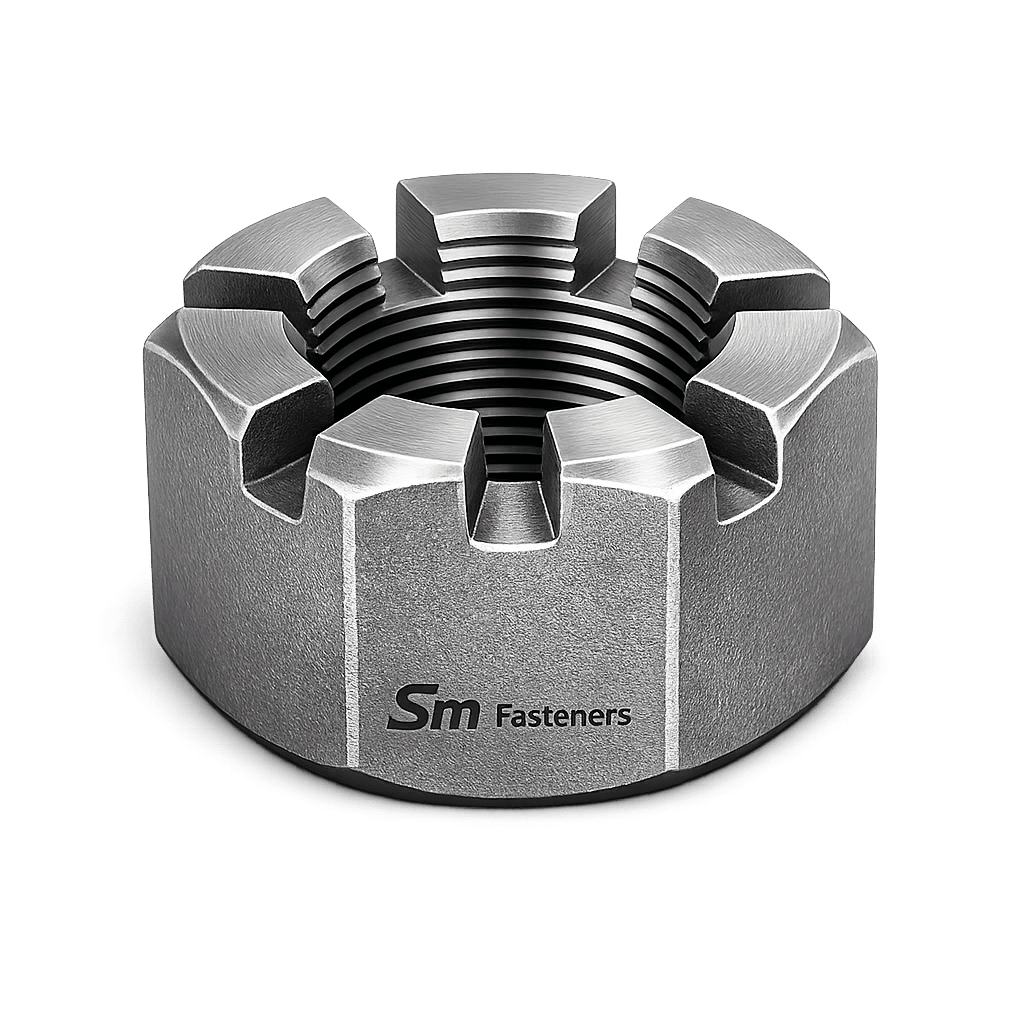
Slotted nuts are safety-locking mechanical fasteners designed for applications where vibration resistance, positional locking, and mechanical redundancy are mandatory. Unlike standard hex nuts that rely solely on preload friction, slotted nuts integrate a positive mechanical locking system using cotter pins, split pins, or safety wires.
They are extensively specified across sectors where loss of preload could lead to catastrophic equipment failure, including:
- Structural steel assemblies
- Rotating machinery
- Automotive steering and suspension systems
- Rail axle assemblies
- Offshore equipment
- Turbine systems
- Pressure-containing equipment
Modern EPC specifications frequently mandate slotted nuts wherever:
- Dynamic loading exists
- Maintenance intervals are long
- Secondary locking is required by safety codes
- Human safety risk is high
SM Fasteners manufactures slotted nuts aligned with global industrial requirements, supporting projects requiring certified quality systems and material traceability.
2. Technical Definition
A Slotted Nut is a hexagonal or cylindrical nut incorporating axial slots (castellations) machined into one end. These slots align with a cross-hole drilled through the mating bolt or stud.
After tightening:
- Nut is torqued to specified preload.
- Slot alignment is achieved.
- Cotter pin or locking element is inserted.
- Mechanical rotation becomes impossible.
Functional Principle
The locking system converts the joint from:
Friction-Based Retention → Mechanical Restraint System
3. Functional Role in Mechanical Assemblies
Primary engineering functions:
| Function | Engineering Purpose |
|---|---|
| Clamp Load Generation | Maintain structural integrity |
| Anti-Loosening | Prevent rotation under vibration |
| Safety Redundancy | Secondary locking independent of friction |
| Position Retention | Maintain axial component alignment |
| Inspection Visibility | Visual confirmation of secure assembly |
Slotted nuts are preferred over chemical locking systems in high-temperature or maintenance-critical installations.
4. Load Mechanics & Force Behavior
4.1 Preload Generation
When torque is applied:
Where:
- = Preload force (N)
- = Applied torque (Nm)
- = Nut factor (friction coefficient)
- = Nominal diameter (m)
Only 10–15% of applied torque becomes useful preload.
Energy distribution:
| Energy Component | Typical Share |
|---|---|
| Thread friction | 40–50% |
| Bearing surface friction | 35–45% |
| Useful bolt tension | 10–15% |
4.2 Load Transfer Mechanism
A slotted nut joint resists loads through:
- Thread shear resistance
- Bolt tensile strength
- Frictional clamping
- Mechanical pin restraint
Under vibration, the cotter pin prevents rotational loosening even if preload decreases.
4.3 Joint Force Behavior
Load paths include:
- Axial tension
- Transverse shear
- Bending loads
- Dynamic fatigue loading
Slotted nuts are typically paired with:
- High-strength bolts
- Stud bolts
- Axle shafts
- Clevis pins
5. Joint Design Principles
5.1 Thread Engagement Requirement
Minimum engagement:
| Material | Engagement Length |
|---|---|
| Steel to Steel | 1 × diameter |
| Stainless Steel | 1.25 × diameter |
| Aluminum mating | 2 × diameter |
5.2 Alignment Requirement
Unlike standard nuts, final torque position must allow:
- Slot alignment with drilled hole
- No torque reduction to achieve alignment
Engineering practice:
✔ Tighten further to next slot
✘ Never loosen to align
5.3 Preload vs Locking Relationship
Important principle:
The cotter pin is NOT load carrying.
It prevents rotation only.
The clamp load must always satisfy design preload requirements.
5.4 Torque–Tension Relationship
Nut factor values:
| Condition | K Factor |
|---|---|
| Dry steel | 0.20 |
| Zinc plated | 0.18 |
| Lubricated | 0.15 |
| PTFE coated | 0.12 |
6. Failure Mechanisms in Slotted Nut Assemblies
6.1 Fatigue Failure
Occurs due to:
- preload loss
- fluctuating stress
- insufficient tightening
6.2 Thread Shear
Caused by:
- inadequate engagement
- soft nut material
- overload conditions
6.3 Hydrogen Embrittlement
Risk for:
- electroplated high-strength steels (>1000 MPa)
SM Fasteners applies controlled baking procedures after plating.
6.4 Stress Corrosion Cracking
Common in:
- chloride environments
- H₂S service
- marine exposure
Mitigation:
- Duplex stainless steels
- Nickel alloys
- NACE compliant materials
6.5 Cotter Pin Failure Modes
Improper installation may cause:
- shear fracture
- pin fatigue
- fretting wear
Correct material selection is essential.
7. Mechanical Behavior Under Dynamic Loading
Slotted nuts are particularly effective in:
- cyclic vibration environments
- rotating shafts
- reciprocating equipment
Advantages compared to prevailing torque nuts:
| Parameter | Slotted Nut |
|---|---|
| Reusability | High |
| Temperature resistance | Excellent |
| Inspection ease | Immediate |
| Chemical resistance | Unlimited |
| Locking reliability | Mechanical positive |
8. Functional Selection Criteria
Engineers select slotted nuts based on:
- Load magnitude
- Safety classification
- Inspection accessibility
- Environmental severity
- Maintenance intervals
Typical design rule:
Use slotted nuts where failure is unacceptable even after preload loss.
9. Standards-Driven Engineering Philosophy — SM Fasteners
SM Fasteners integrates:
- ISO 9001 quality systems
- UKAF certification traceability
- MSME manufacturing compliance
Engineering focus includes:
- Controlled dimensional tolerances
- Verified mechanical properties
- Certified raw material sourcing
- EPC procurement readiness
10. Product Types and Engineering Variants of Slotted Nuts
Slotted nuts are manufactured in several standardized geometries to accommodate varying load levels, locking methods, and assembly constraints. Selection depends on structural loading, clearance requirements, and inspection accessibility.
10.1 Standard Hex Slotted Nut
The most widely used configuration.
Characteristics
- Hexagonal external profile
- Axial slots at top face
- Designed for cotter pin locking
- Compatible with standard spanners and sockets
Primary Applications
- Automotive hubs
- Structural pivots
- Machinery assemblies
- General EPC installations
10.2 Castellated Nut (Castle Nut)
Often confused with slotted nuts but engineered differently.
Key Difference
- Castellated nuts have raised cylindrical projections resembling castle battlements.
- Slotted nuts use continuous slots through hex faces.
| Feature | Slotted Nut | Castellated Nut |
|---|---|---|
| Slot Depth | Through hex | Above hex crown |
| Weight | Lower | Higher |
| Alignment Control | Good | Excellent |
| Heavy Load Use | Moderate–High | High |
10.3 Heavy Hex Slotted Nut
Designed for high-strength bolting systems.
Engineering Advantages
- Increased bearing area
- Improved load distribution
- Higher proof load capacity
Typical in:
- Pressure vessels
- Oil & gas flanges
- Offshore structures
10.4 Round Slotted Nut (Bearing lock nut)
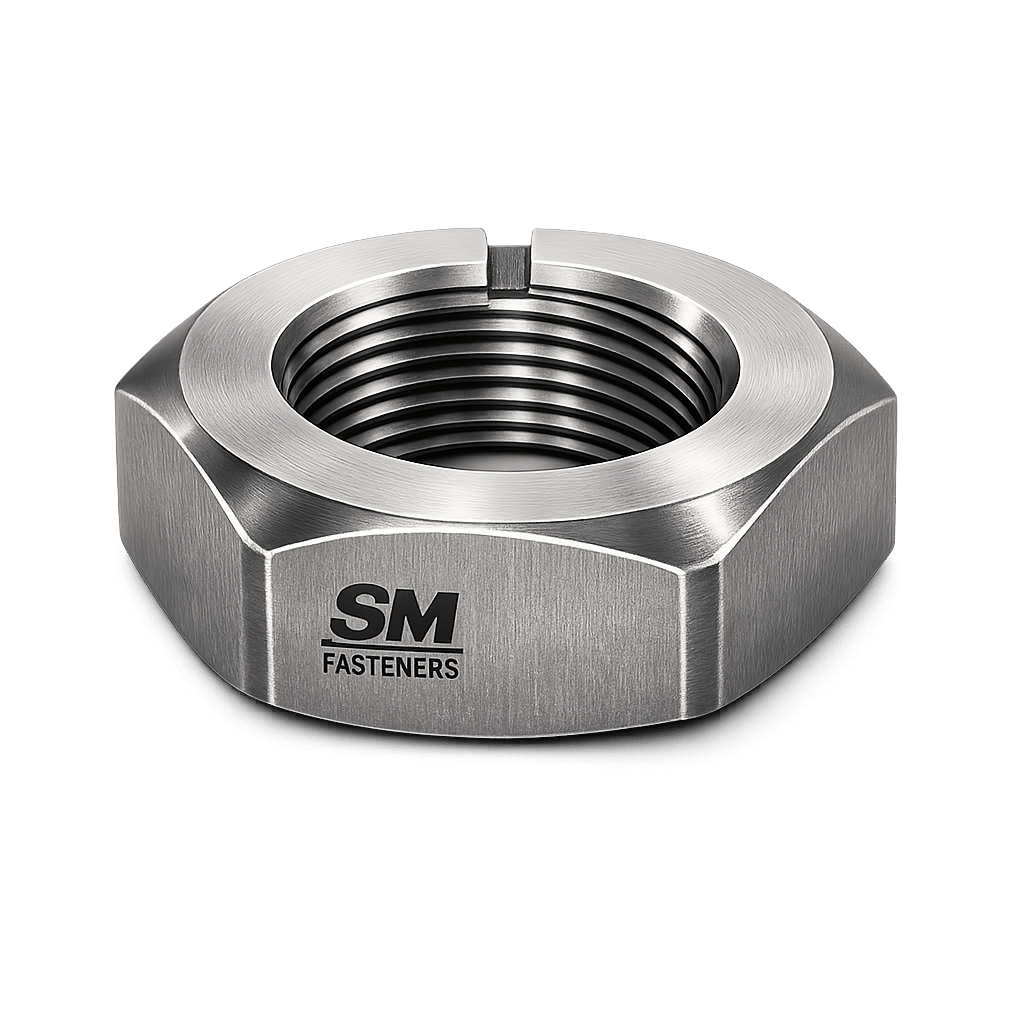
Used where wrench clearance is limited.
Features:
- Cylindrical body
- Slots for hook spanner
- Shaft retention applications
Used in:
- Bearing retention
- Gear assemblies
- Rotating equipment
10.5 Fine Thread Slotted Nut
Designed for:
- Precision adjustment
- High vibration environments
- Aerospace and rail systems
Benefits:
- Higher preload retention
- Better fatigue resistance
10.6 Custom Engineered Slotted Nuts — SM Fasteners Capability
SM Fasteners supplies engineered variants including:
- Reduced height lock nuts
- Extended slot geometry
- Special pitch threads
- Metric–Imperial hybrid systems
- PEEK slotted nuts for insulation applications
- Sour service compliant nuts
Custom engineering is performed under controlled ISO 9001 design validation processes.
11. Dimensional Logic and Geometry Engineering
Slotted nut geometry is driven by three critical engineering principles:
- Torque transmission
- Slot alignment reliability
- Structural strength retention
11.1 Critical Geometrical Parameters
| Symbol | Parameter | Function |
|---|---|---|
| d | Thread diameter | Load capacity |
| P | Thread pitch | Preload sensitivity |
| m | Nut height | Thread engagement |
| s | Width across flats | Torque transfer |
| e | Width across corners | Clearance |
| hₛ | Slot height | Locking engagement |
| n | Number of slots | Alignment flexibility |
11.2 Slot Geometry Requirements
Engineering rules:
- Minimum 6 slots recommended
- Slot width ≥ cotter pin diameter + clearance
- Remaining wall thickness must maintain proof load
Incorrect slot depth reduces fatigue strength.
SM Fasteners maintains CNC-controlled slot machining ensuring dimensional repeatability.
12. Standard Dimensional Specification Table
(Typical ISO/DIN Reference Dimensions)
| Thread Size | Pitch (mm) | Width Across Flats (mm) | Nut Height (mm) | Slot Depth (mm) | Cotter Pin Dia (mm) |
|—|—|—|—|—|
| M6 | 1.0 | 10 | 5 | 2 | 1.6 |
| M8 | 1.25 | 13 | 6.5 | 2.5 | 2 |
| M10 | 1.5 | 17 | 8 | 3 | 2.5 |
| M12 | 1.75 | 19 | 10 | 3.5 | 3 |
| M16 | 2.0 | 24 | 13 | 4 | 4 |
| M20 | 2.5 | 30 | 16 | 5 | 5 |
| M24 | 3.0 | 36 | 19 | 6 | 6 |
| M30 | 3.5 | 46 | 24 | 7 | 8 |
| M36 | 4.0 | 55 | 29 | 8 | 10 |
(Manufactured according to SM Fasteners controlled dimensional programs.)
13. Thread Systems & Interchangeability
Global EPC projects require compatibility between multiple thread standards.
13.1 Major Thread Systems
| Thread Standard | Region | Typical Use |
|---|---|---|
| ISO Metric | Global | General engineering |
| UNC | USA | Structural bolting |
| UNF | USA | Automotive/precision |
| BSW | UK legacy | Heavy engineering |
| BSF | UK fine thread | Rail & marine |
13.2 Thread Tolerance Classes
| Standard | External Thread | Internal Thread |
|---|---|---|
| ISO Metric | 6g | 6H |
| UNC/UNF | 2A | 2B |
| Precision Fit | 3A | 3B |
SM Fasteners validates thread accuracy using calibrated gauges traceable to international standards.
14. Applicable International Standards
Slotted nuts fall under multiple regulatory frameworks depending on application sector.
14.1 ISO Standards
| Standard | Description |
|---|---|
| ISO 7035 | Slotted nuts — Metric |
| ISO 7036 | Low slotted nuts |
| ISO 7037 | High slotted nuts |
| ISO 898-2 | Mechanical properties of nuts |
| ISO 965 | Thread tolerances |
14.2 DIN Standards
| DIN Standard | Description |
|---|---|
| DIN 935 | Slotted hex nuts |
| DIN 937 | Low slotted nuts |
| DIN 979 | Fine thread slotted nuts |
14.3 ASTM Standards
| ASTM Standard | Scope |
|---|---|
| ASTM A194 | High-pressure nuts |
| ASTM A563 | Carbon steel nuts |
| ASTM F594 | Stainless steel nuts |
| ASTM B637 | Nickel alloy fasteners |
14.4 British Standards (BS)
| BS Standard | Application |
|---|---|
| BS 1769 | Slotted and castellated nuts |
| BS 3692 | Metric precision fasteners |
14.5 Property Class System (ISO)
| Property Class | Application |
|---|---|
| 5 | Light duty |
| 8 | Structural |
| 10 | High strength |
| 12 | Critical load |
15. Mechanical Properties Table (Typical ISO Classes)
| Property Class | Proof Load (MPa) | Min Yield (MPa) | Hardness (HV) |
|---|---|---|---|
| 5 | 500 | 300 | 120–220 |
| 8 | 800 | 640 | 220–300 |
| 10 | 1000 | 900 | 272–353 |
| 12 | 1200 | 1080 | 353–390 |
16. Dimensional Compatibility & EPC Procurement Logic
EPC procurement engineers must verify:
- Bolt standard vs nut standard
- Thread pitch compatibility
- Slot alignment tolerance
- Proof load matching
- Material compatibility
SM Fasteners supports multi-standard projects supplying:
- ISO + ASTM interchangeable fasteners
- Project-specific dimensional approval drawings
- Pre-dispatch dimensional verification reports
17. Weight Chart — Slotted Nuts
(Typical SM Fasteners Production Reference)
| Size | Approx Weight / Piece (kg) | Weight per 100 pcs (kg) |
|---|---|---|
| M6 | 0.004 | 0.40 |
| M8 | 0.007 | 0.70 |
| M10 | 0.012 | 1.20 |
| M12 | 0.020 | 2.00 |
| M16 | 0.045 | 4.50 |
| M20 | 0.080 | 8.00 |
| M24 | 0.140 | 14.00 |
| M30 | 0.300 | 30.00 |
| M36 | 0.520 | 52.00 |
Weight data aligns with SM Fasteners manufacturing and export packing calculations.
18. Engineering Selection Logic
Selection must consider:
✔ Required preload
✔ Dynamic loading presence
✔ Inspection frequency
✔ Temperature exposure
✔ Corrosion environment
✔ Applicable codes
Slotted nuts remain the preferred solution where mechanical locking verification is mandatory under QA/QC inspection regimes.
19. Material Engineering Philosophy for Slotted Nuts
Material selection for slotted nuts is fundamentally driven by:
- Required mechanical strength
- Environmental corrosion exposure
- Operating temperature
- Hydrogen embrittlement risk
- Compatibility with mating bolt material
- Regulatory compliance (NACE / PED / EPC specifications)
Unlike standard nuts, slotted nuts frequently serve safety-critical retention functions, making metallurgical stability essential.
SM Fasteners manufactures slotted nuts across a full industrial alloy spectrum under ISO 9001 controlled processes with traceable raw material certification.
20. Industrial Material Grades
20.1 Carbon Steel
Used where strength and economy are primary drivers.
Common Grades:
- ASTM A563 Grade A
- ASTM A563 Grade DH
- ISO Property Class 8 & 10
- EN 1.0503 / C45
Characteristics
- High strength capability
- Good machinability
- Requires corrosion protection
Applications:
- Structural steel
- Heavy equipment
- Infrastructure assemblies
20.2 Alloy Steel
Designed for high-load and fatigue applications.
Typical Grades:
- ASTM A194 Grade 2H
- ASTM A194 Grade 7
- 4140 / 4340 Alloy Steel
Advantages:
- High proof load
- Improved fatigue resistance
- Elevated temperature capability
Used in:
- Oil & Gas pressure systems
- Power generation turbines
- Rotating machinery
20.3 Stainless Steel
Selected for corrosion resistance and hygiene environments.
| Grade | UNS | Typical Use |
|---|---|---|
| SS304 | S30400 | General industrial |
| SS316 | S31600 | Marine & chemical |
| SS316L | S31603 | Low chloride SCC risk |
| SS321 | S32100 | High temperature |
| SS410 | S41000 | High strength martensitic |
Advantages:
- Excellent corrosion resistance
- No coating required
- Suitable for washdown environments
20.4 Duplex & Super Duplex Stainless Steel
Critical for aggressive offshore environments.
| Grade | Standard | PREN |
|---|---|---|
| Duplex 2205 | UNS S32205 | ~35 |
| Super Duplex 2507 | UNS S32750 | >40 |
Benefits:
- High strength + corrosion resistance
- Superior chloride resistance
- NACE MR0175 compliant options
Applications:
- Offshore platforms
- Subsea equipment
- Desalination plants
20.5 Nickel Alloys & High Performance Materials
SM Fasteners manufactures advanced alloy slotted nuts including:
| Material | Service Capability |
|---|---|
| Inconel 625 | High temperature & oxidation |
| Inconel 718 | Aerospace strength |
| Hastelloy C276 | Strong acid resistance |
| Monel 400 | Seawater resistance |
| Incoloy 825 | Chemical processing |
| SMO 254 | Extreme chloride resistance |
Used in:
- LNG plants
- Refinery reactors
- Acid handling equipment
20.6 PEEK Slotted Nuts
Engineered polymer solution supplied by SM Fasteners.
Characteristics:
- Electrically insulating
- Lightweight
- Chemical resistant
- Non-galling
- Non-magnetic
Typical uses:
- Electronics manufacturing
- Medical equipment
- Semiconductor installations
- Cryogenic assemblies
21. Material Comparison Table
| Material | UTS (MPa) | Yield (MPa) | Corrosion Resistance | Temp Limit °C | Relative Cost | Typical Industry |
|---|---|---|---|---|---|---|
| Carbon Steel | 600–800 | 400–640 | Low | 300 | Low | Structural |
| Alloy Steel | 900–1200 | 720–1080 | Moderate | 450 | Medium | Oil & Gas |
| SS304 | 515 | 205 | Good | 870 | Medium | General Industry |
| SS316 | 515 | 205 | Excellent | 870 | Medium-High | Marine |
| Duplex 2205 | 620 | 450 | Very High | 300 | High | Offshore |
| Super Duplex | 800 | 550 | Extreme | 300 | Very High | Subsea |
| Inconel 625 | 930 | 517 | Outstanding | 1000 | Premium | Aerospace/LNG |
| PEEK | — | — | Chemical Resistant | 250 | High | Electronics |
22. Corrosion Resistance vs Environment
| Environment | Recommended Material |
|---|---|
| Atmospheric | Carbon Steel + Zinc |
| Marine | SS316 / Duplex |
| Seawater Immersion | Super Duplex / Monel |
| Acidic Chemical | Hastelloy |
| H₂S Sour Service | NACE Alloy Steel / Duplex |
| High Temperature Oxidation | Inconel |
| Cryogenic | Austenitic Stainless |
| Electrical Isolation | PEEK |
SM Fasteners supports material selection based on project environmental classification.
23. Heat Treatment Engineering
Heat treatment determines mechanical performance and safety compliance.
23.1 Typical Heat Treatment Processes
| Process | Purpose |
|---|---|
| Annealing | Improve machinability |
| Quenching | Increase hardness |
| Tempering | Improve toughness |
| Normalizing | Uniform grain structure |
| Solution Annealing | Stainless corrosion performance |
| Aging | Nickel alloy strengthening |
23.2 Mechanical Property Control
Example — Alloy Steel Slotted Nuts:
- Forging
- Austenitizing (~850°C)
- Oil quenching
- Tempering (550–650°C)
Result:
- Controlled hardness
- High proof load
- Improved fatigue resistance
23.3 Hardness Limits (NACE Service)
For sour service:
- Maximum hardness typically ≤ 22 HRC
- Prevents sulfide stress cracking
SM Fasteners verifies hardness using calibrated testing equipment.
24. End-to-End Manufacturing Workflow
SM Fasteners follows controlled manufacturing aligned with ISO 9001 and UKAF quality frameworks.
24.1 Raw Material Control
- Approved mill sourcing
- Chemical verification
- EN 10204 3.1 certification
- Heat number traceability
24.2 Forging / Forming
Hot forging advantages:
- Improved grain flow
- Higher fatigue resistance
- Better structural integrity
Large sizes may be:
- Closed-die forged
- CNC machined from bar stock
24.3 Machining Operations
Critical machining steps:
- Hex profile generation
- Face squareness control
- Slot machining
- Deburring
CNC machining ensures consistent slot alignment accuracy.
24.4 Thread Production
Thread Rolling (Preferred)
- Cold work strengthening
- Superior fatigue life
- Smooth surface finish
Thread Cutting
Used for:
- Large diameters
- Exotic alloys
- Small production runs
24.5 Slot Manufacturing
Slots must not reduce nut structural strength.
SM Fasteners controls:
- Slot depth tolerance
- Edge radius
- Surface integrity
- Stress concentration reduction
24.6 Cleaning & Preparation
Processes include:
- Ultrasonic cleaning
- Degreasing
- Pickling (stainless)
- Passivation
25. Surface Finishing & Protective Coatings
Coating selection strongly influences service life.
25.1 Common Industrial Coatings
| Coating | Thickness | Corrosion Resistance | Temp Limit |
|---|---|---|---|
| Zinc Plating | 8–12 µm | Moderate | 120°C |
| Hot Dip Galvanized | 50–80 µm | High | 450°C |
| Mechanical Galvanizing | 40 µm | High | 300°C |
| Black Oxide | Minimal | Low | 300°C |
| Phosphate | Moderate | Assembly aid | 250°C |
| PTFE/Xylan | High | Excellent | 260°C |
| Dacromet/Geomet | Excellent | Very High | 300°C |
25.2 Surface Finish Performance Comparison
| Finish | Salt Spray Resistance | Friction Stability | Reusability | Typical Industry |
|---|---|---|---|---|
| Zinc | 72–120 hrs | Medium | Good | Construction |
| HDG | 500+ hrs | High friction | Moderate | Infrastructure |
| PTFE | 1000+ hrs | Low friction | Excellent | Oil & Gas |
| Passivated SS | Excellent | Stable | Excellent | Marine |
| Dacromet | 1000+ hrs | Stable | Excellent | Automotive |
25.3 Hydrogen Embrittlement Prevention
Critical for high-strength fasteners.
SM Fasteners applies:
- Controlled electroplating
- Post-plate baking
- Process validation records
26. Surface Engineering Considerations
Engineers must evaluate:
- Required torque consistency
- Galvanic compatibility
- Temperature exposure
- Maintenance interval
- Environmental classification
Improper coating selection is a primary cause of joint failure.
27. Inspection & Quality Control Philosophy
Slotted nuts are frequently installed in safety-critical assemblies, therefore inspection extends beyond dimensional compliance into mechanical reliability verification.
SM Fasteners operates an ISO 9001 certified quality management system, supported by UKAF-accredited process controls ensuring:
- Material traceability
- Mechanical conformity
- Dimensional precision
- Process repeatability
- Full EPC documentation readiness
Quality assurance begins at raw material procurement and continues through shipment.
28. Incoming Raw Material Inspection
All production batches undergo verification before manufacturing release.
Verification Activities
| Inspection Stage | Method | Objective |
|---|---|---|
| Mill Test Certificate Review | EN 10204 3.1 | Chemical compliance |
| Heat Number Verification | Traceability marking | Material tracking |
| Spectro Analysis | PMI testing | Alloy confirmation |
| Visual Inspection | Surface condition | Defect detection |
| Ultrasonic Test (when required) | NDT | Internal defects |
Materials failing verification are rejected prior to processing.
29. In-Process Dimensional Inspection
Critical parameters monitored:
- Thread pitch accuracy
- Slot depth and spacing
- Across-flat dimension
- Nut height
- Face perpendicularity
- Surface finish quality
Inspection tools include:
- GO/NO-GO thread gauges
- Optical measurement systems
- Coordinate Measuring Machines (CMM)
- Digital calipers and micrometers
30. Mechanical Testing Requirements
Slotted nuts must meet proof load requirements matching the mating bolt grade.
Mechanical Testing Matrix
| Test | Standard | Purpose |
|---|---|---|
| Proof Load Test | ISO 898-2 | Load capacity verification |
| Hardness Test | Rockwell/Vickers | Heat treatment validation |
| Tensile Test (Lot Basis) | ASTM/ISO | Strength confirmation |
| Impact Testing | ASTM E23 | Low temperature reliability |
| Microstructure Examination | Metallography | Grain verification |
31. Non-Destructive Testing (NDT)
Applied for critical service fasteners.
| NDT Method | Application |
|---|---|
| Magnetic Particle Inspection | Surface crack detection |
| Dye Penetrant Testing | Stainless & nickel alloys |
| Ultrasonic Inspection | Forging integrity |
| Eddy Current Testing | Surface discontinuities |
32. Positive Material Identification (PMI)
Mandatory for Oil & Gas and petrochemical projects.
PMI confirms:
- Alloy chemistry
- Grade authenticity
- Sour service compliance
SM Fasteners provides PMI reports linked to heat numbers.
33. Documentation & Certification
Typical export documentation package:
| Document | Description |
|---|---|
| EN 10204 3.1 MTC | Chemical & mechanical properties |
| Heat Treatment Report | Furnace traceability |
| Dimensional Inspection Report | Compliance confirmation |
| Coating Test Report | Thickness & adhesion |
| Hardness Report | Mechanical verification |
| Certificate of Conformity (CoC) | Contract compliance |
| Third-Party Inspection | SGS / TUV / BV options |
3.2 certification available upon request.
34. Mechanical Properties — Grade Wise Reference
| Grade/Class | Proof Load (MPa) | Min Tensile Strength (MPa) | Hardness Range |
|---|---|---|---|
| Class 5 | 500 | 500 | 120–220 HV |
| Class 8 | 800 | 800 | 220–300 HV |
| Class 10 | 1000 | 1040 | 272–353 HV |
| Class 12 | 1200 | 1220 | 353–390 HV |
| A2-70 SS | 450 | 700 | ≤ 223 HV |
| A4-80 SS | 600 | 800 | ≤ 250 HV |
35. Proof Load & Tensile Capacity Table
(Typical Metric Slotted Nut Capacity)
| Size | Stress Area (mm²) | Proof Load Class 8 (kN) | Class 10 (kN) |
|---|---|---|---|
| M8 | 36.6 | 29 | 36 |
| M10 | 58 | 46 | 58 |
| M12 | 84.3 | 67 | 84 |
| M16 | 157 | 125 | 157 |
| M20 | 245 | 196 | 245 |
| M24 | 353 | 282 | 353 |
| M30 | 561 | 449 | 561 |
| M36 | 817 | 654 | 817 |
36. Tightening Torque Chart
(Typical Engineering Reference Values)
| Size | Grade | Dry Torque (Nm) | Lubricated Torque (Nm) |
|---|---|---|---|
| M8 | 8 | 25 | 18 |
| M10 | 8 | 50 | 36 |
| M12 | 8 | 86 | 62 |
| M16 | 8 | 210 | 150 |
| M20 | 8 | 410 | 290 |
| M24 | 8 | 710 | 510 |
| M30 | 10 | 1420 | 1010 |
| M36 | 10 | 2470 | 1750 |
Final tightening must always allow slot alignment without loosening torque.
37. Preload Calculation — Engineering Example
Formula
Where:
- Torque = 410 Nm
- Nut Factor = 0.18
- Diameter = 0.02 m (M20)
Result:
Approximate preload ≈ 114 kN
This preload provides required clamp force while cotter pin prevents rotation.
38. Thread Standards & Tolerance Table
| Thread Type | Pitch System | Tolerance Class | Typical Industry |
|---|---|---|---|
| ISO Metric | mm | 6H | Global EPC |
| UNC | Inch | 2B | Structural USA |
| UNF | Inch | 2B | Automotive |
| BSW | Inch | Medium Fit | Legacy equipment |
| BSF | Inch Fine | Precision Fit | Marine/Rail |
39. Failure Prevention & Reliability Engineering
Major Failure Modes
| Failure | Cause | Prevention |
|---|---|---|
| Fatigue Loosening | Low preload | Correct torque |
| Thread Stripping | Soft material | Proper grade selection |
| SCC | Chloride exposure | Duplex/Alloy selection |
| Hydrogen Embrittlement | Improper plating | Controlled baking |
| Cotter Pin Failure | Wrong pin size | Proper installation |
40. Surface Finish Performance vs Environment
| Environment | Recommended Finish |
|---|---|
| Indoor Industrial | Zinc plated |
| Outdoor Exposure | HDG |
| Marine Atmosphere | SS316 / Duplex |
| Offshore Splash Zone | Super Duplex |
| Chemical Plant | PTFE/Xylan |
| High Temperature | Black oxide / Nickel alloy |
41. Weight Reference Table — Slotted Nuts
| Size | Weight/Piece (kg) | Weight/100 pcs (kg) |
|---|---|---|
| M8 | 0.007 | 0.70 |
| M10 | 0.012 | 1.20 |
| M12 | 0.020 | 2.00 |
| M16 | 0.045 | 4.50 |
| M20 | 0.080 | 8.00 |
| M24 | 0.140 | 14.00 |
| M30 | 0.300 | 30.00 |
| M36 | 0.520 | 52.00 |
Aligned with SM Fasteners export packing calculations.
42. Industry Application Mapping
Construction & Structural Steel
- Bridge pin connections
- Structural pivots
- Crane assemblies
Oil & Gas (Upstream / Downstream)
- Valve retention
- Flange locking systems
- Pipeline mechanical assemblies
- NACE compliant installations
Power Generation
- Turbine shafts
- Generator couplings
- Boiler equipment
Petrochemical & Chemical Processing
- Reactor maintenance assemblies
- Pump systems
- Corrosive service equipment
LNG & Offshore Platforms
- Mooring systems
- Subsea mechanical locking
- Deck equipment
Automotive & Heavy Equipment
- Wheel hubs
- Steering linkages
- Suspension joints
Railways & Infrastructure
- Axle retention
- Track machinery
- Signaling equipment
Shipbuilding & Marine
- Rudder mechanisms
- Propulsion assemblies
- Deck machinery
43. PEEK Slotted Nut Applications
SM Fasteners provides engineered PEEK variants for:
- Electrical isolation assemblies
- MRI equipment
- Semiconductor tooling
- Cryogenic instrumentation
- Lightweight aerospace assemblies
Advantages:
- No galvanic corrosion
- Chemical inertness
- Non-sparking properties
44. Industrial Packaging & Export Logistics
SM Fasteners packaging protects dimensional accuracy and surface finish during global shipment.
Standard Industrial Packaging
- VCI corrosion protection
- Thread protectors
- Moisture barrier sealing
- Batch labeling with heat numbers
Export Packing
- ISPM-15 compliant wooden crates
- Palletized shipment
- Vacuum packing (marine shipments)
- Container humidity control
45. Global Export Documentation
Provided with every EPC shipment:
- Material Test Certificate (EN 10204 3.1 / 3.2)
- Dimensional inspection reports
- Heat treatment certification
- Coating reports
- PMI verification
- Packing list & traceability matrix
- Certificate of Conformity
46. Integration with SM FASTENERS Manufacturing Capability
SM Fasteners demonstrates global procurement readiness through:
✔ ISO 9001 certified manufacturing systems
✔ UKAF accredited quality framework
✔ MSME recognized production facility
✔ Advanced alloy manufacturing capability
✔ Precision forging and CNC machining
✔ Custom fastener engineering support
✔ Full EPC documentation compliance
Material range includes:
- Stainless Steel
- Carbon & Alloy Steel
- Duplex & Super Duplex
- Nickel Alloys
- SMO 254
- PEEK Engineering Fasteners
47. Engineering Selection Summary
Slotted nuts should be specified when:
- Positive mechanical locking is required
- Vibration-induced loosening risk exists
- Inspection visibility is mandatory
- Safety redundancy is required
- Long service intervals are expected
They remain one of the most reliable fastening solutions for critical industrial assemblies worldwide.