

Eye Bolt
1. Industry Context
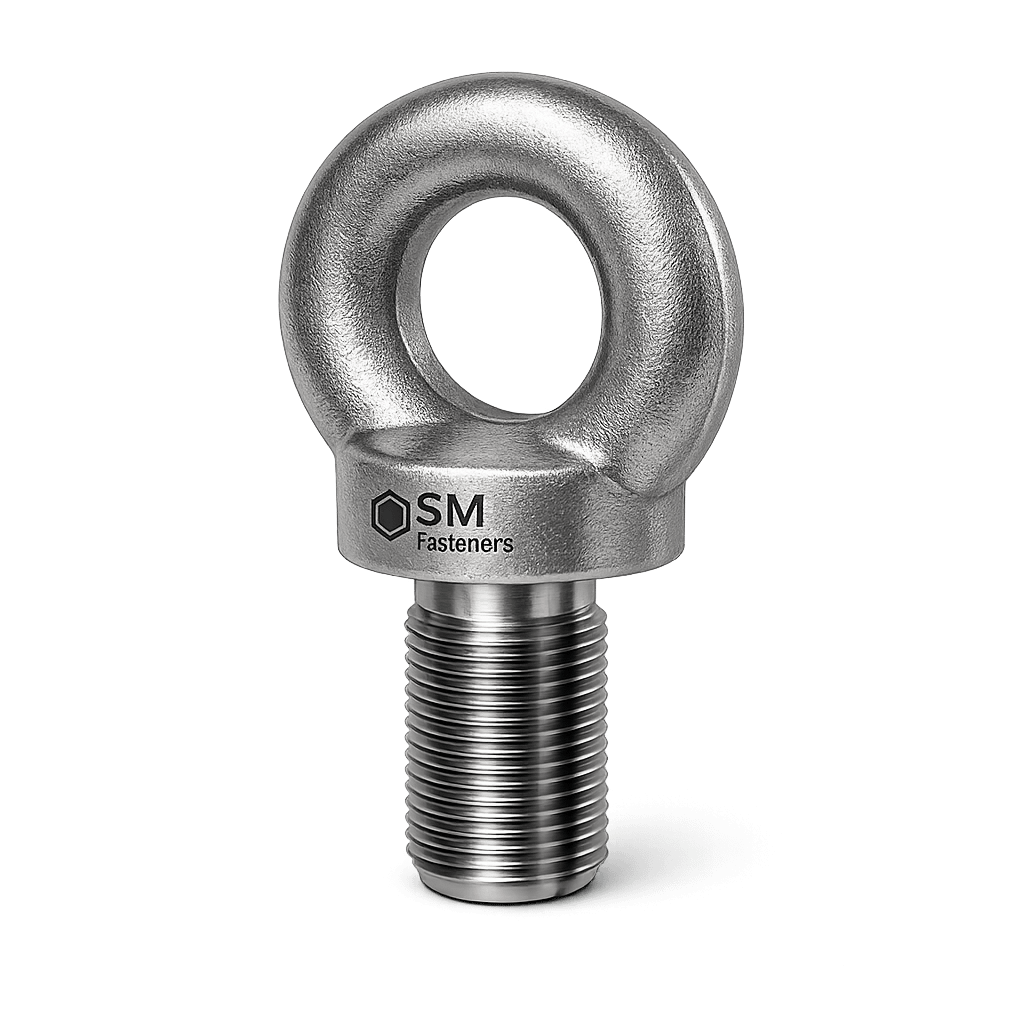
Eye bolts are load-bearing lifting and securing fasteners designed to create a controlled attachment point for lifting equipment, rigging assemblies, tension members, and restraint systems. Unlike conventional threaded fasteners whose primary role is clamping, eye bolts function as structural load interface components transmitting tensile, angular, and dynamic loads.
Across industrial sectors, eye bolts are classified as critical safety components, often governed by lifting regulations, inspection codes, and traceability requirements.
Primary Industrial Usage
| Industry | Functional Role |
|---|---|
| Structural Steel | Temporary lifting points during erection |
| Oil & Gas | Equipment handling, valve lifting, skid installation |
| Power Generation | Turbine casing handling, maintenance lifting |
| Petrochemical | Reactor assembly lifting points |
| LNG & Offshore | Rigging under marine exposure |
| Heavy Engineering | Machinery transport & alignment |
| Shipbuilding | Deck lifting and mooring attachment |
| Railways & Infrastructure | Precast handling and maintenance lifting |
SM Fasteners manufactures eye bolts suitable for static lifting, dynamic rigging, and permanent anchoring applications, supported by ISO 9001 certified production systems and globally compliant material traceability.
2. Technical Definition
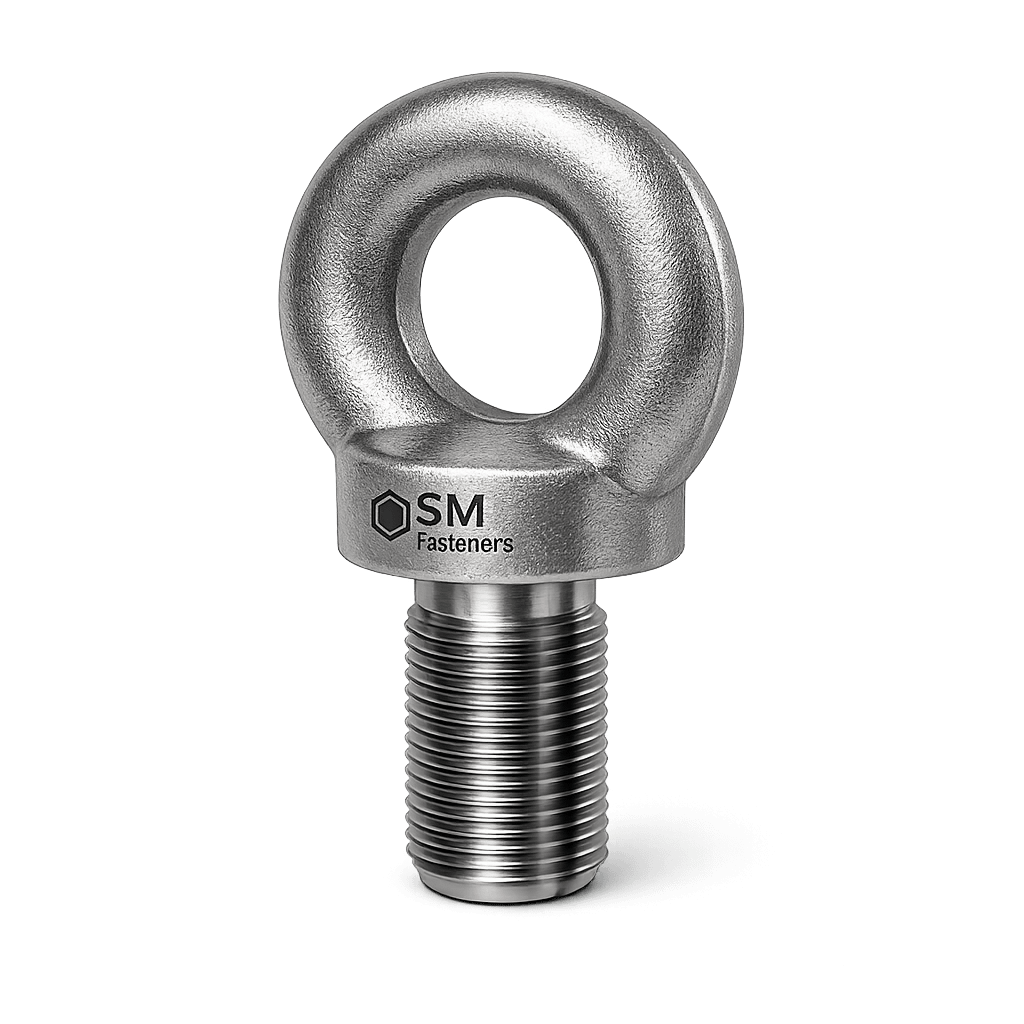
An Eye Bolt is a threaded fastener featuring:
- A circular or forged eye forming a load connection point
- A threaded shank for anchoring into structures or equipment
- Load transmission primarily through axial tension
Functional Components
- Eye Ring — Load interface
- Shoulder (where applicable) — Supports angular loads
- Shank — Transfers force into parent material
- Thread — Provides mechanical engagement
- Bearing Face — Distributes compressive load
3. Functional Role in Engineering Assemblies
Eye bolts perform three critical engineering functions:
3.1 Lifting Interface
- Connect hoists, chains, slings
- Transfer lifting loads safely
3.2 Restraint or Tie-Down Point
- Used in transport securing
- Structural bracing systems
3.3 Permanent Load Anchor
- Suspension systems
- Pipe support assemblies
- Cable routing supports
4. Load Mechanics & Force Behavior
Unlike standard bolts designed for preload and clamping, eye bolts experience direct load transfer.
4.1 Primary Load Types
| Load Type | Description | Design Impact |
|---|---|---|
| Axial Tension | Vertical lifting | Maximum capacity |
| Angular Load | Off-axis lifting | Capacity reduction |
| Shear Load | Lateral force | Not recommended |
| Dynamic Load | Shock/vibration | Fatigue consideration |
| Cyclic Load | Repeated lifting | Requires fatigue resistance |
4.2 Force Flow Path
Load transmission sequence:
Rigging → Eye → Transition Radius → Shank → Threads → Parent MaterialFailure frequently occurs at:
- Eye-to-shank transition radius
- First engaged thread
- Improper angular loading
4.3 Angular Loading Reduction
Standard eye bolts are rated for vertical loading only unless shoulder design exists.
| Lift Angle | Typical Capacity |
|---|---|
| 0° (Vertical) | 100% |
| 30° | ~65% |
| 45° | ~30–40% |
| 90° | Not permitted |
Shoulder eye bolts allow controlled angular loading when seated firmly against the mounting surface.
5. Joint Design Principles
Correct joint design governs safe lifting performance.
5.1 Thread Engagement Requirement
Minimum engagement:
Thread Engagement ≥ 1 × Nominal Diameter (steel)
Thread Engagement ≥ 1.5 × Diameter (aluminum)
5.2 Seating Requirements
- Shoulder must fully contact mounting surface
- No washers unless engineered
- Surface must be flat and perpendicular
5.3 Load Alignment Rule
Golden Engineering Rule:
Load centerline must pass through eye center.
Misalignment introduces bending stress → premature failure.
6. Preload & Installation Mechanics
Eye bolts are not torque-preloaded fasteners but must be installed with sufficient seating torque.
Typical seating torque:
T = K × D × FWhere:
- T = Torque
- K = Nut factor (~0.18–0.22)
- D = Nominal diameter
- F = Desired preload
Worked Example — Preload Calculation
Given:
- M20 Eye Bolt
- Desired preload = 45 kN
- K = 0.20
T = 0.20 × 0.020 × 45,000
T = 180 Nm
7. Mechanical Behavior
7.1 Stress Distribution
Critical stress concentration exists at:
- Eye curvature
- Thread root
- Shoulder transition
Forged eye bolts provide superior grain flow alignment compared to machined designs.
7.2 Torque–Tension Relationship
Approximate preload distribution:
| Energy Usage | Percentage |
|---|---|
| Overcome thread friction | 40% |
| Under-head friction | 50% |
| Useful preload | ~10% |
Hence lubrication significantly affects performance.
8. Friction & Nut Factor Influence
| Condition | Nut Factor (K) |
|---|---|
| Dry steel | 0.22 |
| Light oil | 0.18 |
| MoS₂ coated | 0.14 |
| PTFE coated | 0.10–0.12 |
SM Fasteners provides coated eye bolts enabling predictable preload performance.
9. Failure Mechanisms
Eye bolts fail primarily due to improper application rather than material defects.
9.1 Fatigue Failure
- Cyclic lifting
- Shock loading
- Poor alignment
9.2 Shear Failure
Occurs when lateral loading replaces axial loading.
9.3 Thread Strip-Out
Caused by insufficient engagement length.
9.4 Hydrogen Embrittlement
Risk in high-strength plated bolts (>1000 MPa).
Mitigation:
- Controlled plating
- Post-bake hydrogen relief
9.5 Stress Corrosion Cracking
Occurs in:
- Chloride environments
- H₂S service
- High temperature exposure
SM Fasteners supports NACE MR0175 compliant material supply for sour environments.
10. Safety Factors
Typical design safety factors:
| Application | Safety Factor |
|---|---|
| Static lift | 5:1 |
| Personnel lifting | 10:1 |
| Dynamic lifting | ≥8:1 |
| Offshore lifting | Project specified |
11. Engineering Selection Criteria
Engineers must evaluate:
- Load magnitude
- Load direction
- Frequency of lifting
- Environmental exposure
- Installation material
- Inspection accessibility
- Regulatory compliance
12. Functional Advantages of Forged Eye Bolts
Compared to fabricated or bent versions:
| Parameter | Forged Eye Bolt |
|---|---|
| Grain flow | Continuous |
| Fatigue life | High |
| Shock resistance | Superior |
| Certification | Easier compliance |
| Reliability | EPC-approved |
SM Fasteners manufactures forged eye bolts under controlled forging and inspection workflows ensuring repeatable mechanical performance.
13. Eye Bolt Product Types & Engineering Variants
Eye bolts are engineered according to load direction, installation method, and service environment. Proper variant selection directly influences lifting safety, fatigue life, and compliance with international lifting standards.
SM Fasteners manufactures a complete range of standard and custom-engineered eye bolts, including exotic alloy and high-temperature materials aligned with global EPC specifications.
13.1 Shoulder Eye Bolt (Machinery Eye Bolt)
Primary industrial lifting configuration
Characteristics
- Forged shoulder below eye
- Supports angular lifting loads
- High fatigue resistance
- Controlled seating against surface
Typical Use
- Heavy equipment lifting
- Motor frames
- Pump assemblies
- Structural modules
| Feature | Engineering Benefit |
|---|---|
| Shoulder contact | Prevents bending stress |
| Forged grain flow | Higher load capacity |
| Controlled alignment | Safer angular loading |
13.2 Plain (Non-Shoulder) Eye Bolt
Designed strictly for vertical lifting only.
Limitations
- Cannot sustain side loading
- Susceptible to shank bending
- Used mainly for straight tensile applications
Applications
- Cable routing
- Static tie-down points
- Light assemblies
13.3 Dynamo Eye Bolt (DIN 580 Type)
One of the most globally standardized lifting eye designs.
Features:
- Fully forged body
- Wide bearing surface
- Defined Working Load Limit (WLL)
- Marked load rating
Commonly referenced standard:
DIN 580 – Lifting Eye Bolt13.4 Eyebolt with Collared Shoulder
Used where:
- Rotational alignment required
- Repetitive lifting occurs
Advantages:
- Reduced localized stress
- Improved seating performance
13.5 Long Shank Eye Bolt
Used for:
- Thick wall installation
- Deep tapped holes
- Structural embedment
Industries:
- Bridge construction
- Offshore jackets
- Concrete anchoring
13.6 Swivel Lifting eye bolt
Advanced engineered lifting component.
Capabilities:
- 360° rotation
- Load alignment self-correction
- Reduced bending stress
Preferred in:
- Offshore lifting
- Heavy fabrication yards
- Turbine installation
13.7 Continuous Ring Eye Bolt
Used for permanent anchoring and rigging systems.
Applications:
- Marine rigging
- Fall protection
- Structural suspension
13.8 PEEK Eye Bolts (Specialized Applications)
SM Fasteners supplies PEEK polymer eye bolts for demanding environments where metallic fasteners are unsuitable.
| Property | Engineering Advantage |
|---|---|
| Non-metallic | No galvanic corrosion |
| Chemical resistance | Aggressive media |
| Electrical insulation | HV applications |
| Lightweight | Aerospace assemblies |
| Temperature resistance | up to ~260°C |
Industries:
- Semiconductor
- Chemical plants
- Medical equipment
- Electronics manufacturing
14. Dimensional Logic & Geometry Design
Eye bolt geometry is not arbitrary — dimensions are derived from stress distribution and lifting mechanics.
Critical Design Parameters
| Parameter | Function |
|---|---|
| Eye internal diameter | Sling compatibility |
| Eye thickness | Shear strength |
| Transition radius | Fatigue life |
| Shoulder diameter | Load distribution |
| Thread length | Engagement strength |
| Shank diameter | Tensile capacity |
14.1 Eye Geometry Principles
Engineering design ensures:
- Stress flow continuity
- Minimum stress concentration
- Adequate bending resistance
- Compliance with lifting regulations
Forged eye bolts maintain continuous grain orientation, significantly improving fatigue performance compared with machined rings.
15. Standard Dimensional Specification Table (DIN 580 Reference)
Metric Eye Bolt Dimensions
| Thread Size | Pitch (mm) | Eye ID (mm) | Eye OD (mm) | Shoulder Dia (mm) | Thread Length (mm) | Overall Length (mm) |
|---|---|---|---|---|---|---|
| M6 | 1.0 | 20 | 36 | 20 | 13 | 45 |
| M8 | 1.25 | 20 | 36 | 20 | 13 | 45 |
| M10 | 1.5 | 25 | 45 | 25 | 17 | 53 |
| M12 | 1.75 | 30 | 54 | 30 | 20 | 65 |
| M16 | 2.0 | 35 | 63 | 35 | 24 | 72 |
| M20 | 2.5 | 40 | 72 | 40 | 30 | 90 |
| M24 | 3.0 | 50 | 90 | 50 | 36 | 109 |
| M30 | 3.5 | 65 | 108 | 65 | 45 | 132 |
| M36 | 4.0 | 75 | 126 | 75 | 54 | 150 |
| M42 | 4.5 | 85 | 144 | 85 | 63 | 170 |
| M48 | 5.0 | 95 | 166 | 95 | 72 | 190 |
(Values aligned with standard DIN lifting geometry; SM Fasteners customizes dimensions per project requirement.)
16. Working Load Limit (WLL) & Proof Load Table
Typical DIN 580 Load Capacity
| Size | WLL Vertical (t) | Proof Load (kN) | Minimum Breaking Load (kN) |
|---|---|---|---|
| M8 | 0.14 | 4 | 8 |
| M10 | 0.23 | 6.5 | 13 |
| M12 | 0.34 | 9.5 | 19 |
| M16 | 0.70 | 19 | 38 |
| M20 | 1.20 | 33 | 66 |
| M24 | 1.80 | 50 | 100 |
| M30 | 3.20 | 90 | 180 |
| M36 | 4.60 | 130 | 260 |
| M42 | 6.30 | 180 | 360 |
| M48 | 8.60 | 240 | 480 |
17. International Standards & Compliance
Eye bolts used in global EPC projects must comply with recognized standards.
17.1 Primary Standards
| Standard | Description |
|---|---|
| DIN 580 | Lifting Eye Bolts |
| DIN 582 | Lifting Eye Nuts |
| ISO 3266 | Mechanical properties |
| ISO 898-1 | Carbon steel property classes |
| ASTM A489 | Forged steel lifting eye bolts |
| ASTM A193 | High-temp alloy bolts |
| ASTM F593 | Stainless steel fasteners |
| BS 4278 | Lifting eye specifications |
| ASME B30.26 | Rigging hardware safety |
SM Fasteners manufactures eye bolts aligned with these standards, supported by ISO 9001 certified quality systems and UKAF accreditation.
18. Property Class System (Metric)
| Property Class | Yield Strength (MPa) | Tensile Strength (MPa) |
|---|---|---|
| 4.6 | 240 | 400 |
| 5.6 | 300 | 500 |
| 8.8 | 640 | 800 |
| 10.9 | 940 | 1040 |
| 12.9 | 1100 | 1220 |
Lifting eye bolts typically use forged medium carbon steels equivalent to Class 8.8 or specialized lifting grades.
19. Thread Systems & Interchangeability
Eye bolts are manufactured across global thread systems.
Thread Standards & Tolerances
| System | Standard | Typical Tolerance |
|---|---|---|
| Metric | ISO 261 / ISO 965 | 6g external |
| UNC | ASME B1.1 | 2A |
| UNF | ASME B1.1 | 2A |
| BSW | BS 84 | Medium fit |
| BSF | BS 84 | Fine pitch |
| NPT (special) | ANSI B1.20 | Pressure applications |
SM Fasteners supplies project-specific thread configurations ensuring interchangeability across international assemblies.
20. Thread Engagement Design Logic
Proper engagement prevents:
- Thread stripping
- Pull-out failure
- Localized yielding
| Material | Minimum Engagement |
|---|---|
| Steel | 1 × Diameter |
| Cast Iron | 1.5 × Diameter |
| Aluminum | 2 × Diameter |
| PEEK | 2.5 × Diameter |
21. Eye Orientation & Installation Geometry
Correct orientation ensures safe lifting.
Engineering requirements:
- Shoulder fully seated
- Eye aligned with lift direction
- No spacer stacking
- No partial thread engagement
Improper seating introduces bending moment exceeding design limits.
22. Weight Chart — SM Fasteners Reference
(Aligned with SM Fasteners production data for procurement estimation)
| Size | Weight / Piece (kg) | Weight / 100 pcs (kg) |
|---|---|---|
| M8 | 0.05 | 5 |
| M10 | 0.09 | 9 |
| M12 | 0.16 | 16 |
| M16 | 0.31 | 31 |
| M20 | 0.56 | 56 |
| M24 | 1.02 | 102 |
| M30 | 1.85 | 185 |
| M36 | 3.25 | 325 |
| M42 | 5.20 | 520 |
| M48 | 7.80 | 780 |
Weights support:
- EPC logistics planning
- Crane load calculations
- Export packing optimization
23. Engineering Selection Summary
Correct eye bolt selection requires evaluation of:
- Load direction
- Required WLL
- Material compatibility
- Environmental exposure
- Thread standard
- Inspection requirements
- Certification level
SM Fasteners provides custom engineering support, including special dimensions, exotic alloys, and PEEK lifting solutions tailored for global infrastructure and energy projects.
24. Material Engineering Philosophy for Eye Bolts
Eye bolts are categorized as safety-critical lifting fasteners, therefore material selection is governed not only by strength but also by:
- Fracture toughness
- Fatigue resistance
- Corrosion performance
- Temperature capability
- Hydrogen resistance
- Traceability compliance
SM Fasteners manufactures eye bolts using fully traceable raw materials, supported by EN 10204 3.1 certification, ensuring suitability for EPC, offshore, petrochemical, and infrastructure projects.
25. Industrial Material Grades Used for Eye Bolts
25.1 Carbon Steel Grades
Used for general lifting and structural applications.
Typical standards:
- ASTM A489 — Forged lifting eye bolts
- ASTM A36 / A105
- EN 10269
- ISO 898-1 Property Classes
| Grade | Typical Property Class | Application |
|---|---|---|
| C15 / C20 | 4.6 | Light duty lifting |
| C35 / C45 | 8.8 equivalent | Machinery lifting |
| EN8 | 8.8 | Structural assemblies |
| EN19 / 4140 | 10.9 | Heavy equipment |
Advantages:
- High load capacity
- Good machinability
- Cost efficient
25.2 Alloy Steel Grades
Selected where higher strength and fatigue resistance are required.
| Material | Standard | Key Use |
|---|---|---|
| ASTM A193 B7 | High strength lifting | |
| 4140 / 42CrMo4 | Offshore equipment | |
| ASTM A320 L7 | Low temperature service | |
| AISI 4340 | Heavy dynamic loading |
Benefits:
- High yield strength
- Improved fatigue life
- Shock resistance
25.3 Stainless Steel Grades
Required where corrosion resistance dominates design selection.
| Grade | Standard | Typical Environment |
|---|---|---|
| SS304 | ASTM F593 | Indoor industrial |
| SS316 | ASTM F593 | Marine exposure |
| SS316L | Low carbon | Chemical plants |
| SS321 | Stabilized | High temperature |
| SS904L | Severe corrosion | Acidic environments |
25.4 Duplex & Super Duplex Stainless Steel
Used in aggressive offshore and chloride environments.
| Grade | PREN Value | Application |
|---|---|---|
| Duplex 2205 | ~35 | Offshore structures |
| Super Duplex 2507 | >40 | Seawater service |
| Zeron 100 | Extreme corrosion | Subsea equipment |
25.5 Nickel & High Performance Alloys
SM Fasteners supplies eye bolts in advanced alloys for extreme environments.
| Alloy | Service Capability |
|---|---|
| Inconel 625 | High temperature + corrosion |
| Inconel 718 | Aerospace lifting |
| Incoloy 825 | Acid resistance |
| Hastelloy C276 | Chemical processing |
| Monel 400 | Marine corrosion |
| SMO 254 | Chloride environments |
25.6 PEEK Eye Bolts (Advanced Polymer Engineering)
For specialized industries.
| Property | Value |
|---|---|
| Continuous temperature | ~260°C |
| Chemical resistance | Excellent |
| Electrical insulation | High |
| Weight reduction | ~70% vs steel |
Applications:
- Semiconductor equipment
- MRI systems
- Electronics production
- Chemical handling systems
26. Material Comparison Table
| Material | UTS (MPa) | Yield (MPa) | Corrosion Resistance | Relative Cost | Typical Application |
|---|---|---|---|---|---|
| Carbon Steel | 400–800 | 240–640 | Low | Low | Construction |
| Alloy Steel | 900–1200 | 700–1000 | Moderate | Medium | Heavy lifting |
| SS304 | ~520 | ~210 | Good | Medium | General industry |
| SS316 | ~580 | ~290 | Very good | Medium-High | Marine |
| Duplex 2205 | ~800 | ~550 | Excellent | High | Offshore |
| Inconel 625 | >900 | >450 | Exceptional | Very High | Chemical/LNG |
| PEEK | ~100 | ~90 | Excellent | High | Electronics |
27. Mechanical Properties Table (Grade-Wise)
| Property Class | Yield Strength (MPa) | Tensile Strength (MPa) | Hardness Range (HB) |
|---|---|---|---|
| 4.6 | 240 | 400 | 120–170 |
| 5.6 | 300 | 500 | 150–200 |
| 8.8 | 640 | 800 | 250–320 |
| 10.9 | 940 | 1040 | 320–380 |
| 12.9 | 1100 | 1220 | 380–435 |
Lifting eye bolts typically utilize controlled hardness ranges to avoid brittle fracture.
28. Corrosion Resistance vs Environment
| Environment | Carbon Steel | SS316 | Duplex | Inconel | PEEK |
|---|---|---|---|---|---|
| Indoor Industrial | ✓ | ✓ | ✓ | ✓ | ✓ |
| Marine Atmosphere | ✗ | ✓ | ✓✓ | ✓✓ | ✓ |
| Seawater Immersion | ✗ | Limited | ✓✓ | ✓✓ | ✓ |
| Acidic Media | ✗ | Moderate | ✓ | ✓✓ | ✓✓ |
| H₂S Service | Limited | ✓ | ✓✓ | ✓✓ | ✓ |
| Chlorides | Poor | Good | Excellent | Excellent | Excellent |
✓✓ = preferred material
SM Fasteners supplies materials compliant with NACE MR0175 / ISO 15156 for sour service projects.
29. Heat Treatment Processes
Heat treatment governs mechanical performance and safety reliability.
29.1 Normalizing
Purpose:
- Grain refinement
- Uniform microstructure
Applied to:
- Forged carbon steels
29.2 Quenching & Tempering (Q&T)
Most critical treatment for lifting eye bolts.
Process:
- Austenitizing
- Rapid quench
- Controlled tempering
Benefits:
- High strength
- Improved toughness
- Controlled hardness
29.3 Solution Annealing (Stainless Steel)
Used for:
- SS304
- SS316
- Duplex alloys
Outcome:
- Restored corrosion resistance
- Removal of carbide precipitation
29.4 Stress Relieving
Applied after machining or welding.
Purpose:
- Reduce residual stresses
- Improve fatigue resistance
29.5 Hydrogen Relief Baking
Mandatory for plated high-strength bolts.
Typical requirement:
190–230°C for 2–24 hoursPrevents hydrogen embrittlement failures.
30. Hardness Limits for Critical Service
| Service Condition | Maximum Hardness |
|---|---|
| General lifting | 35 HRC |
| Offshore | 32 HRC |
| NACE Sour Service | 22 HRC |
SM Fasteners strictly controls hardness to prevent sulfide stress cracking.
31. End-to-End Manufacturing Workflow (SM Fasteners)
Step 1 — Raw Material Verification
- Mill Test Certificate verification
- Chemical composition testing
- PMI validation (Positive Material Identification)
Step 2 — Cutting & Billet Preparation
- Controlled sawing
- Heat number traceability maintained
Step 3 — Closed Die Forging
Preferred method for lifting eye bolts.
Advantages:
- Continuous grain flow
- Higher fatigue strength
- Structural integrity
Step 4 — Flash Trimming & Calibration
Ensures dimensional accuracy before machining.
Step 5 — CNC Machining
Operations include:
- Thread preparation
- Shoulder finishing
- Eye calibration
- Bearing surface machining
Step 6 — Thread Formation
Thread Rolling (Preferred)
| Advantage | Benefit |
|---|---|
| Cold working | Increased strength |
| Compressive stress | Fatigue resistance |
| Surface finish | Improved |
Thread Cutting (Special cases)
Used for:
- Large diameters
- Exotic alloys
- Custom geometry
Step 7 — Heat Treatment
Performed in calibrated furnaces compliant with ISO 9001 control systems.
Step 8 — Surface Preparation
- Shot blasting
- Pickling
- Passivation
Step 9 — Coating Application
Performed according to customer specification.
Step 10 — Final Inspection & Marking
Each eye bolt receives:
- Size marking
- Material grade
- Heat number traceability
- WLL identification (when required)
32. Surface Finishing & Coatings
Surface engineering significantly impacts service life.
Surface Finish Comparison Table
| Coating | Corrosion Resistance | Temperature Limit | Hydrogen Risk | Typical Use |
|---|---|---|---|---|
| Black Oxide | Low | 120°C | None | Indoor |
| Zinc Plated | Moderate | 120°C | Medium | General industry |
| Hot Dip Galvanized | High | 200°C | Low | Structural outdoor |
| Mechanical Galvanized | Moderate | 150°C | Low | Lifting hardware |
| PTFE / Xylan | Very High | 260°C | None | Offshore |
| Dacromet / Geomet | High | 300°C | Low | Automotive |
| Passivation (SS) | Excellent | High | None | Marine |
| Nickel Plating | High | 400°C | Medium | Chemical plants |
SM Fasteners provides coating systems aligned with project corrosion specifications.
33. Surface Treatment Selection Logic
| Environment | Recommended Finish |
|---|---|
| Indoor dry | Black oxide |
| Outdoor construction | HDG |
| Offshore splash zone | Duplex SS + PTFE |
| Chemical plant | Inconel + passivation |
| Electrical insulation | PEEK |
34. Hydrogen Embrittlement Control
Critical for high-strength eye bolts.
SM Fasteners applies:
- Controlled electroplating
- Immediate post-bake treatment
- Hardness monitoring
- Process validation under ISO 9001
35. Traceability & Identification System
Every production batch maintains:
- Heat number marking
- Material traceability
- Inspection linkage
- Manufacturing route record
Ensures audit compliance for global EPC projects.
36. Engineering Manufacturing Advantages — SM Fasteners
- ISO 9001 certified quality management
- UKAF accredited inspection control
- MSME registered manufacturing capability
- Forging + machining integration
- Exotic alloy manufacturing capability
- PEEK fastener engineering
- Project-based custom manufacturing
37. Inspection & Quality Control Philosophy
Eye bolts are classified as critical lifting safety components. Failure can result in catastrophic equipment damage, environmental risk, or personnel injury. Therefore, inspection programs must extend beyond dimensional verification into material integrity, mechanical validation, and traceability assurance.
SM Fasteners operates under an ISO 9001 certified Quality Management System, supported by UKAF-accredited processes, ensuring every eye bolt supplied for global EPC projects meets documented compliance requirements.
38. Incoming Raw Material Inspection
All production begins with controlled material verification.
Verification Activities
| Inspection | Method | Purpose |
|---|---|---|
| Mill Test Certificate Review | EN 10204 3.1 | Chemical & mechanical compliance |
| Chemical Analysis | Spectrometer | Grade confirmation |
| PMI Testing | XRF Analyzer | Alloy verification |
| Ultrasonic Testing | UT | Internal defect detection |
| Visual Inspection | ISO 2859 | Surface integrity |
Traceability is maintained from raw material heat number to finished product marking.
39. In-Process Manufacturing Inspection
Inspection checkpoints are integrated into the manufacturing workflow.
| Process Stage | Inspection Control |
|---|---|
| Forging | Grain flow & crack inspection |
| Machining | Dimensional tolerance verification |
| Thread Rolling | Profile gauge validation |
| Heat Treatment | Furnace calibration records |
| Coating | Thickness measurement |
| Marking | Traceability confirmation |
40. Final Inspection & Mechanical Testing
Mandatory Tests for Eye Bolts
| Test | Standard | Purpose |
|---|---|---|
| Proof Load Test | DIN 580 / ASTM A489 | Verify structural capacity |
| Tensile Test | ISO 898-1 | Mechanical validation |
| Hardness Test | ASTM E18 | Heat treatment confirmation |
| Magnetic Particle Testing | ASTM E709 | Surface crack detection |
| Dye Penetrant Testing | ASTM E165 | Non-magnetic alloys |
| Dimensional Inspection | ISO 2768 | Geometry verification |
Proof Load Testing Principle
Each eye bolt must sustain proof load without:
- Permanent deformation
- Thread damage
- Eye distortion
Typical requirement:
Proof Load = 2 × Working Load Limit (minimum)41. Non-Destructive Testing (NDT)
NDT ensures safety integrity for lifting hardware.
| Method | Detects | Application |
|---|---|---|
| MPI | Surface cracks | Carbon & alloy steel |
| PT | Micro surface flaws | Stainless alloys |
| UT | Internal defects | Large forgings |
| Radiography | Internal discontinuities | Critical applications |
SM Fasteners supports third-party inspection agencies including EPC-approved inspectors.
42. Positive Material Identification (PMI)
Mandatory for:
- Oil & Gas
- LNG
- Offshore
- Chemical processing
PMI verifies alloy chemistry ensuring prevention of material mix-ups, one of the most common industrial failure causes.
43. Documentation & Certification Package
Each export supply may include:
| Document | Description |
|---|---|
| EN 10204 3.1 MTC | Material traceability |
| Heat Treatment Report | Furnace cycle verification |
| Dimensional Report | Inspection records |
| Proof Load Certificate | Load validation |
| NDT Report | Crack inspection |
| Coating Report | Thickness confirmation |
| Certificate of Conformity | Compliance declaration |
| Packing List | Shipment traceability |
3.2 certification available upon third-party witnessing.
44. Failure Prevention Engineering
Major Failure Modes & Mitigation
| Failure Mode | Root Cause | Prevention |
|---|---|---|
| Eye deformation | Angular lifting | Use shoulder eye bolt |
| Thread pull-out | Insufficient engagement | Increase embed depth |
| Fatigue cracking | Cyclic loading | Forged construction |
| Hydrogen embrittlement | Improper plating | Controlled baking |
| SCC | Chloride/H₂S | Material upgrade |
45. Industry Applications Mapping
45.1 Construction & Structural Steel
- Steel erection lifting points
- Precast concrete handling
- Bridge segment installation
Materials:
- HDG Carbon Steel
- Alloy Steel Q&T
45.2 Oil & Gas Industry
Upstream
- Wellhead equipment lifting
- Rig assemblies
Midstream
- Pipeline skid handling
Downstream
- Refinery maintenance lifting
Preferred materials:
- ASTM A193 B7
- Duplex Stainless Steel
- Inconel Alloys
Compliance:
- NACE MR0175 / ISO 15156
45.3 Power Generation
- Turbine housing lifting
- Generator transport
- Boiler maintenance
Temperature-resistant alloys often required.
45.4 Petrochemical & Chemical Processing
Key requirements:
- Corrosion resistance
- Chemical compatibility
Materials:
- SS316L
- Hastelloy C276
- SMO 254
45.5 LNG & Offshore Platforms
Critical challenges:
- Chloride attack
- Dynamic loading
- Low temperature
Preferred materials:
- Duplex 2205
- Super Duplex 2507
- ASTM A320 L7
45.6 Automotive & Heavy Equipment
- Engine lifting eyes
- Assembly fixtures
- Production handling
45.7 Railways & Infrastructure
- Maintenance lifting points
- Equipment installation
- Signal structure handling
45.8 Shipbuilding & Marine Engineering
- Deck lifting operations
- Mooring connections
- Marine rigging systems
45.9 PEEK Fastener Applications
Where metallic lifting hardware cannot be used:
- Semiconductor fabrication tools
- Cleanroom equipment
- MRI systems
- Electrically isolated lifting points
SM Fasteners supports engineered PEEK lifting solutions customized per OEM requirements.
46. Tightening Torque Chart
(Seating torque values — lubrication significantly influences results)
| Size | Grade 8.8 Dry (Nm) | Grade 8.8 Lubricated (Nm) | Grade 10.9 Lubricated (Nm) |
|---|---|---|---|
| M8 | 25 | 18 | 26 |
| M10 | 49 | 35 | 51 |
| M12 | 86 | 60 | 88 |
| M16 | 210 | 150 | 220 |
| M20 | 410 | 290 | 420 |
| M24 | 710 | 510 | 720 |
| M30 | 1420 | 1010 | 1450 |
| M36 | 2450 | 1750 | 2500 |
| M42 | 4000 | 2850 | 4100 |
| M48 | 6100 | 4350 | 6250 |
Torque ensures seating only — lifting capacity is independent of torque preload.
47. Proof Load & Tensile Strength Table (By Grade)
| Size | Property Class | Proof Load (kN) | Ultimate Tensile Load (kN) |
|---|---|---|---|
| M12 | 8.8 | 52 | 65 |
| M16 | 8.8 | 95 | 118 |
| M20 | 8.8 | 148 | 185 |
| M24 | 8.8 | 214 | 267 |
| M30 | 10.9 | 353 | 441 |
| M36 | 10.9 | 515 | 644 |
| M42 | 10.9 | 713 | 892 |
48. Thread Standards & Tolerance Reference
| Thread Type | Pitch Series | Fit Class | Application |
|---|---|---|---|
| Metric Coarse | ISO 261 | 6g | General industry |
| Metric Fine | ISO 965 | 6g | Precision equipment |
| UNC | ASME B1.1 | 2A | US equipment |
| UNF | ASME B1.1 | 2A | High vibration |
| BSW | BS 84 | Medium | Legacy systems |
| BSF | BS 84 | Fine | Machinery |
49. Preload Calculation — Engineering Reference
Formula
Preload (F) = T / (K × D)Where:
- T = Applied Torque
- K = Nut factor
- D = Nominal Diameter
Worked Example
Given:
- Torque = 300 Nm
- M20 Eye Bolt
- K = 0.18
F = 300 / (0.18 × 0.02)
F = 83,333 N ≈ 83 kN preload
50. Surface Finish Performance Comparison
| Coating | Corrosion Life | Offshore Use | Maintenance |
|---|---|---|---|
| Zinc Plated | Medium | Limited | Moderate |
| Hot Dip Galvanized | High | Good | Low |
| PTFE/Xylan | Very High | Excellent | Minimal |
| Passivated SS | Excellent | Excellent | Low |
| Duplex Coating | Extreme | Preferred | Very Low |
51. Weight Reference Table — SM Fasteners
| Size | Weight / Piece (kg) | Weight / 100 pcs (kg) |
|---|---|---|
| M8 | 0.05 | 5 |
| M10 | 0.09 | 9 |
| M12 | 0.16 | 16 |
| M16 | 0.31 | 31 |
| M20 | 0.56 | 56 |
| M24 | 1.02 | 102 |
| M30 | 1.85 | 185 |
| M36 | 3.25 | 325 |
| M42 | 5.20 | 520 |
| M48 | 7.80 | 780 |
Supports:
- EPC logistics planning
- Export container calculation
- Crane capacity verification
52. Export Packaging & Global Supply Capability
SM Fasteners supplies eye bolts worldwide with export-ready logistics systems.
Industrial Packaging
- VCI corrosion protection
- Thread caps & protectors
- Oil wrapping (when required)
- Batch identification labels
Export Crating
- ISPM-15 heat-treated wooden crates
- Steel pallet options
- Containerized bulk packaging
- Project-wise segregation
53. Global Procurement Readiness
SM Fasteners supports EPC and OEM procurement teams through:
- Custom engineering drawings
- Special material sourcing
- Fast-track manufacturing
- Batch traceability
- Third-party inspection coordination
- Multi-standard compliance
54. Quality System Integration — SM Fasteners
SM Fasteners manufacturing and supply systems demonstrate:
✅ ISO 9001 certified process control
✅ MSME recognized manufacturing entity
✅ UKAF quality system compliance
✅ Full material traceability
✅ Advanced alloy manufacturing capability
✅ PEEK fastener engineering expertise
✅ Inspection-ready documentation systems
55. Engineering Selection Checklist (Project Use)
Engineers should confirm:
- Required Working Load Limit
- Lift angle condition
- Installation material
- Thread compatibility
- Environmental exposure
- Required certification level
- Inspection requirements
- Coating specification
- Logistics constraints
56. Engineering Conclusion
Eye bolts are not general fasteners — they are engineered lifting interfaces whose reliability depends on metallurgy, forging integrity, correct geometry, installation discipline, and inspection control.
Through integrated forging, machining, material engineering, inspection, and export documentation capability, SM Fasteners provides eye bolt solutions suitable for:
- Global EPC Projects
- Offshore & Energy Infrastructure
- Heavy Engineering Manufacturing
- High-Reliability Industrial Applications
Manufactured under certified quality systems and supplied with full technical documentation, SM Fasteners eye bolts deliver strength, traceability, and global compliance readiness demanded by modern industrial projects.