
Hot Dip Galvanized
1. INDUSTRY CONTEXT, TECHNICAL DEFINITION & JOINT ENGINEERING
1.1 Industry Context of Hot Dip Galvanized Fasteners
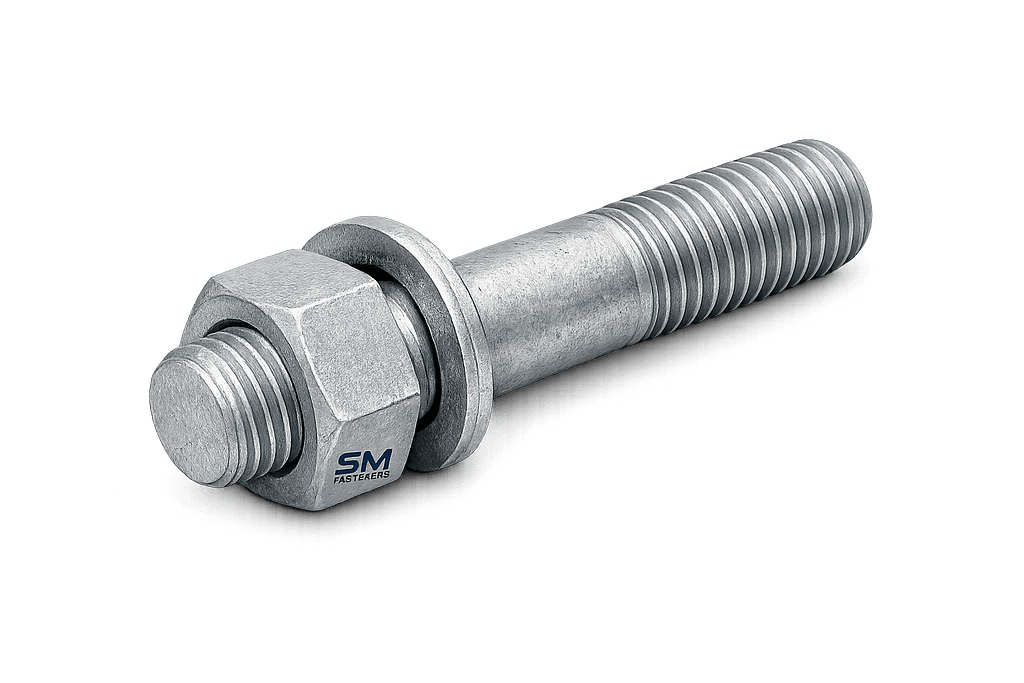
Hot dip galvanized (HDG) fasteners are corrosion-protected threaded components manufactured primarily from carbon steel or alloy steel and coated through immersion in molten zinc. These fasteners are extensively deployed in environments where atmospheric corrosion, moisture exposure, chloride attack, and industrial contamination significantly reduce the service life of unprotected steel assemblies.
HDG fasteners are widely specified across:
- Structural steel fabrication
- Transmission towers
- Bridges and flyovers
- Solar mounting structures
- Wind energy installations
- Offshore support structures
- Railway infrastructure
- Water treatment facilities
- Petrochemical support systems
- Pipe support assemblies
- Heavy equipment foundations
The engineering rationale for selecting hot dip galvanized fasteners is based on:
- Long-term corrosion resistance
- Cathodic protection capability
- Reduced lifecycle maintenance cost
- High coating durability
- Mechanical robustness in outdoor exposure
Unlike electroplated zinc coatings, hot dip galvanizing produces a metallurgically bonded zinc-iron alloy layer with significantly greater thickness and abrasion resistance.
1.2 Technical Definition
A hot dip galvanized fastener is defined as:
A threaded fastening component coated by immersion into molten zinc at approximately 445–465°C, producing a zinc-iron alloy metallurgical bond and an external pure zinc layer for corrosion protection.
Typical products include:
- Hex bolts
- Heavy hex bolts
- Stud bolts
- Threaded rods
- Nuts
- Washers
- Anchor bolts
- U-bolts
- Structural bolting assemblies
The galvanizing process generally conforms to:
| Standard | Scope |
|---|---|
| ASTM A153 | Zinc coating on iron and steel hardware |
| ASTM F2329 | Zinc coating for threaded fasteners |
| ISO 10684 | Hot dip galvanized threaded fasteners |
| BS EN ISO 1461 | Hot dip galvanized fabricated items |
| DIN 267 | Fastener coating requirements |
1.3 Functional Role in Bolted Assemblies
The primary engineering function of a hot dip galvanized fastener is:
- Generation of preload
- Joint clamping
- Load transfer
- Resistance to loosening
- Environmental durability
A properly designed bolted joint converts tightening torque into axial preload.
The preload produces:
- Frictional resistance
- Compression across joint members
- Shear load distribution
- Fatigue resistance improvement
The zinc coating acts as:
- Barrier protection
- Sacrificial anodic protection
- Corrosion inhibitor at damaged locations
1.4 Joint Mechanics & Load Transfer Principles
Axial Tensile Loading
Under tensile loading, the bolt behaves as an elastic spring.
The preload developed in the fastener creates compressive force across joint members.
The relationship is governed by:
Where:
| Symbol | Meaning |
|---|---|
| F | Axial force |
| k | Fastener stiffness |
| Δx | Elastic elongation |
Torque–Tension Relationship
Applied tightening torque generates preload according to:
Where:
| Parameter | Description |
|---|---|
| T | Tightening torque |
| K | Nut factor |
| F | Clamp load |
| d | Nominal diameter |
For HDG fasteners, the nut factor is strongly influenced by:
- Zinc thickness
- Surface roughness
- Lubrication
- Thread interference
- Washer condition
Typical nut factor values:
| Condition | Nut Factor (K) |
|---|---|
| Dry galvanized | 0.20–0.30 |
| Wax lubricated | 0.16–0.20 |
| PTFE coated | 0.10–0.15 |
1.5 Friction & Thread Engagement
Thread friction contributes approximately:
- 40–50% under the nut face
- 35–45% within threads
- 10–15% into preload generation
Due to thicker zinc coatings, HDG fasteners exhibit:
- Increased friction variability
- Higher torque scatter
- Greater installation sensitivity
Therefore, lubrication control becomes essential in structural applications.
1.6 Clamp Load & Preload Behavior
Clamp force must exceed service loads to prevent joint separation.
Recommended preload levels:
| Application | Recommended Preload |
|---|---|
| Structural steel | 70–85% proof load |
| Dynamic machinery | 60–75% proof load |
| Vibration service | 75–90% proof load |
| Thermal cycling | Controlled preload required |
1.7 Shear Load Transfer Mechanisms
Bolted joints resist shear through:
- Friction grip mechanism
- Bearing-type mechanism
Friction Grip Joints
The preload generates friction between contact surfaces.
Shear capacity:
Where:
| Symbol | Meaning |
|---|---|
| μ | Friction coefficient |
| N | Normal clamping force |
Bearing-Type Joints
Load transfers through:
- Bolt shank bearing
- Hole wall contact
- Localized compressive stress
Used where slip-critical behavior is not required.
1.8 Thermal Expansion Considerations
Hot dip galvanized fasteners are commonly exposed to:
- Solar heating
- Thermal cycling
- Process temperatures
- Outdoor weathering
Differential expansion between components can alter preload.
Thermal strain relation:
1.9 Corrosion Protection Mechanism
HDG coatings protect through:
Barrier Protection
Zinc layer isolates steel from:
- Oxygen
- Moisture
- Chlorides
- Industrial pollutants
Cathodic Protection
Zinc sacrifices preferentially:
- Zinc acts anodically
- Steel becomes cathodically protected
Even localized coating damage remains protected.
1.10 Failure Mechanisms in HDG Fasteners
Fatigue Failure
Occurs due to:
- Cyclic stress
- Insufficient preload
- Stress concentration
- Thread root cracking
Mitigation:
- Rolled threads
- Proper preload
- Hardened washers
- Controlled tightening
Hydrogen Embrittlement
Generally less severe in HDG than electroplating because hydrogen absorption is lower.
High-strength fasteners above:
- 1000 MPa tensile strength
- Property class 10.9+
require controlled galvanizing processes.
Stress Corrosion Cracking
Potential risk environments:
- Chlorides
- H₂S
- Offshore atmosphere
Material selection becomes critical.
Galling & Thread Seizure
Common causes:
- Thick zinc buildup
- Poor thread tolerance
- Improper lubrication
Controlled oversize tapping is required for galvanized nuts.
1.11 Joint Design Principles
Engineering joint design requires consideration of:
- External loads
- Vibration
- Temperature
- Corrosion exposure
- Accessibility
- Inspection requirements
1.12 Recommended Thread Engagement
Minimum thread engagement:
| Material Combination | Engagement |
|---|---|
| Steel-to-steel | 1× diameter |
| Cast iron | 1.5× diameter |
| Aluminum | 2× diameter |
1.13 Preload Calculation — Worked Example
Example
M20 property class 8.8 HDG bolt.
Proof stress:
- 600 MPa
Stress area:
- 245 mm²
Target preload:
- 75% proof load
Calculation:
Substituting:
F = 0.75 × 600 × 245
F = 110,250 N
Approximate tightening torque:
Using K = 0.22
T=KFd
T = 0.22 × 110250 × 0.02
T ≈ 485 Nm
1.14 Design Considerations for HDG Fasteners
Important Engineering Factors
| Parameter | Engineering Impact |
|---|---|
| Zinc thickness | Corrosion life |
| Thread allowance | Assembly fit |
| Lubrication | Torque consistency |
| Property class | Structural capacity |
| Temperature | Coating integrity |
| Environment | Corrosion rate |
| Joint stiffness | Load distribution |
1.15 Industrial Relevance of HDG Fasteners
Construction & Structural Steel
Used in:
- Structural beam connections
- Bridges
- Towers
- Pre-engineered buildings
Oil & Gas
Applications include:
- Pipe supports
- Skids
- Cable trays
- Structural supports
Offshore & Marine
Used in splash-zone and atmospheric exposure regions.
Renewable Energy
Critical for:
- Solar mounting structures
- Wind turbine towers
- Substation infrastructure
1.16 SM Fasteners Engineering Capability
SM Fasteners manufactures hot dip galvanized fasteners using controlled process routes aligned with international standards and EPC procurement requirements.
Capabilities include:
- Metric and imperial thread systems
- Heavy structural fasteners
- Custom forged components
- Hot dip galvanized threaded rods
- HDG anchor bolts
- HDG washers and nuts
- PEEK and specialty polymer fasteners for corrosion-critical applications
- Duplex and nickel alloy fastening systems
Manufacturing and inspection systems are aligned with:
ISO 9001
EN 10204 documentation practices
PMI traceability systems
Third-party inspection readiness
2. PRODUCT TYPES, DIMENSIONAL LOGIC, THREAD GEOMETRY & INTERNATIONAL STANDARDS
2.1 Product Categories of Hot Dip Galvanized Fasteners
Hot dip galvanized fasteners are manufactured in multiple geometries to accommodate structural, mechanical, piping, infrastructure, and EPC assembly requirements.
The selection of fastener geometry directly affects:
- Load transfer behavior
- Joint reliability
- Fatigue resistance
- Installation accessibility
- Corrosion performance
- Maintenance capability
2.2 Primary Product Types
Hex Head Bolts
Hex bolts are the most widely used HDG fasteners in structural and industrial applications.
Functional Characteristics
- External wrench engagement
- High torque transmission capability
- Suitable for large preload generation
- Compatible with heavy structural joints
Typical Applications
- Structural steel
- Pipe supports
- Transmission towers
- Heavy equipment mounting
- Infrastructure assemblies
Applicable Standards
| Standard | Description |
|---|---|
| ISO 4014 | Partially threaded hex bolts |
| ISO 4017 | Fully threaded hex bolts |
| DIN 931 | Hex bolts partial thread |
| DIN 933 | Hex bolts full thread |
| ASTM A325 | Structural bolts |
| ASTM A490 | High-strength structural bolts |
| BS 3692 | Hexagon bolts and screws |
HEAVY HEX BOLT
Heavy hex bolts incorporate larger head dimensions for enhanced bearing surface and higher preload capability.
Engineering Advantages
- Improved wrenching area
- Increased clamp distribution
- Higher structural reliability
- Reduced localized bearing stress
Common Sectors
- Offshore structures
- Wind towers
- Refineries
- Pressure vessel supports
- Steel bridges
Stud Bolts
Stud bolts are threaded on both ends or continuously threaded.
Functional Role
Used where:
- Frequent disassembly is required
- Flange alignment is critical
- Controlled preload is necessary
Common Standards
| Standard | Description |
|---|---|
| ASTM A193 | Alloy and stainless stud bolts |
| ASTM A320 | Low-temperature bolting |
| DIN 976 | Threaded studs |
| ASME B16.5 | Flange bolting compatibility |
Industrial Applications
- Heat exchangers
- Pipe flanges
- Pressure vessels
- Valve assemblies
- LNG systems
Threaded Rods
Threaded rods provide continuous thread engagement along full length.
Engineering Uses
- Anchor systems
- Pipe supports
- Hangers
- Structural tie rods
- Electrical support systems
Manufacturing Methods
- Thread rolling
- Thread cutting
- CNC machining
Typical Standards
| Standard | Description |
|---|---|
| DIN 975 | Fully threaded rods |
| ASTM F1554 | Anchor rods |
| ISO 261 | Metric thread dimensions |
Nuts
Galvanized nuts are produced with oversize tapping to compensate for zinc coating thickness.
Nut Types
| Type | Application |
|---|---|
| Hex nuts | General structural use |
| Heavy hex nuts | High-load joints |
| Lock nuts | Vibration resistance |
| Jam nuts | Position locking |
| Flange nuts | Increased bearing area |
Washers
Washers distribute bearing load and protect coated surfaces.
Washer Types
| Washer Type | Function |
|---|---|
| Flat washers | Load distribution |
| Spring washers | Vibration resistance |
| Structural washers | Heavy steel structures |
| Beveled washers | Alignment compensation |
Standards
| Standard | Description |
|---|---|
| ASTM F436 | Hardened structural washers |
| DIN 125 | Flat washers |
| DIN 127 | Spring lock washers |
| ISO 7089 | Plain washers |
2.3 Structural Bolting Assemblies
Structural HDG bolting assemblies typically include:
- Heavy hex bolt
- Heavy hex nut
- Hardened washer
Designed for:
- Slip-critical joints
- Bearing joints
- High preload structural applications
2.4 Anchor Bolt Configurations
Common Types
| Type | Geometry |
|---|---|
| L-bolt | Bent anchorage |
| J-bolt | Curved embedment |
| Straight anchor | Chemical anchoring |
| Sleeve anchor | Expansion type |
| Headed anchor | Mechanical interlock |
2.5 U BOLT
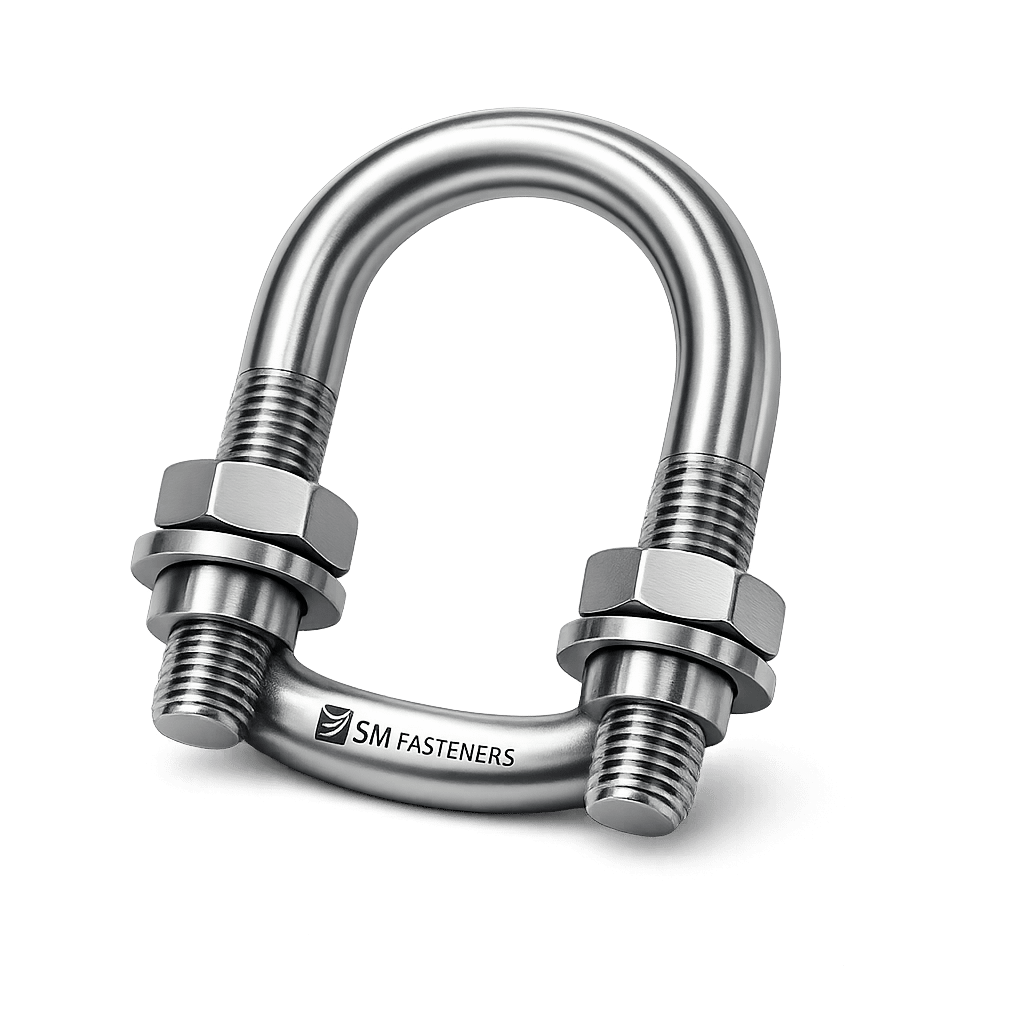
U-bolts are used for:
- Pipe support systems
- Exhaust systems
- Structural clamping
- Cable tray supports
Variants
- Round bend
- Square bend
- Semi-round
- Long tangent
2.6 Dimensional Logic in Fastener Engineering
Fastener geometry directly influences:
- Tensile capacity
- Shear capacity
- Torque transfer
- Fatigue resistance
- Installation clearance
Critical dimensions include:
| Parameter | Description |
|---|---|
| d | Nominal diameter |
| P | Thread pitch |
| s | Head width across flats |
| k | Head height |
| b | Thread length |
| L | Overall length |
2.7 Metric Thread System
Metric threads conform primarily to ISO standards.
Thread designation:
Example:
M20 × 2.5 × 100
Where:
| Parameter | Meaning |
|---|---|
| M | Metric thread |
| 20 | Diameter (mm) |
| 2.5 | Pitch (mm) |
| 100 | Length (mm) |
2.8 UNC & UNF Thread Systems
Unified threads are common in:
- Oil & gas
- OEM equipment
- North American structural systems
UNC Threads
- Coarse pitch
- Better damage resistance
- Faster assembly
UNF Threads
- Fine pitch
- Improved preload precision
- Better fatigue performance
2.9 Thread Forms & Profiles
ISO Metric Thread Geometry
Included angle:
60∘
Characteristics
- Symmetrical V-profile
- Standardized tolerances
- Global interchangeability
Whitworth Threads
Used in legacy British systems.
Characteristics
- 55° thread angle
- Rounded roots and crests
- Improved fatigue resistance
2.10 Thread Tolerance Classes
Thread tolerances ensure interchangeability and coating accommodation.
Metric Tolerance Classes
| Class | Application |
|---|---|
| 6g | External thread standard |
| 6H | Internal thread standard |
| 8g | Loose fit |
| 4h | Precision fit |
2.11 Oversize Tapping for HDG Nuts
Hot dip galvanized nuts require oversize tapping because zinc coating increases thread thickness.
Typical oversize allowance:
| Diameter Range | Oversize Allowance |
|---|---|
| M8–M16 | 0.3 mm |
| M20–M24 | 0.4 mm |
| M27–M36 | 0.5 mm |
This prevents:
- Thread seizure
- Galling
- Improper assembly torque
2.12 Dimensional Specification Table — Metric Hex Bolts
| Size | Pitch (mm) | Head Width s (mm) | Head Height k (mm) | Thread Length b (mm) |
|---|---|---|---|---|
| M6 | 1.0 | 10 | 4 | 18 |
| M8 | 1.25 | 13 | 5.3 | 22 |
| M10 | 1.5 | 16 | 6.4 | 26 |
| M12 | 1.75 | 18 | 7.5 | 30 |
| M16 | 2.0 | 24 | 10 | 38 |
| M20 | 2.5 | 30 | 12.5 | 46 |
| M24 | 3.0 | 36 | 15 | 54 |
| M30 | 3.5 | 46 | 18.7 | 66 |
| M36 | 4.0 | 55 | 22.5 | 78 |
2.13 Heavy Hex Structural Dimensions
| Bolt Size | Heavy Hex Width AF (mm) | Head Height (mm) |
|---|---|---|
| M16 | 27 | 10 |
| M20 | 34 | 13 |
| M24 | 41 | 15 |
| M30 | 50 | 19 |
| M36 | 60 | 23 |
2.14 Thread Standards & Tolerance Comparison
| Thread Type | Standard | Thread Angle | Common Usage |
|---|---|---|---|
| Metric Coarse | ISO 261 | 60° | Global industrial |
| Metric Fine | ISO 261 | 60° | Precision assemblies |
| UNC | ASME B1.1 | 60° | Structural systems |
| UNF | ASME B1.1 | 60° | Dynamic loading |
| BSW | BS 84 | 55° | Legacy UK systems |
| BSF | BS 84 | 55° | Fine British threads |
2.15 Mechanical Property Classes
Metric fasteners use ISO property class systems.
Property Class Meaning
Example:
| Component | Meaning |
|---|---|
| First digit | Tensile strength ÷ 100 |
| Second digit | Yield ratio |
Thus:
- Tensile strength = 800 MPa
- Yield strength = 640 MPa
2.16 Mechanical Properties Table
| Property Class | Tensile Strength (MPa) | Yield Strength (MPa) | Hardness |
|---|---|---|---|
| 4.6 | 400 | 240 | Low |
| 5.8 | 500 | 400 | Medium |
| 8.8 | 800 | 640 | High |
| 10.9 | 1040 | 940 | Very High |
| 12.9 | 1220 | 1100 | Ultra High |
2.17 Proof Load & Tensile Strength Table
| Size | Stress Area (mm²) | Proof Load 8.8 (kN) | Ultimate Tensile Load (kN) |
|---|---|---|---|
| M8 | 36.6 | 17.6 | 29.3 |
| M10 | 58 | 27.8 | 46.4 |
| M12 | 84.3 | 40.5 | 67.4 |
| M16 | 157 | 75.4 | 125.6 |
| M20 | 245 | 117.6 | 196 |
| M24 | 353 | 169.4 | 282.4 |
| M30 | 561 | 269.3 | 448.8 |
2.18 Tightening Torque Table — HDG Bolts
Dry Galvanized Condition
| Size | Grade 8.8 Torque (Nm) | Grade 10.9 Torque (Nm) |
|---|---|---|
| M8 | 25 | 36 |
| M10 | 49 | 70 |
| M12 | 86 | 121 |
| M16 | 210 | 295 |
| M20 | 410 | 580 |
| M24 | 710 | 1000 |
| M30 | 1410 | 1990 |
Lubricated HDG Condition
| Size | Grade 8.8 Torque (Nm) | Grade 10.9 Torque (Nm) |
|---|---|---|
| M8 | 20 | 29 |
| M10 | 39 | 56 |
| M12 | 69 | 97 |
| M16 | 168 | 236 |
| M20 | 328 | 464 |
| M24 | 568 | 800 |
| M30 | 1128 | 1592 |
2.19 Washer Selection Logic
Key Engineering Criteria
| Requirement | Recommended Washer |
|---|---|
| High preload | Hardened washer |
| Structural steel | ASTM F436 |
| Corrosion resistance | HDG flat washer |
| Vibration | Spring washer |
| Angular misalignment | Beveled washer |
2.20 Head Geometry Selection
Hex Head
Preferred for:
- High torque
- Structural joints
- Industrial assembly
Socket Head
Preferred for:
- Compact spaces
- Precision machinery
Countersunk Head
Preferred for:
- Flush surfaces
- Rotating equipment
2.21 Galvanized Thread Compatibility
Critical engineering rule:
Hot dip galvanized external threads must mate only with properly oversized galvanized nuts.
Improper mating causes:
- High installation torque
- Zinc stripping
- Thread seizure
- False preload indication
2.22 Length Selection Criteria
Fastener length must ensure:
- Full nut engagement
- Washer accommodation
- Adequate thread projection
Recommended projection:
- 2–3 threads beyond nut face
2.23 Structural Joint Categories
| Joint Type | Behavior |
|---|---|
| Slip-critical | Friction-based |
| Bearing-type | Bearing load transfer |
| Tension joint | Axial load dominant |
| Combined loading | Shear + tension |
2.24 HDG Fasteners for Offshore Applications
Offshore fasteners require:
- Controlled zinc thickness
- Enhanced corrosion allowance
- NACE compliance where required
- Controlled hardness
- Traceable material certification
Commonly used combinations:
| Base Material | Coating |
|---|---|
| Carbon steel | Hot dip galvanized |
| Alloy steel | HDG + sealant |
| Duplex stainless | Bare/passivated |
2.25 PEEK Fastener Integration
In highly corrosive or electrically sensitive environments, PEEK fasteners may supplement HDG systems.
Typical applications:
- Chemical processing
- Electronic insulation
- Non-metallic assemblies
- High-purity systems
Advantages:
- Non-corrosive
- Electrically insulating
- Lightweight
- Chemical resistant
SM Fasteners supports engineered fastening solutions in both metallic and advanced polymer materials including PEEK for specialized industrial applications.
3. MATERIAL GRADES, HEAT TREATMENT, MANUFACTURING WORKFLOW & SURFACE ENGINEERING
3.1 Material Engineering for Hot Dip Galvanized Fasteners
Material selection is one of the most critical engineering decisions in fastener design because the substrate material directly governs:
- Tensile strength
- Yield performance
- Toughness
- Fatigue resistance
- Weldability
- Corrosion compatibility
- Temperature capability
- Galvanizing behavior
Hot dip galvanizing is primarily applied to:
- Carbon steel
- Low alloy steel
- Structural steel fasteners
However, engineering-grade fastening systems frequently integrate additional material systems for specialized service environments.
3.2 Common Base Materials for HDG Fasteners
Low Carbon Steel
Characteristics
- Excellent formability
- Economical
- Good galvanizing response
- Moderate mechanical strength
Typical Grades
| Standard | Grade |
|---|---|
| ASTM | A307 |
| ISO | Class 4.6 |
| DIN | C15/C20 |
Applications
- Light structural assemblies
- Utility supports
- General construction
- Cable trays
Medium Carbon Steel
Characteristics
- Higher tensile strength
- Good heat treatment response
- Suitable for structural bolting
Typical Grades
| Standard | Grade |
|---|---|
| ASTM | A325 |
| ISO | 8.8 |
| DIN | C35/C45 |
Applications
- Structural steel
- Heavy machinery
- Infrastructure projects
- Bridge assemblies
Alloy Steel
Characteristics
- High strength
- Improved fatigue resistance
- Better toughness
- Heat treatment capability
Typical Grades
| Standard | Grade |
|---|---|
| ASTM | A490 |
| ISO | 10.9 / 12.9 |
| DIN | 42CrMo4 |
Applications
- Heavy engineering
- Dynamic loading
- Wind energy
- Critical bolted joints
3.3 Stainless Steel vs HDG Carbon Steel
Although HDG carbon steel provides economical corrosion resistance, stainless steel is often selected for aggressive environments.
Comparative Engineering Analysis
| Property | HDG Carbon Steel | Stainless Steel 304 | Stainless Steel 316 |
|---|---|---|---|
| Corrosion Resistance | Moderate–High | High | Very High |
| Tensile Strength | Medium–High | Medium | Medium |
| Chloride Resistance | Moderate | Moderate | High |
| Cost | Low | Medium | High |
| Galvanic Risk | Moderate | Low | Low |
| Maintenance | Moderate | Low | Very Low |
3.4 Advanced Materials Supported by SM Fasteners
SM Fasteners manufactures fastening systems in advanced industrial alloys for severe-service environments.
Duplex Stainless Steel
Features
- High strength
- Excellent chloride resistance
- Good SCC resistance
Common Grades
| Grade | Standard |
|---|---|
| Duplex 2205 | UNS S32205 |
| Super Duplex 2507 | UNS S32750 |
Applications
- Offshore platforms
- Desalination plants
- Marine systems
- Chemical processing
Hastelloy Fasteners
Characteristics
- Exceptional acid resistance
- High-temperature capability
- Excellent oxidation resistance
Applications
- Acid processing
- Chemical reactors
- Chlorination systems
Inconel Fasteners
Features
- High-temperature strength
- Oxidation resistance
- Creep resistance
Typical Grades
| Grade | Service Capability |
|---|---|
| Inconel 625 | Corrosive high-temp service |
| Inconel 718 | Aerospace & turbine systems |
Monel Fasteners
Engineering Benefits
- Seawater resistance
- Hydrofluoric acid resistance
- Excellent marine durability
SMO 254 Fasteners
Designed for:
- Chloride-rich environments
- Seawater exposure
- Offshore process systems
3.5 PEEK Fasteners in Corrosion-Critical Systems
PEEK (Polyether Ether Ketone) fasteners are increasingly used where metallic fasteners become unsuitable.
Key Engineering Advantages
| Property | Performance |
|---|---|
| Chemical resistance | Excellent |
| Weight | Very low |
| Electrical insulation | Excellent |
| Corrosion | Non-corrosive |
| Temperature capability | Up to ~260°C |
Typical Applications
- Semiconductor systems
- Chemical plants
- Medical equipment
- Electrical assemblies
- High-purity process systems
3.6 Material Selection Criteria
Material selection must consider:
- Mechanical loading
- Corrosion exposure
- Service temperature
- Installation method
- Regulatory compliance
- Inspection requirements
- Lifecycle cost
3.7 Corrosion Resistance vs Environment Table
| Environment | HDG Steel | SS304 | SS316 | Duplex 2205 | PEEK |
|---|---|---|---|---|---|
| Rural atmosphere | Excellent | Excellent | Excellent | Excellent | Excellent |
| Industrial atmosphere | Very Good | Good | Excellent | Excellent | Excellent |
| Coastal atmosphere | Moderate | Moderate | Excellent | Excellent | Excellent |
| Seawater splash | Limited | Poor | Good | Excellent | Excellent |
| H₂S environment | Controlled use | Moderate | Good | Excellent | Excellent |
| Acidic environment | Poor | Moderate | Good | Excellent | Excellent |
| High purity systems | Poor | Good | Excellent | Excellent | Excellent |
3.8 NACE MR0175 / ISO 15156 Considerations
Oil & gas environments containing H₂S require:
- Hardness control
- Material qualification
- SCC resistance
- Sulfide stress cracking resistance
Critical parameters include:
| Parameter | Requirement |
|---|---|
| Hardness | Controlled maximum |
| Heat treatment | Verified |
| Material chemistry | Traceable |
| Inspection | Documented |
3.9 Heat Treatment Processes
Heat treatment significantly influences:
- Tensile strength
- Hardness
- Toughness
- Fatigue resistance
- Ductility
3.10 Annealing
Purpose
- Softening
- Stress relief
- Improved machinability
Process
Controlled heating followed by slow cooling.
Applications
- Thread machining
- Cold forming preparation
- Residual stress reduction
3.11 Quenching & Tempering
Primary process for high-strength fasteners.
Process Sequence
- Austenitizing
- Rapid quenching
- Tempering
Benefits
- High tensile strength
- Controlled hardness
- Improved toughness
3.12 Spheroidizing
Used for:
- Cold heading wire preparation
- Improved ductility
- Reduced forming load
3.13 Stress Relieving
Applied after:
- Welding
- Machining
- Cold forming
Purpose:
- Residual stress reduction
- Dimensional stability
3.14 Heat Treatment vs Mechanical Properties
| Process | Strength | Toughness | Hardness |
|---|---|---|---|
| Annealing | Low | High | Low |
| Q&T | High | Medium–High | High |
| Stress relieving | Stable | Improved | Controlled |
| Spheroidizing | Low | High | Low |
3.15 Hardness Limitations for HDG Fasteners
Very high hardness materials may experience:
- Liquid metal embrittlement
- Hydrogen-related cracking
- Coating adhesion issues
Typical recommended maximum hardness:
| Property Class | Hardness Consideration |
|---|---|
| 8.8 | Suitable |
| 10.9 | Controlled galvanizing |
| 12.9 | Generally not recommended for HDG |
3.16 End-to-End Manufacturing Workflow
Engineering-grade fastener manufacturing requires strict process control from raw material receipt to dispatch.
3.17 Raw Material Verification
Incoming raw material inspection includes:
- Heat number verification
- Chemical composition
- Mechanical properties
- Mill Test Certificate review
- Visual inspection
Typical documentation:
- EN 10204 3.1
- Heat traceability records
- Supplier approvals
3.18 Wire Rod Preparation
Processes include:
- Pickling
- Descaling
- Spheroidizing
- Lubrication coating
These improve:
- Cold heading quality
- Tool life
- Dimensional accuracy
3.19 Forging Operations
Hot Forging
Used for:
- Large-diameter fasteners
- Heavy hex bolts
- Custom components
Advantages:
- Better grain flow
- Improved structural integrity
Cold Forging
Preferred for:
- High-volume production
- Dimensional precision
- Surface finish quality
3.20 Thread Manufacturing
Thread Rolling
Preferred industrial process.
Advantages
| Benefit | Engineering Impact |
|---|---|
| Grain flow continuity | Higher fatigue strength |
| Work hardening | Improved surface strength |
| Better finish | Lower stress concentration |
Thread Cutting
Used for:
- Large diameters
- Custom threads
- Low-volume manufacturing
3.21 Machining Operations
CNC machining may be used for:
- Special geometries
- Precision tolerances
- Aerospace fasteners
- Large custom studs
3.22 Cleaning Prior to Galvanizing
Critical cleaning stages include:
- Degreasing
- Acid pickling
- Fluxing
- Drying
Purpose:
- Oxide removal
- Surface activation
- Improved zinc adhesion
3.23 Hot Dip Galvanizing Process
Process Overview
Fasteners are immersed in molten zinc at:
445–465°C
The coating forms through metallurgical reaction between:
- Iron
- Zinc
3.24 Zinc Coating Structure
Typical layers:
| Layer | Composition |
|---|---|
| Eta | Pure zinc |
| Zeta | Zinc-iron alloy |
| Delta | Zinc-iron alloy |
| Gamma | Iron-rich alloy |
3.25 Galvanizing Standards
| Standard | Scope |
|---|---|
| ASTM A153 | Hardware galvanizing |
| ASTM F2329 | Threaded fasteners |
| ISO 10684 | HDG threaded fasteners |
| ISO 1461 | General galvanized products |
3.26 Coating Thickness Requirements
| Diameter | Minimum Zinc Thickness |
|---|---|
| < M8 | 40 µm |
| M8–M16 | 50 µm |
| M20–M24 | 65 µm |
| > M24 | 75 µm |
3.27 Surface Finish Comparison Table
| Coating Type | Corrosion Resistance | Thickness | Cost | Typical Use |
|---|---|---|---|---|
| Hot dip galvanized | Excellent | High | Medium | Structural steel |
| Electro zinc | Moderate | Low | Low | Indoor service |
| Mechanical galvanizing | Good | Medium | Medium | High-strength bolts |
| PTFE coating | Excellent | Low | High | Chemical service |
| Dacromet/Geomet | Excellent | Thin | High | Automotive |
| Phosphate | Low | Very thin | Low | Assembly lubrication |
3.28 Duplex Coating Systems
Advanced systems combine:
- Hot dip galvanizing
- Organic topcoat
- PTFE sealing
Benefits:
- Extended corrosion life
- Lower friction
- Improved aesthetics
3.29 Coating Performance vs Environment
| Environment | Recommended Coating |
|---|---|
| Rural outdoor | HDG |
| Marine atmosphere | HDG + sealant |
| Offshore splash zone | Duplex coating |
| Chemical exposure | PTFE |
| High humidity | HDG |
| Abrasive atmosphere | Thick HDG |
3.30 Zinc Coating Life Expectancy
Approximate atmospheric durability:
| Environment | Estimated HDG Life |
|---|---|
| Rural | 50–75 years |
| Urban | 30–50 years |
| Industrial | 20–40 years |
| Coastal | 10–25 years |
3.31 Dimensional Effects of Galvanizing
Hot dip galvanizing increases thread dimensions.
Engineering controls include:
- Oversize nut tapping
- Controlled zinc buildup
- Thread chasing where required
3.32 Galvanizing Defects & Prevention
| Defect | Cause | Prevention |
|---|---|---|
| Excess zinc | Poor drainage | Proper fixturing |
| Bare spots | Surface contamination | Improved cleaning |
| Thread seizure | Thick coating | Oversize tapping |
| Ash inclusions | Bath contamination | Zinc bath control |
| Distortion | Thermal imbalance | Controlled immersion |
3.33 Inspection During Manufacturing
In-process inspections include:
- Dimensional verification
- Thread gauging
- Hardness testing
- Coating thickness testing
- Surface integrity evaluation
3.34 Traceability Systems
Industrial EPC projects require full traceability.
Typical traceability elements:
| Item | Requirement |
|---|---|
| Heat number | Mandatory |
| Batch number | Mandatory |
| Material grade | Mandatory |
| Coating lot | Mandatory |
| Inspection records | Mandatory |
3.35 SM Fasteners Manufacturing Capability
SM Fasteners manufactures hot dip galvanized fastening systems using controlled forging, threading, heat treatment, and coating processes aligned with international industrial standards.
Capabilities include:
- Custom engineering
- Metric and imperial systems
- Structural bolting assemblies
- HDG threaded rods
- Large-diameter anchor bolts
- Specialty alloy fasteners
- PEEK fastening systems
- EPC project documentation support
Manufacturing systems are integrated with:
- ISO 9001 quality management
- MSME-certified industrial operations
- UKAF-aligned quality procedures
- Third-party inspection support
- EN 10204 certification workflows
4. INSPECTION, QUALITY CONTROL, INDUSTRY APPLICATIONS, EXPORT DOCUMENTATION & ENGINEERING TABLES
4.1 Inspection Philosophy for Hot Dip Galvanized Fasteners
Industrial fasteners used in structural, offshore, petrochemical, power generation, and EPC applications require systematic inspection controls to ensure:
- Dimensional conformity
- Mechanical integrity
- Traceability
- Coating compliance
- Long-term service reliability
Hot dip galvanized fasteners are classified as safety-critical components because preload loss, coating failure, or dimensional nonconformance can result in:
- Structural instability
- Joint separation
- Corrosion-induced degradation
- Fatigue failure
- Equipment downtime
Therefore, engineering-grade inspection systems must integrate:
- Incoming inspection
- In-process quality control
- Final dimensional verification
- Mechanical testing
- Coating inspection
- Documentation traceability
4.2 Applicable Inspection Standards
| Standard | Scope |
|---|---|
| ISO 898-1 | Mechanical properties of carbon steel fasteners |
| ASTM F606 | Mechanical testing of fasteners |
| ISO 965 | Thread tolerances |
| ISO 3269 | Acceptance inspection |
| ASTM A153 | Zinc coating inspection |
| ASTM F2329 | HDG threaded fasteners |
| ISO 1461 | Galvanized coating inspection |
| EN 10204 | Material certification |
| ISO 9001 | Quality management system |
4.3 Incoming Raw Material Inspection
Raw material verification is mandatory before production release.
Verification Parameters
| Inspection Parameter | Purpose |
|---|---|
| Heat number verification | Traceability |
| Chemical composition | Alloy conformity |
| Mechanical properties | Strength compliance |
| Surface condition | Manufacturing suitability |
| Diameter verification | Process control |
4.4 Material Test Certificate (MTC) Verification
Industrial procurement specifications typically require:
- EN 10204 3.1 certification
- Heat traceability
- Mechanical test records
- Chemical analysis
For critical projects:
- EN 10204 3.2 certification
- Third-party witness inspection
may be mandatory.
4.5 In-Process Inspection Controls
Manufacturing-stage inspections include:
Cold/Hot Forging Inspection
Verification of:
- Head geometry
- Crack formation
- Fill completeness
- Grain flow consistency
Thread Inspection
Thread conformity is verified using:
- GO gauges
- NO-GO gauges
- Pitch measurement
- Major diameter verification
- Lead accuracy evaluation
4.6 Dimensional Inspection
Critical dimensions inspected include:
| Dimension | Importance |
|---|---|
| Major diameter | Thread compatibility |
| Pitch diameter | Engagement quality |
| Head thickness | Wrench fit |
| Width across flats | Tool compatibility |
| Overall length | Assembly fit |
4.7 Thread Gauge Verification
Metric thread verification typically follows:
| Thread Type | Gauge Standard |
|---|---|
| Metric ISO | ISO 1502 |
| UNC/UNF | ASME B1.2 |
| BSW/BSF | BS 919 |
4.8 Zinc Coating Inspection
Hot dip galvanized coating inspection evaluates:
- Thickness
- Uniformity
- Adhesion
- Surface continuity
- Coating appearance
4.9 Coating Thickness Measurement
Methods include:
| Method | Standard |
|---|---|
| Magnetic thickness gauge | ASTM E376 |
| Microscopic cross-section | ASTM B487 |
| Gravimetric testing | ASTM A90 |
4.10 Zinc Coating Thickness Table
| Fastener Diameter | Minimum Coating Thickness |
|---|---|
| < M8 | 40 µm |
| M8–M16 | 50 µm |
| M20–M24 | 65 µm |
| > M24 | 75 µm |
4.11 Adhesion Testing
Adhesion evaluation ensures metallurgical bonding integrity.
Common methods:
- Hammer test
- Bend test
- Visual inspection after deformation
4.12 Mechanical Testing of Fasteners
Tensile Testing
Tensile tests verify:
- Ultimate tensile strength
- Yield strength
- Elongation
Testing standards:
- ASTM F606
- ISO 898-1
4.13 Proof Load Testing
Proof load testing confirms elastic load capability without permanent deformation.
The proof load relation:
Where:
| Symbol | Meaning |
|---|---|
| Fp | Proof load |
| Sp | Proof stress |
| As | Stress area |
4.14 Hardness Testing
Hardness testing validates heat treatment effectiveness.
Common methods:
| Method | Application |
|---|---|
| Rockwell | Production testing |
| Vickers | Laboratory precision |
| Brinell | Larger sections |
4.15 Wedge Tensile Testing
Used to evaluate:
- Head integrity
- Ductility
- Thread strength
Critical for structural fasteners.
4.16 Impact Testing
Charpy impact testing may be required for:
- Low-temperature service
- Offshore applications
- LNG systems
- Arctic environments
4.17 Nondestructive Testing (NDT)
NDT is essential for critical fasteners.
Magnetic Particle Inspection (MPI)
Detects:
- Surface cracks
- Forging defects
- Heat treatment cracks
Ultrasonic Testing (UT)
Used for:
- Large-diameter studs
- Internal defect detection
Dye Penetrant Testing (PT)
Applicable for:
- Non-magnetic alloys
- Surface crack evaluation
4.18 Positive Material Identification (PMI)
PMI testing verifies alloy chemistry.
Typically used for:
- Duplex fasteners
- Nickel alloys
- Stainless steel
- Critical refinery applications
Methods:
- XRF analysis
- OES spectroscopy
4.19 Hydrogen Embrittlement Control
Although HDG processes reduce hydrogen risk compared with electroplating, high-strength fasteners still require control measures.
Preventive measures include:
- Controlled acid exposure
- Baking procedures where required
- Hardness limitations
- Process monitoring
4.20 Inspection Sampling Plans
Inspection frequency commonly follows:
| Inspection Type | Sampling Standard |
|---|---|
| Dimensional | ISO 3269 |
| Mechanical | ASTM F606 |
| Coating | ASTM A153 |
| NDT | Project specification |
4.21 Calibration Control
Inspection equipment must remain calibrated.
Typical equipment includes:
- Torque wrenches
- Micrometers
- Vernier calipers
- Hardness testers
- Coating gauges
Calibration traceability should align with:
- NABL
- ISO 17025
4.22 Torque Verification & Installation QA
Improper installation is one of the primary causes of fastener failure.
Installation QA includes:
- Torque verification
- Lubrication control
- Washer orientation checks
- Joint surface preparation
- Tightening sequence control
4.23 Torque–Preload Relationship
The preload relationship is affected by friction variation.
Where:
| Symbol | Meaning |
|---|---|
| F | Preload |
| T | Torque |
| K | Nut factor |
| d | Diameter |
4.24 Tightening Torque Chart — HDG Fasteners
Property Class 8.8 — Lubricated Condition
| Size | Torque (Nm) | Approx. Preload (kN) |
|---|---|---|
| M8 | 20 | 13 |
| M10 | 39 | 20 |
| M12 | 69 | 30 |
| M16 | 168 | 57 |
| M20 | 328 | 89 |
| M24 | 568 | 128 |
| M30 | 1128 | 204 |
4.25 Weight Chart — Hex Bolts
Approximate Weights
| Size × Length | Weight/Pc (kg) | Weight/100 Pcs (kg) |
|---|---|---|
| M8 × 50 | 0.025 | 2.5 |
| M10 × 60 | 0.052 | 5.2 |
| M12 × 75 | 0.098 | 9.8 |
| M16 × 100 | 0.235 | 23.5 |
| M20 × 120 | 0.425 | 42.5 |
| M24 × 150 | 0.785 | 78.5 |
| M30 × 180 | 1.580 | 158 |
These values are typically aligned with industrial manufacturing tolerances and procurement weight calculations used by SM Fasteners.
4.26 Surface Finish Performance Comparison
| Surface Finish | Salt Spray Resistance | Abrasion Resistance | Outdoor Life |
|---|---|---|---|
| Electro zinc | Low | Low | Low |
| Hot dip galvanized | High | High | Excellent |
| Mechanical galvanizing | Medium | Medium | Good |
| PTFE coating | Very High | Medium | Excellent |
| Dacromet | High | Medium | Excellent |
4.27 Failure Analysis in HDG Fasteners
Common Failure Modes
| Failure Mode | Root Cause |
|---|---|
| Fatigue fracture | Insufficient preload |
| Thread stripping | Improper engagement |
| SCC | Chloride/H₂S exposure |
| Galling | Poor lubrication |
| Corrosion attack | Inadequate coating |
| Brittle fracture | Improper heat treatment |
4.28 Root Cause Investigation Methods
Engineering failure analysis may include:
- Fractography
- Metallography
- Hardness mapping
- SEM analysis
- Chemical verification
- Coating cross-sections
4.29 Industrial Application Mapping
Construction & Structural Steel
Applications include:
- Beam-column joints
- Transmission towers
- Bridges
- Stadium structures
- Industrial sheds
Preferred standards:
- ASTM A325
- ISO 898 Class 8.8
- ASTM F436 washers
Oil & Gas Industry
Upstream
Used in:
- Drilling structures
- Pipe supports
- Offshore platforms
Midstream
Applications include:
- Pipeline supports
- Compressor stations
- Storage terminals
Downstream
Used in:
- Refineries
- Process skids
- Heat exchangers
- Flanged joints
Petrochemical & Chemical Processing
Critical requirements:
- Corrosion resistance
- Chemical compatibility
- High-temperature stability
Special materials often include:
- Duplex stainless steel
- Inconel
- Hastelloy
- PEEK fasteners
LNG & Offshore Applications
Require:
- Low-temperature toughness
- Chloride resistance
- Traceability
- Third-party inspection
Power Generation Industry
Applications:
- Turbine systems
- Boiler structures
- Cable support systems
- Solar structures
- Wind turbine foundations
Railway & Infrastructure
HDG fasteners are widely used in:
- Signaling systems
- Track support structures
- Electrification assemblies
- Bridge infrastructure
Shipbuilding & Marine Engineering
Marine applications require:
- Corrosion durability
- Salt spray resistance
- Mechanical reliability
Typical solutions:
- HDG heavy hex bolts
- Duplex stainless systems
- Monel fasteners
4.30 Export Packaging Requirements
Industrial export packaging must prevent:
- Corrosion
- Thread damage
- Mixed heat lots
- Transit contamination
4.31 Packaging Methods
Standard Industrial Packaging
| Packaging Type | Application |
|---|---|
| Corrugated cartons | Standard export |
| HDPE bags | Moisture protection |
| Wooden crates | Heavy fasteners |
| Steel pallets | Bulk shipment |
VCI Protection
VCI (Volatile Corrosion Inhibitor) materials provide additional corrosion prevention during:
- Ocean freight
- Long-term storage
- Humid transport conditions
4.32 Thread Protection Systems
Protection methods include:
- Plastic thread caps
- End protectors
- Partition separators
- Oil coatings
4.33 Export Crating Standards
International shipments frequently require:
- ISPM-15 compliant wooden crates
- Heat-treated timber
- Fumigation markings
4.34 Shipping Documentation
Typical EPC export documentation includes:
| Document | Purpose |
|---|---|
| Commercial invoice | Customs clearance |
| Packing list | Shipment verification |
| MTC EN 10204 3.1 | Material traceability |
| Heat treatment report | Mechanical verification |
| Coating report | Galvanizing compliance |
| Inspection report | QA verification |
| Certificate of Conformity | Standards compliance |
4.35 Third-Party Inspection Readiness
Major EPC projects may require inspection agencies such as:
- BV
- DNV
- TUV
- SGS
- Lloyd’s Register
Inspection witness points may include:
- Raw material verification
- Heat treatment
- Galvanizing
- Final inspection
- Packing release
4.36 ISO 9001 Quality System Integration
SM Fasteners operates manufacturing and inspection systems aligned with ISO 9001 quality management principles.
Integrated quality controls typically include:
- Process documentation
- Calibration systems
- Traceability procedures
- Corrective action systems
- Batch inspection records
- Supplier qualification
- Inspection retention records
4.37 Custom Engineering Capability
SM Fasteners supports:
- Special coatings
- Large-diameter bolts
- Custom thread forms
- Project-specific packaging
- EPC documentation packages
- PEEK and specialty alloy fasteners
- Drawings-based manufacturing
4.38 Procurement Considerations for EPC Buyers
Key Evaluation Criteria
| Parameter | Procurement Importance |
|---|---|
| Standards compliance | Critical |
| Traceability | Critical |
| Coating quality | High |
| Delivery reliability | High |
| Documentation | Mandatory |
| Third-party inspection | Project dependent |
| Packaging integrity | High |
4.39 Engineering Summary
Hot dip galvanized fasteners remain one of the most reliable and cost-effective fastening solutions for industrial atmospheric corrosion protection.
Their engineering value derives from:
- Sacrificial zinc protection
- Long-term durability
- Structural reliability
- Broad standards compatibility
- Economic lifecycle performance
Proper specification requires consideration of:
- Material grade
- Property class
- Coating thickness
- Thread tolerance
- Installation torque
- Environmental exposure
- Inspection requirements
Through ISO 9001-aligned manufacturing, traceability systems, advanced material capability, and EPC-focused quality documentation, SM Fasteners supports global industrial procurement requirements for hot dip galvanized fastening systems across construction, oil & gas, offshore, infrastructure, power generation, and heavy engineering sectors.