

Peek Bolt
1. Industry Context — High-Performance Polymer Fastening Systems
Modern industrial assemblies increasingly require non-metallic fastening solutions capable of operating where traditional metallic bolts fail due to:
- Severe corrosion environments
- Electrical insulation requirements
- Magnetic neutrality demands
- Weight reduction objectives
- Chemical processing exposure
- Cleanroom and semiconductor compatibility
PEEK (Polyether Ether Ketone) bolts represent the highest performance class of engineering polymer fasteners.
Unlike commodity plastic fasteners (Nylon, PVC, PP), PEEK bolts provide:
| Requirement | Metallic Bolts | Conventional Plastic | PEEK Bolts |
|---|---|---|---|
| High Temperature Stability | Good | Poor | Excellent |
| Chemical Resistance | Medium | Medium | Outstanding |
| Electrical Insulation | Poor | Excellent | Excellent |
| Structural Load Capability | Excellent | Low | High (Polymer Class) |
| Corrosion Resistance | Coating dependent | Good | Inherent |
| Cleanroom Suitability | Limited | Good | Excellent |
PEEK fasteners are widely specified across:
- Oil & Gas instrumentation
- Semiconductor manufacturing
- Chemical processing equipment
- Offshore electronics
- Medical & aerospace systems
- Power generation insulation assemblies
SM Fasteners manufactures precision PEEK bolts under controlled quality systems aligned with ISO 9001, MSME certification, and UKAF-accredited processes supporting global EPC procurement.
2. Technical Definition — What Is a PEEK Bolt?
A PEEK bolt is a threaded mechanical fastener manufactured from semi-crystalline thermoplastic polymer PEEK, designed to create clamping force between joined components while providing:
- Mechanical retention
- Electrical insulation
- Corrosion immunity
- High temperature performance
Chemical Structure
PEEK belongs to the polyaryletherketone (PAEK) family.
Key molecular features:
- Aromatic backbone → mechanical strength
- Ether linkages → toughness
- Ketone groups → thermal stability
Core Engineering Characteristics
| Property | Typical Value |
|---|---|
| Continuous Service Temperature | 250°C |
| Short-Term Temperature | 300°C |
| Glass Transition Temperature | 143°C |
| Melting Point | 343°C |
| Density | ~1.30 g/cm³ |
| Thermal Expansion | Low for polymer |
| Water Absorption | Extremely Low |
These characteristics allow PEEK bolts to replace stainless steel or titanium fasteners in specialized environments.
3. Functional Role in Mechanical Assemblies
PEEK bolts function through the same preload principle as metallic bolts but within polymer mechanical limits.
Primary Functions
- Maintain joint compression
- Resist vibration loosening
- Electrically isolate assemblies
- Prevent galvanic corrosion
- Enable chemically inert fastening
4. Load Mechanics & Force Behavior
4.1 Bolt Preload Concept
When tightened, a bolt generates clamping force:
Where:
- Fp = preload force
- T = applied torque
- K = nut factor
- d = nominal diameter
PEEK bolts operate at lower preload levels compared with steel bolts because:
- Elastic modulus is lower
- Creep behavior must be considered
- Over-tightening risks polymer deformation
4.2 Elastic Behavior of PEEK vs Steel
| Property | Steel Bolt | PEEK Bolt |
|---|---|---|
| Young’s Modulus | ~210 GPa | ~3.6 GPa |
| Elastic Range | Very High | Moderate |
| Stress Relaxation | Minimal | Considerable |
| Shock Absorption | Low | High |
Engineering Implication:
PEEK bolts provide vibration damping but require conservative torque control.
4.3 Clamping Force Distribution
PEEK bolts behave as:
- Flexible spring elements
- Load isolators
- Thermal expansion compensators
Ideal for assemblies involving:
- Glass
- Ceramics
- Composites
- Electronic housings
5. Torque–Tension Relationship
Torque input converts into preload through frictional interfaces:
- Thread friction (~40–50%)
- Under-head friction (~40%)
- Useful preload (~10–15%)
Because PEEK exhibits higher friction coefficients:
- Lubrication significantly improves preload accuracy.
- Torque scatter increases without lubrication.
6. Joint Design Principles for PEEK Bolts
6.1 Recommended Design Rules
| Parameter | Design Guidance |
|---|---|
| Thread Engagement | ≥ 2 × diameter |
| Clamp Length | Prefer long grip length |
| Washer Use | Recommended |
| Bearing Surface | Smooth & flat |
| Tightening Method | Torque-controlled only |
| Over-Torque Margin | Minimal |
6.2 Creep & Stress Relaxation
PEEK demonstrates viscoelastic behavior.
Design engineers must consider:
- Long-term preload loss
- Elevated temperature creep
- Constant load relaxation
Mitigation methods:
- Use larger bolt sizes
- Add spring washers
- Re-torque after thermal cycling
6.3 Thermal Expansion Compatibility
Coefficient of Thermal Expansion:
| Material | CTE (µm/m·K) |
|---|---|
| Carbon Steel | 12 |
| Stainless Steel | 16 |
| Aluminum | 23 |
| peek bolt | 47 |
PEEK bolts excel when fastening polymer or composite structures where metals would induce stress.
7. Failure Mechanisms in PEEK Bolts
7.1 Creep Rupture
Occurs under sustained load and temperature.
7.2 Shear Failure
Common in undersized fasteners.
7.3 Thread Stripping
Occurs if engagement length insufficient.
7.4 Thermal Softening
Above 250°C continuous exposure.
7.5 Chemical Swelling (Rare)
Only under aggressive solvents at high temperature.
8. Engineering Selection Criteria
| Selection Factor | Engineering Consideration |
|---|---|
| Load Level | Moderate loads only |
| Temperature | Up to 250°C |
| Corrosion | Excellent |
| Electrical Isolation | Required |
| Weight Reduction | Critical |
| Magnetic Sensitivity | Zero magnetic signature |
9. Typical Industrial Use Cases
Aerospace interior structures
Chlorine chemical plants
Semiconductor fabrication tools
Offshore instrumentation panels
LNG insulation systems
10. Product Types & Engineering Variants of PEEK Bolts
PEEK bolts are manufactured in multiple configurations to satisfy structural, electrical, thermal, and chemical service requirements. Unlike metallic fasteners, geometry selection for PEEK bolts is strongly influenced by load distribution and creep resistance.


10.1 Hex Head PEEK Bolts
Primary industrial configuration
Applications:
- Chemical equipment panels
- Instrumentation mounting
- Composite structures
Engineering Advantages:
- Uniform torque transmission
- Large bearing surface
- Compatible with standard tooling
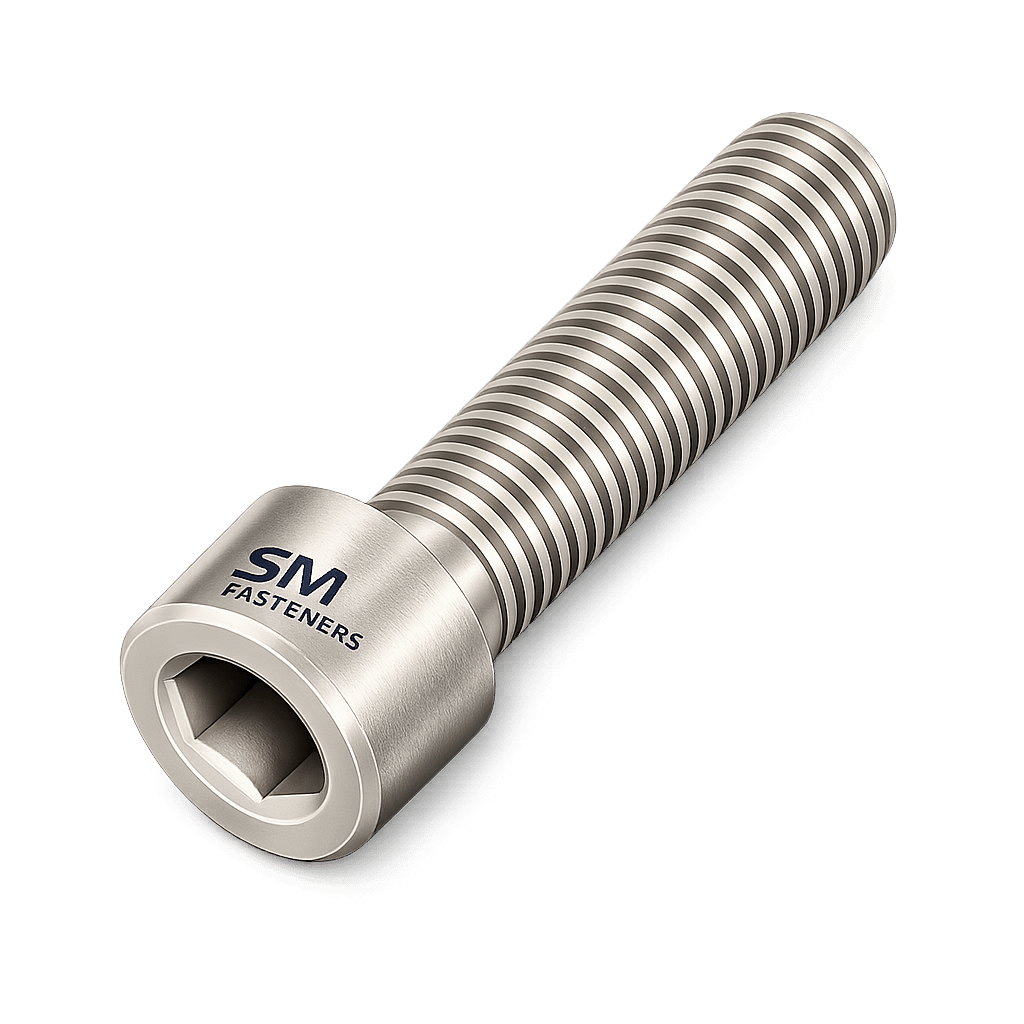
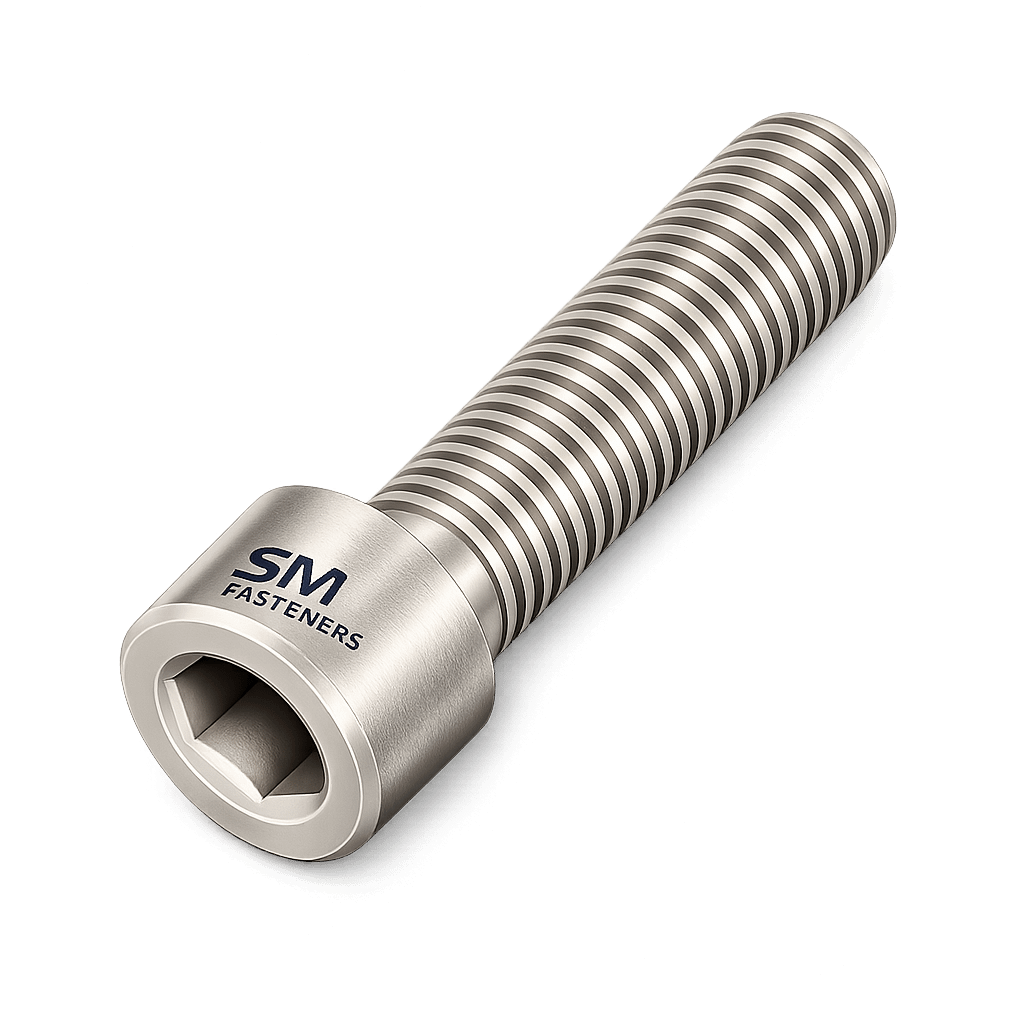
10.2 Socket Head Cap PEEK Bolts
Characteristics:
- Cylindrical head
- Internal hex drive
- High assembly precision
Typical Uses:
- Semiconductor equipment
- Robotics assemblies
- Cleanroom machinery
Engineering Benefit:
- Reduced external profile
- Controlled tightening torque
10.3 Countersunk (Flat Head) PEEK Bolts
Designed for:
- Flush mounting surfaces
- Aerodynamic or hygienic assemblies
Used in:
- Aerospace interiors
- Medical devices
- Electronic housings
10.4 Flanged PEEK Bolts
Features:
- Integrated washer face
- Improved load distribution
Recommended for:
- Polymer-to-polymer joints
- Soft material assemblies
10.5 Fully Threaded PEEK Stud Bolts
Used where:
- Adjustable clamping required
- Limited access assemblies
- Chemical plant fixtures
11. Dimensional Logic & Geometry Design
PEEK bolts follow dimensional standards equivalent to metallic fasteners but require modified engineering interpretation due to polymer mechanics.
Key Geometric Parameters
| Parameter | Engineering Role |
|---|---|
| Nominal Diameter | Load carrying capacity |
| Thread Pitch | Preload control |
| Grip Length | Creep resistance |
| Head Diameter | Bearing stress distribution |
| Thread Engagement | Prevent stripping |
| Root Radius | Fatigue resistance |
Recommended Geometry Adjustments for PEEK
| Design Parameter | Steel Bolt | PEEK Bolt Recommendation |
|---|---|---|
| Engagement Length | 1 × d | 2–2.5 × d |
| Washer Requirement | Optional | Recommended |
| Tightening Margin | Wide | Narrow |
| Bearing Area | Standard | Enlarged preferred |
12. Standard Dimensional Specification Table
(Metric PEEK Hex Bolts — ISO 4014 Equivalent)
| Size | Pitch (mm) | Head Width (s) mm | Head Height (k) mm | Standard Length Range (mm) |
|---|---|---|---|---|
| M3 | 0.5 | 5.5 | 2.0 | 6–30 |
| M4 | 0.7 | 7 | 2.8 | 8–40 |
| M5 | 0.8 | 8 | 3.5 | 10–50 |
| M6 | 1.0 | 10 | 4.0 | 10–80 |
| M8 | 1.25 | 13 | 5.3 | 16–100 |
| M10 | 1.5 | 17 | 6.4 | 20–120 |
| M12 | 1.75 | 19 | 7.5 | 25–150 |
| M16 | 2.0 | 24 | 10 | 30–200 |
SM Fasteners manufactures both standard and custom lengths aligned with EPC drawings.
13. Applicable International Standards
Although PEEK is a polymer material, dimensional compatibility follows established fastener standards.
13.1 ISO Standards
| Standard | Description |
|---|---|
| ISO 4014 | Hex head bolts — partial thread |
| ISO 4017 | Fully threaded hex bolts |
| ISO 4762 | Socket head cap screws |
| ISO 10642 | Countersunk socket screws |
| ISO 965 | Metric thread tolerances |
| ISO 3506 (Reference) | Mechanical property comparison |
13.2 DIN Standards
| DIN Standard | Application |
|---|---|
| DIN 933 | Hex bolts fully threaded |
| DIN 931 | Hex bolts partial thread |
| DIN 912 | Socket head bolts |
| DIN 7991 | Countersunk bolts |
13.3 ASTM Standards (Material & Polymer Reference)
| ASTM Standard | Scope |
|---|---|
| ASTM D6262 | PEEK resin specification |
| ASTM D638 | Tensile testing |
| ASTM D695 | Compression testing |
| ASTM D256 | Impact testing |
13.4 British Standards (BS)
| BS Standard | Application |
|---|---|
| BS 4190 | Metric hex bolts |
| BS 3643 | ISO metric threads |
| BS EN ISO 898 (Reference) | Mechanical property comparison |
14. Thread Standards & Tolerances Table
| Thread System | Standard | Typical Tolerance |
|---|---|---|
| Metric Coarse | ISO 261 | 6g / 6H |
| Metric Fine | ISO 262 | 6g / 6H |
| UNC | ASME B1.1 | 2A / 2B |
| UNF | ASME B1.1 | 2A / 2B |
| BSW | BS 84 | Medium |
| BSF | BS 84 | Medium |
SM Fasteners provides full interchangeability with metallic assemblies where engineering substitution is approved.
15. Dimensional Engineering Considerations Unique to PEEK
15.1 Thread Form Selection
Preferred:
- Metric coarse threads
- UNC threads
Reason:
- Larger flank engagement
- Reduced stripping risk
Avoid:
- Very fine threads under load
15.2 Head Geometry Selection Logic
| Head Type | Load Distribution | Recommended Use |
|---|---|---|
| Hex | Excellent | General industrial |
| Socket | Controlled torque | Precision assemblies |
| Countersunk | Moderate | Flush surfaces |
| Flange | Superior | Soft substrates |
16. Proof Load & Tensile Strength Table (Typical PEEK)
(Values vary by resin grade and fiber reinforcement)
| Size | Tensile Strength (MPa) | Proof Load (kN) | Recommended Working Load (kN) |
|---|---|---|---|
| M4 | 90–100 | 1.2 | 0.6 |
| M5 | 90–100 | 1.9 | 0.9 |
| M6 | 90–100 | 2.8 | 1.4 |
| M8 | 90–100 | 5.0 | 2.5 |
| M10 | 90–100 | 7.8 | 3.8 |
| M12 | 90–100 | 11.5 | 5.5 |
(Engineering reference values; design verification required for critical service.)
17. Mechanical Property Comparison — PEEK vs Metallic Grades
| Property | PEEK | SS304 | A4-80 | Alloy Steel 10.9 |
|---|---|---|---|---|
| Density | 1.3 g/cm³ | 8.0 | 8.0 | 7.8 |
| Tensile Strength | 100 MPa | 520 MPa | 800 MPa | 1040 MPa |
| Modulus | 3.6 GPa | 193 GPa | 193 GPa | 210 GPa |
| Corrosion Resistance | Excellent | Good | Excellent | Coating dependent |
| Electrical Conductivity | Insulator | Conductive | Conductive | Conductive |
| Magnetic Response | None | Slight | None | Magnetic |
18. Engineering Interchangeability Considerations
PEEK bolts may replace metallic fasteners when:
✔ Electrical isolation required
✔ Chemical corrosion severe
✔ Weight reduction important
✔ Temperature within polymer limit
✔ Load demand moderate
Not recommended for:
- Structural steel joints
- High preload flange connections
- High impact dynamic loading
19. SM Fasteners Engineering Capability Integration
SM Fasteners supports:
- Custom PEEK bolt geometries
- CNC precision machining
- Tight tolerance threading
- Drawing-based manufacturing
- OEM substitution engineering
Manufacturing aligns with:
- ISO 9001 certified quality systems
- UKAF-accredited inspection practices
- MSME-recognized industrial production
Medical imaging equipment
20. PEEK Material Grades & Engineering Selection
PEEK fasteners are not a single material category. Industrial performance varies significantly depending on polymer grade, reinforcement system, and processing method.


20.1 Base PEEK Material (Unfilled)
General-purpose engineering grade
Characteristics:
- Excellent chemical resistance
- Electrical insulation
- Cleanroom compatibility
- Low outgassing
- High purity
Typical Applications:
- Semiconductor equipment
- Medical assemblies
- Electrical isolation joints
20.2 Glass Fiber Reinforced PEEK (GF30 PEEK)
Contains ~30% glass fibers.
Engineering Effects:
- Increased stiffness
- Reduced creep deformation
- Improved dimensional stability
- Higher compressive strength
Limitations:
- Reduced impact resistance
- Slightly lower fatigue performance
Applications:
- Chemical reactors
- Pump housings
- Structural polymer assemblies
20.3 Carbon Fiber Reinforced PEEK (CF30 PEEK)
High-performance structural polymer grade.
Advantages:
- Higher modulus
- Improved wear resistance
- Enhanced fatigue strength
- Lower thermal expansion
Applications:
- Aerospace interiors
- Precision mechanical systems
- High-load polymer assemblies
20.4 FDA / Medical Grade PEEK
Features:
- Ultra-low contamination
- Sterilization compatibility
- Biocompatibility
Used in:
- Medical equipment
- Pharmaceutical processing
- Analytical instruments
21. Material Selection Criteria
| Selection Parameter | Unfilled PEEK | GF PEEK | CF PEEK |
|---|---|---|---|
| Strength | Medium | High | Very High |
| Creep Resistance | Moderate | High | Excellent |
| Electrical Insulation | Excellent | Good | Reduced |
| Thermal Stability | Excellent | Excellent | Excellent |
| Wear Resistance | Good | Good | Excellent |
| Cost | High | Higher | Highest |
SM Fasteners assists EPC engineers in material substitution studies when transitioning from metallic fasteners.
22. Mechanical Properties Table — Grade Wise
| Property | Unfilled PEEK | GF30 PEEK | CF30 PEEK |
|---|---|---|---|
| Tensile Strength (MPa) | 90–100 | 140 | 190 |
| Yield Strength (MPa) | 95 | 120 | 165 |
| Elastic Modulus (GPa) | 3.6 | 6.5 | 18 |
| Continuous Temp (°C) | 250 | 260 | 260 |
| Hardness (Rockwell M) | 99 | 102 | 105 |
| Density (g/cm³) | 1.30 | 1.51 | 1.42 |
23. Temperature Capability & Industrial Limits
| Condition | Maximum Recommended |
|---|---|
| Continuous Service | 250°C |
| Intermittent Exposure | 300°C |
| Cryogenic Service | −196°C |
| Steam Exposure | Excellent resistance |
PEEK bolts retain mechanical properties across wide thermal cycles — critical in LNG and power applications.
24. Heat Treatment & Thermal Conditioning
Unlike metallic fasteners, PEEK bolts undergo thermal conditioning rather than hardening heat treatment.
24.1 Annealing Process
Purpose:
- Reduce internal stresses
- Improve dimensional stability
- Enhance creep resistance
Typical Cycle:
- Heat to 200–220°C
- Hold controlled duration
- Slow furnace cooling
Engineering Benefit:
- Prevents post-machining distortion
- Stabilizes threaded geometry
24.2 Crystallinity Control
Mechanical performance depends on crystalline structure.
| Crystallinity Level | Effect |
|---|---|
| Low | Higher toughness |
| Medium | Balanced properties |
| High | Maximum stiffness & temperature resistance |
SM Fasteners controls processing parameters to achieve consistent crystallinity levels.
25. End-to-End Manufacturing Workflow


25.1 Raw Material Verification
Incoming inspection includes:
- Polymer batch certification
- Resin traceability
- Material test certificates
- Supplier qualification audits
Documentation aligned with ISO 9001 quality systems.
25.2 Manufacturing Routes
Method A — CNC Machining (Preferred)
Used for:
- Medium & large diameters
- Precision fasteners
- Custom designs
Advantages:
- Tight tolerance control
- Surface integrity
- Thread accuracy
Method B — Injection Molding
Used for:
- High volume production
- Smaller fasteners
Engineering Consideration:
- Mold shrinkage compensation required.
25.3 Thread Manufacturing
| Method | Suitability |
|---|---|
| Single Point CNC Cutting | High precision |
| Thread Milling | Complex geometry |
| Molded Threads | Mass production |
Thread rolling (common in steel) is generally not used for PEEK.
25.4 Secondary Operations
- Deburring
- Ultrasonic cleaning
- Dimensional calibration
- Lot identification marking
25.5 Traceability System
SM Fasteners maintains:
- Heat/batch number traceability
- Manufacturing traveler records
- Inspection history
- Lot-level identification
26. Surface Engineering & Finishing
PEEK bolts do not require corrosion coatings. However, surface conditioning improves performance.
26.1 Standard Surface Conditions
| Surface Finish | Purpose |
|---|---|
| Natural Machined | Standard industrial use |
| Polished | Cleanroom compatibility |
| Matte | Reduced glare |
| Precision Ground | Tight tolerance assemblies |
27. Surface Finish Performance Comparison
| Finish Type | Friction | Cleanliness | Chemical Resistance | Typical Industry |
|---|---|---|---|---|
| As-Machined | Medium | Good | Excellent | General |
| Polished | Low | Excellent | Excellent | Semiconductor |
| Passivated Clean | Very Low | Ultra Clean | Excellent | Pharma |
| Dry Film Lubricated | Lowest | Good | Excellent | Automation |
28. Chemical & Corrosion Resistance Table
PEEK provides inherent resistance without coatings.
| Environment | Performance |
|---|---|
| Seawater | Excellent |
| Chlorinated Water | Excellent |
| Acids (Dilute) | Excellent |
| Hydrocarbons | Excellent |
| H₂S Service | Compatible |
| Solvents | Very Good |
| UV Exposure | Good |
| Galvanic Corrosion | Immune |
Suitable for NACE MR0175 environments where metallic corrosion risk exists.
29. Failure Prevention Through Material Engineering
Major Risks & Controls
| Risk | Engineering Control |
|---|---|
| Creep | Use reinforced grades |
| Thermal relaxation | Increase clamp length |
| Thread stripping | Increase engagement |
| Over-tightening | Controlled torque |
| Stress concentration | Larger washers |
30. Integration with SM Fasteners Manufacturing Capability
SM Fasteners delivers PEEK bolts under:
- ISO 9001 Quality Management
- MSME certified manufacturing infrastructure
- UKAF-recognized inspection practices
Capabilities include:
- Custom PEEK fastener engineering
- Low-volume prototype to mass production
- Drawing-based EPC manufacturing
- Hybrid assemblies (PEEK + superalloys)
- Advanced materials including SMO 254, Inconel, Hastelloy alongside PEEK solutions
31. Inspection & Quality Control Framework
PEEK fasteners used in EPC, semiconductor, chemical, and offshore projects require verification equal to metallic fasteners, despite being polymer components.
SM Fasteners integrates inspection within an ISO 9001 certified quality management system, ensuring traceability, repeatability, and audit compliance.


6
31.1 Incoming Material Inspection
Verification includes:
- Resin batch certification validation
- Supplier qualification approval
- Polymer identification verification
- Density and melt-flow confirmation
- Visual contamination inspection
Documentation:
- Raw material certificate
- Traceable batch ID
31.2 Dimensional Inspection
Measured Characteristics:
| Parameter | Inspection Method |
|---|---|
| Major Diameter | Digital micrometer |
| Pitch Accuracy | Thread gauge |
| Head Dimensions | Vernier/CMM |
| Straightness | Optical comparator |
| Length Tolerance | Digital height gauge |
Thread tolerances verified per:
- ISO 965
- ASME B1.1
- BS thread standards
31.3 Mechanical Testing
| Test | Standard | Purpose |
|---|---|---|
| Tensile Test | ASTM D638 | Strength verification |
| Compression Test | ASTM D695 | Load capacity |
| Shear Evaluation | Internal procedure | Joint integrity |
| Torque Test | ISO method | Assembly validation |
| Creep Testing | Long-term loading | Service prediction |
31.4 NDT & Advanced Verification
Although polymers do not require metallic NDT, advanced validation includes:
- Ultrasonic defect inspection
- Optical crack inspection
- Density uniformity evaluation
- Dimensional laser scanning
31.5 PMI (Positive Material Identification)
Performed when required for critical projects:
- Polymer grade verification
- Reinforcement identification
- Spectroscopic confirmation
31.6 Documentation & Certification
SM Fasteners supplies complete documentation packages:
- EN 10204 3.1 Material Test Certificate
- Heat / Batch Traceability Report
- Dimensional Inspection Report
- Certificate of Conformance (CoC)
- Heat conditioning records
- Quality release documentation
3.2 third-party inspection supported upon request.
32. Mechanical Properties Table (Engineering Reference)
| Property | Unfilled PEEK | GF30 PEEK | CF30 PEEK |
|---|---|---|---|
| Tensile Strength (MPa) | 95 | 140 | 190 |
| Yield Strength (MPa) | 95 | 120 | 165 |
| Shear Strength (MPa) | 60 | 90 | 120 |
| Elastic Modulus (GPa) | 3.6 | 6.5 | 18 |
| Elongation (%) | 20 | 5 | 2 |
| Continuous Temp (°C) | 250 | 260 | 260 |
33. Tightening Torque Chart (Recommended Values)
Values assume clean threads.
| Size | Dry Torque (Nm) | Lubricated Torque (Nm) |
|---|---|---|
| M4 | 0.5 | 0.4 |
| M5 | 1.0 | 0.8 |
| M6 | 1.8 | 1.4 |
| M8 | 4.0 | 3.2 |
| M10 | 7.0 | 5.5 |
| M12 | 12.0 | 9.5 |
| M16 | 28.0 | 22.0 |
⚠ Torque must be controlled carefully to prevent creep deformation.
34. Torque–Preload Calculation
Engineering Formula
Where:
- F = preload force (N)
- T = torque (Nm)
- K = nut factor (≈0.20 dry, 0.15 lubricated)
- d = nominal diameter (m)
Worked Example — M8 PEEK Bolt
Given:
- Torque = 4 Nm
- Nut factor = 0.20
- Diameter = 0.008 m
Result: Approximate preload = 2.5 kN
Engineering Recommendation:
- Design working load ≤ 50–60% of calculated preload.
35. Corrosion Resistance vs Environment Table
| Environment | PEEK Bolt Performance |
|---|---|
| Seawater | Excellent |
| Offshore Splash Zone | Excellent |
| H₂S / Sour Service | Excellent |
| Chlorine Plants | Outstanding |
| Acids (Dilute) | Excellent |
| Alkalis | Excellent |
| Hydrocarbon Exposure | Excellent |
| Galvanic Systems | Immune |
PEEK bolts eliminate galvanic corrosion between dissimilar metals.
36. Surface Finish Comparison Table
| Finish | Friction | Cleanroom Suitability | Wear Resistance |
|---|---|---|---|
| As-machined | Medium | Good | Good |
| Polished | Low | Excellent | Good |
| Precision ground | Low | Excellent | Very Good |
| Dry-film lubricated | Very Low | Good | Excellent |
37. Thread Standards & Tolerances
| Thread Type | Standard | Tolerance Class |
|---|---|---|
| Metric | ISO 261 / 965 | 6g / 6H |
| UNC | ASME B1.1 | 2A / 2B |
| UNF | ASME B1.1 | 2A / 2B |
| BSW | BS 84 | Medium |
| BSF | BS 84 | Medium |
SM Fasteners ensures compatibility with global assemblies.
38. Weight Chart — PEEK Hex Bolts
(Aligned with SM Fasteners Manufacturing Data)
Density used: 1.30 g/cm³
| Size | Length (mm) | Weight / Piece (g) | Weight / 100 pcs (kg) |
|---|---|---|---|
| M4 | 20 | 0.45 | 0.045 |
| M5 | 25 | 0.80 | 0.080 |
| M6 | 30 | 1.45 | 0.145 |
| M8 | 40 | 3.00 | 0.300 |
| M10 | 50 | 5.80 | 0.580 |
| M12 | 60 | 9.80 | 0.980 |
| M16 | 80 | 22.0 | 2.20 |
Lightweight advantage compared with steel fasteners (~80% weight reduction).
39. Industry Applications Mapping


| Industry | Application |
|---|---|
| Oil & Gas | Instrumentation panels, analyzer systems |
| Petrochemical | Acid service equipment |
| Power Generation | Electrical insulation assemblies |
| Semiconductor | Wafer fabrication tools |
| LNG & Offshore | Anti-corrosion mounting systems |
| Railways | Signal insulation hardware |
| Aerospace | Composite interior fastening |
| Shipbuilding | Electronic housings |
| Medical | MRI compatible assemblies |
40. Failure Mechanisms & Engineering Mitigation
| Failure Mode | Cause | Prevention |
|---|---|---|
| Creep relaxation | High temperature load | Use reinforced PEEK |
| Thread stripping | Low engagement | ≥2× diameter engagement |
| Over-torque damage | Excess tightening | Torque control tools |
| Thermal deformation | Excess heat | Design within limits |
| Stress concentration | Small bearing area | Use washers/flanges |
41. Export Capability & Global Supply Readiness
SM Fasteners supplies PEEK bolts worldwide supporting EPC contractors and OEM procurement programs.
Industrial Packaging
- VCI protective packaging
- Anti-static cleanroom packing
- Thread protection caps
- Moisture barrier sealing
- Batch identification labeling
Export Crating
- ISPM-15 compliant fumigated wooden crates
- Palletized export packing
- Shock-protected cartons
- Long-distance marine shipment preparation
Documentation Package
Supplied with shipments:
- Material Test Certificates (MTC)
- Inspection Reports
- Dimensional Reports
- Certificate of Conformance
- Batch Traceability Records
- Packing List & Commercial Invoice
- Country of Origin Certificate
42. Engineering Selection Summary
PEEK bolts should be selected when:
✔ Chemical corrosion risk is severe
✔ Electrical insulation mandatory
✔ Magnetic neutrality required
✔ Weight reduction critical
✔ Cleanroom or semiconductor service required
✔ Temperatures up to 250°C expected
Avoid use where:
- Structural preload is very high
- Impact loading severe
- Metal-to-metal structural joints required
43. SM FASTENERS — Engineering Manufacturing Positioning
SM Fasteners operates as a precision fastener manufacturer delivering:
- ISO 9001 certified production systems
- MSME recognized manufacturing infrastructure
- UKAF accredited quality framework
- Custom engineered polymer and alloy fasteners
- Advanced materials portfolio including PEEK, Duplex, Super Duplex, Inconel, Hastelloy, Monel, Nickel alloys, and SMO 254
Capabilities include:
- Custom PEEK bolt engineering
- Drawing-based EPC manufacturing
- Prototype-to-volume production
- Global project supply readiness
- Full inspection traceability