

PLOW BOLT
1. Industry Context
Plow bolts are specialized structural fasteners engineered for high-abrasion, flush-surface, heavy-load applications where protruding bolt heads are unacceptable.
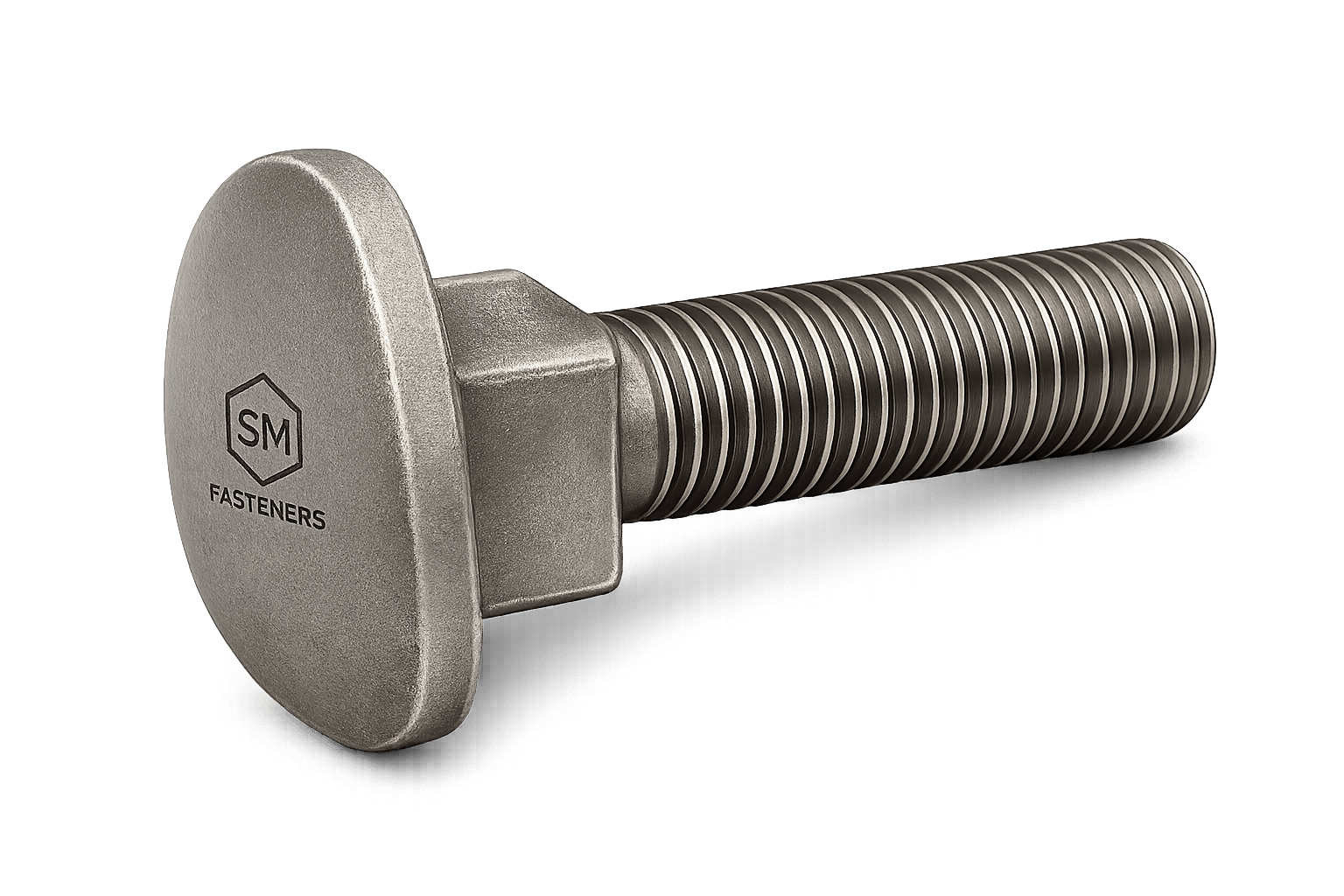
Unlike conventional hex bolts, plow bolts are designed to:
- Maintain surface continuity
- Resist impact and sliding abrasion
- Provide high clamp force under cyclic loading
- Prevent material hang-up in moving assemblies
They are critical fastening solutions across industries involving:
| Industry | Functional Requirement |
|---|---|
| Mining Equipment | Wear plate retention |
| Earthmoving Machinery | Blade and bucket attachment |
| Agriculture | Moldboard plows & cultivators |
| Railways | Track & wear plate fastening |
| Construction | Heavy steel contact surfaces |
| Shipbuilding | Abrasion-resistant deck fittings |
| Oil & Gas | Material handling systems |
| Power Plants | Conveyor & ash handling equipment |
SM Fasteners manufactures plow bolts for global EPC and OEM applications, aligned with ISO 9001 quality systems and export-grade traceability.
2. Technical Definition
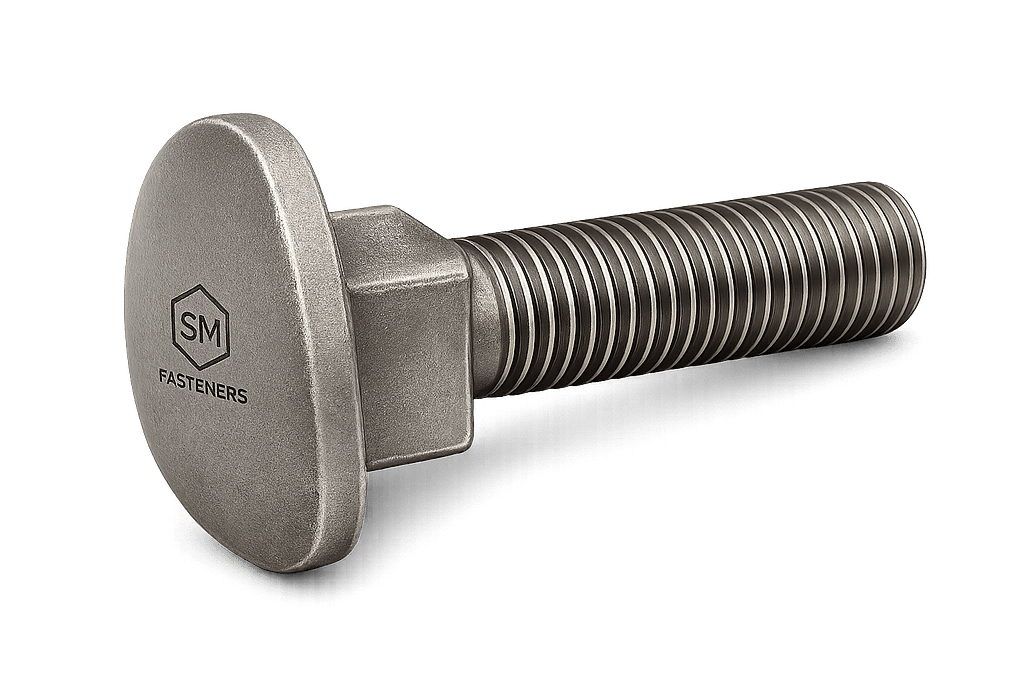
A Plow Bolt is a flat or countersunk head bolt with a square neck beneath the head designed to:
- Seat flush with equipment surfaces.
- Prevent rotation during tightening.
- Transfer load into the parent material.
Key Geometry Elements
- Flat countersunk head (typically 82° or 90°)
- Square neck anti-rotation feature
- Partially or fully threaded shank
- Heavy-duty load transmission design
Functional Principle
The square neck embeds into a matching square hole, allowing tightening from one side — critical for confined industrial assemblies.
3. Functional Role in Assemblies
Plow bolts serve three primary engineering functions:
3.1 Flush Surface Retention
Prevents:
- Material buildup
- Mechanical interference
- Abrasive wear concentration
3.2 High Clamp Force Transfer
Provides stable preload maintaining contact pressure between:
- Wear plate → base structure
- Blade → moldboard
- Liner → chute wall
3.3 Impact Resistance
The countersunk head distributes impact loads into surrounding material rather than concentrating stresses.
4. Load Mechanics & Force Behavior
Plow bolts operate primarily under combined loading conditions.
Applied Loads
| Load Type | Engineering Effect |
|---|---|
| Tensile | Preload generation |
| Shear | Sliding resistance |
| Impact | Shock load absorption |
| Fatigue | Cyclic equipment operation |
| Abrasion | Head surface wear |
4.1 Preload Concept
Fastener performance depends on controlled elastic stretching.
Where:
- = Preload force (N)
- = Torque (Nm)
- = Nut factor (≈0.18–0.22)
- = Nominal diameter (m)
Proper preload ensures:
- No joint separation
- Reduced fatigue stress
- Stable frictional resistance
4.2 Torque–Tension Relationship
Only ~10% of applied torque produces preload.
| Energy Distribution | Percentage |
|---|---|
| Thread friction | 40–50% |
| Under-head friction | 40–45% |
| Useful clamping force | 10–15% |
SM Fasteners applies controlled lubrication and coating processes to stabilize torque coefficients.
4.3 Shear Load Transfer
Unlike shear pins, plow bolts rely on:
- Friction between plates
- Clamp force retention
Shear failure occurs when preload drops below design requirement.
4.4 Countersunk Head Stress Behavior
The head transfers compressive stresses radially.
Benefits:
- Reduced stress concentration
- Improved fatigue life
- Enhanced wear resistance
5. Joint Design Principles
5.1 Countersink Geometry Requirement
Incorrect countersink angles cause:
- Head cracking
- Uneven load distribution
- Premature loosening
Typical match:
| Bolt Head | Countersink |
|---|---|
| 82° | ANSI applications |
| 90° | ISO/DIN equipment |
5.2 Minimum Thread Engagement
| Material | Engagement Length |
|---|---|
| Steel | 1 × diameter |
| Cast Iron | 1.5 × diameter |
| Aluminum | 2 × diameter |
| Polymer / PEEK | 2.5 × diameter |
5.3 Preload Design Rule
Recommended preload:
Ensures:
- Elastic operation
- No yielding
- Maximum fatigue resistance
5.4 Anti-Rotation Mechanics
Square neck prevents rotation by:
- Plastic deformation into mating hole
- Friction locking
- Mechanical interlock
Essential for single-side installation.
5.5 Failure Mechanisms
Fatigue Failure
Occurs under fluctuating loads.
Mitigation:
- Proper preload
- Rolled threads
- Surface finishing control
Shear Failure
Caused by insufficient clamp load.
Hydrogen Embrittlement
Risk in high-strength coated bolts.
SM Fasteners controls:
- Baking procedures
- Coating chemistry
Stress Corrosion Cracking
Relevant in:
- Offshore
- Chemical plants
- Sour service environments
NACE MR0175 compliant materials available.
5.6 Friction & Nut Factor Control
Factors influencing torque accuracy:
- Surface finish
- Coating type
- Lubrication
- Thread tolerance
Typical Nut Factor Values:
| Condition | K Value |
|---|---|
| Dry | 0.22 |
| Zinc plated | 0.20 |
| Phosphate & oil | 0.18 |
| PTFE coated | 0.15 |
5.7 Temperature Effects
Temperature influences preload retention.
| Temperature | Effect |
|---|---|
| <150°C | Minimal loss |
| 200–400°C | Relaxation begins |
| >450°C | Material selection critical |
High-temperature alloys supplied by SM Fasteners include:
- Inconel
- Incoloy
- Hastelloy
- SMO 254
5.8 Role in Abrasion Engineering
Plow bolts are preferred where equipment surfaces must remain smooth:
Examples:
- Snow plows
- Dozer blades
- Conveyor liners
- Crusher wear plates
Flush installation prevents mechanical wear acceleration.
5.9 Engineering Selection Criteria
| Parameter | Design Consideration |
|---|---|
| Load | Tensile + shear |
| Environment | Corrosion exposure |
| Temperature | Alloy selection |
| Maintenance access | One-side tightening |
| Wear level | Head hardness |
| Inspection requirement | Traceability level |
5.10 Integration within SM Fasteners Quality Systems
Manufacturing and engineering design follow:
- ISO 9001 process control
- UKAF audited quality procedures
- Heat traceability systems
- Lot-level documentation
Ensuring procurement readiness for international projects.
6. Product Types & Engineering Variants
Plow bolts are manufactured in multiple configurations to address wear resistance, load transfer, and installation constraints across heavy industrial equipment.
SM Fasteners supplies standardized and custom-engineered variants meeting EPC and OEM specifications.
6.1 Standard Flat Head Plow Bolt
Primary Industrial Configuration
Characteristics
- Flat countersunk head
- Square neck anti-rotation
- Partial thread
- Flush seating capability
Typical Applications
- Dozer blades
- Agricultural plows
- Scraper equipment
- Rail wear plates
6.2 Dome Head Plow Bolt
Designed for applications where slight projection is acceptable but impact resistance is critical.
Features
- Rounded head geometry
- Reduced impact stress concentration
- Enhanced fatigue resistance
Used in:
- Conveyor systems
- Bulk material handling equipment
- Mining liners
6.3 Rib Neck Plow Bolt
Instead of square neck, ribs bite into softer substrates.
Advantages:
- Higher torque resistance
- Improved installation stability in mild steel
- Reduced hole deformation
6.4 Countersunk Heavy-Duty Mining Plow Bolt
Purpose-built for extreme abrasion.
Engineering Enhancements:
- Increased head thickness
- Induction-hardened head surface
- High-strength alloy steel grades
Used in:
- Crusher liners
- Bucket lips
- Dragline systems
6.5 Full Thread Plow Bolt
Provides:
- Adjustable clamping
- Thin material fastening
- Multi-layer assemblies
Preferred where grip length varies.
6.6 Custom Engineered Plow Bolts — SM Fasteners Capability
SM Fasteners supports engineered solutions including:
- Non-standard countersink angles
- Extra-long shank configurations
- Metric/Imperial hybrid designs
- Special head hardness requirements
- PEEK plow bolt variants for corrosion-critical applications
Custom development follows ISO 9001 controlled engineering workflow.
7. Dimensional Logic & Geometry Design
Plow bolt dimensions are governed by functional load transfer, not only thread size.
7.1 Key Geometric Parameters
| Parameter | Engineering Purpose |
|---|---|
| Head Diameter | Load distribution |
| Head Angle | Flush seating |
| Neck Size | Anti-rotation |
| Grip Length | Clamp control |
| Thread Length | Nut engagement |
| Shank Diameter | Shear resistance |
7.2 Countersunk Head Geometry
Standard countersink angles:
| Standard | Angle |
|---|---|
| ANSI | 82° |
| ISO/DIN | 90° |
| Heavy equipment OEM | Custom 100°–120° |
Incorrect angles create localized stresses leading to head failure.
8. Dimensional Specification Table
Metric Plow Bolt Dimensions (Typical Reference)
| Size | Pitch (mm) | Head Dia (mm) | Head Height (mm) | Square Neck (mm) | Thread Length (mm) | Length Range (mm) |
|---|---|---|---|---|---|---|
| M10 | 1.5 | 22 | 6 | 10 | 26 | 30–120 |
| M12 | 1.75 | 26 | 7 | 12 | 30 | 35–150 |
| M16 | 2.0 | 34 | 9 | 16 | 38 | 40–200 |
| M20 | 2.5 | 42 | 11 | 20 | 46 | 50–250 |
| M24 | 3.0 | 50 | 13 | 24 | 54 | 60–300 |
| M30 | 3.5 | 60 | 16 | 30 | 65 | 80–350 |
Dimensions aligned with heavy equipment manufacturing practices and SM Fasteners production standards.
9. Imperial Dimension Reference (UNC Series)
| Size | Threads/Inch | Head Dia (in) | Neck (in) | Typical Length (in) |
|---|---|---|---|---|
| 3/8″ | 16 | 0.87 | 0.375 | 1–4 |
| 1/2″ | 13 | 1.10 | 0.50 | 1.5–6 |
| 5/8″ | 11 | 1.35 | 0.625 | 2–8 |
| 3/4″ | 10 | 1.60 | 0.75 | 2–10 |
| 1″ | 8 | 2.00 | 1.00 | 3–12 |
10. Dimensional Design Engineering Principles
Head Diameter Selection
Larger heads:
- Reduce bearing pressure
- Improve fatigue performance
- Increase wear life
Grip Length Rule
Incorrect grip causes joint relaxation.
Square Neck Design Logic
The neck must resist torque without yielding.
Design condition:
Where torque-induced shear stress must remain below material yield strength.
11. Applicable International Standards
Plow bolts are often application-standardized rather than governed by a single universal specification.
SM Fasteners manufactures according to combinations of:
ISO Standards
| Standard | Scope |
|---|---|
| ISO 898-1 | Mechanical properties |
| ISO 965 | Thread tolerances |
| ISO 261 | Metric threads |
| ISO 4759 | Fastener tolerances |
| ISO 3506 | Stainless steel properties |
ASTM Standards
| Standard | Application |
|---|---|
| ASTM A307 | General carbon steel |
| ASTM A325 | Structural strength |
| ASTM A449 | High-strength bolts |
| ASTM A193 | High temperature service |
| ASTM F568M | Metric mechanical properties |
DIN Standards
| Standard | Scope |
|---|---|
| DIN 608 | Similar carriage/plow configurations |
| DIN 7991 | Countersunk geometry reference |
| DIN 267 | Fastener materials |
| DIN EN ISO 10642 | Countersunk fasteners |
British Standards (BS)
| Standard | Application |
|---|---|
| BS 3692 | Metric precision fasteners |
| BS 4190 | Imperial fasteners |
| BS 1768 | Mechanical properties |
12. Property Class & Strength Systems
Metric Property Classes
| Class | Yield Strength (MPa) | Tensile Strength (MPa) |
|---|---|---|
| 4.6 | 240 | 400 |
| 8.8 | 640 | 800 |
| 10.9 | 940 | 1040 |
| 12.9 | 1100 | 1220 |
ASTM Strength Equivalents
| ASTM Grade | Approx Metric Equivalent |
|---|---|
| A307 | Class 4.6 |
| A325 | Class 8.8 |
| A449 | Class 10.9 |
| A193 B7 | High-temperature equivalent |
13. Thread Standards & Tolerances
Thread System Comparison
| System | Standard | Application |
|---|---|---|
| Metric Coarse | ISO 261 | Global equipment |
| Metric Fine | ISO 965 | Vibration resistance |
| UNC | ASME B1.1 | North America |
| UNF | ASME B1.1 | High preload joints |
| BSW | BS 84 | Legacy equipment |
| BSF | BS 84 | Fine British threads |
Typical Tolerance Classes
| Thread | External | Internal |
|---|---|---|
| Metric | 6g | 6H |
| UNC | 2A | 2B |
| Precision | 4g6g | 4H |
SM Fasteners maintains calibrated thread gauges per ISO 17025 traceability.
14. Interchangeability Considerations
Engineering verification required when substituting standards:
- Head angle differences
- Thread pitch mismatch
- Strength class equivalency
- Coating thickness impact
Incorrect interchangeability may cause:
- Improper seating
- Reduced preload
- Fatigue cracking
15. Weight Chart — SM Fasteners Reference Data
(Approximate values for procurement planning)
| Size | Length (mm) | Weight/Pc (kg) | Weight/100 pcs (kg) |
|---|---|---|---|
| M10×40 | 0.045 | 4.5 | |
| M12×50 | 0.075 | 7.5 | |
| M16×60 | 0.145 | 14.5 | |
| M20×80 | 0.295 | 29.5 | |
| M24×100 | 0.520 | 52 | |
| M30×120 | 0.980 | 98 |
Weights aligned with SM Fasteners production datasets used for export packing calculations.
16. Engineering Selection Matrix
| Requirement | Recommended Variant |
|---|---|
| Severe abrasion | Hardened head plow bolt |
| High tensile load | Class 10.9 / ASTM A449 |
| Corrosive environment | Stainless / Duplex |
| Offshore | Super Duplex / Nickel alloys |
| Chemical exposure | Hastelloy / SMO 254 |
| Electrical insulation | PEEK plow bolts |
17. Integration with Global Procurement Practice
SM Fasteners supports:
- EPC-approved drawings
- Dimensional approval samples
- First article inspection
- Controlled revision documentation
- Lot traceability systems
Ensuring compatibility with international procurement and QA/QC workflows.
18. Material Grades & Engineering Selection Criteria
Material selection for plow bolts is governed by four primary engineering drivers:
- Mechanical strength requirement
- Abrasion and impact resistance
- Environmental corrosion exposure
- Operating temperature range
Because plow bolts operate in high-wear industrial environments, improper material selection is the most common root cause of premature fastener failure.
SM Fasteners manufactures plow bolts across the full industrial metallurgy spectrum to support global EPC and OEM requirements.
18.1 Carbon Steel Grades
Carbon steel remains the most widely specified material for earthmoving and construction applications.
| Standard | Grade | Typical Use |
|---|---|---|
| ASTM A307 | Grade A | General equipment |
| ASTM A325 | Structural | Heavy assemblies |
| ISO 898 | Class 8.8 | Industrial machinery |
| ISO 898 | Class 10.9 | High load joints |
Advantages
- High tensile strength
- Cost efficiency
- Excellent machinability
Limitations
- Requires coating for corrosion protection
18.2 Alloy Steel Grades
Used where high preload retention and fatigue resistance are critical.
Common grades supplied by SM Fasteners:
- ASTM A193 B7
- 4140 / 4340 Alloy Steel
- ISO Property Class 10.9 & 12.9
Applications:
- Mining equipment
- Crusher liners
- Heavy structural machinery
18.3 Stainless Steel Fasteners
For corrosion-critical installations.
| Grade | Standard | Characteristics |
|---|---|---|
| A2-70 | ISO 3506 | General corrosion resistance |
| A4-80 | ISO 3506 | Marine environment |
| 316L | ASTM A193 B8M | Chloride resistance |
Advantages:
- Corrosion resistance
- Reduced maintenance
- Clean service compatibility
18.4 Duplex & Super Duplex Stainless Steel
Required for aggressive environments:
- Offshore platforms
- LNG terminals
- Chemical processing plants
Common grades:
- Duplex 2205
- Super Duplex 2507
- SMO 254
Benefits:
- High yield strength
- Chloride SCC resistance
- Long service life
18.5 Nickel Alloy Fasteners
SM Fasteners supports extreme service environments using advanced alloys:
| Alloy | Service Capability |
|---|---|
| Inconel 625 | High temperature oxidation |
| Incoloy 825 | Acid environments |
| Hastelloy C276 | Chemical resistance |
| Monel 400 | Seawater exposure |
| Nickel 200 | Caustic processing |
18.6 PEEK Plow Bolts (Advanced Polymer Fasteners)
SM Fasteners manufactures PEEK (Polyether Ether Ketone) plow bolts for specialized applications.
Applications include:
- Electrical insulation assemblies
- Chemical reactors
- Semiconductor equipment
- Non-metallic conveyor systems
Properties:
- Continuous service temperature ≈ 260°C
- Chemical inertness
- Lightweight
- Non-magnetic
19. Material Comparison Table
| Material | UTS (MPa) | Yield (MPa) | Corrosion Resistance | Temp Limit | Relative Cost | Typical Application |
|---|---|---|---|---|---|---|
| Carbon Steel 8.8 | 800 | 640 | Low | 300°C | Low | Construction |
| Alloy Steel 10.9 | 1040 | 940 | Low | 400°C | Medium | Mining |
| Stainless 304 | 700 | 450 | Good | 400°C | Medium | General industry |
| Stainless 316 | 800 | 600 | Very Good | 450°C | Medium | Marine |
| Duplex 2205 | 850 | 620 | Excellent | 300°C | High | Offshore |
| Super Duplex | 950 | 750 | Outstanding | 300°C | High | LNG |
| Inconel 625 | 1000+ | 700 | Exceptional | 700°C | Very High | Power/LNG |
| PEEK | 100 | 95 | Excellent | 260°C | High | Electrical/Chemical |
20. Corrosion Resistance vs Environment
| Environment | Carbon Steel | Stainless 304 | 316 | Duplex | Nickel Alloy | PEEK |
|---|---|---|---|---|---|---|
| Atmosphere | Fair | Good | Excellent | Excellent | Excellent | Excellent |
| Seawater | Poor | Moderate | Good | Excellent | Excellent | Excellent |
| Acidic Media | Poor | Fair | Good | Excellent | Outstanding | Excellent |
| H₂S / Sour Service | Poor | Limited | Moderate | Excellent | Excellent | Excellent |
| Chemical Processing | Poor | Good | Excellent | Excellent | Outstanding | Excellent |
| Offshore Splash Zone | Poor | Moderate | Good | Excellent | Excellent | Excellent |
Materials meeting NACE MR0175 / ISO 15156 requirements are available for sour service.
21. Mechanical Properties — Grade Wise
| Property Class | Proof Load (MPa) | Tensile Strength (MPa) | Hardness (HRC) |
|---|---|---|---|
| 4.6 | 225 | 400 | 12–22 |
| 8.8 | 600 | 800 | 22–32 |
| 10.9 | 830 | 1040 | 32–39 |
| 12.9 | 970 | 1220 | 39–44 |
Hardness control is critical to prevent hydrogen embrittlement.
22. Heat Treatment Processes
Heat treatment determines final mechanical performance.
SM Fasteners performs controlled processes under ISO 9001 procedures.
22.1 Normalizing
Purpose:
- Grain refinement
- Uniform microstructure
Used for medium carbon steels.
22.2 Quenching & Tempering
Primary treatment for high-strength plow bolts.
Process:
- Austenitizing
- Rapid quench
- Controlled tempering
Results:
- High tensile strength
- Improved fatigue resistance
- Controlled hardness
22.3 Induction Head Hardening
Common for plow bolts exposed to abrasion.
Benefits:
- Hard wear-resistant head
- Tough ductile shank
Prevents brittle fracture.
22.4 Solution Annealing (Stainless/Duplex)
Ensures:
- Corrosion resistance
- Phase stability
- Removal of residual stress
22.5 Hydrogen Embrittlement Relief Baking
Mandatory for plated high-strength bolts.
Typical procedure:
- 190–220°C baking
- Within 4 hours after plating
23. End-to-End Manufacturing Workflow
SM Fasteners operates a controlled manufacturing sequence ensuring traceability and repeatability.
23.1 Raw Material Verification
Incoming material checks include:
- Mill Test Certificate verification (EN 10204 3.1)
- Chemical composition validation
- Positive Material Identification (PMI)
- Ultrasonic inspection (where required)
23.2 Forging Operations
Preferred process for plow bolts.
Advantages:
- Directional grain flow
- Higher fatigue strength
- Reduced machining waste
Steps:
- Bar cutting
- Heating
- Hot forging of head
- Square neck formation
23.3 Precision Machining
Applied for:
- Custom geometries
- Tight tolerances
- Specialty alloys
CNC machining ensures dimensional accuracy.
23.4 Thread Formation
Thread Rolling (Preferred)
- Cold work hardening
- Improved fatigue resistance
- Smooth surface finish
Thread Cutting
Used for:
- Large diameters
- Exotic alloys
- Low production quantities
23.5 Heat Treatment Execution
Controlled furnaces with:
- Temperature logging
- Batch traceability
- Hardness validation
23.6 Surface Preparation
Before coating:
- Shot blasting
- Pickling
- Degreasing
- Surface activation
Ensures coating adhesion.
24. Surface Finishing & Coating Technologies
Surface engineering extends service life and stabilizes torque values.
24.1 Surface Finish Comparison Table
| Coating | Corrosion Resistance | Torque Stability | Temp Limit | Typical Use |
|---|---|---|---|---|
| Black Oxide | Low | Good | 300°C | Indoor equipment |
| Zinc Plated | Moderate | Good | 120°C | Construction |
| Hot Dip Galvanized | High | Variable | 200°C | Outdoor structures |
| Mechanical Galvanized | High | Good | 200°C | Structural |
| Phosphate & Oil | Moderate | Excellent | 300°C | Mining |
| Dacromet / Geomet | Very High | Excellent | 300°C | Automotive/OEM |
| PTFE Coated | Excellent | Outstanding | 260°C | Chemical |
| Nickel Plating | High | Stable | 400°C | Marine |
| PEEK Coating | Exceptional | Stable | 260°C | Chemical plants |
24.2 Coating Engineering Considerations
Critical factors:
- Coating thickness vs thread tolerance
- Friction coefficient control
- Galvanic compatibility
- Hydrogen embrittlement prevention
SM Fasteners maintains coating qualification records within ISO 9001 documentation systems.
24.3 Lubrication Control
Lubrication stabilizes preload accuracy.
Typical lubricants:
- Wax-based coatings
- Molybdenum disulfide
- PTFE dry film
- Graphite lubricants
25. Manufacturing Traceability System
Each SM Fasteners plow bolt batch maintains:
- Heat number traceability
- Manufacturing route records
- Heat treatment batch ID
- Inspection status identification
Ensuring audit readiness for:
- EPC projects
- Oil & Gas operators
- Third-party inspection agencies
25.1 Integrated Quality Management
Processes aligned with:
- ISO 9001 Quality Management
- UKAF certification requirements
- Controlled document revision
- Calibration traceability
26. Inspection & Quality Control Philosophy
Plow bolts are classified as safety-critical industrial fasteners in heavy equipment, mining, structural, and energy infrastructure. Failure may result in:
- Equipment shutdown
- Structural damage
- Safety hazards
- Production losses
SM Fasteners integrates inspection at every manufacturing stage, ensuring conformity to international standards and EPC procurement specifications.
27. Incoming Material Inspection
Verification Activities
| Inspection | Method | Objective |
|---|---|---|
| Material Certification | EN 10204 3.1 MTC | Chemical compliance |
| Positive Material Identification | PMI (XRF/OES) | Alloy confirmation |
| Visual Inspection | Surface check | Defect detection |
| Ultrasonic Testing | UT | Internal flaw detection |
| Hardness Check | Rockwell/Brinell | Baseline properties |
All raw material heats remain traceable through production.
28. In-Process Dimensional Inspection
Critical parameters monitored:
- Head diameter
- Countersink angle
- Square neck dimension
- Thread pitch accuracy
- Concentricity
- Length tolerance
Inspection equipment includes:
- Digital micrometers
- Optical profile projectors
- Thread plug & ring gauges
- Go/No-Go gauges calibrated under ISO systems
29. Mechanical Testing
Performed according to ISO, ASTM, and customer specifications.
| Test | Standard | Purpose |
|---|---|---|
| Tensile Test | ISO 898-1 | Strength verification |
| Proof Load Test | ASTM F606 | Elastic limit confirmation |
| Hardness Test | ISO 6508 | Heat treatment validation |
| Impact Test | ASTM E23 | Toughness evaluation |
| Wedge Tensile Test | ISO 898 | Head integrity |
30. Non-Destructive Testing (NDT)
Required for critical EPC and Oil & Gas projects.
| Method | Application |
|---|---|
| Magnetic Particle Inspection (MPI) | Surface crack detection |
| Dye Penetrant Testing (DPT) | Stainless alloys |
| Ultrasonic Testing (UT) | Internal defects |
| Eddy Current Testing | Surface integrity |
31. Coating & Surface Verification
Quality checks include:
- Coating thickness measurement
- Adhesion testing
- Salt spray corrosion testing
- Friction coefficient validation
Typical salt spray benchmarks:
| Coating | Corrosion Resistance |
|---|---|
| Zinc Plating | 72–120 hrs |
| HDG | 500+ hrs |
| Geomet/Dacromet | 1000+ hrs |
| PTFE Systems | Chemical resistant |
32. Final Inspection & Traceability
Each shipment undergoes final verification:
- Lot identification marking
- Visual inspection
- Packaging verification
- Documentation review
Traceability includes:
- Heat number
- Batch number
- Manufacturing route
- Inspection records
Integrated under ISO 9001 quality management.
33. Failure Mechanisms & Prevention
33.1 Fatigue Failure
Caused by fluctuating loads.
Mitigation:
- Controlled preload
- Rolled threads
- Smooth head seating
33.2 Shear Failure
Occurs when frictional clamp force is insufficient.
Prevention:
- Correct torque
- Adequate grip length
33.3 Hydrogen Embrittlement
Risk for high-strength plated bolts (>10.9).
SM Fasteners control measures:
- Low hydrogen plating chemistry
- Mandatory baking cycle
33.4 Stress Corrosion Cracking
Critical in chloride or H₂S environments.
Solution:
- Duplex stainless
- Nickel alloys
- NACE MR0175 compliance
34. Industrial Application Mapping
Construction & Structural Steel
- Bridge wear plates
- Heavy steel assemblies
- Earthmoving attachments
Requirements:
- High clamp force
- Galvanized protection
Oil & Gas Industry
Upstream
- Rig floor plates
- Drilling equipment liners
Midstream
- Conveyor systems
- Pipe handling equipment
Downstream
- Refinery material handling systems
Materials supplied:
- A193 B7
- Duplex
- Inconel
- SMO 254
Power Generation
- Coal handling plants
- Ash conveyors
- Turbine service platforms
High-temperature alloys available.
Petrochemical & Chemical Processing
Requires:
- Chemical resistance
- Anti-galling performance
- Controlled friction coatings
LNG & Offshore Installations
Challenges:
- Chloride exposure
- Salt spray
- Thermal cycling
Recommended materials:
- Super Duplex
- Nickel alloys
- PTFE-coated fasteners
Automotive & Heavy Equipment
- Dozer blades
- Excavator buckets
- Agricultural plows
Primary global usage sector for plow bolts.
Railways & Infrastructure
- Track wear components
- Maintenance equipment
- Snow removal systems
Shipbuilding & Marine Engineering
- Deck equipment
- Bulk handling systems
- Abrasion-prone structures
PEEK Plow Bolt Applications
- Electrical insulation panels
- Chemical reactors
- Semiconductor handling equipment
- Corrosion-free assemblies
35. Export Capability & Global Supply Readiness
SM Fasteners supplies plow bolts worldwide supporting EPC contractors and OEM manufacturers.
35.1 Industrial Packaging
| Method | Purpose |
|---|---|
| VCI Packaging | Corrosion prevention |
| Thread Protectors | Damage prevention |
| Oil Wrapping | Marine transport |
| Heat Sealed Bags | Stainless alloys |
35.2 Export Crating
- ISPM-15 compliant wooden crates
- Palletized loads
- Moisture barrier systems
- Container loading plans
35.3 Documentation Package
Provided per shipment:
- Mill Test Certificates (EN 10204 3.1 / 3.2)
- Heat Treatment Reports
- Coating Certificates
- Dimensional Inspection Reports
- NDT Reports
- Certificate of Conformity
- Packing List & Traceability Sheet
Fully aligned with international project procurement requirements.
MANDATORY ENGINEERING TABLES
36. Proof Load & Tensile Strength Table
| Size | Property Class | Proof Load (kN) | Tensile Strength (kN) |
|---|---|---|---|
| M12 | 8.8 | 45 | 60 |
| M16 | 8.8 | 83 | 104 |
| M20 | 10.9 | 145 | 181 |
| M24 | 10.9 | 210 | 262 |
| M30 | 10.9 | 350 | 438 |
37. Tightening Torque Chart
(Approximate Engineering Values)
| Size | Grade | Dry Torque (Nm) | Lubricated Torque (Nm) |
|---|---|---|---|
| M12 | 8.8 | 85 | 65 |
| M16 | 8.8 | 210 | 160 |
| M20 | 10.9 | 420 | 320 |
| M24 | 10.9 | 720 | 540 |
| M30 | 10.9 | 1450 | 1080 |
38. Preload Calculation — Worked Example
Given
- Bolt: M20 Class 10.9
- Torque = 420 Nm
- Nut Factor = 0.20
Recommended preload ≈ 70% proof load → Safe elastic operation.
39. Thread Standards & Tolerance Table
| Thread Type | Standard | Tolerance |
|---|---|---|
| Metric Coarse | ISO 261 | 6g/6H |
| Metric Fine | ISO 965 | 6g/6H |
| UNC | ASME B1.1 | 2A/2B |
| UNF | ASME B1.1 | 2A/2B |
| BSW | BS 84 | Medium fit |
| BSF | BS 84 | Fine fit |
40. Surface Finish Performance Comparison
| Finish | Corrosion Protection | Torque Consistency | Maintenance Need |
|---|---|---|---|
| Black Oxide | Low | High | High |
| Zinc | Moderate | Good | Medium |
| HDG | High | Variable | Low |
| Geomet | Very High | Excellent | Low |
| PTFE | Excellent | Outstanding | Minimal |
| Nickel | High | Stable | Low |
41. Weight Chart — SM Fasteners Reference
| Size | Length | Weight/Piece (kg) | Weight/100 pcs (kg) |
|---|---|---|---|
| M12×50 | 0.075 | 7.5 | |
| M16×60 | 0.145 | 14.5 | |
| M20×80 | 0.295 | 29.5 | |
| M24×100 | 0.520 | 52 | |
| M30×120 | 0.980 | 98 |
Used for logistics planning and container optimization.
42. Engineering Selection Workflow
Step 1 — Define Load
- Tensile
- Shear
- Impact
Step 2 — Environment
- Marine
- Chemical
- High temperature
- Sour service
Step 3 — Material Selection
Using material comparison tables.
Step 4 — Surface Engineering
Based on corrosion exposure.
Step 5 — Certification Level
- Standard industrial
- EPC project
- Third-party inspected
43. SM FASTENERS — ENGINEERING & GLOBAL SUPPLY POSITION
SM Fasteners demonstrates capability through:
- ISO 9001 certified manufacturing systems
- UKAF accredited quality procedures
- MSME registered industrial manufacturing base
- Advanced metallurgy capability including PEEK and Nickel alloys
- Full dimensional and mechanical inspection systems
- Custom fastener engineering and drawing development
- Export-ready packaging and documentation compliance
The organization supports global EPC contractors, OEM manufacturers, and industrial asset owners requiring technically compliant plow bolt solutions with verified quality assurance and reliable supply continuity.