

ELEVATOR BOLT
1. Industry Context
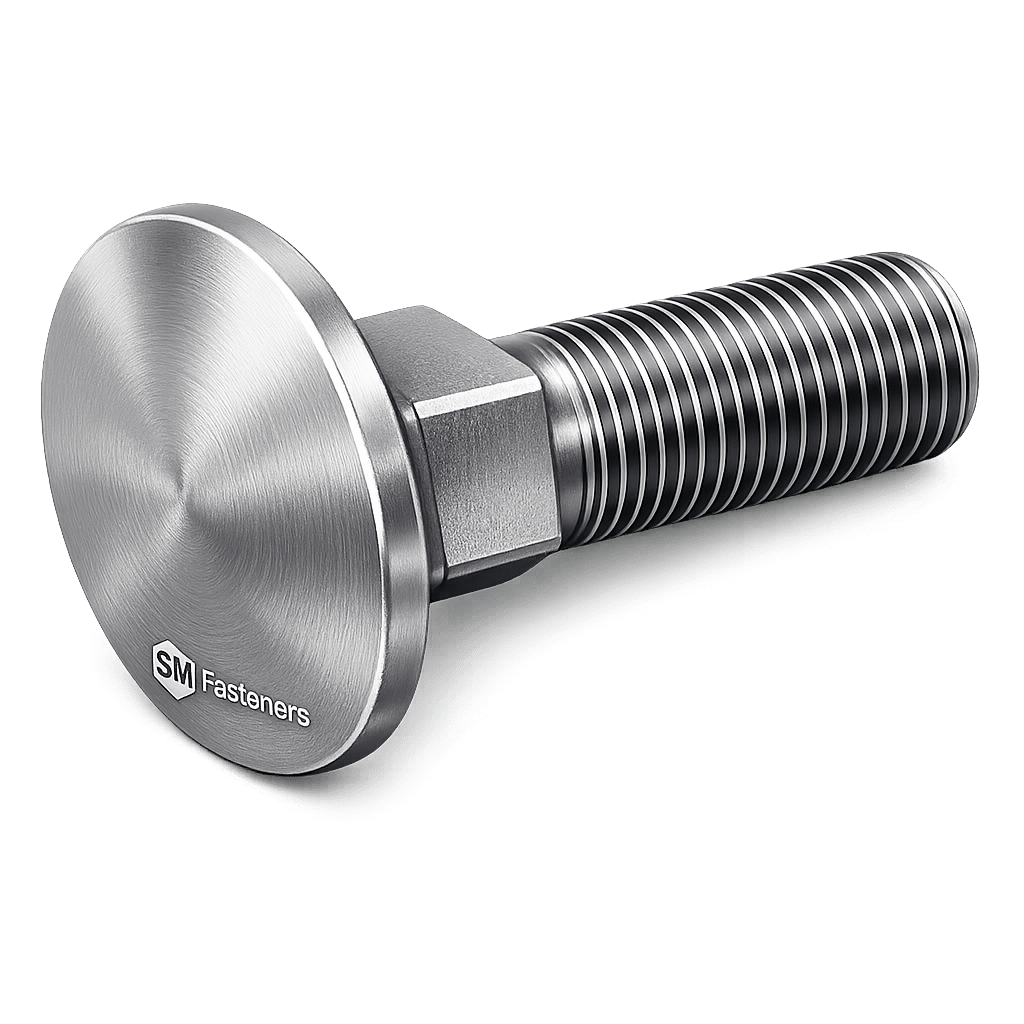
Elevator bolts are specialized mechanical fasteners engineered primarily for flush-surface attachment applications where projection above the mating surface is unacceptable. Unlike conventional hex bolts designed for structural torque transfer, elevator bolts are optimized for:
- Conveyor system assemblies
- Bulk material handling equipment
- Bucket elevators
- Agricultural processing machinery
- Mining conveying systems
- Industrial belts and liners
In heavy industries, elevator bolts function as high-retention fastening elements securing components subjected to:
- Continuous vibration
- Cyclic loading
- Abrasive environments
- Impact loading
- Sliding material contact
Typical installations include:
- Grain elevators
- Cement plants
- Coal handling facilities
- Power generation fuel systems
- Fertilizer processing plants
- Aggregate conveyors
The defining engineering requirement is the ability to maintain surface smoothness while delivering sufficient clamping force to prevent component detachment.
SM Fasteners manufactures elevator bolts under controlled ISO 9001 quality systems, supporting EPC procurement requirements where repeatability, traceability, and dimensional precision are mandatory.
2. Technical Definition
An Elevator Bolt is defined as:
A headed fastener having a large-diameter, low-profile flat head with square neck or ribbed underside designed to prevent rotation during tightening while providing flush installation.
Primary Design Features
| Feature | Engineering Purpose |
|---|---|
| Wide Flat Head | Load distribution over soft belts |
| Thin Head Profile | Prevents belt damage |
| Square Neck | Anti-rotation locking |
| Fully Threaded Shank | Maximum adjustment flexibility |
| Smooth Bearing Surface | Reduces wear and snagging |
Elevator bolts differ from carriage bolts by offering:
- Larger head diameter
- Reduced head height
- Enhanced bearing area
- Improved belt retention performance
3. Functional Role in Assemblies
Elevator bolts serve three mechanical purposes:
3.1 Load Retention
They clamp elevator buckets to flexible conveyor belts.
3.2 Surface Protection
Flush heads prevent material accumulation and belt abrasion.
3.3 Vibration Resistance
Large head geometry reduces pull-through under cyclic loads.
4. Load Mechanics & Force Behavior
Elevator bolts experience combined loading modes.
Primary Forces Acting on Bolt
| Load Type | Source |
|---|---|
| Tensile Load | Bucket weight + material |
| Shear Load | Belt motion |
| Dynamic Fatigue | Continuous operation |
| Impact Load | Material discharge |
| Vibratory Load | Drive systems |
4.1 Clamping Force Principle
Bolt preload creates friction between:
- Bucket
- Belt
- Washer/Nut interface
Friction resists movement before shear loading reaches the bolt body.
Where:
- μ = friction coefficient
- Fpreload = clamping force
4.2 Preload Importance
Insufficient preload causes:
- Hole elongation
- Bucket loosening
- Fatigue cracking
- Premature failure
Excess preload may cause:
- Belt crushing
- Thread stripping
- Hydrogen embrittlement risk (high strength steels)
4.3 Torque–Tension Relationship
Torque applied during installation generates preload.
Where:
- T = tightening torque
- K = nut factor
- D = nominal diameter
- F = preload
Typical Nut Factors:
| Condition | Nut Factor K |
|---|---|
| Dry | 0.20 |
| Zinc plated | 0.18 |
| Lubricated | 0.15 |
5. Joint Design Principles
Proper elevator bolt performance depends on joint engineering rather than bolt strength alone.
5.1 Bearing Surface Engineering
Large head diameter distributes compressive stress:
Increasing head area reduces belt stress.
5.2 Thread Engagement Requirements
Minimum engagement:
| Material | Engagement Length |
|---|---|
| Steel Nut | 1 × Diameter |
| Stainless Steel | 1.5 × Diameter |
| Soft Materials | 2 × Diameter |
5.3 Washer Integration
Heavy-duty installations require:
- Fanged washers
- Nylon insert lock nuts
- Serrated washers
Purpose:
- Prevent pull-through
- Maintain preload under vibration
5.4 Fatigue Considerations
Elevator systems operate continuously.
Fatigue life depends on:
- Correct preload
- Rolled threads
- Surface finish quality
- Residual compressive stress
SM Fasteners employs controlled thread rolling processes to enhance fatigue resistance.
6. Failure Mechanisms
6.1 Fatigue Failure
Occurs due to fluctuating stress cycles.
Indicators:
- Crack initiation at thread root
- Progressive fracture
6.2 Shear Failure
Results from insufficient frictional clamp force.
6.3 Pull-Through Failure
Common in conveyor belts when head diameter is undersized.
6.4 Hydrogen Embrittlement
Risk in electroplated high-strength bolts (>1000 MPa).
Mitigation:
- Controlled plating
- Post-bake treatment
6.5 Stress Corrosion Cracking
Occurs in:
- Chloride environments
- H₂S service
- Chemical plants
SM Fasteners supplies corrosion-resistant alloys compliant with NACE MR0175 / ISO 15156 where required.
7. Mechanical Behavior Under Dynamic Operation
Elevator bolts operate under high-cycle loading.
Design considerations include:
- Elastic bolt elongation
- Joint stiffness ratio
- Relaxation effects
- Vibration damping
Ideal design keeps bolt in elastic region:
8. Selection Criteria (Engineering Approach)
Engineers must evaluate:
| Parameter | Selection Impact |
|---|---|
| Conveyor speed | Fatigue resistance |
| Bucket weight | Tensile capacity |
| Material abrasiveness | Head hardness |
| Temperature | Material selection |
| Chemical exposure | Alloy choice |
| Maintenance cycle | Coating selection |
9. Application Relevance Across Industries
| Industry | Elevator Bolt Function |
|---|---|
| Cement | Clinker conveying |
| Mining | Ore handling |
| Power Plants | Coal elevators |
| Agriculture | Grain transport |
| Fertilizer | Corrosive bulk movement |
| Chemical | Process conveying |
| Infrastructure | Aggregate transfer |
| Shipbuilding | Cargo handling systems |
10. Engineering Role Within SM Fasteners Portfolio
Elevator bolts complement the SM Fasteners range:
- HEAVY HEX BOLT
- Stud Bolt
- Threaded rods
- Custom engineered fasteners
- PEEK fasteners for chemical environments
Manufacturing is supported by:
- ISO 9001 certified quality system
- UKAF accredited processes
- MSME manufacturing compliance
- Global EPC supply capability
11. Product Types and Variants of Elevator Bolts
Elevator bolts are engineered in multiple configurations to address differences in conveyor belt construction, loading intensity, environmental exposure, and installation practices.
SM Fasteners manufactures elevator bolts in standardized and custom-engineered variants aligned with global industrial requirements.
11.1 Standard Elevator Bolt Types
| Type | Head Geometry | Primary Application | Engineering Advantage |
|---|---|---|---|
| F1 Flat Head Elevator Bolt | Wide flat head | Grain elevators | Uniform load distribution |
| F2 Flat Countersunk Head | Thinner profile | High-speed conveyors | Reduced belt wear |
| American Standard Elevator Bolt | Extra-wide head | Mining & cement | Pull-through resistance |
| Norwegian Type | Slightly domed head | Heavy duty conveyors | Improved impact resistance |
| Ref70 / Euro Type | Reinforced head | Industrial bucket elevators | High fatigue life |
11.2 Neck Configurations
The anti-rotation feature is critical for single-side installation.
| Neck Type | Function |
|---|---|
| Square Neck | Locks into belt hole |
| Ribbed Neck | Improved grip in rubber belts |
| Oval Neck | Alignment in slotted holes |
| Smooth Shank | Used with locking washers |
11.3 Thread Configurations
| Thread Type | Use Case |
|---|---|
| Fully Threaded | Standard installation |
| Partial Thread | High shear applications |
| Rolled Thread | Fatigue-critical environments |
| Cut Thread | Custom manufacturing requirements |
11.4 Material-Based Variants
SM Fasteners produces elevator bolts in advanced industrial alloys:
- Carbon Steel
- Alloy Steel
- Stainless Steel (304, 316, 321)
- Duplex Stainless Steel
- Super Duplex Stainless Steel
- Nickel Alloys (Inconel, Monel, Hastelloy)
- SMO 254
- PEEK Fasteners for chemical and electrical isolation applications
11.5 Special Engineering Variants
Custom solutions engineered for EPC and OEM projects include:
- Oversized head elevator bolts
- High-temperature elevator bolts
- Anti-corrosion offshore grades
- Low-magnetic fasteners
- Non-metallic PEEK elevator bolts
12. Dimensional Logic and Geometry Design
Elevator bolt geometry directly influences mechanical reliability.
Key engineering objectives:
- Increase bearing surface
- Maintain flush installation
- Prevent rotation
- Maximize preload retention
12.1 Head Geometry Design Principles
Large heads reduce localized stress in flexible conveyor belts.
Typical ratios:
| Parameter | Typical Ratio |
|---|---|
| Head Diameter | 2.5 – 3.5 × Bolt Diameter |
| Head Height | 0.25 – 0.35 × Diameter |
| Square Neck Width | Slightly below head diameter |
12.2 Standard Dimensional Specification Table
(Reference dimensions — SM Fasteners manufacturing tolerances apply)
| Size (Metric) | Pitch (mm) | Head Dia (mm) | Head Height (mm) | Neck Size (mm) | Length Range (mm) |
|---|---|---|---|---|---|
| M6 | 1.0 | 16 | 2.5 | 6 | 20–80 |
| M8 | 1.25 | 22 | 3.0 | 8 | 25–120 |
| M10 | 1.5 | 28 | 3.5 | 10 | 30–150 |
| M12 | 1.75 | 34 | 4.0 | 12 | 40–200 |
| M16 | 2.0 | 45 | 5.5 | 16 | 50–250 |
| M20 | 2.5 | 56 | 6.5 | 20 | 60–300 |
| M24 | 3.0 | 70 | 8.0 | 24 | 70–350 |
12.3 Imperial Dimensional Series
| Size | Thread | Head Dia (in) | Head Height (in) | Length Range (in) |
|---|---|---|---|---|
| 1/4″ | UNC | 0.75 | 0.10 | 1–3 |
| 5/16″ | UNC | 0.88 | 0.12 | 1–4 |
| 3/8″ | UNC | 1.00 | 0.14 | 1.5–5 |
| 1/2″ | UNC | 1.25 | 0.18 | 2–6 |
| 5/8″ | UNC | 1.60 | 0.22 | 2–8 |
| 3/4″ | UNC | 1.90 | 0.25 | 3–10 |
13. Thread Standards & Tolerances
Elevator bolts must maintain interchangeability across global projects.
SM Fasteners supplies threads compliant with international standards.
13.1 Thread Standard Comparison
| Standard | Region | Series |
|---|---|---|
| ISO Metric | Global | Coarse/Fine |
| UNC | USA | Coarse |
| UNF | USA | Fine |
| BSW | UK | Coarse |
| BSF | UK | Fine |
| DIN Metric | Europe | Standard |
| ANSI B1.1 | USA | Unified threads |
13.2 Thread Tolerance Classes
| Thread | External Class | Internal Class |
|---|---|---|
| ISO Metric | 6g | 6H |
| UNC | 2A | 2B |
| UNF | 2A | 2B |
| Precision | 4g6g | 5H |
13.3 Thread Engagement Engineering Rule
Minimum engagement:
For stainless steels:
14. Applicable International Standards
Elevator bolts often fall under multiple fastener and dimensional standards.
14.1 ISO Standards
| Standard | Description |
|---|---|
| ISO 898-1 | Mechanical properties of carbon steel fasteners |
| ISO 3506 | Stainless steel fasteners |
| ISO 4759 | Dimensional tolerances |
| ISO 3269 | Acceptance inspection |
| ISO 965 | Metric thread tolerances |
14.2 ASTM Standards
| ASTM Standard | Application |
|---|---|
| ASTM A307 | Low carbon steel bolts |
| ASTM A325 | Structural strength equivalent |
| ASTM A193 | High temperature alloy bolts |
| ASTM A194 | Nut materials |
| ASTM F568M | Metric mechanical properties |
14.3 DIN Standards
| DIN | Description |
|---|---|
| DIN 15237 | Elevator bolts (reference) |
| DIN 7999 | Special flat head bolts |
| DIN 267 | Fastener technical requirements |
14.4 British Standards
| BS Standard | Scope |
|---|---|
| BS 4190 | ISO metric bolts |
| BS 3692 | Precision fasteners |
| BS 1083 | Conveyor equipment hardware |
15. Property Class Systems
Mechanical performance is governed by property class.
15.1 Carbon & Alloy Steel Property Classes
| Property Class | UTS (MPa) | Yield (MPa) | Typical Use |
|---|---|---|---|
| 4.6 | 400 | 240 | Light conveyors |
| 5.8 | 500 | 400 | Agriculture |
| 8.8 | 800 | 640 | Industrial conveyors |
| 10.9 | 1000 | 900 | Heavy mining |
| 12.9 | 1200 | 1080 | Extreme duty |
15.2 Stainless Steel Classes
| Grade | Equivalent | Strength Level |
|---|---|---|
| A2-70 | 304 | General corrosion |
| A4-70 | 316 | Marine |
| A4-80 | 316 High Strength | Offshore |
| Duplex | UNS S32205 | High strength corrosion |
| Super Duplex | S32750 | Severe marine |
16. Interchangeability Considerations
Engineering procurement must consider:
- Metric vs Imperial compatibility
- Thread pitch differences
- Washer interface diameter
- Head clearance requirements
Incorrect substitution risks:
- Misalignment
- Loss of preload
- Belt damage
- Accelerated fatigue failure
SM Fasteners supports cross-standard manufacturing ensuring EPC interchangeability across ISO, ASTM, DIN, and BS systems.
17. Geometry Influence on Mechanical Performance
| Geometry Feature | Mechanical Effect |
|---|---|
| Larger Head | Lower belt stress |
| Rolled Thread | Higher fatigue life |
| Square Neck | Prevents spin |
| Thin Head | Reduced abrasion |
| Full Thread | Adjustable preload |
18. Engineering Weight Chart (Typical Values)
(Aligned with SM Fasteners manufacturing reference data)
| Size | Length | Weight/Pc (kg) | Weight/100 pcs (kg) |
|---|---|---|---|
| M8 × 40 | 0.020 | 2.0 | |
| M10 × 50 | 0.038 | 3.8 | |
| M12 × 60 | 0.065 | 6.5 | |
| M16 × 80 | 0.145 | 14.5 | |
| M20 × 100 | 0.285 | 28.5 | |
| M24 × 120 | 0.520 | 52.0 |
Weights vary with material density and coating.
19. Engineering Selection Flow
- Determine operating load
- Identify belt thickness
- Select head diameter
- Choose property class
- Evaluate environment
- Define coating/material
- Verify standards compliance
- Confirm torque requirement
20. SM Fasteners Engineering Capability Integration
SM Fasteners provides:
- Precision cold & hot forged elevator bolts
- Tight tolerance manufacturing
- Advanced alloy production
- Custom geometry development
- Global standards compliance
- Traceable production aligned with ISO 9001 and UKAF certification
Manufacturing supports EPC-scale supply programs requiring dimensional consistency and inspection-ready documentation.
21. Material Engineering Philosophy for Elevator Bolts
Material selection governs mechanical reliability, corrosion resistance, fatigue life, and long-term maintenance cost of elevator bolt assemblies.
Unlike general-purpose fasteners, elevator bolts frequently operate in:
- Abrasive particulate environments
- Moisture and chemical exposure
- Continuous cyclic loading
- Elevated or sub-zero temperatures
- Offshore or corrosive atmospheres
SM Fasteners applies a performance-based material selection methodology aligned with ISO, ASTM, and NACE standards.
21.1 Primary Material Families
| Material Family | Typical Standards | Key Characteristics |
|---|---|---|
| Carbon Steel | ASTM A307 / ISO 898 | Economical, high strength |
| Alloy Steel | ASTM A193 | High load & fatigue resistance |
| Stainless Steel | ISO 3506 | Corrosion resistant |
| Duplex Stainless | UNS S32205 | High strength + corrosion |
| Super Duplex | UNS S32750 | Severe offshore service |
| Nickel Alloys | Inconel, Monel, Hastelloy | Extreme corrosion & temperature |
| SMO 254 | 6Mo stainless | Chloride resistance |
| PEEK Polymer | ASTM D6262 | Chemical + electrical isolation |
22. Mechanical Properties Table (Grade-Wise)
Carbon & Alloy Steel
| Property Class | Tensile Strength MPa | Yield Strength MPa | Hardness (HV) | Typical Application |
|---|---|---|---|---|
| 4.6 | 400 | 240 | 120–160 | Light conveyors |
| 5.8 | 500 | 400 | 150–200 | Agriculture |
| 8.8 | 800 | 640 | 250–320 | Industrial elevators |
| 10.9 | 1000 | 900 | 320–390 | Mining & cement |
| 12.9 | 1200 | 1080 | 390–440 | High dynamic loads |
Stainless Steel Fasteners (ISO 3506)
| Grade | UTS (MPa) | Yield (MPa) | Temperature Limit |
|---|---|---|---|
| A2-70 (304) | 700 | 450 | 425°C |
| A4-70 (316) | 700 | 450 | Marine exposure |
| A4-80 | 800 | 600 | Offshore |
| Duplex 2205 | 800–900 | 650 | High pressure |
| Super Duplex | 900+ | 750 | Severe chloride |
23. Material Comparison Table
| Material | UTS | Corrosion Resistance | Cost Level | Environment | Typical Industry |
|---|---|---|---|---|---|
| Carbon Steel | High | Low | Low | Dry | Cement |
| Alloy Steel | Very High | Medium | Medium | Heavy load | Mining |
| SS 304 | Medium | Good | Medium | Wet | Food/Agri |
| SS 316 | Medium | Excellent | Medium-High | Marine | Offshore |
| Duplex | High | Excellent | High | Chemical | Oil & Gas |
| Super Duplex | Very High | Extreme | Very High | Seawater | LNG |
| Inconel | Extreme | Extreme | Premium | High temp | Power |
| Hastelloy | High | Acid resistant | Premium | Chemical | Petrochemical |
| PEEK | Moderate | Chemical inert | High | Electrical | Specialty OEM |
24. Corrosion Resistance vs Environment
| Environment | Carbon Steel | SS304 | SS316 | Duplex | Super Duplex | Nickel Alloy | PEEK |
|---|---|---|---|---|---|---|---|
| Indoor Dry | ✓ | ✓ | ✓ | ✓ | ✓ | ✓ | ✓ |
| Humid | Limited | ✓ | ✓ | ✓ | ✓ | ✓ | ✓ |
| Seawater | ✗ | Limited | ✓ | ✓✓ | ✓✓✓ | ✓✓✓ | ✓ |
| Acidic | ✗ | Limited | Moderate | ✓ | ✓✓ | ✓✓✓ | ✓✓ |
| H₂S Service | ✗ | Limited | ✓ | ✓✓ | ✓✓✓ | ✓✓✓ | ✓ |
| Chemical Plant | Limited | ✓ | ✓✓ | ✓✓ | ✓✓✓ | ✓✓✓ | ✓✓✓ |
(✓ increasing resistance)
SM Fasteners supports NACE MR0175 / ISO 15156 compliant materials for sour service projects.
25. Temperature Capability of Materials
| Material | Minimum Temp | Maximum Temp |
|---|---|---|
| Carbon Steel | −20°C | 300°C |
| Alloy Steel | −40°C | 450°C |
| Stainless Steel | −196°C | 600°C |
| Duplex | −50°C | 300°C |
| Inconel | −200°C | 1000°C |
| Hastelloy | −200°C | 1100°C |
| PEEK | −50°C | 260°C |
26. Heat Treatment Processes
Heat treatment determines final mechanical properties and fatigue life.
26.1 Heat Treatment Objectives
- Increase tensile strength
- Improve toughness
- Relieve forging stress
- Enhance wear resistance
- Stabilize microstructure
26.2 Heat Treatment Methods
| Process | Purpose |
|---|---|
| Annealing | Softening & machinability |
| Normalizing | Grain refinement |
| Quenching | Hardening |
| Tempering | Toughness improvement |
| Solution Annealing | Stainless steels |
| Age Hardening | Nickel alloys |
| Stress Relieving | Residual stress reduction |
26.3 Quench & Temper Cycle (Example — Class 8.8)
- Austenitizing: 850–900°C
- Oil/Polymer Quench
- Tempering: 450–650°C
Result:
- Balanced strength and ductility
- Improved fatigue resistance
26.4 Hardness Control (Critical Requirement)
| Service | Hardness Limit |
|---|---|
| General Industrial | ≤ 39 HRC |
| Sour Service (NACE) | ≤ 22 HRC |
| Stainless Steel | Controlled cold work |
SM Fasteners verifies hardness through calibrated testing aligned with ISO 6508.
27. End-to-End Manufacturing Workflow
SM Fasteners follows a controlled production methodology compliant with ISO 9001 quality systems.
27.1 Raw Material Verification
Incoming material inspection includes:
- Mill Test Certificate (EN 10204 3.1)
- Chemical composition analysis
- Heat number traceability
- PMI verification
- Mechanical property confirmation
27.2 Manufacturing Route Selection
| Method | Application |
|---|---|
| Cold Forging | High-volume precision bolts |
| Hot Forging | Large diameter bolts |
| CNC Machining | Custom geometry |
| Precision Turning | Exotic alloys |
Forging improves grain flow alignment enhancing fatigue performance.
27.3 Head Forming Process
Steps:
- Wire rod cutting
- Multi-stage forging
- Head shaping
- Neck formation
- Flash trimming
Benefits:
- Dense grain structure
- Higher mechanical strength
27.4 Thread Manufacturing
Thread Rolling (Preferred)
Advantages:
- Compressive surface stress
- Improved fatigue life
- Higher thread strength
- Smooth surface finish
Thread Cutting
Used for:
- Large diameters
- Nickel alloys
- Low-volume custom orders
27.5 Heat Treatment Integration
After forming:
- Controlled furnace heating
- Automated temperature monitoring
- Batch traceability
- Hardness verification
27.6 Surface Preparation
Before coating:
- Shot blasting
- Degreasing
- Pickling
- Ultrasonic cleaning
Ensures coating adhesion and corrosion resistance.
28. Surface Finishing & Coating Technologies
Elevator bolts operate in aggressive environments; coating selection is critical.
28.1 Surface Finish Comparison
| Coating | Corrosion Resistance | Friction | Temperature | Typical Use |
|---|---|---|---|---|
| Plain Black | Low | Medium | High | Indoor |
| Zinc Plated | Moderate | Low | 120°C | Agriculture |
| Hot Dip Galvanized | High | Medium | Outdoor | |
| Mechanical Galvanized | High | Controlled | Conveyor systems | |
| Dacromet / Geomet | Very High | Low | Marine | |
| PTFE Coated | Excellent | Very Low | Chemical | |
| Xylan | High | Low | Offshore | |
| Phosphate | Medium | Stable | Preload control | |
| Passivation | High | Low | Stainless steel |
28.2 Hydrogen Embrittlement Prevention
SM Fasteners applies:
- Controlled electroplating
- Baking within 2 hours
- ASTM F1941 compliance
- Hardness verification
29. Torque Tightening Chart
(Typical values — dry installation)
| Size | Grade 4.6 (Nm) | Grade 8.8 (Nm) | Grade 10.9 (Nm) |
|---|---|---|---|
| M8 | 10 | 25 | 36 |
| M10 | 20 | 49 | 70 |
| M12 | 35 | 85 | 120 |
| M16 | 85 | 210 | 300 |
| M20 | 170 | 410 | 580 |
| M24 | 295 | 710 | 1000 |
Lubrication reduces torque by ~15–25%.
30. Proof Load & Tensile Capacity Table
| Size | Grade | Proof Load (kN) | Ultimate Tensile (kN) |
|---|---|---|---|
| M10 | 8.8 | 23 | 37 |
| M12 | 8.8 | 33 | 52 |
| M16 | 8.8 | 60 | 94 |
| M20 | 8.8 | 96 | 150 |
| M24 | 8.8 | 138 | 216 |
31. Preload Calculation — Engineering Example
Formula
Where:
- T = Torque (Nm)
- K = Nut factor
- D = Diameter (m)
Example — M16 Grade 8.8
Given:
- Torque = 210 Nm
- Nut Factor = 0.2
- Diameter = 0.016 m
This preload provides adequate clamp force for industrial elevator bucket assemblies.
32. Manufacturing Traceability System — SM Fasteners
Each elevator bolt is traceable through:
- Heat number marking
- Batch identification
- Process records
- Inspection reports
- Material certificates
Ensuring audit-ready supply for EPC projects worldwide.
33. Integration with Advanced Materials (PEEK Fasteners)
PEEK elevator bolts are supplied for:Z
34. Engineering Summary — Part 3
Elevator bolt reliability depends on:
- Correct alloy selection
- Controlled heat treatment
- Precision forming
- Verified coatings
- Traceable manufacturing
SM Fasteners integrates these processes within an ISO 9001 certified manufacturing ecosystem delivering globally compliant industrial fasteners.
35. Inspection & Quality Control Philosophy
Elevator bolts used in industrial conveying systems are classified as safety-critical mechanical components. Failure may result in:
- Conveyor shutdown
- Production loss
- Material spillage
- Equipment damage
- Safety hazards
SM Fasteners integrates inspection activities throughout manufacturing under an ISO 9001 certified quality management system with UKAF accreditation support.
Quality assurance is not limited to final inspection; it is embedded across:
- Raw material control
- Manufacturing process verification
- Mechanical testing
- Surface treatment validation
- Documentation traceability
36. Incoming Raw Material Inspection
All production begins with certified raw material verification.
Inspection Activities
| Inspection Method | Objective |
|---|---|
| Mill Test Certificate Review | Chemical & mechanical compliance |
| Heat Number Verification | Traceability control |
| Positive Material Identification (PMI) | Alloy confirmation |
| Spectrochemical Analysis | Element verification |
| Visual Inspection | Surface defect detection |
| Ultrasonic Testing (when required) | Internal discontinuity check |
Material certification complies with:
- EN 10204 Type 3.1 / 3.2
- ASTM material standards
- ISO documentation requirements
37. In-Process Dimensional Inspection
Elevator bolt geometry directly affects performance; therefore dimensional accuracy is tightly controlled.
Measured Parameters
| Parameter | Inspection Tool |
|---|---|
| Head Diameter | Digital Vernier / CMM |
| Head Height | Micrometer |
| Square Neck Dimensions | Profile Gauge |
| Shank Diameter | Precision Micrometer |
| Thread Pitch | Thread Gauge |
| Thread Fit | GO/NO-GO Gauges |
| Straightness | Dial Indicator |
Tolerance compliance aligned with:
- ISO 4759
- DIN dimensional limits
- ANSI B18 practices
38. Mechanical Testing Requirements
Mechanical performance validation ensures conformance to property class specifications.
Mechanical Tests
| Test | Standard |
|---|---|
| Tensile Test | ISO 898-1 |
| Proof Load Test | ASTM F606 |
| Hardness Test | ISO 6508 |
| Impact Test (Low Temp) | ASTM E23 |
| Wedge Tensile Test | Structural integrity |
| Elongation Measurement | Ductility validation |
38.1 Mechanical Property Verification Table
| Grade | Proof Stress (MPa) | Yield (MPa) | Tensile (MPa) | Hardness Limit |
|---|---|---|---|---|
| 4.6 | 225 | 240 | 400 | 120–160 HV |
| 5.8 | 380 | 400 | 500 | 150–200 HV |
| 8.8 | 600 | 640 | 800 | 250–320 HV |
| 10.9 | 830 | 900 | 1000 | 320–390 HV |
| 12.9 | 970 | 1080 | 1200 | 390–440 HV |
39. Non-Destructive Testing (NDT)
For EPC, oil & gas, and critical infrastructure projects, additional NDT is performed.
| Method | Purpose |
|---|---|
| Magnetic Particle Inspection (MPI) | Surface crack detection |
| Dye Penetrant Test (PT) | Fine surface flaws |
| Ultrasonic Testing (UT) | Internal defects |
| Eddy Current Testing | Surface discontinuities |
| Radiography (Special Cases) | Internal integrity |
40. Coating & Surface Verification
Surface engineering is validated through controlled inspection.
| Test | Standard |
|---|---|
| Coating Thickness | ISO 1461 / ASTM B633 |
| Adhesion Test | ASTM D3359 |
| Salt Spray Test | ASTM B117 |
| Passivation Validation | ASTM A967 |
| Friction Coefficient Test | Torque consistency |
41. Traceability & Identification
Each SM Fasteners elevator bolt batch includes:
- Heat number identification
- Manufacturing batch code
- Material grade marking
- Inspection reference linkage
Traceability supports:
- Third-party audits
- EPC inspection
- Long-term asset management
42. Failure Prevention Strategy
Engineering controls used by SM Fasteners:
- Rolled threads for fatigue resistance
- Controlled hardness to prevent brittleness
- Hydrogen embrittlement baking
- Surface compression stress control
- Geometry verification
43. Tightening Torque Chart (Extended Engineering Table)
(Standard friction condition — dry threads)
| Size | 4.6 (Nm) | 5.8 (Nm) | 8.8 (Nm) | 10.9 (Nm) | Lubricated Reduction |
|---|---|---|---|---|---|
| M6 | 4 | 6 | 10 | 14 | −20% |
| M8 | 10 | 15 | 25 | 36 | −20% |
| M10 | 20 | 30 | 49 | 70 | −20% |
| M12 | 35 | 52 | 85 | 120 | −20% |
| M16 | 85 | 125 | 210 | 300 | −20% |
| M20 | 170 | 245 | 410 | 580 | −20% |
| M24 | 295 | 420 | 710 | 1000 | −20% |
44. Thread Standards & Tolerance Reference Table
| System | Standard | Pitch Example | Tolerance Class |
|---|---|---|---|
| ISO Metric | ISO 261 | M16 × 2.0 | 6g/6H |
| UNC | ANSI B1.1 | 5/8-11 | 2A/2B |
| UNF | ANSI B1.1 | 5/8-18 | 2A/2B |
| BSW | BS 84 | 1/2-12 | Medium |
| BSF | BS 84 | 1/2-16 | Fine |
| DIN Metric | DIN 13 | Standard | 6g |
45. Preload Engineering — Design Guidance
Recommended preload:
Maintaining preload below yield prevents fatigue loosening.
Example — M20 Grade 8.8
Proof Load = 96 kN
46. Industry Applications
Elevator bolts are critical components across heavy industries.
46.1 Construction & Structural Engineering
- Aggregate conveyors
- Asphalt plants
- Material handling systems
46.2 Oil & Gas Industry
- Bulk solid handling
- Drilling mud conveying
- Offshore transfer systems
Materials supplied with NACE compliance where required.
46.3 Power Generation
- Coal handling plants
- Biomass conveyors
- Ash handling systems
46.4 Petrochemical & Chemical Processing
- Corrosion-resistant assemblies
- Acid-resistant conveying equipment
- Stainless & nickel alloy bolts
46.5 LNG & Offshore Platforms
- Marine corrosion exposure
- High vibration conveyors
- Duplex & Super Duplex fasteners
46.6 Automotive & Heavy Equipment
- Industrial elevators
- Loader conveyors
- Processing machinery
46.7 Railways & Infrastructure
- Bulk material terminals
- Cement transfer facilities
46.8 Shipbuilding & Ports
- Cargo handling elevators
- Grain loading systems
- Marine corrosion environments
46.9 PEEK Fastener Applications
Used where metallic fasteners are unsuitable:
- Chemical reactors
- Pharmaceutical conveyors
- Electrical isolation systems
- Non-sparking environments
47. Packaging & Preservation Engineering
SM Fasteners ensures export-ready preservation systems.
Industrial Packaging Methods
| Method | Purpose |
|---|---|
| VCI Packaging | Corrosion prevention |
| Thread Protectors | Damage prevention |
| Oil Coating | Moisture protection |
| Heat-Sealed Bags | Long storage |
| Palletized Loads | Handling safety |
Export Packaging
- ISPM-15 certified wooden crates
- Vacuum packing for marine transport
- Barcode traceability labels
- Batch identification tagging
48. Export Documentation Package
Every global shipment may include:
| Document | Purpose |
|---|---|
| Mill Test Certificate | Material compliance |
| Heat Treatment Report | Mechanical validation |
| Inspection Report | Dimensional verification |
| Coating Certificate | Surface compliance |
| Certificate of Conformity | Order confirmation |
| Packing List | Logistics tracking |
| Third-Party Inspection | Client approval |
| EN 10204 3.1 / 3.2 | Traceability |
49. Global Procurement Readiness — SM Fasteners
SM Fasteners supports international EPC procurement through:
- ISO 9001 certified production control
- UKAF accredited quality practices
- MSME registered manufacturing facility
- Multi-standard manufacturing (ISO / ASTM / DIN / BS)
- Custom fastener engineering capability
- Advanced material supply including PEEK and nickel alloys
- Batch traceability and inspection readiness
- Consistent weight-controlled manufacturing aligned with supplied charts
50. Engineering Weight Chart (Expanded Reference)
| Size | Length (mm) | Weight/Pc (kg) | Weight/100 pcs (kg) |
|---|---|---|---|
| M6 × 30 | 0.010 | 1.0 | |
| M8 × 40 | 0.020 | 2.0 | |
| M10 × 50 | 0.038 | 3.8 | |
| M12 × 60 | 0.065 | 6.5 | |
| M16 × 80 | 0.145 | 14.5 | |
| M20 × 100 | 0.285 | 28.5 | |
| M24 × 120 | 0.520 | 52.0 | |
| M30 × 150 | 1.050 | 105.0 |
Values vary with material density and coating thickness.
51. Installation Best Practices (Engineering Guidance)
- Clean threads prior to installation
- Apply specified lubrication condition
- Use calibrated torque tools
- Verify thread engagement ≥ 1D
- Avoid impact tightening for stainless steels
- Recheck preload after initial operation cycle
52. Lifecycle Reliability Considerations
Properly engineered elevator bolt assemblies provide:
- High fatigue life
- Reduced maintenance downtime
- Improved conveyor safety
- Lower total cost of ownership
Reliability depends on coordinated selection of:
- Geometry
- Material
- Heat treatment
- Surface coating
- Installation control
53. SM FASTENERS — ENGINEERING SUMMARY
The elevator bolt manufacturing ecosystem at SM Fasteners demonstrates:
✔ Advanced material engineering capability
✔ Compliance with ISO, ASTM, DIN, and BS standards
✔ Certified ISO 9001 quality management system
✔ UKAF-accredited operational discipline
✔ MSME manufacturing strength
✔ Full inspection and traceability control
✔ Global EPC project supply readiness
✔ Capability in exotic alloys and PEEK fasteners
✔ Precision manufacturing aligned with international audit requirements