

Square nut
1. Industry Context and Engineering Relevance
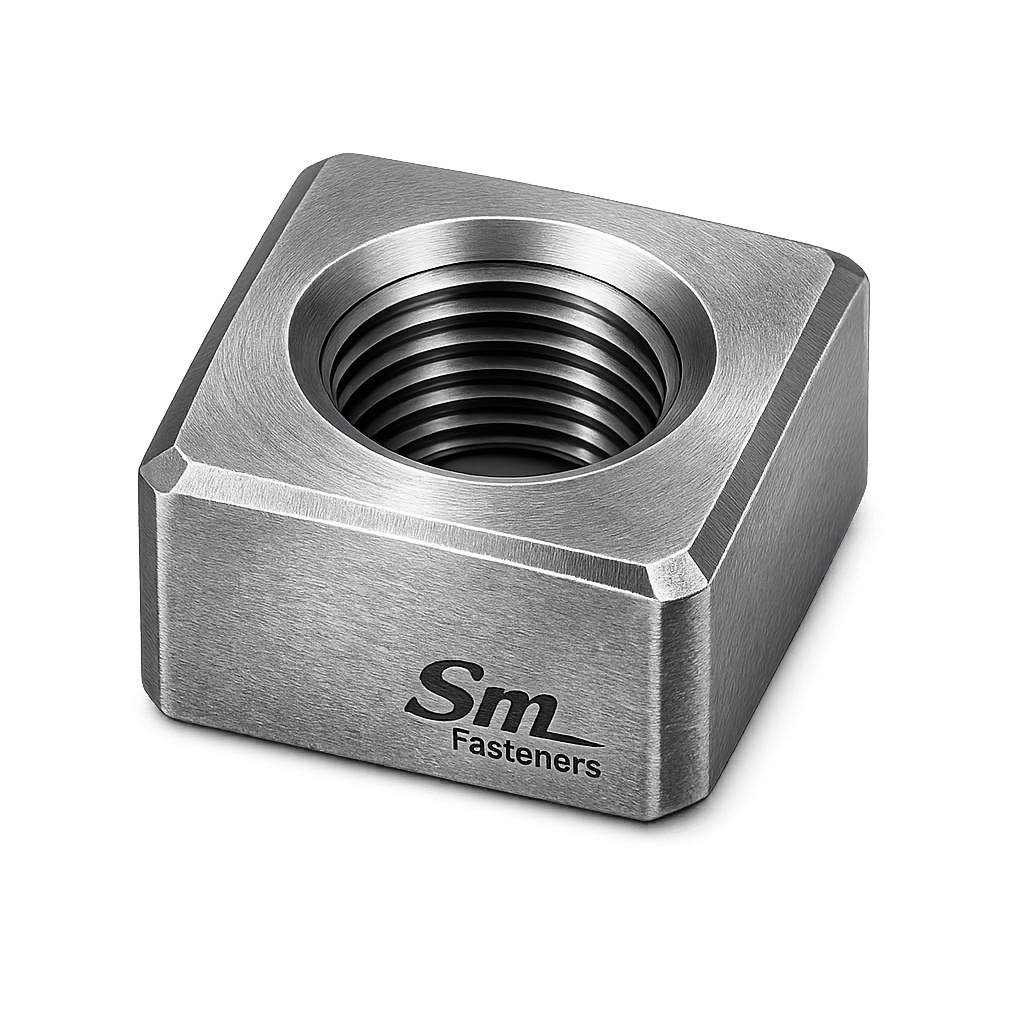
Square nuts represent one of the oldest and most mechanically stable threaded fastening solutions still widely deployed in modern industrial assemblies. Despite the evolution toward hexagonal fasteners, square nuts remain essential in structural engineering, heavy fabrication, rail infrastructure, electrical systems, maintenance assemblies, and equipment retrofits where:
- High bearing surface contact is required
- Tool engagement must remain secure under vibration
- Installation conditions are restricted
- Anti-rotation characteristics are beneficial
Within global industrial projects, square nuts are frequently specified in:
- Structural steel fabrication
- Rail track assemblies
- Channel framing systems
- Electrical grounding systems
- Machine bases and heavy equipment
- Legacy equipment maintenance programs
SM Fasteners manufactures square nuts under controlled ISO 9001 quality systems using precision forging, machining, and advanced material processing technologies suitable for EPC and international procurement requirements.
2. Technical Definition
A square nut is a four-sided internally threaded fastener designed to mate with an externally threaded bolt, stud, or threaded rod to produce a clamped mechanical joint.
Key Characteristics
- Four equal flat sides
- Large bearing surface
- Increased resistance to loosening
- Improved torque transfer capability
- Suitable for automated or manual positioning
Unlike hex nuts, square nuts provide:
✔ Greater contact area with substrate
✔ Better resistance to rounding under heavy torque
✔ Improved anti-rotation performance in slots or channels
3. Functional Role in Mechanical Assemblies
Square nuts perform three primary engineering functions:
3.1 Load Clamping
Convert applied torque into axial preload force.
3.2 Joint Stabilization
Maintain frictional resistance between mating surfaces.
3.3 Alignment and Positioning
Often used in T-slots, channels, and rails where geometry prevents rotation.
4. Load Mechanics & Force Behavior
4.1 Fundamental Load Conversion
Applied torque generates preload:
Where:
| Symbol | Definition |
|---|---|
| Fp | Preload force (N) |
| T | Applied torque (Nm) |
| K | Nut factor |
| D | Nominal diameter (m) |
4.2 Force Distribution in Square Nuts
Because of the square profile:
- Contact pressure spreads over wider area.
- Lower surface indentation occurs.
- Reduced localized stress improves fatigue life.
Load transfer path:
Torque → Thread friction → Axial tension → Surface compression → Joint stability.
4.3 Bearing Surface Advantage
Square nuts typically have ~20–30% larger bearing face compared to hex nuts.
Engineering outcomes:
- Lower surface pressure
- Reduced embedment loss
- Better performance on softer materials
- Improved structural steel connections
5. Joint Design Principles
5.1 Required Thread Engagement
Minimum engagement:
Where D = nominal diameter.
5.2 Preload Objective
Soft materials may require:
A correctly designed bolted joint ensures:
- External loads never exceed preload
- Joint surfaces remain in compression
- Cyclic fatigue minimized
Recommended preload:
| Joint Type | Preload % of Proof Load |
|---|---|
| Static Structural | 70–75% |
| Dynamic | 75–85% |
| Vibration Critical | 85–90% |
5.3 Friction Components
Torque applied is consumed by:
| Location | % Torque Consumption |
|---|---|
| Thread friction | 40–50% |
| Bearing friction | 40–50% |
| Useful preload | 10–15% |
This explains why lubrication control is critical during installation.
6. Torque–Tension Relationship
The square nut’s flat geometry improves wrench grip, reducing slippage and ensuring accurate torque application — particularly valuable in field installations and maintenance work.
Nut Factor (K) ranges:
| Condition | K Value |
|---|---|
| Dry | 0.20–0.25 |
| Zinc plated | 0.18–0.22 |
| Lubricated | 0.14–0.18 |
| PTFE coated | 0.10–0.14 |
7. Mechanical Behavior Under Load
Tensile Loading
Primary design condition. Threads carry axial stress.
Shear Loading
Should be resisted by shank, not threads.
Combined Loading
Common in structural connections and equipment mounts.
8. Failure Mechanisms
Engineering awareness of failure modes is essential.
8.1 Fatigue Failure
Occurs under cyclic loading when preload is insufficient.
Prevention:
- Proper torque control
- Hardened washers
- Surface treatment
8.2 Thread Stripping
Caused by inadequate engagement or soft material.
8.3 Hydrogen Embrittlement
Risk in high-strength plated carbon steel nuts.
Mitigation:
- Controlled baking post plating
- ISO-compliant coating processes at SM Fasteners.
8.4 Stress Corrosion Cracking (SCC)
Occurs in:
- Chloride environments
- Sour gas (H₂S) systems
Solution:
- Duplex
- Nickel alloys
- SMO 254
- PEEK fasteners where metallic corrosion is unacceptable.
9. Engineering Selection Criteria
Engineers specify square nuts based on:
| Parameter | Engineering Consideration |
|---|---|
| Load | Proof strength |
| Environment | Corrosion resistance |
| Temperature | Material stability |
| Maintenance access | Tool engagement |
| Alignment need | Anti-rotation geometry |
10. Functional Advantages Over Hex Nuts
| Characteristic | Square Nut Advantage |
|---|---|
| Surface bearing | Higher |
| Slot/channel use | Excellent |
| Tool grip | Superior |
| Alignment | Easier |
| Heavy fabrication | Preferred |
11. Integration Within SM Fasteners Manufacturing Capability
SM Fasteners supplies square nuts engineered for:
- Structural EPC projects
- Oil & Gas installations
- Global OEM assemblies
- Custom engineered fastener systems
Capabilities include:
Full traceability under ISO 9001 QMS
Precision forging
CNC machining
Exotic alloy processing
PEEK fastener manufacturing
12. Product Types and Engineering Variants
Square nuts exist in multiple engineered configurations to satisfy different mechanical, structural, electrical, and maintenance requirements. Selection is driven by load class, accessibility, installation method, and environmental exposure.
SM Fasteners manufactures square nuts across standardized and custom-engineered geometries, supporting global EPC and OEM specifications.
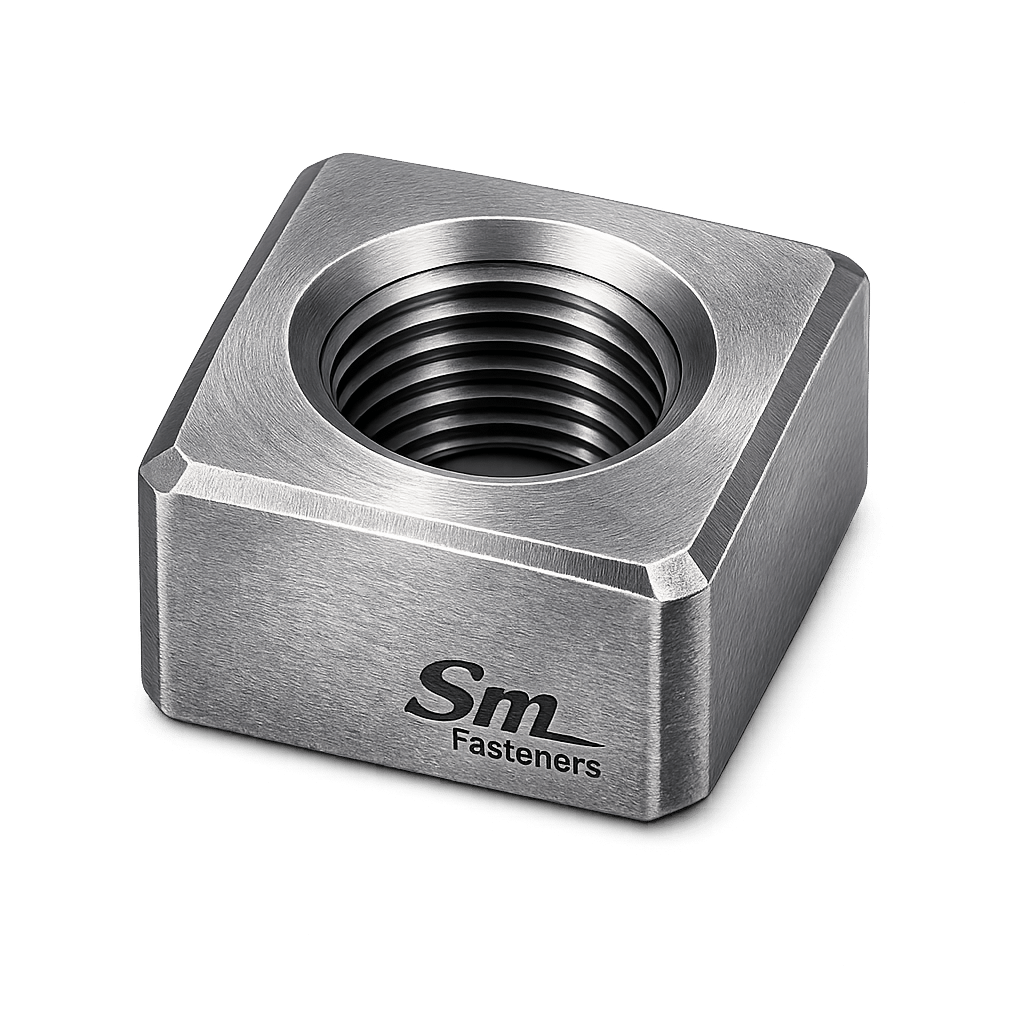
12.1 Standard Square Nut
Primary industrial configuration
Characteristics:
- Equal four-sided geometry
- Chamfered or flat faces
- Through internal threading
- Larger bearing area than hex nuts
Typical Uses:
- Structural assemblies
- Machinery bases
- General industrial fastening
Applicable Standards:
- DIN 557
- BS 1083
- ISO equivalent dimensional practices
12.2 Heavy Pattern Square Nut
Designed for higher proof loads and structural applications.
Features:
- Increased thickness
- Higher load distribution capability
- Improved fatigue resistance
- Greater thread engagement
Applications:
- Rail infrastructure
- Bridge construction
- Mining equipment
- Heavy fabrication
12.3 Jam Square Nut (Thin Pattern)
Used primarily as locking elements.
Engineering Function:
- Installed against primary nut
- Creates counter preload
- Prevents loosening under vibration
Common in:
- Maintenance assemblies
- Rotating equipment
- Adjustment mechanisms
12.4 Square Weld Nut
Used where permanent positioning is required.
Characteristics:
- Projection weld features
- Automated installation compatibility
- Assembly line manufacturing
Applications:
- Automotive frames
- Sheet metal fabrication
- Electrical enclosures
12.5 T-Slot / Channel Square Nut
Specialized geometry preventing rotation inside channels.
Applications:
- Solar mounting systems
- Machine tables
- Cable tray systems
- Structural framing rails
12.6 Custom Engineered Square Nuts — SM Fasteners Capability
SM Fasteners provides engineered solutions including:
- Oversize tolerance nuts
- Fine thread variants
- High-temperature alloys
- Non-metallic PEEK square nuts
- Special coating systems
- Large diameter structural nuts
13. Dimensional Logic and Geometry Engineering
Square nut geometry directly influences mechanical performance.
13.1 Key Dimensional Parameters
| Symbol | Description |
|---|---|
| m | Nut thickness |
| s | Width across flats |
| D | Nominal thread diameter |
| P | Thread pitch |
| dw | Bearing diameter |
| t | Thread engagement depth |
13.2 Geometry Design Principles
1. Width Across Flats (s)
Typically:
Provides:
- Increased wrench engagement
- Reduced rounding risk
- Higher torque transfer
2. Thickness (m)
Normally:
Ensures:
- Adequate thread shear area
- Proof load capability
3. Bearing Surface
Square face increases compressive load distribution, reducing substrate deformation.
14. Dimensional Specification Table (Metric Square Nuts)
Reference Values — DIN 557 Pattern
| Thread Size | Pitch (mm) | Width Across Flats s (mm) | Thickness m (mm) | Approx Weight (g/pc) |
|---|---|---|---|---|
| M6 | 1.0 | 10 | 5 | 2.5 |
| M8 | 1.25 | 13 | 6.5 | 5 |
| M10 | 1.5 | 17 | 8 | 11 |
| M12 | 1.75 | 19 | 10 | 18 |
| M16 | 2.0 | 24 | 13 | 40 |
| M20 | 2.5 | 30 | 16 | 75 |
| M24 | 3.0 | 36 | 19 | 140 |
| M30 | 3.5 | 46 | 24 | 290 |
| M36 | 4.0 | 55 | 29 | 520 |
(Weights aligned with SM Fasteners manufacturing data ranges.)
15. Thread Systems & Global Compatibility
Square nuts must match bolt thread standards precisely to avoid failure.
15.1 International Thread Standards
| Thread System | Standard | Application Region |
|---|---|---|
| Metric Coarse | ISO 261 / ISO 965 | Global EPC |
| Metric Fine | ISO 261 | Precision machinery |
| UNC | ASME B1.1 | USA industry |
| UNF | ASME B1.1 | Aerospace & vibration |
| BSW | BS 84 | Legacy UK equipment |
| BSF | BS 84 | Older machinery |
| ACME | ANSI B1.5 | Motion systems |
15.2 Thread Tolerance Classes
| System | External Thread | Internal Thread |
|---|---|---|
| Metric | 6g | 6H |
| UNC/UNF | 2A | 2B |
| Precision | 3A | 3B |
SM Fasteners maintains calibrated gauges ensuring interchangeability across international supply chains.
16. Applicable International Standards
Square nuts comply with multiple standard families depending on application.
16.1 ISO Standards
| Standard | Scope |
|---|---|
| ISO 4035 | Hex thin nuts (reference) |
| ISO 4032 | General nut requirements |
| ISO 898-2 | Mechanical properties |
| ISO 965 | Thread tolerances |
16.2 DIN Standards
| Standard | Description |
|---|---|
| DIN 557 | Square nuts |
| DIN 798 | Heavy square nuts |
| DIN 928 | Weld square nuts |
16.3 ASTM Standards
| Standard | Application |
|---|---|
| ASTM A563 | Carbon & alloy steel nuts |
| ASTM A194 | High temperature/pressure service |
| ASTM F594 | Stainless steel nuts |
16.4 British Standards
| Standard | Scope |
|---|---|
| BS 1083 | Square nuts |
| BS 3692 | Metric precision fasteners |
17. Mechanical Property Classes
Property class selection governs load capacity.
| Property Class | Proof Strength (MPa) | Typical Application |
|---|---|---|
| Class 5 | 500 | Light fabrication |
| Class 8 | 800 | Structural steel |
| Class 10 | 1000 | Heavy machinery |
| Class 12 | 1200 | Critical assemblies |
18. Interchangeability Considerations
Engineering teams must evaluate:
- Thread pitch compatibility
- Nut height differences
- Bearing surface requirement
- Coating thickness effect
- Temperature expansion mismatch
SM Fasteners validates dimensional interchangeability during production and final inspection.
19. Weight Chart — Procurement Reference
Used for logistics planning and project estimation.
| Size | Weight / Piece (kg) | Weight / 100 pcs (kg) |
|---|---|---|
| M8 | 0.005 | 0.50 |
| M10 | 0.011 | 1.10 |
| M12 | 0.018 | 1.80 |
| M16 | 0.040 | 4.00 |
| M20 | 0.075 | 7.50 |
| M24 | 0.140 | 14.0 |
| M30 | 0.290 | 29.0 |
| M36 | 0.520 | 52.0 |
Aligned with SM Fasteners export packing calculations.
20. Geometry Influence on Performance
Square nuts demonstrate superior performance in:
- Channel mounted systems
- Rail applications
- Heavy fabrication
- Low-access tightening zones
Engineering outcomes:
✔ Reduced rotation
✔ Improved torque repeatability
✔ Stable preload retention
21. Material Engineering Philosophy for Square Nuts
Material selection is the most critical determinant of square nut performance. Engineering selection must consider:
- Mechanical load requirements
- Corrosion environment
- Operating temperature
- Chemical exposure
- Hydrogen sulfide (H₂S) presence
- Galvanic compatibility
- Maintenance life cycle expectations
Under the ISO 9001 certified quality system at SM Fasteners, material traceability begins at raw material procurement and continues through manufacturing, inspection, and export documentation.
22. Industrial Material Range — SM Fasteners Capability
SM Fasteners manufactures square nuts across standard and advanced metallurgical families.
22.1 Carbon Steel
Typical Grades:
- ASTM A563 Grade A / DH
- ISO Property Class 5, 8, 10
Characteristics:
- High strength-to-cost ratio
- Excellent machinability
- Suitable for coated applications
Applications:
- Structural steel
- Construction assemblies
- General mechanical fastening
22.2 Alloy Steel
Common Grades:
- ASTM A194 Grade 2H
- ISO Class 10 / 12
Benefits:
- Higher proof load capability
- Elevated temperature strength
- Improved fatigue resistance
Used in:
- Pressure vessels
- Power plants
- Heavy rotating equipment
22.3 Stainless Steel
Grades Produced:
- SS304 / A2-70
- SS316 / A4-80
- 321 / 347 stabilized grades
Advantages:
- Corrosion resistance
- Low maintenance
- Marine compatibility
22.4 Duplex & Super Duplex Stainless Steel
Grades:
- UNS S31803
- UNS S32205
- UNS S32750
- UNS S32760
Key Benefits:
- High yield strength (≈2× austenitic)
- Chloride SCC resistance
- Offshore suitability
22.5 Nickel Alloys & Exotic Materials
SM Fasteners supplies square nuts in:
- Inconel 625 / 718
- Incoloy 825
- Monel 400
- Hastelloy C276
- Nickel 200
- SMO 254
Applications:
- LNG
- Chemical processing
- Sour gas service
- High temperature reactors
22.6 PEEK Square Nuts (Advanced Polymer Fasteners)
High-performance polymer alternative.
Properties:
- Non-metallic
- Electrically insulating
- Chemical resistant
- Lightweight
- Zero galvanic corrosion
Typical Use:
- Semiconductor equipment
- Electrical insulation systems
- Marine electronics
- Chemical dosing systems
23. Material Comparison Table
| Material | Yield Strength (MPa) | UTS (MPa) | Corrosion Resistance | Temperature Limit | Relative Cost | Typical Application |
|---|---|---|---|---|---|---|
| Carbon Steel | 320–640 | 500–800 | Low | 300°C | Low | Structural |
| Alloy Steel | 700–1000 | 900–1200 | Moderate | 450°C | Medium | Power equipment |
| SS304 | 215 | 515 | Good | 400°C | Medium | General industry |
| SS316 | 220 | 530 | Excellent | 425°C | Medium-High | Marine |
| Duplex 2205 | 450 | 620 | Very High | 300°C | High | Offshore |
| Super Duplex | 550 | 800 | Extreme | 300°C | Very High | Subsea |
| Inconel 625 | 450 | 830 | Outstanding | 700°C | Premium | Aerospace/LNG |
| SMO 254 | 300 | 650 | Exceptional | 400°C | Premium | Desalination |
| PEEK | — | — | Chemical resistant | 250°C | High | Electrical |
24. Corrosion Resistance vs Environment
| Environment | Recommended Material |
|---|---|
| Atmospheric | Carbon steel (coated) |
| Marine / Seawater | SS316 / Duplex |
| Offshore splash zone | Super Duplex |
| Acidic chemicals | Hastelloy |
| Sour Gas (H₂S) | NACE compliant alloys |
| LNG Cryogenic | Inconel / Stainless |
| Electrical insulation | PEEK |
| Chemical plants | SMO 254 |
SM Fasteners supports NACE MR0175 / ISO 15156 compliant material supply for sour service environments.
25. Mechanical Property Table (Grade-wise)
| Property Class | Proof Load (MPa) | Hardness (HV) | Typical Material |
|---|---|---|---|
| Class 5 | 500 | 130–180 | Low carbon steel |
| Class 8 | 800 | 200–250 | Medium carbon |
| Class 10 | 1000 | 250–320 | Alloy steel |
| Class 12 | 1200 | 320–390 | Quenched alloy steel |
26. Heat Treatment Processes
Heat treatment ensures mechanical reliability and compliance with ISO 898-2.
26.1 Normalizing
Refines grain structure after forging.
Benefits:
- Improved toughness
- Uniform properties
26.2 Quenching & Tempering
Primary strengthening method.
Process:
- Austenitizing
- Rapid quench
- Tempering
Results:
- Increased tensile strength
- Controlled hardness
- Improved fatigue resistance
26.3 Solution Annealing (Stainless Steel)
Removes carbide precipitation and restores corrosion resistance.
26.4 Stress Relieving
Used for machined large square nuts.
Prevents:
- Dimensional distortion
- Residual stress cracking
26.5 Hydrogen Embrittlement Relief Baking
Mandatory after electroplating of high-strength nuts.
Typical:
- 200°C bake
- 4–24 hours
27. Hardness Control for Sour Service
NACE MR0175 limits hardness:
| Material | Max Hardness |
|---|---|
| Carbon/Alloy Steel | 22 HRC |
| Stainless Steel | Controlled cold work |
| Nickel Alloys | Controlled heat treatment |
SM Fasteners validates hardness through calibrated testing systems.
28. End-to-End Manufacturing Workflow
28.1 Raw Material Verification
Incoming inspection includes:
- Mill Test Certificate verification
- Heat number traceability
- PMI (Positive Material Identification)
- Chemical composition analysis
28.2 Billet Preparation
Steel bars cut into forging blanks.
Controls:
- Weight tolerance
- Surface defect inspection
28.3 Forging Operations
Hot forging used for strength-critical nuts.
Advantages:
- Grain flow alignment
- Improved fatigue resistance
- Higher impact strength
28.4 Machining & CNC Operations
Applied for:
- Large diameters
- Exotic alloys
- Custom designs
28.5 Thread Formation
Thread Rolling (Preferred)
Benefits:
- Compressive residual stress
- Higher fatigue strength
- Improved surface finish
Thread Cutting
Used when:
- Hard materials
- Low volumes
- Special tolerances
28.6 Heat Treatment Integration
Performed in controlled furnaces with temperature logging and batch traceability.
28.7 Deburring & Cleaning
Processes include:
- Shot blasting
- Ultrasonic cleaning
- Surface conditioning
28.8 Final Inspection
Includes dimensional verification and mechanical testing prior to coating.
29. Surface Finishing & Coating Technologies
Surface engineering dramatically influences service life.
29.1 Coating Types
| Surface Finish | Corrosion Protection | Temperature Limit | Typical Use |
|---|---|---|---|
| Black Oxide | Low | 120°C | Indoor |
| Zinc Plated | Moderate | 200°C | Construction |
| Hot Dip Galvanized | High | 450°C | Outdoor structures |
| Mechanical Galvanized | Uniform | 300°C | Structural |
| PTFE/Xylan | Excellent | 260°C | Offshore |
| Dacromet/Geomet | High | 300°C | Automotive |
| Nickel Plating | Chemical resistant | 400°C | Chemical plants |
| Passivation | Stainless protection | High | Marine |
| Electropolishing | Maximum cleanliness | High | Pharma |
29.2 Coating Selection Logic
Engineers must evaluate:
- Required corrosion life
- Torque coefficient stability
- Hydrogen embrittlement risk
- Temperature exposure
- Assembly friction characteristics
SM Fasteners provides coating systems validated for torque consistency and global specification compliance.
29.3 Surface Finish Performance Comparison
| Finish | Salt Spray Resistance | Friction Stability | Maintenance Level |
|---|---|---|---|
| Zinc | 72–240 hrs | Moderate | Medium |
| HDG | 500–1000 hrs | Variable | Low |
| PTFE | 1000+ hrs | Excellent | Low |
| Stainless Passivated | Excellent | Stable | Very Low |
| PEEK | Immune | Stable | Minimal |
30. Integration With SM Fasteners Engineering Systems
SM Fasteners integrates:
- ISO 9001 controlled manufacturing
- Certified material sourcing
- Advanced alloy processing
- Custom fastener engineering
- Polymer (PEEK) fastener production
- Export-ready finishing systems
Each square nut supplied is traceable from raw material heat to final shipment documentation.
31. Inspection & Quality Control System
Square nuts supplied for industrial and EPC projects require verifiable conformity to dimensional, mechanical, and metallurgical standards.
SM Fasteners operates under an ISO 9001 certified Quality Management System, integrating inspection from raw material receipt through final dispatch.
31.1 Dimensional Inspection
Measured Parameters:
- Width across flats (s)
- Nut thickness (m)
- Thread pitch accuracy
- Thread concentricity
- Chamfer geometry
- Bearing face flatness
Inspection Tools:
- GO / NO-GO thread gauges (ISO 1502)
- Digital micrometers
- Optical comparators
- Coordinate Measuring Machines (CMM)
31.2 Mechanical Testing
| Test | Standard | Purpose |
|---|---|---|
| Proof Load Test | ISO 898-2 | Load verification |
| Tensile Test | ASTM F606 | Strength confirmation |
| Hardness Test | ISO 6508 | Heat treatment validation |
| Impact Test | ASTM A370 | Low temperature service |
| Wedge Test | ISO 898 | Thread performance |
31.3 Non-Destructive Examination (NDT)
Applied for critical service nuts:
- Magnetic Particle Inspection (MPI)
- Dye Penetrant Testing (PT)
- Ultrasonic inspection for large forgings
- PMI spectroscopy verification
31.4 Traceability Control
Each SM Fasteners batch includes:
- Heat number marking
- Manufacturing lot identification
- Inspection status traceability
- Digital inspection records
32. Engineering Failure Prevention
Common Preventive Controls:
| Failure Mode | Preventive Method |
|---|---|
| Fatigue loosening | Correct preload |
| Thread stripping | Adequate engagement |
| Galling (SS nuts) | Lubrication/PTFE coating |
| Hydrogen embrittlement | Post-plate baking |
| SCC | Material upgrade |
33. Tightening Torque Chart (Engineering Reference)
(Dry condition — Property Class 8)
| Size | Torque Nm | Approx Preload (kN) |
|---|---|---|
| M8 | 25 | 12 |
| M10 | 49 | 19 |
| M12 | 85 | 28 |
| M16 | 210 | 52 |
| M20 | 410 | 82 |
| M24 | 710 | 118 |
| M30 | 1420 | 188 |
Lubricated torque ≈ 70–75% of dry torque.
34. Preload Calculation — Worked Example
Given
- Bolt size: M16
- Torque applied: 210 Nm
- Nut factor K = 0.20
- Diameter D = 0.016 m
Result:
Approximate clamping force = 65.6 kN
35. Proof Load & Tensile Strength Table
| Property Class | Proof Load MPa | Tensile Strength MPa |
|---|---|---|
| Class 5 | 500 | 520 |
| Class 8 | 800 | 800 |
| Class 10 | 1000 | 1040 |
| Class 12 | 1200 | 1220 |
36. Thread Standards & Tolerances
| Thread Type | Standard | Tolerance |
|---|---|---|
| Metric | ISO 261 / 965 | 6H |
| UNC | ASME B1.1 | 2B |
| UNF | ASME B1.1 | 2B |
| BSW | BS 84 | Medium |
| BSF | BS 84 | Fine |
SM Fasteners verifies compatibility for global EPC interchangeability.
37. Industry Applications
Construction & Structural Steel
- Base plates
- Structural brackets
- Rail fixing systems
Oil & Gas
- Pipe supports
- Equipment skids
- Offshore modules
- NACE compliant assemblies
Power Generation
- Turbine housings
- Transformer structures
- Boiler installations
Petrochemical & Chemical Plants
- Corrosion-resistant fastening
- High-temperature process equipment
LNG & Offshore
- Duplex/Super Duplex square nuts
- PTFE-coated anti-galling systems
Automotive & Heavy Equipment
- Frame assemblies
- Welded structures
Railways & Infrastructure
- Track hardware
- Signaling systems
- Bridge maintenance
Shipbuilding
- Deck fittings
- Marine structures
PEEK Fastener Applications
- Electrical insulation
- Chemical dosing equipment
- Semiconductor installations
38. Surface Finish Selection Matrix
| Environment | Recommended Finish |
|---|---|
| Indoor industrial | Black oxide |
| Outdoor structural | Hot dip galvanizing |
| Marine | SS316 / Duplex |
| Offshore splash | PTFE coated |
| Chemical exposure | Nickel alloy |
| Electrical isolation | PEEK |
39. Weight Reference Chart (SM Fasteners Alignment)
| Size | Weight/pc (kg) | Weight/100 pcs (kg) |
|---|---|---|
| M10 | 0.011 | 1.10 |
| M12 | 0.018 | 1.80 |
| M16 | 0.040 | 4.00 |
| M20 | 0.075 | 7.50 |
| M24 | 0.140 | 14.0 |
| M30 | 0.290 | 29.0 |
| M36 | 0.520 | 52.0 |
Used for EPC logistics planning and export packing calculations.
40. Export Capability & Documentation
SM Fasteners supplies square nuts globally with complete procurement documentation.
40.1 Industrial Packaging
- VCI corrosion protection
- Thread protectors
- Batch labeling
- Moisture barrier packing
40.2 Export Crating
- ISPM-15 compliant wooden crates
- Seaworthy packaging
- Container optimization
- Project-wise segregation
40.3 Documentation Package
Provided per shipment:
- EN 10204 3.1 / 3.2 Mill Test Certificates
- Heat treatment reports
- Dimensional inspection reports
- Coating certification
- PMI reports (when required)
- Certificate of Conformity (CoC)
- Packing List & Traceability Records
41. SM FASTENERS — Engineering Integration
Square nuts manufactured by SM Fasteners demonstrate:
✔ ISO 9001 controlled production
✔ UKAF certified quality systems
✔ MSME registered manufacturing capability
✔ Advanced alloy & PEEK fastener expertise
✔ Custom engineering support
✔ EPC project readiness
✔ Global export compliance
SM Fasteners delivers square nuts engineered for strength, dimensional precision, corrosion performance, and long-term joint reliability across demanding industrial environments.