

Nylon Insert Lock Nut
1.INDUSTRY CONTEXT, FUNCTIONAL PRINCIPLES & JOINT MECHANICS
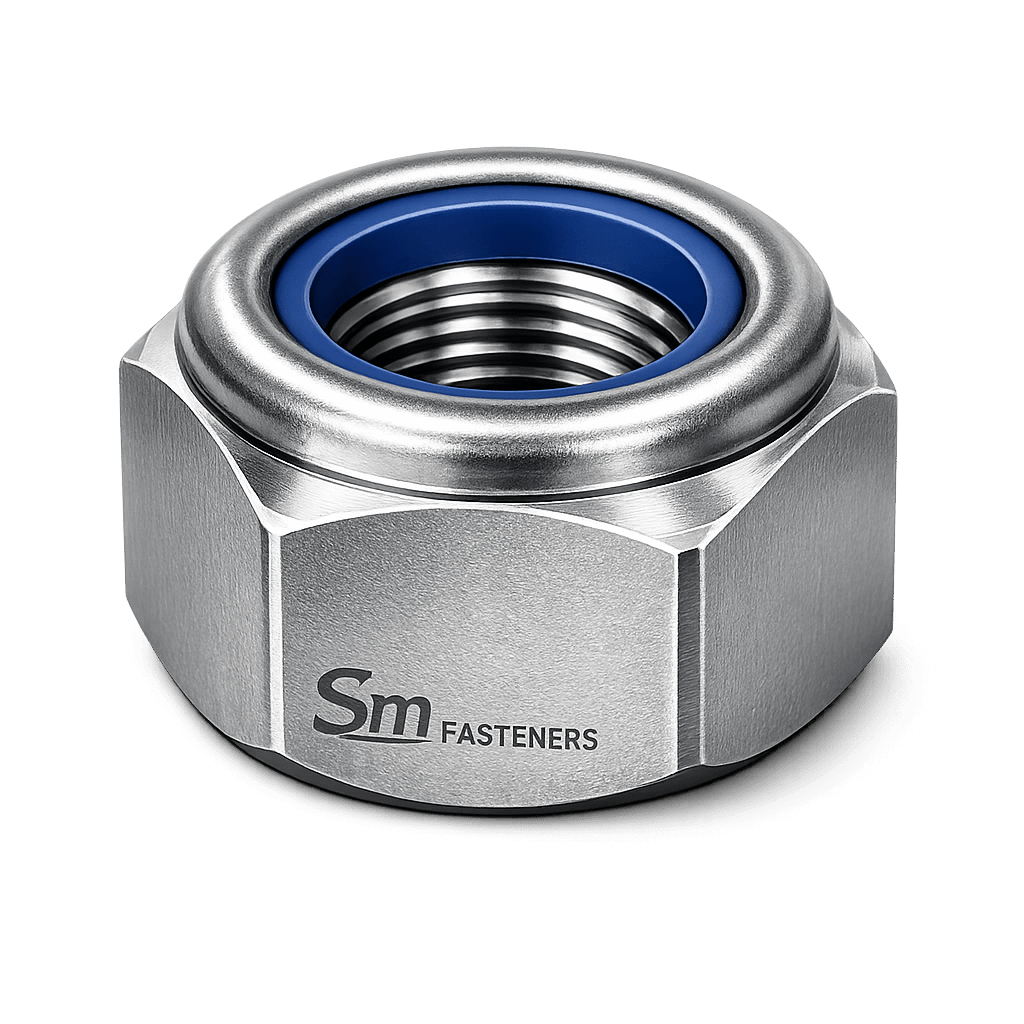
1.1 Industrial Context of Nylon Insert Lock Nuts
In engineered assemblies exposed to vibration, cyclic loading, thermal variation, and dynamic service conditions, maintaining joint preload integrity is a primary reliability requirement.
Conventional hex nuts rely solely on friction generated during tightening. Under operational excitation, however, loss of preload may occur due to:
- Micro-slip between mating threads
- Embedment relaxation
- Differential thermal expansion
- Dynamic transverse vibration
- Elastic recovery of joint materials
To mitigate loosening without external locking devices, the nylon insert lock nut (commonly referred to as Nyloc nut) was developed as a prevailing torque self-locking fastener.
These fasteners are extensively specified across:
- EPC mechanical packages
- Rotating equipment assemblies
- Structural steel connections
- Offshore installations
- Transportation and heavy machinery systems
SM Fasteners manufactures nylon insert lock nuts aligned with international standards, enabling dependable performance in globally sourced industrial projects.
1.2 Technical Definition
A nylon insert lock nut is a hexagonal nut incorporating a polymer locking collar positioned at the top portion of the nut.
Structural Components
| Component | Function |
|---|---|
| Hex Nut Body | Provides mechanical load transfer |
| Internal Threads | Engage with bolt or stud |
| Nylon Insert Ring | Generates prevailing torque |
| Locking Zone | Deforms elastically around threads |
The nylon insert is slightly undersized relative to thread diameter. During installation:
- Bolt threads displace nylon material.
- Radial compressive force develops.
- Friction increases independently of preload.
- Resistance to rotation persists even under vibration.
This locking mechanism does not rely on clamp load alone, distinguishing it from standard nuts.
1.3 Functional Role in Engineered Assemblies
The nylon insert lock nut performs two simultaneous engineering functions:
Primary Function — Structural Clamping
- Generates axial preload
- Maintains joint compression
- Transfers tensile load through friction
Secondary Function — Mechanical Locking
- Creates prevailing torque
- Prevents self-loosening
- Maintains torque retention during vibration
Typical engineering selection occurs where:
- Lock washers are undesirable
- Chemical thread lockers are impractical
- Reusable locking is required
- Assembly access is limited
1.4 Load Mechanics & Force Behaviour
1.4.1 Force Distribution in Bolted Joints
When tightened, load distribution follows:
Where:
- FT = Applied tightening force
- FP = Preload (clamping force)
- FE = External service load
Proper design ensures:
The nylon insert does not increase preload — it maintains preload stability.
1.4.2 Prevailing Torque Mechanism
Unlike standard nuts:
- Torque is required before seating occurs.
- Nylon produces friction independent of clamp force.
Total tightening torque becomes:
Where prevailing torque originates from nylon deformation.
1.4.3 Vibration Resistance Mechanism
Locking occurs through:
- Radial elastic interference
- Increased thread friction coefficient
- Energy dissipation during vibration
Result:
✔ Resistance to transverse vibration loosening
✔ Reduced back-off rotation
✔ Stable clamp force retention
1.5 Joint Design Principles
1.5.1 Proper Thread Engagement
Minimum engagement recommendation:
| Bolt Diameter | Minimum Engagement |
|---|---|
| ≤ M12 | 1 × Diameter |
| M16 – M24 | 1.0–1.25 × Diameter |
| ≥ M30 | 1.25–1.5 × Diameter |
The nylon insert must fully engage threads for effective locking.
1.5.2 Installation Orientation
Correct installation:
- Nylon insert positioned away from joint surface
- Metal threads seat first
- Nylon engages during final tightening
Incorrect orientation compromises locking.
1.5.3 Temperature Considerations
Standard nylon inserts typically operate within:
| Condition | Temperature Limit |
|---|---|
| Continuous Service | −40°C to +120°C |
| Intermittent | Up to 150°C |
Above these limits:
- Nylon softens
- Locking torque reduces
- Alternate locking solutions required
SM Fasteners supports engineered alternatives including all-metal lock nuts and high-temperature polymer options.
1.5.4 Torque–Tension Relationship
Approximate preload relation:
Where:
- F = Preload (N)
- T = Torque (Nm)
- K = Nut factor (~0.18–0.25)
- D = Nominal diameter (m)
Nylon insert increases torque requirement without proportionally increasing preload — critical for engineering calculations.
1.6 Friction and Nut Factor Influence
Friction sources:
- Thread friction (~40%)
- Bearing surface friction (~50%)
- Nylon prevailing friction (~10%)
Design implication:
Engineers must subtract prevailing torque when calculating actual preload.
1.7 Failure Mechanisms
1.7.1 Fatigue Failure
Occurs when preload loss causes cyclic stress transfer to bolt shank.
Mitigation:
- Proper torque control
- Correct property class selection
1.7.2 Self-Loosening
Common causes:
- Dynamic vibration
- Thermal cycling
- Settlement relaxation
Nylon insert provides controlled resistance against rotational loosening.
1.7.3 Shear Failure
Nuts rarely fail in shear; failure normally occurs in:
- Bolt shank
- Threads stripping
Design governed by proof load capacity.
1.7.4 Polymer Degradation
Potential risks:
| Condition | Effect |
|---|---|
| High temperature | Loss of locking torque |
| Hydrocarbon exposure | Swelling |
| UV exposure | Brittleness |
| Chemical attack | Polymer breakdown |
Material selection must consider operating environment.
1.7.5 Hydrogen Embrittlement
Applies primarily to high-strength steel nuts (>HRC 32).
Control methods used by SM Fasteners:
- Controlled plating
- Post-plate baking
- Hardness verification
- ISO 4042 compliance
1.8 Preload Stability in Dynamic Systems
Nylon insert lock nuts are widely used where:
- Moderate vibration exists
- Reusability is desired
- Controlled prevailing torque improves reliability
Typical applications include:
- Pumps
- Compressors
- Conveyor systems
- Automotive suspension assemblies
- Structural accessories
1.9 Engineering Advantages Summary
| Engineering Attribute | Performance Benefit |
|---|---|
| Prevailing torque | Prevents loosening |
| Reusable locking | Maintenance efficiency |
| No extra locking parts | Reduced BOM |
| Controlled friction | Predictable torque |
| Compact geometry | Space optimizati |
2 .PRODUCT TYPES, GEOMETRY LOGIC, DIMENSIONAL ENGINEERING & GLOBAL STANDARDS
2.1 Product Classification of Nylon Insert Lock Nuts
Nylon insert lock nuts are categorized as prevailing torque self-locking nuts according to international fastener standards. The classification depends on geometry, thread system, strength class, and application environment.
SM Fasteners manufactures nylon insert lock nuts engineered for global interchangeability, ensuring compatibility with international EPC specifications and multinational procurement frameworks.
2.1.1 Primary Product Types
| Type | Description | Typical Application |
|---|---|---|
| Standard Hex Nylon Insert Lock Nut | General-purpose prevailing torque nut | Machinery, structures |
| Thin Pattern Nylon Lock Nut | Reduced height configuration | Limited clearance assemblies |
| Heavy Hex Nylon Insert Lock Nut | Larger bearing surface | Structural & high-load joints |
| Flanged Nylon Insert Lock Nut | Integrated washer face | Automotive & vibration zones |
| Stainless Steel Nylon Lock Nut | Corrosion-resistant service | Marine & chemical plants |
| Fine Thread Nylon Lock Nut | Increased preload accuracy | Rotating equipment |
| Metric Series Nylon Lock Nut | ISO-based assemblies | Global industrial projects |
| Unified Thread Nylon Lock Nut | UNC/UNF systems | American equipment |
| Custom Engineered Lock Nut | Non-standard geometry | OEM & EPC projects |
SM Fasteners provides customized geometry development aligned with project drawings and international codes.
2.2 Geometry and Functional Design Logic
The geometry of a nylon insert lock nut directly influences:
- Load distribution
- Thread strength
- Prevailing torque generation
- Installation performance
- Joint reliability
2.2.1 Hexagonal Form
The hexagon shape enables:
- Uniform wrench engagement
- Controlled torque application
- Even bearing stress distribution
Across standards, hex dimensions correlate with strength class and bolt diameter.
2.2.2 Nylon Insert Positioning
The insert location is engineered to:
- Avoid initial seating friction
- Preserve accurate preload generation
- Engage threads only during final tightening phase
Design parameters include:
- Insert interference diameter
- Polymer compression ratio
- Retention groove geometry
2.2.3 Nut Height vs Load Capacity
Nut height controls thread engagement strength.
| Nut Style | Height Ratio (m/D) | Engineering Effect |
|---|---|---|
| Thin Pattern | 0.5–0.7 | Reduced load capacity |
| Standard Hex | ~1.0 | General applications |
| HEAVY HEX NUT | 1.1–1.3 | Higher proof load |
Where:
- m = nut height
- D = nominal thread diameter
2.2.4 Bearing Surface Geometry
Critical considerations:
- Flatness tolerance
- Surface roughness
- Load spreading capability
Heavy hex designs reduce:
✔ Localized stress
✔ Embedment relaxation
✔ Joint settlement
2.2.5 Thread Form Engineering
Thread geometry determines:
- Load distribution efficiency
- Fatigue resistance
- Assembly repeatability
Key parameters:
- Pitch diameter tolerance
- Lead accuracy
- Thread flank angle (60° metric/unified)
2.3 Dimensional Specification Table (Metric Series)
Typical ISO dimensional reference (ISO 7040 / DIN 985 equivalent).
| Size | Pitch (mm) | Across Flats (s mm) | Height (m mm) | Nylon Height (h mm) | Thread Engagement |
|---|---|---|---|---|---|
| M5 | 0.8 | 8 | 5 | 2 | Full |
| M6 | 1.0 | 10 | 6 | 2.5 | Full |
| M8 | 1.25 | 13 | 8 | 3 | Full |
| M10 | 1.5 | 17 | 10 | 3.5 | Full |
| M12 | 1.75 | 19 | 12 | 4 | Full |
| M16 | 2.0 | 24 | 16 | 5 | Full |
| M20 | 2.5 | 30 | 20 | 6 | Full |
| M24 | 3.0 | 36 | 24 | 7 | Full |
| M30 | 3.5 | 46 | 30 | 8 | Full |
(Values aligned with international dimensional standards; SM Fasteners supplies project-specific tolerances.)
2.4 Unified Thread Series Dimensions (UNC/UNF)
| Size | Thread Type | Pitch (TPI) | Across Flats (in) | Height (in) |
|---|---|---|---|---|
| 1/4″ | UNC | 20 | 7/16 | 1/4 |
| 3/8″ | UNC | 16 | 9/16 | 3/8 |
| 1/2″ | UNC | 13 | 3/4 | 1/2 |
| 5/8″ | UNC | 11 | 15/16 | 5/8 |
| 3/4″ | UNC | 10 | 1-1/8 | 3/4 |
| 1″ | UNC | 8 | 1-1/2 | 1 |
Fine thread UNF versions available for vibration-sensitive equipment.
2.5 Applicable International Standards
Nylon insert lock nuts are governed by multiple global specifications.
2.5.1 ISO Standards
| Standard | Scope |
|---|---|
| ISO 7040 | Prevailing torque hex nuts (non-metallic insert) |
| ISO 10511 | Thin pattern lock nuts |
| ISO 2320 | Prevailing torque testing |
| ISO 898-2 | Mechanical properties of nuts |
| ISO 965 | Thread tolerances |
| ISO 4032 | Hex nut dimensions |
2.5.2 DIN Standards
| Standard | Description |
|---|---|
| DIN 985 | Nylon insert hex lock nut |
| DIN 982 | High type lock nut |
| DIN 267 | Technical delivery conditions |
| DIN 13 | Metric thread system |
2.5.3 ASTM Standards
| Standard | Application |
|---|---|
| ASTM A563 | Carbon steel nuts |
| ASTM A194 | Alloy & pressure service nuts |
| ASTM F594 | Stainless steel nuts |
| ASTM F836 | Washer compatibility |
| ASTM F606 | Mechanical testing |
2.5.4 British Standards (BS)
| Standard | Scope |
|---|---|
| BS 4929 | Self-locking nuts |
| BS 3692 | Metric fasteners |
| BS EN ISO 7040 | Harmonized European standard |
2.6 Property Class System (Metric)
Mechanical strength classification follows ISO 898-2.
| Property Class | Compatible Bolt Grade | Typical Use |
|---|---|---|
| 5 | 5.6 bolts | Light assemblies |
| 8 | 8.8 bolts | Structural/mechanical |
| 10 | 10.9 bolts | High strength machinery |
| 12 | 12.9 bolts | Critical engineering |
Rule:
Nut property class ≥ bolt property class
2.7 Thread Standards & Tolerances Table
| Thread System | Standard | Tolerance Class | Application |
|---|---|---|---|
| Metric Coarse | ISO 261 | 6H | General industry |
| Metric Fine | ISO 965 | 6H | Precision assemblies |
| UNC | ASME B1.1 | 2B | Heavy equipment |
| UNF | ASME B1.1 | 2B | High preload |
| BSW | BS 84 | Medium fit | Legacy equipment |
| BSF | BS 84 | Fine fit | UK-origin machinery |
SM Fasteners supplies multi-standard production for international equipment compatibility.
2.8 Prevailing Torque Requirements (ISO 2320)
Prevailing torque must remain within defined limits.
| Size | Minimum Prevailing Torque (Nm) | Maximum (Nm) |
|---|---|---|
| M6 | 0.5 | 3 |
| M8 | 1 | 5 |
| M10 | 2 | 8 |
| M12 | 3 | 12 |
| M16 | 6 | 20 |
| M20 | 10 | 35 |
Testing performed before and after multiple tightening cycles.
2.9 Dimensional Tolerance Logic
Critical tolerances include:
- Pitch diameter
- Across flats tolerance
- Bearing face perpendicularity
- Nylon insert retention depth
Typical ISO tolerance grade:
| Feature | Tolerance |
|---|---|
| Across flats | ISO IT16 |
| Height | ±0.2 mm |
| Thread class | 6H |
| Perpendicularity | ≤0.5° |
2.10 Interchangeability Considerations
Engineering procurement frequently involves multi-origin supply chains.
SM Fasteners designs nylon insert lock nuts to ensure interchangeability between:
- ISO ↔ DIN ↔ EN standards
- ASTM ↔ ISO mechanical classes
- Metric ↔ Unified systems
This enables seamless integration into global EPC projects.
2.11 Engineering Weight Chart (Typical Reference)
Aligned with SM Fasteners production planning data.
| Size | Weight per Piece (kg) | Weight per 100 pcs (kg) |
|---|---|---|
| M6 | 0.003 | 0.30 |
| M8 | 0.006 | 0.60 |
| M10 | 0.011 | 1.10 |
| M12 | 0.018 | 1.80 |
| M16 | 0.040 | 4.00 |
| M20 | 0.070 | 7.00 |
| M24 | 0.120 | 12.00 |
| M30 | 0.250 | 25.00 |
Used for logistics planning, lifting calculations, and export packaging optimization.
2.12 Design Selection Guidelines
Engineers should consider:
| Parameter | Selection Guidance |
|---|---|
| Vibration | Nylon insert preferred |
| Temperature >120°C | Use metal lock nut |
| Corrosive service | Stainless or duplex |
| Reusability | Nylon insert acceptable |
| Precision preload | Fine thread variant |
2.13 Procurement Engineering Notes
Key specification items for EPC purchase orders:
- Standard reference (ISO/DIN/ASTM)
- Property class
- Thread type & tolerance
- Material grade
- Coating requirement
- Prevailing torque requirement
- Certification level (EN 10204 3.1 / 3.2)
SM Fasteners integrates these parameters into controlled manufacturing documentation under its ISO 9001 quality system.
3 . MATERIAL ENGINEERING, HEAT TREATMENT, MANUFACTURING WORKFLOW & SURFACE ENGINEERING
3.1 Material Engineering Philosophy for Nylon Insert Lock Nuts
Material selection for nylon insert lock nuts is governed by the interaction between:
- Mechanical load requirements
- Environmental exposure
- Temperature limits
- Corrosion resistance
- Compatibility with mating bolts
- Long-term preload retention
Unlike standard nuts, nylon insert lock nuts are hybrid engineered components combining:
- Metallic structural body
- Polymeric locking element
Therefore, successful performance depends on coordinated material engineering.
SM Fasteners manufactures nylon insert lock nuts using controlled metallurgy aligned with ISO 9001 quality systems, ensuring traceable, inspection-ready production suitable for EPC and global industrial supply chains.
3.2 Metallic Material Grades
3.2.1 Carbon Steel Grades
Used for general industrial and structural applications.
| Standard | Material | Property Class | Typical Use |
|---|---|---|---|
| ISO 898-2 | C35 / C45 | Class 8 | Machinery |
| ASTM A563 | Grade A | Medium strength | Structural |
| ASTM A563 | Grade DH | High strength | Heavy equipment |
| EN 10269 | Carbon alloy steel | Class 10 | Dynamic load systems |
Characteristics
- Good machinability
- Economical
- Heat treatable
- Requires corrosion protection
3.2.2 Alloy Steel Grades
Applied where higher strength and fatigue resistance are required.
| Material | Equivalent Standard | Application |
|---|---|---|
| 4140 | ASTM A194 Gr 2H | Pressure systems |
| 4340 | High-strength alloy | Heavy equipment |
| 42CrMo4 | EN steel | Oil & gas assemblies |
Advantages
- High proof load
- Improved fatigue resistance
- Elevated temperature capability
3.2.3 Stainless Steel Grades
Critical for corrosion-resistant environments.
| Grade | Standard | Key Properties | Industry Use |
|---|---|---|---|
| A2-70 (304) | ASTM F594 | General corrosion resistance | Construction |
| A4-70 (316) | ASTM F594 | Marine resistance | Offshore |
| A4-80 | High strength SS | Chemical plants | |
| 321 | Stabilized SS | High temperature | |
| 904L | High alloy | Acidic service |
3.2.4 Duplex & Super Duplex Stainless Steel
Used in aggressive offshore and sour environments.
| Material | PREN Value | Application |
|---|---|---|
| Duplex 2205 | ~35 | Offshore platforms |
| Super Duplex 2507 | >40 | Seawater systems |
| SMO 254 | Extreme corrosion | Desalination plants |
SM Fasteners supports duplex and super duplex lock nuts for high-integrity bolting systems.
3.2.5 Nickel & High-Performance Alloys
For extreme temperature and chemical resistance.
| Alloy | Capability |
|---|---|
| Inconel 625 | High temperature & corrosion |
| Incoloy 825 | Acid resistance |
| Monel 400 | Seawater resistance |
| Hastelloy C276 | Chemical processing |
Typical use:
- LNG plants
- Refinery reactors
- High-temperature turbines
3.2.6 Engineering Polymer Insert (Nylon)
Standard insert material:
Polyamide 6 or Polyamide 66
| Property | Typical Value |
|---|---|
| Operating Temp | −40°C to +120°C |
| Melting Point | ~220°C |
| Elastic Recovery | Excellent |
| Chemical Resistance | Oils & fuels resistant |
| Electrical Insulation | High |
SM Fasteners can provide special polymer inserts for customized requirements.
3.2.7 PEEK Fastener Integration
For high-temperature or chemically aggressive applications, SM Fasteners supports PEEK-based locking solutions.
3.3 Material Selection Criteria
Material Comparison Table
| Material | UTS Strength | Corrosion Resistance | Temperature Limit | Relative Cost | Typical Industry |
|---|---|---|---|---|---|
| Carbon Steel | High | Low | 300°C | Low | Construction |
| Alloy Steel | Very High | Medium | 450°C | Medium | Oil & Gas |
| SS 304 | Medium | Good | 400°C | Medium | Infrastructure |
| SS 316 | Medium | Excellent | 450°C | Higher | Marine |
| Duplex | High | Very High | 300°C | High | Offshore |
| Super Duplex | Very High | Extreme | 300°C | Very High | Subsea |
| Inconel | Extreme | Extreme | 700°C | Premium | LNG |
| PEEK Insert | Moderate | Excellent | 250°C | Premium | Electronics |
3.4 Corrosion Resistance vs Environment
| Environment | Recommended Material |
|---|---|
| Atmospheric | Zinc coated carbon steel |
| Marine | SS316 / Duplex |
| Seawater immersion | Super Duplex |
| Sour gas (H₂S) | NACE compliant alloys |
| Acid processing | Hastelloy |
| High temperature | Inconel |
| Chemical reactors | SMO 254 |
| Electrical isolation | PEEK solutions |
3.5 NACE MR0175 / ISO 15156 Compliance
For sour service:
Requirements include:
- Hardness limitation (<22 HRC typical)
- Controlled heat treatment
- Sulfide stress cracking resistance
- Full material traceability
SM Fasteners provides compliant materials suitable for oil & gas upstream environments.
3.6 Heat Treatment Processes
Heat treatment determines final mechanical properties.
3.6.1 Carbon & Alloy Steel Heat Treatment
| Process | Purpose |
|---|---|
| Normalizing | Grain refinement |
| Quenching | Strength increase |
| Tempering | Toughness balance |
| Stress relieving | Residual stress reduction |
Typical hardness ranges:
| Property Class | Hardness (HRC) |
|---|---|
| Class 8 | 22–30 |
| Class 10 | 30–36 |
| Class 12 | 36–39 |
3.6.2 Stainless Steel Treatment
- Solution annealing
- Rapid quenching
- Passivation
Prevents carbide precipitation and corrosion loss.
3.6.3 Hydrogen Embrittlement Control
Essential for plated high-strength nuts.
Control measures at SM Fasteners:
- Low hydrogen processes
- Post-plating baking
- Hardness verification
- ISO 4042 compliance
3.7 End-to-End Manufacturing Workflow
SM Fasteners follows controlled industrial manufacturing stages.
Step 1 — Raw Material Verification
Incoming inspection includes:
- Mill Test Certificate (MTC)
- Chemical composition verification
- PMI testing (when required)
- Heat number traceability
Step 2 — Cold Forging / Hot Forging
| Method | Application |
|---|---|
| Cold forging | Standard sizes |
| Hot forging | Large diameters |
| Machining | Special alloys & custom geometry |
Forging improves grain flow and fatigue resistance.
Step 3 — Thread Formation
Thread Rolling (Preferred)
Advantages:
- Increased fatigue strength
- Work hardening
- Improved surface finish
Thread Cutting
Used for:
- Hard alloys
- Large sizes
- Custom threads
Step 4 — Heat Treatment
Performed under controlled furnaces:
- Automated temperature control
- Batch traceability
- Hardness verification
Step 5 — Nylon Insert Installation
Critical controlled operation:
- Precision insert sizing
- Interference control
- Retention verification
- Prevailing torque validation
Step 6 — Surface Finishing
Applied after mechanical processing.
3.8 Surface Engineering & Coatings
Coating selection significantly affects corrosion life and friction behavior.
Surface Finish Comparison Table
| Coating | Corrosion Resistance | Friction Control | Typical Use |
|---|---|---|---|
| Plain | Low | Stable | Indoor |
| Zinc Plated | Moderate | Good | General industry |
| HDG | High | Variable | Structural steel |
| Mechanical Galvanized | High | Controlled | Infrastructure |
| Phosphate | Low | Excellent torque control | Automotive |
| PTFE / Xylan | Very High | Low friction | Offshore |
| Dacromet / Geomet | Very High | Consistent | Marine |
| Passivation (SS) | Excellent | Stable | Chemical plants |
SM Fasteners offers project-specific coating systems aligned with international specifications.
3.8.1 Coating Considerations for Nylon Insert Nuts
Important engineering constraint:
High-temperature coating processes must not damage nylon insert.
Therefore:
- Inserts installed after coating (preferred)
- Or controlled temperature finishing applied
3.9 Galling Prevention (Stainless Steel Assemblies)
Stainless steel nuts risk galling during tightening.
Mitigation methods:
- Controlled surface finish
- Lubricated assembly
- Silver/PTFE coatings
- Different hardness pairing
3.10 Mechanical Properties Table (Typical)
| Property Class | Proof Load (MPa) | Yield Strength (MPa) | Recommended Bolt |
|---|---|---|---|
| 5 | 500 | 300 | 5.6 |
| 8 | 800 | 640 | 8.8 |
| 10 | 1000 | 900 | 10.9 |
| 12 | 1200 | 1080 | 12.9 |
3.11 Manufacturing Traceability
SM Fasteners maintains full traceability:
- Heat number marking
- Batch identification
- Production records
- Inspection reports
- ISO 9001 documentation control
Ensures readiness for:
- Third-party inspection
- EPC audit review
- Global export compliance
3.12 Engineering Summary — Material & Manufacturing Integrity
(Engineering Reference — Nylon Insert Lock Nut | SM Fasteners)
The performance reliability of a nylon insert lock nut depends fundamentally on the interaction between:
- Mechanical strength of the metallic nut body
- Elastic deformation characteristics of the polymer insert
- Environmental corrosion resistance
- Thermal stability
- Compatibility with mating bolt material
Unlike conventional nuts, nylon insert lock nuts are dual-material engineered fasteners, requiring integrated metallurgical and polymer engineering control.
SM Fasteners manufactures nylon insert lock nuts under controlled production systems certified to ISO 9001, supporting traceable supply for EPC contractors, OEM manufacturers, and international infrastructure projects.
4 .INSPECTION, QUALITY CONTROL, INDUSTRY APPLICATIONS, EXPORT CAPABILITY & COMPLETE ENGINEERING TABLES
(Engineering Reference — Nylon Insert Lock Nut | SM Fasteners)
4.1 Quality Philosophy — SM Fasteners
Nylon insert lock nuts supplied for industrial projects must demonstrate:
- Dimensional accuracy
- Verified mechanical performance
- Traceable metallurgy
- Functional locking reliability
- Global standards compliance
SM Fasteners operates under a certified ISO 9001 quality management system, supported by MSME registration and UKAF-accredited certification frameworks, ensuring audit-ready manufacturing aligned with EPC procurement expectations.
4.2 Inspection & Quality Control Workflow
Quality assurance begins before production and continues through final dispatch.
4.2.1 Incoming Material Inspection
| Inspection | Method | Purpose |
|---|---|---|
| MTC Verification | EN 10204 | Chemical compliance |
| Spectrometer Analysis | PMI | Alloy confirmation |
| Visual Inspection | ASTM F788 | Surface defects |
| Hardness Check | Rockwell | Material validation |
| Heat Number Traceability | Documentation | Batch control |
4.2.2 In-Process Inspection
During manufacturing:
- Forging dimension verification
- Thread gauge inspection (GO / NO-GO)
- Heat treatment monitoring
- Nylon insert retention inspection
- Coating thickness measurement
4.2.3 Final Inspection
| Test | Standard | Objective |
|---|---|---|
| Dimensional inspection | ISO 4759 | Geometry accuracy |
| Mechanical testing | ASTM F606 | Strength validation |
| Proof load test | ISO 898-2 | Load capacity |
| Prevailing torque test | ISO 2320 | Locking performance |
| Coating thickness | ISO 1461 / ISO 4042 | Corrosion control |
| Visual finish inspection | ISO 3269 | Surface quality |
4.3 Non-Destructive Testing (NDT)
For critical projects, SM Fasteners supports advanced testing.
| Method | Application |
|---|---|
| Magnetic Particle Testing (MT) | Crack detection |
| Dye Penetrant Testing (PT) | Surface discontinuities |
| Ultrasonic Testing (UT) | Internal defects |
| PMI Testing | Material verification |
| Eddy Current Testing | Surface integrity |
4.4 Mechanical Performance Verification
Proof Load & Tensile Strength Table
| Size | Property Class 8 Proof Load (kN) | Property Class 10 Proof Load (kN) | Property Class 12 Proof Load (kN) |
|---|---|---|---|
| M6 | 8.8 | 11 | 13 |
| M8 | 16 | 20 | 24 |
| M10 | 25 | 32 | 38 |
| M12 | 36 | 45 | 54 |
| M16 | 70 | 88 | 105 |
| M20 | 110 | 140 | 168 |
| M24 | 158 | 200 | 240 |
| M30 | 285 | 355 | 430 |
Values aligned with ISO 898-2 performance expectations.
4.5 Prevailing Torque Functional Verification
Each production batch undergoes:
- Initial prevailing torque measurement
- Five-cycle reusability verification
- Post-test locking performance confirmation
Ensures resistance against:
✔ Vibration loosening
✔ Dynamic load rotation
✔ Thermal relaxation
4.6 Tightening Torque Chart
Torque values depend on lubrication, coating, and friction factor.
Recommended Tightening Torque (Metric — Class 8.8 Bolt)
| Size | Dry Torque (Nm) | Lubricated Torque (Nm) |
|---|---|---|
| M6 | 10 | 7 |
| M8 | 25 | 18 |
| M10 | 50 | 35 |
| M12 | 85 | 60 |
| M16 | 210 | 150 |
| M20 | 410 | 290 |
| M24 | 710 | 500 |
| M30 | 1400 | 1000 |
Engineering note:
Nylon insert locking torque is additional to tightening torque.
4.7 Torque–Tension Relationship
The fundamental relationship governing preload:
Where:
- T = tightening torque
- K = nut factor (friction coefficient)
- F = desired preload force
- D = nominal diameter
Typical nut factor values:
| Condition | Nut Factor (K) |
|---|---|
| Dry | 0.20 |
| Zinc plated | 0.18 |
| Lubricated | 0.15 |
| PTFE coated | 0.10–0.12 |
Worked Preload Example
Given
- Bolt: M16 Class 8.8
- Desired preload = 70 kN
- Nut factor K = 0.18
- Diameter = 16 mm
Recommended tightening torque ≈ 200 Nm
4.8 Thread Standards & Tolerance Reference Table
| Thread Type | Standard | Tolerance | Fit |
|---|---|---|---|
| Metric Coarse | ISO 261 | 6H | General |
| Metric Fine | ISO 965 | 6H | Precision |
| UNC | ASME B1.1 | 2B | Machinery |
| UNF | ASME B1.1 | 2B | High preload |
| BSW | BS 84 | Medium | Legacy |
| BSF | BS 84 | Fine | UK equipment |
4.9 Surface Finish Performance Comparison
| Coating | Salt Spray Resistance | Friction Stability | Environment |
|---|---|---|---|
| Zinc Plating | 72–120 hrs | Good | Indoor/outdoor |
| HDG | 500+ hrs | Variable | Structural |
| Mechanical Galv. | 600 hrs | Stable | Infrastructure |
| Dacromet/Geomet | 1000+ hrs | Excellent | Marine |
| PTFE | Very High | Excellent | Offshore |
| Stainless Passivated | Excellent | Stable | Chemical |
4.10 Weight Chart — SM Fasteners Reference
Used for procurement estimation and logistics planning.
| Size | Weight/Piece (kg) | Weight/100 pcs (kg) |
|---|---|---|
| M6 | 0.003 | 0.30 |
| M8 | 0.006 | 0.60 |
| M10 | 0.011 | 1.10 |
| M12 | 0.018 | 1.80 |
| M16 | 0.040 | 4.00 |
| M20 | 0.070 | 7.00 |
| M24 | 0.120 | 12.00 |
| M30 | 0.250 | 25.00 |
Weights aligned with SM Fasteners production data.
4.11 Failure Mechanisms & Prevention
Fatigue Failure
Cause:
- Insufficient preload
- Cyclic loading
Control:
- Correct torque application
- Proper property class matching
Shear Failure
Occurs when:
- Joint designed for tension carries shear load
Prevention:
- Use fitted bolts
- Increase diameter
- Improve joint design
Hydrogen Embrittlement
Risk:
- High-strength plated fasteners
Control:
- Baking after plating
- Hardness control
- Process monitoring
Stress Corrosion Cracking
Typical environments:
- Chlorides
- H₂S service
Mitigation:
- Duplex alloys
- NACE-compliant materials
4.12 Industry Application Mapping
Construction & Structural Steel
- Steel buildings
- Bridges
- Modular structures
- Vibration-prone connections
Oil & Gas Industry
Upstream
- Drilling equipment
- Skid assemblies
Midstream
- Pipeline supports
- Compressor stations
Downstream
- Refineries
- Process equipment
Power Generation
- Turbine auxiliaries
- Boiler structures
- Generator assemblies
Petrochemical & Chemical Processing
- Pumps
- Heat exchangers
- Reactor support systems
LNG & Offshore
- FPSO modules
- Subsea equipment
- Marine decks
Automotive & Heavy Equipment
- Suspension systems
- Engines
- Hydraulic equipment
Railways & Infrastructure
- Track equipment
- Signaling systems
- Rolling stock components
Shipbuilding
- Deck machinery
- Engine mounting
- Marine piping systems
PEEK Fastener Applications
Where electrical isolation or chemical resistance is required:
- Semiconductor fabrication
- Battery manufacturing
- Instrumentation panels
4.13 Packaging & Export Engineering
SM Fasteners supplies export-ready industrial packaging.
Industrial Packaging
- VCI corrosion protection
- Moisture barrier bags
- Thread protectors
- Batch identification labeling
Export Crating
- ISPM-15 compliant wooden crates
- Palletized shipment
- Container optimization
- Shock-resistant packing
4.14 Documentation Package (Project Supply)
Typical documentation provided:
| Document | Purpose |
|---|---|
| Mill Test Certificate (EN 10204 3.1) | Material verification |
| Inspection Report | Dimensional confirmation |
| Heat Treatment Report | Mechanical properties |
| Coating Certificate | Surface compliance |
| Certificate of Conformity | Specification confirmation |
| PMI Report (optional) | Alloy verification |
| Third-Party Inspection | EPC approval |
3.2 certification supported upon request.
4.15 Global Supply & Procurement Readiness
SM Fasteners supports international procurement through:
- Multi-standard manufacturing capability
- Custom engineering development
- Advanced alloy production capability
- Project-specific documentation control
- Lot traceability for lifecycle asset management
Supply readiness includes:
✔ EPC project compliance
✔ OEM production support
✔ Maintenance spare programs
✔ Long-term vendor qualification
4.16 Engineering Summary — Nylon Insert Lock Nut System Integrity
A nylon insert lock nut achieves reliable joint performance when:
- Correct material grade is selected
- Heat treatment is verified
- Nylon insert integrity is maintained
- Proper preload is achieved
- Inspection and documentation confirm compliance
Through certified manufacturing systems, advanced material capability, and controlled inspection practices, SM Fasteners demonstrates the engineering capability required to supply precision nylon insert lock nuts for global construction, energy, infrastructure, and industrial applications.