

DOUBLE END STUD
1 — INDUSTRY CONTEXT, TECHNICAL DEFINITION & LOAD MECHANICS
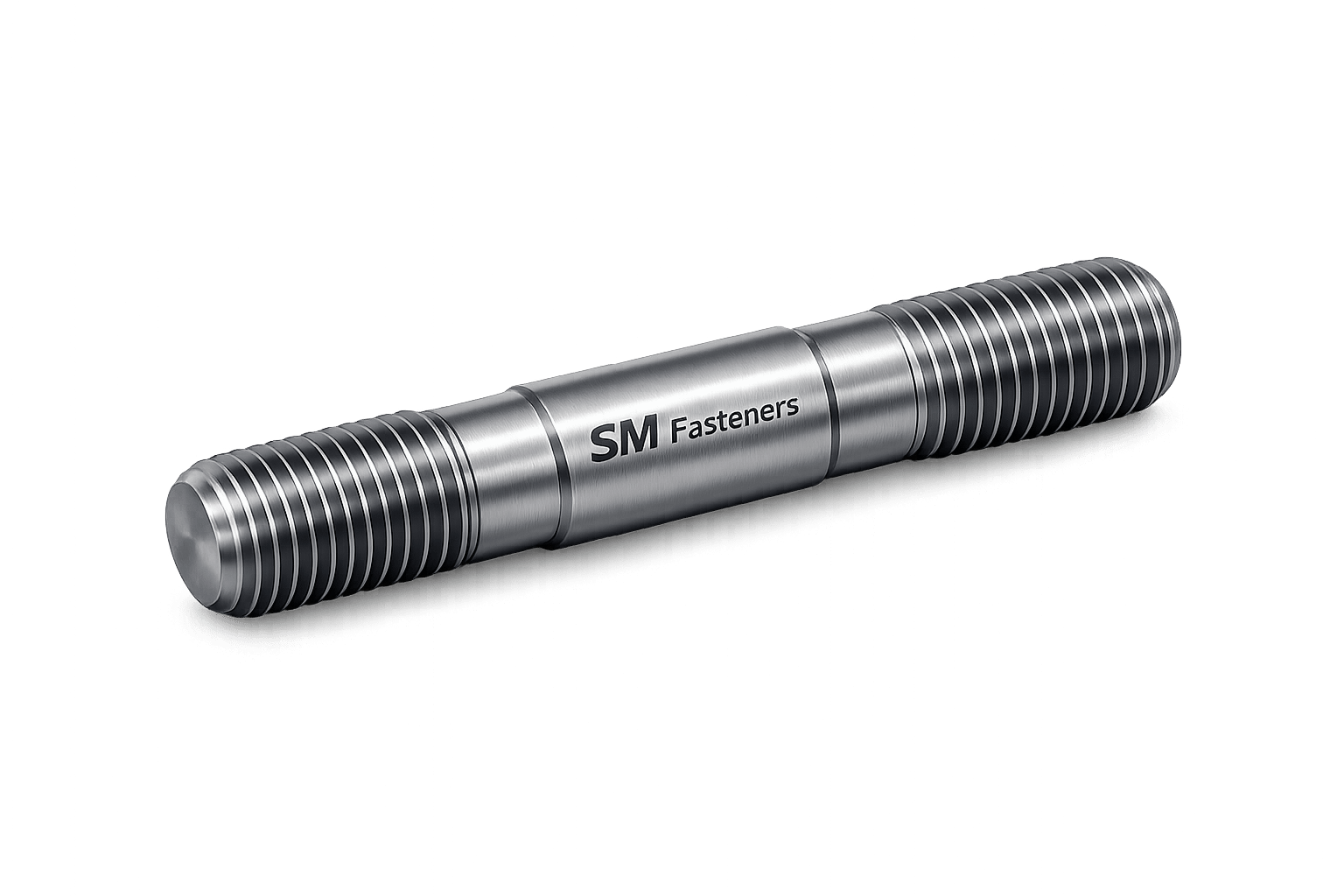
1.1 Industrial Context of Double End Studs
Double End Studs represent one of the most widely used fastening systems in high-integrity bolted joints across heavy engineering industries. Unlike conventional bolts, the stud-and-nut assembly separates the thread engagement function from the load-bearing clamping function, providing superior reliability in critical assemblies.
Typical operating environments include:
| Industry Sector | Functional Requirement |
|---|---|
| Oil & Gas | Pressure containment joints |
| Petrochemical | High-temperature flange assemblies |
| Power Generation | Turbine casings & boilers |
| Structural Steel | Permanent anchoring systems |
| Offshore & Marine | Corrosion-resistant fastening |
| Heavy Equipment | High fatigue resistance joints |
| LNG Facilities | Cryogenic reliability |
| Rail & Infrastructure | Long-term vibration resistance |
Double end studs are preferred where:
- Frequent dismantling is required
- Alignment precision is critical
- High preload stability is necessary
- Thread wear on parent material must be minimized
SM Fasteners manufactures double end studs aligned with global EPC procurement specifications, ensuring interchangeability with ISO, ASTM, DIN, and BS systems.
1.2 Technical Definition
A Double End Stud is a fully threaded or partially threaded fastener with:
- Threads on both ends
- An unthreaded or reduced shank (optional)
- Equal or unequal thread engagement lengths
It is designed to:
- Permanently engage one end into tapped material or component.
- Accept a nut on the exposed end to generate clamping force.
Key Functional Characteristics
- No head → uniform stress distribution
- Improved fatigue life
- Reduced torsional stress during tightening
- Repeatable preload performance
1.3 Functional Role in Mechanical Assemblies
Bolt vs Double End Stud Behavior
| Parameter | Bolt | Double End Stud |
|---|---|---|
| Installation torque applied to | Bolt head | Nut only |
| Parent thread wear | Higher | Minimal |
| Alignment accuracy | Moderate | High |
| Fatigue resistance | Lower | Superior |
| Maintenance repeatability | Limited | Excellent |
The double end stud converts tightening torque exclusively into axial tensile preload, avoiding thread galling inside equipment housings.
1.4 Load Mechanics & Force Behavior
Primary Forces Acting on Double End Studs
- Tensile Load
- Clamping Force
- Shear Load
- Bending Stress
- Thermal Expansion Load
- Dynamic Fatigue Loading
Fundamental Load Relationship
Where:
- F = Preload Force (N)
- T = Applied Torque (Nm)
- K = Nut Factor (0.15–0.25 typical)
- d = Nominal Diameter (m)
Clamping Force Principle
The stud behaves like a spring element.
- Nut tightening stretches the stud elastically.
- Joint members compress simultaneously.
- Stored elastic energy maintains joint integrity.
Elastic Interaction Model
| Component | Behavior |
|---|---|
| Stud | Elastic elongation |
| Joint | Compression |
| Result | Stable preload equilibrium |
Proper stud selection ensures:
- External load never exceeds preload
- Joint separation does not occur
1.5 Thread Engagement Mechanics
Recommended minimum thread engagement:
| Material | Engagement Length |
|---|---|
| Steel into Steel | 1 × Diameter |
| Steel into Cast Iron | 1.5 × Diameter |
| Steel into Aluminum | 2 × Diameter |
| High Temp Alloy | 1.25 × Diameter |
Correct engagement prevents:
- Thread stripping
- Pull-out failure
- Fatigue initiation
1.6 Joint Design Principles
High-Integrity Joint Design Criteria
- Controlled preload
- Uniform stress distribution
- Minimal relaxation
- Resistance to vibration loosening
- Corrosion compatibility
Double End Stud Advantages in Joint Engineering
- Eliminates repeated installation damage
- Improves gasket sealing reliability
- Enables hydraulic tensioning
- Allows accurate torque calibration
1.7 Torque–Tension Relationship
Only 10–15% of applied torque becomes preload.
| Torque Loss Component | Approx. % |
|---|---|
| Thread friction | 40% |
| Bearing friction | 45% |
| Useful preload | 15% |
Surface finish and lubrication therefore directly influence joint reliability.
1.8 Preload Calculation — Worked Example
Given:
- Stud Size: M24
- Torque: 600 Nm
- Nut Factor: 0.18
Result:
The stud generates approximately 139 kN clamping force.
SM Fasteners provides torque recommendations validated against ISO preload standards.
1.9 Mechanical Behavior Under Service Conditions
Static Loading
Maintains gasket compression and structural integrity.
Cyclic Loading
Stud elasticity absorbs fluctuating loads.
Thermal Loading
Stud elongation compensates differential expansion.
1.10 Failure Mechanisms
1. Fatigue Failure
Occurs under fluctuating loads.
Mitigation:
- Rolled threads
- Proper preload
- Controlled surface finish
2. Shear Failure
Result of insufficient clamp force.
Design Rule:
3. Hydrogen Embrittlement
Risk for:
- High strength grades
- Improper electroplating
SM Fasteners controls baking cycles post-coating per ISO requirements.
4. Stress Corrosion Cracking (SCC)
Common environments:
- Chlorides
- H₂S sour service
- High temperature caustics
Material selection must comply with NACE MR0175 / ISO 15156 where applicable.
1.11 Friction & Nut Factor Considerations
| Surface Condition | Nut Factor (K) |
|---|---|
| Dry steel | 0.22 |
| Zinc plated | 0.20 |
| Lubricated | 0.18 |
| PTFE coated | 0.15 |
1.12 Role in Modern EPC Projects
Double End Studs are mandatory in:
- ASME B16.5 flange joints
- Pressure vessels
- Turbine casing assemblies
- Pump housings
- Compressor frames
SM Fasteners supports EPC procurement through:
- Traceable heat numbers
- ISO 9001 manufacturing control
- Custom dimensional engineering
- Advanced alloy and PEEK fastener solutions
2 . PRODUCT TYPES, VARIANTS, DIMENSIONAL ENGINEERING & GLOBAL STANDARDS
2.1 Classification of Double End Studs
Double End Studs are engineered in multiple configurations depending on:
- Joint accessibility
- Load distribution requirements
- Installation methodology
- Service environment
- Maintenance frequency
SM Fasteners manufactures double end studs in standardized and fully customized geometries aligned with EPC project drawings and international specifications.
Primary Product Types
| Type | Description | Typical Application |
|---|---|---|
| Equal Thread Double End Stud | Same thread length both ends | Flange joints |
| Unequal Thread Stud | Different engagement lengths | Cast housings |
| Reduced Shank Stud | Smaller center diameter | Fatigue-resistant joints |
| Fully Threaded Stud | Thread along full length | Structural assemblies |
| Interference Fit Stud | Tight fit installation end | Permanent mounting |
| Tap-End Double End Stud | Short engagement side | Machinery housings |
| Collar Stud | Center locating shoulder | Precision alignment |
| Continuous Thread Stud | Uniform thread form | General industrial use |
2.2 Functional Geometry Differences
Equal Thread Stud
- Balanced loading
- Standard EPC flange requirement
- Interchangeable globally
Unequal Thread Stud
Used where:
- Base material strength differs
- Parent thread depth varies
- Repairable installations are needed
Example:
- Pump casing installation
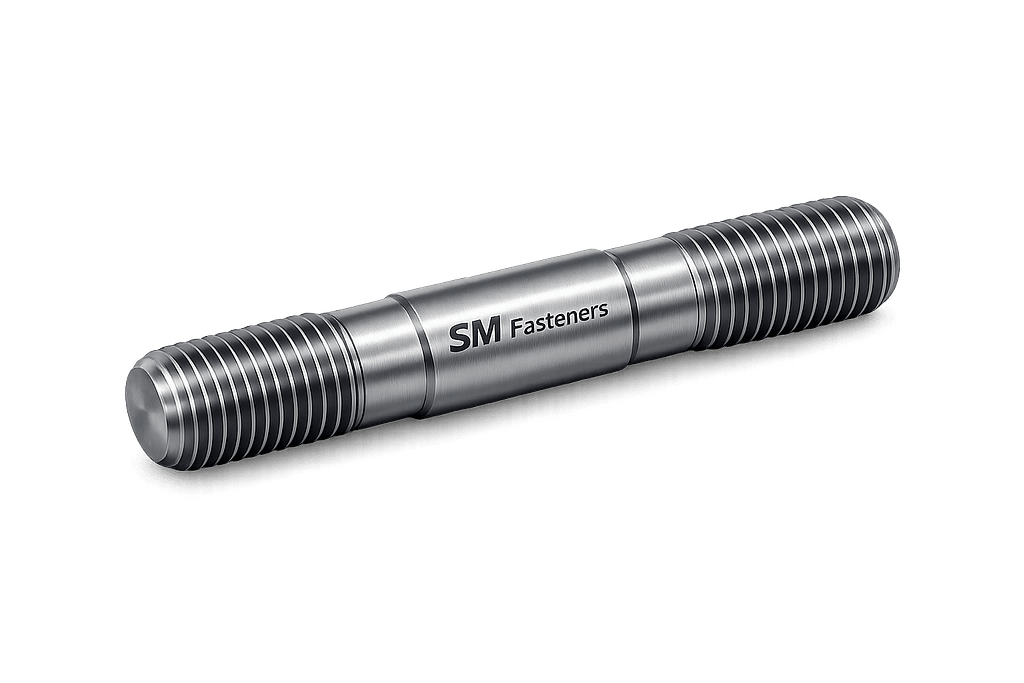
Reduced Shank Double End Stud
Engineering objective:
Reduce stress concentration at first engaged thread.
Benefits:
- Higher fatigue life
- Uniform stress distribution
- Improved vibration resistance
2.3 Dimensional Logic & Engineering Geometry
Double end stud design follows specific dimensional relationships.
Core Dimensional Elements
| Symbol | Description |
|---|---|
| d | Nominal diameter |
| P | Thread pitch |
| L | Overall length |
| b1 | Thread length end 1 |
| b2 | Thread length end 2 |
| ls | Unthreaded shank length |
| ds | Shank diameter |
Standard Dimensional Relationship
Typical design rules:
- Thread engagement ≥ 1D
- Nut engagement ≥ 1D
- Minimum run-out per ISO thread standards
2.4 Standard Metric Double End Stud Dimensions
(Representative Engineering Reference — SM Fasteners Manufacturing Range)
| Size | Pitch (mm) | Standard Length Range (mm) | Thread Length Each End (mm) |
|---|---|---|---|
| M8 | 1.25 | 30–150 | 18 |
| M10 | 1.5 | 40–200 | 22 |
| M12 | 1.75 | 50–250 | 26 |
| M16 | 2.0 | 60–300 | 32 |
| M20 | 2.5 | 70–400 | 40 |
| M24 | 3.0 | 80–500 | 48 |
| M30 | 3.5 | 100–600 | 60 |
| M36 | 4.0 | 120–800 | 72 |
| M42 | 4.5 | 150–900 | 84 |
| M48 | 5.0 | 180–1000 | 96 |
Custom dimensions supplied by SM Fasteners based on EPC drawings and equipment OEM specifications.
2.5 Unified Thread (UNC/UNF) Dimensions
| Size | UNC Pitch | UNF Pitch | Typical Use |
|---|---|---|---|
| 1/2″ | 13 TPI | 20 TPI | Structural |
| 5/8″ | 11 TPI | 18 TPI | Heavy equipment |
| 3/4″ | 10 TPI | 16 TPI | Pressure vessels |
| 1″ | 8 TPI | 12 TPI | Flange joints |
| 1-1/4″ | 7 TPI | 12 TPI | Oil & Gas |
| 1-1/2″ | 6 TPI | 12 TPI | Offshore |
2.6 Thread Standards & Tolerances
| Thread System | Standard | Tolerance Class |
|---|---|---|
| Metric Coarse | ISO 261 / ISO 965 | 6g |
| Metric Fine | ISO 261 | 6g |
| UNC | ASME B1.1 | 2A |
| UNF | ASME B1.1 | 2A |
| BSW | BS 84 | Medium |
| BSF | BS 84 | Fine |
| NPT (Special) | ASME B1.20 | Taper |
SM Fasteners verifies thread accuracy using calibrated GO/NO-GO gauges under ISO 9001 controlled inspection systems.
2.7 Thread Engagement Engineering
Recommended Engagement Length
| Diameter | Minimum Engagement |
|---|---|
| ≤ M12 | 1D |
| M16–M24 | 1–1.25D |
| M30–M48 | 1.25–1.5D |
| Soft alloys | Up to 2D |
2.8 Double End Stud Length Selection Logic
Length selection depends on:
- Component thickness
- Washer thickness
- Nut height
- Thread protrusion requirement
- Thermal expansion allowance
Standard Calculation
Allowance typically:
- 2–3 thread pitches protrusion
2.9 Applicable International Standards
Double end studs manufactured by SM Fasteners conform to major global standards:
ASTM Standards
| Standard | Application |
|---|---|
| ASTM A193 | High temperature / pressure studs |
| ASTM A320 | Low temperature service |
| ASTM A307 | General structural |
| ASTM F1554 | Anchor & structural studs |
| ASTM A453 | High strength turbine studs |
ISO Standards
| Standard | Scope |
|---|---|
| ISO 898-1 | Mechanical properties |
| ISO 4753 | Ends of fasteners |
| ISO 965 | Thread tolerances |
| ISO 3269 | Acceptance inspection |
DIN Standards
| Standard | Description |
|---|---|
| DIN 938 | Double end studs (short thread) |
| DIN 939 | Double end studs (long thread) |
| DIN 940 | Fully threaded studs |
| DIN 976 | Threaded rods |
British Standards
| Standard | Application |
|---|---|
| BS 4439 | Stud bolts |
| BS 1768 | General studs |
| BS 3643 | Thread forms |
2.10 Property Class & Strength Designation
Metric mechanical classes:
| Property Class | Yield Strength (MPa) | Typical Use |
|---|---|---|
| 4.6 | 240 | Light structures |
| 8.8 | 640 | Structural joints |
| 10.9 | 900 | Heavy equipment |
| 12.9 | 1080 | High-load assemblies |
2.11 Dimensional Tolerance Control
Critical tolerances maintained by SM Fasteners:
| Feature | Control Method |
|---|---|
| Major Diameter | Micrometer verification |
| Pitch Diameter | Thread gauge |
| Straightness | V-block inspection |
| Perpendicularity | Optical measurement |
| Surface Finish | Ra measurement |
2.12 Interchangeability Considerations
Global EPC projects require cross-standard compatibility.
Key rules:
- Metric ↔ UNC substitution not permitted without engineering approval
- DIN studs interchangeable with ISO where tolerances align
- ASTM material grades compatible with ISO property classes
SM Fasteners provides engineering cross-reference support during procurement stages.
2.13 Geometry Impact on Mechanical Performance
| Geometry Feature | Engineering Impact |
|---|---|
| Rolled thread root radius | Increased fatigue resistance |
| Reduced shank | Lower stress concentration |
| Equal threads | Balanced loading |
| Precision pitch | Stable preload |
| Chamfered ends | Improved installation |
2.14 Design Considerations for Special Applications
High Temperature Service
- Controlled thread fit
- Creep resistance alloys
Offshore Environments
- Duplex / Super Duplex materials
- Anti-galling coatings
PEEK Double End Studs
Used where:
- Electrical insulation required
- Chemical inertness critical
- Lightweight assemblies necessary
SM Fasteners supplies engineered PEEK stud solutions for chemical processing and electronics equipment.
2.15 SM Fasteners Engineering Capability Integration
SM Fasteners supports global buyers through:
- ISO 9001 certified dimensional control
- CNC precision machining
- Custom stud geometry development
- Drawing-to-manufacture execution
- MSME-recognized manufacturing facility
- UKAF-certified quality assurance
3. MATERIAL GRADES, HEAT TREATMENT, MANUFACTURING & SURFACE FINISHING
3.1 Materials Engineering Philosophy
Material selection for Double End Studs is a critical engineering decision influencing:
- Load capacity
- Corrosion resistance
- Temperature stability
- Fatigue life
- Galling resistance
- Sour service compliance
SM Fasteners manufactures double end studs across a full industrial metallurgy spectrum, supporting EPC specifications, OEM drawings, and international project standards.
Material traceability is maintained through:
- Verified raw material sourcing
- Mill Test Certificates (EN 10204 3.1 / 3.2)
- Heat number traceability
- PMI validation
3.2 Industrial Material Grades for Double End Studs
Carbon Steel Grades
| Grade | Standard | UTS (MPa) | Temp Limit | Application |
|---|---|---|---|---|
| ASTM A307 | ASTM | 415 | 300°C | Structural joints |
| ASTM A36 | ASTM | 400–550 | 350°C | Construction |
| EN 1.0402 (C22) | EN | 430 | 350°C | Machinery |
Advantages:
- Economical
- Good machinability
- High availability
Limitations:
- Limited corrosion resistance
Alloy Steel Grades
| Grade | Standard | UTS (MPa) | Service Temp |
|---|---|---|---|
| ASTM A193 B7 | ASTM | 860 | 450°C |
| ASTM A193 B16 | ASTM | 1035 | 540°C |
| EN 42CrMo4 | EN | 1000 | 500°C |
Applications:
- Pressure vessels
- Petrochemical flanges
- Turbine equipment
Stainless Steel Grades
| Grade | UNS | Corrosion Resistance | Typical Use |
|---|---|---|---|
| SS304 | S30400 | General corrosion | Food & chemical |
| SS316 | S31600 | Chloride resistant | Marine |
| SS316L | S31603 | Low carbon | Welding environments |
| SS321 | S32100 | High temp stability | Exhaust systems |
Duplex & Super Duplex Steels
| Grade | Yield Strength (MPa) | Environment |
|---|---|---|
| Duplex 2205 | 450 | Offshore |
| Super Duplex 2507 | 550 | Seawater / LNG |
Advantages:
- Excellent SCC resistance
- High strength-to-weight ratio
- Long offshore service life
Nickel & High Performance Alloys
SM Fasteners supplies advanced alloys for extreme applications.
| Material | Max Temp | Key Property |
|---|---|---|
| Inconel 625 | 980°C | Oxidation resistance |
| Inconel 718 | 700°C | High strength |
| Hastelloy C276 | Acid resistant | Chemical plants |
| Monel 400 | Marine resistant | Seawater |
| Incoloy 825 | H₂S resistant | Sour service |
| SMO 254 | High chloride resistance | Desalination |
Engineering Polymer — PEEK Double End Studs
Used where metal fasteners are unsuitable.
Properties:
- Continuous temp: 260°C
- Electrically insulating
- Non-magnetic
- Chemical inertness
- Lightweight
Applications:
- Semiconductor equipment
- Chemical dosing systems
- Electrical assemblies
3.3 Material Selection Matrix
| Environment | Recommended Material |
|---|---|
| Indoor structural | Carbon steel |
| Oil & Gas | A193 B7 / B16 |
| Offshore | Duplex / Super Duplex |
| Acidic chemical | Hastelloy |
| Cryogenic LNG | A320 L7 |
| Marine atmosphere | SS316 / Monel |
| Electrical insulation | PEEK |
3.4 Mechanical Properties — Grade Comparison
| Grade | Yield (MPa) | UTS (MPa) | Hardness | Fatigue Resistance |
|---|---|---|---|---|
| 8.8 | 640 | 800 | 22–32 HRC | Good |
| 10.9 | 900 | 1040 | 32–39 HRC | Very High |
| 12.9 | 1080 | 1220 | 39–44 HRC | High but HE risk |
| B7 | 720 | 860 | 24–35 HRC | Excellent |
| Duplex 2205 | 450 | 620 | 28 HRC | Superior |
3.5 NACE MR0175 / ISO 15156 Compliance
Critical for H₂S sour environments.
Requirements:
- Controlled hardness ≤ 22 HRC (typical)
- Verified heat treatment
- Hydrogen embrittlement mitigation
- Material chemistry verification
SM Fasteners supplies NACE-compliant studs with supporting certification.
3.6 Heat Treatment Processes
Heat treatment defines final mechanical properties.
1. Annealing
Purpose:
- Improve machinability
- Reduce internal stress
2. Quenching & Tempering (Q&T)
Primary process for alloy steel studs.
Steps:
- Austenitizing
- Rapid quenching
- Controlled tempering
Result:
- High tensile strength
- Toughness balance
3. Solution Annealing (Stainless Steel)
- Dissolves carbides
- Improves corrosion resistance
- Restores ductility
4. Age Hardening (Nickel Alloys)
Used for:
- Inconel 718
- Precipitation-strengthened alloys
Provides exceptional high-temperature strength.
Heat Treatment Impact Table
| Process | Strength | Ductility | Corrosion Resistance |
|---|---|---|---|
| Annealing | Low | High | Moderate |
| Q&T | High | Balanced | Moderate |
| Solution Anneal | Medium | High | Excellent |
| Age Hardening | Very High | Medium | Excellent |
3.7 Hardness Control Requirements
| Service | Max Hardness |
|---|---|
| General industrial | 35–44 HRC |
| NACE sour service | ≤22 HRC |
| Stainless steel | HRB scale typical |
| Offshore | Controlled per spec |
SM Fasteners performs hardness verification during batch inspection.
3.8 End-to-End Manufacturing Workflow
SM Fasteners operates under ISO 9001 controlled production systems.
Step 1 — Raw Material Verification
- Chemical composition review
- Heat number identification
- MTC verification
- Ultrasonic bar inspection
Step 2 — Cutting & Preparation
- CNC bar cutting
- Length tolerance control
- End chamfering
Step 3 — Forging / Machining
| Method | Application |
|---|---|
| Hot forging | Large diameter studs |
| CNC machining | Precision studs |
| Cold forming | High-volume production |
Step 4 — Thread Production
Thread Rolling (Preferred)
Advantages:
- Grain flow continuity
- Higher fatigue resistance
- Smooth surface finish
Thread Cutting
Used for:
- Large diameters
- Exotic alloys
- Small batch customization
Step 5 — Heat Treatment
Controlled furnace cycles with:
- Temperature recording
- Batch traceability
- Hardness validation
Step 6 — Straightening & Stress Relief
Ensures:
- Alignment accuracy
- Proper preload distribution
Step 7 — Surface Finishing
Applied according to environment.
Step 8 — Final Inspection & Marking
- Dimension verification
- Marking with heat number
- Traceability stamping
3.9 Surface Engineering & Coating Systems
Surface finish directly influences:
- Corrosion resistance
- Torque coefficient
- Galling behavior
- Service life
Surface Finish Comparison Table
| Coating | Corrosion Resistance | Temp Limit | Typical Use |
|---|---|---|---|
| Black Oxide | Low | 300°C | Indoor |
| Zinc Plating | Moderate | 120°C | Structural |
| Hot Dip Galvanized | High | 450°C | Construction |
| PTFE / Xylan | Excellent | 260°C | Offshore |
| Cadmium | High | Aerospace | |
| Phosphate | Moderate | Machinery | |
| Nickel Plating | High | Chemical | |
| Dacromet / Geomet | Very High | Marine |
SM Fasteners selects coating systems aligned with torque-preload consistency requirements.
3.10 Hydrogen Embrittlement Prevention
Critical for high-strength studs (>1000 MPa).
Controls include:
- Limited electroplating exposure
- Post-bake hydrogen relief
- Controlled coating thickness
- Hardness monitoring
3.11 Corrosion Resistance vs Environment
| Environment | Recommended Finish |
|---|---|
| Indoor dry | Black oxide |
| Coastal atmosphere | HDG / Duplex |
| Offshore platform | PTFE coated |
| Chemical plant | Nickel alloy + PTFE |
| Sour gas | NACE-compliant coating |
| High humidity | Zinc flake coating |
3.12 Surface Roughness & Friction Control
Surface roughness affects torque accuracy.
| Finish | Typical Ra Value |
|---|---|
| Rolled thread | 3–6 µm |
| Machined | 6–12 µm |
| Coated | Variable |
Lower roughness → predictable preload.
3.13 Manufacturing Traceability System (SM Fasteners)
Each double end stud maintains:
- Heat number tracking
- Batch identification
- Process history
- Inspection records
- Material origin verification
Aligned with ISO 9001 and UKAF auditing requirements.
3.14 Engineering Customization Capability
SM Fasteners provides:
- Non-standard thread forms
- Special engagement lengths
- Reduced shank designs
- High-temperature alloys
- PEEK custom molded studs
- Project-specific coatings
Supporting global EPC procurement and OEM integration.
4 . INSPECTION, QUALITY ASSURANCE, APPLICATIONS & PROCUREMENT DATA
4.1 Quality Philosophy — SM Fasteners
Double End Studs used in critical industrial systems must comply with strict mechanical, dimensional, and metallurgical verification standards.
SM Fasteners integrates quality control through:
- ISO 9001 certified manufacturing system
- UKAF accredited quality framework
- MSME-recognized production infrastructure
- Fully traceable manufacturing workflow
Quality assurance begins from raw material intake and continues through final dispatch.
4.2 Incoming Material Inspection
Every production batch undergoes verification prior to manufacturing.
| Inspection Parameter | Method |
|---|---|
| Chemical composition | Spectrometer analysis |
| Mill Test Certificate | EN 10204 3.1 review |
| Heat number traceability | Physical marking |
| Surface defects | Visual & magnetic check |
| Internal defects | Ultrasonic testing |
4.3 Dimensional Inspection & Control
Critical tolerances ensure preload reliability and interchangeability.
| Feature | Inspection Tool |
|---|---|
| Major diameter | Micrometer |
| Pitch diameter | Thread micrometer |
| Thread pitch | Profile gauge |
| Length tolerance | Digital caliper |
| Straightness | V-block & dial gauge |
| Concentricity | CMM inspection |
| Thread tolerance | GO / NO-GO gauges |
4.4 Mechanical Testing Requirements
Performed according to ISO / ASTM specifications.
| Test | Purpose |
|---|---|
| Tensile test | Verify UTS & yield |
| Proof load test | Confirm elastic behavior |
| Hardness test | Heat treatment validation |
| Impact testing | Low-temperature service |
| Bend testing | Ductility confirmation |
| Fatigue testing | Dynamic load reliability |
4.5 Non-Destructive Testing (NDT)
Required for critical EPC and oil & gas projects.
| Method | Detection Capability |
|---|---|
| Magnetic Particle (MPI) | Surface cracks |
| Dye Penetrant (DPT) | Micro defects |
| Ultrasonic Testing | Internal flaws |
| Eddy Current | Surface discontinuity |
| Radiography | Special applications |
4.6 Positive Material Identification (PMI)
Mandatory for alloy and corrosion-resistant materials.
PMI verifies:
- Nickel content
- Chromium composition
- Molybdenum percentage
- Alloy grade authenticity
Ensures compliance with:
- ASTM A193
- NACE MR0175
- Project material specifications
4.7 Certification & Documentation Package
SM Fasteners supplies complete export documentation:
| Document | Purpose |
|---|---|
| EN 10204 3.1 / 3.2 MTC | Material traceability |
| Heat Treatment Report | Mechanical confirmation |
| Dimensional Inspection Report | QA verification |
| Coating Certificate | Surface compliance |
| PMI Report | Alloy validation |
| NDT Report | Defect verification |
| Certificate of Conformity | Order compliance |
| Packing List & Traceability Sheet | Logistics control |
4.8 Industrial Applications of Double End Studs
Construction & Structural Steel
- Steel column base plates
- Bridge assemblies
- Heavy structural nodes
- Expansion joints
Engineering Need:
- Long-term preload retention
Oil & Gas Industry
Upstream
- Wellhead equipment
- Christmas trees
- Drilling rigs
Midstream
- Pipeline compressor stations
- Pump skids
Downstream
- Refinery flanges
- Reactor vessels
- Heat exchangers
Material focus:
A193 B7, B16, Duplex, Inconel.
Power Generation
- Steam turbines
- Boiler casings
- Generator frames
- Nuclear auxiliary equipment
Requirement:
High temperature creep resistance.
Petrochemical & Chemical Processing
- Pressure reactors
- Acid handling equipment
- Process piping
Preferred materials:
Hastelloy, SMO 254, Stainless steel.
LNG & Cryogenic Facilities
- Cryogenic valves
- LNG storage tanks
- Gas liquefaction systems
Material:
ASTM A320 L7 or stainless alloys.
Offshore & Marine
- FPSO systems
- Subsea structures
- Shipbuilding assemblies
Requirement:
Chloride stress corrosion resistance.
Automotive & Heavy Equipment
- Engine mounting systems
- Mining machinery
- Hydraulic presses
Railways & Infrastructure
- Track systems
- Signal structures
- Rolling stock assemblies
PEEK Double End Stud Applications
- Semiconductor tooling
- Chemical dosing skids
- Electrical insulation assemblies
- MRI & non-magnetic equipment
4.9 Failure Prevention Engineering
| Failure Mode | Preventive Measure |
|---|---|
| Fatigue | Rolled threads + correct preload |
| Galling | Lubrication / PTFE coating |
| Hydrogen embrittlement | Controlled plating & baking |
| SCC | Proper alloy selection |
| Thread stripping | Correct engagement length |
MANDATORY ENGINEERING TABLES
4.10 Proof Load & Tensile Strength Table
| Size | Property Class | Proof Load (kN) | Tensile Strength (kN) |
|---|---|---|---|
| M12 | 8.8 | 45 | 52 |
| M16 | 8.8 | 84 | 98 |
| M20 | 8.8 | 131 | 153 |
| M24 | 10.9 | 226 | 262 |
| M30 | 10.9 | 353 | 409 |
| M36 | 10.9 | 520 | 600 |
4.11 Material Comparison Table
| Material | Yield | UTS | Corrosion Resistance | Cost Level | Typical Industry |
|---|---|---|---|---|---|
| Carbon Steel | Medium | Medium | Low | Low | Construction |
| Alloy Steel B7 | High | High | Medium | Medium | Oil & Gas |
| SS316 | Medium | Medium | High | Medium | Marine |
| Duplex 2205 | High | High | Very High | High | Offshore |
| Inconel 625 | Very High | Very High | Excellent | Very High | Aerospace |
| PEEK | Low | Moderate | Excellent | High | Electronics |
4.12 Corrosion Resistance vs Environment
| Environment | Carbon Steel | SS316 | Duplex | Nickel Alloy | PEEK |
|---|---|---|---|---|---|
| Seawater | Poor | Good | Excellent | Excellent | Excellent |
| Acidic | Poor | Moderate | Good | Excellent | Excellent |
| H₂S Sour | Poor | Limited | Excellent | Excellent | Excellent |
| High Temp | Moderate | Good | Good | Excellent | Limited |
| Cryogenic | Poor | Good | Excellent | Excellent | Excellent |
4.13 Mechanical Properties — Grade Wise
| Grade | Yield (MPa) | UTS (MPa) | Hardness |
|---|---|---|---|
| 4.6 | 240 | 400 | 120 HB |
| 8.8 | 640 | 800 | 22–32 HRC |
| 10.9 | 900 | 1040 | 32–39 HRC |
| 12.9 | 1080 | 1220 | 39–44 HRC |
| A193 B7 | 720 | 860 | 24–35 HRC |
4.14 Tightening Torque Chart (Metric Studs)
(Lubricated condition — Nut Factor ≈ 0.18)
| Size | Class 8.8 (Nm) | Class 10.9 (Nm) |
|---|---|---|
| M12 | 80 | 115 |
| M16 | 200 | 300 |
| M20 | 390 | 560 |
| M24 | 680 | 960 |
| M30 | 1350 | 1900 |
| M36 | 2350 | 3300 |
4.15 Preload Calculation Formula
Example
- Size: M20
- Torque: 560 Nm
- Nut Factor: 0.18
Approximate Preload = 156 kN
4.16 Thread Standards & Tolerances
| Thread | Standard | Class |
|---|---|---|
| Metric Coarse | ISO 261 | 6g |
| Metric Fine | ISO 965 | 6g |
| UNC | ASME B1.1 | 2A |
| UNF | ASME B1.1 | 2A |
| BSW | BS 84 | Medium |
| BSF | BS 84 | Fine |
4.17 Surface Finish Performance Comparison
| Coating | Corrosion Life | Torque Consistency | Offshore Suitability |
|---|---|---|---|
| Black Oxide | Low | Good | No |
| Zinc Plated | Medium | Moderate | Limited |
| HDG | High | Variable | Yes |
| PTFE/Xylan | Excellent | Excellent | Ideal |
| Dacromet | Very High | Stable | Excellent |
| Nickel Plating | High | Good | Chemical |
4.18 Weight Chart — Double End Studs
(Approximate — aligned with SM Fasteners manufacturing data)
| Size | Weight / Piece (kg) | Weight / 100 pcs (kg) |
|---|---|---|
| M12 × 100 | 0.09 | 9 |
| M16 × 120 | 0.19 | 19 |
| M20 × 150 | 0.37 | 37 |
| M24 × 180 | 0.66 | 66 |
| M30 × 200 | 1.15 | 115 |
| M36 × 220 | 2.00 | 200 |
| M42 × 250 | 3.20 | 320 |
| M48 × 300 | 5.10 | 510 |
SM Fasteners provides project-specific weight calculations for logistics planning and export packaging optimization.
4.19 Industrial Packaging & Export Logistics
Protective Packaging
- VCI corrosion protection
- Thread protectors
- Oil coating (as required)
- Batch segregation
Export Packaging
- ISPM-15 compliant wooden crates
- Palletized loading
- Moisture barrier wrapping
- Shock protection
4.20 Global Supply & Procurement Readiness
SM Fasteners supports international projects through:
- ISO 9001 certified quality systems
- UKAF accredited inspection compliance
- MSME manufacturing recognition
- Custom fastener engineering capability
- Advanced alloys & PEEK manufacturing
- Full EPC documentation support
- Traceable global export supply chain
Engineering Summary
Double End Studs manufactured by SM Fasteners provide:
✔ Controlled preload performance
✔ Global standards compliance (ISO / ASTM / DIN / BS)
✔ Advanced material capability including Nickel alloys & PEEK
✔ Verified manufacturing and inspection systems
✔ Reliable supply for high-integrity industrial applications