

Socket Head Cap Screws
1. Industry Context
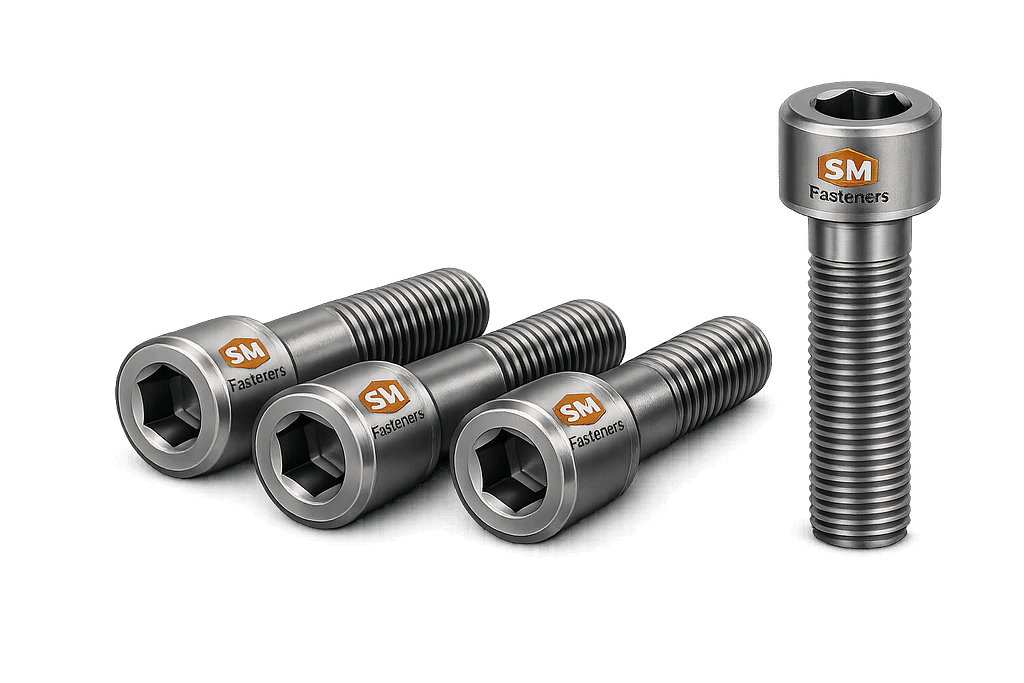
Socket Head Cap Screws (SHCS) are precision-engineered high-strength threaded fasteners primarily used in space-constrained, high-load mechanical assemblies where conventional hex bolts cannot deliver required performance or accessibility.
Across global heavy engineering sectors, SHCS are considered critical load-transfer components, not simple fastening elements.
Primary Industrial Drivers
| Industry Sector | Engineering Requirement | SHCS Advantage |
|---|---|---|
| Oil & Gas | High preload reliability | High tensile property classes |
| Power Generation | Vibration resistance | Deep internal drive torque capacity |
| Structural Steel | Compact installation | High clamp force in limited space |
| Petrochemical | Corrosion resistance | Advanced alloys & coatings |
| OEM Machinery | Precision alignment | Controlled preload accuracy |
| Rail & Infrastructure | Fatigue resistance | Uniform load distribution |
SM Fasteners manufactures socket head cap screws aligned with global EPC project specifications, ensuring compatibility with international inspection and procurement systems.
2. Technical Definition
A Socket Head Cap Screw is a:
Cylindrical-headed, internally driven threaded fastener designed to achieve high preload values using an internal hexagonal drive interface.
Fundamental Geometry
Key Design Elements
- Cylindrical head with precision height tolerance
- Internal hex (Allen) drive
- Close tolerance shank
- Rolled or precision cut threads
- High-strength material structure
Unlike hex bolts, torque is applied axially through the socket, allowing:
- Higher torque transmission
- Reduced head diameter
- Improved tool clearance
- Controlled tightening accuracy
3. Functional Role in Mechanical Assemblies
Socket head cap screws function primarily as clamping force generators.
They do not carry load through shear alone; instead, properly designed joints rely on:
Frictional resistance generated by preload.
Functional Roles
- Structural clamping
- Machine assembly retention
- Precision component positioning
- Dynamic load stabilization
- Pressure equipment fastening
4. Load Mechanics & Force Behavior
4.1 Fundamental Bolt Load Model
When tightened:
- Screw elongates elastically
- Joint components compress
- Preload develops
- Friction resists separation
External Load → Joint Interface → Friction → Bolt Preload Resistance4.2 Preload Concept
Preload is the initial tensile force introduced during tightening.
Where:
| Symbol | Meaning |
|---|---|
| F | Preload force |
| T | Applied torque |
| K | Nut factor |
| D | Nominal diameter |
Typical Nut Factor:
| Condition | K Value |
|---|---|
| Dry steel | 0.20–0.24 |
| Lubricated | 0.15–0.18 |
| MoS₂ coated | 0.10–0.13 |
4.3 Torque–Tension Relationship
Approximately:
- 90% torque lost to friction
- 10% converted into useful preload
Therefore, surface condition control is mandatory.
SM Fasteners integrates coating control and dimensional consistency under ISO 9001 quality systems to stabilize torque behavior.
4.4 Force Distribution in Joint Design
External loads distribute between bolt and joint stiffness.
Where:
| Term | Definition |
|---|---|
| Kb | Bolt stiffness |
| Kj | Joint stiffness |
| C | Load sharing factor |
Rigid joints reduce bolt fatigue.
5. Joint Design Principles
5.1 Proper Thread Engagement
Minimum engagement:
| Material | Engagement Length |
|---|---|
| Steel | 1 × Diameter |
| Aluminum | 1.5 × Diameter |
| Cast Iron | 1.2 × Diameter |
5.2 Clamp Length Considerations
Longer grip length provides:
- Better fatigue resistance
- Reduced stress concentration
- Stable preload retention
5.3 Head Seating Requirements
Socket head cap screws require:
- Flat bearing surface
- Perpendicular seating
- Surface roughness control
Improper seating leads to bending stress and premature failure.
6. Mechanical Behavior Under Service Loads
Tensile Loading
Primary operating mode.
Shear Loading
Should be minimized via friction joint design.
Fatigue Loading
Common in rotating machinery and rail equipment.
Thermal Expansion
Differential expansion affects preload retention.
7. Failure Mechanisms
Fatigue Failure
Occurs below yield strength due to cyclic stress.
Mitigation
- Correct preload
- Rolled threads
- Smooth fillet radii
Shear Failure
Occurs when joint slips.
Prevented by:
- Adequate clamp force
- Friction coefficient control
Hydrogen Embrittlement
High-strength screws (>1000 MPa) are vulnerable.
SM Fasteners applies controlled coating processes compliant with industrial baking requirements.
Stress Corrosion Cracking (SCC)
Common environments:
- Chlorides
- H₂S
- Caustic service
Material selection must follow NACE MR0175 / ISO 15156.
8. Why Socket Head Cap Screws Are Preferred in Engineering Systems
| Design Parameter | SHCS Benefit |
|---|---|
| High Strength | Property class 12.9 capability |
| Space Constraint | Reduced head diameter |
| Automation | Compatible with robotic assembly |
| Precision | Tight tolerance manufacturing |
| Maintenance | Repeatable torque accuracy |
9. Product Types and Variants
Socket Head Cap Screws are engineered into multiple configurations to satisfy installation access, load transfer requirements, and environmental constraints across global industrial systems.
Unlike commodity fasteners, selection depends heavily on joint architecture, not merely diameter or strength class.
9.1 Standard Socket Head Cap Screw (SHCS)

Primary Standard: ISO 4762 / DIN 912
Characteristics
- Cylindrical head
- Internal hex drive
- Full or partial thread
- High preload capability
Applications
- Machine assemblies
- Structural modules
- Precision fixtures
- Hydraulic equipment
9.2 Low Head Socket Cap Screws
Design Intent
Used where vertical clearance is restricted.
Engineering Consideration
- Reduced head strength
- Lower torque capacity
- Requires torque adjustment
Typical usage:
- Electronics housings
- Robotics
- Aerospace subassemblies
9.3 Button Head Socket Screws
Geometry
- Rounded head profile
- Larger bearing surface
- Lower head height
Advantages
- Aesthetic assemblies
- Reduced snag risk
- Non-structural clamping
Not recommended for high tensile structural loading.
9.4 Flat Head (Countersunk) Socket Screws


Function
Provides flush surface installation.
Requires:
- Countersunk seat machining
- Accurate alignment
Used in:
- Sliding surfaces
- Rail equipment
- Automotive panels
9.5 Shoulder Socket Screws
Engineering Role
Acts as both:
- Fastener
- Precision locating shaft
Applications:
- Pivot joints
- Bearing mounts
- Tooling fixtures
9.6 Vented Socket Head Cap Screws
Designed for:
- Vacuum systems
- Semiconductor equipment
- Aerospace assemblies
Feature:
- Axial vent hole preventing trapped gases.
9.7 Peek socket head cap screws
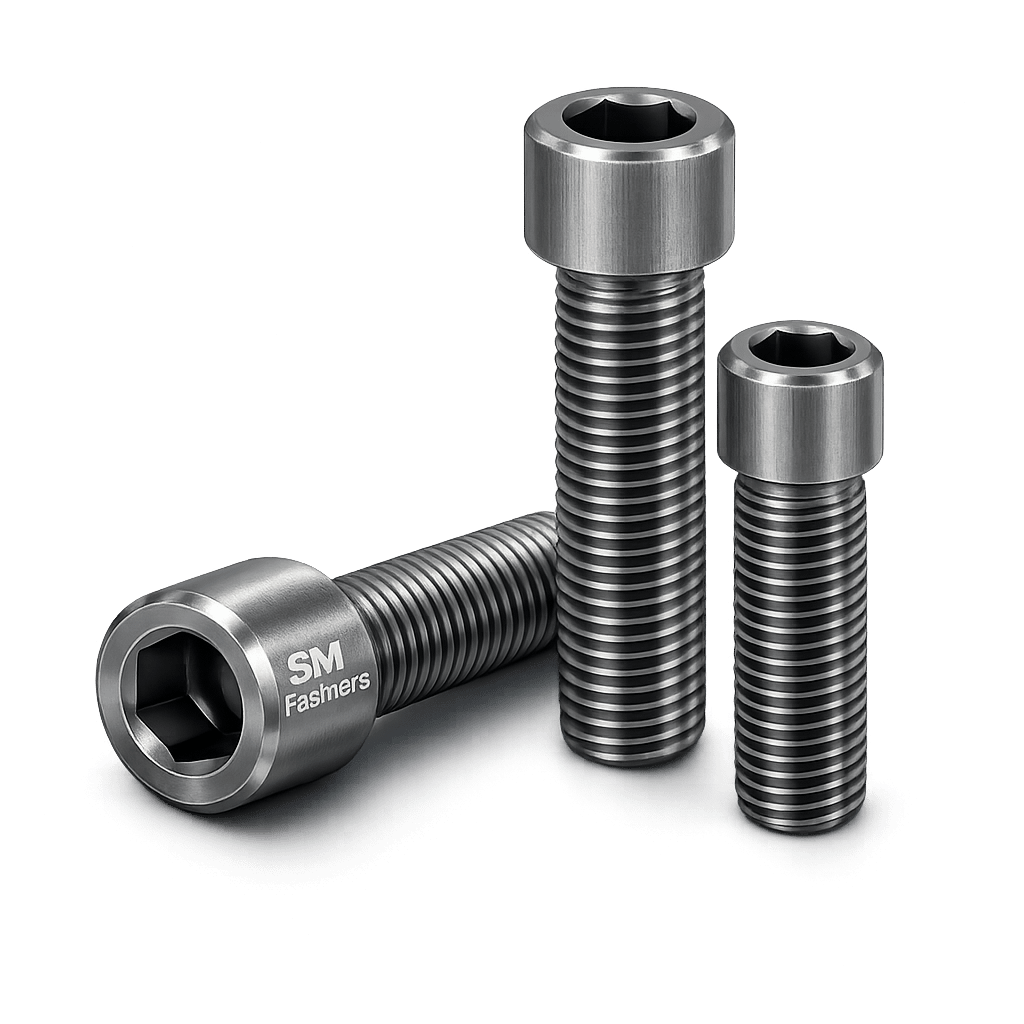
SM Fasteners supports high-performance polymer fasteners for extreme environments.
Material: PEEK (Polyether Ether Ketone)
Advantages:
- Non-magnetic
- Chemical resistant
- Electrically insulating
- Lightweight
- Radiation tolerant
Used in:
- Semiconductor fabrication
- Medical equipment
- Chemical processing systems
10. Dimensional Logic & Engineering Geometry
Socket head cap screw geometry is standardized to achieve:
- Optimal torque transmission
- Controlled stress flow
- Minimum stress concentration
10.1 Key Dimensional Parameters
| Symbol | Description |
|---|---|
| d | Nominal thread diameter |
| P | Thread pitch |
| k | Head height |
| dk | Head diameter |
| s | Hex socket size |
| t | Socket depth |
| L | Overall length |
| b | Thread length |
11. Metric Socket Head Cap Screw Dimensions (ISO 4762)
Dimensional Specification Table
| Size | Pitch (mm) | Head Dia dk (mm) | Head Height k (mm) | Socket Size s (mm) | Thread Length b (mm) |
|---|---|---|---|---|---|
| M3 | 0.5 | 5.5 | 3 | 2.5 | 12 |
| M4 | 0.7 | 7 | 4 | 3 | 14 |
| M5 | 0.8 | 8.5 | 5 | 4 | 16 |
| M6 | 1.0 | 10 | 6 | 5 | 18 |
| M8 | 1.25 | 13 | 8 | 6 | 22 |
| M10 | 1.5 | 16 | 10 | 8 | 26 |
| M12 | 1.75 | 18 | 12 | 10 | 30 |
| M16 | 2.0 | 24 | 16 | 14 | 38 |
| M20 | 2.5 | 30 | 20 | 17 | 46 |
| M24 | 3.0 | 36 | 24 | 19 | 54 |
Dimensions aligned with ISO/DIN tolerance systems maintained by SM Fasteners production control.
12. Applicable International Standards
Socket head cap screws operate under strict dimensional and mechanical standardization.
Primary Standards
| Standard | Description |
|---|---|
| ISO 4762 | Metric SHCS |
| DIN 912 | German equivalent |
| ISO 898-1 | Mechanical properties |
| ASTM A574 | Alloy steel SHCS |
| BS 2470 | British socket screws |
| ASME B18.3 | Inch series SHCS |
| ISO 261 | Metric thread pitches |
| ISO 965 | Thread tolerances |
SM Fasteners supplies interchangeable products across standards for multinational EPC projects.
13. Property Class System
Metric fasteners use property class designation.
| Property Class | Tensile Strength (MPa) | Yield Strength (MPa) |
|---|---|---|
| 8.8 | 800 | 640 |
| 10.9 | 1000 | 900 |
| 12.9 | 1200 | 1080 |
Higher classes provide higher preload capacity but require stricter coating control.
14. Thread Standards & Tolerances
Thread System Comparison
| System | Standard | Typical Use |
|---|---|---|
| Metric Coarse | ISO 261 | Global machinery |
| Metric Fine | ISO 965 | High precision joints |
| UNC | ASME B1.1 | USA structural |
| UNF | ASME B1.1 | High fatigue resistance |
| BSW | BS 84 | Legacy UK equipment |
| BSF | BS 84 | Fine British threads |
Thread Tolerance Classes
| Thread | External Class | Internal Class |
|---|---|---|
| Metric | 6g | 6H |
| Precision | 4g6g | 4H |
| UNC | 2A | 2B |
| UNF | 3A | 3B |
SM Fasteners controls thread rolling dies to maintain tolerance repeatability for automated assembly systems.
15. Geometry Influence on Performance
Head Height vs Torque Capacity
Higher head height allows:
- Larger socket depth
- Higher torque transfer
- Reduced rounding risk
Fillet Radius Importance
Critical for fatigue life.
Rolled fillets reduce stress concentration by up to 30% compared to sharp transitions.
Socket Engagement
Minimum engagement rule:
Prevents stripping during installation.
16. Interchangeability Considerations
Engineering procurement teams must verify:
- Head diameter compatibility
- Socket size equivalency
- Thread pitch matching
- Strength class equivalence
- Coating thickness effect
SM Fasteners supports multi-standard compliance enabling cross-regional sourcing flexibility.
17. Engineering Selection Logic
| Requirement | Recommended Variant |
|---|---|
| High strength joint | Standard SHCS |
| Limited head clearance | Low head |
| Flush mounting | Countersunk |
| Pivot motion | Shoulder screw |
| Electrical isolation | PEEK SHCS |
| Vacuum application | Vented screw |
18. Material Grades & Engineering Selection Criteria
Material selection for Socket Head Cap Screws is a critical engineering decision influencing:
- Mechanical strength
- Corrosion resistance
- Temperature capability
- Hydrogen embrittlement susceptibility
- Service life reliability
SM Fasteners manufactures socket head cap screws using certified raw materials supported by EN 10204 3.1 material test certificates, ensuring traceability from steel mill to finished fastener.
18.1 Industrial Material Categories
| Material Category | Typical Grades | Key Advantages | Typical Industries |
|---|---|---|---|
| Carbon Steel | C45, EN8 | Economical strength | Construction, machinery |
| Alloy Steel | 4140, 4340, SCM435 | High tensile performance | Oil & Gas, heavy equipment |
| Stainless Steel | A2-70, A4-80 | Corrosion resistance | Marine, chemical |
| Duplex Stainless | 2205 | Chloride resistance | Offshore platforms |
| Super Duplex | 2507 | Extreme corrosion resistance | Subsea systems |
| Nickel Alloys | Inconel, Monel | High temperature stability | LNG, petrochemical |
| Hastelloy | C276 | Acid resistance | Chemical processing |
| SMO 254 | 6Mo stainless | Seawater durability | Desalination plants |
| PEEK | Polymer grade | Electrical insulation | Semiconductor, medical |
SM Fasteners supports full material traceability under ISO 9001 quality management systems.
19. Mechanical Properties by Material Grade
Mechanical Property Comparison Table
| Grade | UTS (MPa) | Yield Strength (MPa) | Hardness (HRC/HB) | Temp Limit °C | Typical Use |
|---|---|---|---|---|---|
| 8.8 | 800 | 640 | 22–32 HRC | 300 | Structural |
| 10.9 | 1000 | 900 | 32–39 HRC | 350 | Machinery |
| 12.9 | 1200 | 1080 | 39–44 HRC | 400 | High load assemblies |
| A2-70 | 700 | 450 | ≤95 HRB | 400 | General corrosion |
| A4-80 | 800 | 600 | ≤100 HRB | 450 | Marine |
| Duplex 2205 | 800+ | 550 | 28–32 HRC | 300 | Offshore |
| Inconel 718 | 1240 | 1030 | 36–45 HRC | 700 | Gas turbines |
| Monel 400 | 550 | 240 | 150 HB | 480 | Seawater |
| PEEK | — | — | Polymer | 260 | Electrical isolation |
20. Material Selection Based on Environment
Corrosion Resistance vs Environment
| Environment | Recommended Material | Reason |
|---|---|---|
| Atmospheric | Carbon steel + coating | Cost efficiency |
| Marine | A4-80 / Duplex | Chloride resistance |
| Offshore splash zone | Super Duplex | Pitting resistance |
| Sour gas (H₂S) | Controlled hardness alloy steel | NACE compliance |
| Acid processing | Hastelloy C276 | Chemical stability |
| LNG cryogenic | Austenitic stainless | Toughness retention |
| High temperature | Inconel/Incoloy | Creep resistance |
| Electrical isolation | PEEK | Non-conductive |
SM Fasteners provides material selection guidance aligned with NACE MR0175 / ISO 15156 where required.
21. Heat Treatment Processes
Heat treatment defines final mechanical performance.
21.1 Heat Treatment Objectives
- Increase tensile strength
- Improve fatigue resistance
- Refine grain structure
- Control hardness limits
21.2 Typical Heat Treatment Cycle (Alloy Steel SHCS)
- Austenitizing — 850–900°C
- Quenching — Oil or polymer medium
- Tempering — 400–650°C
- Stress Relief
Heat Treatment vs Property Outcome
| Process | Effect |
|---|---|
| Quenching | Hardness increase |
| Tempering | Toughness improvement |
| Normalizing | Grain refinement |
| Solution Annealing | Corrosion resistance recovery |
Hardness Control (Critical for Oil & Gas)
| Requirement | Limit |
|---|---|
| NACE Sour Service | ≤34 HRC |
| Hydrogen Embrittlement Risk Zone | >39 HRC |
| Typical Class 12.9 | 39–44 HRC |
SM Fasteners maintains calibrated furnace systems and batch traceability records.
22. End-to-End Manufacturing Workflow
Socket head cap screws require precision manufacturing control unlike general-purpose bolts.
22.1 Raw Material Verification
Incoming inspection includes:
- Mill Test Certificate verification
- Chemical composition testing
- Ultrasonic inspection (when required)
- PMI verification for alloy grades
22.2 Forging / Head Forming
Cold heading preferred for strength-critical fasteners.
Benefits
- Grain flow continuity
- Improved fatigue resistance
- Reduced material waste
Machining used for:
- Exotic alloys
- Large diameters
- Custom designs
22.3 Socket Formation
High precision broaching or forging produces:
- Accurate hex geometry
- High torque transmission capability
- Reduced tool wear during installation
22.4 Thread Production
Thread Rolling (Preferred)
Advantages:
- Compressive surface stress
- Higher fatigue life
- Improved dimensional accuracy
Thread Cutting
Used only when rolling is not feasible.
Thread Quality Control
| Parameter | Inspection Method |
|---|---|
| Pitch accuracy | Thread gauges |
| Lead error | Optical measurement |
| Surface integrity | Visual + magnification |
| Concentricity | Runout inspection |
22.5 Heat Treatment Execution
- Controlled atmosphere furnaces
- Digital temperature logging
- Batch identification traceability
22.6 Straightening & Stress Relief
Prevents distortion after quenching.
22.7 Surface Preparation
Before coating:
- Degreasing
- Shot blasting
- Pickling (stainless grades)
- Ultrasonic cleaning
23. Surface Engineering & Coatings
Surface finish directly influences:
- Corrosion resistance
- Torque coefficient
- Galling prevention
- Installation repeatability
Surface Finish Comparison Table
| Coating | Corrosion Resistance | Friction Stability | Temp Limit | Typical Use |
|---|---|---|---|---|
| Black Oxide | Low | Good | 300°C | Machinery |
| Zinc Plating | Moderate | Variable | 120°C | Construction |
| HDG | High | High friction | 200°C | Structural |
| Mechanical Zinc | Moderate | Consistent | 120°C | Automotive |
| Zinc Nickel | Very High | Stable | 180°C | Offshore |
| PTFE / Xylan | Excellent | Low friction | 260°C | Oil & Gas |
| Cadmium (restricted) | High | Excellent | Aerospace | Controlled usage |
| Passivation (SS) | High | Stable | 400°C | Marine |
| Electropolishing | Very High | Smooth | 450°C | Pharma |
SM Fasteners selects coating processes to maintain mechanical integrity and avoid hydrogen embrittlement.
24. Hydrogen Embrittlement Prevention
Critical for high-strength socket screws.
Control Measures:
- Baking after electroplating
- Controlled pickling exposure
- Alternative coatings (mechanical zinc, ZnNi)
- Hardness monitoring
25. Galling Prevention (Stainless Fasteners)
Galling risk increases with:
- High preload
- Similar material pairing
- Poor lubrication
Solutions:
- MoS₂ lubrication
- Silver plating
- Controlled tightening speed
- Dissimilar material pairing
26. Manufacturing Traceability System
SM Fasteners integrates traceability aligned with ISO 9001 systems:
| Stage | Traceability Method |
|---|---|
| Raw material | Heat number |
| Forging | Batch ID |
| Heat treatment | Furnace log |
| Coating | Process record |
| Inspection | Report reference |
| Dispatch | Packing trace code |
27. Custom Engineering Capability — SM Fasteners
Capabilities include:
- Non-standard head geometry
- Special thread forms
- High-temperature alloys
- PEEK precision fasteners
- Coated EPC project fasteners
- Project-specific marking & coding
Designed to support global EPC procurement specifications.
28. Inspection & Quality Control Framework
Socket Head Cap Screws supplied to industrial projects must pass multi-stage verification before acceptance in EPC, Oil & Gas, power, or infrastructure installations.
SM Fasteners operates within an ISO 9001 certified quality management system, integrating inspection checkpoints from raw material intake through final dispatch.
28.1 Inspection Philosophy
Quality assurance objectives:
- Dimensional conformity
- Mechanical property verification
- Metallurgical integrity
- Surface condition validation
- Full traceability
Industrial fasteners are treated as load-bearing engineered components, not commercial hardware.
29. Incoming Material Inspection
Raw Material Control
| Inspection Activity | Method | Purpose |
|---|---|---|
| MTC verification | EN 10204 3.1 | Chemical traceability |
| Chemical analysis | Spectrometer | Alloy confirmation |
| Ultrasonic testing | UT scan | Internal defect detection |
| Visual inspection | Surface check | Rolling defects |
| PMI testing | XRF analyzer | Grade validation |
All materials remain traceable via heat numbers maintained throughout production.
30. In-Process Dimensional Inspection
Critical Dimensional Controls
| Parameter | Inspection Tool |
|---|---|
| Thread diameter | GO/NO-GO gauges |
| Pitch accuracy | Thread measuring system |
| Head diameter | Digital micrometer |
| Head height | Height gauge |
| Socket depth | Plug gauge |
| Concentricity | Dial indicator |
| Length tolerance | Vernier / Optical comparator |
ISO 4762 tolerance compliance ensures interchangeability across global installations.
31. Mechanical Testing Requirements
Mandatory Mechanical Testing
| Test | Standard | Purpose |
|---|---|---|
| Tensile Test | ISO 898-1 / ASTM A574 | Strength verification |
| Proof Load Test | ISO 898 | Elastic behavior confirmation |
| Hardness Test | Rockwell/Vickers | Heat treatment validation |
| Impact Test | ASTM E23 | Low temperature reliability |
| Wedge Tensile Test | ISO method | Head integrity |
32. Non-Destructive Testing (NDT)
High criticality projects require additional inspection.
| NDT Method | Application |
|---|---|
| Magnetic Particle (MPI) | Crack detection |
| Dye Penetrant (DPT) | Surface discontinuities |
| Ultrasonic Testing | Large diameter bolts |
| Eddy Current | Surface integrity |
| PMI | Alloy verification |
SM Fasteners supports third-party inspections including TPI agencies and project consultants.
33. Documentation & Certification Package
Typical EPC documentation supplied:
- EN 10204 3.1 Material Test Certificate
- Heat Treatment Report
- Mechanical Test Report
- Coating Thickness Report
- Dimensional Inspection Report
- Certificate of Conformity (CoC)
- PMI Report (when specified)
3.2 certification available with third-party witnessing.
34. Mechanical Properties Table — Grade Wise
| Property Class | Proof Stress MPa | Yield MPa | Tensile MPa | Elongation % |
|---|---|---|---|---|
| 8.8 | 580 | 640 | 800 | 12 |
| 10.9 | 830 | 900 | 1000 | 9 |
| 12.9 | 970 | 1080 | 1200 | 8 |
| A2-70 | 450 | 450 | 700 | 40 |
| A4-80 | 600 | 600 | 800 | 35 |
35. Proof Load & Tensile Capacity (Typical Values)
| Size | Tensile Area mm² | Proof Load (kN) Class 10.9 | Ultimate Load (kN) Class 12.9 |
|---|---|---|---|
| M6 | 20.1 | 16.6 | 24.1 |
| M8 | 36.6 | 30.4 | 43.9 |
| M10 | 58 | 48.1 | 69.6 |
| M12 | 84.3 | 70 | 101 |
| M16 | 157 | 130 | 188 |
| M20 | 245 | 203 | 294 |
| M24 | 353 | 292 | 424 |
36. Tightening Torque Chart
(Approximate values — lubricated condition, K ≈ 0.16)
| Size | Torque Class 8.8 (Nm) | Torque Class 10.9 (Nm) | Torque Class 12.9 (Nm) |
|---|---|---|---|
| M6 | 10 | 17 | 20 |
| M8 | 25 | 41 | 49 |
| M10 | 49 | 81 | 97 |
| M12 | 85 | 141 | 169 |
| M16 | 210 | 350 | 420 |
| M20 | 410 | 680 | 815 |
| M24 | 710 | 1180 | 1415 |
Actual torque must consider coating friction coefficients.
37. Preload Calculation — Worked Example
Example:
Bolt: M12 Class 10.9
Torque Applied: 140 Nm
Nut Factor: 0.16
Diameter: 12 mm
Result:
Joint preload ≈ 73 kN clamp force
Engineering practice recommends preload ≈ 70–75% of proof load.
38. Corrosion Resistance vs Environment
| Environment | Carbon Steel | SS A2 | SS A4 | Duplex | Super Duplex | Nickel Alloy |
|---|---|---|---|---|---|---|
| Indoor | Good | Excellent | Excellent | Excellent | Excellent | Excellent |
| Outdoor | Moderate | Excellent | Excellent | Excellent | Excellent | Excellent |
| Seawater | Poor | Moderate | Good | Excellent | Outstanding | Outstanding |
| Acidic | Poor | Moderate | Good | Very Good | Excellent | Outstanding |
| H₂S Service | Controlled | Limited | Limited | Good | Excellent | Excellent |
| High Temp | Moderate | Good | Good | Good | Good | Outstanding |
39. Thread Standards & Tolerance Summary
| Thread Type | Standard | Typical Tolerance |
|---|---|---|
| Metric Coarse | ISO 261 | 6g / 6H |
| Metric Fine | ISO 965 | 4g6g |
| UNC | ASME B1.1 | 2A / 2B |
| UNF | ASME B1.1 | 3A / 3B |
| BSW | BS 84 | Medium |
| BSF | BS 84 | Fine precision |
40. Surface Finish Performance Comparison
| Finish | Salt Spray Resistance | Torque Consistency | Hydrogen Risk |
|---|---|---|---|
| Black Oxide | 24 hrs | Stable | None |
| Zinc Plated | 72–120 hrs | Variable | Medium |
| HDG | 500+ hrs | High friction | Low |
| Zinc Nickel | 1000+ hrs | Excellent | Low |
| PTFE | 1000+ hrs | Excellent | None |
| Passivated SS | Excellent | Stable | None |
41. Weight Chart — Socket Head Cap Screws
(Aligned with SM Fasteners engineering datasets)
| Size | Length 30mm (kg/100 pcs) | Weight per Piece (g) |
|---|---|---|
| M6 | 0.72 | 7.2 |
| M8 | 1.45 | 14.5 |
| M10 | 2.85 | 28.5 |
| M12 | 4.8 | 48 |
| M16 | 9.6 | 96 |
| M20 | 15.8 | 158 |
| M24 | 24.5 | 245 |
Weights assist EPC logistics planning and container load calculations.
42. Industry Applications Mapping
Construction & Structural Steel
- Steel connections
- Modular structures
- Heavy fabrication
Oil & Gas (Upstream–Downstream)
- Valve assemblies
- Pump housings
- Compressor systems
- Offshore platforms
NACE compliant grades supplied where required.
Power Generation
- Turbine casings
- Generator frames
- Boiler equipment
- Renewable energy systems
Petrochemical & Chemical Processing
- Reactor assemblies
- Heat exchangers
- Flange connections
LNG & Offshore
- Cryogenic systems
- Subsea equipment
- Marine loading arms
Automotive & Heavy Equipment
- Engine blocks
- Gearboxes
- Hydraulic systems
Railways & Infrastructure
- Track equipment
- Signaling structures
- Bridge assemblies
Shipbuilding
- Deck equipment
- Engine mounting
- Corrosion-critical zones
PEEK Fastener Applications
SM Fasteners provides engineered PEEK socket head screws for:
- Semiconductor manufacturing
- MRI systems
- Chemical reactors
- Electrical insulation assemblies
- Lightweight aerospace components
43. Export Packaging & Global Logistics
Industrial packaging protects preload reliability and surface condition.
Standard Packaging Methods
| Method | Purpose |
|---|---|
| VCI packaging | Corrosion protection |
| Thread protectors | Prevent damage |
| Heat number labeling | Traceability |
| Moisture barrier bags | Marine shipment |
| Batch coding | QA tracking |
Export Crating
- ISPM-15 compliant wooden crates
- Vacuum sealing (on request)
- Container optimization for EPC logistics
44. SM FASTENERS — Global Supply Capability
SM Fasteners integrates:
- ISO 9001 certified quality systems
- MSME registered manufacturing infrastructure
- UKAF accredited certification framework
- Advanced alloy manufacturing capability
- Custom engineering support
Capabilities include:
- Project-specific manufacturing
- Special coatings
- Exotic alloy machining
- PEEK precision fasteners
- Third-party inspection coordination
45. Engineering Selection Checklist (Procurement Use)
| Parameter | Verification |
|---|---|
| Standard | ISO / ASTM / DIN / BS |
| Property Class | 8.8 / 10.9 / 12.9 |
| Material | Environment compatible |
| Coating | Corrosion requirement |
| Certification | EN 10204 3.1 |
| Inspection | Mechanical + NDT |
| Traceability | Heat number verified |
| Packaging | Export compliant |
ENGINEERING CONCLUSION
Socket Head Cap Screws represent high-precision structural fastening systems requiring:
- Controlled preload engineering
- Accurate material selection
- Certified manufacturing
- Documented inspection compliance
Through integrated engineering knowledge, advanced material capability, and globally aligned quality systems, SM Fasteners delivers socket head cap screws suitable for critical industrial applications and international EPC procurement environments.