

Toothed lock Washers
1. Industry Context
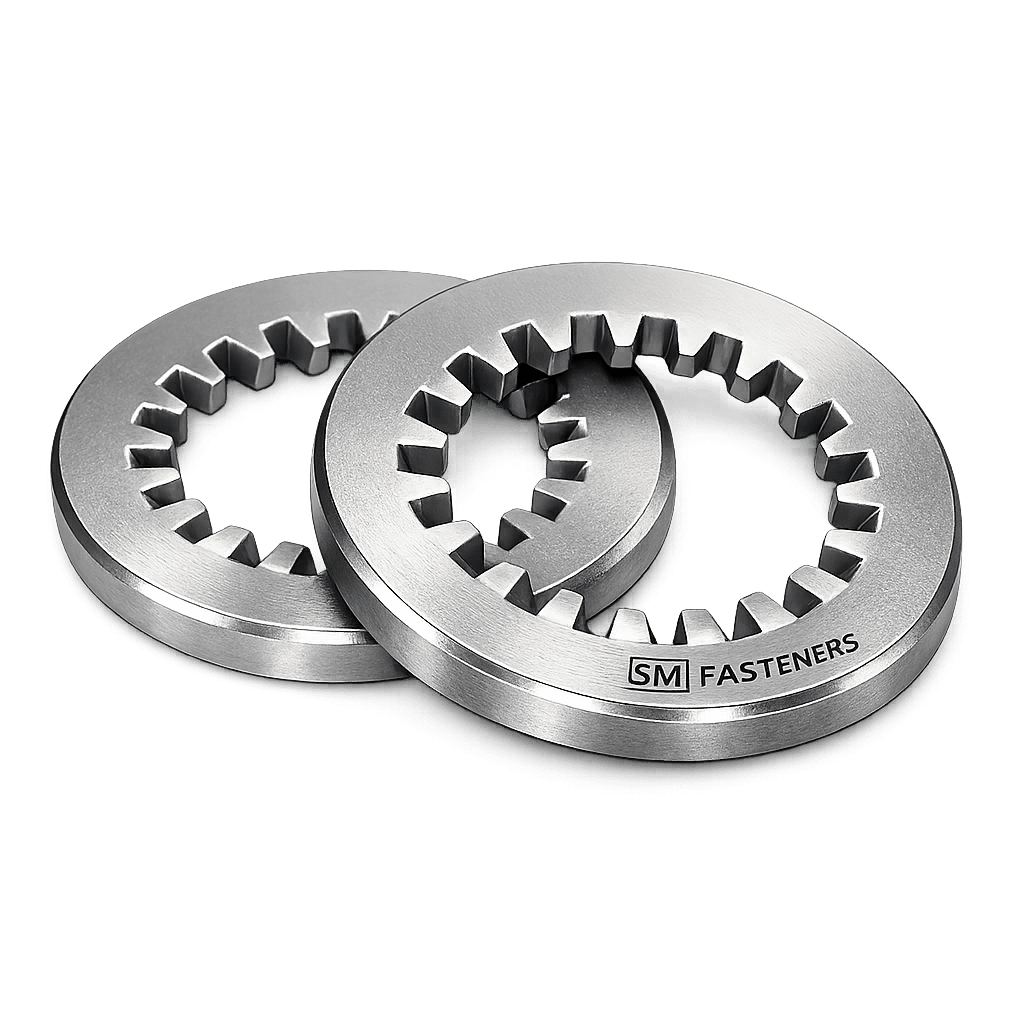
Threaded fastener joints represent more than 70% of mechanical connections across global industrial infrastructure. Despite advances in bonding and welding technologies, bolted assemblies remain dominant because they provide:
- Controlled preload generation
- Field maintainability
- Inspection accessibility
- Replaceability without structural damage
However, vibration, cyclic loading, thermal expansion, and dynamic shear forces introduce a critical engineering challenge:
Loss of clamp load leading to self-loosening.
Toothed lock washers were developed specifically to mitigate this failure mode.
They are extensively deployed across:
- Structural steel assemblies
- Rotating machinery
- Electrical grounding systems
- Automotive components
- Offshore platforms
- Turbine and pump systems
- Rail infrastructure
- Power distribution equipment
For EPC projects and OEM manufacturing, toothed lock washers serve as secondary mechanical locking devices supporting preload retention.
2. Technical Definition
Engineering Definition
A Toothed Lock Washer is a mechanical locking washer incorporating radially formed teeth designed to:
- Penetrate mating surfaces,
- Increase friction coefficient,
- Resist rotational loosening,
- Maintain clamping force under vibration.
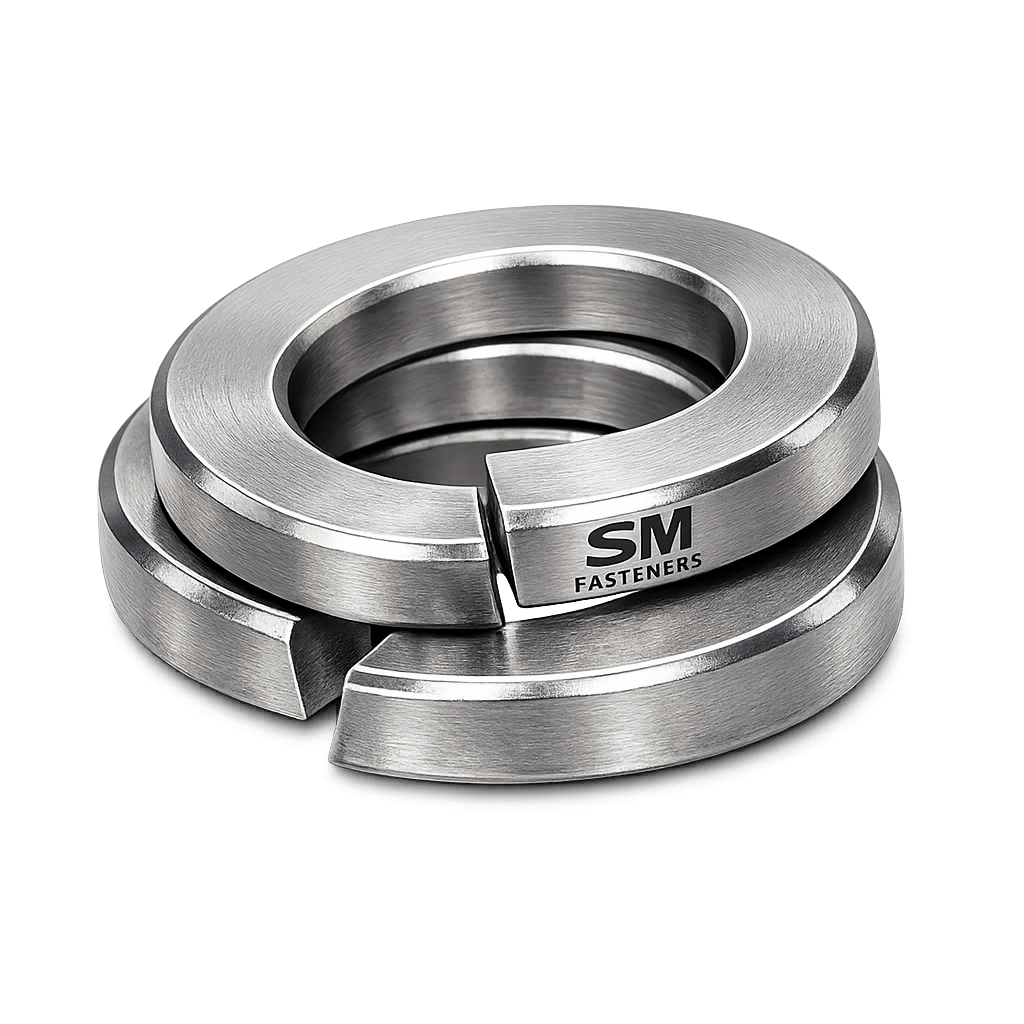
Unlike spring washers that rely on elastic deflection, toothed lock washers function primarily through surface interference locking.
Functional Mechanism
When tightening torque is applied:
- Teeth plastically deform or bite into:
- Nut face
- Bolt head
- Joint surface
- Relative rotation becomes mechanically resisted.
- Micro-slippage between surfaces is prevented.
This creates a mechanical anti-rotation barrier rather than a purely frictional solution.
3. Load Mechanics & Force Behavior
3.1 Bolt Preload Fundamentals
A bolted joint functions as a preloaded spring system.
Where:
| Parameter | Description |
|---|---|
| Fp | Preload force |
| T | Applied torque |
| K | Nut factor |
| D | Nominal diameter |
Toothed washers contribute by maintaining preload stability rather than increasing preload magnitude.
3.2 Forces Acting on a Joint
Typical industrial joints experience combined loading:
- Axial tensile loads
- Transverse shear
- Cyclic vibration
- Thermal expansion
- Impact loading
Loss of preload occurs due to:
- Embedment relaxation
- Surface creep
- Differential expansion
- Micro-slip under vibration
Toothed lock washers counteract these mechanisms.
3.3 Friction Enhancement Mechanism
The teeth produce:
- Localized high contact stress
- Increased coefficient of friction
- Mechanical interlocking
Typical friction increase:
| Surface Condition | μ (Coefficient of Friction) |
|---|---|
| Plain steel surface | 0.12–0.18 |
| With toothed washer | 0.30–0.45 |
This dramatically improves resistance to rotational loosening.
4. Joint Design Principles
4.1 Correct Washer Placement
Engineering rule:
Teeth must engage the rotating component.
Recommended positioning:
| Assembly | Washer Location |
|---|---|
| Bolt & Nut | Under rotating element |
| Electrical bonding | Against conductive surface |
| Painted structures | Against metal substrate |
4.2 Surface Hardness Compatibility
Tooth penetration requires:Hwasher>Hjoint
Typical guidance:
| Component | Hardness Range |
|---|---|
| Washer | 300–450 HV |
| Joint surface | < 250 HV |
If the joint surface is harder than the washer, locking effectiveness reduces significantly.
4.3 Preload Retention Behavior
Unlike prevailing torque nuts:
- No additional tightening torque required
- Maintains standard torque values
- Compatible with automated assembly
Advantages for EPC installations:
- Predictable torque control
- Easy inspection
- Reusable under controlled conditions
5. Torque–Tension Relationship
Only 10–15% of applied torque produces useful preload.
Torque distribution:
| Energy Loss Component | Percentage |
|---|---|
| Thread friction | 40% |
| Bearing surface friction | 45% |
| Useful preload | 15% |
Toothed lock washers increase bearing surface friction — improving preload retention stability.
6. Failure Mechanisms Prevented
6.1 Self-Loosening (Junker Effect)
Primary failure under vibration:
- Transverse displacement
- Progressive preload loss
- Complete nut rotation
Toothed washers disrupt slip initiation.
6.2 Fatigue Failure
Reduced preload causes alternating stress:
Maintaining preload minimizes fatigue crack initiation.
6.3 Embedment Relaxation
Surface flattening reduces clamp force.
Tooth penetration minimizes embedment loss.
6.4 Electrical Joint Failure
In grounding systems:
- Paint films increase resistance.
- Teeth cut through coatings ensuring metal-to-metal contact.
7. Design Selection Criteria
Engineers select toothed lock washers based on:
Mechanical Parameters
- Bolt diameter
- Preload level
- Vibration severity
- Joint material hardness
Environmental Conditions
- Corrosion exposure
- Temperature range
- Chemical exposure
- Offshore/sour service
Assembly Constraints
- Available tightening access
- Automation compatibility
- Electrical continuity requirements
8. Functional Advantages Over Other Locking Systems
| Locking Method | Mechanism | Limitation |
|---|---|---|
| Spring Washer | Elastic force | Relaxation risk |
| Nylon Lock Nut | Polymer friction | Temperature limits |
| Adhesive Lock | Chemical bonding | Maintenance difficulty |
| Toothed Washer | Mechanical biting | Requires suitable surface hardness |
9. Engineering Applications Overview
Toothed lock washers are critical where:
- Vibration is moderate to high
- Fastener size is small–medium
- Electrical continuity required
- Space constraints exist
Typical assemblies:
- Control panels
- Motor housings
- Instrumentation mounts
- Automotive assemblies
- Sheet metal structures
- Rail signaling equipment
10. Role within SM Fasteners Product Ecosystem
Within the integrated portfolio of
SM Fasteners, toothed lock washers complement:
- Bolts & nuts
- Precision screws
- Threaded rods
- Rings & retaining elements
- High-performance PEEK fasteners
- Corrosion-resistant specialty alloys
Manufacturing under ISO 9001 quality systems ensures:
Controlled hardness
Dimensional repeatability
Full traceability
Global EPC procurement acceptance
11. Product Types and Variants
Toothed lock washers are classified according to tooth orientation, locking mechanism, and application environment. Selection directly influences locking effectiveness, electrical performance, and joint durability.
11.1 External Tooth Lock Washers

Engineering Characteristics
- Teeth located on outer circumference
- Maximum surface engagement area
- High resistance to rotation
- Superior vibration performance
Functional Advantages
- Higher torsional resistance
- Effective on larger bearing surfaces
- Improved grounding conductivity
Typical Applications
- Structural panels
- Electrical bonding
- Motor assemblies
- Sheet metal fastening
11.2 Internal Tooth Lock Washers


Engineering Characteristics
- Teeth positioned internally
- Hidden under screw head
- Cleaner aesthetic appearance
- Reduced external interference
Advantages
- Suitable for small head screws
- Prevents scratching visible surfaces
- Ideal for precision equipment
Applications
- Electronics assemblies
- Instrumentation
- Control panels
- Automotive interiors
11.3 Internal–External Combination Washers


Engineering Characteristics
- Dual locking teeth configuration
- Maximum gripping action
- High vibration resistance
Recommended Use
- Dynamic machinery
- Rotating equipment
- Heavy industrial environments
11.4 Countersunk Tooth Lock Washers

Engineering Characteristics
- Conical profile
- Designed for countersunk screws
- Maintains flush assembly
Applications
- Aerospace interiors
- Control cabinets
- Precision housings
11.5 Heavy-Duty Toothed Lock Washers
Engineered for:
- High preload bolts
- Structural applications
- High dynamic loading
Characteristics:
- Increased thickness
- Hardened teeth geometry
- Enhanced penetration capability
12. Dimensional Logic and Geometry
Engineering geometry directly determines washer performance.
12.1 Critical Dimensional Parameters
| Parameter | Symbol | Engineering Function |
|---|---|---|
| Inner Diameter | d₁ | Bolt clearance |
| Outer Diameter | d₂ | Load distribution |
| Thickness | t | Structural stiffness |
| Tooth Height | h | Penetration ability |
| Tooth Count | n | Friction multiplication |
| Pitch Angle | α | Anti-rotation efficiency |
Engineering Design Principle
Tooth penetration pressure:
Smaller contact area produces higher localized stress enabling mechanical locking.
12.2 Standard Dimensional Specification Table
(Aligned with SM Fasteners Manufacturing Capability)
| Bolt Size | Inner Dia (mm) | Outer Dia (mm) | Thickness (mm) | Typical Tooth Count |
|---|---|---|---|---|
| M3 | 3.2 | 6.0 | 0.4 | 8 |
| M4 | 4.3 | 8.0 | 0.5 | 9 |
| M5 | 5.3 | 10.0 | 0.6 | 10 |
| M6 | 6.4 | 12.0 | 0.7 | 11 |
| M8 | 8.4 | 16.0 | 0.8 | 12 |
| M10 | 10.5 | 20.0 | 1.0 | 14 |
| M12 | 13.0 | 24.0 | 1.2 | 16 |
| M16 | 17.0 | 30.0 | 1.6 | 18 |
| M20 | 21.0 | 36.0 | 2.0 | 20 |
Manufactured under ISO-controlled tooling ensuring dimensional repeatability.
12.3 Geometry vs Locking Performance
| Geometry Factor | Effect |
|---|---|
| More teeth | Higher vibration resistance |
| Greater tooth height | Better penetration |
| Increased OD | Improved load distribution |
| Higher hardness | Stronger locking action |
13. Applicable International Standards
Toothed lock washers supplied by SM Fasteners conform to globally accepted standards enabling EPC interchangeability.
13.1 DIN Standards
| Standard | Description |
|---|---|
| DIN 6797 | External/Internal Tooth Lock Washers |
| DIN 6798 | Serrated Lock Washers |
| DIN 6905 | Heavy Duty Lock Washers |
13.2 ISO Standards
| Standard | Application |
|---|---|
| ISO 10669 | Serrated Washers |
| ISO 7089 | Plain washer reference dimensions |
| ISO 898-1 | Mechanical properties of fasteners |
| ISO 3269 | Acceptance inspection |
13.3 ASTM Standards
| Standard | Scope |
|---|---|
| ASTM F436 | Hardened washers |
| ASTM A684 | Steel strip properties |
| ASTM F606 | Mechanical testing |
| ASTM A967 | Passivation (SS) |
13.4 British Standards (BS)
| Standard | Description |
|---|---|
| BS 1802 | Lock washers |
| BS 4320 | Washer dimensions |
| BS EN ISO 4759 | Fastener tolerances |
13.5 Interchangeability Considerations
International procurement often mixes specifications.
| System | Equivalent Usage |
|---|---|
| DIN 6797 | ISO serrated washers |
| BS 1802 | DIN compatible |
| ASTM F436 | Heavy structural washers |
SM Fasteners engineering verification ensures compatibility across global projects.
14. Thread Standards & Tolerance Compatibility
Although washers are non-threaded, compatibility with thread systems is critical.
Thread Standards Table
| Thread System | Standard | Typical Application |
|---|---|---|
| Metric Coarse | ISO 261 | Global industrial |
| Metric Fine | ISO 965 | Precision equipment |
| UNC | ASME B1.1 | North America |
| UNF | ASME B1.1 | High strength joints |
| BSW | BS 84 | Legacy infrastructure |
| BSF | BS 84 | Heavy engineering |
| NPT | ANSI B1.20 | Piping systems |
Tolerance Interaction
Washer ID clearance must accommodate:
Typical clearance: +0.2 to +0.5 mm
Ensures:
- Easy installation
- No binding
- Proper seating
15. Dimensional Inspection Criteria
ISO 9001 manufacturing control at SM Fasteners includes:
- Optical profile measurement
- Go/No-Go gauges
- Statistical Process Control (SPC)
- Tool wear monitoring
16. Weight Chart — Toothed Lock Washers
(Aligned with SM Fasteners export packing calculations)
| Size | Approx Weight / Piece (g) | Weight / 100 pcs (kg) |
|---|---|---|
| M3 | 0.10 | 0.01 |
| M4 | 0.18 | 0.018 |
| M5 | 0.30 | 0.03 |
| M6 | 0.45 | 0.045 |
| M8 | 0.80 | 0.08 |
| M10 | 1.30 | 0.13 |
| M12 | 2.00 | 0.20 |
| M16 | 4.50 | 0.45 |
| M20 | 7.50 | 0.75 |
Used for:
- Container load planning
- EPC logistics estimation
- Inventory forecasting
17. Engineering Selection Matrix
| Condition | Recommended Washer Type |
|---|---|
| Electrical grounding | External tooth |
| Cosmetic assemblies | Internal tooth |
| Severe vibration | Combination tooth |
| Flush mounting | Countersunk |
| Heavy load | Heavy-duty toothed |
18. Integration Within SM Fasteners Manufacturing Platform
Through controlled production under ISO 9001 quality management,
SM Fasteners provides:
- Metric & imperial dimensional compliance
- Custom OD/ID geometries
- Special tooth designs
- High-temperature alloys
- PEEK washer variants for electrical insulation
All variants are engineered for EPC, OEM, and global project supply chains.
19. Material Grades and Selection Criteria
Material selection determines the mechanical reliability, corrosion resistance, temperature capability, and service life of toothed lock washers.
Unlike plain washers, toothed lock washers require:
- High surface hardness
- Controlled ductility
- Tooth integrity under preload
- Resistance to wear and relaxation
SM Fasteners manufactures washers from industrial-grade certified raw materials supported by EN 10204 Material Test Certificates (MTC).
19.1 Industrial Material Categories
Carbon Steel
Primary choice for structural and general industrial applications.
Typical Grades:
- C45
- EN8
- SAE 1045
- ASTM A684 strip steel
Characteristics:
- High strength
- Economical
- Suitable for coating systems
Applications:
- Construction assemblies
- Machinery frames
- Automotive components
Alloy Steel
Used where higher mechanical strength or elevated temperature resistance is required.
Typical Grades:
- 4140
- 4340
- EN19
- ASTM A193 Grade B7 compatible assemblies
Advantages:
- Higher hardness potential
- Improved fatigue resistance
- Stable tooth performance
Applications:
- Power plants
- Turbines
- Heavy rotating equipment
Stainless Steel
For corrosion-resistant installations.
Common Grades:
| Grade | Standard | Key Feature |
|---|---|---|
| A2-70 | ISO 3506 | General corrosion resistance |
| A4-80 | ISO 3506 | Marine & chloride resistance |
| 304 | ASTM A240 | General industrial |
| 316 | ASTM A240 | Offshore & chemical |
| 316L | ASTM A240 | Welded assemblies |
Advantages:
- Corrosion resistance
- Electrical conductivity stability
- Low maintenance
Duplex & Super Duplex Stainless Steel
Used in aggressive offshore and subsea conditions.
Typical Grades:
- UNS S31803
- UNS S32205
- UNS S32750
- UNS S32760
Benefits:
- High strength
- Excellent chloride resistance
- Superior SCC resistance
Nickel-Based Alloys
Critical for extreme environments.
| Material | Application |
|---|---|
| Inconel 625 | High temperature turbines |
| Incoloy 825 | Acidic chemical plants |
| Monel 400 | Seawater exposure |
| Hastelloy C276 | Severe corrosion service |
| Nickel 200 | Electrical conductivity applications |
| SMO 254 | High chloride resistance |
High-Performance Polymer — PEEK Washers
SM Fasteners supplies PEEK toothed lock washers for specialized applications.
Advantages:
- Electrically insulating
- Lightweight
- Chemical resistant
- Non-magnetic
- Radiation resistant
Applications:
- Semiconductor equipment
- Medical devices
- Aerospace electronics
- LNG instrumentation
20. Material Comparison Table
| Material | UTS (MPa) | Yield (MPa) | Corrosion Resistance | Temperature Limit | Relative Cost | Typical Industry |
|---|---|---|---|---|---|---|
| Carbon Steel | 600–800 | 350 | Low | 300°C | Low | Construction |
| Alloy Steel | 900–1200 | 700 | Moderate | 450°C | Medium | Power & Heavy Equipment |
| SS 304 | 700 | 450 | Good | 425°C | Medium | General Industry |
| SS 316 | 750 | 450 | Excellent | 500°C | Medium-High | Offshore |
| Duplex | 800 | 550 | Very High | 300°C | High | Oil & Gas |
| Super Duplex | 950 | 700 | Extreme | 300°C | Very High | Subsea |
| Inconel 625 | 1030 | 690 | Outstanding | 980°C | Premium | Aerospace/LNG |
| PEEK | 100 | 90 | Chemical Resistant | 260°C | Premium | Electronics |
21. Mechanical Properties (Grade-Wise)
Toothed washers must maintain hardness without brittleness.
| Material Grade | Hardness (HV) | Tensile Strength (MPa) | Recommended Use |
|---|---|---|---|
| Carbon Steel Hardened | 350–450 | 700 | General locking |
| Alloy Steel Q&T | 400–500 | 1000 | Dynamic loading |
| SS A2-70 | 200–250 | 700 | Corrosion resistance |
| SS A4-80 | 240–300 | 800 | Marine |
| Duplex | 260–320 | 800 | Offshore |
| Inconel | 250–350 | 1030 | High temperature |
22. Corrosion Resistance vs Environment
| Environment | Carbon Steel | SS304 | SS316 | Duplex | Super Duplex | Nickel Alloys | PEEK |
|---|---|---|---|---|---|---|---|
| Indoor Industrial | ✓ | ✓ | ✓ | ✓ | ✓ | ✓ | ✓ |
| Marine Atmosphere | ✗ | △ | ✓ | ✓ | ✓ | ✓ | ✓ |
| Seawater Immersion | ✗ | ✗ | ✓ | ✓ | ✓✓ | ✓✓ | ✓ |
| Acidic Chemicals | ✗ | △ | ✓ | ✓ | ✓✓ | ✓✓ | ✓✓ |
| H₂S / Sour Service | ✗ | △ | ✓ | ✓✓ | ✓✓ | ✓✓ | ✓ |
| High Temperature | △ | △ | ✓ | ✓ | ✓ | ✓✓ | △ |
Legend: ✓ Suitable | △ Limited | ✗ Not recommended
Materials supplied in compliance with NACE MR0175 / ISO 15156 when required.
23. Heat Treatment Processes
Heat treatment is critical for achieving tooth performance.
23.1 Hardening
Purpose:
- Increase surface hardness
- Improve tooth penetration ability
Process:
- Austenitizing
- Quenching (oil/polymer)
- Controlled cooling
Typical hardness target:
38–48 HRC
23.2 Tempering
Objective:
- Reduce brittleness
- Improve fatigue resistance
Temperature range:
150–450°C depending on material grade.
23.3 Case Hardening / Carbonitriding
Used for:
- Thin washers
- Enhanced wear resistance
Benefits:
- Hard surface
- Tough core
23.4 Solution Annealing (Stainless Steel)
Required for corrosion resistance restoration.
Process:
- Heating to ~1050°C
- Rapid quenching
Prevents sensitization and intergranular corrosion.
23.5 Hydrogen Embrittlement Control
Critical for coated high-strength washers.
Preventive Controls:
- Baking after electroplating
- Controlled hardness limits
- ISO 4042 compliance
24. End-to-End Manufacturing Workflow
SM Fasteners operates under ISO 9001 process control ensuring complete traceability.
24.1 Raw Material Verification
Incoming inspection includes:
- Heat number verification
- Chemical analysis
- Spectrometer testing
- MTC review
24.2 Strip Preparation
- Precision slit coils
- Surface cleaning
- Thickness verification
24.3 Precision Stamping / Blanking
High-speed progressive dies produce:
- Inner diameter
- Outer diameter
- Tooth geometry
Critical tolerance control:
±0.02–0.05 mm
24.4 Tooth Forming Operation
Teeth are formed through controlled cold forming.
Engineering objective:
- Maintain sharp tooth profile
- Avoid micro-cracking
24.5 Heat Treatment
Automated furnace systems provide:
- Uniform hardness
- Controlled atmosphere
- Batch traceability
24.6 Deburring & Surface Conditioning
Processes:
- Vibratory finishing
- Shot blasting
- Edge smoothing
Ensures:
- Safe handling
- Accurate seating
- Consistent torque performance
24.7 Final Inspection & Sorting
Includes:
- Optical inspection
- Hardness testing
- Dimensional sampling
- Statistical quality control
25. Surface Finishing & Coating Engineering
Surface treatment determines corrosion performance and service life.
25.1 Coating Types
| Coating | Standard | Thickness | Typical Use |
|---|---|---|---|
| Plain Oil | — | Minimal | Indoor |
| Zinc Plating | ISO 4042 | 5–12 µm | General industry |
| HDG | ISO 10684 | 40–80 µm | Structural steel |
| Zinc Flake | ASTM F1136 | 8–12 µm | Automotive |
| Mechanical Galvanizing | ASTM B695 | 50 µm | Heavy assemblies |
| Black Oxide | ASTM D769 | 1 µm | Indoor machinery |
| Passivation | ASTM A967 | — | Stainless steel |
| PTFE/Xylan | Project Spec | 20–30 µm | Low friction |
| Dacromet/Geomet | OEM Specs | 8–12 µm | Corrosion-critical |
25.2 Surface Finish Performance Comparison
| Coating | Corrosion Resistance | Friction Control | Temperature Limit |
|---|---|---|---|
| Zinc | Medium | Moderate | 120°C |
| HDG | High | High friction | 300°C |
| Zinc Flake | Very High | Stable | 300°C |
| PTFE | Excellent | Low friction | 260°C |
| Passivated SS | Excellent | Stable | 500°C |
25.3 Coating Selection Engineering Criteria
Selection depends on:
- Galvanic compatibility
- Required salt spray hours
- Operating temperature
- Electrical conductivity needs
- Assembly torque stability
26. Traceability & Process Integration
Every washer manufactured by
SM Fasteners
is traceable through:
- Heat number marking
- Batch identification
- Inspection records
- Heat treatment reports
- Coating certification
Integrated ISO 9001 system ensures global EPC acceptance.
27. Inspection & Quality Control Framework
Toothed lock washers are small components but critically influence joint reliability, vibration resistance, and electrical continuity. For EPC and OEM supply, inspection requirements are equivalent to structural fasteners.
SM Fasteners integrates inspection within an ISO 9001 quality management system, ensuring repeatable mechanical performance and global project acceptance.
27.1 Incoming Material Inspection
Verification performed prior to production:
| Inspection Activity | Method | Standard |
|---|---|---|
| Material certification review | MTC validation | EN 10204 3.1 |
| Chemical composition | Optical emission spectroscopy | ASTM E415 |
| Strip thickness verification | Digital micrometer | ISO 9445 |
| Surface quality | Visual inspection | ISO 8785 |
Objective: Prevent non-conforming metallurgy entering production.
27.2 In-Process Manufacturing Inspection
| Stage | Inspection |
|---|---|
| Stamping | OD/ID dimensional control |
| Tooth forming | Profile verification |
| Heat treatment | Hardness testing |
| Deburring | Edge condition inspection |
| Coating | Thickness measurement |
Statistical Process Control (SPC) ensures dimensional stability across high-volume manufacturing.
27.3 Final Inspection Requirements
| Test | Purpose |
|---|---|
| Dimensional inspection | Fit and seating accuracy |
| Hardness testing | Tooth penetration capability |
| Surface coating thickness | Corrosion performance |
| Visual inspection | Burrs & deformation |
| Functional seating test | Locking performance validation |
Inspection acceptance aligned with ISO 3269.
27.4 Mechanical & Metallurgical Testing
Applicable verification methods:
- Rockwell/Vickers hardness testing
- Microstructure examination
- Salt spray corrosion testing (ASTM B117)
- Torque retention testing
- Metallographic analysis
27.5 Positive Material Identification (PMI)
Required for:
- Duplex
- Super Duplex
- Nickel alloys
- Critical oil & gas service
PMI confirms alloy chemistry traceability.
27.6 Non-Destructive Examination (NDT)
Where specified by EPC projects:
- Magnetic particle inspection
- Dye penetrant testing
- Micro-crack detection post heat treatment
27.7 Documentation & Certification
Typical supply documentation:
- EN 10204 3.1 / 3.2 MTC
- Heat treatment report
- Coating compliance certificate
- Dimensional inspection report
- Certificate of Conformity (CoC)
28. Mechanical Performance & Proof Strength
Toothed lock washers themselves do not carry tensile load but must withstand compressive stresses from bolt preload.
Mechanical Property Reference Table
| Washer Material | Hardness Range | Compressive Strength (MPa) | Service Class |
|---|---|---|---|
| Hardened Carbon Steel | 350–450 HV | 900 | Standard Industrial |
| Alloy Steel | 400–500 HV | 1100 | Heavy Duty |
| SS A2-70 | 200–250 HV | 600 | Corrosion Resistant |
| SS A4-80 | 240–300 HV | 700 | Marine |
| Duplex SS | 260–320 HV | 850 | Offshore |
| Inconel 625 | 250–350 HV | 1000 | High Temperature |
29. Tightening Torque Engineering
Correct torque application ensures washer effectiveness.
Torque Relationship
Where:
- T = Torque
- K = Nut factor
- D = Bolt diameter
- F = Desired preload
Typical nut factors:
| Condition | Nut Factor (K) |
|---|---|
| Dry | 0.20 |
| Light oil | 0.18 |
| Zinc coated | 0.16 |
| PTFE coated | 0.12 |
Tightening Torque Chart (Typical Engineering Values)
| Bolt Size | Property Class | Dry Torque (Nm) | Lubricated Torque (Nm) |
|---|---|---|---|
| M5 | 8.8 | 5 | 4 |
| M6 | 8.8 | 9 | 7 |
| M8 | 8.8 | 22 | 17 |
| M10 | 8.8 | 45 | 36 |
| M12 | 8.8 | 78 | 62 |
| M16 | 8.8 | 190 | 150 |
| M20 | 8.8 | 370 | 295 |
Toothed lock washers do not require torque increase.
30. Preload Calculation — Worked Engineering Example
Design Requirement
Bolt Size: M10
Property Class: 8.8
Desired preload: 70% of proof load
Proof load (M10-8.8):
Required preload:
Torque required:
Recommended Torque ≈ 45–50 Nm
Toothed washer maintains this preload under vibration.
31. Failure Mechanisms & Engineering Prevention
| Failure Mode | Cause | Washer Contribution |
|---|---|---|
| Self-loosening | Vibration | Teeth resist rotation |
| Embedment relaxation | Surface flattening | Penetration stabilizes joint |
| Fretting corrosion | Micro movement | Eliminates slip |
| Electrical resistance rise | Coatings | Teeth cut through paint |
| Fatigue cracking | Preload loss | Maintains clamp force |
32. Industry Application Mapping
Construction & Structural Steel
- Steel frames
- HVAC supports
- Cladding assemblies
- Bridge accessories
Oil & Gas (Upstream–Downstream)
- Instrument mounting
- Control panels
- Valve actuators
- Offshore electrical bonding
NACE-compliant material options available.
Power Generation
- Turbine housings
- Switchgear assemblies
- Generator terminals
Petrochemical & Chemical Plants
- Pump skids
- Pipe support systems
- Reactor instrumentation
LNG & Offshore Platforms
- Marine corrosion-resistant assemblies
- Explosion-proof equipment
- Subsea monitoring systems
Automotive & Heavy Equipment
- Engine accessories
- Transmission assemblies
- Hydraulic equipment
Railways & Infrastructure
- Signaling systems
- Electrical grounding
- Rolling stock assemblies
Shipbuilding & Marine Engineering
- Navigation equipment
- Deck hardware
- Electrical continuity joints
PEEK Washer Applications
SM Fasteners provides engineered PEEK toothed lock washers for:
- Electrically isolated joints
- Cryogenic LNG systems
- Semiconductor cleanrooms
- Aerospace electronics
33. Thread Standards & Tolerance Compatibility
| Thread Type | Standard | Typical Region |
|---|---|---|
| Metric Coarse | ISO 261 | Global |
| Metric Fine | ISO 965 | Precision equipment |
| UNC | ASME B1.1 | USA |
| UNF | ASME B1.1 | Aerospace |
| BSW | BS 84 | Legacy UK |
| BSF | BS 84 | Heavy engineering |
Washer clearance tolerances designed to accommodate all systems supplied by SM Fasteners.
34. Surface Finish Selection Matrix
| Environment | Recommended Finish |
|---|---|
| Indoor machinery | Zinc plated |
| Outdoor structural | Hot dip galvanized |
| Offshore | SS316 / Duplex |
| Chemical plant | PTFE / Nickel alloy |
| High temperature | Inconel |
| Electrical bonding | Passivated stainless |
35. Weight Chart — Export & Logistics Planning
(Aligned with SM Fasteners production database)
| Size | Weight/Piece (g) | Weight/100 pcs (kg) |
|---|---|---|
| M3 | 0.10 | 0.01 |
| M4 | 0.18 | 0.018 |
| M5 | 0.30 | 0.03 |
| M6 | 0.45 | 0.045 |
| M8 | 0.80 | 0.08 |
| M10 | 1.30 | 0.13 |
| M12 | 2.00 | 0.20 |
| M16 | 4.50 | 0.45 |
| M20 | 7.50 | 0.75 |
Used for:
- Container optimization
- Freight calculations
- EPC material planning
36. Export Packaging & Global Supply Capability
SM Fasteners supports international EPC supply requirements.
Industrial Packaging
- VCI anti-corrosion packing
- Moisture barrier bags
- Batch labeling
- Thread protection
Export Crating
- ISPM-15 compliant wooden crates
- Palletized shipments
- Vacuum sealing for offshore projects
- Barcode traceability
Supply Chain Capabilities
- Project-wise batch control
- Mixed fastener kits
- Custom labeling
- Vendor documentation packages
37. Documentation Supplied with Shipments
Typical export documentation:
- Material Test Certificates (EN 10204 3.1/3.2)
- Inspection Reports
- Heat Treatment Records
- Coating Compliance Certificates
- Certificate of Conformance
- Packing List & Traceability Sheet
38. Integration with SM Fasteners Engineering Systems
Under ISO 9001 quality governance,
SM Fasteners delivers:
- Precision stamping & heat treatment
- Advanced alloy manufacturing
- PEEK fastener engineering capability
- Custom dimensional design
- Full international standards compliance
- Reliable EPC and OEM supply readiness
39. Engineering Summary
Toothed lock washers provide a mechanically reliable, compact, and standards-compliant locking solution for modern industrial assemblies.
Key engineering outcomes:
- Maintained preload under vibration
- Improved electrical continuity
- Reduced fatigue failure risk
- Compatibility with global fastener systems
- Reliable performance across severe industrial environments
When manufactured under certified systems with controlled metallurgy and inspection discipline, toothed lock washers become a critical component supporting long-term joint integrity.