

Cage Nut
1. Industry Context
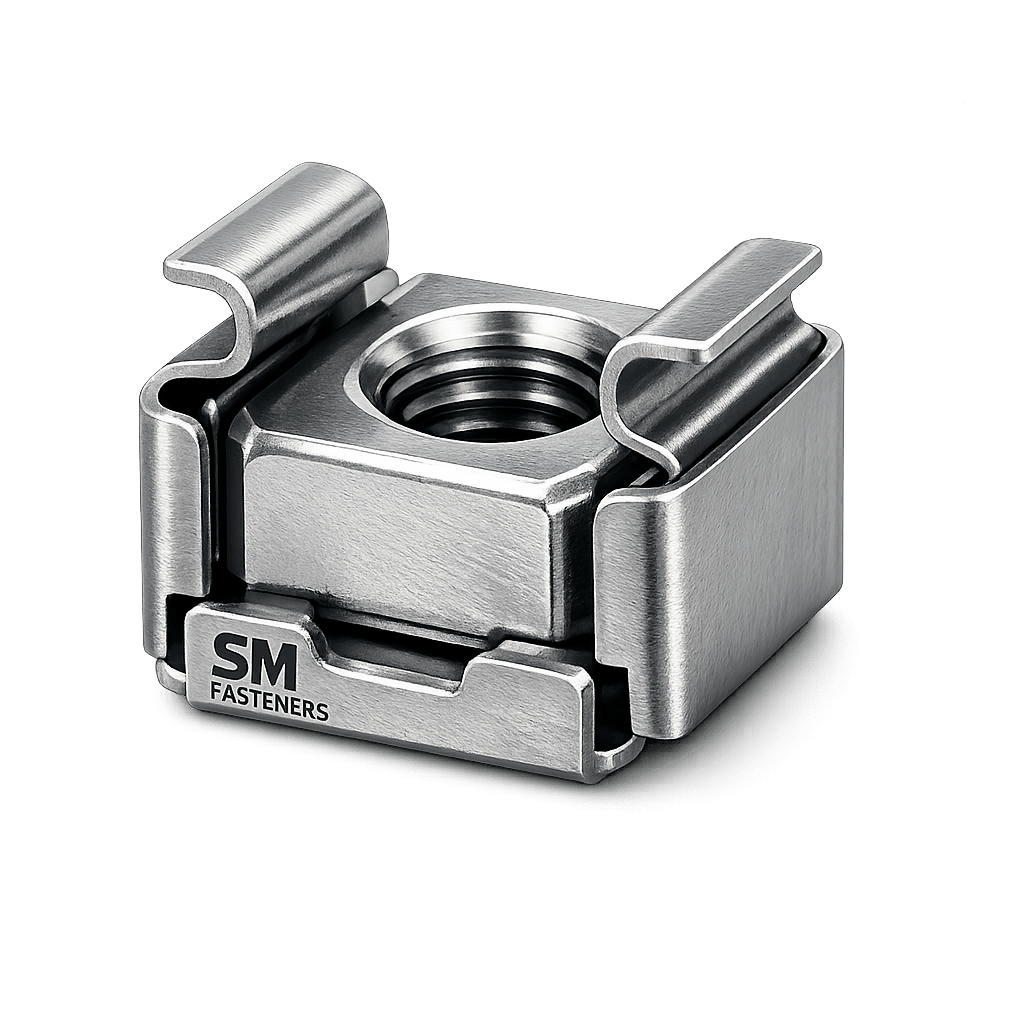
Modern industrial assemblies increasingly rely on modular structural systems where access to the reverse side of a joint is limited or impossible. Equipment racks, sheet-metal enclosures, control cabinets, railway panels, telecom infrastructure, server racks, HVAC systems, and lightweight structural frames require:
- Rapid installation
- Serviceability
- Replaceable threads
- Controlled preload
- Vibration resistance
- Minimal structural modification
Traditional nuts require rear access or welding. Welding introduces:
- Heat-affected zones
- Distortion
- Corrosion initiation
- Loss of modularity
- Difficult maintenance
To eliminate these limitations, the industry adopted the Cage Nut system, now standardized across global mechanical and electronic infrastructure.
Cage nuts are widely deployed across:
- Data center infrastructure
- Oil & gas control panels
- Power distribution systems
- Railway electronics
- Offshore equipment housings
- Industrial automation frames
- Telecom racks (19” standard systems)
SM Fasteners manufactures cage nuts designed for high-cycle assembly environments, ensuring consistent performance across international installations.
2. Technical Definition
A Cage Nut is a floating nut retained inside a spring steel cage designed to clip into square or rectangular panel holes, providing a captive threaded element without welding or permanent installation.
Core Components
- Nut Element
- Usually square or rectangular
- Internally threaded
- Load-bearing component
- Spring Steel Cage
- Retention mechanism
- Provides elasticity
- Enables floating alignment
- Floating Clearance
- Allows positional compensation
- Prevents thread cross-engagement
Functional Engineering Definition
A cage nut is a detachable captive fastening system that converts a sheet or frame aperture into a reusable, load-bearing threaded joint.
3. Functional Role in Mechanical Assemblies
Cage nuts provide:
| Function | Engineering Benefit |
|---|---|
| Captive threading | No loose hardware |
| Floating alignment | Reduced installation stress |
| Replaceable threads | Maintenance-friendly |
| No welding required | Preserves metallurgy |
| Rapid assembly | Reduced labor cost |
| Panel protection | No tapping required |
4. Load Mechanics & Force Behavior
4.1 Load Transmission Path
Load transfer occurs through:
Unlike conventional nuts:
- Cage carries retention load only
- Nut carries structural load
Critical Engineering Principle
The cage is NOT load-bearing — the panel edge reaction supports the load.
4.2 Types of Loads Acting on Cage Nuts
| Load Type | Behavior |
|---|---|
| Tensile load | Supported by nut threads |
| Clamp load | Controlled by bolt preload |
| Shear load | Panel edge engagement |
| Vibration load | Floating nut reduces stress |
| Dynamic fatigue | Absorbed through compliance |
4.3 Preload and Clamping Force
Correct preload prevents:
- Joint separation
- Fatigue cracking
- Loosening
Fundamental relationship:
Where:
- Fp = Preload force (N)
- T = Applied torque (Nm)
- K = Nut factor (0.16–0.22)
- D = Nominal bolt diameter (m)
Worked Example — M6 Cage Nut Assembly
Given:
- Torque = 10 Nm
- K = 0.18
- Diameter = 0.006 m
This preload generates sufficient clamping force for typical equipment mounting applications.
5. Joint Design Principles
5.1 Floating Nut Alignment
Floating clearance typically:
±0.5 mm to ±1.0 mm
Advantages:
- Compensates manufacturing tolerances
- Prevents cross-threading
- Improves assembly speed
5.2 Panel Design Requirements
| Parameter | Recommendation |
|---|---|
| Hole type | Square |
| Panel thickness | 0.8–3.0 mm |
| Edge distance | ≥1.5× hole width |
| Material | Steel / Aluminum / Composite |
| Hardness | Must resist deformation |
5.3 Thread Engagement Requirement
Minimum engagement:
Where:
- D = bolt diameter
For soft materials:
5.4 Torque–Tension Relationship
Approximately:
- 85–90% torque lost to friction
- 10–15% converted into preload
Friction contributors:
- Thread friction
- Bearing surface friction
- Coating interaction
- Lubrication state
6. Failure Mechanisms
6.1 Thread Stripping
Occurs when:
- Insufficient engagement
- Low strength material
- Over-torque
6.2 Panel Deformation Failure
Common in thin sheet applications.
Mitigation:
- Use load-spreading washers
- Increase panel thickness
- Select larger cage size
6.3 Fatigue Failure
Caused by cyclic vibration.
Prevented by:
- Correct preload
- Elastic joint design
- Controlled torque
6.4 Cage Spring Fatigue
Occurs only under improper installation or repeated removal cycles.
SM Fasteners cage springs are engineered for:
- Controlled elasticity
- High fatigue resistance
- Multi-installation durability
6.5 Hydrogen Embrittlement (High Strength Grades)
Risk exists in:
- Electroplated high-strength steels (>1000 MPa)
Mitigation:
- Post-plate baking
- Mechanical coatings
- Controlled hardness limits
6.6 Stress Corrosion Cracking
Critical environments:
- Offshore
- Chloride exposure
- H₂S service
Recommended materials:
- Duplex Stainless Steel
- SMO 254
- Nickel alloys
- PEEK fasteners (non-metallic alternative)
7. Functional Selection Criteria
Engineers must evaluate:
| Parameter | Selection Basis |
|---|---|
| Load | Bolt size & property class |
| Environment | Material grade |
| Vibration | Floating capability |
| Maintenance | Replaceable design |
| Corrosion | Surface coating |
| Temperature | Alloy selection |
8. Engineering Advantages Over Alternatives
| Method | Limitation | Cage Nut Advantage |
|---|---|---|
| Weld nut | Heat distortion | No welding |
| Tapped hole | Thread wear | Replaceable |
| Rivet nut | Permanent | Removable |
| Loose nut | Assembly difficulty | Captive |
9. Role in Modern EPC & OEM Design
Cage nuts enable:
- Standardized global assembly
- Rapid field replacement
- Reduced downtime
- Logistics simplification
- Modular equipment manufacturing
They are now considered a critical fastening interface rather than a simple accessory.
10. Product Types and Variants
Cage nuts are engineered in multiple configurations to satisfy varying load requirements, panel geometries, environmental conditions, and installation practices across global industrial sectors.
SM Fasteners manufactures cage nuts compatible with international rack systems, industrial enclosures, EPC modular structures, and OEM assemblies.
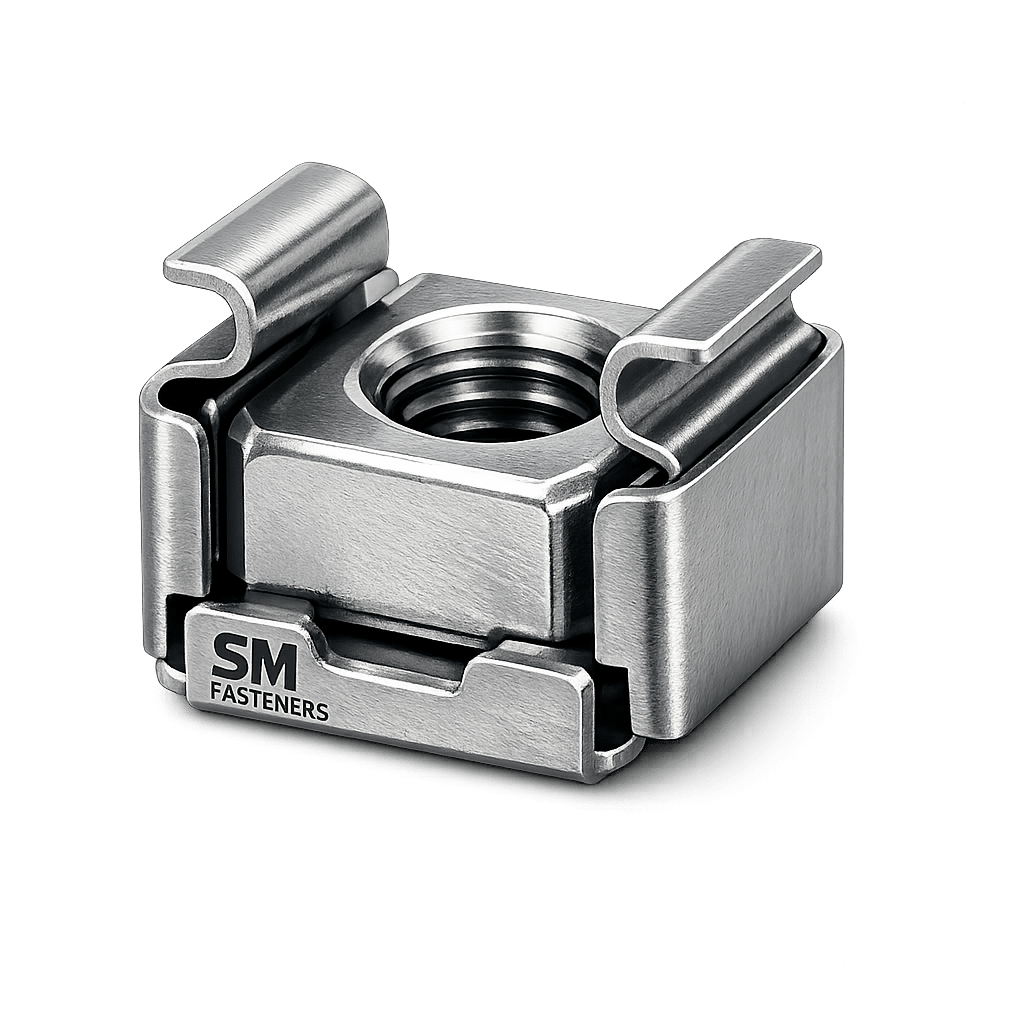
10.1 Standard Square Cage Nut
Most widely used industrial configuration
Characteristics
- Square floating nut
- Spring steel cage
- Snap-in installation
- Metric or Unified threads
Applications
- Server racks
- Electrical cabinets
- Telecom infrastructure
- Instrument panels
- Automation equipment
10.2 Heavy-Duty Cage Nut
Designed for higher structural loads.
Engineering Enhancements
- Thicker cage spring material
- Increased bearing surface
- Higher property class nut
- Improved fatigue resistance
Used in:
- Railway equipment
- Power distribution panels
- Offshore control systems
- Industrial machinery guarding
10.3 Floating Cage Nut (High Alignment Type)
Provides increased positional tolerance.
Typical float range:
Advantages:
- Compensates fabrication tolerance stack-up
- Reduces installation stress
- Prevents thread damage
Preferred by EPC contractors during field assembly.
10.4 Stainless Steel Cage Nut Assemblies
Used where corrosion resistance is critical.
Materials:
- SS304
- SS316 / 316L
- Duplex Stainless Steel
- SMO 254
Applications:
- Marine systems
- Chemical plants
- LNG facilities
- Outdoor infrastructure
10.5 PEEK Cage Nut Assemblies (Special Engineering Variant)
SM Fasteners supplies engineered polymer solutions using PEEK fasteners for specialized applications.
Advantages:
- Non-conductive
- Chemical inertness
- Zero galvanic corrosion
- Lightweight
- Radiation resistant
Typical sectors:
- Semiconductor manufacturing
- Medical equipment
- Aerospace electronics
- Hydrogen energy systems
10.6 Metric vs Unified Thread Cage Nuts
| System | Region | Typical Use |
|---|---|---|
| Metric (M) | Europe / Asia | Industrial equipment |
| UNC | USA | Rack systems |
| UNF | USA Aerospace | Precision assemblies |
| BSW | Legacy UK | Maintenance retrofit |
| BSF | UK fine pitch | Specialized equipment |
SM Fasteners ensures interchangeability for global project requirements.
11. Dimensional Logic and Geometry
The performance of a cage nut depends heavily on geometric relationships between:
- Panel hole
- Cage spring geometry
- Nut body dimensions
- Thread engagement
11.1 Standard Rack Geometry
Most global rack systems follow:
Square hole sizes:
| Nominal Size | Hole Dimension |
|---|---|
| M5 | 8.5 × 8.5 mm |
| M6 | 9.5 × 9.5 mm |
| M8 | 12 × 12 mm |
| 10-32 UNC | 9.5 × 9.5 mm |
11.2 Cage Geometry Engineering Principles
Key parameters:
| Parameter | Function |
|---|---|
| Spring arm angle | Retention force |
| Cage elasticity | Installation/removal cycles |
| Float clearance | Alignment compensation |
| Nut thickness | Load capacity |
| Bearing face | Load distribution |
11.3 Floating Design Mechanics
The nut is intentionally smaller than cage clearance.
Engineering effects:
- Prevents binding
- Allows angular compensation
- Reduces installation torque variation
12. Dimensional Specification Table
Standard SM Fasteners Cage Nut Dimensions
| Thread Size | Hole Size (mm) | Nut Width (mm) | Nut Thickness (mm) | Cage Height (mm) | Typical Panel Thickness |
|---|---|---|---|---|---|
| M4 | 8.2 | 6.8 | 3.2 | 9 | 0.8–2.0 mm |
| M5 | 8.5 | 7.5 | 4.0 | 9.5 | 0.8–2.5 mm |
| M6 | 9.5 | 9.0 | 4.5 | 10 | 1.0–3.0 mm |
| M8 | 12.0 | 11.5 | 6.0 | 13 | 1.5–4.0 mm |
| 10-32 UNC | 9.5 | 9.0 | 4.5 | 10 | 1.0–3.0 mm |
| 12-24 UNC | 9.5 | 9.0 | 4.5 | 10 | 1.0–3.0 mm |
Dimensions aligned with SM Fasteners manufacturing capability and international rack standards.
13. Applicable International Standards
Although cage nuts are application-driven components, multiple standards govern their dimensional and mechanical performance.
13.1 Primary Dimensional Standards
| Standard | Scope |
|---|---|
| IEC 60297 | 19″ equipment racks |
| DIN 41494 | Electronic rack systems |
| EIA-310 | Server rack mounting |
| BS 5954 | Rack structures |
| ISO 4759 | Fastener tolerances |
13.2 Thread Standards
| Standard | Description |
|---|---|
| ISO 261 | Metric thread series |
| ISO 965 | Metric tolerance classes |
| ASME B1.1 | Unified threads |
| BS 84 | BSW threads |
| BS 1083 | BSF threads |
13.3 Mechanical Property Standards
| Standard | Application |
|---|---|
| ISO 898-2 | Carbon steel nuts |
| ASTM A563 | Structural nuts |
| ASTM F594 | Stainless steel nuts |
| ASTM A194 | Alloy & stainless nuts |
| ISO 3506 | Stainless fasteners |
13.4 Surface & Coating Standards
| Standard | Description |
|---|---|
| ISO 4042 | Electroplating |
| ASTM B633 | Zinc plating |
| ISO 10683 | Mechanical coating |
| ASTM B117 | Salt spray testing |
| ISO 9227 | Corrosion testing |
14. Thread Standards & Tolerances Table
| Thread Type | Pitch | Tolerance Class | Fit |
|---|---|---|---|
| M4 | 0.7 | 6H | Medium |
| M5 | 0.8 | 6H | General |
| M6 | 1.0 | 6H | Standard |
| M8 | 1.25 | 6H | Structural |
| UNC 10-32 | 32 TPI | 2B | Standard |
| UNC 12-24 | 24 TPI | 2B | Standard |
| UNF | Fine | 2B | Precision |
15. Mechanical Properties — Nut Grades
Property Class Comparison
| Property Class | Proof Load (MPa) | Typical Material | Application |
|---|---|---|---|
| Class 5 | 500 | Low carbon steel | Light equipment |
| Class 8 | 800 | Medium carbon | General industry |
| Class 10 | 1000 | Alloy steel | Heavy equipment |
| A2-70 | 700 | SS304 | Corrosion resistant |
| A4-80 | 800 | SS316 | Marine service |
SM Fasteners supplies cage nuts matched to bolt property class to prevent joint imbalance.
16. Proof Load & Tensile Strength Table
| Size | Property Class | Proof Load (kN) | Recommended Bolt Grade |
|---|---|---|---|
| M4 | 8 | 5.6 | 8.8 |
| M5 | 8 | 8.9 | 8.8 |
| M6 | 8 | 12.9 | 8.8 |
| M6 | 10 | 16.0 | 10.9 |
| M8 | 8 | 23.0 | 8.8 |
| M8 | 10 | 30.0 | 10.9 |
17. Design Interchangeability Considerations
Engineering teams must ensure:
- Thread compatibility
- Hole size compliance
- Load rating equivalency
- Material compatibility
- Coating compatibility
Improper interchange leads to:
- Galling
- Reduced preload
- Assembly failure
18. Weight Chart — SM Fasteners Standard Reference
| Size | Approx Weight/Pc (g) | Weight per 100 pcs (kg) |
|---|---|---|
| M4 | 3.5 | 0.35 |
| M5 | 5.0 | 0.50 |
| M6 | 7.5 | 0.75 |
| M8 | 14.0 | 1.40 |
| 10-32 | 7.0 | 0.70 |
Weights aligned with SM Fasteners production data for logistics planning and EPC procurement estimation.
19. Engineering Selection Matrix
| Requirement | Recommended Cage Nut |
|---|---|
| Standard racks | M6 zinc plated |
| Outdoor installation | SS316 |
| Offshore platform | Duplex SS |
| Chemical exposure | SMO 254 |
| Electrical isolation | PEEK |
| High vibration | Floating heavy-duty |
20. Material Grades and Selection Criteria
Material selection for cage nuts is a critical engineering decision directly influencing:
- Load capacity
- Corrosion resistance
- Fatigue performance
- Electrical compatibility
- Temperature resistance
- Service life in aggressive environments
Unlike conventional nuts, cage nut assemblies combine two different materials:
- Load-bearing nut
- Elastic retaining cage
SM Fasteners designs both elements independently to achieve optimal mechanical performance.
20.1 Nut Material Options
Carbon Steel
Primary industrial choice.
Grades:
- C1010
- C1022
- C1035
- ASTM A563 Grades A/C
Advantages:
- High strength
- Economical
- Good machinability
Limitations:
- Requires protective coating
Applications:
- Indoor racks
- Industrial panels
- Machinery enclosures
Alloy Steel
Used where higher strength is required.
Common grades:
- 4140
- 4340
- EN19
- ASTM A194 Grade 2H
Applications:
- Railway equipment
- Heavy industrial structures
- Dynamic loading systems
Stainless Steel
| Grade | Characteristics |
|---|---|
| SS304 (A2) | General corrosion resistance |
| SS316 (A4) | Marine/chloride resistance |
| 316L | Low carbon welding environments |
| Duplex 2205 | High strength + corrosion |
| Super Duplex 2507 | Offshore service |
| SMO 254 | Extreme chloride resistance |
Nickel Alloys (Special Projects)
SM Fasteners supplies cage nuts in:
- Inconel 625 / 718
- Incoloy 825
- Monel 400
- Hastelloy C276
- Nickel 200/201
Used in:
- LNG plants
- Sour gas facilities
- Chemical reactors
- Hydrogen systems
PEEK Cage Nut Assemblies
PEEK fasteners provide unique advantages:
- Continuous service temperature: 260°C
- Chemical inertness
- Electrical insulation
- Zero galvanic corrosion
- Lightweight assemblies
Typical use:
- Semiconductor tooling
- Medical devices
- High-purity processing
- Electrical isolation applications
21. Cage Material Engineering
The cage must exhibit:
- Elastic deformation
- Fatigue endurance
- Spring memory retention
Typical materials:
| Material | Standard |
|---|---|
| Spring Steel C75 | DIN EN 10132 |
| Stainless Spring Steel 301 | ASTM A666 |
| Phosphor Bronze | Specialty electrical applications |
Critical properties:
- High yield strength
- Controlled hardness
- Crack resistance
22. Material Comparison Table
| Material | UTS (MPa) | Yield Strength (MPa) | Corrosion Resistance | Temperature Limit | Relative Cost | Typical Use |
|---|---|---|---|---|---|---|
| Carbon Steel | 400–800 | 250–600 | Low | 300°C | Low | Indoor equipment |
| Alloy Steel | 900–1200 | 700–1000 | Moderate | 400°C | Medium | Heavy machinery |
| SS304 | 700 | 450 | Good | 870°C | Medium | General industry |
| SS316 | 800 | 550 | Excellent | 900°C | Medium-High | Marine |
| Duplex 2205 | 950 | 650 | Excellent | 300°C | High | Offshore |
| SMO 254 | 650 | 300 | Extreme | 400°C | Very High | Chemical |
| Inconel 625 | 1000 | 700 | Exceptional | 1000°C | Premium | LNG |
| PEEK | 100 | 90 | Absolute | 260°C | High | Electronics |
23. Corrosion Resistance vs Environment
| Environment | Recommended Material |
|---|---|
| Indoor dry | Carbon steel Zn plated |
| Outdoor industrial | HDG or SS304 |
| Marine atmosphere | SS316 |
| Offshore splash zone | Duplex / Super Duplex |
| Acidic chemical | Hastelloy |
| H₂S / Sour service | NACE compliant alloys |
| Electrical isolation | PEEK |
| High humidity telecom | SS304 passivated |
SM Fasteners material selection aligns with NACE MR0175 / ISO 15156 requirements when specified.
24. Heat Treatment Processes
Heat treatment establishes mechanical strength, fatigue resistance, and hardness control.
24.1 Nut Heat Treatment
Through Hardening
Process:
- Austenitizing
- Quenching
- Tempering
Result:
- Uniform hardness
- Improved strength
Used for:
Property classes 8, 10, 12.
Case Hardening (Selective Applications)
Used when:
- Surface wear resistance required
- Core ductility maintained
Stress Relieving
Applied after cold forming.
Benefits:
- Dimensional stability
- Reduced residual stress
24.2 Cage Spring Heat Treatment
Critical for elasticity.
Process:
- Cold forming
- Hardening
- Tempering to spring condition
Typical hardness:
Ensures long-term retention force.
24.3 Hydrogen Embrittlement Prevention
Mandatory for electroplated high-strength cage nuts.
Controls applied by SM Fasteners:
- Controlled pickling
- Low hydrogen plating chemistry
- Post-plate baking (200°C / 4 hrs)
25. Hardness Limits (Sour Service Compliance)
| Application | Maximum Hardness |
|---|---|
| General service | 36 HRC |
| High strength fasteners | 39 HRC |
| NACE MR0175 environments | ≤22 HRC |
Ensures resistance to sulfide stress cracking.
26. End-to-End Manufacturing Workflow
SM Fasteners follows a fully traceable manufacturing system integrated with ISO 9001 quality management.
26.1 Raw Material Procurement
Incoming verification includes:
- Mill Test Certificate (MTC)
- Heat number traceability
- Chemical analysis verification
- PMI testing (critical alloys)
26.2 Nut Manufacturing Process
- Wire rod inspection
- Cold forging / heading
- Trimming & sizing
- Thread forming
- Heat treatment
- Surface finishing
- Final inspection
26.3 Thread Manufacturing — Rolling vs Cutting
| Method | Advantage |
|---|---|
| Thread Rolling | Increased fatigue strength |
| Thread Cutting | Suitable for hard alloys |
| Form tapping | Better surface finish |
SM Fasteners prioritizes thread rolling wherever metallurgically suitable.
26.4 Cage Manufacturing Process
- Spring steel strip preparation
- Progressive die stamping
- Forming operations
- Heat treatment
- Deburring
- Coating application
26.5 Assembly Process
- Nut insertion into cage
- Float verification
- Retention force testing
- Functional inspection
27. Surface Finishing & Coating Systems
Surface engineering determines corrosion resistance and torque behavior.
27.1 Common Coatings
| Coating | Thickness | Corrosion Resistance | Notes |
|---|---|---|---|
| Zinc Plating | 5–12 µm | Moderate | Standard indoor |
| Zinc Nickel | 8–15 µm | High | Automotive |
| Mechanical Galvanizing | 40–60 µm | High | No embrittlement |
| Hot Dip Galvanized | 50–80 µm | Very High | Outdoor structures |
| Black Oxide | Minimal | Low | Appearance only |
| Passivation | — | Improves SS corrosion | Stainless only |
| PTFE Coating | — | Excellent | Low friction |
| Dacromet/Geomet | — | Superior | Offshore use |
27.2 Surface Finish Performance Comparison
| Finish | Salt Spray (hrs) | Friction Control | Hydrogen Risk | Typical Application |
|---|---|---|---|---|
| Zinc | 72–120 | Medium | Possible | Indoor |
| Zn-Ni | 500–1000 | Stable | Low | Automotive |
| HDG | 720+ | High friction | None | Structural |
| Geomet | 1000+ | Excellent | None | Offshore |
| Stainless | Excellent | Stable | None | Marine |
| PEEK | Absolute | Low | None | Electronics |
27.3 Coating Selection Engineering Logic
Selection depends on:
- Environmental exposure
- Required torque consistency
- Electrical conductivity
- Galvanic compatibility
- Maintenance interval
28. Galvanic Compatibility Considerations
Avoid combinations causing galvanic corrosion.
Example:
| Panel Material | Recommended Cage Nut |
|---|---|
| Aluminum | SS304 or coated steel |
| Stainless steel | Stainless cage nut |
| Carbon steel | Zn plated |
| Composite | Any compatible |
PEEK assemblies eliminate galvanic interaction completely.
29. Traceability & Manufacturing Control
SM Fasteners maintains:
- Heat number tracking
- Batch manufacturing control
- Inspection lot segregation
- ERP-based traceability
- Documentation retention
Ensures compliance for:
- EPC projects
- Oil & gas installations
- Export inspections
30. Inspection & Quality Control Philosophy
Cage nuts function as critical threaded interfaces in modular assemblies. Failure typically results in:
- Equipment detachment
- Structural instability
- Electrical enclosure failure
- Maintenance shutdowns
Therefore, SM Fasteners applies multi-stage quality assurance aligned with ISO 9001 certified systems.
Quality control integrates:
- Incoming inspection
- In-process validation
- Final inspection
- Documentation traceability
31. Incoming Raw Material Inspection
Verification Activities
| Inspection | Method | Standard |
|---|---|---|
| Chemical composition | Spectrometer / PMI | ASTM E415 |
| Mechanical properties | Mill certification | EN 10204 |
| Heat number traceability | Documentation review | ISO 9001 |
| Surface defects | Visual inspection | ISO 3269 |
| Wire diameter | Micrometer measurement | ISO 286 |
SM Fasteners ensures all materials are backed by EN 10204 3.1 certification.
32. Dimensional Inspection
Critical cage nut dimensions directly influence installation reliability.
Controlled Parameters
- Thread pitch diameter
- Nut width & thickness
- Cage elasticity
- Float clearance
- Hole engagement geometry
Inspection equipment:
- GO / NO-GO gauges
- Optical comparators
- Digital calipers
- Thread plug gauges
- Profile projectors
33. Mechanical Testing
| Test | Purpose |
|---|---|
| Proof load test | Validate load capacity |
| Thread stripping test | Confirm engagement strength |
| Torque test | Functional verification |
| Hardness test | Heat treatment validation |
| Retention force test | Cage performance |
Applicable standards:
- ISO 898-2
- ASTM A563
- ISO 3506
34. Non-Destructive Testing (NDT)
Required for critical industries.
| Method | Application |
|---|---|
| Magnetic Particle Testing | Crack detection |
| Dye Penetrant Inspection | Surface flaws |
| Eddy Current Testing | Material defects |
| Ultrasonic Inspection | Specialty alloys |
35. Positive Material Identification (PMI)
Mandatory for:
- Duplex stainless steels
- Nickel alloys
- SMO 254
- Oil & gas service
Ensures material compliance before shipment.
36. Surface Coating Inspection
Verification includes:
- Coating thickness measurement
- Adhesion testing
- Salt spray validation
- Visual uniformity check
Standards followed:
- ISO 4042
- ASTM B633
- ISO 9227
37. Documentation & Certification Package
SM Fasteners supplies complete export documentation.
Standard Documentation
- Material Test Certificate (EN 10204 3.1 / 3.2)
- Heat Treatment Report
- Dimensional Inspection Report
- Coating Compliance Certificate
- Certificate of Conformity (CoC)
- Packing List
- Traceability Record
Suitable for:
- EPC projects
- Third-party inspection agencies
- Oil & gas audits
38. Industrial Application Engineering
38.1 Construction & Structural Steel
Applications:
- Modular building systems
- Cable trays
- Facade mounting
- HVAC supports
Engineering benefit:
- No site welding required.
38.2 Oil & Gas Industry
Used in:
- Control panels
- Analyzer houses
- Instrument racks
- Offshore modules
Material selections:
- SS316
- Duplex
- NACE compliant alloys
38.3 Power Generation
Typical installations:
- Switchgear panels
- Transformer enclosures
- Turbine instrumentation
- Control cabinets
Requirements:
- Vibration resistance
- Long maintenance intervals
38.4 Petrochemical & Chemical Processing
Exposure conditions:
- Acids
- Chlorides
- High humidity
Recommended materials:
- SMO 254
- Hastelloy
- PTFE coated assemblies
38.5 LNG & Offshore Platforms
Critical considerations:
- Salt spray
- Thermal cycling
- Vibration
Preferred materials:
- Duplex Stainless Steel
- Super Duplex
- Geomet coated carbon steel
38.6 Automotive & Heavy Equipment
Used in:
- Electronic control modules
- Battery enclosures
- Equipment panels
Advantages:
- Fast assembly line installation.
38.7 Railways & Infrastructure
Applications:
- Signaling cabinets
- Coach interiors
- Electrical panels
Requirements:
- Anti-vibration performance
- Rapid maintenance replacement
38.8 Shipbuilding & Marine Systems
Cage nuts enable removable equipment mounting without damaging coated structures.
Recommended materials:
- SS316
- Duplex stainless steel
38.9 PEEK Cage Nut Applications
Used where metals are unsuitable:
- Semiconductor cleanrooms
- Medical imaging equipment
- Hydrogen energy systems
- Electrical isolation assemblies
39. Failure Analysis & Reliability Engineering
Common Failure Modes
| Failure | Root Cause | Prevention |
|---|---|---|
| Thread stripping | Over-torque | Correct grade selection |
| Cage deformation | Wrong panel thickness | Proper sizing |
| Corrosion seizure | Wrong coating | Material upgrade |
| Fatigue loosening | Low preload | Torque control |
| Galling (SS) | Dry assembly | Lubrication |
40. Tightening Torque Chart
(Typical Engineering Reference — Steel Bolt with Cage Nut)
| Size | Grade 8.8 Dry (Nm) | Lubricated (Nm) | A2-70 SS (Nm) |
|---|---|---|---|
| M4 | 2.8 | 2.2 | 2.0 |
| M5 | 5.5 | 4.5 | 4.0 |
| M6 | 10 | 8 | 7 |
| M8 | 25 | 20 | 18 |
| M10 | 49 | 39 | 35 |
Lubrication reduces friction coefficient → higher preload accuracy.
41. Preload Calculation — Engineering Example
Formula:
Where:
- T = tightening torque
- K = nut factor (0.18 typical)
- D = nominal diameter
Example — M8 Cage Nut Joint
Given:
- Torque = 25 Nm
- Diameter = 0.008 m
- K = 0.18
This preload ensures stable clamping under vibration.
42. Mechanical Properties Table
| Property Class | Proof Stress (MPa) | Hardness | Application |
|---|---|---|---|
| Class 5 | 500 | 120–220 HV | Light duty |
| Class 8 | 800 | 200–300 HV | Industrial |
| Class 10 | 1000 | 280–340 HV | Heavy duty |
| A2-70 | 700 | 220 HV | Corrosion resistant |
| A4-80 | 800 | 250 HV | Marine |
43. Thread Engagement & Tolerance Table
| Thread | Pitch | Tolerance | Standard |
|---|---|---|---|
| M4 | 0.7 | 6H | ISO 965 |
| M5 | 0.8 | 6H | ISO 965 |
| M6 | 1.0 | 6H | ISO 965 |
| M8 | 1.25 | 6H | ISO 965 |
| UNC 10-32 | 32 TPI | 2B | ASME B1.1 |
| UNC 12-24 | 24 TPI | 2B | ASME B1.1 |
| BSW | Coarse | Medium | BS 84 |
| BSF | Fine | Medium | BS 1083 |
44. Corrosion Resistance vs Environment Table
| Environment | Recommended Material | Expected Performance |
|---|---|---|
| Indoor controlled | Zn plated steel | Good |
| Outdoor urban | HDG | Very good |
| Marine | SS316 | Excellent |
| Offshore splash | Duplex | Outstanding |
| Acidic | Hastelloy | Exceptional |
| H₂S | NACE alloy | Safe |
| Electronics | PEEK | Absolute resistance |
45. Surface Finish Performance Comparison
| Coating | Salt Spray (hrs) | Friction Stability | Maintenance Cycle |
|---|---|---|---|
| Zinc | 96 | Moderate | Short |
| Zinc Nickel | 720 | Stable | Medium |
| HDG | 720+ | High | Long |
| Geomet | 1000+ | Excellent | Long |
| Stainless | Excellent | Stable | Long |
| PEEK | Unlimited | Stable | Very long |
46. Weight Chart — SM Fasteners Cage Nuts
| Size | Weight / Piece (g) | Weight / 100 pcs (kg) |
|---|---|---|
| M4 | 3.5 | 0.35 |
| M5 | 5.0 | 0.50 |
| M6 | 7.5 | 0.75 |
| M8 | 14.0 | 1.40 |
| M10 | 24.0 | 2.40 |
Used by EPC buyers for logistics estimation and procurement planning.
47. Industrial Packaging & Export Preparation
SM Fasteners follows international export preservation practices.
Packaging Methods
- VCI anti-corrosion packaging
- Thread protection
- Moisture barrier bags
- Batch labeling
- Barcode traceability
Export Crating
- ISPM-15 compliant wooden crates
- Vacuum sealing (marine shipments)
- Container load optimization
- Shock-resistant packing
48. Global Supply & Procurement Readiness
SM Fasteners supports:
- EPC mega projects
- OEM volume supply
- Custom engineered fasteners
- Multi-material production
- Small batch prototypes to bulk export orders
Supported by:
- ISO 9001 Quality Management
- MSME registered manufacturing
- UKAF certification framework
- Complete inspection traceability
49. Custom Engineering Capability
SM Fasteners provides:
- Non-standard cage geometries
- High-temperature alloys
- PEEK engineered assemblies
- Special coatings
- Customer drawing manufacturing
- Prototype development
50. Engineering Summary
Cage nuts represent a precision fastening interface enabling:
- Modular construction
- Maintainable assemblies
- Controlled preload
- Global standard compatibility
Through certified manufacturing systems, advanced materials capability, and strict inspection control, SM Fasteners delivers cage nuts suitable for:
- Construction
- Oil & Gas
- Power Generation
- Petrochemical Processing
- LNG & Offshore
- Infrastructure & Rail
- Marine & Shipbuilding
- Advanced electronics using PEEK fastener technology