

Clip Nut
1. Industry Context
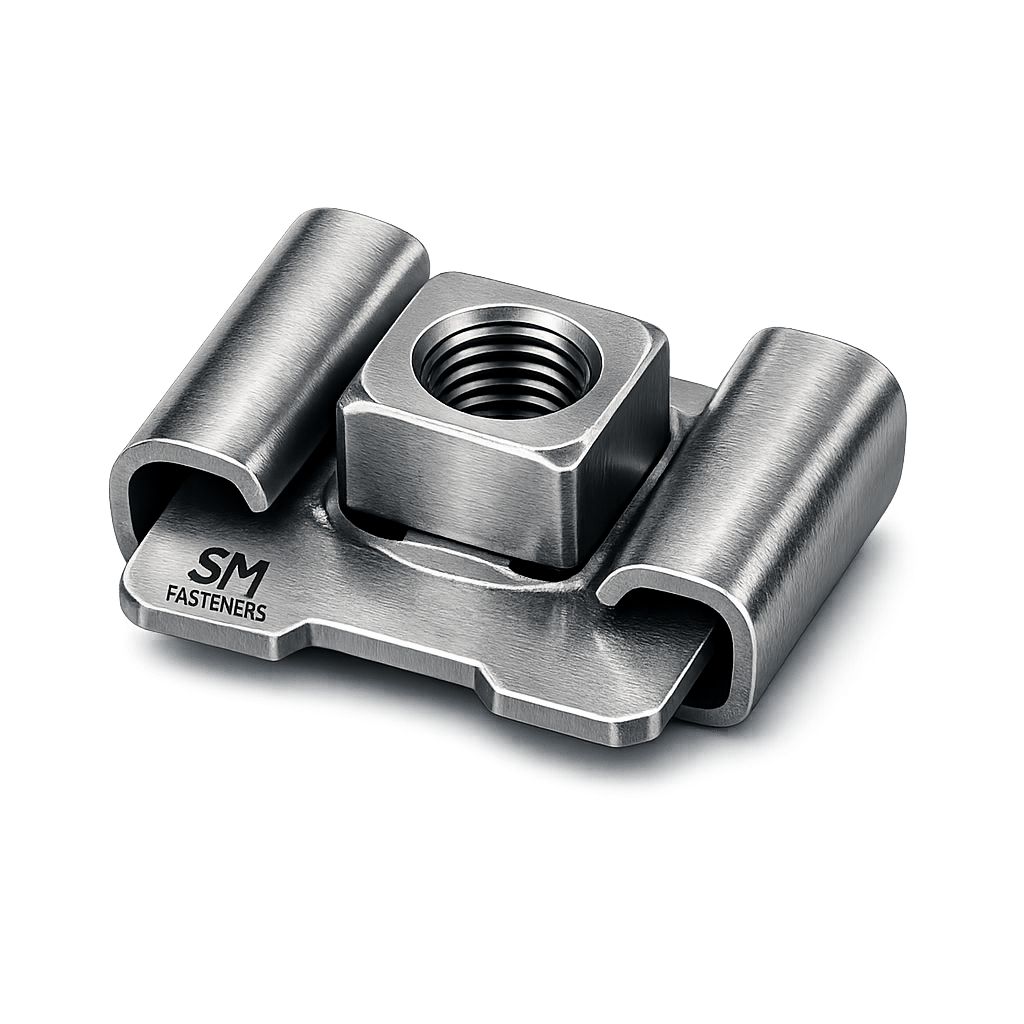
Clip Nuts are critical fastening elements used where rapid assembly, thin sheet fastening, serviceability, and controlled load distribution are required without access to the reverse side of a joint.
Across modern engineered systems, assemblies increasingly rely on:
- Thin sheet metal structures
- Modular equipment designs
- Lightweight structural panels
- High-volume manufacturing environments
- Maintenance-accessible joints
Traditional tapped holes or welded nuts introduce limitations:
| Limitation | Engineering Impact |
|---|---|
| Welding distortion | Loss of dimensional tolerance |
| Tapped holes in thin sheet | Thread stripping risk |
| Loose nut installation | Assembly inefficiency |
| Back-side access requirement | Increased labor time |
Clip Nuts solve these problems by providing:
- Self-retained threaded interface
- Floating alignment capability
- Tool-free positioning
- Repeatable torque control
- Serviceability for maintenance cycles
They are extensively deployed in:
- Automotive platforms
- Electrical enclosures
- Rail systems
- HVAC assemblies
- Equipment panels
- Industrial machinery housings
- EPC modular construction packages
SM Fasteners manufactures Clip Nuts for global industrial environments, engineered to meet ISO-controlled production standards under ISO 9001, MSME, and UKAF certification systems.
2. Technical Definition
A Clip Nut is a spring steel or formed metal fastener combining:
- A threaded nut element
- A retention clip or cage
- A panel-gripping spring mechanism
It installs over a sheet edge or through a panel slot, creating an immediate captive threaded location.
Functional Architecture
Key Functional Characteristics
- Self-retaining prior to bolt installation
- Compensates for hole misalignment
- Enables blind assembly
- Maintains preload stability under vibration
- Reduces assembly time
3. Functional Role in Mechanical Assemblies
Clip Nuts perform three simultaneous engineering roles:
3.1 Thread Creation
Provide usable internal threads where tapping is impossible.
3.2 Load Transfer
Transmit bolt preload into thin substrates without local deformation.
3.3 Alignment Compensation
Floating designs accommodate manufacturing tolerances.
4. Load Mechanics & Force Behavior
4.1 Primary Load Path
Load transfer depends on:
- Thread shear capacity
- Clip spring stiffness
- Panel bearing strength
- Contact friction
4.2 Bolt Preload Mechanics
The clamping force generated:
Where:
| Symbol | Meaning |
|---|---|
| T | Applied torque |
| K | Nut factor (0.14–0.25) |
| D | Nominal bolt diameter |
| Fp | Preload force |
Typical preload efficiency:
- 85–90% torque lost to friction
- 10–15% converted into clamping force
Clip Nut design must therefore ensure:
- Thread integrity
- Controlled friction coefficient
- Stable seating geometry
4.3 Force Components Acting on Clip Nuts
| Force Type | Engineering Effect |
|---|---|
| Tensile | Bolt preload |
| Shear | Panel movement |
| Peel force | Clip disengagement risk |
| Vibration | Self-loosening tendency |
| Thermal expansion | Preload variation |
5. Joint Design Principles
5.1 Panel Thickness Compatibility
Clip Nuts are selected based on:
| Panel Thickness | Recommended Clip Type |
|---|---|
| 0.5–1.2 mm | U-type |
| 1.2–3 mm | Spring steel clip |
| 3–6 mm | Heavy-duty clip nut |
Incorrect selection causes:
- Thread misalignment
- Clip deformation
- Reduced clamp load
5.2 Thread Engagement Requirements
Minimum engagement:
| Bolt Size | Minimum Engagement |
|---|---|
| M4 | ≥4 mm |
| M5 | ≥5 mm |
| M6 | ≥6 mm |
| M8 | ≥8 mm |
5.3 Alignment Float Principle
Floating clip nuts allow ±0.5 to ±1.5 mm positional tolerance.
Benefits:
- Reduced assembly rejection
- Faster automated installation
- Compensation for thermal expansion
5.4 Torque–Tension Relationship
Factors affecting preload:
- Thread finish
- Coating type
- Lubrication
- Material hardness
- Surface roughness
6. Failure Mechanisms
6.1 Thread Strip Failure
Occurs when bolt strength exceeds nut thread capacity.
Preventive design:
- Match property class
- Ensure sufficient thread depth
6.2 Clip Fatigue Failure
Repeated vibration leads to spring relaxation.
Mitigation:
- Heat-treated spring steel
- Proper hardness control
6.3 Panel Tear-Out
Occurs under excessive shear or peel loads.
Engineering control:
- Load-spreading flange
- Increased contact area
6.4 Hydrogen Embrittlement
Risk in high-strength plated carbon steels.
Control measures:
- Baking after electroplating
- Controlled hardness < 39 HRC
6.5 Stress Corrosion Cracking
Applicable environments:
- Chlorides
- Offshore atmosphere
- H₂S exposure
Solution:
- Duplex or nickel alloys
- PEEK fasteners for extreme corrosion resistance
7. Functional Role & Selection Criteria
Engineers evaluate Clip Nuts using:
| Selection Parameter | Consideration |
|---|---|
| Load requirement | Static vs dynamic |
| Assembly method | Manual / robotic |
| Environment | Corrosion / temperature |
| Panel material | Steel / Aluminum / Composite |
| Maintenance cycle | Removable or permanent |
Typical Engineering Selection Workflow
- Determine bolt size
- Calculate required preload
- Verify panel strength
- Select clip geometry
- Confirm material compatibility
- Validate coating system
8. Mechanical Behavior Summary
| Characteristic | Clip Nut Behavior |
|---|---|
| Preload retention | Moderate–High |
| Shear resistance | Dependent on panel |
| Reusability | High |
| Installation speed | Very High |
| Automation suitability | Excellent |
Engineering Advantage
Clip Nuts provide an optimized balance between:
Cost control
Structural performance
Manufacturing efficiency
Serviceability.
9. Product Types and Engineering Variants
Clip Nuts exist in multiple configurations developed to satisfy varying load paths, panel geometries, installation methods, and environmental demands.
Selection is governed primarily by:
- Assembly accessibility
- Sheet thickness
- Alignment tolerance
- Required preload stability
- Service environment
9.1 U-Type Clip Nut (speed nut)
Construction
- Formed spring steel body
- Fixed threaded nut section
- Edge-mounted installation
Engineering Characteristics
| Parameter | Performance |
|---|---|
| Installation | Push-on |
| Alignment | Fixed |
| Load capacity | Medium |
| Assembly speed | Very High |
| Reusability | Moderate |
Typical Applications
- Automotive body panels
- HVAC systems
- Electrical enclosures
- Appliance housings
9.2 Floating Clip Nut
Designed for tolerance compensation in precision assemblies.
Features
- Floating threaded insert
- Radial play ±1 mm
- Reduced cross-threading risk
Engineering Advantage
Critical in EPC equipment where fabrication tolerances accumulate across large assemblies.
Applications:
- Control panels
- Railway interiors
- Generator housings
- Modular skid assemblies
9.3 J-Type Clip Nut
Provides enhanced retention force.
| Feature | Benefit |
|---|---|
| Hooked geometry | Strong edge grip |
| Increased spring force | Vibration resistance |
| Deep thread engagement | Higher torque capability |
Used in:
- Heavy equipment panels
- Truck chassis assemblies
- Structural sheet installations
9.4 Extruded Thread Clip Nut
Panel material forms partial thread engagement.
Advantages:
- Higher stripping resistance
- Improved preload transfer
Used where higher mechanical load is required without increasing thickness.
9.5 Cage Clip Nut (Captive Floating Nut)
Common in server racks and industrial cabinets.
Characteristics:
- Independent cage
- Full floating nut
- High alignment tolerance
Widely used in:
- Data centers
- Industrial electronics
- Power distribution cabinets
9.6 Heavy-Duty Industrial Clip Nut
Engineered for industrial and EPC projects supplied by SM Fasteners.
Features:
- Thick spring steel
- Reinforced nut body
- High preload compatibility
Available materials:
- Stainless Steel
- Duplex Steel
- Nickel Alloys
- PEEK insulated variants
9.7 PEEK Clip Nut (Advanced Polymer Variant)
SM Fasteners supplies engineered PEEK-based clip nuts for:
- Electrical isolation
- Chemical resistance
- Lightweight assemblies
Benefits:
| Property | Advantage |
|---|---|
| Non-conductive | Electrical safety |
| Chemical inertness | Chemical plants |
| Temperature resistance | up to 260°C |
| Zero galvanic corrosion | Mixed-metal assemblies |
10. Dimensional Logic and Geometry Design
Clip Nut geometry directly affects:
- Preload stability
- Panel deformation
- Installation reliability
- Fatigue resistance
10.1 Core Geometric Elements
| Element | Function |
|---|---|
| Nut thickness | Thread strength |
| Spring arm length | Retention force |
| Clip opening | Panel thickness range |
| Floating clearance | Alignment tolerance |
| Bearing surface | Load distribution |
10.2 Dimensional Specification Table
(Typical Industrial Metric Series — SM Fasteners Manufacturing Range)
| Size | Thread Pitch (mm) | Panel Range (mm) | Nut Thickness (mm) | Clip Width (mm) | Overall Height (mm) |
|---|---|---|---|---|---|
| M4 | 0.7 | 0.6–1.5 | 3.2 | 9 | 7 |
| M5 | 0.8 | 0.8–2.0 | 4.0 | 11 | 8 |
| M6 | 1.0 | 1.0–3.0 | 5.0 | 13 | 10 |
| M8 | 1.25 | 1.5–4.0 | 6.5 | 17 | 12 |
| M10 | 1.5 | 2.0–5.0 | 8.0 | 21 | 15 |
Manufacturing tolerances maintained under ISO-controlled production.
11. Thread Systems & Interchangeability
Clip Nuts are manufactured compatible with global bolt systems.
11.1 Thread Standards & Tolerances
| Thread System | Standard | Typical Tolerance |
|---|---|---|
| Metric | ISO 261 / ISO 965 | 6H |
| UNC | ASME B1.1 | 2B |
| UNF | ASME B1.1 | 2B |
| BSW | BS 84 | Medium |
| BSF | BS 84 | Fine |
| DIN Metric | DIN 13 | 6H |
SM Fasteners provides full interchangeability validation for EPC procurement compliance.
11.2 Thread Engagement Engineering
Recommended engagement:
Where:
- = engagement length
- = bolt diameter
Critical for avoiding thread stripping.
12. Applicable International Standards
Clip Nuts are not governed by a single universal standard; instead they comply with multiple related fastener and material standards.
12.1 Dimensional & Product Standards
| Standard | Description |
|---|---|
| DIN 7965 | Sheet metal clip nuts |
| DIN 7981 compatibility | Self-tapping screw interface |
| ISO 4032 | Hex nut geometry reference |
| ISO 4759 | Fastener tolerances |
| ISO 3269 | Acceptance inspection |
| BS 4183 | General fastener dimensions |
12.2 Mechanical Property Standards
| Standard | Coverage |
|---|---|
| ISO 898-2 | Mechanical properties of nuts |
| ASTM A563 | Carbon steel nuts |
| ASTM F594 | Stainless steel nuts |
| ASTM A194 | Alloy steel high-temp nuts |
12.3 Material Standards
| Material | Standard |
|---|---|
| Carbon Steel | ASTM A1008 / EN 10130 |
| Stainless Steel | ASTM A240 / A276 |
| Duplex Steel | ASTM A182 F51/F60 |
| Nickel Alloys | ASTM B564 |
| PEEK | ASTM D6262 |
12.4 Coating & Surface Protection Standards
| Process | Standard |
|---|---|
| Zinc Plating | ISO 4042 |
| Mechanical Galvanizing | ASTM B695 |
| Hot Dip Galvanizing | ISO 1461 |
| Geomet/Dacromet | ISO 10683 |
| Passivation | ASTM A967 |
12.5 Inspection & Certification Standards
| Requirement | Standard |
|---|---|
| Quality Management | ISO 9001 |
| Material Certification | EN 10204 3.1 / 3.2 |
| PMI Testing | ASTM E1476 |
| Hardness Testing | ISO 6508 |
SM Fasteners integrates these standards within audited manufacturing systems.
13. Property Classes & Mechanical Compatibility
Clip Nut mechanical capability must match bolt strength.
13.1 Nut Property Class Selection
| Bolt Grade | Compatible Nut Property |
|---|---|
| 4.6 | Class 5 |
| 8.8 | Class 8 |
| 10.9 | Class 10 |
| 12.9 | Alloy or special nut design |
Improper pairing causes premature thread failure.
14. Dimensional Tolerance Philosophy
Engineering tolerances address:
- Manufacturing variation
- Thermal expansion
- Assembly alignment
Typical tolerance control:
| Feature | Tolerance |
|---|---|
| Thread pitch diameter | ISO 965 |
| Clip opening | ±0.15 mm |
| Float clearance | ±0.3 mm |
| Nut perpendicularity | ISO 4759 limits |
15. Geometry Influence on Mechanical Performance
| Geometry Change | Mechanical Effect |
|---|---|
| Wider clip base | Increased shear resistance |
| Longer spring arm | Higher retention |
| Floating nut | Reduced installation damage |
| Thicker nut body | Higher proof load |
16. Interchangeability Considerations for EPC Procurement
Procurement engineers must validate:
- Bolt compatibility
- Panel thickness range
- Coating system interaction
- Corrosion class matching
SM Fasteners provides:
- Drawing validation
- Sample approval
- Dimensional PPAP-style documentation
- Batch traceability
17. Standard Engineering Weight Chart
(Typical Reference — Actual SM Fasteners drawings govern supply)
| Size | Weight / Piece (g) | Weight / 100 pcs (kg) |
|---|---|---|
| M4 | 2.1 | 0.21 |
| M5 | 3.5 | 0.35 |
| M6 | 6.2 | 0.62 |
| M8 | 11.5 | 1.15 |
| M10 | 18.0 | 1.80 |
Weight control assists EPC logistics and export planning.
18. Design Integration Summary
Clip Nuts represent an optimized fastening solution combining:
- Structural reliability
- Assembly efficiency
- Dimensional tolerance compensation
- Serviceability
SM Fasteners supports custom engineering development including:
- Non-standard geometries
- High-temperature alloys
- PEEK insulated fastener systems
- Project-specific compliance documentation
19. Material Engineering Philosophy for Clip Nuts
Material selection is the most critical factor governing:
- Thread strength
- Spring retention performance
- Fatigue resistance
- Corrosion durability
- Torque repeatability
- Service life under cyclic loading
Unlike conventional nuts, Clip Nuts must simultaneously satisfy:
- High thread load capacity
- Elastic spring behavior
- Long-term relaxation resistance
Therefore, material engineering involves balancing:
- Strength vs ductility
- Hardness vs embrittlement risk
- Corrosion resistance vs cost
- Formability vs fatigue life
SM Fasteners applies controlled material selection aligned with ISO 9001-certified procurement and traceability systems.
20. Industrial Material Grades
SM Fasteners manufactures Clip Nuts across a complete industrial material spectrum suitable for EPC and OEM supply chains.
20.1 Carbon Steel Clip Nuts
Primary industrial solution.
Typical Grades
- SAE 1008
- SAE 1010
- SAE 1022
- EN 10130 DC01–DC04
Characteristics:
| Property | Value |
|---|---|
| Strength | Moderate |
| Formability | Excellent |
| Cost | Low |
| Spring performance | Very Good |
| Corrosion resistance | Requires coating |
Applications:
- Automotive
- HVAC systems
- Electrical panels
- Infrastructure assemblies
20.2 Alloy Steel Clip Nuts
Used where higher preload and fatigue resistance are required.
Typical grades:
- 4140
- 4135
- EN 42CrMo4
Advantages:
- High proof load
- Improved wear resistance
- Elevated temperature capability
20.3 Stainless Steel Clip Nuts
Supplied according to ASTM and ISO standards.
| Grade | Equivalent | Typical Use |
|---|---|---|
| A2-70 | 304 | General corrosion environments |
| A4-70 | 316 | Marine & chemical exposure |
| A4-80 | 316 High Strength | Offshore & petrochemical |
Benefits:
- Corrosion resistance
- No coating required
- Reduced maintenance
20.4 Duplex & Super Duplex Stainless Steel
Available within SM Fasteners advanced alloy portfolio.
| Grade | Standard | Feature |
|---|---|---|
| UNS S31803 | Duplex | High strength + corrosion resistance |
| UNS S32750 | Super Duplex | Severe offshore environments |
Performance:
- Chloride resistance
- High fatigue strength
- SCC resistance
20.5 Nickel & High-Performance Alloys
Used in extreme EPC environments.
| Material | Application |
|---|---|
| Inconel 625 | High temperature |
| Incoloy 825 | Acid service |
| Hastelloy C276 | Chemical plants |
| Monel 400 | Seawater exposure |
| SMO 254 | High chloride systems |
20.6 PEEK Clip Nuts
SM Fasteners provides engineered PEEK fasteners where metallic fasteners are unsuitable.
Properties:
| Property | Value |
|---|---|
| Continuous temperature | 260°C |
| Chemical resistance | Excellent |
| Density | 1.3 g/cm³ |
| Electrical insulation | Outstanding |
| Galvanic corrosion | None |
Applications:
- Semiconductor plants
- Chemical dosing systems
- Electrical isolation assemblies
- LNG instrumentation
21. Material Selection Criteria
Engineering selection matrix:
| Environment | Recommended Material |
|---|---|
| Indoor dry | Carbon Steel |
| Outdoor atmosphere | SS 304 |
| Marine | SS 316 / Duplex |
| Offshore platform | Super Duplex |
| Acidic chemicals | Hastelloy |
| High temperature | Inconel |
| Electrical insulation | PEEK |
22. Mechanical Properties by Material
| Material | Yield Strength MPa | UTS MPa | Hardness | Temp Limit |
|---|---|---|---|---|
| Carbon Steel | 320 | 450 | 120–180 HB | 250°C |
| Alloy Steel | 650 | 850 | 28–35 HRC | 400°C |
| SS 304 | 215 | 505 | 90 HRB | 425°C |
| SS 316 | 240 | 515 | 95 HRB | 450°C |
| Duplex | 450 | 620 | 25 HRC | 300°C |
| Inconel 625 | 460 | 827 | 35 HRC | 700°C |
| PEEK | — | — | Rockwell M99 | 260°C |
23. Corrosion Resistance vs Environment
| Environment | CS | SS304 | SS316 | Duplex | Nickel Alloy | PEEK |
|---|---|---|---|---|---|---|
| Atmospheric | Fair | Good | Excellent | Excellent | Excellent | Excellent |
| Seawater | Poor | Moderate | Excellent | Excellent | Excellent | Excellent |
| H₂S | Limited | Moderate | Good | Excellent | Excellent | Excellent |
| Acids | Poor | Moderate | Good | Excellent | Excellent | Excellent |
| Chemical Plants | Poor | Good | Excellent | Excellent | Excellent | Excellent |
NACE MR0175 / ISO 15156 compliance materials supplied for sour service applications.
24. Heat Treatment Processes
Heat treatment determines:
- Spring elasticity
- Thread strength
- Fatigue resistance
- Crack resistance
24.1 Process Flow
24.2 Hardening
- Austenitizing: 820–900°C
- Oil or polymer quench
- Creates martensitic structure
Purpose:
- Increase strength
- Improve wear resistance
24.3 Tempering
Performed at 350–600°C.
Benefits:
- Restores ductility
- Reduces brittleness
- Stabilizes spring force
24.4 Spring Steel Treatment
Critical for clip retention.
Controlled hardness range:
38–45 HRC
Ensures:
- Elastic recovery
- Long fatigue life
24.5 Hydrogen Embrittlement Control
Mandatory for plated high-strength components.
SM Fasteners controls through:
- Post-plate baking (190–220°C)
- Hardness monitoring
- Process certification
25. End-to-End Manufacturing Workflow
SM Fasteners follows a fully traceable industrial workflow.
25.1 Raw Material Verification
Incoming inspection:
- Mill Test Certificate (MTC)
- Chemical composition analysis
- PMI verification
- Mechanical property validation
25.2 Coil Preparation
- Decoiling
- Leveling
- Surface cleaning
25.3 Progressive Stamping / Forming
High-speed precision tooling creates:
- Clip geometry
- Spring arms
- Nut housing
Tolerances maintained within ISO limits.
25.4 Nut Formation
Two methods:
| Method | Application |
|---|---|
| Cold forging | High volume |
| CNC machining | Special alloys |
25.5 Thread Production
Preferred method: Thread Rolling
Advantages:
- Grain flow continuity
- Higher fatigue strength
- Superior surface finish
Thread cutting used for exotic alloys.
25.6 Assembly Integration
- Nut insertion
- Floating cage assembly
- Retention force calibration
25.7 Heat Treatment & Stress Relief
Controlled furnaces with batch traceability.
25.8 Surface Preparation
- Degreasing
- Pickling
- Shot blasting
- Activation
25.9 Final Inspection
100% visual inspection supported by statistical sampling.
26. Surface Finishing & Coating Technologies
Surface engineering directly affects:
- Torque coefficient
- Corrosion resistance
- Assembly consistency
- Service life
26.1 Surface Finish Comparison Table
| Coating | Corrosion Resistance | Friction Stability | Temp Limit | Typical Use |
|---|---|---|---|---|
| Zinc Plating | 72–120 hrs | Good | 120°C | Indoor |
| Zinc Nickel | 500+ hrs | Excellent | 180°C | Automotive |
| Hot Dip Galvanized | High | Moderate | 450°C | Structural |
| Geomet | 1000 hrs | Excellent | 300°C | EPC projects |
| PTFE Coated | Excellent | Low friction | 260°C | Chemical |
| Passivation | High | Stable | 400°C | Stainless Steel |
26.2 Friction Coefficient Range
| Finish | Nut Factor (K) |
|---|---|
| Dry Steel | 0.20–0.25 |
| Zinc Plated | 0.18–0.22 |
| Lubricated | 0.14–0.18 |
| PTFE | 0.10–0.14 |
Critical for torque calculation accuracy.
26.3 Coating Selection Logic
| Environment | Recommended Finish |
|---|---|
| Indoor | Zinc |
| Automotive | Zn-Ni |
| Offshore | Geomet |
| Chemical | PTFE |
| Marine | SS Passivated |
27. Manufacturing Traceability
SM Fasteners maintains full traceability:
- Heat number identification
- Batch control
- Manufacturing records
- Inspection history
- Material origin tracking
Integrated within ISO 9001 QMS.
28. Engineering Summary — Materials & Manufacturing
Clip Nuts supplied by SM Fasteners achieve performance reliability through:
- Advanced material engineering
- Controlled heat treatment
- Precision forming technology
- Verified surface engineering
- Full international standards compliance
29. Inspection & Quality Assurance Philosophy
Clip Nuts operate within assemblies where failure typically results from:
- Loss of preload
- Thread stripping
- Spring relaxation
- Corrosion degradation
- Installation misalignment
Therefore, inspection requirements extend beyond dimensional verification to include:
- Mechanical validation
- Material verification
- Surface integrity
- Functional performance testing
SM Fasteners integrates inspection activities within an ISO 9001 certified Quality Management System, supported by UKAF-accredited auditing practices.
30. Incoming Material Inspection
Every production batch begins with verified raw material conformity.
30.1 Raw Material Verification Checklist
| Inspection | Method | Standard |
|---|---|---|
| Chemical Composition | Spectrometer / PMI | ASTM E415 |
| Mechanical Properties | Tensile Test | ISO 6892 |
| Hardness | Rockwell/Brinell | ISO 6508 |
| Surface Quality | Visual | ISO 8785 |
| MTC Verification | Document Review | EN 10204 |
All materials traceable via heat number identification.
31. In-Process Manufacturing Inspection
Critical checkpoints during production:
31.1 Progressive Forming Control
- Tool wear monitoring
- Spring force verification
- Dimensional sampling
31.2 Thread Inspection
- GO / NO-GO gauges
- Pitch diameter verification
- Thread angle inspection
Standards:
- ISO 1502
- ASME B1.2
32. Final Dimensional Inspection
Dimensional Inspection Parameters
| Feature | Inspection Method |
|---|---|
| Nut thickness | Digital micrometer |
| Clip opening | Vernier measurement |
| Parallelism | Optical comparator |
| Thread concentricity | Dial indicator |
| Float clearance | Functional gauge |
Acceptance per ISO 4759 fastener tolerance system.
33. Mechanical Testing Requirements
Clip Nuts must match bolt mechanical capability.
33.1 Proof Load Testing
Validates thread strength.
| Size | Property Class | Proof Load (kN) |
|---|---|---|
| M4 | Class 8 | 5.2 |
| M5 | Class 8 | 8.3 |
| M6 | Class 8 | 11.9 |
| M8 | Class 8 | 21.2 |
| M10 | Class 8 | 33.5 |
33.2 Torque Testing
Ensures repeatable preload generation.
Measured parameters:
- Installation torque
- Strip torque
- Prevailing torque (if applicable)
33.3 Spring Retention Force Test
Unique to Clip Nuts.
Evaluates:
- Clip elasticity
- Panel grip force
- Fatigue resistance
34. Non-Destructive Testing (NDT)
Applied for critical EPC supply.
| Method | Purpose |
|---|---|
| Magnetic Particle | Crack detection |
| Dye Penetrant | Surface flaws |
| Eddy Current | Surface defects |
| Ultrasonic | Internal discontinuities |
35. Positive Material Identification (PMI)
Mandatory for alloy and offshore projects.
Verification includes:
- Duplex phase confirmation
- Nickel alloy chemistry validation
- NACE compliance verification
Standard:
ASTM E1476
36. Mechanical Property Table (Grade-Wise)
| Property Class | Proof Stress MPa | Hardness | Typical Application |
|---|---|---|---|
| Class 5 | 500 | 120 HB | Light assemblies |
| Class 8 | 800 | 22–30 HRC | Industrial |
| Class 10 | 1000 | 30–36 HRC | High load |
| Stainless A2-70 | 450 | HRB 95 | Corrosion environments |
| Duplex | 550 | 25 HRC | Offshore |
37. Tightening Torque Chart
(Lubricated condition — Reference Engineering Values)
| Size | Class 8 (Nm) | Class 10 (Nm) | Stainless A4-70 (Nm) |
|---|---|---|---|
| M4 | 3 | 4 | 2.5 |
| M5 | 6 | 8 | 5 |
| M6 | 10 | 14 | 9 |
| M8 | 25 | 35 | 22 |
| M10 | 49 | 69 | 42 |
Actual torque depends on coating friction coefficient.
38. Preload Calculation — Engineering Example
Formula
Where:
- T = Torque (Nm)
- K = Nut factor
- D = Nominal diameter (m)
Worked Example
Bolt: M8
Torque: 25 Nm
K = 0.18
Result:
≈17.3 kN clamping force
39. Failure Prevention Engineering
| Failure Mode | Preventive Action |
|---|---|
| Thread stripping | Match property class |
| Fatigue cracking | Use rolled threads |
| Hydrogen embrittlement | Baking process |
| Stress corrosion | Duplex/Nickel alloys |
| Vibration loosening | Proper preload |
40. Industry Applications
40.1 Construction & Structural Steel
- Façade panels
- Steel partitions
- Cable trays
- Access panels
40.2 Oil & Gas Industry
Upstream:
- Instrument panels
- Skid packages
Midstream:
- Compressor housings
- Pipeline instrumentation
Downstream:
- Refinery enclosures
- Control cabinets
NACE compliant materials supplied.
40.3 Power Generation
- Turbine enclosures
- Switchgear panels
- Generator housings
- Solar mounting systems
40.4 Petrochemical & Chemical Plants
Preferred materials:
- SS316
- Duplex
- Hastelloy
- PEEK insulated clip nuts
40.5 LNG & Offshore Platforms
Requirements:
- High corrosion resistance
- Vibration tolerance
- Long inspection intervals
SM Fasteners provides offshore-grade alloys.
40.6 Automotive & Heavy Equipment
Advantages:
- Rapid assembly
- Reduced labor time
- Consistent torque control
40.7 Railways & Infrastructure
Used in:
- Coach interiors
- Signaling cabinets
- Trackside equipment
40.8 Shipbuilding
Marine-grade stainless clip nuts prevent galvanic corrosion in saltwater environments.
41. Export Capability & Global Supply Readiness
SM Fasteners supplies Clip Nuts aligned with EPC procurement expectations.
41.1 Industrial Packaging
| Method | Purpose |
|---|---|
| VCI Packaging | Corrosion prevention |
| Thread Protectors | Damage prevention |
| Vacuum sealing | Export humidity control |
| Batch labeling | Traceability |
41.2 Export Crating
- ISPM-15 compliant wooden crates
- Shock-resistant packaging
- Container optimization
- Project-wise palletization
42. Documentation Package
Supplied with each shipment:
| Document | Purpose |
|---|---|
| MTC (EN 10204 3.1 / 3.2) | Material traceability |
| Heat Treatment Report | Mechanical verification |
| Inspection Report | Dimensional compliance |
| Coating Certificate | Surface validation |
| PMI Report | Alloy confirmation |
| Certificate of Conformity | Contract compliance |
43. Thread Standards & Tolerance Table
| Thread | Standard | Class |
|---|---|---|
| Metric | ISO 261 | 6H |
| UNC | ASME B1.1 | 2B |
| UNF | ASME B1.1 | 2B |
| BSW | BS 84 | Medium |
| BSF | BS 84 | Fine |
44. Surface Finish Performance Comparison
| Finish | Salt Spray (hrs) | Friction Stability | Reusability |
|---|---|---|---|
| Zinc | 96 | Good | Medium |
| Zn-Ni | 500 | Excellent | High |
| Geomet | 1000 | Excellent | High |
| Passivated SS | Excellent | Stable | Very High |
| PTFE | Excellent | Low friction | High |
45. Weight Chart — SM Fasteners Reference
| Size | Weight / Piece (g) | Weight / 100 pcs (kg) |
|---|---|---|
| M4 | 2.1 | 0.21 |
| M5 | 3.5 | 0.35 |
| M6 | 6.2 | 0.62 |
| M8 | 11.5 | 1.15 |
| M10 | 18.0 | 1.80 |
Used for logistics estimation and EPC tender documentation.
46. SM FASTENERS — Engineering & Manufacturing Capability
SM Fasteners demonstrates global supply readiness through:
- ISO 9001 certified manufacturing
- UKAF-accredited quality systems
- MSME registered industrial production
- Advanced alloy capability
- PEEK fastener manufacturing
- Custom fastener engineering
- Full traceability manufacturing workflow
47. Engineering Conclusion
Clip Nuts represent a specialized fastening solution delivering:
- Rapid assembly efficiency
- Controlled preload performance
- Alignment tolerance compensation
- Long service reliability
Through integrated engineering, certified quality systems, and advanced material capability, SM Fasteners provides Clip Nuts suitable for:
- EPC megaprojects
- OEM manufacturing
- Offshore installations
- Infrastructure development
- High-reliability industrial assemblies