

Dome nut
1. INDUSTRY CONTEXT, TECHNICAL FUNDAMENTALS & JOINT MECHANICS
1.1 Industry Context
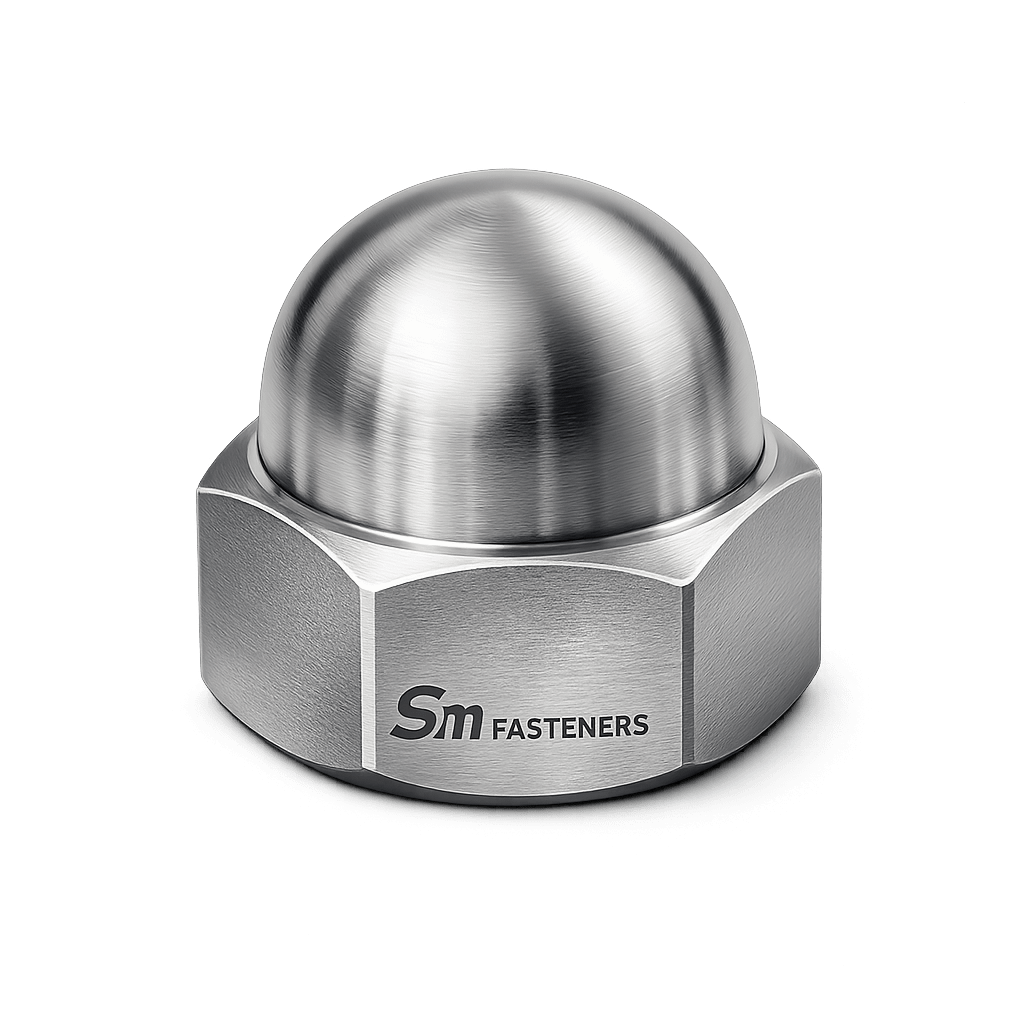
Dome Nuts — internationally recognized as Acorn Nuts or Cap Nuts — are specialized internally threaded fasteners designed to enclose exposed bolt threads while maintaining structural fastening integrity.
Within modern industrial assemblies, dome nuts serve functions extending far beyond cosmetic protection. They are widely specified across:
- Structural steel fabrication
- Rotating machinery assemblies
- Oil & Gas equipment skids
- Pressure boundary accessories
- Rail and transportation equipment
- Offshore installations
- Hygienic process equipment
- Electrical and enclosure systems
Unlike conventional hex nuts, dome nuts introduce protective geometry into the joint design.
This geometry:
- Prevents thread exposure damage
- Improves corrosion resistance
- Enhances operational safety
- Maintains preload stability
- Supports long-term maintenance reliability
For EPC procurement environments, dome nuts are frequently mandated where:
- Personnel contact risk exists
- Environmental sealing is required
- Contamination prevention is critical
- Aesthetic uniformity aligns with equipment standards
SM Fasteners manufactures dome nuts under certified quality systems:
- ISO 9001 Quality Management
- UKAF accredited processes
- MSME certified manufacturing
with global export readiness.
1.2 Technical Definition
A Dome Nut is defined as:
A hexagonal internally threaded fastener incorporating a closed hemispherical or domed end designed to fully cover the protruding bolt or stud threads.
Functional Characteristics
| Feature | Engineering Function |
|---|---|
| Hex body | Torque transmission |
| Internal thread | Load engagement |
| Domed cap | Thread protection |
| Closed end | Environmental sealing |
| Extended height | Increased thread coverage |
Unlike open nuts, dome nuts eliminate thread exposure — a frequent origin of corrosion initiation and mechanical injury.
1.3 Functional Role in Fastener Assemblies
Dome nuts operate within preloaded bolted joints.
Primary engineering roles include:
1. Protection Function
- Prevents thread galling
- Avoids mechanical damage during operation
- Protects coating systems
- Reduces corrosion nucleation points
2. Safety Function
- Eliminates sharp thread projections
- Required in railways, public infrastructure, and machinery guarding
3. Environmental Isolation
- Shields threads from:
- Moisture
- Chlorides
- Dust ingress
- Process contamination
4. Reliability Enhancement
- Maintains consistent friction conditions
- Reduces maintenance interventions
1.4 Load Mechanics & Force Behaviour
Dome nuts do not change the fundamental mechanics of bolted joints.
The load transfer mechanism remains identical to standard hex nuts.
The dome itself does not carry structural load.
All mechanical load is transferred through:
- Thread flanks
- Bearing face
- Bolt shank
Bolt Preload Principle
The performance of a dome nut assembly depends on achieving adequate preload.
Where:
| Parameter | Meaning |
|---|---|
| Fp | Preload force |
| T | Applied torque |
| K | Nut factor |
| D | Nominal diameter |
Typical Nut Factor:
| Condition | K Value |
|---|---|
| Dry | 0.20–0.25 |
| Lubricated | 0.15–0.18 |
| PTFE coated | 0.10–0.13 |
Engineering Insight
Because dome nuts are closed-end, incorrect bolt length selection may cause:
- Bottoming inside dome
- False torque readings
- Reduced preload
Proper design must ensure:
1.5 Stress Distribution in Dome Nut Joints
The stress behavior is governed by:
- Thread shear stress
- Bearing compression
- Bolt tensile stress
Thread Engagement Requirement
Minimum engagement:
For softer materials:
Stress Zones
| Zone | Stress Type |
|---|---|
| First engaged thread | Highest shear stress |
| Nut bearing face | Compression |
| Bolt shank | Tensile |
| Dome cap | Non-load carrying |
1.6 Joint Design Principles
Bolt Length Selection Rule
Correct selection avoids dome interference.
Washer Compatibility
Recommended use with:
- Flat washers (ISO 7089)
- Hardened washers (ISO 7090)
- PEEK insulating washers (electrical isolation)
Preload Retention Factors
Engineering variables affecting reliability:
- Surface roughness
- Lubrication condition
- Material hardness pairing
- Thermal expansion mismatch
- Embedment relaxation
1.7 Torque–Tension Relationship
Only 10–15% of applied torque produces useful clamping force.
Remaining torque loss:
| Loss Mechanism | Percentage |
|---|---|
| Thread friction | 40% |
| Bearing friction | 45% |
| Useful preload | 15% |
1.8 Friction & Nut Factor Engineering
Friction coefficient strongly affects preload accuracy.
Variables influencing K:
- Coating type
- Surface finish
- Lubricant presence
- Material pairing
- Thread quality
SM Fasteners maintains controlled thread production to ensure repeatable nut factor performance.
1.9 Failure Mechanisms
1. Fatigue Failure
Occurs under cyclic loading.
Mitigation:
- Correct preload
- Rolled threads
- Controlled surface finish
2. Thread Stripping
Caused by:
- Insufficient engagement
- Soft material pairing
- Over-torque
3. Hydrogen Embrittlement
Risk materials:
- High-strength carbon steels
- Electroplated coatings
Controlled baking procedures required.
4. Stress Corrosion Cracking (SCC)
Occurs in:
- Chloride environments
- H₂S sour service
Material selection critical.
5. Galling (Stainless Steel)
Prevention:
- Lubrication
- Surface coatings
- Controlled hardness differential
1.10 Functional Selection Criteria
Engineers select dome nuts based on:
| Parameter | Consideration |
|---|---|
| Load type | Static / dynamic |
| Exposure | Outdoor / offshore |
| Safety requirement | Personnel contact |
| Hygiene requirement | Food/pharma |
| Corrosion risk | Chemical exposure |
| Temperature | Thermal stability |
1.11 Application Relevance Across Industries
| Industry | Functional Purpose |
|---|---|
| Structural Steel | Personnel safety |
| Oil & Gas | Corrosion protection |
| Power Plants | Equipment reliability |
| Petrochemical | Contamination prevention |
| LNG & Offshore | Salt protection |
| Railways | Vibration resistance |
| Shipbuilding | Marine durability |
| Heavy Equipment | Mechanical protection |
1.12 SM Fasteners Engineering Positioning
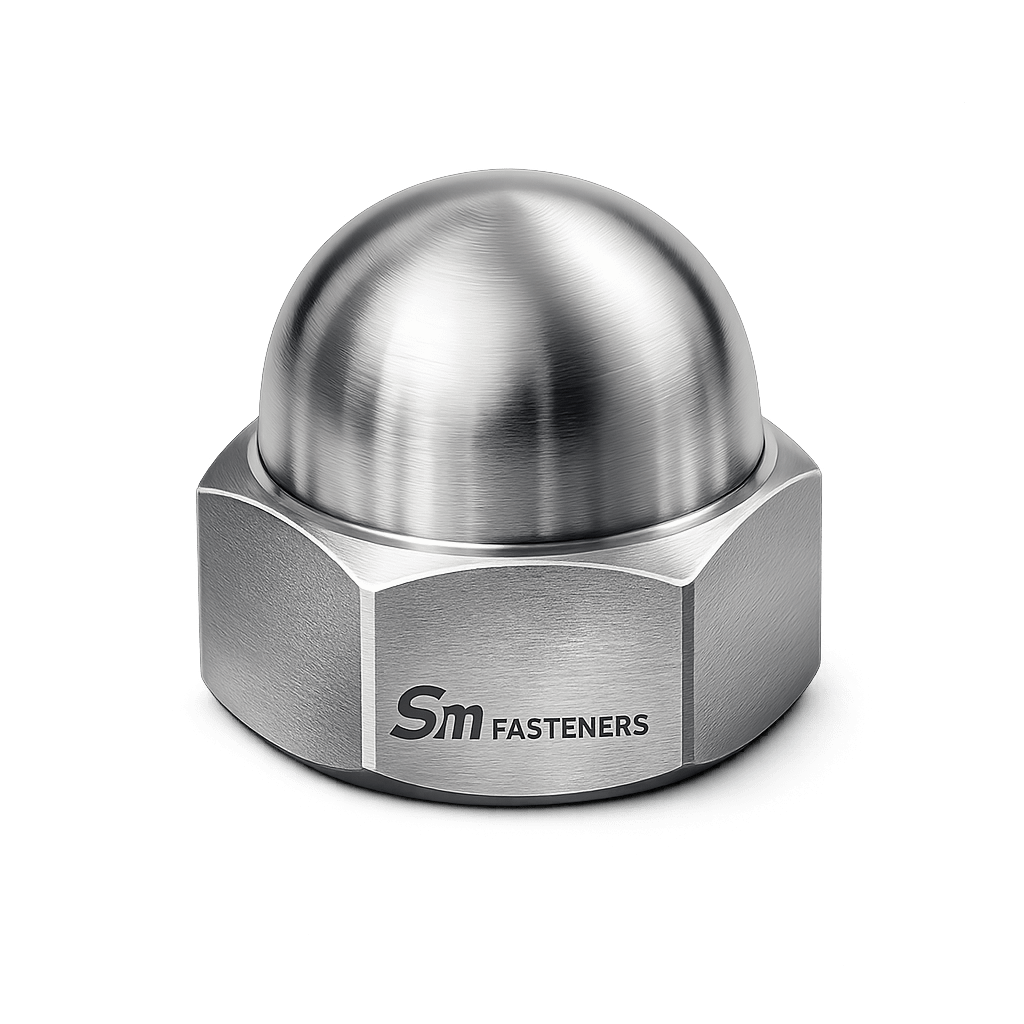
SM Fasteners supports dome nut supply through:
- Precision cold/hot forging
- Advanced alloy material capability
- Exotic alloys including:
- Duplex
- Super Duplex
- Inconel
- Hastelloy
- SMO 254
- PEEK high-performance polymer fasteners
All products operate within:
Global EPC procurement readiness
ISO 9001 controlled manufacturing
Traceable heat numbers
2 .PRODUCT TYPES, GEOMETRY ENGINEERING & INTERNATIONAL STANDARDS
2.1 Product Types and Variants of Dome Nuts
Dome nuts are manufactured in multiple configurations to satisfy structural, environmental, and installation requirements across global industries. Selection depends on load conditions, clearance requirements, corrosion exposure, and applicable standards.
2.1.1 Standard Hex Dome Nut (Acorn Nut)
Most widely used configuration.
Characteristics
- Hexagonal drive
- Closed hemispherical cap
- Full internal threading
- Standard height geometry
Typical Uses
- Structural assemblies
- Machinery guards
- Equipment frames
- General industrial fastening
2.1.2 High Dome Nut (Tall Pattern)
Designed with increased dome height.
Engineering Purpose
- Accommodates longer bolt projection
- Protects extended threaded studs
- Improves sealing in outdoor exposure
Applications
- Heavy equipment
- Railway infrastructure
- Offshore platforms
- Pipe support systems
2.1.3 Low Profile Dome Nut
Reduced dome height for clearance-sensitive assemblies.
Advantages
- Reduced envelope dimensions
- Suitable for confined installations
- Weight reduction
Typical Use
- Automotive assemblies
- Electrical enclosures
- Instrumentation panels
2.1.4 Stainless Hygienic Dome Nut
Used where contamination control is critical.
Design Features
- Smooth surface finish
- No exposed threads
- Cleanability compliant geometry
Industries
- Food processing
- Pharmaceutical equipment
- Water treatment systems
2.1.5 Nylon Insert Dome Nut (Locking Type)
Hybrid configuration combining:
- Dome protection
- Prevailing torque locking
Functional Benefit
- Resists vibration loosening.
Limitations
- Temperature restricted (≈120°C typical)
2.1.6 PEEK Dome Nuts (High-Performance Polymer)
SM Fasteners manufactures dome nuts in PEEK (Polyether Ether Ketone) for advanced engineering environments.
Engineering Advantages
| Property | Benefit |
|---|---|
| Electrically insulating | Prevents galvanic corrosion |
| Lightweight | Aerospace & electronics |
| Chemical resistant | Process industries |
| Non-magnetic | Instrumentation systems |
| High temperature stability | Up to ~260°C |
2.1.7 Heavy Pattern Dome Nut
Enhanced wall thickness and bearing area.
Used for:
- High clamp loads
- Heavy machinery
- Oil & gas skids
2.2 Geometry & Dimensional Logic
Dome nut performance depends heavily on geometric relationships.
Key Geometric Parameters
| Symbol | Parameter |
|---|---|
| d | Nominal thread diameter |
| P | Thread pitch |
| m | Nut height |
| s | Width across flats |
| e | Width across corners |
| k | Dome height |
| t | Internal thread depth |
| Dc | Dome cavity diameter |
Engineering Geometry Principles
1. Thread Coverage Rule
Prevents bottoming inside dome.
2. Bearing Area Requirement
Larger bearing surface reduces:
- Embedment relaxation
- Surface indentation
- Preload loss
3. Dome Radius Design
Hemispherical profiles reduce:
- Stress concentration
- Corrosion accumulation zones
- Impact damage risk
2.3 Standard Dimensional Specification Table (Metric — Typical Values)
(Aligned with DIN 1587 reference geometry)
| Size | Pitch (mm) | Width Across Flats s (mm) | Nut Height m (mm) | Dome Height k (mm) | Thread Depth t (mm) |
|---|---|---|---|---|---|
| M4 | 0.7 | 7 | 8 | 4 | 6 |
| M5 | 0.8 | 8 | 10 | 5 | 7 |
| M6 | 1.0 | 10 | 12 | 6 | 9 |
| M8 | 1.25 | 13 | 15 | 8 | 11 |
| M10 | 1.5 | 17 | 18 | 9 | 13 |
| M12 | 1.75 | 19 | 22 | 11 | 16 |
| M16 | 2.0 | 24 | 28 | 14 | 20 |
| M20 | 2.5 | 30 | 34 | 17 | 24 |
| M24 | 3.0 | 36 | 42 | 21 | 30 |
Exact tolerances controlled under ISO manufacturing systems at SM Fasteners.
2.4 International Standards Compliance
Dome nuts must comply with recognized global dimensional and mechanical standards.
Primary Standards
| Standard | Description |
|---|---|
| DIN 1587 | Hexagon dome nuts |
| ISO 4033 | Hex nuts dimensional reference |
| ISO 898-2 | Mechanical properties |
| ISO 965 | Thread tolerances |
| ISO 261 / 262 | Metric thread system |
| BS 1768 | British dome nuts |
| ASTM A563 | Carbon steel nuts |
| ASTM A194 | High-temperature/pressure nuts |
| ASME B18.2.2 | Inch series nuts |
| ANSI B1.1 | Unified threads |
Engineering Compliance Note
SM Fasteners supplies dome nuts meeting:
- EPC project specifications
- Third-party inspection requirements
- Interchangeability across ISO/DIN/ASTM systems
2.5 Thread Forms and Systems
Dome nuts are produced across global thread standards.
Thread Standards & Tolerances Table
| Thread System | Standard | Typical Tolerance |
|---|---|---|
| Metric Coarse | ISO 261 | 6H |
| Metric Fine | ISO 262 | 6H |
| UNC | ANSI B1.1 | 2B |
| UNF | ANSI B1.1 | 2B |
| BSW | BS 84 | Medium |
| BSF | BS 84 | Fine |
| NPT (special) | ANSI B1.20 | Custom |
Engineering Considerations
- Fine threads → better vibration resistance
- Coarse threads → faster assembly, higher damage tolerance
- Unified threads → North American EPC compatibility
2.6 Property Classes and Mechanical Rating Systems
Dome nuts follow international strength classification systems.2
ISO Property Classes
| Property Class | Minimum Proof Load (MPa) | Typical Application |
|---|---|---|
| 5 | 500 | Light equipment |
| 6 | 600 | General engineering |
| 8 | 800 | Structural applications |
| 10 | 1000 | Heavy machinery |
| 12 | 1200 | High-strength assemblies |
ASTM Equivalents
| ASTM Grade | Equivalent Use |
|---|---|
| A563 Grade A | General structural |
| A563 DH | High strength |
| A194 2H | Pressure service |
| A194 8M | Stainless service |
2.7 Mechanical Properties Table (Typical)
| Grade | Proof Load MPa | Yield MPa | Tensile MPa | Hardness HB |
|---|---|---|---|---|
| Class 5 | 500 | 300 | 500 | 140–180 |
| Class 8 | 800 | 640 | 800 | 200–250 |
| Class 10 | 1000 | 900 | 1040 | 280–320 |
| Class 12 | 1200 | 1080 | 1220 | 340–380 |
2.8 Dimensional Tolerancing & Interchangeability
International projects require interchangeability between standards.
Key tolerance control areas:
- Thread pitch diameter
- Across-flat dimension
- Bearing face flatness
- Dome concentricity
- Internal cavity depth
SM Fasteners maintains dimensional compliance through:
- Calibrated gauges
- Go/No-Go thread inspection
- ISO 9001 controlled measurement systems
2.9 Geometry Influence on Mechanical Behaviour
Dome Height Effects
| Condition | Impact |
|---|---|
| High dome | Increased protection |
| Low dome | Reduced clearance requirement |
| Thick wall | Improved durability |
| Thin wall | Reduced weight |
Thread Engagement vs Strength
Nut stripping resistance depends on:
Where adequate engagement ensures failure occurs in the bolt rather than nut.
2.10 Special Engineering Variants Manufactured by SM Fasteners
SM Fasteners supports customized dome nut manufacturing including:
- Extended internal depth designs
- Reduced hex geometry
- High-temperature alloy versions
- Sour service compliant nuts
- PEEK insulating dome nuts
- Non-magnetic instrumentation fasteners
- Metric–Inch hybrid specifications
All variants produced under controlled engineering drawings and customer-approved inspection plans.
2.11 Procurement Engineering Considerations
EPC buyers evaluate dome nuts based on:
| Requirement | Engineering Evaluation |
|---|---|
| Standards compliance | ISO/DIN/ASTM |
| Material traceability | Heat number tracking |
| Coating performance | Environmental suitability |
| Mechanical property certification | Proof load validation |
| Dimensional interchangeability | Project compatibility |
| Documentation | EN 10204 certification |
2.12 Engineering Selection Checklist
Before specifying dome nuts:
✓ Bolt length verified
✓ Dome clearance confirmed
✓ Thread system matched
✓ Property class compatible
✓ Coating validated for environment
✓ Inspection level defined
✓ Certification requirement established
3. MATERIAL ENGINEERING, HEAT TREATMENT, MANUFACTURING WORKFLOW & SURFACE ENGINEERING
3.1 Materials Engineering for Dome Nuts
Material selection governs the mechanical reliability, corrosion resistance, temperature capability, and lifecycle performance of dome nuts.
In engineered assemblies, dome nuts must maintain:
- Thread integrity under preload
- Resistance to environmental degradation
- Dimensional stability during service
- Compatibility with mating bolt materials
SM Fasteners manufactures dome nuts across a full industrial alloy spectrum, enabling supply into EPC, offshore, petrochemical, and heavy engineering projects.
3.1.1 Material Families Used in Dome Nuts
| Material Group | Typical Grades |
|---|---|
| Carbon Steel | C35, C45, ASTM A563 |
| Alloy Steel | 4140, 4340, ASTM A194 2H |
| Stainless Steel | A2-70, A4-80 |
| Duplex Stainless | UNS S31803 |
| Super Duplex | UNS S32750 |
| Nickel Alloys | Inconel 625, 718 |
| High Alloy | Hastelloy C276 |
| Copper Nickel | Monel 400 |
| High Mo Stainless | SMO 254 |
| Engineering Polymer | PEEK |
3.2 Material Selection Criteria
Engineering selection must consider operational exposure conditions.
Load vs Environment Matrix
| Condition | Preferred Material |
|---|---|
| Indoor structural | Carbon steel |
| Outdoor atmosphere | Stainless steel |
| Marine offshore | Duplex / Super Duplex |
| Sour service (H₂S) | NACE compliant alloys |
| High temperature | Inconel / Incoloy |
| Chemical processing | Hastelloy |
| Electrical isolation | PEEK |
| Lightweight assemblies | Stainless / PEEK |
Temperature Capability
| Material | Service Temperature |
|---|---|
| Carbon Steel | −20°C to 300°C |
| Stainless Steel | −196°C to 600°C |
| Duplex | −50°C to 300°C |
| Inconel | Up to 1000°C |
| Hastelloy | Up to 1100°C |
| PEEK | Up to 260°C |
3.3 Material Comparison Table
| Material | UTS (MPa) | Yield (MPa) | Corrosion Resistance | Relative Cost | Typical Application |
|---|---|---|---|---|---|
| Carbon Steel | 500–800 | 300–640 | Low | Low | Structural |
| Alloy Steel | 900–1200 | 700–1000 | Moderate | Medium | Heavy machinery |
| SS 304 | 700 | 450 | Good | Medium | General outdoor |
| SS 316 | 800 | 600 | Excellent | Medium | Marine |
| Duplex | 800–900 | 550 | Very High | High | Offshore |
| Super Duplex | 900+ | 650 | Extreme | High | FPSO/LNG |
| Inconel 625 | 1000 | 700 | Exceptional | Very High | High temperature |
| Hastelloy C276 | 790 | 355 | Chemical resistant | Very High | Acid service |
| SMO 254 | 680 | 300 | Chloride resistant | High | Seawater |
| PEEK | 100 | 95 | Excellent chemical | High | Electrical isolation |
3.4 NACE MR0175 / ISO 15156 Compliance
Oil & Gas sour environments demand strict hardness control.
Requirements
- Resistance to Sulfide Stress Cracking
- Controlled hardness limits
- Verified material chemistry
- Heat treatment validation
Typical hardness limits:
| Material | Max Hardness |
|---|---|
| Carbon Steel | 22 HRC |
| Low Alloy Steel | 22 HRC |
| Stainless Austenitic | Not restricted |
| Duplex | Controlled phase balance |
SM Fasteners supports NACE-compliant manufacturing upon project requirement.
3.5 Heat Treatment Processes
Heat treatment controls mechanical properties and dimensional stability.
3.5.1 Annealing
Purpose:
- Softening
- Improved machinability
- Stress relief
Used for:
- Stainless steel dome nuts
- Nickel alloys
3.5.2 Quenching & Tempering
Applied to carbon/alloy steel nuts.
Process:
- Austenitizing
- Rapid quenching
- Tempering
Result:
- Increased strength
- Improved toughness
- Controlled hardness
3.5.3 Solution Annealing (Stainless & Duplex)
Purpose:
- Restore corrosion resistance
- Dissolve carbides
- Prevent sensitization
3.5.4 Aging / Precipitation Hardening
Used for:
- Inconel 718
- High-performance aerospace applications
Heat Treatment Impact on Properties
| Process | Strength | Toughness | Corrosion |
|---|---|---|---|
| Annealing | ↓ | ↑ | ↑ |
| Q&T | ↑↑ | ↑ | Moderate |
| Solution Anneal | Moderate | ↑ | ↑↑ |
| Aging | ↑↑↑ | Moderate | ↑ |
3.6 End-to-End Manufacturing Workflow
(SM Fasteners Production System)
3.6.1 Raw Material Verification
Incoming inspection includes:
- Mill Test Certificate (MTC)
- Heat number verification
- Chemical composition analysis
- Positive Material Identification (PMI)
3.6.2 Forging Operations
Cold Forging
Used for:
- High volume production
- Superior grain flow
- Improved fatigue resistance
Hot Forging
Used for:
- Larger diameters
- Alloy materials
- Heavy pattern dome nuts
Engineering Advantage:
Forging aligns grain structure with load path.
3.6.3 Machining Operations
Performed where precision geometry required:
- Dome contour shaping
- Internal cavity machining
- Special tolerance requirements
3.6.4 Thread Production
Thread Rolling (Preferred)
Benefits:
- Increased fatigue strength
- Compressive surface stress
- Improved dimensional repeatability
Thread Cutting
Used for:
- Large diameters
- Exotic alloys
- Low production volumes
3.6.5 Deburring & Surface Preparation
Processes include:
- Vibratory finishing
- Edge rounding
- Surface cleaning
Critical for coating adhesion.
3.6.6 Heat Treatment Integration
Batch-controlled furnaces ensure:
- Uniform hardness
- Traceable process records
- Calibration compliance
3.6.7 Final Finishing & Cleaning
Includes:
- Passivation
- Shot blasting
- Chemical cleaning
- Ultrasonic washing
3.7 Surface Engineering & Coatings
Surface treatment significantly affects dome nut service life.
Surface Finish Comparison Table
| Finish | Corrosion Resistance | Friction | Appearance | Typical Use |
|---|---|---|---|---|
| Plain | Low | Medium | Industrial | Indoor |
| Zinc Plated | Moderate | Low | Bright | Construction |
| Hot Dip Galvanized | High | High | Matte | Structural outdoor |
| Mechanical Galvanized | High | Moderate | Uniform | Bridges |
| Phosphate | Low | Controlled | Dark | Automotive |
| PTFE/Xylan | Very High | Very Low | Smooth | Offshore |
| Dacromet/Geomet | High | Stable | Silver-grey | Automotive |
| Electropolished SS | Excellent | Low | Hygienic | Pharma |
| Passivated SS | Excellent | Medium | Clean | Marine |
| Nickel Plated | Moderate | Low | Decorative | Equipment |
| PEEK Natural | Chemical resistant | Low | Polymer | Electrical |
Coating Selection vs Environment
| Environment | Recommended Finish |
|---|---|
| Indoor dry | Zinc plating |
| Outdoor exposure | HDG |
| Marine atmosphere | SS316 / Duplex |
| Offshore splash zone | PTFE coated |
| Chemical plant | Hastelloy / SMO |
| Hygienic area | Electropolished SS |
| Electrical insulation | PEEK |
3.8 Corrosion Resistance vs Environment Table
| Environment | Carbon Steel | SS304 | SS316 | Duplex | Inconel | PEEK |
|---|---|---|---|---|---|---|
| Atmospheric | Fair | Good | Excellent | Excellent | Excellent | Excellent |
| Seawater | Poor | Moderate | Good | Excellent | Excellent | Excellent |
| Acidic | Poor | Moderate | Good | Excellent | Excellent | Excellent |
| H₂S | Risk | Good | Good | Excellent | Excellent | Excellent |
| Chlorides | Poor | Moderate | Excellent | Excellent | Excellent | Excellent |
| High Temp | Moderate | Good | Good | Excellent | Excellent | Good |
3.9 Hydrogen Embrittlement Control
Critical for high-strength plated dome nuts.
SM Fasteners applies:
- Controlled electroplating parameters
- Immediate post-plating baking
- Hardness verification
- Process traceability
3.10 Surface Roughness & Friction Control
Controlled surface roughness ensures predictable torque values.
Typical values:
| Surface | Ra (µm) |
|---|---|
| Forged | 3.2–6.3 |
| Machined | 1.6–3.2 |
| Polished | <1.6 |
3.11 SM Fasteners Manufacturing Capability Integration
SM Fasteners integrates:
- Certified ISO 9001 quality systems
- Advanced alloy machining capability
- PEEK fastener manufacturing expertise
- Custom drawing-based engineering
- Global EPC project documentation control
Capabilities include:
✓ Special material sourcing
✓ Custom dome geometry
✓ High-temperature alloy production
✓ Sour service compliance
✓ Export-ready pac
4. INSPECTION, QUALITY CONTROL, INDUSTRY APPLICATIONS, EXPORT READINESS & ENGINEERING TABLES
4.1 Inspection & Quality Control Philosophy
In industrial fastening systems, dome nuts are treated as load-critical engineered components, not commodity hardware.
Failures in nut integrity directly affect joint reliability, equipment safety, and project compliance.
SM Fasteners integrates inspection controls aligned with:
- ISO 9001 Quality Management System
- UKAF accredited quality processes
- EPC project Inspection & Test Plans (ITP)
- Third-Party Inspection Agency requirements
Quality assurance is applied across the entire lifecycle:
4.2 Incoming Material Inspection
All production begins with verified raw material.
Verification Activities
| Inspection | Purpose |
|---|---|
| Mill Test Certificate Review | Chemical & mechanical verification |
| Heat Number Traceability | Batch control |
| Spectrometer Analysis | Composition confirmation |
| PMI Testing | Alloy authentication |
| Visual inspection | Surface defects |
Material traceability is preserved throughout manufacturing using batch and heat identification.
4.3 Dimensional Inspection
Dimensional accuracy directly affects preload behavior and interchangeability.
Critical Characteristics
- Thread pitch diameter
- Across flats dimension
- Dome internal depth
- Bearing face flatness
- Concentricity of dome
- Thread class tolerance
Gauging Methods
| Parameter | Inspection Tool |
|---|---|
| Threads | Go/No-Go gauges |
| Height | Digital caliper |
| Dome radius | Profile projector |
| Flatness | Surface plate |
| Concentricity | Dial indicator |
4.4 Mechanical Testing
Mechanical testing validates compliance with ISO 898-2 or ASTM property requirements.
Proof Load Test
Confirms nut resists stripping at specified load.
Hardness Testing
| Method | Application |
|---|---|
| Rockwell | Alloy steel |
| Brinell | Carbon steel |
| Vickers | Stainless/alloys |
Tensile Compatibility Testing
Ensures nut strength exceeds mating bolt requirement.
Design principle:
4.5 Non-Destructive Testing (NDT)
Applied where project specifications demand advanced quality assurance.
| Method | Detection |
|---|---|
| Magnetic Particle (MPI) | Surface cracks |
| Dye Penetrant (DPI) | Micro defects |
| Ultrasonic Testing | Internal flaws |
| Eddy Current | Surface discontinuity |
4.6 Positive Material Identification (PMI)
Mandatory for:
- Oil & Gas
- LNG
- Offshore projects
- Petrochemical
PMI verifies alloy composition using portable spectrometers.
4.7 Documentation & Certification
SM Fasteners supplies full documentation packages aligned with EPC procurement.
Standard Documentation
| Document | Standard |
|---|---|
| Mill Test Certificate | EN 10204 3.1 |
| Third-Party Certificate | EN 10204 3.2 |
| Heat Treatment Report | Project requirement |
| Coating Report | Thickness verification |
| Dimensional Report | Inspection record |
| Certificate of Conformance | Supply validation |
| Packing List | Export control |
4.8 Failure Prevention & Reliability Engineering
Common Failure Modes
| Failure Mode | Root Cause | Prevention |
|---|---|---|
| Thread stripping | Insufficient engagement | Correct design |
| Fatigue failure | Low preload | Torque control |
| Hydrogen embrittlement | Improper plating | Post-bake process |
| Stress corrosion cracking | Wrong material | Alloy selection |
| Galling | Stainless friction | Lubrication |
4.9 Industry Applications
Dome nuts are selected where protection, safety, and environmental durability are essential.
Construction & Structural Steel
- Handrail assemblies
- Architectural steel
- Public infrastructure
- Safety-critical installations
Purpose:
- Injury prevention
- Corrosion protection
Oil & Gas (Upstream / Midstream / Downstream)
Applications:
- Valve assemblies
- Instrument mounting
- Pipe supports
- Skid equipment
- Control panels
Requirements:
- NACE compliance
- Traceability
- Corrosion resistance
Power Generation
Used in:
- Turbine auxiliaries
- Switchgear systems
- Generator housings
- Cable trays
Benefits:
- Maintenance safety
- Long service intervals
Petrochemical & Chemical Processing
Dome nuts protect threads against:
- Chemical splash
- Contaminant accumulation
- Corrosive vapors
Common materials:
- SS316
- Hastelloy
- SMO 254
LNG & Offshore Installations
Operating risks include:
- Salt spray
- Cyclic loading
- Moisture ingress
Preferred materials:
- Duplex
- Super Duplex
- PTFE-coated alloys
Automotive & Heavy Equipment
- Suspension systems
- Agricultural equipment
- Mining machinery
Benefits:
- Thread protection
- Reduced maintenance damage
Railways & Infrastructure
Widely used on:
- Platform structures
- Signal installations
- Passenger safety zones
Shipbuilding & Marine
Key roles:
- Prevent corrosion initiation
- Protect exposed studs
- Improve long-term reliability
PEEK Dome Nut Applications
SM Fasteners supplies PEEK dome nuts for:
- Electrical insulation assemblies
- Semiconductor equipment
- Medical systems
- High-frequency electronics
- Non-magnetic instrumentation
4.10 Export Packaging & Logistics
Industrial fasteners must survive long transit periods without degradation.
Industrial Packaging
| Method | Purpose |
|---|---|
| VCI Packaging | Corrosion prevention |
| Thread protectors | Damage prevention |
| Oil wrapping | Moisture protection |
| Heat-sealed bags | Clean shipment |
Export Crating
SM Fasteners utilizes:
- ISPM-15 compliant wooden crates
- Fumigated pallets
- Moisture barrier liners
- Container loading plans
Export Documentation
- Commercial Invoice
- Packing List
- Certificate of Origin
- Inspection Certificates
- Material Traceability Records
4.11 ENGINEERING TABLES (MANDATORY REFERENCE DATA)
A. Dimensional Specification Table (Metric Dome Nuts)
| Size | Pitch | Across Flats (mm) | Height (mm) | Dome Height (mm) | Weight/Pc (kg) |
|---|---|---|---|---|---|
| M6 | 1.0 | 10 | 12 | 6 | 0.004 |
| M8 | 1.25 | 13 | 15 | 8 | 0.007 |
| M10 | 1.5 | 17 | 18 | 9 | 0.012 |
| M12 | 1.75 | 19 | 22 | 11 | 0.020 |
| M16 | 2.0 | 24 | 28 | 14 | 0.045 |
| M20 | 2.5 | 30 | 34 | 17 | 0.080 |
| M24 | 3.0 | 36 | 42 | 21 | 0.150 |
B. Proof Load & Tensile Strength Table
| Size | Class 8 Proof Load (kN) | Class 10 (kN) | Class 12 (kN) |
|---|---|---|---|
| M8 | 19 | 24 | 29 |
| M10 | 30 | 38 | 45 |
| M12 | 43 | 54 | 64 |
| M16 | 80 | 100 | 120 |
| M20 | 125 | 156 | 188 |
| M24 | 180 | 225 | 270 |
C. Mechanical Property Table
| Property Class | Yield MPa | Tensile MPa | Hardness |
|---|---|---|---|
| 8 | 640 | 800 | 22–30 HRC |
| 10 | 900 | 1040 | 30–36 HRC |
| 12 | 1080 | 1220 | 36–44 HRC |
D. Tightening Torque Chart (Lubricated Condition)
| Size | Class 8 Torque (Nm) | Class 10 (Nm) | Class 12 (Nm) |
|---|---|---|---|
| M6 | 9 | 12 | 14 |
| M8 | 22 | 28 | 34 |
| M10 | 44 | 56 | 67 |
| M12 | 77 | 97 | 116 |
| M16 | 190 | 240 | 290 |
| M20 | 380 | 480 | 575 |
| M24 | 650 | 820 | 980 |
E. Preload Calculation (Worked Example)
Given:
- Bolt Size = M12
- Torque = 90 Nm
- Nut Factor K = 0.18
- Diameter = 0.012 m
Result: Approximate preload ≈ 41.6 kN
F. Thread Standards & Tolerances
| System | Tolerance Class |
|---|---|
| Metric | 6H |
| UNC | 2B |
| UNF | 2B |
| BSW | Medium |
| BSF | Fine |
G. Surface Finish Performance Comparison
| Coating | Corrosion Life | Friction Stability |
|---|---|---|
| Zinc | Medium | Good |
| HDG | High | Variable |
| PTFE | Very High | Excellent |
| Dacromet | High | Stable |
| Passivation | Excellent | Moderate |
H. Weight Chart (Aligned with SM Fasteners Production Data)
| Size | Weight / Pc (kg) | Weight / 100 Pcs (kg) |
|---|---|---|
| M6 | 0.004 | 0.4 |
| M8 | 0.007 | 0.7 |
| M10 | 0.012 | 1.2 |
| M12 | 0.020 | 2.0 |
| M16 | 0.045 | 4.5 |
| M20 | 0.080 | 8.0 |
| M24 | 0.150 | 15.0 |
4.12 SM FASTENERS — GLOBAL SUPPLY & ENGINEERING POSITIONING
SM Fasteners demonstrates industrial readiness through:
- ISO 9001 certified manufacturing systems
- UKAF accredited quality framework
- MSME registered production capability
- Advanced alloy and PEEK fastener manufacturing
- Custom engineering support for EPC projects
- Full traceability and inspection integration
- Export-oriented logistics and documentation
The dome nut portfolio reflects:
✓ Engineering-driven design
✓ Standards compliance
✓ Material expertise
✓ Controlled manufacturing
✓ Global procurement readiness