

Prevailing Torque Nut
1. Industrial Context
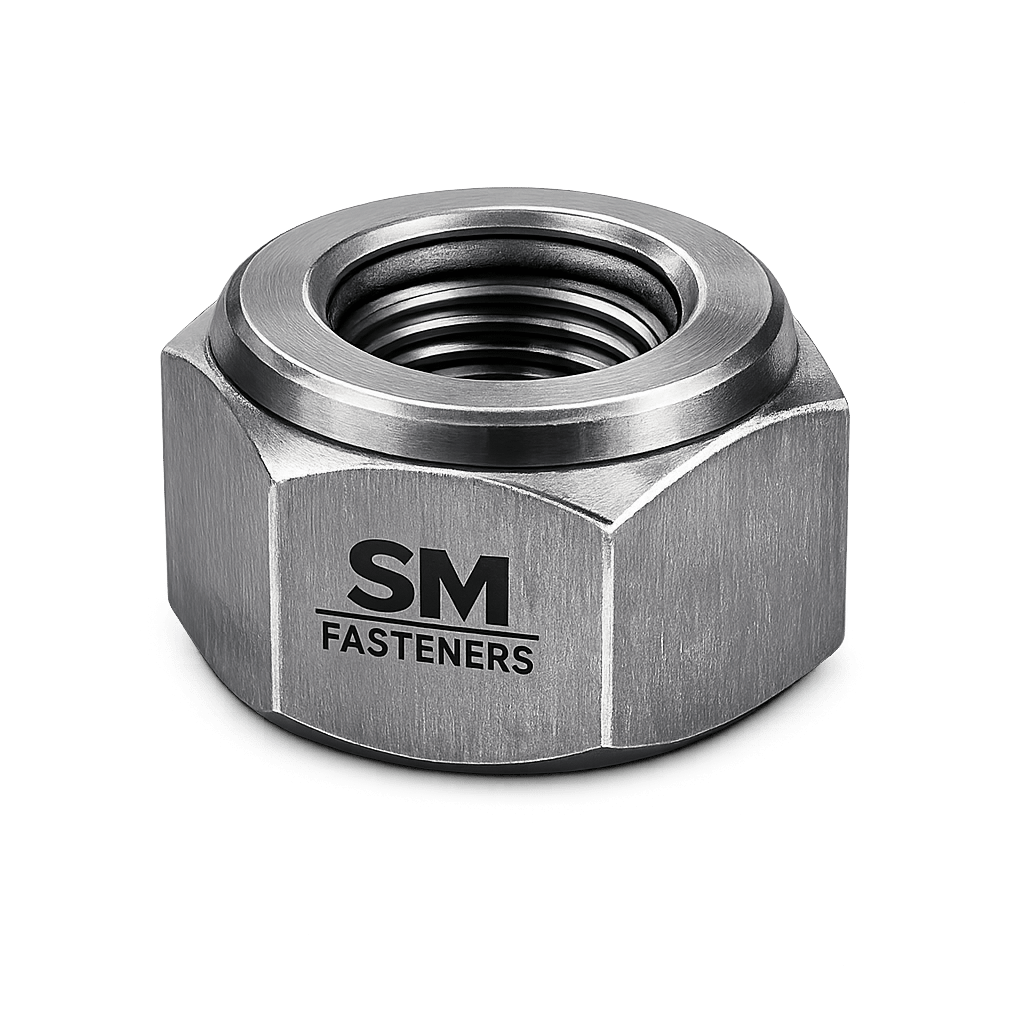
Prevailing Torque Nuts are critical self-locking threaded fasteners developed to maintain clamp load integrity under dynamic operating conditions where conventional nuts lose preload due to vibration, thermal cycling, or fluctuating loads.
Across modern engineered systems, bolted joints increasingly operate under:
- cyclic stress
- impact loading
- rotational vibration
- pressure pulsation
- thermal expansion mismatch
- fatigue-sensitive assemblies
Traditional locking approaches such as double-nutting, spring washers, or adhesives introduce variability, installation complexity, or inspection limitations. Prevailing torque nuts provide a mechanically integrated locking mechanism that delivers predictable resistance to loosening independent of external locking devices.
These fasteners are widely specified in:
| Industry Sector | Functional Requirement |
|---|---|
| Oil & Gas | Anti-vibration joint retention |
| Offshore Structures | Dynamic wave loading resistance |
| Power Generation | Thermal expansion stability |
| Petrochemical Plants | Reliability under cyclic pressure |
| Structural Steel | Wind and seismic resistance |
| Railways | Shock and oscillation durability |
| Heavy Equipment | Rotational vibration control |
| Automotive OEM | Controlled clamp force retention |
| LNG Facilities | Cryogenic contraction tolerance |
SM Fasteners manufactures prevailing torque nuts aligned with global EPC procurement specifications, ensuring compatibility with ISO, ASTM, DIN, and BS fastening systems.
2. Technical Definition
2.1 Definition
A Prevailing Torque Nut is a nut incorporating a locking feature that creates controlled frictional resistance independent of clamp load, preventing spontaneous rotation after installation.
The locking torque exists even when:
- axial load = 0
- joint relaxation occurs
- vibration attempts rotation
This differentiates it from friction-dependent locking devices.
2.2 Engineering Definition
A prevailing torque nut develops a specified torque required to rotate the nut on mating threads due to intentional deformation or insert interference.
The locking mechanism produces:
2.3 Fundamental Functional Characteristics
| Characteristic | Engineering Meaning |
|---|---|
| Prevailing Torque | Torque required to overcome locking feature |
| Clamp Load | Axial preload generated during tightening |
| Reusability | Depends on locking mechanism type |
| Self-Locking | No auxiliary washer or adhesive required |
| Controlled Friction | Predictable installation behavior |
| Anti-Loosening | Maintains joint integrity |
3. Functional Role in Bolted Assemblies
A bolted joint must satisfy three simultaneous engineering objectives:
- Generate sufficient preload
- Maintain preload during service
- Prevent rotational loosening
Prevailing torque nuts primarily address Objective 3 while supporting Objectives 1 and 2.
3.1 Why Bolted Joints Fail
Field failure investigations show loosening occurs due to:
- transverse vibration
- differential expansion
- embedment relaxation
- gasket creep
- cyclic shear forces
Loss of preload leads to:
- fatigue cracking
- gasket leakage
- structural instability
- flange separation
Prevailing torque nuts act as a mechanical energy barrier against rotation.
4. Load Mechanics & Force Behavior
4.1 Bolt–Nut System Mechanics
A bolted joint behaves like a spring system:
- Bolt = elastic tension spring
- Clamped parts = compression spring
Preload ensures joint compression exceeds external load.
When vibration introduces micro-slip, rotation begins unless resisted.
Prevailing torque provides resistance torque:
4.2 Torque–Tension Relationship
Installation torque consists of three components:
| Torque Component | Typical Share |
|---|---|
| Thread friction | 40–50% |
| Bearing surface friction | 35–45% |
| Useful preload generation | 10–15% |
Prevailing torque nuts introduce an additional controlled friction component.
General Torque Equation
Where:
- = Preload force
- = Applied torque
- = Nut factor (friction coefficient)
- = Nominal diameter
4.3 Prevailing Torque Influence
Total tightening torque:
Therefore, installation procedures must consider:
- Minimum prevailing torque
- Maximum prevailing torque
- Desired preload
Failure to account for prevailing torque results in:
- under-tightening
- over-stressing
- inaccurate clamp load
SM Fasteners supplies prevailing torque data during project submittals to support accurate tightening procedures.
5. Joint Design Principles
5.1 Self-Locking Mechanism Physics
Self-locking occurs when rotational energy required exceeds vibration energy input.
Design objective:Tprevailing>Tvibration
Locking mechanisms typically operate through:
- elastic interference
- plastic deformation
- polymer compression
- distorted thread geometry
5.2 Frictional Energy Dissipation
Prevailing torque nuts convert vibrational motion into:
- frictional heat
- micro-plastic deformation
- energy damping
This prevents reverse rotation.
5.3 Clamp Load Stability
Prevailing torque nuts:
✔ Maintain preload after relaxation
✔ Reduce self-loosening probability
✔ Improve fatigue life of bolts
✔ Stabilize gasket compression
5.4 Design Considerations for Engineers
| Design Parameter | Engineering Guidance |
|---|---|
| Joint Type | Dynamic or cyclic joints preferred |
| Access | Limited access favors integrated locking |
| Maintenance Interval | Long-term installations |
| Temperature Range | Verify insert compatibility |
| Reuse Requirement | Select metal locking types |
| Inspection Requirement | Visible mechanical locking preferred |
5.5 Prevailing Torque vs Other Locking Methods
| Method | Reliability | Reusable | Inspection Ease |
|---|---|---|---|
| Double Nut | Medium | Yes | Moderate |
| Spring Washer | Low | Yes | Easy |
| Adhesive | High | No | Difficult |
| Safety Wire | High | Yes | Labor intensive |
| Prevailing Torque Nut | Very High | Depends on type | Excellent |
6. Preload Calculation — Worked Engineering Example
Given
- Bolt Size: M16
- Torque Applied: 210 Nm
- Nut Factor (K): 0.18
- Diameter (D): 16 mm = 0.016 m
Approximate Preload = 73 kN
Engineers must subtract prevailing torque contribution when determining installation torque.
7. Failure Mechanisms Prevented by Prevailing Torque Nuts
7.1 Self-Loosening (Junker Effect)
Primary failure mode under transverse vibration.
Prevailing torque resists rotational slip initiation.
7.2 Fatigue Failure
Loss of preload causes fluctuating stress amplitude.
Maintained clamp load reduces fatigue crack propagation.
7.3 Shear Joint Failure
Proper preload ensures shear loads transfer via friction instead of bolt shear.
7.4 Hydrogen Embrittlement Risk
High-strength prevailing torque nuts must control:
- hardness limits
- coating processes
- baking procedures
SM Fasteners manufacturing integrates controlled heat treatment and post-plating hydrogen relief processes.
7.5 Stress Corrosion Cracking
Critical in:
- offshore environments
- sour service (H₂S)
- chloride exposure
Material selection must comply with:
- NACE MR0175
- ISO 15156
8. Engineering Advantages in Critical Systems
Prevailing torque nuts enable:
- predictable torque retention
- reduced maintenance shutdowns
- improved structural reliability
- standardized installation procedures
- compatibility with automated assembly lines
They are therefore preferred in EPC project specifications requiring lifecycle reliability.
9. Functional Selection Criteria
Engineers select prevailing torque nuts based on:
| Selection Factor | Consideration |
|---|---|
| Vibration Severity | High vibration favors metal locking types |
| Temperature | Nylon inserts limited by temperature |
| Chemical Exposure | Stainless or nickel alloys required |
| Reusability | All-metal preferred |
| Load Level | Match property class to bolt grade |
| Inspection Requirements | Mechanical locking preferred |
10. Role Within SM Fasteners Engineering Capability
Prevailing Torque Nuts supplied by SM Fasteners are manufactured within certified quality systems:
- ISO 9001 Quality Management
- UKAF accredited processes
- MSME certified manufacturing
- Full traceability from raw material to dispatch
Engineering integration includes:
- controlled prevailing torque validation
- compatibility with international bolt standards
- advanced alloy and corrosion-resistant material capability
- availability of PEEK-based high-performance locking solutions for electrical isolation and chemical resistance applications
11. Product Types and Variants
Prevailing torque nuts are classified according to the locking mechanism used to generate resistance torque. Selection must consider temperature capability, reuse requirement, vibration severity, and inspection accessibility.
11.1 Primary Classification
| Type | Locking Principle | Typical Standards | Reusable | Temperature Capability |
|---|---|---|---|---|
| Nylon Insert (Nyloc) Nut | Polymer interference | ISO 7040 / DIN 985 | Limited | ≤120°C |
| All metal lock nut | Thread deformation | DIN 980V / ISO 7042 | Yes | High |
| Stover Nut | Elliptical distortion | ASTM A563 | Yes | High |
| Flex Lock Nut | Slotted crown distortion | IFI Standards | Yes | High |
| Two-Way Lock Nut | Dual deformation zones | OEM Specs | Yes | High |
| Center Lock Nut | Mid-body deformation | DIN 980M | Yes | High |
| Serrated Flange Prevailing Nut | Combined friction + locking | DIN 6927 | Limited | Medium |
| PEEK Insert Lock Nut | High-performance polymer insert | Custom / Aerospace | Limited | Up to 260°C |
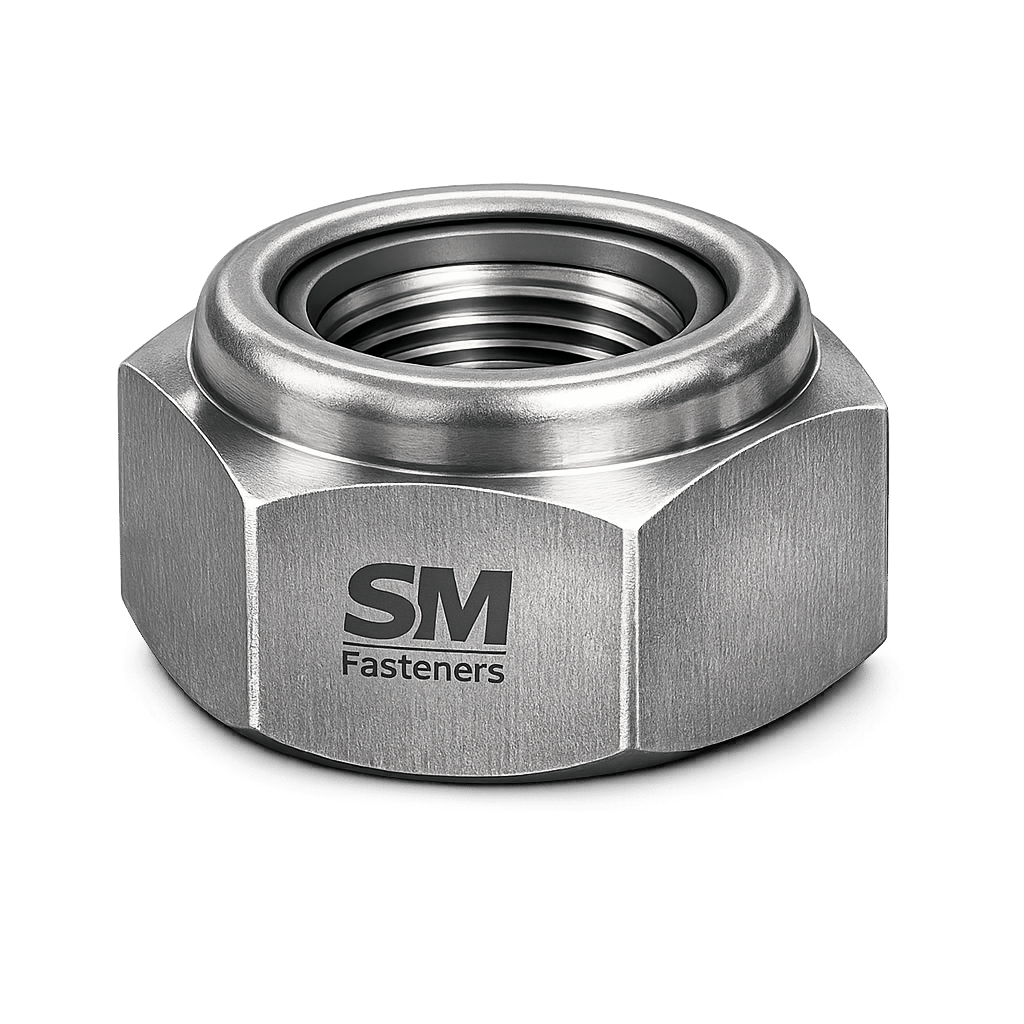
SM Fasteners manufactures these configurations in metric and imperial systems aligned with EPC procurement requirements.
11.2 Nylon Insert Prevailing Torque Nuts
Functional Principle
A nylon ring produces radial compression against mating bolt threads.
Locking Behavior
- Elastic deformation
- High friction coefficient
- Reduced vibration loosening
Engineering Characteristics
| Parameter | Value |
|---|---|
| Prevailing torque consistency | High |
| Reusability | 3–5 cycles typical |
| Chemical resistance | Moderate |
| Temperature limitation | Polymer dependent |
| Electrical insulation | Partial |
Limitations
Not suitable for:
- high-temperature flanges
- offshore fire zones
- sour service
- aggressive hydrocarbons
11.3 All-Metal Prevailing Torque Nuts
All-metal locking nuts rely on controlled plastic deformation of threads.
Locking Mechanisms
- elliptical top section
- crimped crown
- distorted pitch diameter
- slotted deformation zones
Engineering Advantages
✔ High temperature stability
✔ No polymer degradation
✔ Full reusability
✔ Resistant to oils and chemicals
✔ Compatible with offshore and petrochemical systems
11.4 Stover Type Lock Nuts
Developed for heavy-duty industrial vibration environments.
Key Geometry Feature
Top threads intentionally ovalized.
| Characteristic | Value |
|---|---|
| Prevailing torque repeatability | Excellent |
| Impact resistance | High |
| Installation automation | Suitable |
| Heavy equipment usage | Preferred |
Common in:
- mining equipment
- structural steel
- railway assemblies
- turbine equipment
11.5 Flex Lock Nuts
Flex lock nuts incorporate slots creating flexible segments.
Locking action generated by:
- elastic flexure
- distributed pressure zones
Benefits include reduced thread damage and smoother installation torque curves.
11.6 Center Lock Nuts
Locking deformation located at mid-height of nut.
Engineering benefits:
- preserves thread lead-in
- improves installation alignment
- suitable for automated assembly systems
11.7 Serrated Flange Prevailing Torque Nuts
Combine:
- integrated washer flange
- serration friction
- prevailing torque locking
Applications:
- automotive assemblies
- sheet metal structures
- machinery covers
Not suitable for hardened surfaces or sliding joints.
11.8 High-Performance PEEK Insert Lock Nuts
SM Fasteners provides engineered solutions using PEEK (Polyether Ether Ketone) inserts.
Advantages
| Property | Benefit |
|---|---|
| Temperature Resistance | up to 260°C |
| Chemical Resistance | Excellent |
| Electrical Isolation | High |
| Radiation Stability | Excellent |
| Low Outgassing | Aerospace suitable |
Applications include:
- LNG instrumentation
- semiconductor equipment
- electrical isolation joints
- chemical processing equipment
12. Dimensional Logic & Geometry
Prevailing torque nuts follow standard hex geometry ensuring interchangeability with standard tooling.
12.1 Basic Nut Geometry
Key dimensions:
- Width across flats (s)
- Nut height (m)
- Thread diameter (d)
- Thread pitch (P)
- Locking zone height
Standard Geometry Representation
| Symbol | Description |
|---|---|
| d | Nominal diameter |
| P | Pitch |
| s | Width across flats |
| m | Nut height |
| hL | Locking zone height |
12.2 Metric Dimensional Specification Table
ISO Metric Prevailing Torque Nuts
| Size | Pitch (mm) | Width Across Flats (mm) | Height (mm) |
|---|---|---|---|
| M6 | 1.0 | 10 | 6 |
| M8 | 1.25 | 13 | 8 |
| M10 | 1.5 | 17 | 10 |
| M12 | 1.75 | 19 | 12 |
| M16 | 2.0 | 24 | 16 |
| M20 | 2.5 | 30 | 20 |
| M24 | 3.0 | 36 | 24 |
| M30 | 3.5 | 46 | 30 |
| M36 | 4.0 | 55 | 36 |
(Aligned with ISO 4032 dimensional envelope.)
12.3 Height Variations
| Type | Height Ratio |
|---|---|
| Standard | 1.0 × diameter |
| Thin Lock Nut | 0.5 × diameter |
| Heavy Hex | 1.2 × diameter |
| High Strength Lock Nut | Increased locking section |
13. Thread Forms & Standards
Prevailing torque nuts must match mating bolt thread standards precisely.
13.1 Thread Standard Comparison
| Standard | Region | Thread Angle |
|---|---|---|
| ISO Metric | Global | 60° |
| UNC | USA | 60° |
| UNF | USA | 60° |
| BSW | UK | 55° |
| BSF | UK | 55° |
13.2 Thread Tolerance Classes
| System | External Thread | Internal Thread |
|---|---|---|
| ISO Metric | 6g | 6H |
| UNC/UNF | 2A | 2B |
| Precision Fit | 3A | 3B |
| Structural Bolting | As specified |
Proper tolerance ensures controlled prevailing torque performance.
13.3 Metric Thread Pitch Table
| Size | Coarse Pitch | Fine Pitch |
|---|---|---|
| M8 | 1.25 | 1.0 |
| M10 | 1.5 | 1.25 |
| M12 | 1.75 | 1.5 |
| M16 | 2.0 | 1.5 |
| M20 | 2.5 | 1.5 |
| M24 | 3.0 | 2.0 |
14. Applicable International Standards
Prevailing torque nuts supplied for global projects must comply with recognized standards.
14.1 ISO Standards
| Standard | Description |
|---|---|
| ISO 7040 | Nylon insert hex nuts |
| ISO 7042 | All-metal prevailing torque nuts |
| ISO 2320 | Prevailing torque performance requirements |
| ISO 898-2 | Mechanical properties of nuts |
| ISO 4032 | Hex nut dimensions |
| ISO 965 | Thread tolerances |
14.2 DIN Standards
| Standard | Description |
|---|---|
| DIN 985 | Nylon insert lock nuts |
| DIN 980V | All-metal lock nuts |
| DIN 982 | High type lock nuts |
| DIN 6927 | Serrated flange nuts |
14.3 ASTM Standards
| Standard | Application |
|---|---|
| ASTM A563 | Carbon steel nuts |
| ASTM A194 | Alloy & pressure vessel nuts |
| ASTM F594 | Stainless steel nuts |
| ASTM A320 | Low-temperature bolting |
| ASTM A453 | High temperature service |
14.4 BS Standards
| Standard | Description |
|---|---|
| BS 3692 | Metric fasteners |
| BS 1768 | Hexagon nuts |
| BS EN ISO 2320 | Prevailing torque verification |
15. Property Class Compatibility
Prevailing torque nuts must match bolt strength.
| Nut Property Class | Compatible Bolt Class |
|---|---|
| Class 8 | Bolt 8.8 |
| Class 10 | Bolt 10.9 |
| Class 12 | Bolt 12.9 |
| ASTM 2H | ASTM A193 B7 |
| ASTM 8M | Stainless B8M |
Incorrect pairing causes thread stripping or preload loss.
16. Interchangeability Considerations
Global EPC projects require interchangeability between:
- ISO
- ASTM
- DIN
- BS systems
Critical parameters:
- thread pitch
- tolerance class
- proof load
- material grade
- coating thickness allowance
SM Fasteners validates interchangeability through dimensional inspection and functional prevailing torque testing under ISO 2320 requirements.
17. Engineering Selection Matrix
| Application Condition | Recommended Type |
|---|---|
| High temperature | All-metal |
| Offshore vibration | Stover |
| Automotive | Nylon insert |
| Chemical plant | Stainless all-metal |
| LNG | Duplex / PEEK insert |
| Electrical isolation | PEEK locking nut |
| Heavy machinery | Center lock |
18. Material Grades and Selection Criteria
Material selection for prevailing torque nuts directly influences:
- preload retention
- fatigue resistance
- corrosion performance
- temperature capability
- hydrogen embrittlement susceptibility
- lifecycle cost
SM Fasteners manufactures prevailing torque nuts across a full industrial metallurgy range suitable for EPC, offshore, petrochemical, and heavy engineering applications.
18.1 Industrial Material Families
| Material Group | Typical Standards | Primary Use |
|---|---|---|
| Carbon Steel | ASTM A563 | Structural & construction |
| Alloy Steel | ASTM A194 / A320 | High load & pressure systems |
| Stainless Steel | ASTM F594 | Corrosion resistance |
| Duplex Stainless | UNS S31803 | Offshore & marine |
| Super Duplex | UNS S32750 | Seawater service |
| Nickel Alloys | Inconel / Monel | Extreme environments |
| SMO 254 | UNS S31254 | Chloride resistance |
| Hastelloy | C276 | Chemical processing |
| PEEK Polymer | Custom engineered | Electrical isolation & chemical resistance |
18.2 Material Selection Criteria
Engineers evaluate:
| Parameter | Selection Influence |
|---|---|
| Design load | Yield & proof strength |
| Temperature | Material stability |
| Corrosive environment | Alloy chemistry |
| H₂S exposure | NACE compliance |
| Maintenance interval | Corrosion allowance |
| Weight reduction | Advanced alloys or PEEK |
| Electrical isolation | Polymer solutions |
19. Mechanical Properties by Material Grade
Mechanical Property Comparison
| Material | Yield Strength (MPa) | UTS (MPa) | Hardness | Temperature Limit |
|---|---|---|---|---|
| Carbon Steel Class 8 | 640 | 800 | 22–32 HRC | 300°C |
| Alloy Steel Class 10 | 900 | 1040 | 26–36 HRC | 450°C |
| Alloy Steel Class 12 | 1100 | 1220 | 32–39 HRC | 500°C |
| SS 304 | 205 | 515 | HRB 95 | 400°C |
| SS 316 | 205 | 520 | HRB 95 | 450°C |
| Duplex 2205 | 450 | 620 | 28 HRC | 300°C |
| Super Duplex 2507 | 550 | 800 | 32 HRC | 300°C |
| Inconel 625 | 460 | 830 | — | 980°C |
| Hastelloy C276 | 355 | 790 | — | 1000°C |
| PEEK | 100 | 140 | — | 260°C |
20. Material Performance vs Environment
Corrosion Resistance Matrix
| Environment | Carbon Steel | SS316 | Duplex | SMO 254 | Nickel Alloy |
|---|---|---|---|---|---|
| Atmospheric | Medium | Excellent | Excellent | Excellent | Excellent |
| Marine | Poor | Good | Excellent | Excellent | Excellent |
| Seawater Immersion | Poor | Moderate | Excellent | Excellent | Excellent |
| Chloride Acid | Poor | Moderate | Good | Excellent | Excellent |
| Sour Gas (H₂S) | Controlled | Good | Excellent | Excellent | Excellent |
| High Temperature Oxidation | Moderate | Good | Good | Good | Excellent |
SM Fasteners assists EPC buyers in selecting materials compliant with NACE MR0175 / ISO 15156 for sour service.
21. Property Class System (ISO 898-2)
Prevailing torque nuts must equal or exceed bolt strength.
| Nut Property Class | Proof Stress (MPa) | Matching Bolt |
|---|---|---|
| 5 | 500 | 5.8 |
| 8 | 800 | 8.8 |
| 10 | 1000 | 10.9 |
| 12 | 1200 | 12.9 |
22. Heat Treatment Processes
Heat treatment defines mechanical reliability and locking stability.
22.1 Typical Heat Treatment Workflow
- Controlled heating
- Austenitizing
- Quenching
- Tempering
- Stress relief
- Hardness verification
22.2 Heat Treatment Methods
| Process | Purpose |
|---|---|
| Quench & Temper | High strength alloy nuts |
| Normalizing | Grain refinement |
| Solution Annealing | Stainless steels |
| Age Hardening | Nickel alloys |
| Stress Relieving | Distortion control |
22.3 Hardness Control for Lock Nuts
Excessive hardness increases embrittlement risk.
| Application | Maximum Hardness |
|---|---|
| General Service | 36 HRC |
| High Strength | 39 HRC |
| Sour Service | ≤22 HRC (NACE) |
SM Fasteners validates hardness through calibrated testing aligned with ISO 6508 and ASTM E18.
23. Hydrogen Embrittlement Control
Critical for plated high-strength prevailing torque nuts.
Preventive measures:
- controlled electroplating
- low hydrogen pick-up processes
- post-plating baking (200°C)
- hardness monitoring
- coating thickness control
24. End-to-End Manufacturing Workflow
SM Fasteners operates controlled manufacturing aligned with ISO 9001 quality systems.
24.1 Raw Material Verification
Incoming inspection includes:
- Mill Test Certificate (MTC)
- chemical composition verification
- PMI testing
- dimensional validation
- heat number traceability
24.2 Forging vs Machining
| Method | Advantage | Application |
|---|---|---|
| Cold Forging | Grain flow strength | High-volume nuts |
| Hot Forging | Large diameters | Heavy hex nuts |
| CNC Machining | Precision alloys | Nickel & special materials |
Forging enhances fatigue resistance due to continuous grain structure.
24.3 Thread Manufacturing
Thread Rolling (Preferred)
Benefits:
- increased fatigue strength
- work hardening
- improved surface finish
Thread Cutting
Used when:
- large sizes
- exotic alloys
- custom threads required
24.4 Creation of Locking Feature
Depending on nut type:
| Lock Type | Manufacturing Method |
|---|---|
| Nyloc insert lock nut | Insert press fitting |
| Stover | Controlled top deformation |
| All-metal | Mechanical crimping |
| Flex Lock | Slot forming |
| Center Lock | Mid-body deformation |
| PEEK Insert | Precision thermal insertion |
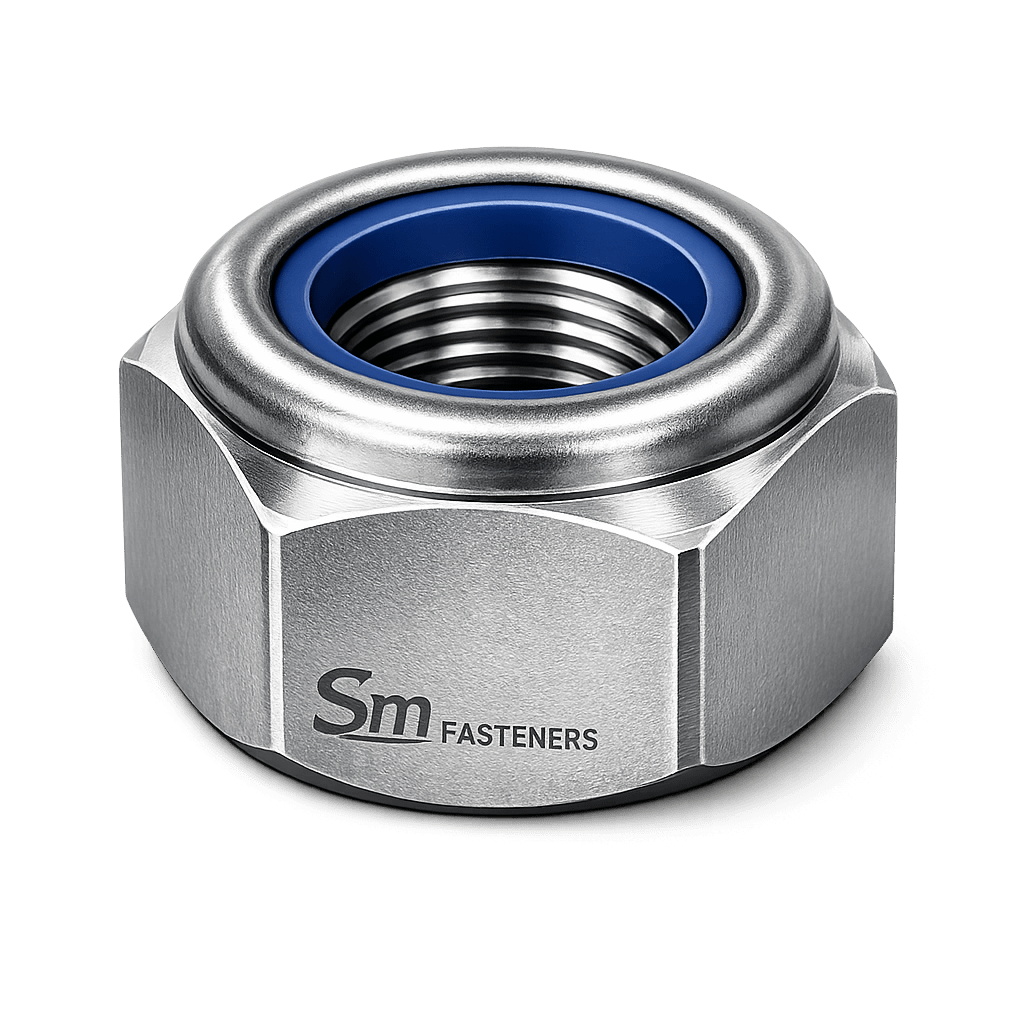
Each batch undergoes prevailing torque verification per ISO 2320.
25. Surface Engineering & Coatings
Surface treatment protects against corrosion and influences torque behavior.
25.1 Surface Finish Comparison
| Coating | Corrosion Resistance | Temperature Limit | Friction Control |
|---|---|---|---|
| Zinc Plating | Moderate | 120°C | Good |
| Hot Dip Galvanizing | High | 300°C | Requires oversize tapping |
| Mechanical Galvanizing | High | 250°C | Uniform coating |
| Phosphate | Low | 400°C | Excellent lubrication |
| PTFE / Xylan | Very High | 260°C | Low friction |
| Dacromet / Geomet | Excellent | 300°C | Stable torque |
| Passivation | Stainless steels | High | Neutral |
| Nickel Plating | Chemical resistance | High | Smooth surface |
25.2 Coating Selection vs Application
| Industry | Recommended Finish |
|---|---|
| Structural Steel | HDG |
| Offshore | Duplex + PTFE |
| Petrochemical | Fluoropolymer coatings |
| Automotive | Zinc flake |
| LNG | Stainless passivation |
| Electrical Equipment | PEEK isolation nuts |
26. Coating Impact on Torque & Preload
Coatings alter friction coefficient (nut factor K).
| Surface Condition | Nut Factor (K) |
|---|---|
| Dry Steel | 0.20–0.25 |
| Zinc Plated | 0.18 |
| Lubricated | 0.12–0.15 |
| PTFE Coated | 0.10–0.13 |
Proper torque adjustment is mandatory.
SM Fasteners supplies torque reference data aligned with coating selection.
27. Surface Integrity & Quality Assurance
Inspection includes:
- coating thickness measurement
- adhesion testing
- salt spray validation
- visual inspection
- dimensional verification post-coating
28. Traceability System
Each prevailing torque nut batch maintains full traceability:
- heat number marking
- manufacturing lot identification
- inspection linkage
- material certification reference
Traceability supports EPC audits and third-party inspection agencies.
29. Integration of Advanced Materials — PEEK Fasteners
SM Fasteners integrates PEEK prevailing torque nuts for specialized engineering requirements.
Functional Advantages
- non-conductive assemblies
- galvanic isolation
- chemical plant instrumentation
- cryogenic service compatibility
- weight reduction vs metal
Used in:
- LNG control panels
- electrical busbar supports
- semiconductor manufacturing
- aerospace electronics
30. Manufacturing Quality Alignment with SM Fasteners
Production workflow integrates:
- ISO 9001 process control
- UKAF accredited quality practices
- MSME-certified manufacturing infrastructure
- calibrated inspection equipment
- documented process validation
Result:
✔ Repeatable prevailing torque performance
✔ Controlled mechanical properties
✔ Global EPC supply readiness
31. Inspection & Quality Control Philosophy
Prevailing torque nuts are classified as safety-critical fastening components in pressure systems, structural assemblies, rotating equipment, and vibration-sensitive installations.
Quality assurance must verify:
- dimensional conformity
- mechanical performance
- locking effectiveness
- material integrity
- coating reliability
- traceability compliance
SM Fasteners integrates inspection procedures aligned with:
- ISO 9001 Quality Management Systems
- UKAF accredited inspection practices
- EPC project quality plans
- Third-party inspection requirements
31.1 Inspection Workflow
| Stage | Inspection Activity |
|---|---|
| Raw Material | Chemical & PMI verification |
| Forging | Dimensional monitoring |
| Threading | GO/NO-GO gauge inspection |
| Heat Treatment | Hardness verification |
| Lock Formation | Deformation validation |
| Coating | Thickness measurement |
| Final QA | Prevailing torque testing |
| Dispatch | Documentation verification |
32. Dimensional Inspection
Verification performed using:
- calibrated Vernier gauges
- micrometers
- optical comparators
- thread ring gauges
- coordinate measuring systems
Critical checks:
- thread pitch diameter
- nut height
- across flats dimension
- locking deformation geometry
33. Prevailing Torque Performance Testing
Performed according to ISO 2320.
Test Procedure
- Nut assembled on test bolt.
- Rotation torque measured before seating.
- Removal torque measured after tightening cycle.
- Repeatability validated across cycles.
Prevailing Torque Acceptance Concept
| Requirement | Purpose |
|---|---|
| Minimum torque | Prevent loosening |
| Maximum torque | Avoid bolt overstress |
| Cycle performance | Reusability verification |
34. Mechanical Testing
| Test | Standard |
|---|---|
| Proof Load | ISO 898-2 |
| Tensile Strength | ASTM F606 |
| Hardness | ISO 6508 |
| Impact Testing | ASTM A370 |
| Load Test | Project specification |
35. Non-Destructive Examination (NDT)
Applied for critical applications.
| Method | Purpose |
|---|---|
| Magnetic Particle | Surface crack detection |
| Dye Penetrant | Stainless steel inspection |
| Ultrasonic | Internal discontinuities |
| Eddy Current | Surface integrity |
36. Positive Material Identification (PMI)
PMI ensures alloy compliance.
Typical methods:
- XRF analysis
- Optical emission spectroscopy
Required for:
- duplex stainless
- nickel alloys
- sour service bolting
- refinery shutdown projects
37. Certification & Documentation
SM Fasteners supplies complete project documentation.
Standard Documentation Package
- EN 10204 3.1 Material Test Certificate
- Heat Treatment Report
- Hardness Test Report
- Dimensional Inspection Report
- Coating Certificate
- Compliance Certificate (CoC)
- Traceability Records
- Third-Party Inspection Release
Optional:
- EN 10204 3.2 certification
- NACE compliance declaration
- ITP documentation
38. Failure Modes & Engineering Prevention
| Failure Mode | Cause | Prevention via Prevailing Torque Nut |
|---|---|---|
| Self-loosening | Vibration | Locking friction |
| Fatigue cracking | Preload loss | Clamp load retention |
| Thread stripping | Grade mismatch | Correct property class |
| Hydrogen embrittlement | Improper plating | Controlled processing |
| Stress corrosion cracking | Environment | Correct material selection |
39. Industrial Applications
39.1 Construction & Structural Steel
Used in:
- high-rise structures
- bridges
- seismic connections
- wind-loaded frameworks
Benefit: vibration-resistant joint integrity.
39.2 Oil & Gas Industry
Upstream
- drilling equipment
- wellhead assemblies
- offshore platforms
Midstream
- pipeline supports
- compressor stations
Downstream
- refinery structures
- pressure equipment
All-metal prevailing torque nuts preferred for temperature and hydrocarbon exposure.
39.3 Power Generation
Applicable in:
- turbines
- boilers
- generators
- nuclear auxiliary systems
Advantages:
- thermal cycling resistance
- preload stability
39.4 Petrochemical & Chemical Processing
Critical where joint relaxation causes leakage.
Materials used:
- SS316
- Duplex
- Hastelloy
- SMO 254
39.5 LNG & Cryogenic Systems
Requirements:
- contraction resistance
- corrosion resistance
- low-temperature toughness
Duplex and nickel alloy lock nuts supplied by SM Fasteners meet LNG project demands.
39.6 Automotive & Heavy Equipment
Applications include:
- suspension assemblies
- drivetrain mounting
- engine components
Prevailing torque prevents loosening under cyclic vibration.
39.7 Railways & Infrastructure
Used in:
- rolling stock
- track equipment
- signaling structures
39.8 Shipbuilding & Offshore
Essential for:
- deck equipment
- propulsion systems
- marine structural joints
39.9 PEEK Fastener Applications
SM Fasteners provides PEEK prevailing torque solutions for:
- electrical isolation
- instrumentation mounting
- semiconductor facilities
- corrosive chemical plants
- lightweight assemblies
40. Export Capability & Global Supply
SM Fasteners supports EPC procurement worldwide.
40.1 Industrial Packaging
| Method | Purpose |
|---|---|
| VCI Packaging | Corrosion prevention |
| Thread Protectors | Damage prevention |
| Moisture Barrier Bags | Export humidity protection |
| Batch Labeling | Traceability |
40.2 Export Crating
- ISPM-15 compliant wooden crates
- palletized shipment
- container optimization
- heavy lift packaging
40.3 Logistics Documentation
Provided with shipments:
- Commercial invoice
- Packing list
- Certificate of origin
- MTC documentation
- Inspection release note
- HS code classification
41. Engineering Tables (Mandatory Reference Data)
41.1 Mechanical Properties — Grade Wise
| Property Class | Proof Load (MPa) | Min Tensile Strength (MPa) |
|---|---|---|
| 8 | 800 | 800 |
| 10 | 1000 | 1040 |
| 12 | 1200 | 1220 |
41.2 Tightening Torque Chart (Metric)
(Values include prevailing torque consideration — reference only)
| Size | Grade 8.8 Dry (Nm) | Lubricated (Nm) |
|---|---|---|
| M8 | 25 | 18 |
| M10 | 49 | 36 |
| M12 | 85 | 63 |
| M16 | 210 | 155 |
| M20 | 410 | 300 |
| M24 | 710 | 520 |
| M30 | 1420 | 1050 |
41.3 Preload Calculation Formula
Where:
- = Preload force (N)
- = Applied torque (Nm)
- = Nut factor
- = Nominal diameter (m)
Worked Example
M20 bolt
Torque = 410 Nm
K = 0.18
41.4 Thread Standards & Tolerances
| Thread Type | External | Internal |
|---|---|---|
| ISO Metric | 6g | 6H |
| UNC | 2A | 2B |
| UNF | 2A | 2B |
| BSW | Medium Fit | Medium Fit |
| BSF | Medium Fit | Medium Fit |
41.5 Surface Finish Performance Comparison
| Finish | Corrosion Resistance | Typical Use |
|---|---|---|
| Zinc | Indoor structures | |
| HDG | Structural steel | |
| PTFE | Offshore | |
| Zinc Flake | Automotive | |
| Passivation | Stainless | |
| Nickel | Chemical plants |
41.6 Material Comparison Table
| Material | Strength | Corrosion Resistance | Relative Cost | Typical Industry |
|---|---|---|---|---|
| Carbon Steel | High | Low | Low | Construction |
| Alloy Steel | Very High | Moderate | Medium | Power |
| SS316 | Medium | High | Medium | Petrochemical |
| Duplex | High | Very High | High | Offshore |
| SMO 254 | High | Excellent | Very High | Seawater |
| Inconel | Very High | Excellent | Premium | LNG/Aerospace |
| PEEK | Medium | Excellent | Premium | Electrical |
41.7 Weight Chart — Prevailing Torque Nuts
(Aligned with SM Fasteners production references)
| Size | Weight / Piece (kg) | Weight / 100 pcs (kg) |
|---|---|---|
| M6 | 0.003 | 0.30 |
| M8 | 0.007 | 0.70 |
| M10 | 0.012 | 1.20 |
| M12 | 0.020 | 2.00 |
| M16 | 0.050 | 5.00 |
| M20 | 0.090 | 9.00 |
| M24 | 0.160 | 16.0 |
| M30 | 0.350 | 35.0 |
| M36 | 0.650 | 65.0 |
42. Engineering Procurement Checklist
EPC buyers typically verify:
- applicable standard compliance
- property class compatibility
- prevailing torque certification
- coating specification
- MTC traceability
- inspection release
- packaging suitability
SM Fasteners supports full procurement lifecycle integration.
43. SM Fasteners — Engineering Manufacturing Capability
Prevailing Torque Nuts are produced within a certified manufacturing ecosystem:
- ISO 9001 Quality Management System
- UKAF accredited quality assurance
- MSME recognized manufacturing infrastructure
- Advanced alloy machining capability
- Custom fastener engineering
- PEEK fastener manufacturing expertise
- Global EPC supply readiness