

T BOLT
1. Industry Context
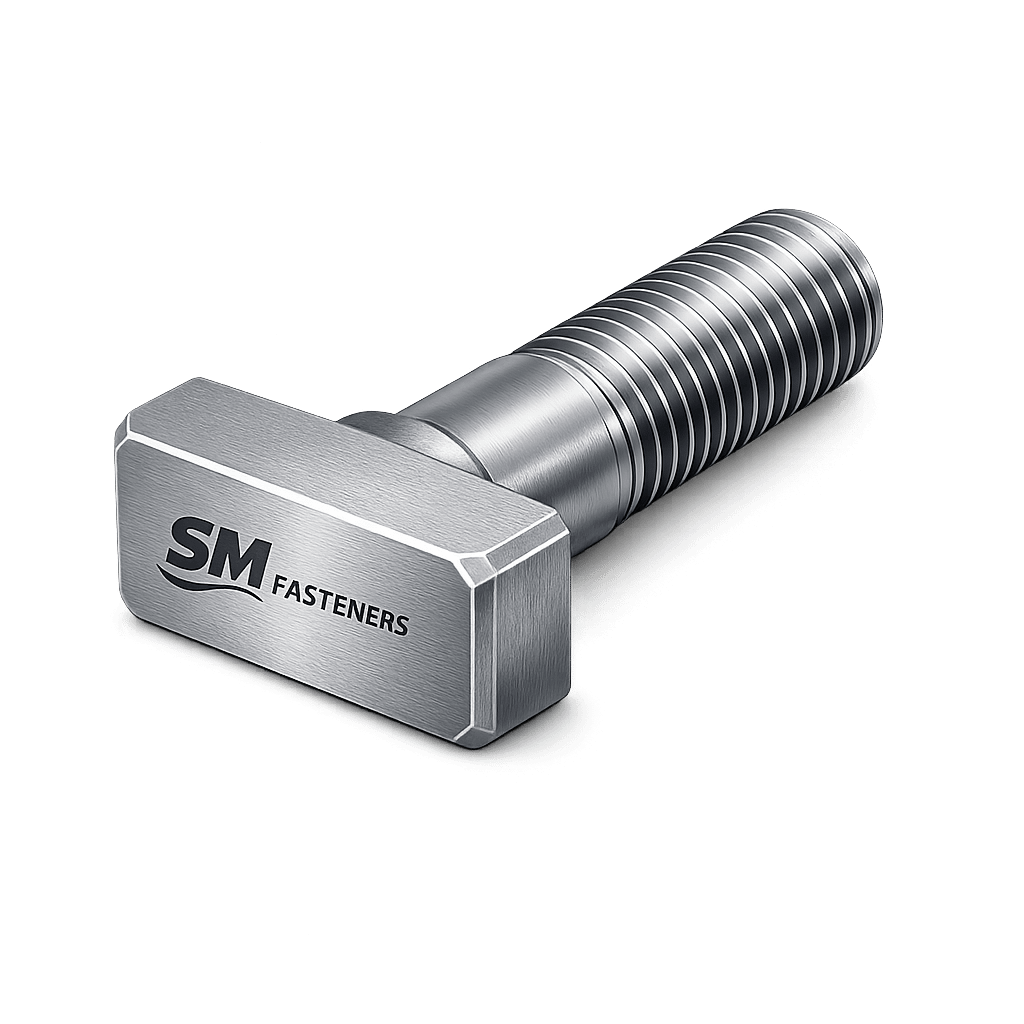
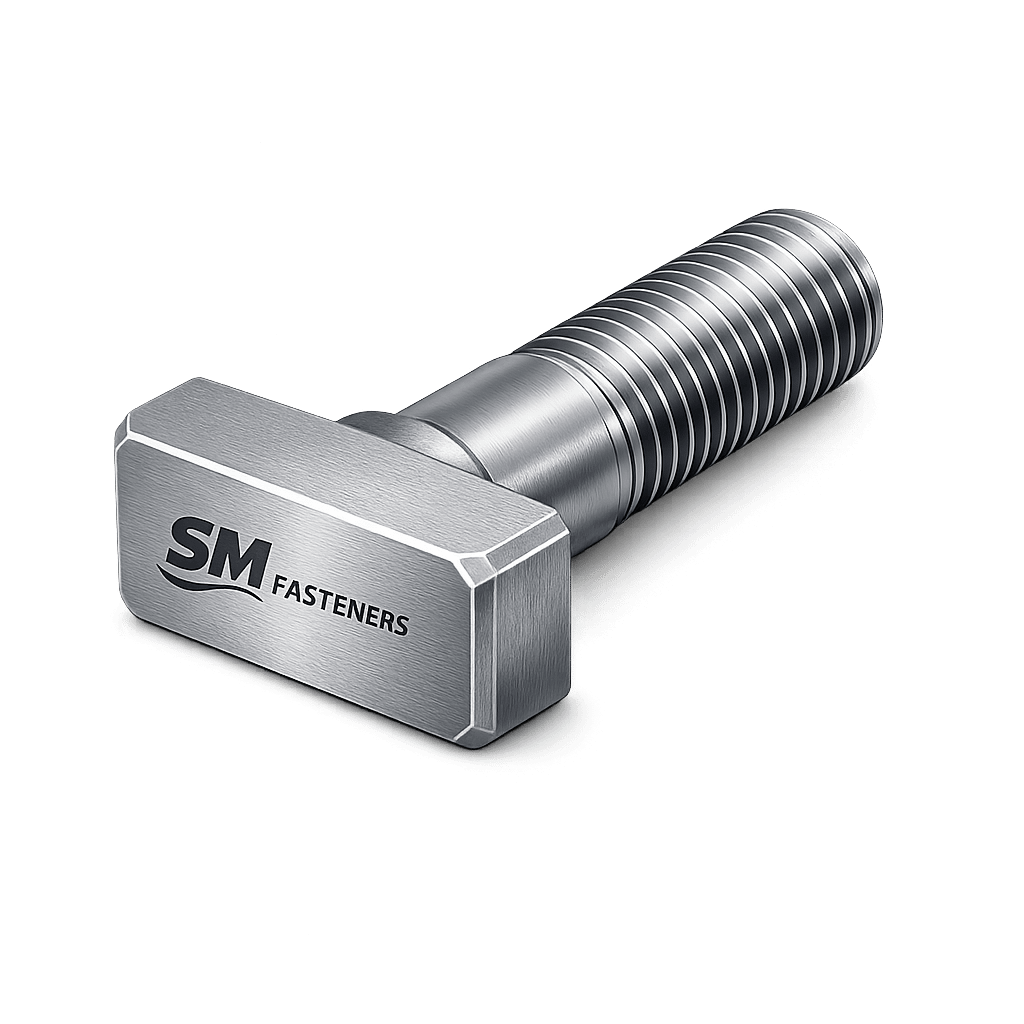
T Bolts are specialized fastening elements engineered for slot-mounted structural connections and high-load clamping assemblies. Unlike conventional hex bolts that rely on nut rotation restraint, T Bolts achieve mechanical locking through head geometry engagement inside T-slots, channels, rails, or custom profiles.
They are extensively specified across industries where:
- Positional adjustment is required during assembly
- Distributed clamping force must be achieved
- Access for conventional bolting tools is restricted
- Repeated adjustment or modular assembly exists
Major Industrial Adoption
| Industry | Functional Role |
|---|---|
| Structural Steel | Adjustable framing systems |
| Oil & Gas | Pipe supports, cable trays |
| Power Plants | Turbine platforms & equipment bases |
| Petrochemical | Instrument mounting structures |
| Railways | Track hardware & brackets |
| Offshore | Corrosion-resistant adjustable fastening |
| Automotive Manufacturing | Fixture tables & tooling |
| Heavy Equipment | Machine bed clamping |
| Shipbuilding | Deck equipment mounting |
EPC contractors and OEM designers specify T Bolts where precision alignment combined with high clamping reliability is mandatory.
SM Fasteners manufactures T Bolts aligned with international standards, offering global project compatibility and traceable quality systems under ISO 9001.
2. Technical Definition of a T Bolt
A T Bolt is a threaded fastener characterized by:
- A T-shaped head
- A partially or fully threaded shank
- Designed to slide into a T-slot channel
- Provides anti-rotation locking via head engagement
Fundamental Functional Characteristics
- Head resists rotation automatically
- Enables single-side tightening
- Allows positional adjustment prior to torque application
- Generates axial preload similar to conventional bolting
Basic Geometry
| Element | Function |
|---|---|
| T Head Width | Slot retention |
| Head Thickness | Shear resistance |
| Neck Radius | Stress transition control |
| Shank | Load transmission |
| Thread | Preload generation |
| Bearing Surface | Load distribution |
3. Functional Role in Engineering Assemblies
T Bolts convert applied torque into:
- Axial tensile force
- Clamping pressure
- Frictional resistance between joined components
Typical assemblies include:
- Machine table fixtures
- Structural channel frameworks
- Solar mounting systems
- Pipe racks
- Modular equipment skids
Unlike standard bolts, load stability depends strongly on slot geometry interaction.
4. Load Mechanics & Force Behavior
4.1 Primary Load Types
| Load Type | Description |
|---|---|
| Tensile Load | Generated during tightening |
| Shear Load | Acting parallel to slot direction |
| Combined Load | Most industrial applications |
| Fatigue Load | Cyclic vibration environments |
4.2 Load Path in T BOLT Assembly
- Torque applied to nut
- Thread converts torque → axial tension
- Head transfers load into slot wall
- Clamped members resist slip through friction
4.3 Clamping Force Principle
Where:
- F = Clamp Force (N)
- T = Applied Torque (Nm)
- K = Nut Factor (0.15–0.25 typical)
- D = Nominal Diameter (m)
Worked Example
M16 T Bolt — Property Class 8.8
- Torque = 210 Nm
- Nut Factor = 0.20
- Diameter = 0.016 m
Result: 65.6 kN preload achieved.
5. Torque–Tension Relationship
Only 10–15% of torque produces useful preload.
| Torque Consumption | Percentage |
|---|---|
| Thread Friction | 40–45% |
| Bearing Friction | 40–50% |
| Useful Clamp Load | 10–15% |
Engineering implication:
✔ Surface finish
✔ Lubrication
✔ Coating selection
directly affect joint performance.
SM Fasteners supplies coating-controlled fasteners ensuring predictable preload performance.
6. Joint Design Principles
6.1 T Slot Engagement Requirement
Proper head engagement must satisfy:
- Full seating inside slot
- No rocking movement
- Even bearing contact
Improper engagement leads to:
- Slot deformation
- Shear failure
- Preload loss
6.2 Minimum Thread Engagement
| Material | Engagement Length |
|---|---|
| Steel | 1 × Diameter |
| Stainless Steel | 1.5 × Diameter |
| Aluminum | 2 × Diameter |
| Polymer (PEEK) | 2–2.5 × Diameter |
6.3 Preload Design Rule
Recommended preload:
Ensures:
- Joint stability
- Fatigue resistance
- Elastic behavior
6.4 Friction & Slip Resistance
Slip resistance determined by:
Where μ depends on surface condition.
| Surface Condition | Coefficient μ |
|---|---|
| Dry Steel | 0.30 |
| Oiled | 0.18 |
| Zinc Plated | 0.14 |
| PTFE Coated | 0.10 |
7. Mechanical Behavior Under Service Conditions
Elastic Zone Operation
Industrial bolting must remain elastic.
Benefits:
- Maintains preload
- Absorbs vibration
- Prevents loosening
Plastic Deformation Risks
Occurs when:
- Torque exceeds specification
- Material hardness mismatch exists
- Improper heat treatment applied
ISO-controlled manufacturing at SM Fasteners ensures controlled mechanical properties.
8. Failure Mechanisms
8.1 Fatigue Failure
Common in:
- Railways
- Vibrating machinery
- Compressors
- Rotating equipment
Cause:
Repeated stress cycles exceeding endurance limit.
Prevention:
- Proper preload
- Rolled threads
- Radius-controlled transitions
8.2 Shear Failure
Critical in T Bolts because load transfers through head.
Design consideration:
- Head thickness proportional to diameter
- Slot material strength verification
8.3 Hydrogen Embrittlement
Risk factors:
- High-strength carbon steels (>1000 MPa)
- Electroplated coatings
SM Fasteners controls:
- Baking procedures
- Coating chemistry
- Hardness limits
8.4 Stress Corrosion Cracking
Occurs in:
- Chlorides
- Sour service (H₂S)
- Offshore installations
Materials selected per:
- NACE MR0175
- ISO 15156
9. Thread Engagement & Load Distribution
Threads share load unevenly.
| Thread Position | Load Share |
|---|---|
| First Thread | ~34% |
| Second Thread | ~23% |
| Third Thread | ~16% |
| Remaining Threads | Gradual reduction |
Therefore:
✔ Proper nut height
✔ Precision thread manufacturing
are mandatory.
10. Functional Advantages of T Bolts
- Rapid installation
- Adjustable positioning
- Anti-rotation locking
- Reduced installation access requirement
- Repeatable assembly accuracy
11. Engineering Selection Criteria
Load-Based Selection
- Static structural → Property Class 8.8
- Dynamic equipment → 10.9
- High fatigue → Alloy steel
- Corrosive → Stainless/Duplex
Environment-Based Selection
- Offshore → Duplex / Super Duplex
- Chemical → Hastelloy / Inconel
- Non-metallic isolation → PEEK fasteners
12. Role of T Bolts in Modern Modular Engineering
Modern EPC projects increasingly adopt:
- Modular skids
- Prefabricated racks
- Adjustable mounting systems
T Bolts enable:
✔ Faster installation
✔ Alignment correction
✔ Reduced hot work on site
13. Product Types and Engineering Variants
T Bolts are not a single universal configuration. Industrial requirements demand variations based on:
- Slot geometry
- Load condition
- Installation method
- Material compatibility
- Environmental exposure
SM Fasteners manufactures standardized and fully custom-engineered T Bolts suitable for EPC, OEM, and infrastructure projects.
13.1 Standard T Slot T Bolts
Primary Application: Machine tables, structural channels, solar mounting rails.
Characteristics:
- Rectangular T head
- Metric or UNC threads
- Sliding installation
- Anti-rotation locking
| Feature | Engineering Benefit |
|---|---|
| Wide head | High shear resistance |
| Low profile | Clearance in slots |
| Rolled threads | Fatigue resistance |
13.2 Hammer Head T Bolts
Designed for rapid assembly systems.
Operation:
- Insert vertically
- Rotate 90°
- Head locks automatically
Applications:
- Cable tray systems
- HVAC supports
- Industrial modular frames
Advantage:
✔ Installation without full slot access.
13.3 Double T Head Bolts
Used where:
- Bidirectional loading exists
- Large contact area required
Industries:
- Offshore platforms
- Heavy equipment bases
- Structural steel assemblies
13.4 Long Neck T Bolts
Features:
- Extended unthreaded shank
- Reduced bending stress
- Improved fatigue resistance
Common in vibration environments.
13.5 Heavy Duty Structural T Bolts
Engineered for:
- High preload joints
- Structural steel frameworks
- Crane rails
Typical grades:
- 8.8
- 10.9
- ASTM A325 equivalent applications
13.6 Stainless Steel & Corrosion-Resistant T Bolts
Materials include:
- SS304 / SS316
- Duplex 2205
- Super Duplex 2507
- SMO 254
- Hastelloy
- Inconel / Incoloy
- Monel
Used in:
- Offshore LNG
- Chemical processing
- Marine installations
13.7 High Temperature Alloy T Bolts
Applicable where temperature exceeds carbon steel capability.
| Material | Continuous Temp Limit |
|---|---|
| Inconel 625 | 980°C |
| Incoloy 825 | 540°C |
| A286 Alloy | 700°C |
13.8 Non-Metallic PEEK T Bolts
SM Fasteners supplies PEEK fasteners for specialized engineering environments.
Applications:
- Semiconductor plants
- Electrical insulation assemblies
- Chemical handling equipment
- MRI environments
Advantages:
- Non-conductive
- Chemical inertness
- Lightweight
- Zero galvanic corrosion
14. Dimensional Logic and Geometry Engineering
Unlike hex bolts, T Bolt performance depends heavily on head-slot compatibility.
14.1 Critical Geometric Parameters
| Parameter | Description | Engineering Impact |
|---|---|---|
| Head Width | Fits slot | Prevents rotation |
| Head Height | Load capacity | Shear strength |
| Neck Radius | Stress control | Fatigue life |
| Thread Length | Adjustment range | Assembly flexibility |
| Overall Length | Stack thickness | Joint integrity |
14.2 Standard Dimensional Specification — Metric T Bolts
(Typical Industrial Reference — SM Fasteners Manufacturing Alignment)
| Size | Pitch (mm) | Head Width (mm) | Head Height (mm) | Thread Length (mm) | Standard Length Range (mm) |
|---|---|---|---|---|---|
| M6 | 1.0 | 10 | 4 | 18 | 20–80 |
| M8 | 1.25 | 13 | 5 | 22 | 25–120 |
| M10 | 1.5 | 16 | 6 | 26 | 30–150 |
| M12 | 1.75 | 20 | 8 | 30 | 35–200 |
| M16 | 2.0 | 24 | 10 | 38 | 40–300 |
| M20 | 2.5 | 30 | 12 | 45 | 50–400 |
| M24 | 3.0 | 36 | 14 | 55 | 60–450 |
Custom slot dimensions manufactured against customer drawings.
14.3 Slot Compatibility Principle
Proper fit must ensure:
- Head clearance ≤ 0.3 mm
- Full seating surface
- No lateral rocking
Improper tolerance causes:
- Head shear
- Slot deformation
- Preload relaxation
15. Thread Forms & Engineering Logic
T Bolts are produced across global thread systems to maintain interchangeability.
Thread Standards & Tolerances
| Thread Standard | Region | Tolerance Class |
|---|---|---|
| ISO Metric (M) | Global | 6g / 6H |
| UNC | USA | 2A / 2B |
| UNF | USA | 2A / 2B |
| BSW | UK | Medium |
| BSF | UK | Fine |
| ACME (Special) | Motion systems | Custom |
SM Fasteners ensures CNC-controlled threading aligned with international inspection gauges.
Thread Production Methods
| Method | Benefit |
|---|---|
| Thread Rolling | Grain flow continuity, fatigue resistance |
| Thread Cutting | Large diameters & exotic alloys |
Rolled threads preferred for high-cycle industrial use.
16. Applicable International Standards
T Bolts are governed by multiple overlapping standards depending on application.
16.1 ISO Standards
| Standard | Scope |
|---|---|
| ISO 261 | Metric thread dimensions |
| ISO 965 | Thread tolerances |
| ISO 898-1 | Mechanical properties |
| ISO 3506 | Stainless fasteners |
| ISO 3269 | Acceptance inspection |
| ISO 4759 | Fastener tolerances |
16.2 DIN Standards
| Standard | Description |
|---|---|
| DIN 787 | T Slot Bolts |
| DIN 7992 | T Head Bolts |
| DIN 650 | T Slots for machine tables |
DIN standards dominate machinery applications globally.
16.3 ASTM Standards
| Standard | Application |
|---|---|
| ASTM A307 | General carbon steel |
| ASTM A325 | Structural bolting |
| ASTM A193 | High temperature service |
| ASTM A320 | Low temperature service |
| ASTM F568M | Metric mechanical properties |
16.4 British Standards (BS)
| Standard | Application |
|---|---|
| BS 916 | T Head Bolts |
| BS 3692 | Metric fasteners |
| BS EN ISO series | Harmonized standards |
17. Property Class Systems
Mechanical performance defined by property class or ASTM grade.
Metric Property Classes
| Property Class | Yield Strength (MPa) | UTS (MPa) |
|---|---|---|
| 4.6 | 240 | 400 |
| 8.8 | 640 | 800 |
| 10.9 | 940 | 1040 |
| 12.9 | 1100 | 1220 |
ASTM Equivalent Comparison
| ISO Class | Approx ASTM Equivalent |
|---|---|
| 8.8 | A325 |
| 10.9 | A490 |
| Stainless A4-80 | ASTM A193 B8M |
18. Interchangeability Considerations
Critical for global EPC projects.
Engineering checks required:
- Thread system compatibility
- Slot geometry match
- Proof load equivalency
- Coating thickness allowance
SM Fasteners supports international projects through:
✔ Multi-standard manufacturing
✔ Dual marking capability
✔ Cross-standard documentation
19. Dimensional Tolerances
Fastener tolerance affects preload accuracy.
| Parameter | Typical Tolerance |
|---|---|
| Diameter | ISO h9 |
| Thread Pitch | ISO Medium |
| Head Width | ±0.1–0.3 mm |
| Straightness | ≤0.2 mm/100 mm |
| Perpendicularity | ≤0.5° |
All dimensions verified under ISO 9001 inspection procedures.
20. Proof Load & Tensile Strength Table
(Typical Carbon Steel Metric T Bolts)
| Size | Stress Area (mm²) | Proof Load 8.8 (kN) | Proof Load 10.9 (kN) | Ultimate Tensile Load (kN) |
|---|---|---|---|---|
| M8 | 36.6 | 23 | 34 | 46 |
| M10 | 58 | 37 | 55 | 73 |
| M12 | 84.3 | 54 | 80 | 108 |
| M16 | 157 | 100 | 149 | 201 |
| M20 | 245 | 157 | 234 | 314 |
| M24 | 353 | 226 | 337 | 452 |
21. Engineering Geometry Selection Guidelines
| Requirement | Recommended Variant |
|---|---|
| Adjustable positioning | Standard T Bolt |
| Fast installation | Hammer head |
| Heavy structural load | Heavy duty T Bolt |
| Corrosive offshore | Duplex stainless |
| Electrical isolation | PEEK T Bolt |
| High temperature | Inconel alloy |
22. SM Fasteners Engineering Capability Integration
SM Fasteners provides:
- CNC precision head machining
- Hot forging capability
- Special slot compatibility manufacturing
- Multi-material processing
- Project-specific dimensional engineering
- Certified inspection traceability
Manufacturing aligned with:
- ISO 9001 quality systems
- MSME registered manufacturing operations
- UKAF accredited processes
23. Materials Engineering Philosophy for T Bolts
Material selection for T Bolts is a critical engineering decision directly influencing:
- Load capacity
- Fatigue performance
- Corrosion resistance
- Temperature stability
- Compliance with international project specifications
Unlike standard bolts, T Bolts experience combined tensile and transverse shear loading through the head-slot interface. Therefore, material properties must address both strength and toughness.
SM Fasteners manufactures T Bolts across a full industrial material spectrum compliant with global EPC procurement requirements.
24. Industrial Material Range
24.1 Carbon Steel T Bolts
Primary choice for structural and machinery applications.
| Grade | Standard | Typical Use |
|---|---|---|
| Low Carbon Steel | ASTM A307 | General assemblies |
| Medium Carbon | ISO 898 Class 8.8 | Structural connections |
| Alloy Carbon Steel | Class 10.9 | High-load equipment |
| High Strength Alloy | Class 12.9 | Precision machinery |
Advantages:
- High strength-to-cost ratio
- Excellent machinability
- Suitable for coating systems
Limitation:
- Requires corrosion protection.
24.2 Stainless Steel T Bolts
Selected where corrosion resistance dominates design.
| Material | Standard | Characteristics |
|---|---|---|
| SS304 (A2-70) | ISO 3506 | General corrosion resistance |
| SS316 (A4-80) | ISO 3506 | Marine & chloride resistance |
| 316L | ASTM A193 B8M | Low carbon welding environments |
| 904L | Special | Acid resistance |
Applications:
- Chemical plants
- Offshore modules
- Food processing systems
24.3 Duplex & Super Duplex Stainless Steel
High strength + superior corrosion resistance.
| Grade | Yield Strength | Key Advantage |
|---|---|---|
| Duplex 2205 | ~450 MPa | Chloride resistance |
| Super Duplex 2507 | ~550 MPa | Seawater resistance |
Used in:
- Offshore platforms
- LNG terminals
- Desalination plants
24.4 Nickel Alloy T Bolts
For extreme environments.
| Material | Service Condition |
|---|---|
| Inconel 625 | High temperature & oxidation |
| Incoloy 825 | Acid environments |
| Hastelloy C276 | Aggressive chemicals |
| Monel 400 | Marine & HF acid service |
| SMO 254 | Chloride attack resistance |
24.5 High Temperature Alloy Selection
| Material | Max Continuous Temp |
|---|---|
| Carbon Steel | 400°C |
| Stainless Steel | 600°C |
| A286 Alloy | 700°C |
| Inconel | 980°C |
24.6 PEEK T Bolts (Advanced Engineering Applications)
SM Fasteners manufactures precision PEEK fasteners for specialized industries.
Properties:
- Continuous temperature: 260°C
- Electrically insulating
- Chemical inertness
- Radiation resistance
- Lightweight
Applications:
- Semiconductor manufacturing
- Medical equipment
- Electrical isolation systems
- Cryogenic LNG instrumentation
25. Material Comparison Table
| Material | UTS (MPa) | Yield (MPa) | Corrosion Resistance | Relative Cost | Typical Application |
|---|---|---|---|---|---|
| Carbon Steel 8.8 | 800 | 640 | Low | Low | Structural |
| Alloy Steel 10.9 | 1040 | 940 | Low | Medium | Machinery |
| SS304 | 700 | 450 | Moderate | Medium | Industrial |
| SS316 | 800 | 600 | High | Medium-High | Marine |
| Duplex 2205 | 900 | 450 | Very High | High | Offshore |
| Super Duplex | 950 | 550 | Extreme | Very High | Seawater |
| Inconel 625 | 1000+ | 600 | Extreme | Premium | High Temp |
| PEEK | 100 | 90 | Excellent | Premium | Electrical |
26. Corrosion Resistance vs Environment
| Environment | Recommended Material |
|---|---|
| Indoor Industrial | Carbon Steel + Zinc |
| Outdoor Atmospheric | HDG / SS304 |
| Marine | SS316 / Duplex |
| Seawater Immersion | Super Duplex / SMO 254 |
| Acidic Chemical | Hastelloy |
| Sour Service (H₂S) | NACE compliant alloys |
| Cryogenic | Austenitic Stainless |
| Electrical Isolation | PEEK |
Materials supplied according to:
- NACE MR0175
- ISO 15156
- Project metallurgy specifications.
27. Mechanical Properties by Property Class
| Property Class | Proof Strength (MPa) | Yield Strength (MPa) | Tensile Strength (MPa) | Hardness Range |
|---|---|---|---|---|
| 4.6 | 225 | 240 | 400 | 120–180 HB |
| 8.8 | 580 | 640 | 800 | 22–32 HRC |
| 10.9 | 830 | 940 | 1040 | 32–39 HRC |
| 12.9 | 970 | 1100 | 1220 | 39–44 HRC |
28. Heat Treatment Processes
Heat treatment defines mechanical reliability.
28.1 Typical Heat Treatment Workflow
- Austenitizing
- Quenching
- Tempering
- Stress Relieving
- Hardness Verification
28.2 Mechanical Impact of Heat Treatment
| Process | Result |
|---|---|
| Quenching | Strength increase |
| Tempering | Toughness improvement |
| Normalizing | Grain refinement |
| Solution Annealing | Stainless corrosion resistance |
28.3 Hardness Control (Sour Service)
To prevent sulfide stress cracking:
- Hardness typically limited to ≤22 HRC
- Mandatory for H₂S environments
SM Fasteners performs hardness verification aligned with NACE compliance.
29. Raw Material Control & Traceability
Manufacturing begins with certified material verification.
Incoming inspection includes:
- Mill Test Certificate (MTC)
- Heat number traceability
- Chemical composition verification
- Mechanical property confirmation
All production batches remain traceable under ISO 9001 quality systems.
30. End-to-End Manufacturing Workflow
30.1 Process Flow
- Raw Material Procurement
- Chemical Verification
- Cutting / Billet Preparation
- Hot or Cold Forging
- Head Forming
- Shank Machining
- Thread Rolling / Cutting
- Heat Treatment
- Surface Finishing
- Inspection & Testing
- Marking & Traceability
- Packaging
30.2 Forging vs Machining
| Method | Advantage | Application |
|---|---|---|
| Hot Forging | Grain flow strength | High volume |
| Cold Forging | Surface accuracy | Medium sizes |
| CNC Machining | Precision/custom | Exotic alloys |
SM Fasteners utilizes hybrid manufacturing depending on material and tolerance requirement.
31. Thread Manufacturing Methods
Thread Rolling (Preferred)
Benefits:
- Compressive residual stress
- Improved fatigue life
- Smooth surface finish
- Increased tensile strength
Thread Cutting
Used when:
- Material hardness high
- Large diameter bolts
- Nickel alloys
32. Surface Engineering & Coatings
Surface treatments control corrosion and torque behavior.
Surface Finish Comparison Table
| Coating | Corrosion Resistance | Torque Stability | Temperature Limit | Application |
|---|---|---|---|---|
| Black Oxide | Low | Good | 300°C | Indoor |
| Zinc Plating | Moderate | Excellent | 120°C | General |
| Hot Dip Galvanized | High | Variable | 450°C | Structural |
| Mechanical Galvanizing | High | Consistent | 300°C | Infrastructure |
| PTFE / Xylan | Very High | Low friction | 260°C | Offshore |
| Dacromet / Geomet | Very High | Stable | 300°C | Automotive |
| Nickel Plating | Moderate | Stable | 600°C | Chemical |
| Passivation (SS) | High | Stable | High | Stainless |
| PEEK Coating | Chemical resistant | Insulating | 260°C | Special |
33. Hydrogen Embrittlement Control
High-strength coated fasteners undergo:
- Controlled plating chemistry
- Post-bake treatment (190–230°C)
- Hardness limitation control
- Process qualification
Essential for property classes ≥10.9.
34. Marking & Identification
Typical marking includes:
- Manufacturer mark: SM
- Property class
- Heat number traceability
- Material grade (where applicable)
Supports full project traceability.
35. Manufacturing Quality Integration — SM Fasteners
SM Fasteners integrates:
- ISO 9001 quality management
- UKAF accredited inspection processes
- MSME certified manufacturing operations
- CNC precision manufacturing
- Advanced alloy processing capability
- Custom engineering solutions
- PEEK fastener manufacturing capability
Production designed to support:
✔ EPC megaprojects
✔ OEM manufacturing
✔ International export supply chains
36. Inspection Philosophy for Industrial T Bolts
In EPC and heavy engineering projects, fasteners are classified as safety-critical components. T Bolts directly influence:
- Structural integrity
- Equipment stability
- Operational safety
- Long-term reliability
SM Fasteners applies inspection procedures aligned with:
- ISO 9001 Quality Management System
- ISO 3269 Fastener Acceptance Inspection
- EN 10204 Certification Requirements
- Third-party inspection readiness (TPI)
37. Dimensional Inspection & Verification
Dimensional compliance ensures interchangeability with international slot systems.
Inspection Parameters
| Parameter | Inspection Method | Equipment |
|---|---|---|
| Diameter | Micrometer | Digital micrometer |
| Thread pitch | Gauge check | GO/NO-GO gauge |
| Head width | Vernier/CMM | Coordinate Measuring Machine |
| Head thickness | Height gauge | Digital height gauge |
| Straightness | Dial indicator | V-block setup |
| Perpendicularity | Optical inspection | CMM |
Tolerance verification follows ISO 4759.
38. Mechanical Testing Requirements
Mechanical testing validates structural performance.
| Test | Standard | Purpose |
|---|---|---|
| Tensile Test | ISO 898-1 | Strength verification |
| Proof Load Test | ISO 898 | Elastic performance |
| Hardness Test | ISO 6508 | Heat treatment control |
| Impact Test | ASTM E23 | Low temperature service |
| Wedge Test | ISO 898 | Head integrity |
| Elongation Test | ASTM A370 | Ductility |
All tests traceable to material heat numbers.
39. Non-Destructive Testing (NDT)
Required for critical applications.
| NDT Method | Detects |
|---|---|
| Magnetic Particle Inspection | Surface cracks |
| Dye Penetrant Testing | Fine discontinuities |
| Ultrasonic Testing | Internal defects |
| Eddy Current Testing | Surface anomalies |
Used extensively in:
- Offshore
- LNG
- Nuclear
- Pressure systems
40. Positive Material Identification (PMI)
PMI confirms alloy chemistry.
Methods:
- XRF Analysis
- Optical Emission Spectroscopy
Mandatory for:
- Duplex
- Super Duplex
- Nickel alloys
- Sour service fasteners
41. Certification & Documentation
SM Fasteners supplies complete documentation packages.
Standard Deliverables
- EN 10204 3.1 Material Test Certificate
- Chemical composition report
- Mechanical property report
- Heat treatment charts
- Dimensional inspection report
- Coating thickness report
- Certificate of Conformity (CoC)
- Third-Party Inspection Release Note
Optional:
- EN 10204 3.2 certification
- NACE compliance declaration
42. Industry Application Mapping
Construction & Structural Steel
Uses:
- Beam supports
- Adjustable frameworks
- Solar structures
Requirement:
High preload + corrosion protection.
Oil & Gas (Upstream / Midstream / Downstream)
Applications:
- Pipe supports
- Instrument racks
- Cable trays
- Skid assemblies
Materials:
Duplex, Super Duplex, ASTM A193 grades.
Power Generation
- Turbine foundations
- Generator alignment systems
- Maintenance platforms
Requirement:
Fatigue resistance and preload stability.
Petrochemical & Chemical Processing
Needs:
- Chemical resistance
- High temperature stability
Materials:
Hastelloy, Inconel, SMO 254.
LNG & Offshore Installations
Critical factors:
- Chloride resistance
- Hydrogen sulfide exposure
- Temperature variation
Preferred materials:
Super Duplex / Nickel alloys.
Automotive & Heavy Equipment
Applications:
- Fixture tables
- Production tooling
- Conveyor structures
Requirement:
Repeatable positioning accuracy.
Railways & Infrastructure
Used for:
- Track equipment
- Signaling frames
- Maintenance platforms
Requirement:
Vibration resistance.
Shipbuilding & Marine
- Deck equipment
- Machinery mounting
- Structural supports
Materials:
SS316 / Duplex / Monel.
PEEK Fastener Applications
SM Fasteners supplies precision PEEK T Bolts for:
- Electrical insulation assemblies
- Semiconductor clean rooms
- Medical imaging systems
- Chemical processing equipment
Benefits:
✔ Zero galvanic corrosion
✔ Lightweight structures
✔ Chemical inertness
43. Tightening Torque Chart
(Typical Values — Dry Condition)
| Size | Grade 8.8 Torque (Nm) | Grade 10.9 Torque (Nm) | Lubricated Torque (Nm) |
|---|---|---|---|
| M6 | 10 | 15 | 8 |
| M8 | 25 | 36 | 20 |
| M10 | 49 | 72 | 40 |
| M12 | 85 | 125 | 70 |
| M16 | 210 | 310 | 170 |
| M20 | 410 | 610 | 330 |
| M24 | 710 | 1050 | 580 |
Actual torque must consider coating friction factor.
44. Preload Calculation Table
Formula
Where:
- T = Torque
- K = Nut factor
- D = Diameter
Worked Engineering Example
M20 — Grade 10.9
Torque = 610 Nm
K = 0.18
D = 0.02 m
Preload ≈ 169 kN
45. Mechanical Properties Table (Expanded)
| Grade | Proof Stress (MPa) | Yield (MPa) | Tensile (MPa) | Elongation |
|---|---|---|---|---|
| A2-70 | 450 | 450 | 700 | 0.4 |
| A4-80 | 600 | 600 | 800 | 0.3 |
| 8.8 | 580 | 640 | 800 | 0.12 |
| 10.9 | 830 | 940 | 1040 | 0.09 |
| 12.9 | 970 | 1100 | 1220 | 0.08 |
46. Corrosion Resistance vs Environment Table
| Environment | Recommended Finish |
|---|---|
| Indoor Dry | Black oxide |
| Outdoor Industrial | Zinc plated |
| Coastal | Hot dip galvanized |
| Marine | SS316 |
| Offshore Splash Zone | Super Duplex |
| Chemical Acid | Hastelloy |
| Sour Gas | NACE compliant alloy |
| Electrical | PEEK |
47. Surface Finish Performance Comparison
| Finish | Salt Spray Resistance | Friction Stability | Maintenance |
|---|---|---|---|
| Zinc | 72–120 hrs | Good | Medium |
| HDG | 500+ hrs | Moderate | Low |
| PTFE | 1000+ hrs | Excellent | Low |
| Dacromet | 1000 hrs | Excellent | Low |
| Passivation | High | Stable | Low |
48. Thread Standards & Tolerances Table
| Thread | Pitch Type | Tolerance |
|---|---|---|
| ISO Metric | Coarse/Fine | 6g |
| UNC | Unified | 2A |
| UNF | Fine | 2A |
| BSW | Coarse | Medium |
| BSF | Fine | Medium |
49. Weight Chart — SM Fasteners Production Alignment
(Approximate Weights — Carbon Steel)
| Size | Length (mm) | Weight / Piece (kg) | Weight / 100 pcs (kg) |
|---|---|---|---|
| M8 | 40 | 0.020 | 2.0 |
| M10 | 50 | 0.038 | 3.8 |
| M12 | 60 | 0.065 | 6.5 |
| M16 | 80 | 0.155 | 15.5 |
| M20 | 100 | 0.310 | 31.0 |
| M24 | 120 | 0.540 | 54.0 |
Weights aligned with SM Fasteners export packing calculations.
50. Failure Prevention Engineering
Major Failure Modes
| Failure | Prevention Method |
|---|---|
| Fatigue cracking | Correct preload |
| Head shear | Proper slot fit |
| Corrosion failure | Material upgrade |
| Hydrogen embrittlement | Controlled plating |
| Stress corrosion | NACE compliant alloys |
51. Packaging & Export Preparation
SM Fasteners supplies T Bolts suitable for global logistics.
Industrial Packaging
- VCI corrosion protection
- Thread caps
- Oil protection coating
- Heat-number labeling
- Moisture barrier packing
Export Crating
- ISPM-15 certified wooden crates
- Palletized loads
- Container vibration protection
- Project-wise segregation
52. Global Export Capability
SM Fasteners supports:
- EPC contractors
- OEM manufacturing
- Infrastructure megaprojects
- Oil & Gas operators
- International distributors
Capabilities include:
✔ Multi-standard manufacturing
✔ Custom drawing production
✔ Exotic alloy processing
✔ Project documentation control
✔ Batch traceability
53. Quality System Integration — SM Fasteners
The manufacturing ecosystem integrates:
- ISO 9001 certified QMS
- UKAF accredited processes
- MSME recognized manufacturing
- Digital inspection traceability
- Controlled metallurgy verification
- Advanced alloy and PEEK fastener capability
Ensuring readiness for:
- Technical audits
- Third-party inspections
- Global procurement approval
Engineering Conclusion
T Bolts represent a specialized fastening solution engineered for adjustable structural connections, slot-mounted assemblies, and precision equipment mounting.
Through controlled material selection, precision manufacturing, validated heat treatment, and rigorous inspection systems, SM Fasteners delivers T Bolts compliant with:
- ISO
- ASTM
- DIN
- BS
- NACE
- EN certification systems
Supporting industries requiring:
- High mechanical reliability
- Corrosion resistance
- Traceable quality
- Global supply assurance