

HANGER BOLT
1. Industrial Context of Hanger Bolts
Hanger bolts are specialized dual-threaded fasteners engineered to create a permanent or semi-permanent anchoring interface between wood, masonry, composite structures, or soft substrates and metallic assemblies.
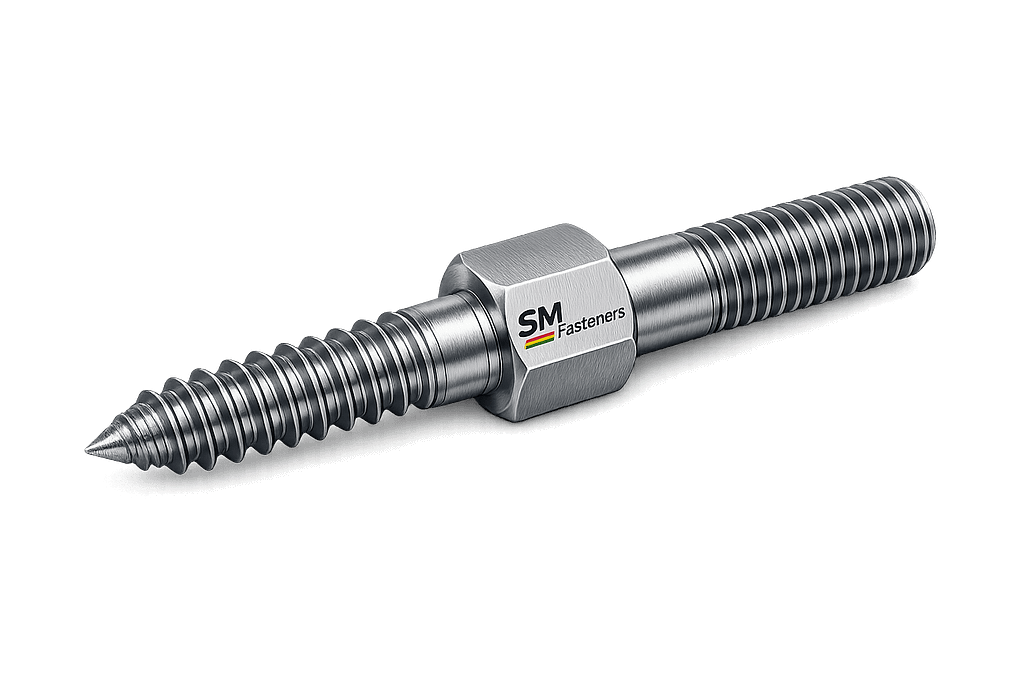
Unlike conventional bolts requiring head engagement, hanger bolts provide:
- Concealed structural anchoring
- Adjustable mounting interfaces
- High axial load transmission
- Reliable alignment of suspended equipment
They are extensively specified across EPC projects, OEM manufacturing, infrastructure construction, and mechanical installations where threaded studs must transition between dissimilar materials.
Primary Industrial Drivers
| Industry Requirement | Engineering Need Addressed |
|---|---|
| Structural suspension | Ceiling systems, cable trays |
| Equipment mounting | HVAC, piping, panels |
| Retrofit installation | No-head anchoring capability |
| Modular construction | Adjustable assembly |
| Maintenance operations | Replaceable external connections |
2. Technical Definition
A Hanger Bolt is defined as:
A headless externally threaded fastener having two different thread forms or pitches on opposite ends, typically comprising:
- Wood screw or lag thread for embedment
- Machine thread for nut or component attachment
Functional Configuration
| Section | Function |
|---|---|
| Wood Thread End | Substrate engagement |
| Center Shank | Load transmission |
| Machine Thread End | Component clamping |
| Drive Section | Installation interface |
Drive methods include:
- Hex drive
- Slot drive
- Torx/internal drive
- Double nut method
3. Functional Role in Engineering Assemblies
Hanger bolts operate as transition fasteners, converting non-metallic structural media into threaded mechanical joints.
Key Engineering Functions
✔ Suspension of mechanical loads
✔ Creation of reusable threaded interfaces
✔ Adjustable height installations
✔ Vibration-resistant mounting
✔ Structural alignment correction
Typical assemblies include:
- Pipe supports
- Solar mounting systems
- Cable management infrastructure
- Machine guards
- Structural facade systems
4. Load Mechanics & Force Behavior
4.1 Load Transfer Mechanism
Hanger bolts primarily experience:
- Axial tensile loads
- Combined shear loading
- Bending stress from eccentric loads
- Pull-out resistance governed by substrate
Load path:
External Load → Machine Thread → Shank → Embedded Thread → Base Material4.2 Forces Acting on Hanger Bolts
| Load Type | Engineering Impact |
|---|---|
| Tensile | Governs pull-out capacity |
| Shear | Controls lateral stability |
| Bending | Occurs in offset installations |
| Fatigue | Cyclic vibration environments |
| Torsion | Installation torque effects |
4.3 Pull-Out Resistance
Critical design parameter.
General empirical relationship:
Where:
- P = Pull-out load
- D = Effective diameter
- Lₑ = Embedment length
- τ = Shear strength of substrate
Design engineers must consider:
- Wood density
- Concrete compressive strength
- Installation depth
- Thread geometry
5. Torque–Tension Relationship
Hanger bolts convert applied torque into preload.
Where:
- T = Torque
- K = Nut factor (0.15–0.25 typical)
- F = Clamp force
- d = Nominal diameter
Friction Contributors
| Interface | Effect |
|---|---|
| Thread friction | 40–50% torque loss |
| Bearing friction | 35–45% |
| Useful preload | Only ~10% |
SM Fasteners recommends controlled lubrication for critical assemblies.
6. Preload and Clamping Force Principles
Proper preload ensures:
- Joint rigidity
- Fatigue resistance
- Vibration stability
- Seal integrity
Target preload typically:
Under-tightening → joint slip
Over-tightening → thread stripping or substrate failure
7. Thread Engagement Requirements
Minimum engagement rules:
| Material | Required Engagement |
|---|---|
| Steel | 1 × Diameter |
| Aluminum | 1.5 × Diameter |
| Wood | 6–10 thread pitches |
| Polymer/PEEK | 2 × Diameter |
8. Joint Design Principles
8.1 Design Objectives
Engineering joint design must ensure:
- Load distribution
- Resistance to loosening
- Controlled preload retention
- Compatibility with base material
8.2 Recommended Design Practices
✔ Avoid eccentric loading
✔ Maintain perpendicular installation
✔ Use washers on machine-thread side
✔ Prevent overdriving into wood substrate
✔ Maintain thread lubrication consistency
8.3 Nut Factor Influence
| Condition | Nut Factor (K) |
|---|---|
| Dry carbon steel | 0.22 |
| Zinc plated | 0.20 |
| Lubricated | 0.15 |
| PTFE coated | 0.12 |
9. Failure Mechanisms
Engineering failures generally arise from improper selection rather than manufacturing defects.
9.1 Fatigue Failure
Occurs under vibration or fluctuating load.
Mitigation:
- Correct preload
- Fine thread selection
- Avoid stress risers
9.2 Shear Failure
Common in suspended piping and equipment mounts.
Mitigation:
- Increase diameter
- Reduce cantilever offset
9.3 Pull-Out Failure
Most critical risk.
Influencing variables:
- Embedment depth
- Substrate density
- Thread geometry
9.4 Hydrogen Embrittlement
Risk for:
- High strength steels ≥10.9
- Electroplated coatings
SM Fasteners applies controlled baking procedures compliant with ISO practices.
9.5 Stress Corrosion Cracking
Critical environments:
- Offshore
- Chloride exposure
- Sour gas service
Recommended materials:
- Duplex
- Super Duplex
- SMO 254
- Nickel alloys
10. Application Relevance in Industrial Assemblies
| Sector | Typical Use |
|---|---|
| Construction | Suspended ceilings, anchors |
| Oil & Gas | Pipe support systems |
| Power Plants | Cable trays & instrumentation |
| Petrochemical | Equipment mounting |
| Railways | Interior panel fixing |
| Shipbuilding | Modular installations |
| Heavy Equipment | Guarding and panels |
11. Selection Criteria Summary
Engineers must evaluate:
- Applied load
- Substrate material
- Corrosion environment
- Installation accessibility
- Temperature exposure
- Maintenance requirements
12. Product Types and Variants of Hanger Bolts
Hanger bolts are engineered in multiple configurations to suit installation environments, substrate materials, and load conditions. Selection must be based on mechanical performance, installation accessibility, and global standards compatibility.
12.1 Standard Wood-to-Machine Thread Hanger Bolt
Most widely used industrial configuration
Construction:
- Wood screw thread (coarse, deep penetration)
- Machine thread (metric or unified)
Typical Applications
- HVAC suspension systems
- Solar mounting structures
- Pipe hangers
- Electrical tray installations
| Feature | Engineering Benefit |
|---|---|
| Deep wood thread | High pull-out resistance |
| Machine thread | Standard nut compatibility |
| Headless design | Concealed installation |
12.2 Double Machine Thread Hanger Bolt (Stud Type Stud Bolt)
Both ends contain machine threads.
Used where:
- One side anchors into tapped metal
- Opposite side supports equipment
Applications:
- Machinery installation
- Steel structure attachments
- Panel mounting
12.3 Lag Thread Hanger Bolt (Heavy Duty)
Characteristics:
- Larger root diameter
- Aggressive thread angle
- High torque resistance
Preferred for:
- Structural timber
- Heavy suspended equipment
- Seismic installations
12.4 Metric Hanger Bolt
Designed for global EPC compatibility.
Common metric sizes:
M6, M8, M10, M12, M16, M20
Advantages:
- ISO interchangeability
- Worldwide procurement acceptance
12.5 UNC / UNF Hanger Bolt
Used primarily in:
- North American projects
- Oil & Gas equipment
- Export assemblies
Thread systems:
- UNC — coarse thread, faster installation
- UNF — fine thread, vibration resistance
12.6 Internal Drive Hanger Bolt
Includes:
- Hex socket drive
- Torx drive
- Square drive
Benefits:
- Controlled installation torque
- Reduced thread damage
- High repeatability
12.7 Custom Engineered Hanger Bolts — SM Fasteners Capability
SM Fasteners manufactures engineered variants including:
- Extended embedment designs
- Differential thread pitch combinations
- Reduced shank stress-relief geometry
- High-temperature alloy hanger bolts
- PEEK hanger bolts for electrical isolation
13. Dimensional Logic & Geometry Engineering
Hanger bolt geometry is designed around load transfer efficiency and substrate compatibility.
13.1 Critical Dimensional Elements
| Parameter | Symbol | Engineering Function |
|---|---|---|
| Nominal Diameter | d | Load capacity |
| Thread Pitch | P | Preload control |
| Wood Thread Length | L1 | Pull-out strength |
| Machine Thread Length | L2 | Clamp engagement |
| Overall Length | L | Assembly clearance |
| Shank Diameter | ds | Stress distribution |
13.2 Standard Dimensional Specification Table
(Typical SM Fasteners Manufacturing Range)
| Size | Metric Pitch | Machine Thread Length (mm) | Wood Thread Length (mm) | Standard Length Range (mm) |
|---|---|---|---|---|
| M6 | 1.0 | 20 | 25 | 40–100 |
| M8 | 1.25 | 25 | 30 | 50–150 |
| M10 | 1.5 | 30 | 35 | 60–200 |
| M12 | 1.75 | 35 | 45 | 80–250 |
| M16 | 2.0 | 40 | 60 | 100–300 |
| M20 | 2.5 | 50 | 70 | 120–350 |
Custom dimensions available under ISO 9001 controlled manufacturing procedures.
13.3 Recommended Embedment Depth
| Diameter | Minimum Embedment |
|---|---|
| M6 | 30 mm |
| M8 | 40 mm |
| M10 | 50 mm |
| M12 | 65 mm |
| M16 | 85 mm |
| M20 | 110 mm |
14. Thread Geometry Engineering
14.1 Wood Screw Thread Characteristics
- Large pitch
- Deep flank angle
- High withdrawal resistance
- Optimized fiber compression
Typical flank angle: 30°–45°
14.2 Machine Thread Characteristics
| Thread Type | Flank Angle |
|---|---|
| Metric ISO | 60° |
| UNC | 60° |
| UNF | 60° |
| BSW | 55° |
| BSF | 55° |
15. Applicable International Standards
Hanger bolts generally follow combinations of standards since dual-thread geometry exists.
15.1 ISO Standards
| Standard | Scope |
|---|---|
| ISO 261 | Metric thread series |
| ISO 965 | Thread tolerances |
| ISO 898-1 | Mechanical properties carbon steel |
| ISO 3506 | Stainless steel fasteners |
| ISO 4759 | Dimensional tolerances |
| ISO 3269 | Acceptance inspection |
15.2 DIN Standards
| DIN Standard | Application |
|---|---|
| DIN 975 / 976 | Stud dimensions reference |
| DIN 571 | Wood screw reference |
| DIN 267 | Fastener property classes |
| DIN 13 | Metric thread system |
15.3 ASTM Standards
| ASTM | Description |
|---|---|
| ASTM A193 | Alloy steel bolting |
| ASTM A320 | Low temperature service |
| ASTM F593 | Stainless fasteners |
| ASTM A307 | Carbon steel bolts |
| ASTM B633 | Zinc coating |
15.4 British Standards (BS)
| BS Standard | Scope |
|---|---|
| BS 3643 | Unified threads |
| BS 84 | BSW threads |
| BS EN ISO 898 | Mechanical properties |
16. Thread Standards & Tolerance Table
| Thread System | Typical Class | Fit Type |
|---|---|---|
| Metric | 6g | General engineering |
| Metric Precision | 4h | High accuracy |
| UNC | 2A | Standard fit |
| UNF | 3A | Precision |
| BSW | Medium fit | Structural |
| BSF | Close fit | Machinery |
SM Fasteners verifies thread accuracy using calibrated gauges under ISO 9001 systems.
17. Interchangeability Considerations
Engineering risks arise when mixing thread systems.
Never Interchange:
- Metric with UNC
- BSW with Metric
- UNF with coarse metric
Consequences:
- Reduced preload
- Thread stripping
- Fatigue failure
18. Mechanical Properties — Property Class Systems
Carbon Steel Mechanical Properties
| Property Class | Yield Strength (MPa) | Tensile Strength (MPa) | Hardness |
|---|---|---|---|
| 4.6 | 240 | 400 | 120–180 HB |
| 5.8 | 400 | 500 | 150–220 HB |
| 8.8 | 640 | 800 | 22–32 HRC |
| 10.9 | 940 | 1040 | 32–39 HRC |
| 12.9 | 1100 | 1220 | 39–44 HRC |
Stainless Steel Classes (ISO 3506)
| Grade | Tensile Strength | Corrosion Resistance |
|---|---|---|
| A2-70 | 700 MPa | General industrial |
| A4-70 | 700 MPa | Marine/chemical |
| A4-80 | 800 MPa | Offshore |
19. Proof Load & Tensile Strength Table (Typical)
| Size | Property Class 8.8 Proof Load (kN) | Tensile Capacity (kN) |
|---|---|---|
| M6 | 8.0 | 10 |
| M8 | 15 | 20 |
| M10 | 24 | 32 |
| M12 | 35 | 45 |
| M16 | 70 | 90 |
| M20 | 110 | 140 |
Values aligned with ISO 898-1 calculations.
20. Engineering Geometry Impact on Performance
Fine vs Coarse Thread
| Feature | Fine Thread | Coarse Thread |
|---|---|---|
| Vibration resistance | High | Moderate |
| Installation speed | Slower | Faster |
| Pull-out resistance | Higher | Moderate |
| Damage tolerance | Lower | Higher |
21. Structural Design Considerations
Engineers must validate:
- Minimum edge distance
- Substrate strength
- Combined shear/tension interaction
- Thermal expansion mismatch
22. Weight Chart — SM Fasteners Reference Data
| Size | Length (mm) | Weight/Pc (kg) | Weight/100 Pcs (kg) |
|---|---|---|---|
| M6 × 60 | 0.012 | 1.2 | |
| M8 × 80 | 0.025 | 2.5 | |
| M10 × 100 | 0.048 | 4.8 | |
| M12 × 120 | 0.085 | 8.5 | |
| M16 × 150 | 0.180 | 18 | |
| M20 × 200 | 0.360 | 36 |
Weights maintained within controlled manufacturing tolerance.
23. Engineering Selection Logic Summary
Selection workflow:
- Determine applied load
- Select diameter by proof load
- Verify substrate compatibility
- Choose thread standard
- Confirm corrosion environment
- Validate installation torque
24. Material Engineering Philosophy for Hanger Bolts
Material selection governs:
- Load-bearing capacity
- Corrosion resistance
- Fatigue life
- Temperature performance
- Compliance with international industrial specifications
Because hanger bolts interface with dissimilar materials (wood, concrete, metals, polymers), correct metallurgy is critical to prevent:
- galvanic corrosion
- thread seizure
- stress corrosion cracking
- hydrogen embrittlement
SM Fasteners manufactures hanger bolts using controlled metallurgical sourcing, traceable raw material verification, and ISO 9001 certified production systems.
25. Industrial Material Grades Available
25.1 Carbon Steel Grades
Used where structural strength and cost efficiency are primary requirements.
| Material Grade | Standard | Typical Property Class | Application |
|---|---|---|---|
| Low Carbon Steel | ASTM A307 | 4.6 / 5.8 | General construction |
| Medium Carbon Steel | ISO 898 | 8.8 | Structural suspension |
| Alloy Carbon Steel | ISO 898 | 10.9 | Heavy equipment mounting |
| High Strength Alloy | ISO 898 | 12.9 | High load assemblies |
Advantages:
- High tensile strength
- Economical large-volume production
- Wide coating compatibility
Limitations:
- Requires corrosion protection
25.2 Stainless Steel Grades
Critical for corrosion-prone industrial environments.
| Stainless Grade | Standard | Features | Typical Use |
|---|---|---|---|
| SS 304 / A2 | ASTM F593 | General corrosion resistance | Buildings, HVAC |
| SS 316 / A4 | ASTM F593 | Chloride resistance | Offshore, marine |
| SS 316L | ASTM A193 | Low carbon, weld-safe | Chemical plants |
| SS 410 | ASTM A193 | Hardenable | Mechanical fastening |
25.3 Duplex & Super Duplex Stainless Steel
Engineered for aggressive environments.
| Grade | Standard | PREN Value | Application |
|---|---|---|---|
| Duplex 2205 | ASTM A182 | ~35 | Offshore structures |
| Super Duplex 2507 | ASTM A182 | >40 | Seawater & subsea |
Benefits:
- High strength
- Excellent SCC resistance
- Reduced maintenance lifecycle cost
25.4 Nickel Alloy & High-Performance Materials
SM Fasteners supplies advanced materials for extreme environments.
| Material | Key Property | Industry |
|---|---|---|
| Inconel 625 | High temperature resistance | Power & LNG |
| Inconel 718 | High strength at temperature | Turbines |
| Monel 400 | Seawater resistance | Marine |
| Hastelloy C276 | Acid resistance | Chemical processing |
| Incoloy 825 | H₂S & sour service | Oil & Gas |
| SMO 254 | Extreme chloride resistance | Desalination |
25.5 PEEK Hanger Bolts (Advanced Polymer Fasteners)
SM Fasteners manufactures PEEK hanger bolts for specialized applications.
Properties:
- Electrically insulating
- Lightweight
- Non-magnetic
- Chemical resistant
- Temperature capability up to ~260°C
Applications:
- Semiconductor equipment
- Electrical panels
- MRI environments
- Corrosion-sensitive instrumentation
26. Material Comparison Table
| Material | UTS (MPa) | Yield (MPa) | Corrosion Resistance | Cost Index | Typical Industry |
|---|---|---|---|---|---|
| Carbon Steel 8.8 | 800 | 640 | Low | 1 | Construction |
| Carbon Steel 10.9 | 1040 | 940 | Low | 1.3 | Heavy equipment |
| SS 304 | 700 | 450 | Good | 2.5 | General industrial |
| SS 316 | 700 | 450 | Very Good | 3 | Marine |
| Duplex 2205 | 900 | 620 | Excellent | 4 | Offshore |
| Super Duplex | 1000 | 800 | Extreme | 5 | Subsea |
| Inconel 625 | 830 | 460 | Extreme | 8 | LNG |
| PEEK | 100 | 90 | Chemical resistant | 7 | Electrical |
27. Corrosion Resistance vs Environment
| Environment | Recommended Material |
|---|---|
| Indoor dry | Carbon steel zinc plated |
| Outdoor atmospheric | HDG / SS304 |
| Marine | SS316 / Duplex |
| Seawater immersion | Super Duplex / Monel |
| Acid exposure | Hastelloy |
| Sour service (H₂S) | NACE compliant alloys |
| Chemical plants | Incoloy / SMO 254 |
| Electrical isolation | PEEK |
SM Fasteners supports NACE MR0175 / ISO 15156 material compliance upon project request.
28. Temperature Capability Comparison
| Material | Temperature Limit |
|---|---|
| Carbon Steel | −20°C to 300°C |
| Stainless Steel | −200°C to 600°C |
| Duplex | −50°C to 315°C |
| Inconel | Up to 980°C |
| PEEK | Up to 260°C |
29. Heat Treatment Processes
Heat treatment determines final mechanical properties.
29.1 Annealing
Purpose:
- Stress relief
- Improved machinability
Applied to:
- Stainless steels
- Nickel alloys
29.2 Quenching & Tempering
Used for high strength hanger bolts.
Process:
- Austenitizing
- Oil or polymer quench
- Tempering
Result:
- Property Class 8.8 / 10.9 / 12.9 strength
29.3 Solution Annealing (Stainless Steel)
Restores corrosion resistance by dissolving carbides.
Critical for:
- SS316
- Duplex grades
29.4 Precipitation Hardening
Applied to:
- Inconel 718
- High-performance alloys
Enhances:
- High temperature strength
- Creep resistance
29.5 Hydrogen Embrittlement Control
SM Fasteners performs:
- Controlled electroplating
- Post-bake de-embrittlement (typically 190–220°C)
- Hardness verification
Mandatory for high-strength bolts ≥10.9.
30. Hardness Limits (Including Sour Service)
| Material | Max Hardness |
|---|---|
| Carbon Steel (General) | 44 HRC |
| NACE Sour Service | ≤22 HRC |
| Duplex | 28–32 HRC |
| Stainless A4 | ~95 HRB |
31. End-to-End Manufacturing Workflow — SM Fasteners
Manufacturing follows a controlled process flow ensuring traceability.
31.1 Raw Material Procurement
- Approved steel mills only
- EN 10204 3.1 Material Test Certificates
- Heat number traceability
- Chemical composition verification
31.2 Incoming Inspection
Checks include:
✔ PMI verification
✔ Diameter inspection
✔ Ultrasonic defect detection
✔ Surface defect inspection
31.3 Forging vs Machining
| Method | Application |
|---|---|
| Cold forging | High volume production |
| Hot forging | Large diameter hanger bolts |
| CNC machining | Custom geometries |
| Precision turning | Alloy materials |
Forging improves grain flow and fatigue resistance.
31.4 Thread Manufacturing
Thread Rolling (Preferred)
Advantages:
- Increased fatigue strength
- Compressive surface stress
- Superior dimensional accuracy
Thread Cutting
Used when:
- Hard alloys
- Custom pitches
- Small batch production
31.5 Secondary Operations
- Center grinding
- Straightening
- Deburring
- Cleaning
31.6 Heat Treatment Control
- Furnace calibration
- Controlled atmosphere
- Batch traceability
- Hardness mapping
32. Surface Finishing & Coatings
Surface engineering protects hanger bolts against environmental degradation.
32.1 Coating Types
| Coating | Thickness | Corrosion Resistance |
|---|---|---|
| Zinc Plating | 5–12 µm | Moderate |
| Zinc Nickel | 8–15 µm | High |
| Hot Dip Galvanizing | 50–80 µm | Excellent |
| Mechanical Galvanizing | 40 µm | Good |
| Black Oxide | Minimal | Indoor use |
| PTFE/Xylan | Thin film | Anti-seize |
| Dacromet/Geomet | Flake coating | Offshore |
| Passivation | Chemical | Stainless protection |
32.2 Surface Finish Comparison Table
| Finish | Salt Spray Resistance | Friction Stability | Hydrogen Risk | Typical Industry |
|---|---|---|---|---|
| Zinc Plated | 72–120 hrs | Moderate | Medium | Construction |
| HDG | 500+ hrs | Variable | Low | Infrastructure |
| Zinc Nickel | 700+ hrs | Stable | Low | Automotive |
| PTFE | Excellent | Excellent | None | Chemical |
| Stainless Passivated | Excellent | Stable | None | Marine |
| Dacromet | 1000+ hrs | Stable | None | Offshore |
33. Galvanic Compatibility Considerations
Avoid combinations such as:
- Carbon steel hanger bolt + stainless structure
- Stainless bolt + aluminum without isolation
Solutions:
- Isolation washers
- Compatible alloys
- Protective coatings
34. Lubrication and Anti-Seize Treatments
Critical for accurate preload.
Common lubricants:
- Molybdenum disulfide
- PTFE coatings
- Nickel anti-seize (high temperature)
35. Manufacturing Traceability — SM Fasteners System
Each hanger bolt batch includes:
- Heat number marking
- Process routing records
- Inspection traceability
- Material origin documentation
Integrated within ISO 9001 certified quality management.
36. Engineering Summary — Material & Process Selection
Correct hanger bolt performance depends on:
✔ Material compatibility
✔ Controlled heat treatment
✔ Precision thread manufacturing
✔ Environment-appropriate coating
✔ Certified quality control
SM Fasteners integrates metallurgy, manufacturing precision, and inspection assurance to meet EPC and global industrial procurement requirements.
37. Inspection & Quality Control Philosophy
Hanger bolts used in industrial projects are safety-critical components. Failure can result in:
- suspended equipment collapse
- pipeline misalignment
- structural vibration damage
- production shutdowns
Therefore, SM Fasteners applies multi-stage inspection aligned with ISO 9001 Quality Management Systems, ensuring full traceability from raw material to global shipment.
38. Incoming Material Inspection
Every production batch begins with controlled verification.
Verification Activities
✔ Material Test Certificate validation (EN 10204 3.1)
✔ Heat number traceability
✔ Chemical composition verification
✔ Positive Material Identification (PMI)
✔ Surface defect inspection
✔ Dimensional bar stock inspection
Typical Chemical Verification Methods
| Method | Purpose |
|---|---|
| Optical Emission Spectroscopy | Alloy verification |
| XRF / PMI Testing | Grade confirmation |
| Microstructure Examination | Heat treatment readiness |
39. In-Process Manufacturing Inspection
SM Fasteners integrates inspection checkpoints throughout production.
| Stage | Inspection |
|---|---|
| Forging | Grain flow & dimensional check |
| Thread Rolling | Pitch diameter control |
| Heat Treatment | Hardness testing |
| Coating | Thickness measurement |
| Final Machining | Straightness & concentricity |
Thread inspection tools:
- GO / NO-GO gauges
- Optical profile systems
- Coordinate measuring machines (CMM)
40. Mechanical Testing Requirements
Mechanical Properties Verification
| Test | Standard | Objective |
|---|---|---|
| Tensile Test | ISO 898-1 | Strength confirmation |
| Proof Load Test | ISO 898 | Elastic limit |
| Hardness Test | ISO 6508 | Heat treatment verification |
| Impact Test | ASTM A370 | Low temperature performance |
| Wedge Tensile Test | ISO methods | Thread integrity |
41. Non-Destructive Testing (NDT)
Applied for critical projects such as Oil & Gas and Power.
| NDT Method | Detects |
|---|---|
| Magnetic Particle Testing | Surface cracks |
| Ultrasonic Testing | Internal defects |
| Dye Penetrant Testing | Micro surface flaws |
| Eddy Current | Surface discontinuities |
42. Dimensional Inspection Control
Measured characteristics:
- Major diameter
- Pitch diameter
- Thread lead
- Straightness
- Total length
- Thread engagement length
Tolerance compliance based on:
- ISO 965
- ISO 4759
- DIN thread tolerances
43. PMI Testing & Alloy Verification
Mandatory for:
- Duplex
- Super Duplex
- Nickel alloys
- SMO 254
- Critical EPC projects
PMI ensures material supplied matches engineering specifications.
44. Certification & Documentation
SM Fasteners supplies full project documentation packages.
Standard Documentation
- EN 10204 3.1 Material Test Certificate
- Heat Treatment Report
- Dimensional Inspection Report
- Coating Thickness Report
- Mechanical Test Report
- Certificate of Conformance (CoC)
Optional (Project-Specific)
- EN 10204 3.2 Third-Party Certification
- NACE MR0175 compliance statement
- PMI report
- ITP (Inspection Test Plan)
45. ISO 9001 System Integration
Quality control is embedded through:
- Controlled procedures
- Calibrated inspection equipment
- Documented work instructions
- Batch traceability
- Corrective action system
SM Fasteners operates under ISO 9001, MSME, and UKAF certification frameworks, supporting global audit acceptance.
46. Industrial Applications of Hanger Bolts
46.1 Construction & Structural Steel
Applications:
- Suspended ceilings
- Facade anchoring
- Timber-to-steel connections
- Solar mounting infrastructure
Engineering Need:
- High pull-out resistance
- Fast installation
46.2 Oil & Gas Industry
Used across:
Upstream
- Pipe supports
- Instrument mounting
Midstream
- Pump skid installations
Downstream
- Refinery cable trays
- Structural attachments
Preferred Materials:
- SS316
- Duplex
- Incoloy
- NACE compliant alloys
46.3 Power Generation
Applications:
- Cable management systems
- Turbine auxiliary supports
- Control panels
- Heat exchanger assemblies
Critical Requirement:
- Long-term vibration resistance
46.4 Petrochemical & Chemical Processing
Engineering Challenges:
- Acid exposure
- High temperature
- Chloride environments
Recommended Materials:
- Hastelloy
- SMO 254
- PTFE coated hanger bolts
46.5 LNG & Offshore Platforms
Key requirements:
- Salt spray resistance
- Stress corrosion resistance
- Extreme reliability
Common selections:
- Super Duplex 2507
- Inconel alloys
46.6 Railways & Infrastructure
Typical uses:
- Interior panels
- Signal mounting
- Platform structures
Benefits:
- Concealed installation
- Reduced vibration loosening
46.7 Shipbuilding
Applications:
- Equipment mounting
- HVAC systems
- Marine interiors
Preferred materials:
- SS316
- Monel
46.8 Automotive & Heavy Equipment
Used for:
- Guard mounting
- Hydraulic assemblies
- Body fixtures
High-strength property classes 8.8–10.9 typically specified.
46.9 PEEK Fastener Applications
SM Fasteners provides PEEK hanger bolts where metals are unsuitable.
Used in:
- Semiconductor fabrication
- Electrical insulation systems
- Medical equipment
- Corrosion-free instrumentation
47. Failure Prevention Strategy
| Failure Mode | Prevention |
|---|---|
| Fatigue | Proper preload |
| Pull-out | Adequate embedment |
| Corrosion | Correct material/coating |
| Galling | Lubrication |
| Hydrogen embrittlement | Controlled plating |
48. ENGINEERING TABLES (MANDATORY DATA SET)
48.1 Mechanical Properties Table (Grade-Wise)
| Grade | Yield (MPa) | Tensile (MPa) | Elongation |
|---|---|---|---|
| 4.6 | 240 | 400 | 22% |
| 5.8 | 400 | 500 | 14% |
| 8.8 | 640 | 800 | 12% |
| 10.9 | 940 | 1040 | 9% |
| 12.9 | 1100 | 1220 | 8% |
| A2-70 | 450 | 700 | 40% |
| A4-80 | 600 | 800 | 35% |
48.2 Tightening Torque Chart (Lubricated Condition)
| Size | 8.8 Torque (Nm) | 10.9 Torque (Nm) |
|---|---|---|
| M6 | 10 | 14 |
| M8 | 25 | 36 |
| M10 | 49 | 70 |
| M12 | 85 | 120 |
| M16 | 210 | 300 |
| M20 | 410 | 580 |
Values assume nut factor ≈0.15.
48.3 Preload Calculation — Worked Example
Formula:
Where:
T = Torque
K = Nut factor
d = Diameter
Example — M12 Hanger Bolt
Torque = 85 Nm
K = 0.15
d = 0.012 m
Result: 47.2 kN preload
48.4 Thread Standards & Tolerance Table
| Standard | Series | Typical Fit |
|---|---|---|
| ISO Metric | Coarse/Fine | 6g |
| UNC | Coarse | 2A |
| UNF | Fine | 3A |
| BSW | Whitworth | Medium |
| BSF | Fine Whitworth | Close |
48.5 Corrosion Resistance vs Environment Table
| Environment | Recommended Material |
|---|---|
| Indoor | Zinc plated steel |
| Outdoor | HDG / SS304 |
| Marine atmosphere | SS316 |
| Seawater immersion | Super Duplex |
| Acidic | Hastelloy |
| H₂S | NACE compliant alloys |
| Chemical | SMO 254 |
| Electrical isolation | PEEK |
48.6 Surface Finish Performance Comparison
| Finish | Corrosion Resistance | Friction Control | Maintenance |
|---|---|---|---|
| Zinc Plating | Medium | Moderate | Periodic |
| HDG | High | Variable | Low |
| Zinc Nickel | Very High | Stable | Low |
| PTFE | Excellent | Excellent | Minimal |
| Passivated SS | Excellent | Stable | Minimal |
| Dacromet | Offshore Grade | Stable | Minimal |
48.7 Weight Reference Chart — SM Fasteners Production Data
| Size | Length | Weight/Pc (kg) | Weight/100 pcs (kg) |
|---|---|---|---|
| M6 × 60 | 0.012 | 1.2 | |
| M8 × 80 | 0.025 | 2.5 | |
| M10 × 100 | 0.048 | 4.8 | |
| M12 × 120 | 0.085 | 8.5 | |
| M16 × 150 | 0.180 | 18 | |
| M20 × 200 | 0.360 | 36 |
Weights maintained under controlled manufacturing tolerances.
49. Export Capability & Global Supply Readiness
SM Fasteners supports EPC and OEM procurement worldwide.
Industrial Packaging
- VCI corrosion protection
- Thread protection caps
- Batch identification labels
- Moisture barrier packaging
Export Crating
- ISPM-15 compliant wooden crates
- Sea freight packaging
- Air cargo compatible cartons
- Palletized industrial handling
Shipping Documentation
Provided with every export shipment:
- Commercial Invoice
- Packing List
- Certificate of Origin
- MTC EN 10204 3.1 / 3.2
- Inspection Reports
- Heat Treatment Reports
- CoC
50. Engineering & Custom Manufacturing Capability — SM Fasteners
SM Fasteners supports project-specific engineering including:
- Custom hanger bolt geometries
- Special thread combinations
- High-temperature alloy fasteners
- Offshore-grade coatings
- PEEK engineered fasteners
- Prototype-to-volume manufacturing
All manufacturing aligned with:
✔ ISO 9001 Quality Systems
✔ International Standards Compliance
✔ Full Traceability
✔ Global EPC Procurement Requirements
FINAL ENGINEERING SUMMARY
Hanger bolts serve as critical transition fasteners enabling reliable load transfer between non-metallic substrates and mechanical assemblies. Their performance depends on:
- Correct geometry selection
- Verified material metallurgy
- Controlled heat treatment
- Precision thread manufacturing
- Environment-appropriate surface engineering
- Comprehensive inspection and documentation
Through certified manufacturing systems, advanced materials capability, and export-ready quality assurance, SM Fasteners demonstrates full readiness to supply precision-engineered hanger bolts for global construction, energy, infrastructure, petrochemical, marine, and heavy engineering projects.