

TOGGLE BOLT
1. Industry Context
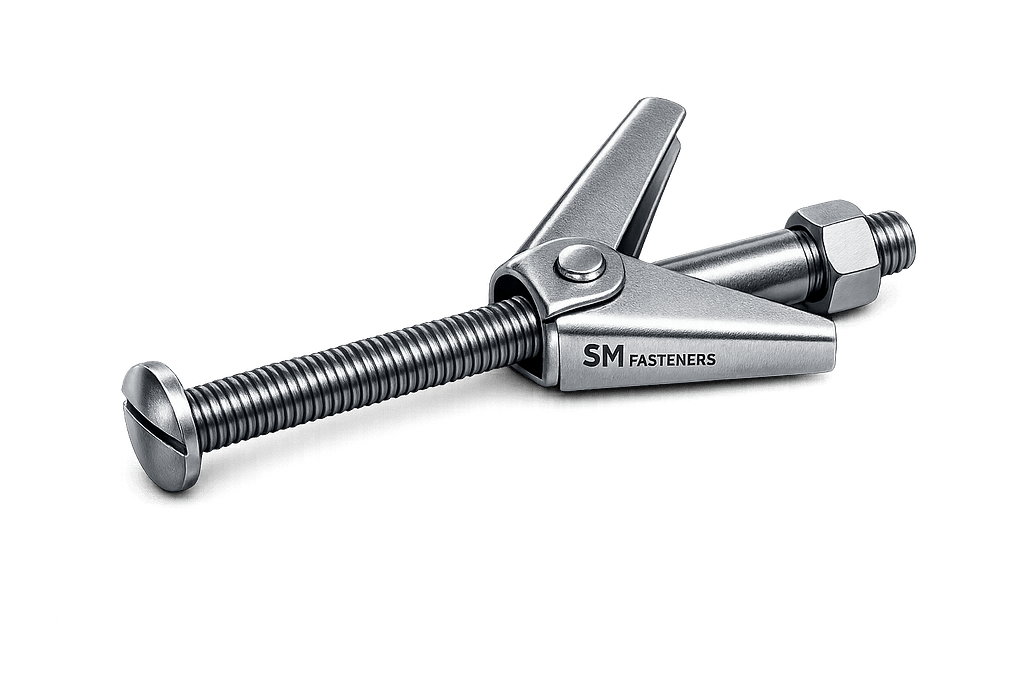
Toggle bolts are specialized mechanical anchoring fasteners designed for secure attachment in hollow or low-density base materials where conventional threaded anchorage cannot develop adequate load-bearing engagement.
Unlike expansion anchors or chemical anchors that rely on compressive expansion forces, toggle bolts develop strength through:
- Mechanical bearing action
- Load distribution over a large backside surface
- Lever-arm load transfer
- Controlled clamping force
They are extensively specified in:
| Industry | Functional Requirement |
|---|---|
| Structural Steel & Construction | Suspended loads in hollow walls |
| Oil & Gas Facilities | Cable trays, instrumentation supports |
| Power Plants | HVAC and suspended services |
| Petrochemical Plants | Lightweight structural mounting |
| Rail & Infrastructure | Panel systems & enclosures |
| Shipbuilding | Bulkhead equipment mounting |
| OEM Manufacturing | Modular assembly attachment |
Within EPC environments, toggle bolts serve as secondary structural fastening solutions where backside access is unavailable after installation.
SM Fasteners manufactures toggle bolt assemblies engineered for consistent deployment reliability, dimensional accuracy, and international interchangeability.
2. Technical Definition
A Toggle Bolt is a mechanical hollow-wall anchor system consisting of:
- Machine threaded bolt
- Spring-loaded folding toggle wings
- Bearing plate mechanism
- Clamping interface
Functional Principle
After insertion through a drilled hole:
- Wings collapse for entry
- Springs deploy wings behind substrate
- Tightening creates clamp load
- Load transfers through wing bearing surface
Engineering Classification
| Category | Classification |
|---|---|
| Fastener Type | Mechanical Hollow Anchor |
| Load Type | Tensile + Shear |
| Installation Method | Blind Installation |
| Reusability | Limited |
| Joint Type | Clamp Load Joint |
| Thread Type | Machine Thread |
3. Load Mechanics & Force Behaviour
3.1 Load Transfer Mechanism
Toggle bolts resist loads via:
- Bearing Stress on backside material
- Tension in Bolt Shank
- Frictional Clamping Force
- Moment Resistance via Wing Span
Primary Force Flow
Applied Load → Bolt Tension → Wing Bearing → Substrate Distribution3.2 Mechanical Load Components
| Load Component | Behavior |
|---|---|
| Tensile Load | Resisted by wing bearing |
| Shear Load | Resisted by bolt shank |
| Dynamic Load | Limited unless preloaded |
| Impact Load | Dependent on substrate strength |
| Fatigue Load | Controlled by preload quality |
3.3 Preload & Clamping Force Principles
Proper preload is essential for:
- Joint rigidity
- Fatigue resistance
- Vibration stability
- Load sharing
Preload Equation
Where:
| Symbol | Description |
|---|---|
| F | Preload Force |
| T | Applied Torque |
| K | Nut Factor |
| D | Nominal Diameter |
Worked Example
M10 Toggle Bolt:
- Torque = 45 Nm
- Nut Factor = 0.18
- Diameter = 10 mm
Result: Approx. 25 kN clamp load
3.4 Torque–Tension Relationship
Major influencing factors:
| Variable | Influence |
|---|---|
| Thread friction | 40% torque loss |
| Bearing friction | 50% torque loss |
| Useful preload | ~10% |
Nut Factor (K)
| Condition | K Value |
|---|---|
| Dry steel | 0.22 |
| Zinc plated | 0.20 |
| Lubricated | 0.16–0.18 |
| PTFE coated | 0.12–0.15 |
4. Joint Design Principles
Toggle bolts are used where:
- Rear surface engagement is required
- Base material lacks compressive strength
- Access is single-sided
4.1 Minimum Design Parameters
| Parameter | Requirement |
|---|---|
| Hole Diameter | Wing clearance + tolerance |
| Wall Thickness | ≥ 10 mm recommended |
| Edge Distance | ≥ 2.5 × hole diameter |
| Spacing | ≥ 4 × diameter |
4.2 Thread Engagement Requirements
Minimum engagement:
For critical industrial assemblies:
4.3 Failure Modes
Tensile Pull-Out
Occurs when substrate fails before bolt strength.
Wing Deformation
Improper material hardness or overload.
Shear Failure
Bolt shank exceeds yield strength.
Fatigue Failure
Insufficient preload under cyclic loading.
Hydrogen Embrittlement
Risk in high-strength plated carbon steels.
Stress Corrosion Cracking
Observed in chloride or H₂S environments.
4.4 Engineering Safety Considerations
| Design Aspect | Recommendation |
|---|---|
| Safety Factor | ≥ 3 for structural use |
| Dynamic Load | Avoid unless engineered |
| High Temperature | Use alloy materials |
| Corrosive Media | Stainless or nickel alloys |
| Sour Service | NACE MR0175 compliant material |
4.5 Substrate Compatibility
| Base Material | Suitability |
|---|---|
| Gypsum Board | Excellent |
| Hollow Concrete Block | Good |
| Sheet Metal Panels | Good |
| Thin Structural Steel | Conditional |
| Solid Concrete | Not Recommended |
4.6 Engineering Selection Logic
Step 1 — Determine Load Type
- Static
- Dynamic
- Suspended
Step 2 — Evaluate Environment
- Indoor
- Offshore
- Chemical exposure
- Temperature range
Step 3 — Select Material
- Stainless
- Alloy Steel
- Duplex
- PEEK
Step 4 — Verify Standards Compliance
4.7 Role of Precision Manufacturing
In toggle bolts, small dimensional deviations can cause:
- Wing deployment failure
- Uneven load distribution
- Installation malfunction
SM Fasteners integrates:
- ISO 9001 process validation
- Controlled forging
- Thread rolling precision
- Batch traceability
ensuring deployment reliability required by EPC projects.
4.8 Mechanical Behaviour Summary
| Engineering Parameter | Toggle Bolt Response |
|---|---|
| Clamp Load | High |
| Pull-Out Resistance | Substrate dependent |
| Vibration Resistance | Moderate |
| Installation Speed | Fast |
| Inspection Accessibility | Limited post-installation |
| Maintenance Requirement | Low |
5. Toggle Bolt Product Types & Engineering Variants
Toggle bolts are engineered in multiple configurations to accommodate load direction, installation constraints, and substrate geometry. Selection must be based on mechanical performance, not visual similarity.
At SM Fasteners, toggle bolt assemblies are manufactured with strict dimensional control to ensure predictable deployment and repeatable load performance required in EPC and OEM applications.
5.1 Standard Spring Wing Toggle Bolt
Most widely specified industrial configuration.
Construction
- Machine threaded bolt
- Two spring-loaded wings
- Central hinge
- Expansion through spring deployment
Engineering Characteristics
| Parameter | Performance |
|---|---|
| Installation | Blind installation |
| Load Distribution | Wide bearing surface |
| Removal | Non-reusable wings |
| Suitable Materials | Hollow walls, panels |
| Typical Use | Cable trays, lighting supports |
5.2 Strap Toggle (Channel Toggle)
Designed for higher installation control.
Features
- Parallel steel channel
- Plastic or steel positioning straps
- Pre-centered anchor placement
Advantages
| Feature | Engineering Benefit |
|---|---|
| Controlled positioning | Reduced installation error |
| Larger bearing area | Higher pull-out capacity |
| Reusable bolt | Maintenance friendly |
5.3 Heavy-Duty Industrial Toggle Assembly
Used in:
- Petrochemical plants
- Heavy suspended mechanical systems
- Offshore modules
Characteristics
| Feature | Description |
|---|---|
| Wing Thickness | Increased section modulus |
| Bolt Grade | High-strength alloy steel |
| Coating | Corrosion resistant |
| Design Load | High tensile applications |
5.4Eye Bolt Toggle Assembly
Used where load direction changes.
Applications:
- Suspended piping
- Safety chains
- HVAC hangers
Mechanical Advantage
Allows alignment with load vector minimizing bending stresses.
5.5 Hook Toggle Bolt
Provides removable hanging interface.
Used for:
- Maintenance-access equipment
- Temporary installations
- Cable routing systems
5.6 PEEK Toggle Bolt Assemblies
SM Fasteners supports advanced PEEK (Polyether Ether Ketone) toggle solutions for specialized industries.
Applications include:
- Semiconductor manufacturing
- Chemical processing
- Electrical isolation environments
- Cryogenic systems
PEEK Advantages
| Property | Benefit |
|---|---|
| Non-metallic | No galvanic corrosion |
| Chemical resistance | Acid/solvent environments |
| Lightweight | Reduced structural load |
| Electrical insulation | Safety compliance |
6. Dimensional Logic & Geometry Engineering
Toggle bolt performance is highly dependent on geometric relationships.
6.1 Critical Dimensions
| Symbol | Description |
|---|---|
| D | Bolt diameter |
| L | Bolt length |
| W | Wing span |
| T | Substrate thickness |
| H | Head height |
| P | Thread pitch |
6.2 Geometry Influence on Load Capacity
Wing Span (W) directly controls bearing area:
Larger wings distribute load over greater substrate area, reducing localized crushing.
6.3 Recommended Hole Size Relationship
Typical clearance:
| Bolt Size | Clearance |
|---|---|
| M4–M6 | +1 mm |
| M8–M10 | +2 mm |
| M12+ | +3 mm |
7. Dimensional Specification Table
(Engineering Reference — Typical Industrial Sizes)
| Size | Thread Pitch (mm) | Bolt Length (mm) | Wing Span (mm) | Head Diameter (mm) | Hole Dia (mm) |
|---|---|---|---|---|---|
| M4 | 0.7 | 50–75 | 35 | 7 | 10 |
| M5 | 0.8 | 60–90 | 40 | 8 | 11 |
| M6 | 1.0 | 70–120 | 45 | 10 | 13 |
| M8 | 1.25 | 80–150 | 60 | 13 | 18 |
| M10 | 1.5 | 100–200 | 75 | 17 | 22 |
| M12 | 1.75 | 120–250 | 90 | 19 | 26 |
| M16 | 2.0 | 150–300 | 110 | 24 | 32 |
Manufacturing tolerances align with ISO 4759 dimensional tolerances.
8. Thread Forms & International Compatibility
Toggle bolts integrate standard machine threads enabling interchangeability with nuts, couplers, and equipment interfaces.
Thread Standards & Tolerances Table
| Thread System | Standard | Pitch Type | Tolerance Class |
|---|---|---|---|
| Metric | ISO 261 / ISO 965 | Coarse/Fine | 6g / 6H |
| UNC | ASME B1.1 | Coarse | 2A / 2B |
| UNF | ASME B1.1 | Fine | 2A / 2B |
| BSW | BS 84 | Coarse | Medium |
| BSF | BS 84 | Fine | Medium |
SM Fasteners manufactures according to project-specified thread standards ensuring EPC compatibility.
9. Applicable International Standards
Toggle bolts themselves are assembly systems, therefore compliance references cover components and performance criteria.
ISO Standards
| Standard | Scope |
|---|---|
| ISO 898-1 | Mechanical properties carbon steel fasteners |
| ISO 3506 | Stainless steel fasteners |
| ISO 4759 | Dimensional tolerances |
| ISO 3269 | Acceptance inspection |
| ISO 965 | Thread tolerances |
ASTM Standards
| Standard | Application |
|---|---|
| ASTM A307 | Carbon steel bolts |
| ASTM A193 | Alloy steel high temperature |
| ASTM A320 | Low temperature service |
| ASTM F593 | Stainless bolts |
| ASTM B633 | Zinc plating |
DIN Standards
| Standard | Description |
|---|---|
| DIN 931/933 | Hex bolts |
| DIN 125 | Washers |
| DIN 267 | Fastener properties |
British Standards (BS)
| Standard | Coverage |
|---|---|
| BS 3692 | Metric fasteners |
| BS 4190 | Hex bolts & nuts |
| BS EN ISO 898 | Mechanical properties |
10. Property Class System (Metric Fasteners)
Toggle bolt strength is governed by bolt material grade.
| Property Class | Min Tensile Strength (MPa) | Yield Strength (MPa) |
|---|---|---|
| 4.6 | 400 | 240 |
| 5.8 | 500 | 400 |
| 8.8 | 800 | 640 |
| 10.9 | 1040 | 940 |
| 12.9 | 1220 | 1100 |
11. Interchangeability & Procurement Considerations
Industrial buyers must verify:
- Thread standard compatibility
- Head drive configuration
- Wing deployment clearance
- Material certification
- Surface coating compatibility
SM Fasteners provides project-based dimensional customization to align with:
- EPC drawings
- OEM assemblies
- Retrofit replacements
12. Engineering Geometry vs Application Matrix
| Application | Recommended Variant | Reason |
|---|---|---|
| Cable tray supports | Standard toggle | Balanced load |
| Suspended piping | Eye toggle | Load alignment |
| Chemical plants | Stainless toggle | Corrosion resistance |
| Offshore modules | Duplex toggle | Chloride resistance |
| Electrical panels | PEEK toggle | Insulation |
| Maintenance access | Hook toggle | Quick removal |
13. Weight Chart — Toggle Bolt Assemblies
(Aligned with SM Fasteners Manufacturing Data)
| Size | Length (mm) | Weight / Piece (kg) | Weight / 100 pcs (kg) |
|---|---|---|---|
| M4×75 | 75 | 0.018 | 1.8 |
| M5×80 | 80 | 0.026 | 2.6 |
| M6×100 | 100 | 0.042 | 4.2 |
| M8×120 | 120 | 0.078 | 7.8 |
| M10×150 | 150 | 0.140 | 14.0 |
| M12×200 | 200 | 0.240 | 24.0 |
| M16×250 | 250 | 0.480 | 48.0 |
Weight control is critical for:
- Shipping cost estimation
- Structural dead-load calculation
- Offshore lifting documentation
14. Dimensional Tolerance Philosophy
Precision tolerancing ensures:
- Proper wing deployment
- Correct preload achievement
- Reduced installation rejection
Typical SM Fasteners controls:
| Feature | Tolerance |
|---|---|
| Bolt Diameter | ISO h6 |
| Thread Pitch | ISO 965 |
| Wing Thickness | ±0.05 mm |
| Wing Angle | ±1° |
| Surface Finish | Ra ≤ 3.2 µm |
15. Engineering Summary
Toggle bolts are not generic anchors but engineered fastening systems requiring coordination between:
- Geometry
- Material strength
- Thread standard
- Installation clearance
- Environmental conditions
Through ISO 9001 certified manufacturing and dimensional verification, SM Fasteners ensures global interchangeability across EPC projects and industrial installations.
16. Material Engineering & Selection Criteria
Material selection for toggle bolts directly governs:
- Load capacity
- Corrosion resistance
- Temperature performance
- Fatigue life
- Compliance with international project specifications
As a precision manufacturer, SM Fasteners supplies toggle bolts across carbon steel, stainless steel, alloy steel, duplex alloys, nickel alloys, and advanced engineering polymers (PEEK) to meet EPC and OEM engineering requirements.
16.1 Functional Material Requirements
A toggle bolt assembly includes multiple mechanical elements:
| Component | Critical Material Requirement |
|---|---|
| Bolt Shank | Tensile strength + fatigue resistance |
| Toggle Wings | Ductility + deformation resistance |
| Spring Mechanism | Elastic memory |
| Head Interface | Wear resistance |
| Coating Layer | Environmental protection |
16.2 Industrial Material Range
Carbon Steel
Used where corrosion exposure is controlled.
Typical Grades:
- ASTM A307
- ISO Property Class 4.6 / 5.8
- EN 1.0301 (C10E)
Advantages:
- Economical
- Good machinability
- Adequate structural strength
Limitations:
- Requires protective coating
Alloy Steel
Specified for higher mechanical loading.
Standards:
- ASTM A193 B7
- ISO 8.8 / 10.9 / 12.9
Applications:
- Heavy suspended equipment
- Industrial structures
- Power plants
Stainless Steel
Used in corrosion-sensitive environments.
Common Grades:
| Grade | Standard | Characteristics |
|---|---|---|
| A2-70 | ISO 3506 | General corrosion resistance |
| A4-70 | ISO 3506 | Marine resistance |
| 316L | ASTM F593 | Chloride environments |
| 904L | ASTM B649 | Acid resistance |
Duplex & Super Duplex Stainless Steel
For offshore and aggressive chemical environments.
Examples:
- UNS S31803
- UNS S32750
- UNS S32760
Benefits:
- High strength
- Excellent chloride resistance
- Reduced stress corrosion cracking
Nickel & High-Performance Alloys
Used in extreme process environments.
| Material | Typical Use |
|---|---|
| Inconel 625 | High temperature systems |
| Incoloy 825 | Acidic media |
| Hastelloy C276 | Chemical reactors |
| Monel 400 | Seawater exposure |
| SMO 254 | High chloride service |
PEEK Fasteners (Advanced Engineering Polymer)
SM Fasteners manufactures PEEK toggle bolt systems for specialized applications.
Properties:
| Property | Value |
|---|---|
| Continuous Temperature | 260°C |
| Chemical Resistance | Excellent |
| Electrical Conductivity | Insulating |
| Weight | Very Low |
Applications:
- Semiconductor facilities
- Electrical isolation assemblies
- Chemical dosing systems
17. Material Comparison Table
| Material | UTS (MPa) | Yield (MPa) | Corrosion Resistance | Temperature Limit | Relative Cost | Typical Application |
|---|---|---|---|---|---|---|
| Carbon Steel | 400–800 | 240–640 | Low | 300°C | Low | Construction |
| Alloy Steel | 800–1200 | 640–1000 | Moderate | 450°C | Medium | Heavy industry |
| SS 304 | 700 | 450 | Good | 400°C | Medium | Indoor plants |
| SS 316 | 700 | 450 | Very Good | 450°C | Medium | Marine |
| Duplex | 800–950 | 550–750 | Excellent | 300°C | High | Offshore |
| Inconel | 900+ | 600+ | Outstanding | 700°C | Very High | LNG |
| PEEK | — | — | Excellent | 260°C | High | Electrical isolation |
18. Corrosion Resistance vs Environment
| Environment | Carbon Steel | SS304 | SS316 | Duplex | Nickel Alloy | PEEK |
|---|---|---|---|---|---|---|
| Indoor Dry | ✓ | ✓ | ✓ | ✓ | ✓ | ✓ |
| Outdoor Atmosphere | Coated | ✓ | ✓ | ✓ | ✓ | ✓ |
| Seawater | ✗ | △ | ✓ | ✓✓ | ✓✓ | ✓✓ |
| Acids | ✗ | △ | ✓ | ✓ | ✓✓ | ✓✓ |
| H₂S (Sour Service) | NACE req. | △ | ✓ | ✓✓ | ✓✓ | ✓ |
| Chemical Plants | Coated | ✓ | ✓ | ✓✓ | ✓✓ | ✓✓ |
Legend: ✓ Suitable | △ Limited | ✗ Not Recommended
19. Mechanical Properties (Grade-wise)
| Property Class | Proof Stress (MPa) | Tensile Strength (MPa) | Hardness (HV) |
|---|---|---|---|
| 4.6 | 225 | 400 | 120–180 |
| 5.8 | 380 | 500 | 150–220 |
| 8.8 | 600 | 800 | 250–320 |
| 10.9 | 830 | 1040 | 320–380 |
| 12.9 | 970 | 1220 | 380–435 |
20. Heat Treatment Processes
Heat treatment ensures required mechanical properties and fatigue resistance.
20.1 Typical Heat Treatment Cycle
- Austenitizing
- Quenching
- Tempering
- Stress Relieving
20.2 Process vs Mechanical Impact
| Process | Purpose | Result |
|---|---|---|
| Annealing | Softening | Improved machinability |
| Normalizing | Grain refinement | Uniform strength |
| Quenching | Hardening | Increased tensile strength |
| Tempering | Toughness | Reduced brittleness |
| Solution Annealing | Stainless steels | Corrosion resistance |
20.3 Hardness Control (Sour Service)
For NACE MR0175 / ISO 15156:
| Requirement | Limit |
|---|---|
| Maximum Hardness | 22 HRC (≈ 248 HV) |
| Hydrogen Control | Mandatory |
| Heat Treatment Traceability | Required |
SM Fasteners maintains full heat-treatment traceability aligned with ISO 9001 quality systems.
21. End-to-End Manufacturing Workflow
Toggle bolts require coordinated multi-stage manufacturing.
21.1 Raw Material Procurement
- Approved mills only
- Heat number traceability
- EN 10204 3.1 Mill Test Certificates
- PMI verification
21.2 Manufacturing Process Flow
Raw Material Inspection
        ↓
Wire Rod / Bar Preparation
        ↓
Cold Forging / Hot Forging
        ↓
Wing Stamping & Forming
        ↓
Machining Operations
        ↓
Thread Rolling
        ↓
Heat Treatment
        ↓
Surface Finishing
        ↓
Assembly Integration
        ↓
Inspection & Testing
        ↓
Packaging & Dispatch
21.3 Forging vs Machining
| Process | Advantage |
|---|---|
| Cold Forging | Grain flow strength |
| Hot Forging | Large size capability |
| CNC Machining | Custom geometry |
| Thread Rolling | Improved fatigue life |
Thread rolling preferred because:
- Increases surface hardness
- Eliminates notch effect
- Improves fatigue resistance
21.4 Wing Manufacturing
Critical operations:
- Precision stamping
- Controlled hinge forming
- Spring force calibration
- Deployment verification
22. Surface Engineering & Coating Systems
Surface finish determines corrosion life more than base metal alone.
22.1 Coating Types
| Coating | Standard | Thickness |
|---|---|---|
| Zinc Plating | ASTM B633 | 5–12 µm |
| Hot Dip Galvanizing | ASTM A153 | 45–85 µm |
| Mechanical Galvanizing | ASTM B695 | 25–50 µm |
| Dacromet / Geomet | ISO 10683 | 8–12 µm |
| PTFE | Project Spec | Variable |
| Passivation | ASTM A967 | — |
22.2 Surface Finish Performance Comparison
| Coating | Corrosion Life | Hydrogen Risk | Temperature Limit | Offshore Suitability |
|---|---|---|---|---|
| Zinc | Moderate | Medium | 120°C | Limited |
| HDG | High | Low | 300°C | Good |
| Mechanical Galv. | High | Very Low | 250°C | Good |
| Dacromet | Very High | None | 300°C | Excellent |
| PTFE | Chemical resistant | None | 260°C | Excellent |
| Passivated SS | Excellent | None | 400°C | Excellent |
22.3 Hydrogen Embrittlement Control
Mandatory for high-strength toggle bolts:
- Post-plating baking
- Controlled electroplating
- Hardness limitation
- Process validation records
23. Surface Roughness & Friction Control
Surface finish affects torque-preload relationship.
| Finish | Typical K Factor |
|---|---|
| Dry Steel | 0.22 |
| Zinc Plated | 0.20 |
| Lubricated | 0.18 |
| PTFE Coated | 0.12–0.15 |
SM Fasteners validates friction coefficients during production batches for torque consistency.
24. Manufacturing Traceability System
Integrated ISO 9001 workflow includes:
- Heat number identification
- Batch coding
- Process inspection records
- Heat treatment certification
- Coating batch traceability
25. Engineering Summary
Material engineering and manufacturing quality directly determine toggle bolt reliability. Industrial performance depends on:
- Correct alloy selection
- Controlled heat treatment
- Precision forming and threading
- Advanced surface engineering
- Verified traceability
SM Fasteners integrates advanced metallurgy, certified manufacturing control, and global standards compliance to support demanding EPC, offshore, and heavy engineering projects.
26. Inspection & Quality Control Philosophy
Toggle bolts used in industrial assemblies must comply with traceable, inspection-driven manufacturing systems rather than visual acceptance alone.
At SM Fasteners, manufacturing and inspection activities operate under an ISO 9001 certified quality management system, ensuring repeatable performance across global EPC projects.
Quality assurance integrates:
- Incoming material verification
- In-process dimensional inspection
- Mechanical validation testing
- Surface treatment verification
- Documentation traceability
27. Incoming Raw Material Inspection
Verification Activities
| Inspection Stage | Method |
|---|---|
| Material Identification | PMI / Spectrometer |
| Chemical Composition | Mill Test Certificate review |
| Heat Number Traceability | Batch registration |
| Mechanical Properties | Mill verification |
| Surface Condition | Visual + dimensional checks |
All raw materials are supplied with EN 10204 3.1 certification.
For critical projects, 3.2 third-party certification is available.
28. Dimensional Inspection & Gauging
Toggle bolt performance depends heavily on dimensional accuracy.
Critical Measured Parameters
| Feature | Inspection Tool |
|---|---|
| Thread pitch | GO / NO-GO gauges |
| Bolt diameter | Digital micrometer |
| Head dimensions | Vernier measurement |
| Wing span | Optical inspection |
| Wing deployment angle | Fixture gauge |
| Straightness | Dial indicator |
Inspection frequency follows ISO 3269 acceptance inspection standards.
29. Mechanical Testing Requirements
Mandatory Mechanical Tests
| Test | Standard | Purpose |
|---|---|---|
| Tensile Test | ISO 898-1 | Strength verification |
| Proof Load Test | ISO 898-1 | Elastic integrity |
| Hardness Test | ISO 6508 | Heat treatment validation |
| Wedge Tensile Test | ISO 898 | Head integrity |
| Pull-Out Simulation | Project Spec | Functional validation |
30. Non-Destructive Testing (NDT)
Applied for critical or safety-related installations.
| NDT Method | Application |
|---|---|
| Magnetic Particle (MPI) | Surface cracks |
| Dye Penetrant (DPT) | Stainless components |
| Ultrasonic Testing | Forged sections |
| Eddy Current | Surface defects |
| Visual Inspection | 100% inspection stage |
31. Positive Material Identification (PMI)
Required for:
- Oil & Gas
- Offshore platforms
- LNG terminals
- Chemical processing
PMI ensures supplied material matches specified alloy grade.
32. Inspection Documentation Package
Typical SM Fasteners supply documentation includes:
| Document | Description |
|---|---|
| Mill Test Certificate | Chemical & mechanical properties |
| Heat Treatment Report | Hardness & cycle data |
| Coating Certificate | Thickness verification |
| Dimensional Inspection Report | Measurement results |
| Compliance Certificate (CoC) | Order conformity |
| Packing List | Traceability reference |
| Third-Party Inspection | TÜV / BV / SGS (if required) |
33. Failure Mechanisms & Preventive Engineering
33.1 Fatigue Failure
Cause:
- Insufficient preload
- Cyclic vibration
Prevention:
- Correct torque application
- Rolled threads
- Controlled lubrication
33.2 Shear Failure
Cause:
- Incorrect diameter selection
- Misaligned loading
Mitigation:
- Verify load direction
- Increase diameter or grade
33.3 Hydrogen Embrittlement
Risk Factors:
- High-strength carbon steel
- Electroplating processes
Control:
- Baking procedures
- Hardness limits
- Process validation
33.4 Stress Corrosion Cracking (SCC)
Occurs in:
- Chloride environments
- H₂S exposure
Solution:
- Duplex stainless
- Nickel alloys
- PEEK fasteners
34. Industry Application Engineering
Toggle bolts supplied by SM Fasteners support multiple industrial sectors.
Construction & Structural Steel
Applications:
- Suspended ceilings
- HVAC supports
- Modular structures
- Safety rail systems
Engineering Requirement:
- Controlled pull-out resistance
Oil & Gas (Upstream / Midstream / Downstream)
Applications:
- Cable tray systems
- Instrument panels
- Junction boxes
- Secondary structural supports
Material Recommendation:
- Stainless steel / Duplex
- NACE compliant alloys
Power Generation
Used in:
- Turbine halls
- Control rooms
- Electrical containment
- Auxiliary equipment
Key Requirement:
- Vibration stability
Petrochemical & Chemical Processing
Conditions:
- Acid vapors
- Corrosive gases
- Temperature variation
Recommended Materials:
- Hastelloy
- Incoloy
- SMO 254
- PEEK
LNG & Offshore Platforms
Critical considerations:
- Chloride exposure
- Salt spray
- Fatigue loading
Preferred materials:
- Super Duplex
- Nickel alloys
Automotive & Heavy Equipment
Applications:
- Assembly fixtures
- Modular mounting
- Lightweight panel attachment
Railways & Infrastructure
Use cases:
- Tunnel equipment mounting
- Signaling enclosures
- Service brackets
Shipbuilding
Applications:
- Bulkhead installations
- Marine electrical systems
- Equipment mounting
Material:
- A4 stainless or Duplex stainless.
PEEK Fastener Applications
| Industry | Function |
|---|---|
| Semiconductor | Non-contamination fastening |
| Electrical | Insulated assemblies |
| Chemical dosing | Corrosion immunity |
| Medical equipment | Lightweight secure mounting |
35. Export Capability & Global Supply Readiness
SM Fasteners operates as an internationally compliant precision fastener manufacturer supporting EPC and OEM procurement programs.
Export Packaging Standards
| Packaging Type | Purpose |
|---|---|
| VCI Packaging | Corrosion prevention |
| Thread Protectors | Damage prevention |
| Heat-Sealed Bags | Moisture control |
| Industrial Cartons | Handling safety |
| Wooden Crates | Heavy export shipments |
All wooden packaging complies with:
ISPM-15 international fumigation requirements.
Logistics Integration
- Batch traceability labels
- Palletized shipment systems
- Container load optimization
- Global freight compatibility
36. Tightening Torque Chart
(Typical Engineering Guidance — Carbon Steel)
| Size | Grade 8.8 Dry (Nm) | Lubricated (Nm) | Grade 10.9 Dry (Nm) |
|---|---|---|---|
| M4 | 3 | 2.5 | 4 |
| M5 | 6 | 5 | 8 |
| M6 | 10 | 8 | 14 |
| M8 | 25 | 20 | 35 |
| M10 | 50 | 40 | 70 |
| M12 | 85 | 70 | 120 |
| M16 | 210 | 170 | 300 |
37. Proof Load & Tensile Strength Table
| Size | Property Class | Proof Load (kN) | Ultimate Tensile (kN) |
|---|---|---|---|
| M6 | 8.8 | 8 | 10 |
| M8 | 8.8 | 14 | 18 |
| M10 | 8.8 | 22 | 30 |
| M12 | 8.8 | 32 | 45 |
| M16 | 8.8 | 60 | 85 |
| M10 | 10.9 | 30 | 42 |
| M12 | 10.9 | 46 | 65 |
38. Surface Finish Comparison Table
| Surface Finish | Corrosion Resistance | Friction Stability | Maintenance |
|---|---|---|---|
| Zinc Plated | Medium | Moderate | Periodic |
| Hot Dip Galv. | High | Variable | Low |
| Mechanical Galv. | High | Stable | Low |
| Dacromet | Very High | Excellent | Very Low |
| Passivated Stainless | Excellent | Stable | Minimal |
| PTFE | Chemical resistant | Very Stable | Minimal |
39. Preload Calculation — Engineering Example
Formula
Where:
- F = Preload (N)
- T = Torque (Nm)
- K = Nut factor
- D = Nominal diameter (m)
Example — M12 Toggle Bolt
Torque = 85 Nm
K = 0.18
D = 0.012 m
Clamp Load ≈ 39 kN
40. Thread Standards & Tolerance Summary
| Thread | Standard | Typical Use |
|---|---|---|
| Metric | ISO 261 | Global EPC |
| UNC | ASME B1.1 | North America |
| UNF | ASME B1.1 | High vibration |
| BSW | BS 84 | Legacy infrastructure |
| BSF | BS 84 | Maintenance retrofit |
41. Toggle Bolt Weight Reference Chart
(Aligned with SM Fasteners Manufacturing Data)
| Size | Length | Weight/Pc (kg) | Weight/100 pcs (kg) |
|---|---|---|---|
| M4×75 | 75 mm | 0.018 | 1.8 |
| M5×80 | 80 mm | 0.026 | 2.6 |
| M6×100 | 100 mm | 0.042 | 4.2 |
| M8×120 | 120 mm | 0.078 | 7.8 |
| M10×150 | 150 mm | 0.140 | 14 |
| M12×200 | 200 mm | 0.240 | 24 |
| M16×250 | 250 mm | 0.480 | 48 |
42. Engineering Procurement Checklist
Before ordering toggle bolts, EPC buyers should verify:
- Required load capacity
- Substrate compatibility
- Material grade & certification
- Coating system
- Thread standard
- Heat treatment compliance
- Inspection documentation
- Packaging specification
SM Fasteners supports project-specific engineering review prior to production.
43. Integrated Manufacturing Capability — SM Fasteners
Through ISO 9001 certified systems, SM Fasteners delivers:
- Precision forging & machining
- Advanced metallurgy capability
- Custom engineered toggle solutions
- PEEK and exotic alloy manufacturing
- Full inspection & traceability
- Global EPC export readiness
The organization operates as a precision industrial fastener manufacturer, supporting construction, offshore, petrochemical, power generation, infrastructure, and OEM sectors worldwide.
TOGGLE BOLT ENGINEERING REFERENCE — COMPLETE
All four parts collectively establish a comprehensive engineering-grade reference demonstrating:
✔ Advanced fastener engineering expertise
✔ Compliance with ISO, ASTM, DIN, and BS standards
✔ Certified manufacturing & inspection systems
✔ Material engineering capability including PEEK and nickel alloys
✔ Full EPC procurement readiness and global supply capability