

Hex Bolt
1. Industry Context
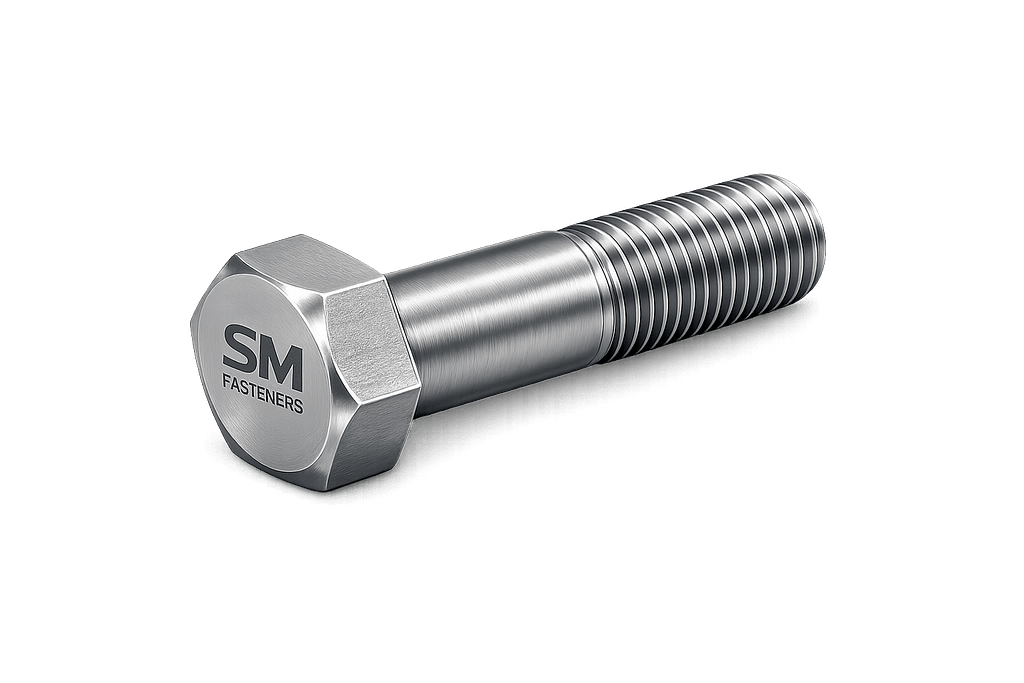
Hex bolts represent one of the most fundamental mechanical fastening elements used across global industrial infrastructure. Their universal adoption is driven by predictable load transfer characteristics, standardized geometries, and compatibility with automated manufacturing, inspection, and maintenance systems.
Within heavy engineering environments, a hex bolt is not merely a fastening component; it functions as a controlled load-transfer device responsible for maintaining structural integrity, pressure containment, vibration resistance, and long-term operational reliability.
Industries relying heavily on engineered hex bolt systems include:
| Industry Sector | Functional Role of Hex Bolts |
|---|---|
| Structural Steel Construction | Primary load-bearing connections |
| Oil & Gas (Upstream–Downstream) | Pressure flange assemblies, pipe supports |
| Petrochemical Plants | Equipment anchoring & reactor assemblies |
| Power Generation | Turbine casing and boiler structures |
| LNG & Offshore | Corrosion-resistant bolting systems |
| Heavy Equipment & Mining | Dynamic load retention |
| Rail & Infrastructure | Fatigue-resistant structural joints |
| Shipbuilding | High corrosion marine fastening |
| OEM Machinery | Precision mechanical assemblies |
Modern EPC projects demand fasteners that satisfy:
- Global standard interchangeability
- Traceable metallurgy
- Predictable preload behavior
- Certified manufacturing quality systems
SM Fasteners, operating under ISO 9001 certified quality management, MSME registration, and UKAF-accredited systems, manufactures hex bolts aligned with international engineering and procurement requirements for critical industrial service.
2. Technical Definition of a Hex Bolt
A hex bolt is an externally threaded mechanical fastener featuring:
- Six-sided (hexagonal) head geometry
- Cylindrical shank
- External machine thread
- Designed for use with a nut or tapped hole
Functional Definition
A hex bolt converts tightening torque into axial clamping force, generating frictional resistance between joint members sufficient to prevent separation, shear movement, or fatigue failure under service loads.
Basic Component Geometry
| Element | Function |
|---|---|
| Hex Head | Tool engagement & torque transmission |
| Bearing Surface | Load distribution on joint face |
| Shank | Shear load transfer |
| Threaded Portion | Preload generation |
| Thread Root | Critical fatigue zone |
| Chamfer | Thread engagement initiation |
Bolt vs Screw Clarification
| Parameter | Hex Bolt | Hex Cap Screw |
|---|---|---|
| Installation | Nut required | Tapped hole |
| Thread Length | Partial or full | Usually fully threaded |
| Tolerance Control | Assembly based | Precision fit |
| Structural Usage | Preferred | Secondary usage |
In EPC and structural applications, hex bolts are preferred due to superior alignment and controlled clamping behavior.
3. Functional Role in Mechanical Assemblies
Hex bolts serve four primary engineering functions:
3.1 Clamping Function
Creates compressive force between connected components.
3.2 Load Transfer
Transfers operational loads through friction rather than bolt shear whenever properly preloaded.
3.3 Alignment Retention
Maintains dimensional stability under thermal and dynamic loading.
3.4 Sealing Integrity
Maintains gasket compression in pressure-containing joints.
4. Load Mechanics & Force Behavior
Understanding hex bolt mechanics requires analysis of the bolt–joint system rather than the fastener alone.
4.1 Force Conversion Principle
Applied torque generates tensile force:
Where:
| Symbol | Meaning |
|---|---|
| F | Preload force |
| T | Applied torque |
| K | Nut factor |
| D | Nominal diameter |
Typical nut factor values:
| Condition | Nut Factor (K) |
|---|---|
| Dry steel | 0.20–0.25 |
| Zinc coated | 0.18–0.22 |
| Lubricated | 0.14–0.18 |
| PTFE coated | 0.10–0.13 |
4.2 Preload and Clamping Force
The primary objective of tightening is achieving correct preload.
Engineering Principle:
External service loads should never exceed the established preload.
When preload is correct:
- Joint surfaces remain compressed
- Fatigue resistance increases
- Shear load transfers through friction
4.3 Bolt Stretch Behavior
A properly designed bolt behaves like a spring.
| Component | Stiffness |
|---|---|
| Bolt | Elastic spring |
| Joint Members | Compression spring |
The interaction defines load distribution.
4.4 Load Distribution Diagram Concept
External force divides between:
- Bolt tension increase
- Joint compression reduction
Approximate relationship:
Where C is stiffness ratio.
Typical values:
- Steel joints: 0.2–0.3
- Soft gasketed joints: up to 0.8
4.5 Shear vs Friction Joint Design
Friction-Type Joint (Preferred)
Load resisted by friction between plates.
Advantages:
- High fatigue life
- No hole deformation
- Stable alignment
Bearing-Type Joint
Bolt shank carries shear load.
Used when:
- Slip is acceptable
- Lower preload applied
5. Torque–Tension Relationship
Only 10–15% of applied torque creates preload.
Remaining torque losses:
| Energy Loss | Percentage |
|---|---|
| Thread friction | 40% |
| Bearing friction | 45% |
| Useful preload | 15% |
This explains why surface finish, lubrication, and coatings significantly influence joint performance.
6. Joint Design Principles
Correct hex bolt selection begins with joint engineering.
6.1 Joint Design Objectives
- Maintain clamping force
- Prevent loosening
- Resist fatigue
- Avoid yielding
- Maintain sealing integrity
6.2 Bolt Selection Parameters
| Parameter | Engineering Consideration |
|---|---|
| Diameter | Load requirement |
| Grip Length | Joint thickness |
| Grade | Strength requirement |
| Thread Type | Vibration vs precision |
| Material | Environment |
| Coating | Corrosion protection |
| Temperature | Material stability |
6.3 Grip Length Rule
Ideal grip length:
Ensures shank carries shear rather than threads.
6.4 Thread Engagement Requirement
Minimum engagement:
| Material | Engagement Length |
|---|---|
| Steel | 1 × Diameter |
| Cast Iron | 1.5 × Diameter |
| Aluminum | 2 × Diameter |
| Plastics / PEEK | 2.5–3 × Diameter |
6.5 Preload Target
Typical design preload:
Maximizes fatigue life while preventing yield.
7. Failure Mechanisms in Hex Bolt Assemblies
Engineering-grade fastener selection requires understanding failure modes.
7.1 Fatigue Failure
Most common industrial failure.
Caused by:
- Insufficient preload
- Cyclic loading
- Surface defects
- Thread root stress concentration
Mitigation:
- Proper torque control
- Rolled threads
- High-quality material verification
7.2 Shear Failure
Occurs when:
- Joint slips
- Bolt acts as dowel pin
Prevented by:
- Adequate preload
- Proper joint design
7.3 Hydrogen Embrittlement
Risk for high-strength bolts (>1000 MPa).
Sources:
- Acid pickling
- Electroplating
Control Measures implemented by SM Fasteners:
- Controlled coating processes
- Post-bake de-embrittlement
- Process validation under ISO 9001 system
7.4 Stress Corrosion Cracking (SCC)
Common in:
- Chloride environments
- Sour gas service
Requires:
- Duplex / Super Duplex
- Nickel alloys
- NACE MR0175 compliance
7.5 Over-Tightening Failure
Leads to:
- Yielding
- Thread stripping
- Reduced fatigue life
Requires calibrated torque control procedures.
8. Functional Role Across Industrial Applications
| Industry | Hex Bolt Function |
|---|---|
| Structural Steel | Moment connections |
| Oil & Gas | Flange bolting |
| Power Plants | Turbine assemblies |
| Petrochemical | Pressure vessels |
| Offshore | Corrosion-resistant joints |
| Heavy Machinery | Dynamic vibration joints |
| Rail Infrastructure | High fatigue connections |
| Shipbuilding | Marine structural fastening |
High-Performance Materials Integration
SM Fasteners supports advanced materials including:
- Duplex & Super Duplex Stainless Steel
- Hastelloy
- Inconel / Incoloy
- Monel
- SMO 254
- Nickel alloys
- PEEK Fasteners for:
- Electrical isolation
- Chemical processing
- Non-magnetic assemblies
- Cryogenic applications
9. Engineering Selection Philosophy (SM Fasteners Approach)
Hex bolt specification follows a structured engineering workflow:
- Load definition
- Environment analysis
- Material compatibility
- Standard compliance selection
- Manufacturing route validation
- Inspection & certification planning
- Packaging & export readiness
This methodology aligns with EPC procurement expectations and third-party inspection practices.
10. Product Types and Engineering Variants of Hex bolt
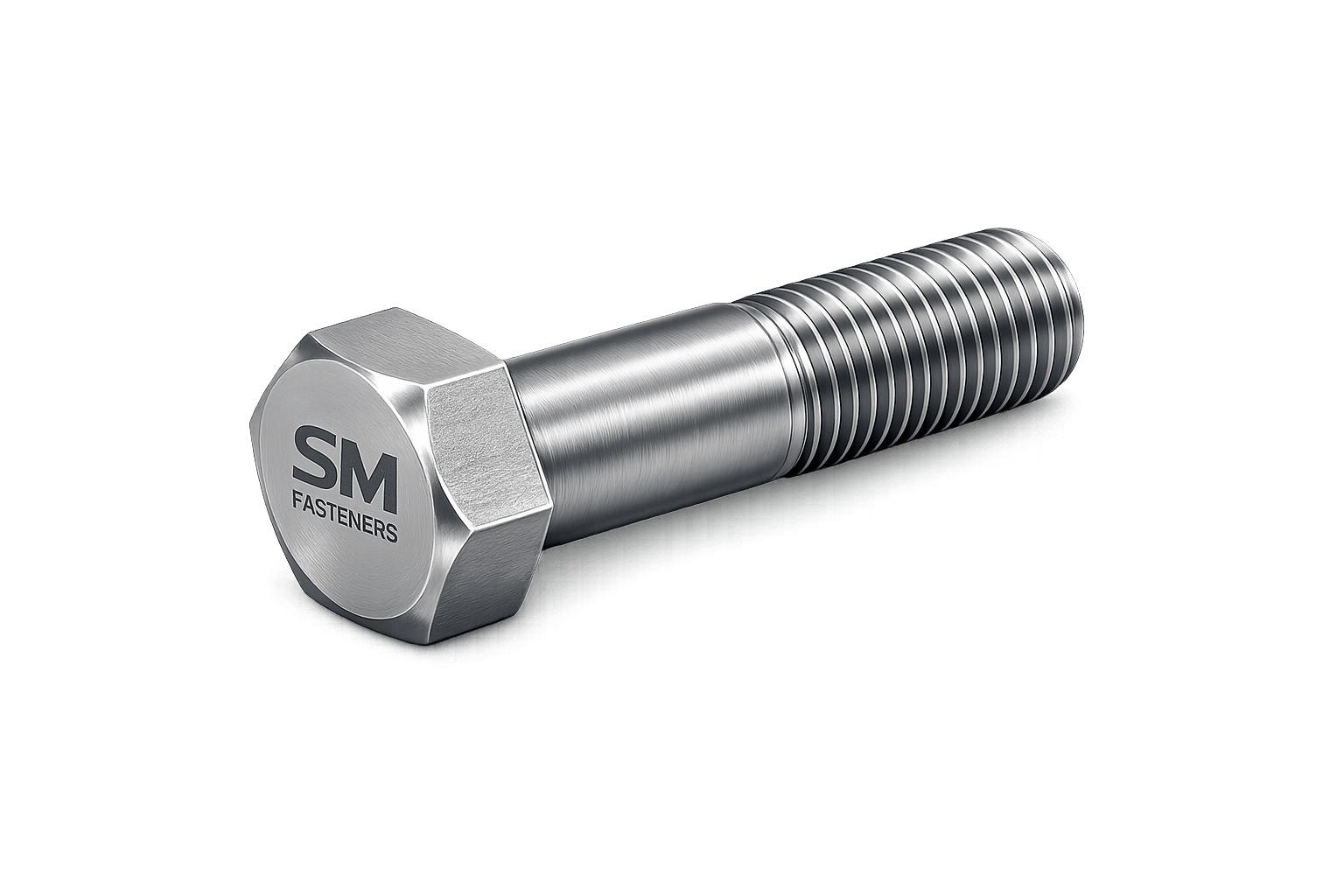
Hex bolts are manufactured in multiple configurations to satisfy different structural, mechanical, and pressure-service requirements. Selection depends on load direction, joint configuration, environmental exposure, and installation methodology.
10.1 Standard Hex Bolt (Partial Thread)
Primary Industrial Configuration
Characteristics:
- Threaded portion shorter than bolt length
- Smooth shank designed to carry shear loads
- Improved fatigue resistance
Typical Applications:
- Structural steel assemblies
- Bridge construction
- Heavy machinery frames
- EPC structural modules
Engineering Advantage:
Shear loads transfer through the unthreaded shank rather than threads.
10.2 Fully Threaded Hex Bolt
Features:
- Threads along entire length
- Maximum adjustability
- Increased clamping flexibility
Applications:
- Thin joint assemblies
- Equipment mounting
- Maintenance installations
- Pipe supports
Limitations:
- Reduced shear capacity
- Higher fatigue sensitivity
10.3 Heavy Hex Bolt
Defined by larger head dimensions.
Characteristics:
- Increased bearing surface
- Higher preload capability
- Improved wrench engagement
Common Standards:
- ASTM A325
- ASTM A490
- ASTM A193 Series
Primary Industries:
- Oil & Gas flanges
- Pressure vessels
- Structural connections
- Offshore modules
10.4 Structural Hex Bolts
Designed specifically for structural engineering.
Key Properties:
- Controlled mechanical properties
- Verified toughness
- Tight dimensional tolerance
Typical Grades:
- ASTM A325
- ASTM A490
- EN 14399 HV sets
10.5 Flange Hex Bolts
Integrated washer face beneath head.
Benefits:
- Uniform load distribution
- Reduced need for separate washer
- Improved vibration resistance
Used In:
- Automotive assemblies
- Machinery manufacturing
- Rotating equipment
10.6 Tap Bolts
Fully threaded bolts intended for threaded holes.
Applications:
- Castings
- Equipment housings
- Pump assemblies
10.7 Custom Engineered Hex Bolts — SM Fasteners Capability
SM Fasteners manufactures project-specific variants including:
- Extended grip length bolts
- Reduced shank tolerance bolts
- High-temperature alloy bolts
- PEEK hex bolts for electrical isolation
- Corrosion-critical offshore bolting
Customization supported under ISO 9001 controlled design and manufacturing procedures.
11. Dimensional Logic and Geometry Engineering
Hex bolt geometry directly influences:
- Torque transmission
- Preload stability
- Tool accessibility
- Load distribution
11.1 Key Dimensional Parameters
| Symbol | Parameter | Engineering Function |
|---|---|---|
| d | Nominal Diameter | Load capacity |
| P | Thread Pitch | Adjustment precision |
| L | Bolt Length | Joint thickness |
| s | Width Across Flats | Tool engagement |
| k | Head Height | Torque strength |
| b | Thread Length | Preload generation |
| r | Underhead Radius | Stress reduction |
11.2 Standard Metric Hex Bolt Dimensions (ISO 4014 / ISO 4017)
| Size | Pitch (mm) | Head Width s (mm) | Head Height k (mm) | Thread Length b (mm) |
|---|---|---|---|---|
| M6 | 1.0 | 10 | 4 | 18 |
| M8 | 1.25 | 13 | 5.3 | 22 |
| M10 | 1.5 | 17 | 6.4 | 26 |
| M12 | 1.75 | 19 | 7.5 | 30 |
| M16 | 2.0 | 24 | 10 | 38 |
| M20 | 2.5 | 30 | 12.5 | 46 |
| M24 | 3.0 | 36 | 15 | 54 |
| M30 | 3.5 | 46 | 18.7 | 66 |
| M36 | 4.0 | 55 | 22.5 | 78 |
Dimensions aligned with international ISO tolerances used by SM Fasteners production.
11.3 Length Selection Logic
Bolt length must satisfy:
Engineering rule:
- Minimum 2 threads beyond nut after tightening.
11.4 Head Geometry Importance
Larger bearing surface:
- Reduces localized stresses
- Prevents embedding relaxation
- Improves preload retention
12. Thread Systems and Engineering Standards
Hex bolts must meet globally interchangeable thread standards to support EPC procurement across multiple regions.
12.1 Major Thread Systems
| Thread System | Standard | Region |
|---|---|---|
| Metric Coarse | ISO 261 / ISO 965 | Global |
| Metric Fine | ISO 261 | Precision assemblies |
| UNC | ASME B1.1 | USA |
| UNF | ASME B1.1 | Aerospace / vibration |
| BSW | BS 84 | Legacy UK |
| BSF | BS 84 | Fine British |
| NPT (special use) | ASME B1.20 | Pressure fittings |
12.2 Thread Tolerance Classes
| System | External Thread | Internal Thread |
|---|---|---|
| Metric Standard | 6g | 6H |
| Precision Fit | 4g6g | 5H |
| Structural | 8g | 7H |
| UNC/UNF | 2A | 2B |
SM Fasteners verifies thread accuracy using calibrated gauges traceable to ISO standards.
13. International Standards Compliance
Global projects demand strict conformity with recognized fastener standards.
13.1 ISO Standards
| Standard | Description |
|---|---|
| ISO 4014 | Hex bolts — partial thread |
| ISO 4017 | Hex bolts — full thread |
| ISO 898-1 | Mechanical properties |
| ISO 965 | Thread tolerances |
| ISO 3506 | Stainless steel bolts |
13.2 DIN Standards
| DIN Standard | Equivalent ISO |
|---|---|
| DIN 931 | ISO 4014 |
| DIN 933 | ISO 4017 |
| DIN 267 | Fastener properties |
| DIN 267-11 | Corrosion resistant fasteners |
13.3 ASTM Standards (Oil & Gas / Pressure Systems)
| ASTM Standard | Application |
|---|---|
| ASTM A193 | High temperature pressure bolting |
| ASTM A320 | Low temperature service |
| ASTM A307 | General structural bolts |
| ASTM A325 | Structural high strength |
| ASTM A490 | High-strength structural |
| ASTM F593 | Stainless steel bolts |
13.4 British Standards (BS)
| BS Standard | Application |
|---|---|
| BS 3692 | Metric fasteners |
| BS EN 14399 | Structural preloaded bolts |
| BS 4190 | ISO metric bolts |
13.5 Property Class System (ISO)
| Property Class | Tensile Strength (MPa) | Yield Ratio |
|---|---|---|
| 4.6 | 400 | 0.6 |
| 5.8 | 500 | 0.8 |
| 8.8 | 800 | 0.8 |
| 10.9 | 1000 | 0.9 |
| 12.9 | 1200 | 0.9 |
Used extensively in mechanical and structural engineering.
14. Mechanical Property Classes vs Application
| Grade | Typical Industry Usage |
|---|---|
| 4.6 | Light structures |
| 5.8 | Machinery housings |
| 8.8 | Structural steel |
| 10.9 | Heavy equipment |
| 12.9 | High dynamic loads |
Selection must consider:
- Temperature
- Corrosion exposure
- Fatigue loading
- Inspection requirement
15. Thread Engagement & Strength Relationship
Thread shear strength depends on engagement length and material compatibility.
General Rule:Thread Strength≥Bolt Tensile Strength
Design engineers must ensure:
- Nut grade ≥ bolt grade
- Compatible hardness levels
- Controlled lubrication
16. Interchangeability Considerations for EPC Projects
Global EPC projects require cross-standard compatibility.
Example Equivalence:
| ISO | DIN | ASTM Approx |
|---|---|---|
| ISO 4014 | DIN 931 | ASTM A307/A325 |
| ISO 4017 | DIN 933 | ASTM A449 |
SM Fasteners maintains dimensional conformity enabling substitution without redesign risk.
17. Dimensional Tolerances
Critical tolerances affecting performance:
| Feature | Typical Tolerance |
|---|---|
| Diameter | ISO h6 |
| Head height | ±0.2 mm |
| Across flats | ISO tolerance grade C |
| Thread pitch | ISO 965 |
Controlled tolerances ensure repeatable preload behavior.
18. Engineering Weight Chart — Hex Bolts
(Aligned with SM Fasteners production reference data)
| Size | Length 50 mm (kg/pc) | Weight per 100 pcs (kg) |
|---|---|---|
| M6 | 0.008 | 0.8 |
| M8 | 0.017 | 1.7 |
| M10 | 0.031 | 3.1 |
| M12 | 0.054 | 5.4 |
| M16 | 0.118 | 11.8 |
| M20 | 0.215 | 21.5 |
| M24 | 0.370 | 37.0 |
| M30 | 0.710 | 71.0 |
| M36 | 1.200 | 120 |
Used by procurement teams for:
- Load calculations
- Shipping estimation
- Structural dead load evaluation
19. Engineering Design Summary — Geometry Selection Workflow
- Determine load requirement
- Select bolt diameter
- Choose property class
- Define thread system
- Verify grip length
- Check standard compliance
- Confirm dimensional tolerances
SM Fasteners applies this structured workflow during project engineering support and technical bid documentation preparation.
20. Material Engineering for Hex Bolts
Material selection governs the performance envelope of a hex bolt. Mechanical strength, corrosion resistance, fatigue life, temperature stability, and compatibility with operating media are primarily determined by metallurgical composition.
SM Fasteners manufactures hex bolts across the full industrial material spectrum under controlled ISO 9001 quality systems with complete traceability from raw material to finished product.
20.1 Primary Industrial Fastener Materials
| Material Category | Typical Grades | Key Characteristics |
|---|---|---|
| Carbon Steel | ASTM A307, EN 4.6–8.8 | Economical, structural use |
| Alloy Steel | ASTM A193 B7, B16 | High strength & temperature resistance |
| Stainless Steel | A2-70, A4-80 | Corrosion resistant |
| Duplex Stainless Steel | UNS S31803 | High strength + corrosion resistance |
| Super Duplex | UNS S32750 | Offshore & seawater |
| Nickel Alloys | Inconel, Monel | Extreme temperature resistance |
| Hastelloy | C276, C22 | Acid resistance |
| SMO 254 | UNS S31254 | Chloride environments |
| PEEK | Engineering polymer | Non-metallic, chemical resistant |
21. Material Selection Criteria
Engineering selection considers interaction between mechanical load and operating environment.
21.1 Selection Parameters
| Design Factor | Engineering Requirement |
|---|---|
| Tensile Load | Select property class or alloy |
| Temperature | Maintain strength stability |
| Corrosion | Match alloy resistance |
| Hydrogen Exposure | NACE compliance |
| Fatigue | High toughness material |
| Weight Reduction | Advanced alloys / PEEK |
21.2 Material Comparison Table
| Material | UTS (MPa) | Yield (MPa) | Corrosion Resistance | Temperature Limit | Relative Cost | Typical Applications |
|---|---|---|---|---|---|---|
| Carbon Steel 8.8 | 800 | 640 | Low | 300°C | Low | Structural |
| Alloy Steel B7 | 860 | 720 | Moderate | 450°C | Medium | Pressure vessels |
| SS 304 | 700 | 450 | Good | 425°C | Medium | Chemical plants |
| SS 316 | 700 | 450 | Excellent | 500°C | Medium | Marine |
| Duplex 2205 | 800 | 550 | Very High | 300°C | High | Offshore |
| Super Duplex 2507 | 950 | 650 | Extreme | 300°C | Very High | Seawater |
| Inconel 625 | 1030 | 690 | Outstanding | 1000°C | Premium | LNG & turbines |
| Hastelloy C276 | 790 | 355 | Acid Resistant | 1000°C | Premium | Chemical reactors |
| SMO 254 | 650 | 300 | Chloride Resistant | 400°C | High | Desalination |
| PEEK | 100 | 95 | Chemical inert | 260°C | Specialized | Electrical isolation |
22. Corrosion Resistance vs Environment
| Environment | Recommended Material |
|---|---|
| Atmospheric | Carbon Steel + Coating |
| Industrial Pollution | Stainless Steel 304 |
| Marine Exposure | SS316 / Duplex |
| Seawater Immersion | Super Duplex |
| Sour Gas (H₂S) | NACE-compliant alloys |
| Acidic Chemicals | Hastelloy |
| LNG Cryogenic | A320 L7 / Nickel alloys |
| Electrical Insulation | PEEK Fasteners |
SM Fasteners supports material selection aligned with NACE MR0175 / ISO 15156 requirements for sour service applications.
23. Mechanical Properties — Grade-Wise Table
| Property Class | Yield Strength (MPa) | Tensile Strength (MPa) | Hardness (HV) | Typical Use |
|---|---|---|---|---|
| 4.6 | 240 | 400 | 120–180 | Light duty |
| 5.8 | 400 | 500 | 160–220 | General machinery |
| 8.8 | 640 | 800 | 250–320 | Structural |
| 10.9 | 900 | 1000 | 320–380 | Heavy equipment |
| 12.9 | 1080 | 1200 | 380–435 | High dynamic load |
Hardness control is critical to prevent brittle fracture and hydrogen embrittlement.
24. Heat Treatment Processes
Heat treatment determines final mechanical performance.
24.1 Typical Heat Treatment Cycle
- Austenitizing
- Quenching
- Tempering
- Stress relieving
24.2 Heat Treatment by Grade
| Grade | Treatment |
|---|---|
| 4.6 | Normalized |
| 8.8 | Quenched & Tempered |
| 10.9 | Controlled Q&T |
| 12.9 | High precision Q&T |
24.3 Engineering Effects of Heat Treatment
| Process | Effect |
|---|---|
| Quenching | Strength increase |
| Tempering | Toughness improvement |
| Stress Relief | Distortion reduction |
| Solution Annealing | Corrosion resistance (SS) |
SM Fasteners validates heat treatment through hardness testing and mechanical verification under ISO 9001 procedures.
24.4 Sour Service Hardness Limits
Per NACE requirements:
- Maximum hardness ≈ 22 HRC
- Prevent sulfide stress cracking
25. End-to-End Manufacturing Workflow
SM Fasteners operates a controlled manufacturing sequence ensuring traceability and repeatable mechanical performance.
25.1 Raw Material Verification
Incoming material checks include:
- Mill Test Certificate (EN 10204 3.1)
- Chemical composition verification
- Heat number traceability
- PMI (Positive Material Identification)
25.2 Manufacturing Process Flow
- Raw material inspection
- Wire rod cutting
- Hot or cold forging
- Trimming & facing
- Thread formation
- Heat treatment
- Surface finishing
- Inspection & testing
- Marking & traceability
- Packaging & dispatch
25.3 Forging vs Machining
| Method | Advantage | Application |
|---|---|---|
| Cold Forging | High strength grain flow | Standard bolts |
| Hot Forging | Large diameters | Heavy hex bolts |
| Machining | Custom geometry | Special alloys |
Forged bolts offer superior fatigue resistance due to continuous grain structure.
25.4 Thread Manufacturing Methods
| Method | Characteristics |
|---|---|
| Thread Rolling | Compressive strengthening |
| Thread Cutting | Low-volume customization |
Rolled threads improve fatigue life up to 30%.
26. Surface Engineering and Coating Systems
Surface finishing controls corrosion performance, friction coefficient, and tightening reliability.
26.1 Surface Finish Comparison
| Coating | Corrosion Resistance | Friction Control | Temperature Limit | Typical Use |
|---|---|---|---|---|
| Black Oxide | Low | Stable | 300°C | Indoor |
| Zinc Plating | Moderate | Good | 120°C | General construction |
| Hot Dip Galvanized | High | Variable | 200°C | Structural outdoor |
| Mechanical Galvanized | High | Controlled | 200°C | Bridges |
| PTFE / Xylan | Very High | Excellent | 260°C | Offshore |
| Dacromet / Geomet | High | Stable | 300°C | Automotive |
| Nickel Plating | Chemical resistant | Good | 400°C | Process plants |
| Passivation (SS) | Excellent | Stable | 500°C | Marine |
| PEEK Coated | Chemical inert | Excellent | 260°C | Electrical isolation |
26.2 Coating Selection by Environment
| Environment | Recommended Coating |
|---|---|
| Outdoor Structural | Hot Dip Galvanized |
| Offshore Platform | PTFE / Duplex SS |
| Chemical Processing | Nickel / Hastelloy |
| High Temperature | Alloy steel + oxide |
| Corrosive Gas | Xylan/PTFE |
26.3 Hydrogen Embrittlement Control
SM Fasteners applies:
- Controlled electroplating
- Post-bake treatment
- Process monitoring
- Mechanical testing verification
27. Surface Friction & Torque Influence
Coating affects nut factor (K) significantly.
| Surface Condition | Nut Factor |
|---|---|
| Dry | 0.22 |
| Zinc Plated | 0.20 |
| Lubricated | 0.16 |
| PTFE Coated | 0.12 |
Torque specifications must always match coating condition.
28. Traceability and Identification
Every hex bolt manufactured by SM Fasteners may include:
- Grade marking
- Manufacturer identification
- Heat number traceability
- Inspection linkage
Traceability ensures compliance with EPC audit requirements.
29. PEEK Hex Bolts — Advanced Engineering Applications
SM Fasteners manufactures high-performance PEEK hex bolts for specialized industries.
Key Characteristics
- Non-metallic
- Electrically insulating
- Chemical inert
- Non-magnetic
- Lightweight
- Radiation resistant
PEEK Application Areas
| Industry | Use |
|---|---|
| Semiconductor | Cleanroom equipment |
| Chemical Processing | Acid environments |
| Electrical Systems | Isolation fastening |
| Medical Equipment | MRI compatible assemblies |
| Aerospace | Weight-sensitive components |
30. Manufacturing Quality Philosophy — SM Fasteners
Engineering objectives maintained throughout production:
- Metallurgical consistency
- Controlled mechanical properties
- Dimensional repeatability
- Global standard compliance
- Procurement-ready documentation
All manufacturing and inspection activities integrate within SM Fasteners’ ISO 9001 certified quality management system, ensuring reliable supply to global EPC, infrastructure, and heavy engineering projects.
31. Inspection and Quality Control Philosophy
In critical industrial assemblies, fasteners are classified as safety-critical engineered components. Quality assurance therefore extends beyond dimensional verification to full lifecycle traceability and performance validation.
SM Fasteners operates under an ISO 9001 certified quality management system, ensuring consistent manufacturing control, inspection reliability, and audit-ready documentation for EPC and international procurement environments.
31.1 Quality Control Stages
| Stage | Inspection Activity |
|---|---|
| Incoming Material | Chemical & certification verification |
| In-Process | Dimensional monitoring |
| Heat Treatment | Hardness & structure validation |
| Thread Formation | Gauge inspection |
| Surface Finishing | Coating thickness testing |
| Final Inspection | Mechanical & visual verification |
| Dispatch | Documentation validation |
32. Dimensional Inspection Methods
Precision geometry directly affects preload behavior and joint reliability.
Measurement Controls
- Digital calipers
- Micrometers
- Thread plug & ring gauges
- Optical comparators
- Coordinate measuring systems (CMM for critical projects)
Dimensional Inspection Parameters
| Feature | Inspection Method |
|---|---|
| Diameter | Micrometer |
| Thread pitch | Thread gauge |
| Head dimensions | Vernier inspection |
| Straightness | Runout testing |
| Length | Calibrated scale |
33. Mechanical Testing Requirements
Mechanical properties must comply with ISO, ASTM, or project-specific specifications.
Typical Mechanical Tests
| Test | Purpose |
|---|---|
| Tensile Test | Verify strength |
| Proof Load Test | Elastic performance |
| Hardness Test | Heat treatment validation |
| Impact Test (Charpy) | Low temperature toughness |
| Wedge Tensile Test | Head integrity |
Mechanical Properties Table (Engineering Reference)
| Grade | Proof Load (MPa) | Tensile Strength (MPa) | Yield Strength (MPa) |
|---|---|---|---|
| 4.6 | 225 | 400 | 240 |
| 5.8 | 380 | 500 | 400 |
| 8.8 | 600 | 800 | 640 |
| 10.9 | 830 | 1000 | 900 |
| 12.9 | 970 | 1200 | 1080 |
34. Non-Destructive Testing (NDT)
Applied when required by EPC specifications.
| NDT Method | Detection Capability |
|---|---|
| Magnetic Particle Inspection | Surface cracks |
| Ultrasonic Testing | Internal defects |
| Dye Penetrant | Surface discontinuities |
| PMI Testing | Alloy verification |
| Eddy Current | Surface integrity |
SM Fasteners supports third-party inspections including TPI agencies and client witness inspection.
35. Material Traceability & Certification
Industrial projects require full documentation traceability.
Certification Levels
| Certificate | Description |
|---|---|
| EN 10204 2.1 | Compliance declaration |
| EN 10204 2.2 | Test report |
| EN 10204 3.1 | Mill test certificate |
| EN 10204 3.2 | Third-party witnessed certification |
Documentation linked to:
- Heat number
- Manufacturing batch
- Inspection records
36. Tightening Torque Chart
(Reference values — clean threads)
| Size | Grade 8.8 (Nm) | Grade 10.9 (Nm) | Lubricated (Nm) |
|---|---|---|---|
| M8 | 25 | 36 | 20 |
| M10 | 49 | 70 | 39 |
| M12 | 85 | 120 | 68 |
| M16 | 210 | 300 | 168 |
| M20 | 410 | 580 | 330 |
| M24 | 710 | 1000 | 568 |
| M30 | 1420 | 2000 | 1135 |
| M36 | 2480 | 3500 | 1980 |
Torque values must always be validated against coating friction factors.
37. Preload Calculation — Engineering Method
Fundamental Equation
Where:
- F = Preload force
- T = Applied torque
- K = Nut factor
- D = Bolt diameter
Worked Example
Given:
- Bolt: M20 Grade 8.8
- Torque: 410 Nm
- Nut factor: 0.20
- Diameter: 0.02 m
Result:
≈102 kN clamping force
Used by engineers to verify flange and structural joint integrity.
38. Thread Standards & Tolerances Table
| Thread Type | Standard | External Class | Internal Class |
|---|---|---|---|
| Metric Coarse | ISO 261 | 6g | 6H |
| Metric Fine | ISO 965 | 4g6g | 5H |
| UNC | ASME B1.1 | 2A | 2B |
| UNF | ASME B1.1 | 2A | 2B |
| BSW | BS 84 | Medium | Medium |
| BSF | BS 84 | Fine | Fine |
Ensures interchangeability in multinational EPC projects.
39. Surface Finish Performance Comparison
| Surface Finish | Corrosion Resistance | Friction Stability | Maintenance Interval |
|---|---|---|---|
| Black Oxide | Low | Stable | Indoor only |
| Zinc Plated | Medium | Good | Periodic |
| HDG | High | Variable | Structural outdoor |
| PTFE | Very High | Excellent | Long-term |
| Passivated SS | Excellent | Stable | Minimal |
| Nickel Alloy | Chemical Resistant | Good | Process plants |
40. Failure Prevention Engineering
Common prevention strategies implemented during SM Fasteners engineering support:
- Correct preload calculation
- Material compatibility verification
- Controlled hardness limits
- Anti-galling measures for stainless steels
- Hydrogen embrittlement mitigation
- Proper lubrication specification
41. Industry Application Mapping
41.1 Construction & Structural Steel
- Beam connections
- Steel frames
- Anchor assemblies
- Bridges and stadium structures
Preferred Grades:
8.8, A325, Hot Dip Galvanized.
41.2 Oil & Gas Industry
Upstream
- Wellhead equipment
- Drill rigs
Midstream
- Pipeline flanges
- Compressor stations
Downstream
- Refineries
- Process reactors
Materials:
A193 B7, B16, Duplex, Inconel.
41.3 Power Generation
- Turbine casing bolts
- Boiler supports
- Generator frames
Temperature-resistant alloy steels required.
41.4 Petrochemical & Chemical Processing
Requires:
- Corrosion-resistant alloys
- Controlled hardness
- NACE compliance
41.5 LNG & Offshore Platforms
Challenges:
- Salt spray
- Chlorides
- Cryogenic conditions
Recommended Materials:
Super Duplex, Nickel Alloys, PTFE-coated fasteners.
41.6 Automotive & Heavy Equipment
- Engine mounting
- Suspension systems
- Structural chassis assemblies
Grades 10.9 and 12.9 commonly used.
41.7 Railways & Infrastructure
- Track fastening systems
- Structural bridges
- Signaling equipment
High fatigue resistance required.
41.8 Shipbuilding & Marine
- Deck structures
- Engine assemblies
- Propulsion equipment
Preferred Materials:
SS316, Duplex, Monel.
41.9 PEEK Fastener Applications
Used where metallic fasteners are unsuitable:
- Electrical isolation panels
- Chemical exposure environments
- Non-magnetic equipment
- Lightweight aerospace systems
42. Packaging & Industrial Logistics
Proper packaging preserves dimensional accuracy and coating integrity during global transport.
Standard Industrial Packaging
| Method | Purpose |
|---|---|
| VCI Packaging | Corrosion prevention |
| Thread Protectors | Damage avoidance |
| Sealed Poly Bags | Clean environment supply |
| Batch Labeling | Traceability |
Export Packaging
- ISPM-15 compliant wooden crates
- Moisture barrier protection
- Palletized heavy loads
- Shock-resistant packing
Supports international shipping and EPC project logistics.
43. Export Documentation Package
Typical SM Fasteners supply includes:
- Mill Test Certificate (EN 10204 3.1 / 3.2)
- Heat Treatment Report
- Mechanical Test Report
- Dimensional Inspection Report
- Coating Certification
- Certificate of Conformity (CoC)
- Packing List
- Traceability Records
Ensures procurement acceptance across global projects.
44. Engineering Weight Reference Table
(Extended Procurement Table)
| Size | Weight per Piece (kg) | Weight per 100 pcs (kg) |
|---|---|---|
| M6 | 0.008 | 0.8 |
| M8 | 0.017 | 1.7 |
| M10 | 0.031 | 3.1 |
| M12 | 0.054 | 5.4 |
| M16 | 0.118 | 11.8 |
| M20 | 0.215 | 21.5 |
| M24 | 0.370 | 37.0 |
| M30 | 0.710 | 71.0 |
| M36 | 1.200 | 120 |
Used by procurement teams for freight estimation and structural calculations.
45. Proof Load Reference by Size (Grade 8.8)
| Size | Stress Area (mm²) | Proof Load (kN) |
|---|---|---|
| M8 | 36.6 | 22 |
| M10 | 58 | 35 |
| M12 | 84.3 | 51 |
| M16 | 157 | 94 |
| M20 | 245 | 147 |
| M24 | 353 | 212 |
| M30 | 561 | 337 |
| M36 | 817 | 490 |
46. SM Fasteners — Global Supply & Engineering Capability
SM Fasteners integrates:
- ISO 9001 certified manufacturing systems
- MSME recognized industrial operations
- UKAF accredited quality framework
- Advanced alloy manufacturing capability
- Custom engineered fastener production
- PEEK and specialty material expertise
Capabilities include:
- EPC project supply
- Custom drawings manufacturing
- Third-party inspection coordination
- International export logistics support
- Technical bid documentation assistance
47. Engineering Conclusion
Hex bolts remain the backbone of modern industrial assembly systems due to their predictable mechanical behavior, global standardization, and adaptability across extreme service conditions.
Through controlled metallurgy, precision manufacturing, advanced surface engineering, and rigorous inspection practices, SM Fasteners delivers hex bolt solutions aligned with:
- Global engineering standards
- EPC procurement expectations
- High reliability industrial applications
- Long-term operational safety.