

Self tapping screws
1. Industry Context
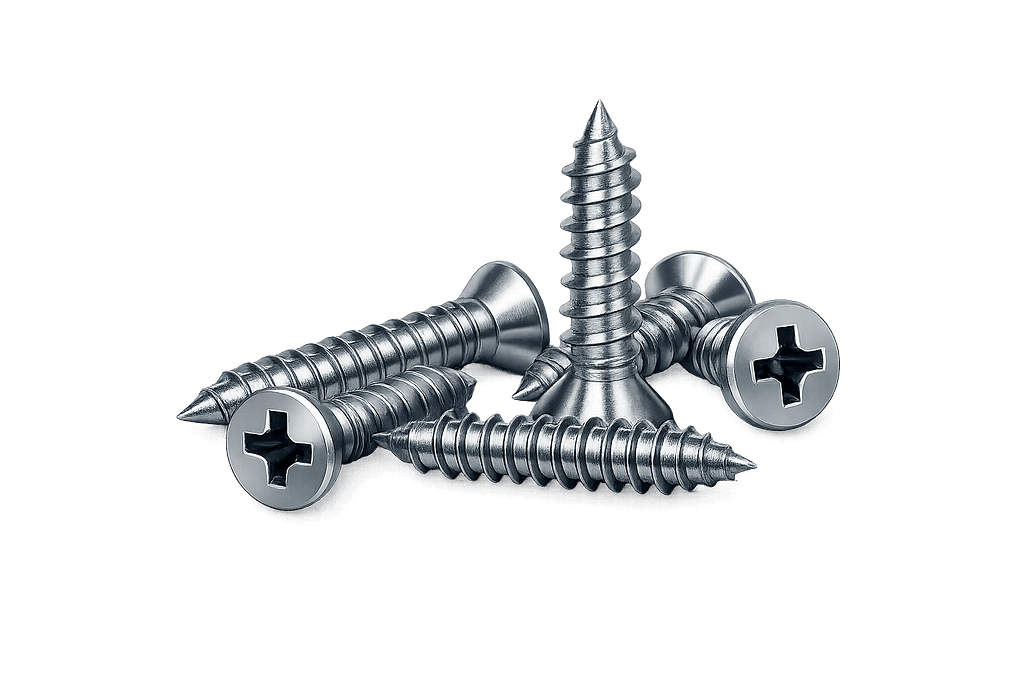
Self tapping screws occupy a critical position within modern mechanical fastening technology where pre-threaded holes are undesirable, uneconomical, or impractical.
Unlike conventional machine screws, self tapping screws:
- Create mating threads during installation.
- Reduce secondary machining operations.
- Enable faster assembly cycles.
- Maintain high pull-out resistance in thin or soft materials.
Primary Industrial Drivers
| Industry Sector | Functional Requirement |
|---|---|
| Structural Construction | Sheet steel fixing & cladding |
| Oil & Gas | Equipment housings, panels, instrumentation |
| Power Plants | Electrical enclosures & HVAC systems |
| Petrochemical | Corrosion-resistant panel assemblies |
| Automotive | Thin sheet joining |
| Railways | Interior modular assemblies |
| Shipbuilding | Marine panels & deck fittings |
| OEM Equipment | Rapid assembly production |
Within EPC projects, self tapping screws reduce:
- Assembly labor hours
- Thread machining cost
- Alignment complexity
- Field installation time
SM Fasteners manufactures precision self tapping screws under controlled ISO 9001 systems ensuring dimensional repeatability, traceability, and mechanical reliability required by global buyers.
2. Technical Definition
A self tapping screw is a threaded fastener capable of:
- Penetrating material.
- Forming or cutting internal mating threads.
- Generating clamp load without pre-tapped threads.
Functional Characteristics
- Hardened thread profile
- Special tip geometry
- Controlled flank angle
- High surface hardness
- Optimized lead threads
Self tapping screws fall into two fundamental mechanisms:
| Mechanism | Function |
|---|---|
| Thread Forming | Displaces material plastically |
| Thread Cutting | Removes material chips |
3. Functional Role in Mechanical Assemblies
Self tapping screws act simultaneously as:
- Fastener
- Thread generator
- Load transmitting element
They eliminate the need for:
- Tapping operations
- Nut access
- Thread inserts
- Secondary machining
Engineering Advantages
- Reduced component count
- Improved automation compatibility
- Lightweight joint design
- Lower installation torque variability
4. Load Mechanics & Force Behavior
Self tapping screw performance depends on interaction between:
- Applied torque
- Generated preload
- Thread engagement
- Material deformation behavior
4.1 Force Distribution
When installed, the screw generates:
- Axial clamping force
- Radial expansion pressure
- Shear resistance
- Pull-out resistance
Load transfer occurs through:
- Thread flank contact
- Head bearing surface
- Frictional interface
4.2 Torque–Tension Relationship
Fundamental relationship:
Where:
| Symbol | Meaning |
|---|---|
| T | Installation torque |
| K | Nut factor (friction coefficient) |
| F | Preload |
| d | Nominal diameter |
Typical Nut Factor Values:
| Condition | K Value |
|---|---|
| Dry | 0.20 – 0.24 |
| Zinc coated | 0.16 – 0.20 |
| Lubricated | 0.12 – 0.16 |
| PTFE coated | 0.08 – 0.12 |
4.3 Preload Generation
Preload provides:
- Joint rigidity
- Vibration resistance
- Fatigue life improvement
Insufficient preload leads to:
- Loosening
- Fretting wear
- Fatigue cracking
Preload Calculation Example
Given
- Screw: ST5.5 mm
- Tensile stress area: 14.2 mm²
- Property class equivalent: 10.9
- Yield strength: 900 MPa
- Target preload = 70% yield
Required preload ≈ 8.9 kN
5. Joint Design Principles
5.1 Thread Engagement Rule
Recommended engagement:
| Material | Engagement Length |
|---|---|
| Steel | 1 × diameter |
| Aluminum | 1.5 × diameter |
| Plastics | 2–2.5 × diameter |
| Composite panels | 2 × diameter |
5.2 Pilot Hole Design
Critical engineering parameter.
| Screw Size | Typical Pilot Hole |
|---|---|
| ST3.5 | 2.7–2.9 mm |
| ST4.2 | 3.2–3.4 mm |
| ST4.8 | 3.8–4.0 mm |
| ST5.5 | 4.5–4.7 mm |
| ST6.3 | 5.2–5.4 mm |
Incorrect pilot hole causes:
- Over-torque failure
- Thread stripping
- Material cracking
5.3 Failure Mechanisms
Fatigue Failure
Occurs under cyclic loading.
Mitigation:
- Proper preload
- Controlled torque
- Surface coating integrity
Shear Failure
Common in panel joints.
Design rule:
Hydrogen Embrittlement
Risk for hardened carbon steel screws.
Controlled by:
- Baking after plating
- Hardness limits
- Process monitoring
SM Fasteners applies strict post-plating baking procedures aligned with ISO requirements.
Stress Corrosion Cracking (SCC)
Occurs in:
- Chloride environments
- Sour gas service
- Marine exposure
Mitigation:
- Duplex stainless steel
- Nickel alloys
- PEEK fasteners
5.4 Friction & Clamp Stability
Joint stability depends on:
- Head bearing friction
- Thread friction
- Surface finish
- Coating type
Approximate torque energy distribution:
| Energy Use | Percentage |
|---|---|
| Thread friction | 40% |
| Under head friction | 50% |
| Actual preload | 10% |
Engineering implication: small friction variation drastically changes preload.
5.5 Self Tapping Screws in Thin Material Design
Ideal where:
- Thickness < 5 mm
- One-side access only
- Welding undesirable
- Thermal distortion unacceptable
5.6 Design Integration in EPC Projects
Self tapping screws are widely specified for:
- Electrical panels
- HVAC ducting
- Structural decking
- Offshore instrumentation
- Cable trays
- Marine interiors
SM Fasteners supports EPC buyers through:
Global specification compliance
Custom geometry engineering
Material certification traceability
6. Product Types & Engineering Variants
Self tapping screws are engineered according to installation method, substrate behavior, and required mechanical performance. Selection must always consider joint function rather than visual similarity.
6.1 Thread Forming Self Tapping Screws
Function:
Cold-form internal threads by plastic deformation of base material.
Engineering Characteristics
- No chip generation
- Improved vibration resistance
- Higher pull-out strength
- Better fatigue life
Suitable Materials
- Low carbon steel sheets
- Aluminum alloys
- Brass
- Plastics
- Thin stainless sheet
Typical Applications
- Automotive assemblies
- Electrical enclosures
- Appliance manufacturing
- Instrument housings
6.2 Thread Cutting Self Tapping Screws
Function:
Cut mating threads through chip removal.
Design Features
- Cutting flute or notch
- Reduced installation torque
- Suitable for harder substrates
Suitable Materials
- Structural steel sections
- Cast iron
- Fiber composites
- Reinforced plastics
6.3 Self Drilling Screws (TEK Type)
Combined drilling and tapping functionality.
Features:
- Drill point tip
- Eliminates pilot hole
- High productivity installation
Applications:
- Steel roofing
- Structural decking
- HVAC duct installation
- Offshore panel work
6.4 Sheet Metal Screws
Widely used industrial configuration.
Characteristics:
- Sharp or blunt tip
- Fully threaded shank
- High flank engagement
6.5 Plastite / Trilobular Screws
Designed for thermoplastics.
Engineering Benefits:
- Reduced stress cracking
- Controlled radial pressure
- Improved reusability
6.6 High Performance Industrial Variants by SM Fasteners
SM Fasteners supplies engineered variants including:
- Stainless steel self tapping screws
- Duplex & Super Duplex marine-grade screws
- Nickel alloy fasteners for corrosive service
- High-temperature alloy screws
- PEEK polymer self tapping screws for insulation and chemical resistance
7. Head Types & Functional Geometry
Head geometry directly affects load distribution and installation torque.
| Head Type | Engineering Purpose | Typical Industry Use |
|---|---|---|
| Pan Head | Large bearing surface | Electrical panels |
| Hex Washer Head | High torque transfer | Structural steel |
| Countersunk (CSK) | Flush finish | Machinery covers |
| Truss Head | Thin sheet clamping | HVAC |
| Button Head | Aesthetic + low snag | Rail interiors |
| Flat Head | Embedded joints | Equipment housings |
8. Drive Systems
Drive selection influences torque accuracy and automation compatibility.
| Drive Type | Engineering Advantage |
|---|---|
| Phillips | High-speed installation |
| Pozidriv | Reduced cam-out |
| Torx | High torque accuracy |
| Hex Socket | Precision torque control |
| External Hex | Structural installation |
| Square Drive | Automation assembly |
Torx and Hex drives are preferred in EPC installations due to consistent torque transmission.
9. Thread Geometry & Dimensional Logic
Self tapping screw performance depends on thread profile engineering.
Thread Elements
- Major diameter
- Minor diameter
- Pitch
- Lead angle
- Flank angle
- Thread depth
Typical Self Tapping Thread Characteristics
| Parameter | Typical Range |
|---|---|
| Flank angle | 60° |
| Thread pitch | Coarse |
| Thread depth | High engagement |
| Lead | Single start |
| Crest radius | Optimized for forming |
10. Dimensional Specification Table
(Engineering Reference — SM Fasteners Production Range)
| Size | Major Dia (mm) | Pitch (mm) | Head Dia (mm) | Head Height (mm) | Length Range (mm) |
|---|---|---|---|---|---|
| ST2.9 | 2.9 | 1.1 | 5.5 | 2.2 | 6–25 |
| ST3.5 | 3.5 | 1.3 | 7.0 | 2.6 | 6–32 |
| ST4.2 | 4.2 | 1.4 | 8.0 | 3.0 | 9–50 |
| ST4.8 | 4.8 | 1.6 | 10.0 | 3.4 | 13–75 |
| ST5.5 | 5.5 | 1.8 | 11.0 | 4.0 | 19–100 |
| ST6.3 | 6.3 | 2.0 | 12.5 | 4.6 | 25–150 |
Dimensions may be customized by SM Fasteners for OEM and EPC specifications.
11. International Standards & Compliance
Self tapping screws must comply with globally recognized standards ensuring interchangeability.
11.1 ISO Standards
| Standard | Description |
|---|---|
| ISO 1478 | Thread dimensions for tapping screws |
| ISO 7049 | Pan head tapping screws |
| ISO 7050 | Countersunk tapping screws |
| ISO 7051 | Raised countersunk |
| ISO 10666 | Drilling screws |
| ISO 2702 | Heat treatment requirements |
11.2 DIN Standards
| DIN Standard | Application |
|---|---|
| DIN 7981 | Pan head tapping screws |
| DIN 7982 | Countersunk tapping screws |
| DIN 7983 | Raised CSK screws |
| DIN 7504 | Self drilling screws |
11.3 ASTM Standards (Material & Performance)
| ASTM | Scope |
|---|---|
| ASTM F568M | Carbon steel mechanical properties |
| ASTM A193 | High temperature alloy fasteners |
| ASTM A320 | Low temperature service |
| ASTM F1941 | Coating systems |
| ASTM B117 | Salt spray corrosion testing |
11.4 British Standards (BS)
| BS Standard | Description |
|---|---|
| BS 4174 | Self tapping screws |
| BS 3692 | Mechanical properties |
| BS EN ISO 3506 | Stainless steel fasteners |
12. Thread Standards & Tolerances
| Thread System | Standard | Tolerance Class |
|---|---|---|
| Metric | ISO 1478 | 6g |
| UNC | ASME B1.1 | 2A |
| UNF | ASME B1.1 | 2A |
| BSW | BS 84 | Medium |
| BSF | BS 84 | Fine |
SM Fasteners ensures thread rolling precision within international tolerance bands verified through calibrated gauges.
13. Mechanical Property Classes
Self tapping screws typically follow hardened property classifications.
| Property Level | Equivalent Property Class | Typical Hardness |
|---|---|---|
| Standard | ~8.8 | 28–34 HRC |
| High Strength | ~10.9 | 32–39 HRC |
| Structural | ~12.9 | 39–44 HRC |
Heat treatment conformity aligned with ISO 2702.
14. Proof Load & Tensile Strength Table
| Size | Tensile Strength (MPa) | Proof Load (kN) |
|---|---|---|
| ST3.5 | 900 | 3.2 |
| ST4.2 | 900 | 4.6 |
| ST4.8 | 1000 | 6.5 |
| ST5.5 | 1000 | 8.9 |
| ST6.3 | 1100 | 11.5 |
Values depend on material grade and heat treatment condition.
15. Interchangeability & Engineering Considerations
When replacing self tapping screws:
Check:
- Thread forming vs cutting type
- Substrate hardness
- Coating thickness impact
- Head bearing diameter
- Installation torque window
Incorrect substitution may result in:
- Thread stripping
- Loss of preload
- Galvanic corrosion
- Premature fatigue failure
16. Geometry Selection Matrix
| Application | Recommended Type |
|---|---|
| Thin sheet steel | Thread forming |
| Structural steel | Self drilling |
| Aluminum panels | Forming screw |
| Plastics | Trilobular |
| Offshore equipment | Duplex SS |
| Chemical plant | Nickel alloy |
| Electrical panels | Stainless steel |
| Cryogenic service | Austenitic SS |
SM Fasteners supports custom engineering drawings, tolerance optimization, and dimensional validation for global EPC procurement programs.
17. Materials Engineering for Self Tapping Screws
Material selection determines:
- Mechanical strength
- Thread forming capability
- Corrosion resistance
- Temperature performance
- Service life reliability
Self tapping screws require a unique balance between:
- High surface hardness (for thread creation)
- Core ductility (to prevent brittle fracture)
SM Fasteners manufactures self tapping screws across a complete industrial alloy spectrum aligned with ISO 9001 quality systems and global EPC procurement requirements.
18. Industrial Material Grades
18.1 Carbon Steel
Primary material for high-volume industrial fastening.
Characteristics
- Excellent hardenability
- High strength after heat treatment
- Cost-effective
- Suitable for coated systems
Typical Grades:
- C1022
- SAE 1018 / 1022
- ASTM F568M Class 8.8–10.9 equivalent
Applications:
- Structural sheet assemblies
- Roofing systems
- Equipment housings
18.2 Alloy Steel
Used where higher mechanical performance is required.
Grades:
- 4140
- 4340
- 40CrMo
Advantages:
- Higher fatigue resistance
- Improved shear strength
- Elevated temperature performance
18.3 Stainless Steel Fasteners
Essential for corrosion resistance and hygienic environments.
| Grade | Features | Typical Service |
|---|---|---|
| A2-70 (304) | General corrosion resistance | Construction |
| A4-80 (316) | Marine & chemical resistance | Offshore |
| 410 SS | Hardenable stainless | Structural tapping |
| 904L | Acid resistance | Chemical plants |
18.4 Duplex & Super Duplex Stainless Steel
Designed for aggressive chloride and offshore environments.
Grades:
- UNS S31803
- UNS S32205
- UNS S32750
- UNS S32760
Benefits:
- High strength
- SCC resistance
- Excellent seawater performance
Used extensively in LNG terminals and offshore platforms.
18.5 Nickel & High Performance Alloys
Manufactured by SM Fasteners for extreme operating environments.
| Alloy | Key Capability |
|---|---|
| Inconel 625 / 718 | High temperature strength |
| Incoloy 825 | Acid resistance |
| Monel 400 | Seawater corrosion resistance |
| Hastelloy C276 | Chemical processing resistance |
| SMO 254 | Chloride resistance |
18.6 PEEK Self Tapping Fasteners
High-performance polymer fasteners supplied by SM Fasteners.
Advantages:
- Electrically non-conductive
- Chemical inertness
- Lightweight
- Non-magnetic
- Radiation resistant
- No galvanic corrosion
Applications:
- Semiconductor equipment
- LNG instrumentation
- Electrical insulation systems
- Chemical dosing equipment
19. Material Selection Comparison Table
| Material | UTS (MPa) | Yield (MPa) | Corrosion Resistance | Temperature Limit | Relative Cost | Typical Application |
|---|---|---|---|---|---|---|
| Carbon Steel | 800–1000 | 640 | Low | 300°C | Low | Construction |
| Alloy Steel | 1000–1200 | 900 | Moderate | 450°C | Medium | Heavy equipment |
| SS 304 | 700 | 450 | Good | 400°C | Medium | Panels |
| SS 316 | 800 | 600 | Very Good | 500°C | Medium-High | Offshore |
| Duplex SS | 900 | 650 | Excellent | 300°C | High | Marine |
| Inconel 718 | 1200+ | 1000 | Exceptional | 700°C | Very High | Turbines |
| Hastelloy C276 | 900 | 355 | Outstanding | 600°C | Very High | Chemical plants |
| PEEK | 100 | 95 | Exceptional | 260°C | High | Electrical |
20. Corrosion Resistance vs Environment
| Environment | Carbon Steel | SS304 | SS316 | Duplex | Nickel Alloy | PEEK |
|---|---|---|---|---|---|---|
| Atmospheric | Fair | Good | Excellent | Excellent | Excellent | Excellent |
| Seawater | Poor | Moderate | Very Good | Excellent | Excellent | Excellent |
| Acidic | Poor | Moderate | Good | Very Good | Excellent | Excellent |
| H₂S / Sour Service | Limited | Moderate | Good | Excellent | Excellent | Excellent |
| Chlorides | Poor | Moderate | Good | Excellent | Excellent | Excellent |
| Chemical Processing | Poor | Good | Very Good | Excellent | Excellent | Excellent |
Materials for sour service comply with NACE MR0175 / ISO 15156 hardness limits when required.
21. Heat Treatment Processes
Self tapping screws rely heavily on controlled heat treatment.
Objectives
- High thread surface hardness
- Tough core structure
- Controlled brittleness resistance
21.1 Process Flow
- Austenitizing
- Quenching
- Tempering
- Surface hardening stabilization
Typical Heat Treatment Parameters
| Step | Temperature |
|---|---|
| Austenitizing | 850–900°C |
| Quenching | Oil / Polymer |
| Tempering | 350–450°C |
Resulting Properties
| Property | Requirement |
|---|---|
| Surface Hardness | 45–55 HRC |
| Core Hardness | 28–38 HRC |
| Case Depth | Controlled |
| Toughness | Maintained |
ISO 2702 governs tapping screw heat treatment.
Hydrogen Embrittlement Control
SM Fasteners applies:
- Controlled electroplating
- Mandatory baking (190–220°C)
- Time-controlled post plating process
- Hardness verification
Critical for EPC and offshore procurement approval.
22. End-to-End Manufacturing Workflow
SM Fasteners follows a traceable manufacturing process aligned with ISO 9001 and UKAF-certified systems.
22.1 Raw Material Verification
- Mill Test Certificate (MTC)
- Heat number traceability
- PMI verification
- Chemical composition analysis
22.2 Wire Processing
- Wire drawing
- Spheroidizing annealing
- Surface cleaning
- Lubrication coating
22.3 Cold Heading / Forging
Produces:
- Head geometry
- Shank formation
- Grain flow alignment
Advantages:
- Improved fatigue strength
- Material efficiency
22.4 Thread Rolling (Preferred Method)
Thread rolling is superior to thread cutting.
Benefits:
- Work hardening
- Improved fatigue resistance
- Smooth surface finish
- No material removal
22.5 Tip Forming
Specialized tooling creates:
- Sharp points
- Drill tips
- Cutting flutes
22.6 Heat Treatment
Controlled furnace systems ensure:
- Uniform hardness
- Distortion control
- Mechanical consistency
22.7 Surface Finishing
Applied according to application environment.
23. Surface Engineering & Protective Coatings
Surface treatment directly influences corrosion resistance and torque behavior.
Surface Finish Comparison Table
| Coating | Corrosion Resistance | Friction Control | Typical Use |
|---|---|---|---|
| Zinc Plating | Moderate | Good | Indoor use |
| Zinc Flake | High | Excellent | Automotive |
| Hot Dip Galvanized | Very High | Moderate | Structural |
| Mechanical Galvanizing | High | Good | Construction |
| Phosphate | Low | Excellent | Base coating |
| Dacromet | Very High | Stable | Offshore |
| PTFE | Excellent | Very Low Friction | Chemical |
| Black Oxide | Low | Controlled | Machinery |
| Passivation (SS) | High | Stable | Marine |
SM Fasteners validates coatings through ASTM B117 salt spray testing.
Coating Thickness Guidelines
| Coating | Thickness |
|---|---|
| Electro Zinc | 5–12 µm |
| Zinc Flake | 8–20 µm |
| HDG | 40–70 µm |
| PTFE | 20–40 µm |
24. Torque Behavior vs Surface Condition
Coating significantly alters torque values.
| Surface Condition | Torque Reduction |
|---|---|
| Dry | Baseline |
| Zinc plated | −10% |
| Lubricated | −25% |
| PTFE coated | −40% |
Engineering torque recalculation is mandatory after coating selection.
25. Manufacturing Quality Integration at SM Fasteners
Integrated controls include:
- Process qualification
- Heat lot traceability
- Gauge calibration
- SPC monitoring
- Batch inspection
- Certified documentation
Capabilities include:
- Custom self tapping geometries
- Special alloy machining
- PEEK precision molding
- Project-specific coating systems
SM Fasteners delivers self tapping screws engineered for global industrial reliability, material traceability, and audit-ready compliance required by EPC contractors and OEM manufacturers.
26. Inspection & Quality Control Framework
Self tapping screws used in industrial projects must demonstrate mechanical reliability, dimensional precision, and full traceability.
SM Fasteners operates under an ISO 9001 certified quality management system, ensuring every production batch satisfies international inspection protocols demanded by EPC contractors, OEM manufacturers, and third-party inspectors.
Manufacturer Reference:
SM Fasteners
26.1 Incoming Raw Material Inspection
Verification begins prior to manufacturing.
Inspection Activities
- Mill Test Certificate (MTC) verification
- Heat number traceability
- Chemical composition analysis
- Positive Material Identification (PMI)
- Wire rod dimensional inspection
- Surface defect examination
Standards Referenced:
- ASTM A751
- ISO 6892
- EN 10204
26.2 In-Process Manufacturing Inspection
| Process Stage | Inspection Method |
|---|---|
| Cold Heading | Head dimension gauging |
| Thread Rolling | GO / NO-GO ring gauges |
| Tip Formation | Optical inspection |
| Heat Treatment | Hardness verification |
| Coating | Thickness measurement |
| Sorting | Automated defect detection |
Statistical Process Control (SPC) ensures dimensional stability across production lots.
26.3 Mechanical Testing
Performed according to ISO, ASTM, and BS requirements.
| Test | Purpose |
|---|---|
| Tensile Test | Strength validation |
| Proof Load Test | Elastic performance |
| Torsional Test | Installation capability |
| Hardness Test | Heat treatment verification |
| Pull-Out Test | Substrate performance |
| Drive Torque Test | Head integrity |
26.4 Non-Destructive Testing (NDT)
Critical for high-integrity applications.
| Method | Application |
|---|---|
| Magnetic Particle Testing | Surface crack detection |
| Dye Penetrant | Stainless fasteners |
| Ultrasonic Testing | Alloy fasteners |
| Eddy Current | Surface discontinuity |
| Visual Inspection | Final acceptance |
26.5 Dimensional Inspection Requirements
Verified parameters include:
- Major diameter
- Pitch accuracy
- Thread angle
- Head height
- Drive recess geometry
- Overall length tolerance
Calibration follows ISO 17025 traceable standards.
26.6 Documentation & Certification
SM Fasteners supplies complete export documentation:
- EN 10204 3.1 Material Test Certificate
- 3.2 certification (third-party witness)
- Heat treatment report
- Coating report
- Inspection & test plan (ITP)
- Certificate of Conformity (CoC)
- PMI reports (when required)
27. Mechanical Properties Table (Grade-wise)
| Property Level | Tensile Strength (MPa) | Yield Strength (MPa) | Hardness HRC | Typical Material |
|---|---|---|---|---|
| Standard | 800–900 | 640 | 28–34 | Carbon Steel |
| High Strength | 900–1040 | 830 | 32–39 | Alloy Steel |
| Structural | 1100–1220 | 1000 | 39–44 | Heat Treated Alloy |
| A2-70 | 700 | 450 | HRB 95 | SS304 |
| A4-80 | 800 | 600 | HRB 100 | SS316 |
| Duplex | 900 | 650 | 28–36 | S32205 |
28. Tightening Torque Chart
(Engineering Reference — Dry Condition)
| Size | 8.8 Equivalent (Nm) | 10.9 Equivalent (Nm) | Lubricated (Nm) |
|---|---|---|---|
| ST3.5 | 2.5 | 3.5 | 2.0 |
| ST4.2 | 4.5 | 6.5 | 3.5 |
| ST4.8 | 7.5 | 10 | 6 |
| ST5.5 | 12 | 16 | 9 |
| ST6.3 | 20 | 26 | 15 |
Torque must always be validated through application testing.
29. Preload Engineering — Formula & Example
General Formula
Where:
- F = Preload force
- T = Applied torque
- K = Nut factor
- d = Nominal diameter
Worked Example
Given:
- Torque = 16 Nm
- Diameter = 5.5 mm
- Nut factor = 0.18
Approximate preload = 16.1 kN
30. Failure Mechanisms & Preventive Engineering
| Failure Mode | Cause | Prevention |
|---|---|---|
| Thread Stripping | Small pilot hole | Correct hole sizing |
| Fatigue Failure | Low preload | Controlled torque |
| Hydrogen Embrittlement | Electroplating | Baking process |
| Galling | SS friction | Lubrication/PTFE |
| Stress Corrosion Cracking | Chlorides | Duplex/Nickel alloy |
| Head Shear | Over-torque | Torque control tools |
31. Industry Application Mapping
31.1 Construction & Structural Steel
Used for:
- Metal decking
- Roofing systems
- Facade fixing
- Steel partitions
Requirements:
- Zinc flake coating
- High pull-out strength
31.2 Oil & Gas Industry
Upstream, midstream, downstream facilities utilize self tapping screws for:
- Instrument panels
- Control cabinets
- Offshore modules
- Cable tray systems
Material Selection:
- SS316
- Duplex
- Nickel alloys
- NACE compliant materials
31.3 Power Generation
Applications include:
- Turbine enclosures
- Electrical panels
- Cooling systems
- Solar mounting assemblies
31.4 Petrochemical & Chemical Processing
Critical factors:
- Chemical resistance
- Non-contamination
- Anti-galling performance
Preferred materials:
- A4-80
- SMO 254
- Hastelloy
- PEEK fasteners
31.5 LNG & Offshore Platforms
Requirements:
- Seawater corrosion resistance
- Vibration endurance
- Salt spray resistance
Preferred grades:
- Duplex
- Super Duplex
- Inconel
31.6 Automotive & Heavy Equipment
Used in:
- Body panels
- Interior assemblies
- HVAC modules
- Engine compartment shields
31.7 Railways & Infrastructure
- Coach interiors
- Signaling equipment
- Control cabinets
- Modular structures
31.8 Shipbuilding & Marine Engineering
- Deck equipment
- Cabin interiors
- Electrical housings
- Marine ventilation systems
31.9 PEEK Fastener Applications
PEEK self tapping screws supplied by SM Fasteners are used where metal fasteners are unsuitable:
- Electrically isolated assemblies
- MRI equipment
- Chemical dosing systems
- Semiconductor manufacturing
- Cryogenic insulation systems
32. Thread Standards & Tolerances Table
| Thread Type | Standard | Tolerance |
|---|---|---|
| Metric ST | ISO 1478 | 6g |
| UNC | ASME B1.1 | 2A |
| UNF | ASME B1.1 | 2A |
| BSW | BS 84 | Medium |
| BSF | BS 84 | Fine |
33. Surface Finish Performance Comparison
| Finish | Corrosion Protection | Torque Stability | Offshore Suitability |
|---|---|---|---|
| Zinc | Moderate | Good | Limited |
| Zinc Flake | High | Excellent | Good |
| Hot Dip Galvanized | Very High | Moderate | Good |
| Dacromet | Very High | Excellent | Excellent |
| PTFE | Excellent | Excellent | Excellent |
| Passivated SS | High | Stable | Excellent |
34. Weight Chart — Self Tapping Screws
(Aligned with SM Fasteners Manufacturing Data)
| Size | Length (mm) | Weight / Piece (g) | Weight / 100 pcs (kg) |
|---|---|---|---|
| ST3.5 | 13 | 0.6 | 0.06 |
| ST3.5 | 25 | 0.9 | 0.09 |
| ST4.2 | 25 | 1.5 | 0.15 |
| ST4.8 | 38 | 2.6 | 0.26 |
| ST5.5 | 50 | 4.5 | 0.45 |
| ST6.3 | 75 | 7.8 | 0.78 |
Custom weights available based on material density and coating.
35. Export Packaging & Logistics
SM Fasteners supports global EPC supply chains.
Industrial Packaging
- VCI corrosion protection
- Thread protection caps
- Moisture barrier packing
- Heat number labeling
- Barcode traceability
Export Crating
- ISPM-15 compliant wooden crates
- Vacuum sealed packaging
- Palletized export systems
- Container optimization
Shipment Documentation
- Commercial invoice
- Packing list
- Country of origin certificate
- MTC EN 10204 3.1 / 3.2
- Inspection reports
- Coating compliance certificates
36. Procurement Readiness — EPC Supply Capability
SM Fasteners supports project procurement through:
- Custom engineering drawings
- Special alloy manufacturing
- Project-specific coating systems
- Lot traceability
- Third-party inspection coordination
- Global export compliance
Capabilities include:
- Stainless, Duplex & Super Duplex fasteners
- Nickel alloy and high-temperature fasteners
- Precision PEEK fastening systems
- Custom dimensional manufacturing
37. Engineering Summary
Self tapping screws represent a highly engineered fastening solution combining:
- Controlled material hardness
- Optimized thread geometry
- Accurate torque–tension behavior
- Advanced surface engineering
- Strict inspection protocols
Through ISO 9001 certified manufacturing, UKAF accredited systems, and MSME-recognized industrial capability, SM Fasteners delivers self tapping screws suitable for:
- High-reliability industrial assemblies
- EPC megaproject procurement
- Offshore and chemical environments
- Precision OEM manufacturing