

STRUCTURAL BOLT
1. Industry Context
1.1 Role of Structural Bolting in Modern Engineering
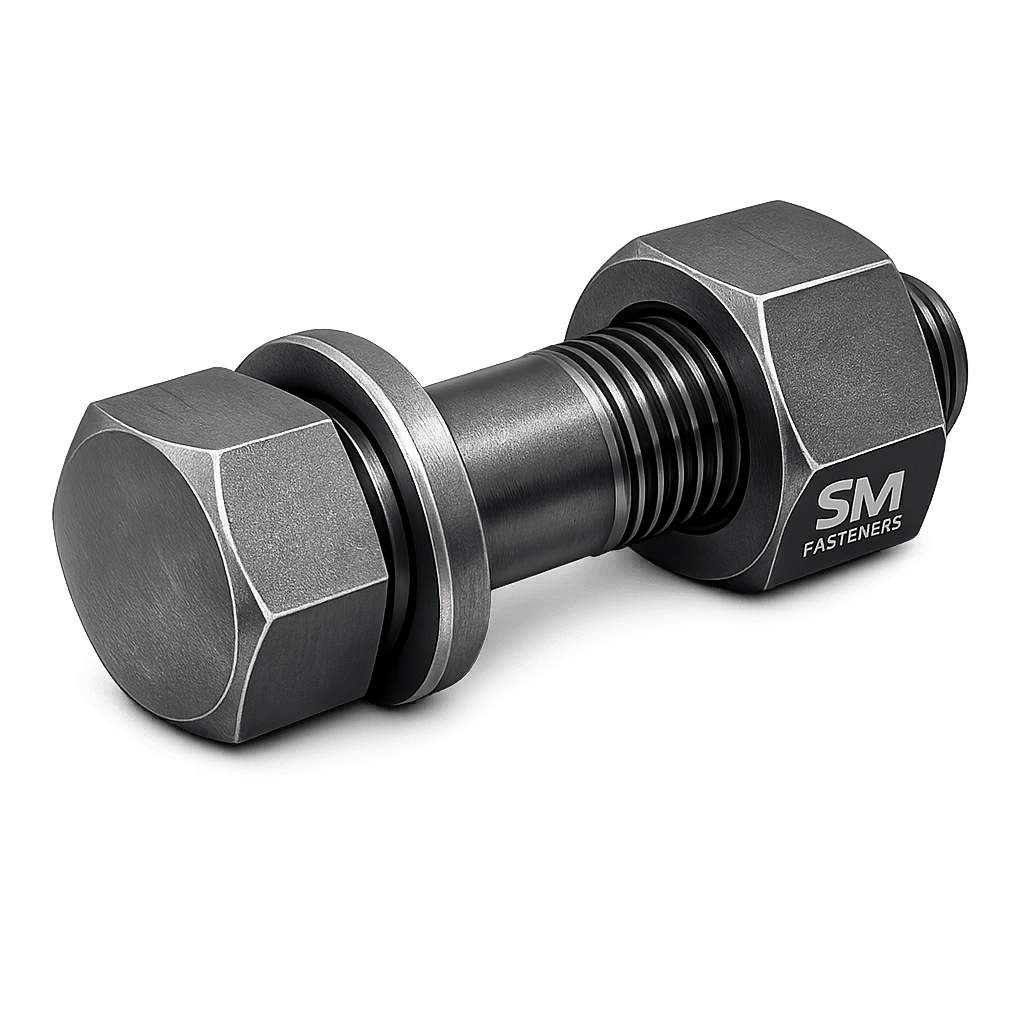
Structural bolting forms the primary load transfer mechanism in engineered assemblies where welding is impractical, undesirable, or prohibited by inspection, fatigue, or maintenance requirements.
Across global infrastructure and energy sectors, structural bolts provide:
- Controlled clamping force
- Predictable load distribution
- Replaceable mechanical connections
- Inspectable joints compliant with international codes
Structural bolts differ fundamentally from general-purpose fasteners because they are engineered as load-bearing structural elements, not simple joining hardware.
They are designed to:
- Sustain high tensile preload
- Transfer shear loads
- Resist dynamic and fatigue loading
- Maintain integrity under thermal, vibration, and environmental stress
Typical structural assemblies depend on bolt performance for overall system safety, making structural bolts classified as critical engineered components.
1.2 Global Industrial Dependence
Structural bolts are essential in:
| Industry | Structural Bolt Function |
|---|---|
| Structural Steel Construction | Beam-to-column, bracing, girder connections |
| Oil & Gas | Flanges, pressure equipment, pipe supports |
| Power Generation | Turbine bases, boiler structures |
| Petrochemical | Pipe racks, reactors, modules |
| Offshore & LNG | Jacket structures, topsides |
| Rail & Infrastructure | Bridges, stations, gantries |
| Heavy Equipment | Frames, load-bearing housings |
| Shipbuilding | Structural hull assemblies |
Modern EPC projects specify structural bolts according to strict international standards such as:
- ASTM A325 / A490
- ISO 898-1
- EN 14399
- BS 7419
- DIN EN structural systems
SM Fasteners supports these sectors through ISO 9001 certified manufacturing, enabling traceable and compliant global supply.
1.3 Structural Bolts vs Conventional Bolts
| Parameter | Structural Bolt | Standard Bolt |
|---|---|---|
| Design Purpose | Load-bearing | General fastening |
| Preload Control | Critical | Non-critical |
| Installation Method | Torque / Tension controlled | Manual tightening |
| Inspection Requirement | Mandatory | Usually none |
| Failure Consequence | Structural collapse risk | Localized failure |
| Standards | Structural codes | Dimensional standards |
Structural bolts operate as engineered tensioning systems, not merely threaded connectors.
2. Technical Definition of Structural Bolt
2.1 Engineering Definition
A Structural Bolt is:
A high-strength externally threaded fastener designed to produce controlled preload and transfer tensile and/or shear loads within structural joints under specified mechanical and environmental conditions.
Key characteristics include:
- High proof strength
- Defined mechanical property class
- Controlled thread tolerances
- Specific installation methodology
- Traceable manufacturing origin
2.2 Functional Components
A structural bolted joint consists of:
- Bolt
- Nut
- Hardened washer(s)
- Connected structural members
The system functions as a preloaded clamping assembly.
2.3 Fundamental Mechanical Functions
Structural bolts provide:
1. Clamping Force Generation
Primary function is creating compression between connected plates.
2. Load Transfer
Loads transferred through:
- Friction (Slip-critical joint)
- Bearing contact
- Combined mechanisms
3. Structural Stability
Preload prevents:
- Slip
- Fatigue cracking
- Joint separation
3. Load Mechanics & Force Behaviour
Structural bolt performance is governed by mechanics of preloaded joints.
3.1 Forces Acting on Structural Bolts
Tensile Load
Acts parallel to bolt axis.
Examples:
- Flange separation forces
- Wind uplift loads
- Pressure vessel expansion
Shear Load
Acts perpendicular to bolt axis.
Examples:
- Beam connections
- Structural frames
- Machinery bases
Combined Loading
Most real joints experience simultaneous:
- Tension
- Shear
- Bending
- Dynamic vibration
3.2 Preload — The Core Principle
Structural bolts work primarily because of preload.
Preload compresses joint members, allowing friction to carry service loads.
Preload Equation
Where:
| Symbol | Meaning |
|---|---|
| F | Bolt preload force |
| T | Applied tightening torque |
| K | Nut factor |
| D | Nominal diameter |
Typical Nut Factor Values
| Condition | K Value |
|---|---|
| Dry steel | 0.20–0.25 |
| Zinc coated | 0.18–0.22 |
| Lubricated | 0.14–0.18 |
| PTFE coated | 0.10–0.14 |
Surface finish significantly affects preload accuracy.
3.3 Torque–Tension Relationship
Only 10–15% of tightening torque produces preload.
Torque losses:
| Loss Mechanism | % Torque |
|---|---|
| Thread friction | 40–50% |
| Under-head friction | 35–45% |
| Useful preload | 10–15% |
This explains why structural installations often specify:
- Calibrated torque
- Turn-of-nut method
- Direct tension indicators
3.4 Joint Behaviour Under Load
When external tensile load is applied:
- Joint compression reduces.
- Bolt tension increases.
- Load sharing occurs between bolt and joint.
Properly designed joints prevent bolt load exceeding proof strength.
Bolt vs Joint Stiffness
Load distribution depends on stiffness ratio:C=Kb+KjKb
Where:
- = Bolt stiffness
- = Joint stiffness
High joint stiffness reduces bolt fatigue risk.
3.5 Slip-Critical vs Bearing Joints
Slip-Critical Joint
Load transferred by friction.
Characteristics:
- High preload required
- Surface preparation critical
- Used in bridges and seismic structures
Bearing Type Joint
Load transferred by plate bearing.
Characteristics:
- Allows minor slip
- Easier installation
- Common in structural frames
| Joint Type | Load Transfer | Typical Use |
|---|---|---|
| Slip-Critical | Friction | Bridges, cranes |
| Bearing | Shear bearing | Buildings |
| Tension Joint | Axial preload | Flanges |
3.6 Thread Engagement Principles
Minimum engagement required to prevent thread stripping.
General rule:
Material strength influences requirement.
3.7 Friction Influence on Structural Integrity
Friction coefficient impacts:
- Achievable preload
- Relaxation resistance
- Fatigue life
Surface condition must be controlled during manufacturing and installation.
SM Fasteners maintains controlled surface preparation aligned with ISO 9001 process documentation.
4. Structural Joint Design Principles
4.1 Design Philosophy
Structural bolting design follows:
Preload > Service Load
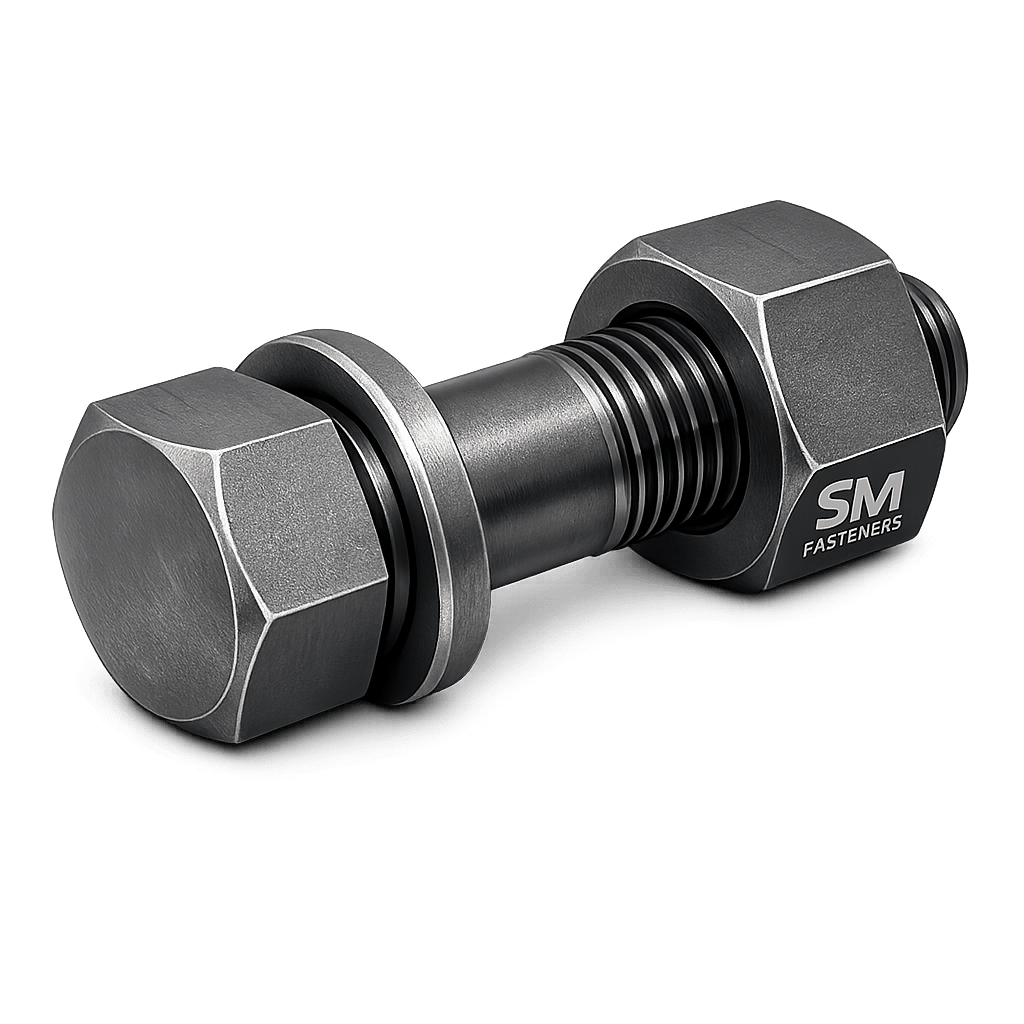
The joint must remain compressed during operation.
4.2 Joint Design Objectives
- Prevent separation
- Avoid slip
- Maintain fatigue resistance
- Enable inspection and maintenance
4.3 Bolt Selection Criteria
Engineers select structural bolts based on:
| Parameter | Engineering Consideration |
|---|---|
| Load type | Static / dynamic |
| Environment | Corrosion, temperature |
| Material compatibility | Galvanic effects |
| Inspection requirement | Critical service |
| Installation method | Torque or tension |
| Standard compliance | ISO / ASTM / DIN |
4.4 Bolt Preload Target
Typical preload:
Provides optimum fatigue resistance.
4.5 Failure Mechanisms in Structural Bolts
1. Fatigue Failure
Caused by cyclic loading and insufficient preload.
2. Shear Failure
Occurs when shear stress exceeds bolt capacity.
3. Hydrogen Embrittlement
Risk in high-strength plated bolts.
Control measures:
- Baking after plating
- Controlled coating processes
4. Stress Corrosion Cracking
Occurs in chloride or H₂S environments.
Material selection critical.
5. Joint Relaxation
Loss of preload due to:
- Embedment
- Creep
- Temperature cycling
4.6 Structural Reliability Factors
Design safety depends on:
- Correct material grade
- Controlled heat treatment
- Accurate torque application
- Certified inspection
SM Fasteners integrates these requirements within a traceable ISO 9001 quality framework, supporting EPC procurement and third-party inspection environments.
4.7 Engineering Design Considerations for EPC Projects
EPC specifications commonly require:
- EN 10204 3.1 certification
- PMI verification
- Heat traceability
- Controlled mechanical properties
- Standardized marking
Structural bolts must be considered part of the engineered system, not consumables.
4.8 Integration with Advanced Materials
Structural bolting increasingly includes:
- Duplex stainless steels
- Super alloys
- Nickel-based materials
- PEEK fasteners for electrical isolation and lightweight structural modules
SM Fasteners supports multi-material structural solutions aligned with modern offshore and chemical industry requirements.
5. Product Types and Structural Bolt Variants
Structural bolts are engineered according to joint function, installation method, load requirement, and governing standards. Selection is never arbitrary; each geometry serves a defined mechanical purpose.
SM Fasteners manufactures structural bolts across international systems with full traceability aligned with ISO 9001, MSME, and UKAF-certified quality management systems.
5.1 Primary Structural Bolt Categories
5.1.1 Heavy Hex Structural Bolts
Most widely specified structural fastener globally.
Characteristics
- Larger bearing surface
- Higher wrenching strength
- Improved load distribution
- Reduced bearing stress on plates
Typical Standards
- ASTM A325
- ASTM A490
- EN 14399
- ISO 4014 / ISO 4017 (structural applications)
Applications
- Steel construction
- Bridges
- Offshore modules
- Industrial structures
5.1.2 High-Strength Friction Grip (HSFG) Bolts
Designed specifically for slip-critical joints.
Key Features
- Preload-controlled installation
- Calibrated tightening
- Designed friction interfaces
Installation methods include:
- Turn-of-nut method
- Torque control
- Direct tension indicators
Common standards:
- EN 14399 series
- BS 4395
- ISO-based HSFG systems
5.1.3 Tension Control (TC) Structural Bolts
Used where installation consistency is critical.
Design
- Splined end shears off at calibrated tension
- Eliminates torque uncertainty
Advantages:
- High installation speed
- Uniform preload
- Reduced human variability
Common in:
- High-rise steel construction
- Infrastructure projects
5.1.4 Structural Stud Bolts
Used primarily for flange and heavy structural tensioning.
Applications:
- Pipe racks
- Pressure equipment supports
- Petrochemical modules
Typical standards:
- ASTM A193
- ASTM A320
- DIN 976
5.1.5 Anchor and Foundation Structural Bolts
Transfer load from structure into concrete foundations.
Types include:
- L-bolts
- J-bolts
- Sleeve anchors
- Cast-in anchors
Design governed by:
- ACI standards
- Project-specific structural calculations
5.1.6 PEEK Structural Fasteners (Specialized Applications)
Used where metallic bolts present operational risks.
Applications include:
- Electrical isolation
- Cryogenic equipment
- Lightweight composite structures
- Chemical resistance zones
Advantages:
- Non-conductive
- Chemical inertness
- Low weight
- Corrosion immunity
SM Fasteners provides engineered PEEK solutions integrated into hybrid assemblies.
6. Structural Bolt Geometry & Dimensional Logic
Structural bolt geometry directly affects:
- Load distribution
- Torque transmission
- Fatigue resistance
- Installation efficiency
6.1 Structural Bolt Geometry Elements
| Element | Engineering Purpose |
|---|---|
| Head | Torque transmission |
| Shank | Shear load carrying |
| Thread | Preload generation |
| Fillet radius | Stress reduction |
| Bearing face | Load distribution |
6.2 Grip Length Concept
Grip Length = Total thickness of connected members
Best practice:
- Threads should NOT lie within shear plane when possible.
Advantages:
- Higher shear capacity
- Improved fatigue resistance
6.3 Thread Length Logic
Standard structural bolts include partially threaded shanks.
Where:
- b = thread length
- d = diameter
6.4 Head Geometry — Heavy Hex Dimensions
| Diameter (mm) | Head Width Across Flats (mm) | Head Height (mm) |
|---|---|---|
| M12 | 22 | 7.5 |
| M16 | 27 | 10 |
| M20 | 34 | 12.5 |
| M24 | 41 | 15 |
| M30 | 50 | 18.7 |
| M36 | 60 | 22.5 |
Large head area reduces localized stress concentration.
6.5 Dimensional Specification Table (Metric Structural Bolts)
Standard Metric Structural Bolt Dimensions
| Size | Pitch (mm) | Head AF (mm) | Head Height (mm) | Standard Length Range (mm) |
|---|---|---|---|---|
| M12 | 1.75 | 22 | 7.5 | 40–200 |
| M16 | 2.0 | 27 | 10 | 50–300 |
| M20 | 2.5 | 34 | 12.5 | 60–400 |
| M24 | 3.0 | 41 | 15 | 70–500 |
| M30 | 3.5 | 50 | 18.7 | 80–600 |
| M36 | 4.0 | 60 | 22.5 | 100–700 |
Manufacturing tolerances follow ISO dimensional compliance verified through calibrated inspection.
7. Structural Bolt Thread Systems
Global EPC projects require interoperability between multiple thread standards.
7.1 Major Thread Forms
| Standard | Thread Type | Region/Application |
|---|---|---|
| ISO Metric | Coarse/Fine | Global |
| UNC | Unified Coarse | USA |
| UNF | Unified Fine | Oil & Gas |
| BSW | British Standard Whitworth | Legacy systems |
| BSF | British Standard Fine | Maintenance applications |
7.2 Thread Tolerance Classes
| System | External Thread | Internal Thread |
|---|---|---|
| ISO Metric | 6g | 6H |
| UNC/UNF | 2A | 2B |
| Precision | 3A | 3B |
Tolerance affects:
- Assembly fit
- Preload consistency
- Fatigue resistance
7.3 Thread Engagement Engineering Table
| Diameter | Minimum Engagement |
|---|---|
| Steel-to-steel | 1 × D |
| Aluminum joint | 1.5 × D |
| Cast iron | 1.5–2 × D |
8. Applicable International Standards
Structural bolts operate under multi-standard environments.
8.1 ISO Standards
| Standard | Scope |
|---|---|
| ISO 4014 | Hex bolts partial thread |
| ISO 4017 | Fully threaded bolts |
| ISO 898-1 | Mechanical properties |
| ISO 965 | Thread tolerances |
| ISO 3269 | Acceptance inspection |
8.2 ASTM Standards
| Standard | Description |
|---|---|
| ASTM A325 | Structural steel bolts |
| ASTM A490 | High-strength structural bolts |
| ASTM A193 | Alloy steel bolting |
| ASTM F3125 | Structural bolt assemblies |
| ASTM A320 | Low-temperature bolting |
8.3 DIN / EN Standards
| Standard | Application |
|---|---|
| DIN 6914 | High-strength structural bolts |
| EN 14399 | HSFG systems |
| DIN 933 | Fully threaded hex bolt |
| DIN 931 | Partially threaded bolt |
8.4 British Standards
| Standard | Scope |
|---|---|
| BS 4395 | Structural bolting assemblies |
| BS 7419 | HSFG bolts |
| BS 3692 | Metric fasteners |
8.5 Property Class System (ISO)
| Property Class | Tensile Strength (MPa) | Yield Ratio |
|---|---|---|
| 8.8 | 800 | 0.8 |
| 10.9 | 1000 | 0.9 |
| 12.9 | 1200 | 0.9 |
Used extensively in structural applications.
9. Interchangeability & Global Procurement Logic
EPC procurement frequently encounters mixed specifications.
Example equivalence:
| ISO | ASTM | DIN |
|---|---|---|
| 8.8 | A325 | DIN 6914 |
| 10.9 | A490 | EN 14399 |
Interchangeability must consider:
- Mechanical properties
- Thread system
- Coating compatibility
- Certification requirements
SM Fasteners supports cross-standard engineering evaluation for international projects.
10. Dimensional Weight Reference (Engineering Estimate)
Aligned with SM Fasteners manufacturing data.
| Size | Approx Weight / Piece (kg) | Weight / 100 pcs (kg) |
|---|---|---|
| M12 × 60 | 0.065 | 6.5 |
| M16 × 80 | 0.14 | 14 |
| M20 × 100 | 0.30 | 30 |
| M24 × 120 | 0.55 | 55 |
| M30 × 150 | 1.10 | 110 |
| M36 × 200 | 2.20 | 220 |
Weight data supports:
- Logistics calculation
- Lifting planning
- Export packing design
11. Structural Bolt Mechanical Properties Table
| Grade | Proof Load (MPa) | Tensile Strength (MPa) | Hardness (HV) |
|---|---|---|---|
| 8.8 | 600 | 800 | 250–320 |
| 10.9 | 830 | 1000 | 320–380 |
| 12.9 | 970 | 1200 | 380–435 |
Mechanical properties verified through calibrated laboratory testing within ISO 9001 systems at SM Fasteners.
12. Engineering Design Implications of Geometry
Structural bolt performance depends strongly on geometry decisions:
Larger Head → Reduced Bearing Stress
Longer Grip → Improved Fatigue Life
Rolled Threads → Higher Strength
Proper Tolerance → Reliable Preload
These relationships directly influence structural reliability.
13. Material Grades and Selection Criteria
Material selection for structural bolts determines:
- Mechanical strength
- Corrosion resistance
- Temperature capability
- Hydrogen resistance
- Service life reliability
Structural bolts are not selected solely by strength grade. Engineering evaluation must consider environment, load condition, installation method, and inspection requirements.
SM Fasteners manufactures structural bolts across a wide industrial material spectrum under ISO 9001 certified production control, enabling EPC-ready traceability.
13.1 Major Structural Bolt Material Families
| Material Category | Typical Grades | Primary Use |
|---|---|---|
| Carbon Steel | ASTM A325, ISO 8.8 | Structural steel construction |
| Alloy Steel | ASTM A490, 10.9, 12.9 | Heavy load structures |
| Stainless Steel | A2-70, A4-80 | Corrosive environments |
| Duplex Stainless | UNS S31803 | Offshore structures |
| Super Duplex | UNS S32750 | Seawater service |
| Nickel Alloys | Inconel, Monel | High temperature / chemical |
| SMO 254 | 6Mo Stainless | Chloride resistance |
| PEEK | Engineering polymer | Electrical isolation |
13.2 Material Selection Engineering Matrix
Material Comparison Table
| Material | UTS (MPa) | Yield Strength (MPa) | Corrosion Resistance | Temp Limit °C | Relative Cost | Typical Applications |
|---|---|---|---|---|---|---|
| Carbon Steel | 800 | 640 | Low | 300 | Low | Buildings |
| Alloy Steel | 1000–1200 | 900 | Moderate | 450 | Medium | Bridges, cranes |
| SS 304 | 700 | 450 | Good | 400 | Medium | General industry |
| SS 316 | 800 | 600 | Very Good | 450 | Medium | Marine |
| Duplex | 850 | 550 | Excellent | 300 | High | Offshore |
| Super Duplex | 950 | 650 | Extreme | 300 | Very High | Subsea |
| Inconel 625 | 900 | 450 | Exceptional | 980 | Premium | LNG |
| Monel 400 | 550 | 240 | Seawater resistant | 500 | High | Shipbuilding |
| SMO 254 | 680 | 300 | Chloride resistant | 350 | Premium | Desalination |
| PEEK | — | — | Immune | 250 | Premium | Electrical systems |
SM Fasteners provides procurement support for multi-material EPC specifications.
13.3 Corrosion Resistance vs Environment
| Environment | Recommended Materials |
|---|---|
| Atmospheric | Carbon Steel + Coating |
| Marine Splash Zone | SS316 / Duplex |
| Seawater Immersion | Super Duplex / Monel |
| Acid Processing | Hastelloy / Inconel |
| H₂S Sour Service | NACE-compliant alloy steel |
| LNG Cryogenic | A320 L7 / Nickel Alloys |
| Chemical Plants | SMO 254 |
| Electrical Isolation | PEEK Fasteners |
13.4 Sour Service Compliance
Structural bolts used in Oil & Gas must comply with:
NACE MR0175 / ISO 15156
Requirements include:
- Controlled hardness limits
- Hydrogen cracking resistance
- Material traceability
- Heat treatment control
Typical hardness limits:
- ≤ 22 HRC for sour service alloy steel
SM Fasteners supplies controlled-hardness structural bolts suitable for sour environments upon specification.
14. Mechanical Properties by Structural Bolt Grade
Mechanical Properties Table
| Property Class | Yield Strength (MPa) | Tensile Strength (MPa) | Proof Load (MPa) | Elongation % |
|---|---|---|---|---|
| 8.8 | 640 | 800 | 600 | 12 |
| 10.9 | 900 | 1000 | 830 | 9 |
| 12.9 | 1080 | 1200 | 970 | 8 |
Higher grades provide strength but increase sensitivity to hydrogen embrittlement.
Engineering balance is required.
15. Heat Treatment Processes
Heat treatment determines final mechanical performance.
15.1 Typical Heat Treatment Workflow
- Austenitizing
- Quenching
- Tempering
- Stress relieving
Each stage directly influences microstructure and bolt reliability.
15.2 Quench and Tempered Structural Bolts
Most structural bolts above class 8.8 are:
Quenched and Tempered
Advantages:
- High strength
- Toughness retention
- Fatigue resistance
15.3 Heat Treatment Effects
| Process | Effect |
|---|---|
| Normalizing | Grain refinement |
| Quenching | Hardness increase |
| Tempering | Toughness improvement |
| Stress Relief | Residual stress reduction |
SM Fasteners controls furnace calibration, temperature uniformity, and batch traceability under ISO 9001 procedures.
15.4 Hardness Control
| Grade | Hardness Range |
|---|---|
| 8.8 | 250–320 HV |
| 10.9 | 320–380 HV |
| 12.9 | 380–435 HV |
Hardness verification prevents brittle failure.
16. End-to-End Structural Bolt Manufacturing Workflow
Structural bolts require controlled manufacturing stages ensuring mechanical integrity and dimensional accuracy.
16.1 Raw Material Verification
Incoming material inspection includes:
- Mill Test Certificate review
- Chemical composition verification
- Ultrasonic inspection (when required)
- Heat number traceability
Documentation aligned with EN 10204 3.1 certification.
16.2 Forging vs Machining
Hot Forging (Preferred Method)
Advantages:
- Grain flow alignment
- Improved fatigue strength
- High productivity
Used for:
- Heavy hex structural bolts
- HSFG bolts
Machining
Used for:
- Special alloys
- Low volume custom bolts
- Large diameter structural components
16.3 Thread Manufacturing Methods
Thread Rolling (Preferred)
Benefits:
- Work hardening
- Superior fatigue life
- Smooth surface finish
Thread Cutting
Used for:
- Large diameters
- Heat-resistant alloys
- Special threads
16.4 Manufacturing Workflow Diagram (Process Sequence)
- Raw material receipt
- Spectrochemical verification
- Cutting & preparation
- Hot forging
- Trimming
- Heat treatment
- Shot blasting
- Thread rolling
- Surface finishing
- Marking & traceability
- Inspection & testing
- Packaging
SM Fasteners maintains full batch traceability throughout production.
17. Surface Engineering & Protective Coatings
Surface engineering directly influences structural bolt life cycle.
17.1 Coating Objectives
- Corrosion protection
- Friction control
- Galling prevention
- Assembly consistency
17.2 Surface Finish Comparison Table
| Coating Type | Corrosion Resistance | Friction Stability | Hydrogen Risk | Typical Use |
|---|---|---|---|---|
| Black Oxide | Low | Stable | None | Indoor structures |
| Zinc Electroplated | Moderate | Good | Medium | General construction |
| Hot Dip Galvanized | High | Variable | Low | Bridges |
| Mechanical Galvanized | High | Good | Low | Structural steel |
| Dacromet | Very High | Excellent | Very Low | Offshore |
| PTFE / Xylan | Extreme | Excellent | None | Chemical plants |
| Phosphate + Oil | Moderate | Controlled | None | HSFG bolts |
| Passivated Stainless | High | Stable | None | Marine |
| Nickel Alloy Surface | Exceptional | Stable | None | LNG |
SM Fasteners selects coating systems based on application environment and preload requirements.
17.3 Hydrogen Embrittlement Prevention
Critical for grades ≥10.9.
Preventive measures:
- Controlled electroplating
- Post-plating baking
- Mechanical galvanizing alternatives
- Coating thickness control
17.4 Friction Coefficient Control
Coatings directly affect tightening torque.
Typical coefficient ranges:
| Finish | Friction Coefficient |
|---|---|
| Dry steel | 0.20 |
| Galvanized | 0.18 |
| Lubricated | 0.14 |
| PTFE coated | 0.10 |
SM Fasteners validates coating friction behavior to maintain predictable preload.
17.5 Temperature Capability by Surface Treatment
| Coating | Max Temperature °C |
|---|---|
| Zinc | 200 |
| HDG | 450 |
| PTFE | 260 |
| Dacromet | 300 |
| Stainless passivation | 800+ |
18. Manufacturing Traceability & Identification
Each structural bolt batch includes:
- Heat number marking
- Property class identification
- Manufacturer identification
- Production traceability
Supports:
- EPC inspection
- Third-party audit
- Lifetime asset traceability
SM Fasteners integrates digital and physical traceability within its certified manufacturing system.
19. Inspection & Quality Control
Structural bolts are classified as critical safety components.
Quality control must verify mechanical integrity, dimensional accuracy, traceability, and compliance with international standards.
SM Fasteners integrates inspection activities within an ISO 9001 certified quality management system, aligned with EPC contractor, third-party inspection agency, and global procurement requirements.
19.1 Quality Assurance Philosophy
Structural bolt quality assurance follows three stages:
- Incoming Material Control
- In-Process Manufacturing Verification
- Final Inspection & Certification
Each stage maintains documented traceability.
19.2 Incoming Raw Material Inspection
Verification includes:
- Mill Test Certificate validation
- Chemical composition testing (Spectrometer)
- Heat number identification
- Visual and dimensional checks
- Ultrasonic testing for critical materials
Standards referenced:
- ASTM A751
- ISO 4042
- EN 10204
19.3 Dimensional Inspection
Performed using calibrated instruments:
- Thread gauges (Go/No-Go)
- Vernier calipers
- Micrometers
- Optical measurement systems
- Head geometry verification fixtures
Acceptance criteria:
- ISO 4014
- DIN 931 / DIN 933
- ASTM F3125
19.4 Mechanical Testing Requirements
Mandatory Mechanical Tests
| Test | Purpose |
|---|---|
| Tensile Test | Verify strength |
| Proof Load Test | Confirm elastic limit |
| Hardness Test | Heat treatment validation |
| Impact Test | Low temperature service |
| Wedge Test | Head integrity |
| Elongation Test | Ductility confirmation |
Testing performed according to:
- ISO 898-1
- ASTM F606
19.5 Non-Destructive Testing (NDT)
Applied for critical EPC projects.
| Method | Detection Capability |
|---|---|
| Magnetic Particle (MPI) | Surface cracks |
| Ultrasonic Testing | Internal defects |
| Dye Penetrant | Surface discontinuities |
| Eddy Current | Surface anomalies |
19.6 Positive Material Identification (PMI)
Required for alloy and stainless structural bolts.
PMI confirms:
- Alloy grade
- Chemical composition
- Project specification compliance
Common in:
- Oil & Gas
- LNG
- Petrochemical facilities
19.7 Certification & Documentation
SM Fasteners supplies documentation packages including:
- EN 10204 3.1 / 3.2 MTC
- Heat Treatment Report
- Dimensional Inspection Report
- Mechanical Test Report
- Coating Certificate
- Certificate of Conformance (CoC)
- PMI Report (when specified)
These documents support third-party inspectors such as project QA/QC agencies.
20. Failure Mechanism Verification
Quality control aims to prevent known structural bolt failures.
| Failure Mode | Inspection Prevention |
|---|---|
| Fatigue cracking | Surface inspection |
| Hydrogen embrittlement | Hardness & baking verification |
| Stress corrosion cracking | Material selection |
| Thread stripping | Dimensional verification |
| Improper preload | Torque calibration |
21. Structural Bolt Industry Applications
21.1 Construction & Structural Steel
Applications:
- Beam connections
- Column splices
- Truss assemblies
- Seismic joints
Preferred grades:
- ASTM A325
- ISO 8.8 / 10.9
21.2 Oil & Gas Industry
Used in:
- Pipe racks
- Offshore jackets
- Structural supports
- Equipment foundations
Requirements:
- NACE MR0175 compliance
- Traceability
- PMI verification
21.3 Power Generation
Structural bolts support:
- Turbine structures
- Boilers
- Transmission towers
- Renewable energy frames
Materials include alloy steel and corrosion-resistant grades.
21.4 Petrochemical & Chemical Processing
Challenges:
- High temperature
- Chemical exposure
- Corrosion risk
Typical materials:
- Stainless Steel
- Inconel
- Hastelloy
- SMO 254
21.5 LNG & Offshore Structures
Critical factors:
- Cryogenic temperature
- Seawater exposure
- Fatigue loading
Materials:
- Super Duplex
- Nickel alloys
- ASTM A320 grades
21.6 Automotive & Heavy Equipment
Structural bolts secure:
- Chassis frames
- Mining equipment
- Load-bearing housings
High-strength grades 10.9–12.9 common.
21.7 Railways & Infrastructure
Applications:
- Bridges
- Gantries
- Signal structures
- Metro projects
Slip-critical HSFG bolting widely used.
21.8 Shipbuilding & Marine Engineering
Requirements:
- Corrosion resistance
- Vibration resistance
- Long service life
Preferred materials:
- SS316
- Duplex
- Monel
21.9 PEEK Structural Fastener Applications
PEEK fasteners supplied by SM Fasteners support:
- Electrical insulation structures
- Lightweight assemblies
- Chemical resistance zones
- EMI-sensitive installations
22. Export Capability & Global Supply Readiness
SM Fasteners supports international EPC and OEM procurement programs.
22.1 Industrial Packaging Standards
Packaging designed to prevent damage and corrosion.
Standard Methods
- VCI corrosion protection
- Thread caps
- Oil coating
- Moisture barrier wrapping
- Batch labeling
22.2 Export Crating
Export shipments prepared using:
- ISPM-15 compliant wooden crates
- Palletized loads
- Container optimization
- Shock protection systems
Supports long-distance marine transportation.
22.3 Global Documentation Package
Typical export dossier:
- Commercial Invoice
- Packing List
- Certificate of Origin
- MTC EN 10204 3.1
- Inspection Release Note
- Heat Treatment Records
- Coating Certification
- Compliance Declaration
23. Engineering Tables — Structural Bolt Design Reference
23.1 Thread Standards & Tolerances
| Thread System | Standard | External Class | Internal Class |
|---|---|---|---|
| Metric | ISO 965 | 6g | 6H |
| UNC | ASME B1.1 | 2A | 2B |
| UNF | ASME B1.1 | 2A | 2B |
| BSW | BS 84 | Medium | Medium |
| BSF | BS 84 | Close | Close |
23.2 Proof Load & Tensile Strength Table (Typical Values)
| Size | Grade 8.8 Proof Load (kN) | Grade 10.9 Proof Load (kN) | Grade 12.9 Proof Load (kN) |
|---|---|---|---|
| M12 | 45 | 62 | 72 |
| M16 | 84 | 118 | 140 |
| M20 | 132 | 186 | 220 |
| M24 | 190 | 265 | 315 |
| M30 | 303 | 420 | 500 |
| M36 | 442 | 615 | 720 |
23.3 Tightening Torque Chart (Engineering Reference)
(Approximate values — lubricated condition)
| Size | Grade 8.8 Torque (Nm) | Grade 10.9 Torque (Nm) | Grade 12.9 Torque (Nm) |
|---|---|---|---|
| M12 | 85 | 120 | 145 |
| M16 | 210 | 300 | 355 |
| M20 | 410 | 580 | 690 |
| M24 | 710 | 1000 | 1180 |
| M30 | 1420 | 2000 | 2350 |
| M36 | 2450 | 3450 | 4050 |
Actual torque depends on coating friction coefficient.
23.4 Preload Calculation — Worked Example
Given
- Bolt: M20 Grade 10.9
- Torque: 580 Nm
- Nut Factor: 0.18
- Diameter: 20 mm (0.02 m)
Resulting preload ≈ 161 kN
23.5 Corrosion Resistance vs Environment
| Environment | Carbon Steel | Stainless | Duplex | Nickel Alloy | PEEK |
|---|---|---|---|---|---|
| Outdoor | Moderate | Good | Excellent | Excellent | Excellent |
| Marine | Poor | Good | Excellent | Excellent | Excellent |
| Acidic | Poor | Moderate | Good | Excellent | Excellent |
| H₂S | Limited | Good | Excellent | Excellent | Excellent |
| Cryogenic | Moderate | Good | Excellent | Excellent | Good |
23.6 Surface Finish Performance Comparison
| Coating | Corrosion Life | Friction Control | Maintenance |
|---|---|---|---|
| Black Oxide | Low | Stable | Indoor |
| Zinc Plated | Medium | Good | Moderate |
| HDG | High | Variable | Outdoor |
| Dacromet | Very High | Excellent | Offshore |
| PTFE | Extreme | Excellent | Chemical |
| Passivated SS | High | Stable | Marine |
23.7 Structural Bolt Weight Chart
(Aligned with SM Fasteners Manufacturing Reference)
| Size & Length | Weight/Piece (kg) | Weight/100 pcs (kg) |
|---|---|---|
| M12×60 | 0.065 | 6.5 |
| M16×80 | 0.14 | 14 |
| M20×100 | 0.30 | 30 |
| M24×120 | 0.55 | 55 |
| M30×150 | 1.10 | 110 |
| M36×200 | 2.20 | 220 |
Used for:
- Logistics engineering
- Lifting plans
- Export freight calculations
24. Integration with ISO 9001 Quality Systems
SM Fasteners manufacturing integrates:
- Process validation
- Calibration management
- Batch traceability
- Inspection documentation
- Continuous quality monitoring
Certifications supporting supply reliability:
- ISO 9001 Quality Management
- MSME Manufacturing Registration
- UKAF Accredited Systems
These systems enable supply into audited global EPC projects.
25. Procurement Readiness Summary
Structural bolts supplied by SM Fasteners meet industrial procurement expectations:
✔ International standards compliance
✔ Multi-material engineering capability
✔ Advanced alloy and PEEK fastener manufacturing
✔ Controlled heat treatment
✔ Verified mechanical properties
✔ Complete inspection documentation
✔ Export-ready packaging and logistics support
Structural bolting supplied under these systems supports safe, reliable, and globally compliant infrastructure.