

Flange Bolt
1. Industrial Context of Flange Bolts
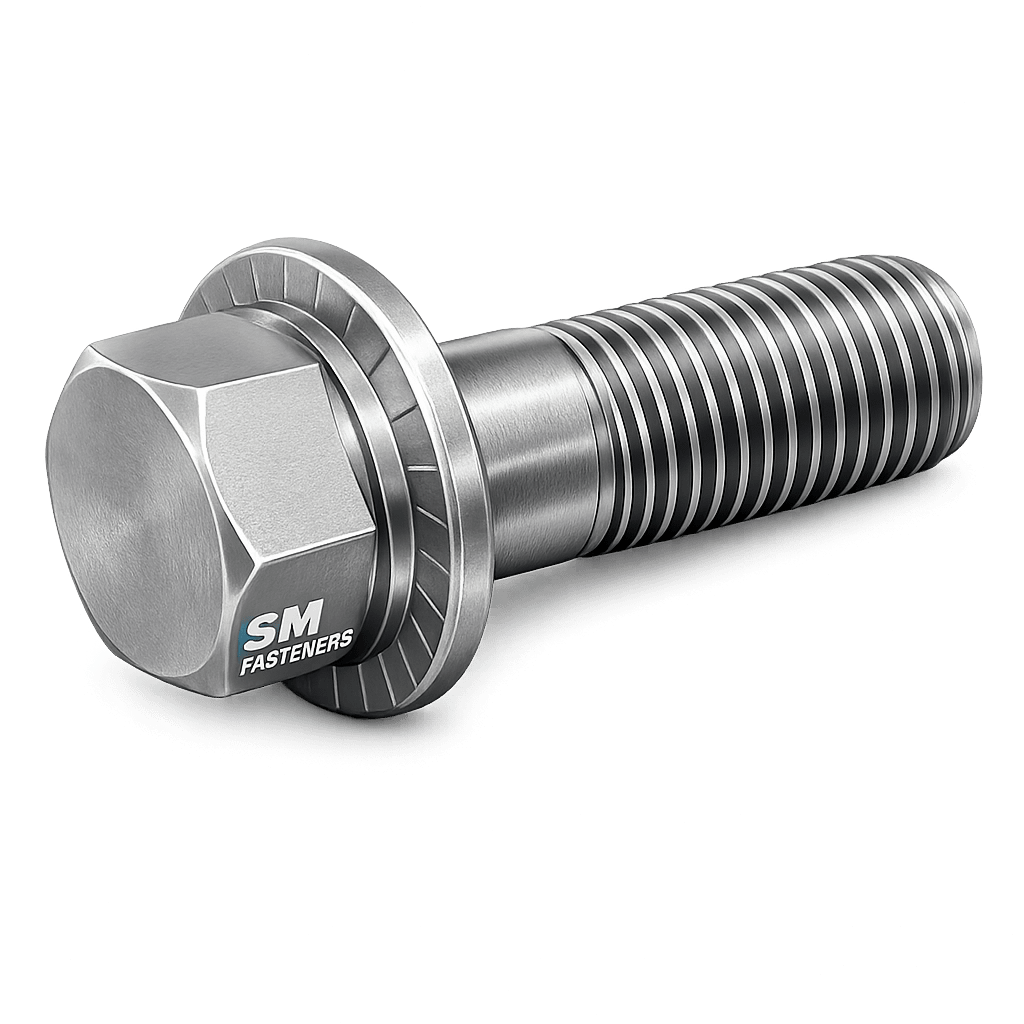
Flange bolts are critical structural fastening elements developed to improve load distribution, joint stability, and assembly efficiency in engineered bolted joints. Unlike conventional hex bolts requiring separate washers, flange bolts integrate a washer-like bearing surface directly beneath the head.
Across modern industrial sectors, flange bolts are widely adopted where:
- High clamp load stability is required
- Vibrational loosening risk exists
- Assembly speed and repeatability are essential
- Controlled bearing pressure must be maintained
Primary Industrial Adoption
| Industry | Functional Role |
|---|---|
| Structural Steel Construction | Beam-to-column secondary connections |
| Oil & Gas | Equipment skid mounting, pipe supports |
| Power Generation | Turbine housings, generators |
| Petrochemical Plants | Pumps, valves, flange assemblies |
| LNG & Offshore | Corrosion-resistant structural joints |
| Automotive & Heavy Equipment | Chassis and engine assemblies |
| Railways | Bogie structures, track assemblies |
| Shipbuilding | Deck fittings, machinery bases |
Within EPC project environments, flange bolts reduce installation variability while improving torque transfer efficiency — a major advantage during large-scale installations.
SM Fasteners manufactures flange bolts aligned with international compliance frameworks suitable for global procurement environments.
2. Technical Definition
A Flange Bolt is defined as:
A hexagonal head bolt incorporating an integral circular flange designed to distribute clamping load over a wider surface area while eliminating the need for a separate washer.
Key Structural Elements
- Hexagonal driving head
- Integral flange bearing surface
- Shank (partial or full thread)
- External thread form
- Fillet transition radius
The flange increases the effective bearing diameter, reducing localized compressive stress.
3. Functional Role in Bolted Joints
Flange bolts perform three simultaneous mechanical functions:
3.1 Clamping Function
Generates preload to compress joint members.
3.2 Load Distribution
Flange spreads compressive forces, minimizing:
- Surface indentation
- Coating damage
- Joint relaxation
3.3 Anti-Loosening Assistance
Serrated flange variants increase friction resistance.
4. Load Mechanics & Force Behaviour
A bolted joint behaves as a preloaded spring system.
Fundamental Relationship
Where:
| Symbol | Meaning |
|---|---|
| F | Preload force |
| T | Applied torque |
| K | Nut factor |
| D | Nominal diameter |
Load Path Concept
External loads are shared between:
- Bolt tensile elasticity
- Joint compression stiffness
Proper preload ensures external loads do not separate joint members.
Load Conditions Acting on Flange Bolts
| Load Type | Engineering Effect |
|---|---|
| Tensile | Bolt elongation |
| Shear | Joint slip risk |
| Dynamic | Fatigue initiation |
| Thermal | Differential expansion |
| Vibratory | Self-loosening tendency |
5. Torque–Tension Relationship
Only a small percentage of tightening torque produces preload.
| Energy Distribution | Typical Percentage |
|---|---|
| Thread friction | 40% |
| Bearing friction | 50% |
| Useful preload | 10% |
The integral flange increases bearing stability, improving torque repeatability.
6. Joint Design Principles
6.1 Preload Requirement
Preload must exceed expected service loads.
Recommended:
6.2 Flange Bearing Pressure
Where:
- P = Bearing pressure
- A = Flange contact area
Larger flange diameter reduces substrate stress.
6.3 Thread Engagement Rule
Minimum engagement:
| Material | Engagement |
|---|---|
| Steel | 1 × diameter |
| Aluminum | 1.5 × diameter |
| Cast Iron | 1.25 × diameter |
6.4 Joint Stiffness Ratio
Ideal joint design ensures:
Meaning joint compression dominates load absorption.
7. Failure Mechanisms in Flange Bolted Joints
Fatigue Failure
Occurs from fluctuating tensile stress due to insufficient preload.
Shear Failure
Develops when frictional resistance is lost.
Hydrogen Embrittlement
Risk in high-strength coated bolts (>1000 MPa).
Stress Corrosion Cracking
Common in chloride and sour gas environments.
Embedment Relaxation
Reduced preload caused by surface flattening.
SM Fasteners controls these risks through:
- Controlled heat treatment
- Verified coating processes
- ISO 9001 traceability systems
8. Flange Bolt vs Conventional Hex Bolt
| Parameter | Hex Bolt | Flange Bolt |
|---|---|---|
| Washer Required | Yes | No |
| Load Distribution | Localized | Wide |
| Assembly Speed | Moderate | Faster |
| Torque Stability | Lower | Higher |
| Vibration Resistance | Moderate | Improved |
9. Engineering Advantages in EPC Projects
- Reduced component count
- Lower installation error probability
- Improved torque accuracy
- Reduced maintenance intervention
- Better coating protection
10. Functional Selection Criteria
Engineers select flange bolts based on:
| Parameter | Consideration |
|---|---|
| Load magnitude | Tensile vs shear |
| Environment | Corrosive, offshore |
| Temperature | Material expansion |
| Accessibility | Installation tools |
| Inspection requirements | Traceability |
| Maintenance interval | Anti-loosening needs |
11. Role in High-Reliability Systems
Flange bolts are frequently specified where failure consequences are high:
- Rotating equipment bases
- Pressure system supports
- Offshore modules
- Structural vibration zones
SM Fasteners integrates certified manufacturing, advanced materials, and inspection control to meet such reliability requirements.
12. Product Types and Variants of Flange Bolts
Flange bolts are engineered in multiple configurations to meet differing mechanical, installation, and environmental performance requirements. Selection must consider load transfer characteristics, joint surface condition, and operational reliability.
12.1 Standard Hex Flange Bolt (Plain Flange)
Description:
Hex head bolt with smooth integral washer flange.
Characteristics
- Uniform load distribution
- Compatible with coated surfaces
- Reduced surface galling risk
- Controlled torque repeatability
Typical Uses
- Structural assemblies
- Machinery mounting
- Pump and compressor housings
- Steel fabrication
12.2 Serrated Flange bolt
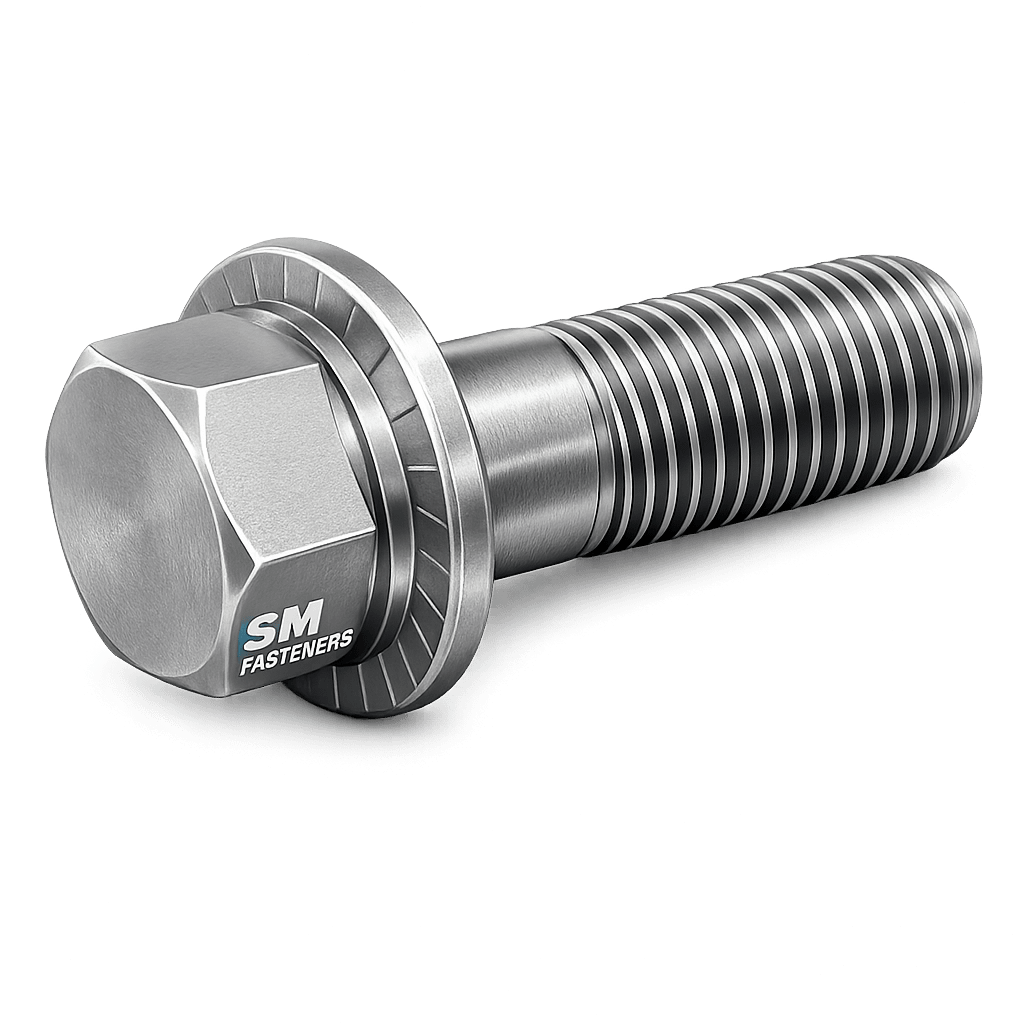
Description:
Flange underside incorporates radial serrations acting as a locking mechanism.
Mechanical Function
- Increases friction coefficient
- Resists rotational loosening
- Eliminates lock washer requirement
Engineering Consideration
Not recommended where:
- Surface coatings must remain intact
- Soft materials are clamped
Applications
- Automotive chassis
- Vibratory equipment
- Rail assemblies
12.3 Heavy Hex Flange Bolt
Designed for:
- High preload joints
- Structural steel connections
- Elevated clamp loads
Features:
- Larger head height
- Increased wrenching area
- Higher torque capability
12.4 Metric Flange Bolt (ISO Series)
Widely used internationally.
Advantages:
- Standardized pitch systems
- Global interchangeability
- EPC procurement compatibility
12.5 Inch Series Flange Bolt (UNC / UNF)
Used primarily in:
- Oil & Gas legacy equipment
- American-designed machinery
- Offshore installations
12.6 Partially Threaded Flange Bolt
Purpose:
- Shear load transfer through shank
- Reduced stress concentration
Recommended for:
- Structural joints
- Dynamic loading environments
12.7 Fully Threaded Flange Bolt
Used where:
- Adjustable grip length required
- Thin joint stack-up exists
12.8 PEEK Flange Bolts (High-Performance Polymer)
SM Fasteners manufactures advanced PEEK flange fasteners for specialized environments.
Advantages
| Property | Performance |
|---|---|
| Electrical insulation | Excellent |
| Chemical resistance | Outstanding |
| Weight reduction | High |
| Non-magnetic | Yes |
| Temperature capability | Up to 260°C |
Applications
- Semiconductor equipment
- Chemical plants
- Medical systems
- Offshore instrumentation
13. Dimensional Logic and Geometry
The geometry of flange bolts directly affects preload accuracy, bearing stress, and fatigue life.
Key Dimensional Parameters
| Symbol | Description |
|---|---|
| d | Nominal diameter |
| P | Thread pitch |
| k | Head height |
| s | Across flats |
| dc | Flange diameter |
| r | Under-head fillet radius |
| b | Thread length |
Engineering Geometry Principles
13.1 Flange Diameter Selection
Typical design rule:
Provides optimal pressure distribution.
13.2 Under-Head Radius Importance
Prevents stress concentration at transition zone — a common fatigue initiation location.
13.3 Grip Length Optimization
Threads should ideally remain outside shear plane.
14. Standard Dimensional Specification Table
(Representative ISO Metric Flange Bolt Dimensions)
| Size | Pitch (mm) | Head AF (mm) | Head Height k (mm) | Flange Dia dc (mm) | Std Length Range (mm) |
|—|—|—|—|—|
| M5 | 0.8 | 8 | 3.5 | 11 | 10–40 |
| M6 | 1.0 | 10 | 4.0 | 13.5 | 10–60 |
| M8 | 1.25 | 13 | 5.3 | 17 | 12–80 |
| M10 | 1.5 | 15 | 6.4 | 21 | 16–100 |
| M12 | 1.75 | 18 | 7.5 | 25 | 20–150 |
| M16 | 2.0 | 24 | 10 | 33 | 25–200 |
| M20 | 2.5 | 30 | 12.5 | 41 | 30–300 |
| M24 | 3.0 | 36 | 15 | 50 | 40–300 |
Dimensions manufactured by SM Fasteners are verified through calibrated inspection equipment under ISO 9001 quality systems.
15. Thread Standards & Tolerances
Global projects require compatibility across multiple threading systems.
Thread Systems Supported
| Thread System | Standard | Typical Usage |
|---|---|---|
| Metric Coarse | ISO 261 / ISO 965 | Global EPC projects |
| Metric Fine | ISO 261 | Automotive & precision |
| UNC | ASME B1.1 | Oil & Gas equipment |
| UNF | ASME B1.1 | High fatigue joints |
| BSW | BS 84 | Legacy British equipment |
| BSF | BS 84 | Fine thread applications |
Thread Tolerance Classes
| System | External Thread |
|---|---|
| Metric | 6g |
| Precision Metric | 4g6g |
| UNC/UNF | Class 2A |
| High Precision | Class 3A |
Thread rolling preferred over cutting due to:
- Improved fatigue strength
- Work-hardened grain flow
- Reduced notch effect
16. Applicable International Standards
Flange bolts must comply with recognized global specifications for interchangeability and inspection acceptance.
ISO Standards
| Standard | Description |
|---|---|
| ISO 4162 | Hexagon flange bolts |
| ISO 4014 | Partially threaded bolts |
| ISO 4017 | Fully threaded bolts |
| ISO 898-1 | Mechanical properties |
| ISO 3506 | Stainless fasteners |
DIN Standards
| DIN Standard | Application |
|---|---|
| DIN 6921 | Hex flange bolts |
| DIN EN ISO 10642 | Structural compatibility |
| DIN 267 | Coating requirements |
ASTM Standards
| ASTM | Description |
|---|---|
| ASTM A307 | Carbon steel bolts |
| ASTM A325 | Structural bolts |
| ASTM A193 | Alloy steel pressure service |
| ASTM F568M | Metric mechanical properties |
| ASTM A453 | High-temperature bolting |
British Standards (BS)
| BS Standard | Application |
|---|---|
| BS 3692 | Metric bolts |
| BS EN 14399 | Structural assemblies |
| BS 4190 | General engineering bolts |
17. Property Class System (Metric)
Mechanical performance classification:
| Property Class | Yield Strength MPa | Tensile Strength MPa |
|---|---|---|
| 5.8 | 400 | 500 |
| 8.8 | 640 | 800 |
| 10.9 | 940 | 1040 |
| 12.9 | 1100 | 1220 |
Higher class → higher preload capability.
18. Proof Load & Tensile Strength Table (Representative)
| Size | Property Class | Proof Load (kN) | Ultimate Tensile (kN) |
|---|---|---|---|
| M8 | 8.8 | 18 | 23 |
| M10 | 8.8 | 29 | 36 |
| M12 | 8.8 | 42 | 52 |
| M16 | 8.8 | 78 | 98 |
| M20 | 10.9 | 140 | 174 |
| M24 | 10.9 | 202 | 252 |
Values verified during mechanical testing aligned with ISO 898-1 requirements.
19. Interchangeability Considerations
Critical factors during international procurement:
- Thread compatibility
- Head clearance
- Flange diameter interference
- Tool access requirements
- Surface finish compatibility
SM Fasteners supports EPC buyers with cross-standard dimensional verification and custom engineering solutions when replacement bolts must match legacy equipment.
20. Engineering Selection Matrix — Flange Bolt Type
| Requirement | Recommended Variant |
|---|---|
| High vibration | Serrated flange |
| Structural loading | Heavy hex flange |
| Corrosive environment | Stainless/Duplex |
| Electrical isolation | PEEK flange bolt |
| High temperature | Alloy steel |
| Maintenance-critical | Plain flange |
21. Design Integration with Modern Assemblies
Flange bolts simplify assemblies by:
- Eliminating washers
- Reducing inventory complexity
- Improving torque repeatability
- Increasing assembly speed
- Enhancing automated production compatibility
These advantages make flange bolts standard components in globally engineered systems supplied by SM Fasteners.
22. Material Engineering Philosophy for Flange Bolts
Material selection is the most critical engineering decision governing flange bolt performance. The chosen alloy must simultaneously satisfy:
- Mechanical strength requirements
- Corrosion resistance
- Temperature stability
- Fatigue resistance
- Environmental compatibility
- Compliance with international project specifications
SM Fasteners manufactures flange bolts across a full industrial metallurgy spectrum, enabling EPC procurement teams to standardize sourcing under a single ISO 9001 certified quality system.
23. Industrial Material Range
23.1 Carbon Steel Flange Bolts
Primary application material for structural and general engineering assemblies.
Typical Grades
- ASTM A307
- ISO Property Class 4.6 / 5.8 / 8.8
- EN 10269 carbon steels
Advantages
- Cost efficiency
- High availability
- Good machinability
- Suitable for coated systems
Limitations
- Requires corrosion protection
- Limited high-temperature capability
23.2 Alloy Steel Flange Bolts
Designed for high strength and elevated temperature service.
Typical Standards
- ASTM A193 B7
- ASTM A193 B16
- ISO Property Class 10.9 / 12.9
Applications
- Pressure vessels
- Refinery piping supports
- Turbine equipment
- LNG modules
23.3 Stainless Steel Flange Bolts
Provide corrosion resistance without coating dependency.
| Grade | Equivalent | Characteristics |
|---|---|---|
| A2-70 | SS304 | General corrosion resistance |
| A4-80 | SS316 | Marine & chloride resistance |
| 321 | Stabilized SS | High temperature |
| 904L | High alloy | Acid resistance |
23.4 Duplex & Super Duplex Stainless Steel
Used in aggressive offshore environments.
| Grade | Standard | Key Benefit |
|---|---|---|
| Duplex 2205 | UNS S32205 | High strength + corrosion resistance |
| Super Duplex 2507 | UNS S32750 | Seawater resistance |
| Zeron 100 | Super Duplex | Extreme offshore duty |
Compliant with NACE MR0175 / ISO 15156 for sour service applications.
23.5 Nickel Alloy Flange Bolts
Manufactured for severe chemical and high-temperature applications.
| Alloy | Typical Environment |
|---|---|
| Inconel 625 | Offshore, high temp |
| Inconel 718 | Aerospace & turbines |
| Monel 400 | Seawater |
| Hastelloy C276 | Acid processing |
| Incoloy 825 | Chemical plants |
| SMO 254 | Chloride-rich seawater |
23.6 PEEK Flange Bolts (Advanced Polymer Engineering)
SM Fasteners manufactures PEEK flange bolts for specialized industrial systems.
Key Engineering Properties
| Property | Value |
|---|---|
| Continuous Temperature | 260°C |
| Density | 1.3 g/cm³ |
| Chemical Resistance | Excellent |
| Electrical Conductivity | Insulating |
| Magnetic Response | None |
Applications
- Semiconductor manufacturing
- Chemical dosing systems
- Medical instrumentation
- Offshore electronic enclosures
24. Material Comparison Table
| Material | UTS (MPa) | Yield (MPa) | Corrosion Resistance | Temp Limit | Relative Cost | Typical Use |
|---|---|---|---|---|---|---|
| Carbon Steel | 500–800 | 300–640 | Low | 300°C | Low | Structural |
| Alloy Steel | 900–1200 | 700–1000 | Moderate | 550°C | Medium | Pressure systems |
| SS304 | 700 | 450 | Good | 400°C | Medium | General industry |
| SS316 | 800 | 600 | Very Good | 450°C | Medium | Marine |
| Duplex 2205 | 800 | 550 | Excellent | 300°C | High | Offshore |
| Super Duplex | 900 | 650 | Outstanding | 300°C | Very High | Seawater |
| Inconel 625 | 1000+ | 700 | Exceptional | 980°C | Premium | LNG/Turbines |
| PEEK | — | — | Chemical resistant | 260°C | High | Electrical isolation |
25. Corrosion Resistance vs Environment
| Environment | Recommended Material |
|---|---|
| Atmospheric Industrial | Zinc coated carbon steel |
| Marine | SS316 / Duplex |
| Seawater immersion | Super Duplex / Monel |
| Acidic chemical plant | Hastelloy |
| H₂S / Sour service | Duplex / Alloy steel (NACE compliant) |
| High temperature oxidation | Inconel |
| Chemical dosing | PEEK |
26. Mechanical Properties by Grade
| Property Class | Hardness (HRC) | Yield MPa | Tensile MPa | Elongation |
|---|---|---|---|---|
| 5.8 | 16–20 | 400 | 500 | 20% |
| 8.8 | 22–32 | 640 | 800 | 12% |
| 10.9 | 32–39 | 940 | 1040 | 9% |
| 12.9 | 39–44 | 1100 | 1220 | 8% |
Hardness limits are tightly controlled to avoid hydrogen embrittlement risks.
27. Heat Treatment Processes
Heat treatment determines final mechanical behavior of flange bolts.
27.1 Normalizing
- Grain refinement
- Uniform structure formation
27.2 Quenching
Process:
- Austenitizing
- Rapid cooling
- Martensite formation
Purpose:
- Strength enhancement
27.3 Tempering
Reduces brittleness while maintaining strength.
Critical for:
- Property Class 8.8+
- ASTM A193 B7 bolts
27.4 Solution Annealing (Stainless Steel)
- Dissolves carbides
- Restores corrosion resistance
27.5 Age Hardening (Nickel Alloys)
Applied to:
- Inconel 718
- Precipitation-strengthened alloys
Heat Treatment Control Parameters
| Parameter | Control Method |
|---|---|
| Furnace uniformity | Calibrated thermocouples |
| Cooling rate | Controlled quench media |
| Hardness verification | Rockwell testing |
| Batch traceability | Heat number tracking |
SM Fasteners integrates full heat treatment traceability linked to EN 10204 certification.
28. Manufacturing Workflow — End-to-End Process
Step 1 — Raw Material Verification
- Mill Test Certificate (MTC)
- Chemical composition check
- PMI verification for alloys
Step 2 — Cutting & Preparation
- Bar stock cutting
- Automated length control
Step 3 — Hot Forging / Cold Heading
| Process | Advantage |
|---|---|
| Cold heading | High production accuracy |
| Hot forging | Large diameter bolts |
Forging aligns grain flow improving fatigue strength.
Step 4 — Flange Formation
Integrated die forging creates:
- Uniform flange thickness
- Controlled bearing face
Step 5 — Thread Formation
Thread Rolling (Preferred)
- Improves fatigue resistance
- Work hardening
- Smooth surface finish
Thread Cutting
Used for:
- Large diameters
- Exotic alloys
Step 6 — Heat Treatment
Performed under controlled furnace conditions ensuring mechanical compliance.
Step 7 — Surface Preparation
- Shot blasting
- Pickling
- Passivation (stainless steel)
Step 8 — Coating / Surface Engineering
29. Surface Finish & Coating Technologies
Surface engineering extends service life.
Common Industrial Coatings
| Coating | Thickness | Corrosion Protection | Temp Limit |
|---|---|---|---|
| Zinc Plating | 8–12 µm | Moderate | 120°C |
| Hot Dip Galvanizing | 45–85 µm | Excellent | 450°C |
| Mechanical Galvanizing | Uniform | Good | 300°C |
| Dacromet / Geomet | Thin film | Very High | 300°C |
| PTFE / Xylan | Low friction | Chemical resistant | 260°C |
| Black Oxide | Minimal | Low | 150°C |
| Passivation | Stainless only | Enhances CR | High |
30. Surface Finish Comparison Table
| Finish | Corrosion Life | Friction Stability | Hydrogen Embrittlement Risk | Typical Industry |
|---|---|---|---|---|
| Zinc Electroplate | Medium | Good | Possible | Construction |
| HDG | High | Moderate | Low | Infrastructure |
| Dacromet | Very High | Excellent | Very Low | Automotive |
| PTFE Coating | High | Excellent | None | Chemical |
| Passivated SS | Excellent | Stable | None | Offshore |
31. Hydrogen Embrittlement Control
Critical for high-strength flange bolts.
SM Fasteners applies:
- Baking after plating
- Controlled hardness limits
- Certified coating vendors
- Process validation records
32. Manufacturing Traceability System
Each production batch includes:
- Heat number traceability
- Production lot identification
- Heat treatment records
- Mechanical test linkage
- Inspection documentation
All maintained under ISO 9001 quality management systems audited under UKAF accreditation.
33. Engineering Impact of Manufacturing Choices
| Manufacturing Factor | Engineering Outcome |
|---|---|
| Forged head | Increased fatigue life |
| Rolled threads | Higher tensile performance |
| Controlled tempering | Reduced brittleness |
| Proper coating | Extended service life |
| Accurate flange geometry | Stable preload |
34. Procurement Advantages from SM Fasteners
- Multi-material capability under one manufacturer
- Custom flange geometry development
- PEEK and exotic alloy manufacturing
- EPC documentation readiness
- Consistent batch traceability
35. Inspection & Quality Control Philosophy
Flange bolts used in industrial systems are classified as safety-critical mechanical components. Their acceptance depends not only on dimensional compliance but also on verified metallurgical integrity, mechanical performance, and full traceability.
SM Fasteners operates under an ISO 9001 certified quality management system audited under UKAF accreditation, ensuring compliance with global EPC inspection and procurement protocols.
Quality assurance integrates:
- Incoming material verification
- In-process manufacturing inspection
- Mechanical validation testing
- Final inspection and documentation release
36. Incoming Raw Material Inspection
Every production batch begins with verification of raw material integrity.
Incoming Inspection Controls
| Inspection Activity | Method |
|---|---|
| Mill Test Certificate Review | EN 10204 3.1 |
| Chemical Composition | Spectrometer analysis |
| Positive Material Identification (PMI) | XRF / OES |
| Surface defect inspection | Visual & magnetic |
| Heat number allocation | Traceability marking |
Material traceability is maintained from steel mill to final dispatch.
37. In-Process Dimensional Inspection
Critical flange bolt geometry is monitored during production.
Controlled Parameters
- Head dimensions
- Flange diameter
- Thread pitch accuracy
- Thread concentricity
- Under-head fillet radius
- Straightness and runout
Inspection tools include:
- Digital micrometers
- Go/No-Go thread gauges
- Optical profile measurement
- Coordinate measuring instruments
38. Mechanical Testing Requirements
Performed according to ISO 898-1, ASTM, and DIN requirements.
| Test | Purpose |
|---|---|
| Tensile Test | Ultimate strength verification |
| Proof Load Test | Elastic limit confirmation |
| Hardness Test | Heat treatment validation |
| Wedge Test | Head integrity |
| Impact Test (if specified) | Low-temperature service |
| Elongation | Ductility confirmation |
39. Non-Destructive Testing (NDT)
Used for critical or high-value fasteners.
| Method | Detection Capability |
|---|---|
| Magnetic Particle Inspection | Surface cracks |
| Ultrasonic Testing | Internal defects |
| Dye Penetrant | Micro surface flaws |
| Eddy Current | Thread defects |
40. Coating Inspection
Surface engineering quality significantly influences corrosion life.
Inspection includes:
- Coating thickness measurement
- Adhesion testing
- Salt spray testing (ASTM B117)
- Hydrogen embrittlement verification
41. Documentation & Certification Package
SM Fasteners supplies full documentation required by EPC contractors and third-party inspectors.
Standard Documentation
| Document | Standard |
|---|---|
| Mill Test Certificate | EN 10204 3.1 / 3.2 |
| Heat Treatment Report | Furnace traceability |
| Dimensional Inspection Report | ISO compliance |
| Mechanical Test Report | ISO / ASTM |
| Coating Certificate | Process validation |
| Certificate of Conformity | ISO 9001 system |
| PMI Report (when required) | Alloy verification |
42. Failure Prevention & Reliability Assurance
Major Failure Modes
| Failure Mode | Preventive Control |
|---|---|
| Fatigue failure | Correct preload |
| Shear failure | Proper grip design |
| Hydrogen embrittlement | Controlled plating |
| Stress corrosion cracking | Material selection |
| Galling | Lubrication or coating |
| Joint relaxation | Correct flange bearing |
SM Fasteners integrates engineering review during procurement stages to prevent mismatch between bolt design and operating environment.
43. Industrial Application Mapping
Construction & Structural Steel
- Secondary structural joints
- Equipment platforms
- Steel fabrication assemblies
Oil & Gas — Upstream / Midstream / Downstream
- Pipe supports
- Compressor bases
- Valve mounting
- Offshore modules
Power Generation
- Turbine casings
- Generator housings
- Boiler auxiliary equipment
Petrochemical & Chemical Processing
- Pumps
- Heat exchangers
- Reactor assemblies
LNG & Offshore Installations
- Corrosion-resistant assemblies
- Marine structural equipment
Automotive & Heavy Equipment
- Chassis mounting
- Engine brackets
- Suspension systems
Railways & Infrastructure
- Track structures
- Bridge fittings
- Signaling equipment
Shipbuilding & Marine Engineering
- Deck equipment
- Machinery fastening
- Corrosion-prone assemblies
PEEK Flange Bolt Applications
- Electrical isolation joints
- Instrumentation panels
- Chemical dosing systems
- Semiconductor production lines
44. Export Capability & Global Supply Readiness
SM Fasteners supports international EPC procurement programs with structured export logistics.
Industrial Packaging
| Packaging Method | Purpose |
|---|---|
| VCI Packaging | Corrosion prevention |
| Thread Protectors | Damage avoidance |
| Heat-sealed bags | Moisture control |
| Batch labeling | Traceability |
Export Crating
- ISPM-15 compliant wooden crates
- Fumigated export pallets
- Shock-resistant packing
- Containerized bulk shipment capability
Global Documentation Support
- Packing List
- Commercial Invoice
- Certificate of Origin
- Material Traceability Records
- Third-Party Inspection Approval
- Customs compliance documentation
45. Tightening Torque Chart
(Lubricated Condition — Typical Engineering Reference)
| Size | Grade 8.8 (Nm) | Grade 10.9 (Nm) | Grade 12.9 (Nm) |
|---|---|---|---|
| M6 | 10 | 14 | 17 |
| M8 | 25 | 36 | 43 |
| M10 | 49 | 70 | 84 |
| M12 | 85 | 120 | 145 |
| M16 | 210 | 300 | 355 |
| M20 | 410 | 580 | 690 |
| M24 | 710 | 1000 | 1200 |
Torque values depend on lubrication coefficient and coating type.
46. Preload Calculation — Worked Engineering Example
Formula
Where:
- T = Torque applied
- K = Nut factor (≈0.18 lubricated)
- D = Bolt diameter
Example — M16 Flange Bolt
Given:
- Torque = 300 Nm
- Diameter = 16 mm = 0.016 m
- Nut factor = 0.18
This preload ensures sufficient clamp force for structural reliability.
47. Thread Standards & Tolerance Table
| Thread Type | Pitch Example | Tolerance | Application |
|---|---|---|---|
| Metric Coarse | M16×2 | 6g | Global EPC |
| Metric Fine | M16×1.5 | 6g | Dynamic loading |
| UNC | 5/8-11 | 2A | Oil & Gas |
| UNF | 5/8-18 | 2A | Fatigue resistant |
| BSW | 5/8″ | Medium | Legacy equipment |
| BSF | Fine | Precision | British systems |
48. Surface Finish Performance Comparison
| Coating | Corrosion Life | Friction | Reusability | Industry |
|---|---|---|---|---|
| Zinc Plated | Medium | Stable | Moderate | Construction |
| HDG | High | Higher friction | Limited | Infrastructure |
| Dacromet | Very High | Excellent | High | Automotive |
| PTFE | Chemical resistant | Very Low | High | Chemical |
| Passivated Stainless | Excellent | Stable | High | Offshore |
49. Weight Chart — Flange Bolts
(Approximate Values — aligned with SM Fasteners manufacturing data)
| Size | Length (mm) | Weight/Pc (kg) | Weight/100 pcs (kg) |
|---|---|---|---|
| M8 | 25 | 0.020 | 2.0 |
| M10 | 30 | 0.040 | 4.0 |
| M12 | 40 | 0.075 | 7.5 |
| M16 | 50 | 0.160 | 16 |
| M20 | 60 | 0.300 | 30 |
| M24 | 70 | 0.520 | 52 |
Weight data supports project estimation, logistics planning, and structural load calculations.
50. Proof Load & Tensile Strength Reference Table
| Size | Grade | Proof Load (kN) | Ultimate Tensile (kN) |
|---|---|---|---|
| M12 | 8.8 | 42 | 52 |
| M16 | 8.8 | 78 | 98 |
| M20 | 10.9 | 140 | 174 |
| M24 | 10.9 | 202 | 252 |
| M24 | 12.9 | 230 | 290 |
51. Engineering Selection Checklist
Before specifying flange bolts, engineers should confirm:
- Required preload
- Joint material hardness
- Environmental exposure
- Temperature range
- Required inspection level
- Coating compatibility
- Standard compliance
- Documentation requirement
SM Fasteners supports customized engineering consultation aligned with EPC specifications.
52. Integration into ISO 9001 Manufacturing System
SM Fasteners quality integration includes:
- Documented procedures
- Calibration control
- Process validation
- Risk-based manufacturing planning
- Continuous improvement monitoring
- UKAF audited certification framework
53. SM Fasteners — Engineering Manufacturing Capability
SM Fasteners positions flange bolts as engineered components rather than commodity hardware by providing:
- Multi-standard manufacturing (ISO / ASTM / DIN / BS)
- Advanced metallurgy capability including Duplex, Nickel alloys, and PEEK
- Precision forging and thread rolling
- Complete inspection traceability
- Global export packaging and logistics support
- Custom fastener engineering solutions
FINAL ENGINEERING SUMMARY
Flange bolts represent an optimized fastening solution combining:
- Improved load distribution
- Enhanced preload stability
- Reduced assembly complexity
- Increased vibration resistance
- Reliable performance across demanding industrial environments
Through certified quality systems, advanced materials capability, and full compliance with international standards, SM Fasteners demonstrates global readiness to supply flange bolts suitable for structural, mechanical, offshore, petrochemical, and high-reliability engineering applications.